Disclosure: Some links in this post are affiliate links. As an Amazon Associate I earn from qualifying purchases, at no extra cost to you. Learn more
Specs are compiled from manufacturer listings and verified buyer reviews and can change over time — please confirm the key details on the product page before buying.
A cheap floor jack has one job: raise your car high enough to slot in jack stands before you work. Most people overthink the brand name and skip the two numbers that actually matter — the minimum height (how low the saddle sits so it slides under your car) and the maximum lift height (how tall it reaches before you can slot in a jack stand). Get those wrong and even a beefy steel jack is useless on your driveway. This guide covers eleven real jacks, from low-profile sedan lifters to 3-ton hybrid rigs that handle trucks, so you can match one to your vehicle and your budget without guessing.
This guide is built by comparing the manufacturers’ published specifications and the patterns across verified customer reviews, so you get each pick’s real strengths and trade-offs instead of marketing spin.
Start with your car’s ground clearance and the lift height you need, then check the capacity margin. Below you’ll find eleven picks for every ride height and budget — the full rundown of the Best Cheap Floor Jack.
Top Picks


How To Choose The Best Cheap Floor Jack
The fastest way to buy the wrong jack is to shop by tonnage alone. A 3-ton jack that starts at 5.5 inches simply will not fit under a lowered sedan, no matter how strong it is. Work through these four checks in order and you will land on a jack that fits your car, your garage, and the way you actually work.
Match the minimum height to your ground clearance
The minimum height is how tall the jack’s saddle sits when it is fully collapsed — the number that decides whether the jack slides under your pinch weld or scrapes the bumper. A low-profile jack typically starts around 3 to 3.4 inches, while a standard steel jack often begins closer to 5 inches or more. Measure the gap under your car’s jack point before you buy; if your car is lowered or has a low front lip, a low-profile model is the only kind that will work.
Check the maximum lift height against your jack points
The maximum lift height is how high the saddle reaches before it stops. You want enough travel to get the tire off the ground and still slide a jack stand underneath at a safe working height. A jack that tops out around 14 inches works fine for sedans and compact cars, but a truck or SUV with a taller frame usually needs 18 inches or more. Check both ends of the range, not just the capacity.
Decide how much the jack itself needs to weigh
Steel jacks are strong and stable but heavy to drag around, while aluminum-and-steel hybrids trim the weight at the cost of a little extra care. If the jack lives in one garage bay and only moves a few feet, extra weight is a non-issue. If you haul it to track days or lift it in and out of a trunk, the carry weight matters more than the capacity number. Whichever you pick, always lower the car onto jack stands before you put any part of yourself underneath it.
Side-by-Side Comparison
| Model | Best For | Capacity | Lift Range | Jack Weight | Amazon |
|---|---|---|---|---|---|
| ARCAN 3-Ton Hybrid A20004★ Best Overall | Trucks and SUVs with low clearance | 3 tons | 4″ to 18.5″ | 58 lb | Amazon |
| Pro-Lift 2 Ton F-2332BLightest Pick | Light-duty lifts and small equipment | 2 tons | 5.38″ to 13.63″ | 19 lb | Amazon |
| TCE TCET825051RLowest Entry | Sedans and low cars on a tight budget | 2.5 tons | 3.33″ to 15″ | 27.7 lb | Amazon |
| Big RED AT825051BR | Cars only, occasional home use | 5000 lb | 3.33″ to 15″ | 26 lb | Amazon |
| AV Steel 2.5 Ton Low Profile | Low-clearance sedans and coupes | 5000 lb | 3.4″ to 14.6″ | 30 lb | Amazon |
| Henf 3 Ton Low Profile | Fast lifts on cars, trucks and SUVs | 3 tons | 3.3″ to 18.5″ | 72 lb | Amazon |
| TONDA 2 Ton Low Profile | Older or smaller owners moving it around | 2 tons | 3.35″ to 13.98″ | 16.22 kg | Amazon |
| LARBANKE 3 Ton K465 | Mixed garages of cars and trucks | 3 tons | 3.15″ to 18.31″ | — | Amazon |
| AV Steel 3 Ton Single Piston | Standard trucks and SUVs in one bay | 6000 lb | 5.5″ to 18.5″ | 63.9 lb | Amazon |
| VEVOR 3 Ton Aluminum & Steel | Tall lifts and frequent carry-around use | 3 tons | 3.54″ to 19.68″ | 63 lb | Amazon |
| Torin T83505W BlackJack | Lowered cars and specialty garage work | 3 tons | 3.7″ to 18.07″ | — | Amazon |
Detailed Reviews
1. ARCAN A20004
The hybrid build that lifts low cars and trucks without busting your back.
The ARCAN A20004 is the pick that covers the most ground: 3 tons of capacity, a 4-inch minimum saddle height so it slides under low cars, and an 18.5-inch maximum that reaches real truck frame rails. It weighs 58 pounds, which is a heavy lift for a shelf unit but light for a jack with this much travel — its aluminum-and-steel hybrid frame is what keeps it manageable to roll around the garage. Its dual piston pump closes the gap to the load fast, then lifts with fewer strokes than a single-piston jack.
What wins people over here is the build quality — the solidity you feel the moment you start pumping, and the sense that the reinforced lift arm keeps the chassis steady under load. Durability runs a close second in owner feedback, and the jack handles everything from a daily sedan to a Tesla without complaint, according to the review pages. As one buyer summed it up: the jack “goes from low to high in 6 1/2 pumps every time.”
The honest catch is twofold. The rubber saddle pad is the weak link — it can crack and stop gripping after a handful of uses, so budget for a replacement puck if you lift at pinch-weld points. And while the hybrid frame helps, most owners still describe it as heavy rather than featherlight. Neither is a reason to skip it; both are reasons to plan around it. The four-wheel casters and side carry handle do make repositioning easy once it is on flat concrete.
What earns its keep
- 3 tons of capacity with a 4″ low-profile entry and 18.5″ top end — fits low cars and tall trucks
- Dual piston pump reaches the load quickly with minimal effort
- Reinforced lift arm keeps the chassis steady under load
- Side carry handle and casters make it easy to move around the bay
Where it asks more of you
- 58 lb is a lot to hoist onto a shelf or into a trunk
- The rubber saddle pad can crack and lose grip at pinch-weld points
Reach for this if: you want one jack that genuinely handles a low sedan and a full-size truck, and you work mostly in a fixed garage bay.
Look elsewhere if: you need something you can pick up one-handed or cart to a track day — the 58-pound frame fights that.
2. Pro-Lift 2 Ton Floor Jack
A 19-pound steel jack for small equipment and light-duty lifts.
The defining number here is weight: 19 pounds, against the ARCAN’s 58. That makes it the easy one to grab off the shelf, drop in a trunk, or carry out to a lawnmower. Capacity is 2 tons, and the lift range runs 5.38 inches at the bottom to 13.63 inches at the top — noticeably shorter travel than the ARCAN’s 18.5 inches, which tells you the real story: this jack is built for light loads and low lift points, not full-size trucks.
The steel frame is welded and the front wheels paired with rear casters roll smoothly, so positioning it under a golf cart or a small trailer is straightforward. An overload bypass valve protects the hydraulic system from over-pumping, which is the kind of safety feature you want on a budget jack. Owners use it under UTVs, to tip a pool table, to hold up a golf cart — this is a household helper, not a shop tool.
The catch is capacity and quality consistency. A few buyers report the jack lowering a car shortly after lifting, and the recurring note is that this is strictly light-duty hardware — one owner found it barely lifted an Outlander Sport off the ground. That is not a defect so much as a mismatch: pick it for small jobs and it does fine; ask it to be a truck jack and it will let you down.
What it is built for: small equipment, lawnmowers, UTVs, and light household lifts where 13.63 inches of maximum height is enough and 19 pounds of carry weight is the priority.
Where it stops short: not the jack for a full-size car or truck at full height — the 5.38-inch start and 13.63-inch top leave tall vehicles wanting.
Your match if: portability is the whole point — you want a jack that lives in a vehicle or a shed and lifts small stuff.
Not your jack if: you need to get a full-size car or truck genuinely in the air.
3. TCET825051R 2.5 Ton
A 3.33-inch entry height that slips under the lowest sedans.
If your car sits low, the number that matters is 3.33 inches — the fully collapsed saddle height that slides under a lowered sedan where a standard jack scrapes. The TCE gets there with a 2.5-ton capacity and a top end of 15 inches, so it works low and still gets a car high enough to drop in stands. It weighs 27.7 pounds, roughly half the ARCAN, and rolls on large steel casters with swivel wheels that make steering it under the car painless. The steel body has a rust-resistant finish, useful if it lives in a damp garage.
Owners tend to describe this as a straightforward, no-nonsense jack that does its job at a fair price — it scores well for basic functionality and value, and it has held up for owners using it over a year. One thing to sort out before lifting: the release valve is small and actuates fast, so lowering the car calls for a light touch. A tiny twist drops it, which is unnerving if you’re new to hydraulics. The saddle cup can also sit off angle on some units, so check it seats flat before you trust it.
For a sedan owner who needs 3.33-inch low-profile access on a tight budget, this is a solid first jack. It won’t take a full-size truck to service height, and it wants careful handling on the way down.
Standout spec: a 3.33-inch minimum height paired with a 15-inch maximum — low enough for sports cars, tall enough for jack stands on a sedan.
Mind the release: the lowering valve is abrupt; practice a slow drop on an empty lift before you go under a loaded car.
Good fit if: you drive a low or standard sedan and want an affordable low-profile jack for tire swaps.
Not ideal if: you need truck-level lift height or a very gradual, controlled lowering valve.
4. Big RED AT825051BR

A no-fuss car jack that arrives assembled and ready for tire swaps.
The Big RED shares its core geometry with the TCE above — the same 3.33-inch minimum, the same 15-inch maximum, and a 26-pound carry weight — but it drops the capacity to 5,000 pounds and adds a welded steel body with swivel casters. For sedan and coupe work it gets the job done: one owner used it to pull all four tires and reported it raised right from the start without needing to be bled or refilled. That matters on a budget jack, since air in the system is the usual reason a new jack won’t lift.
The catch is refinement. The welds are described as cheap by at least one owner, and another had the bolt holding the arms break, so a jack stand should be part of the plan on every lift. It also isn’t built for lifted vehicles or trucks — keep it to cars. For occasional tire swaps on a sedan, it gets the car up without fuss.
What does the job
- 3.33″ low-profile entry fits low cars
- Arrives assembled and works without bleeding in many cases
- Swivel casters steer it easily under the car
What to keep in mind
- Build quality on the welds and arm bolt has been called out by some owners
- Cars only — no lifted vehicles or trucks
Worth it if: you want a low-profile jack for occasional car maintenance and you always work with jack stands.
Pass if: you’re lifting heavier vehicles or want a build that feels premium in the hand.
5. AV Steel 2.5 Ton

The low-profile sedan jack with the biggest owner following on this list.
AV Steel’s 2.5-ton low-profile jack is the crowd favorite for a specific reason: it does the everyday sedan job well and has the review volume to prove it. The 3.4-inch minimum height slides under low cars, the single piston quick-lift pump raises the vehicle with minimal strokes, and the 360-degree rotating saddle adds stability at the lifting point. This is designed for passenger cars, coupes, hatchbacks, and sedans — AV Steel is direct that it is not for trucks, SUVs, or lifted vehicles, and the 14.6-inch maximum confirms that.
Owners mention it as sturdy and good value, with a straightforward jack-up that one owner managed solo without help. The single piston pump does the work without a lot of fuss, and the steel frame with two rear rotating wheels repositions easily. An overload safety valve protects against overloading, and the rotating saddle keeps the contact point from slipping.
Two things to know before you buy. The pad is on the small side, which a few owners flag — it works, but it leaves less margin at pinch welds. And the handle length draws complaints; if you are tall or lifting high, the stroke can feel short. For sedan and coupe owners who want a dependable low-profile jack at a fair outlay, this is one of the safest bets on the list.
Why it has a following: the 3.4-inch entry height fits low cars, the single-piston pump lifts with few strokes, and the 360° saddle keeps contact stable.
The honest limit: 14.6 inches of maximum height and a car-only design mean trucks and SUVs need a taller jack — and the handle runs short for some owners.
Buy it if: you drive a sedan, coupe, or hatchback and want a proven low-profile jack for flats and brake jobs.
Skip if: your vehicle needs more than 14.6 inches of lift or you drive a lifted truck.
6. Henf 3 Ton

A dual-piston 3-ton that lifts full-size trucks with a low 3.3-inch start.
Start with the range, because it is the reason this jack earns its spot: a 3.3-inch minimum height that fits low cars, and an 18.5-inch maximum that reaches truck frame rails. That is broadly the same travel as the ARCAN, but the Henf does it with a dual piston pump that the maker says lifts loads 5 times faster than a single pump — in practice, fewer strokes to get to working height. Capacity is 3 tons (6,600 pounds), and it weighs 72 pounds, so it is a fixed-shop jack, not a carry-around one.
Owners put it under a Ford F150 to rotate tires and report it held the truck without issues, and it has handled repeated brake jobs and oil changes without complaint. The build quality and durability come up again and again, and the low-profile access helps on sport utility vehicles. A rubber saddle and foam handle bumper protect the vehicle, and the 360-degree saddle detaches and is replaceable. It meets ANSI/ASME PASE safety standards, and the steel casters and swivel front casters make it easy to steer.
The trade-off is the weight — 72 pounds is heavy to drag out and set up, so it suits a garage where it stays put. If you move your jack around frequently, the ARCAN’s hybrid frame is the lighter choice. For anyone who wants quick, truck-capable lifting that stays in one place, the Henf is hard to argue with.
The number that delivers: a 3.3-inch-to-18.5-inch range on a 3-ton jack means one unit covers a low sedan and a full-size truck alike.
The number that costs you: 72 pounds makes it a stay-in-the-garage jack, not a portable one.
Best for: a home garage where the jack stays in one bay and you need to lift everything from cars to a full-size truck.
Not for: anyone who hauls their jack to track days or lifts it in and out of a trunk.
7. TONDA 2 Ton

A lightweight aluminum-and-steel jack for owners who move it a lot.
The TONDA’s draw is the frame material — aluminum and steel — which trims the weight enough that one older owner described it as “perfect for using and manoeuvring around.” The lift range runs 3.35 inches to 13.98 inches on a 2-ton capacity, so it is low-profile but not tall-lift; it fits low cars and gives enough height for maintenance, but it will not reach truck frame rails. The dual pump system raises the saddle efficiently, and the large rubber saddle grips the lifting point while protecting coated chassis components.
Two 360-degree swivel casters make it easy to position, and the side-mounted handle helps with carrying and transport. Owners who lift a car to slot in jack stands report it stable once it is up, and it has worked long-term for some. The main caution is the release — it can drop fast when the handle turns, so lowering needs a careful hand.
A few units arrived needing fluid added and air purged before they would lift, and there is at least one report of a unit losing pressure after a handful of uses. Treat those as rare build misses rather than a pattern, but check the release and lift before you trust it with a loaded car.
Why it travels well
- Aluminum-and-steel frame is light enough to carry and reposition
- 3.35″ low-profile entry fits low cars
- Dual pump raises the saddle with fewer strokes
What to watch
- Lowering can be abrupt — practice a slow release
- 13.98″ top end won’t reach truck frame rails
Pick it for: low cars and owners who value light weight and easy moving over maximum lift height.
Look past it for: trucks, SUVs, or anyone who needs a very gradual, controlled drop.
8. LARBANKE 3 Ton Low-Profile Hydraulic Floor Jack, K465
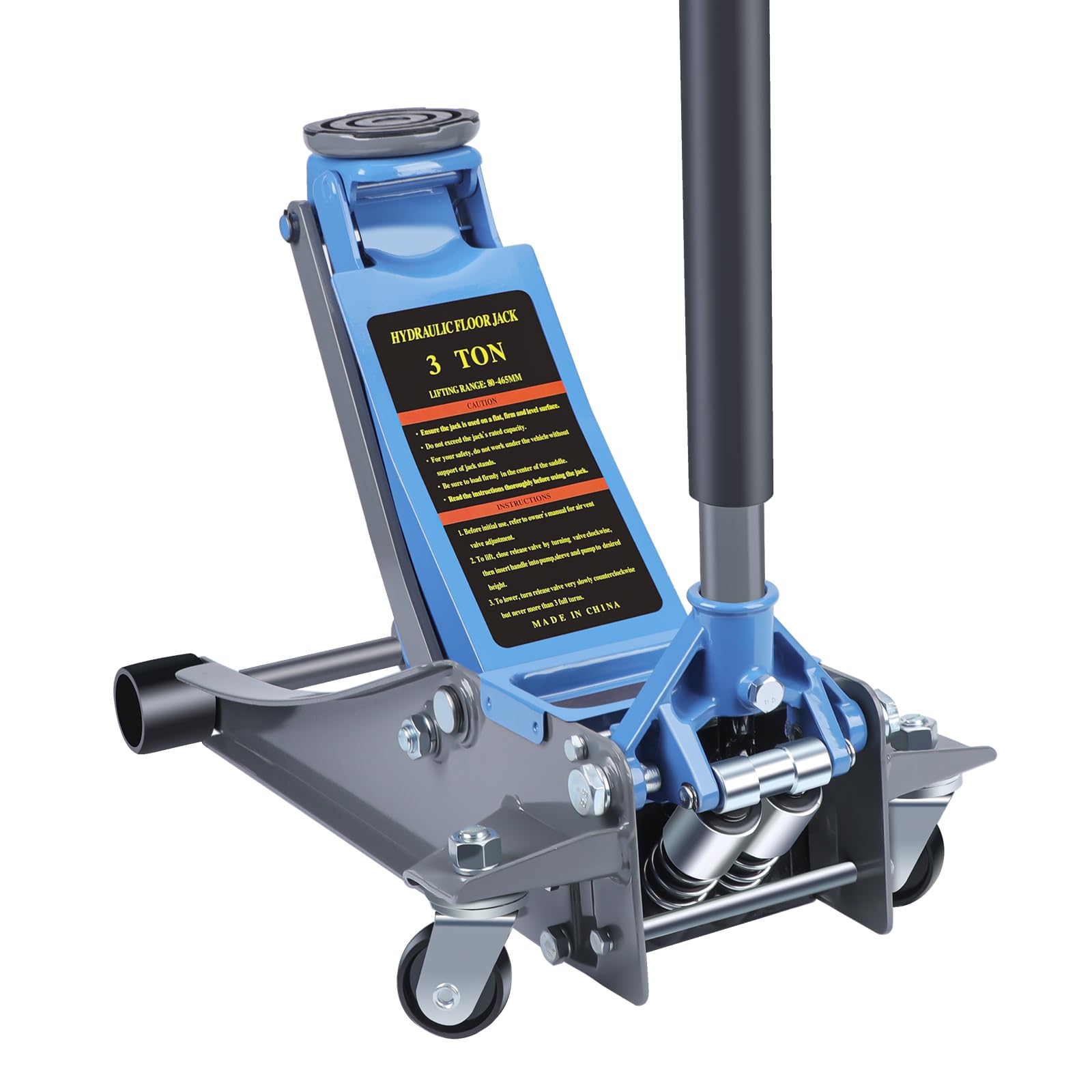
A 3-ton jack with one of the lowest entries and the tallest reach here.
On paper the LARBANKE wins the range battle: a 3.15-inch minimum height is the lowest entry on this list, and the 18.31-inch maximum is among the tallest, all on a 3-ton (6,600-pound) capacity. That combination is why it suits a garage with mixed vehicles — it slides under a BMW X5 and a Mercedes E-Class both, then lifts high enough for jack stands. A dual piston hydraulic pump delivers the fast, smooth lift, and the 4-wheel system with two large steel front casters and two 360-degree swivel casters makes steering it under the car easy.
Owners praise the build and durability most, and the value lands well too — it has handled a 1500 Silverado and generally earned its keep in home garages. A large rubber saddle and foam handle bumper protect the vehicle, the 360-degree saddle detaches and replaces, and the removable handle cuts storage space when it is not in use. The steel-and-high-strength-carbon frame keeps it durable while staying portable enough to move.
The catch is the usual one for a tall-range jack — weight is mixed in owner feedback, with some finding it fine to move and others noting it is heavy. It stays a fixed-bay tool for most people. At this price, few 3-ton jacks pair a 3.15-inch entry with an 18.31-inch reach.
The winning combo: a 3.15-inch entry and 18.31-inch top end mean it fits the lowest cars and still reaches truck height.
Weigh the trade-off: a tall, strong jack carries more mass to move — fine if it stays in one bay.
A smart pick if: your garage holds both a low car and a tall truck and you want one jack that covers both.
Think twice if: you need a jack light enough to carry to a job site every day.
9. AV Steel 3 Ton

The 63.9-pound steel beast built for standard trucks and long service life.
AV Steel’s 3-ton single-piston jack trades portability for muscle. At 63.9 pounds of steel construction, it is built for maximum stability and long-term use, and the 5.5-inch minimum height means it is aimed at standard cars, SUVs, minivans, and pickup trucks — not lifted vehicles, heavy-duty trucks, or RVs. The lift range runs 5.5 inches to 18.5 inches, and a single piston pump does the lifting; AV Steel points buyers who want faster lifts toward their dual-piston model instead.
Owners find it functionally excellent and sturdy, with easy assembly and a build that feels like a heavy steel beast — one used it on a Yukon XL and reported it held well with no leaks or dropping. The 360-degree rotatable saddle adds stability, two rear rotating wheels reposition it, and a built-in safety valve prevents overloading. It meets ANSI/ASME PASE safety standards.
The honest notes: the release is tricky, with owners saying a slow, controlled drop takes care, and the weight is a real consideration — AV Steel itself warns that if weight is a concern, this jack may not be the right fit. For a standard truck or SUV owner who wants a stable, long-lived jack, it earns its keep in a fixed garage bay.
Why buy it: 63.9 pounds of steel and an 18.5-inch maximum give standard trucks and SUVs a stable, long-lasting lift.
Why hesitate: the 5.5-inch start rules out low cars, and 63.9 pounds is a load to move.
Right for: standard trucks, SUVs, and minivans in a home garage where the jack stays put.
Wrong for: lowered cars, lifted trucks, or anyone who wants a portable jack.
10. VEVOR 3 Ton Low Profile Aluminum & Steel Racing Floor Jack
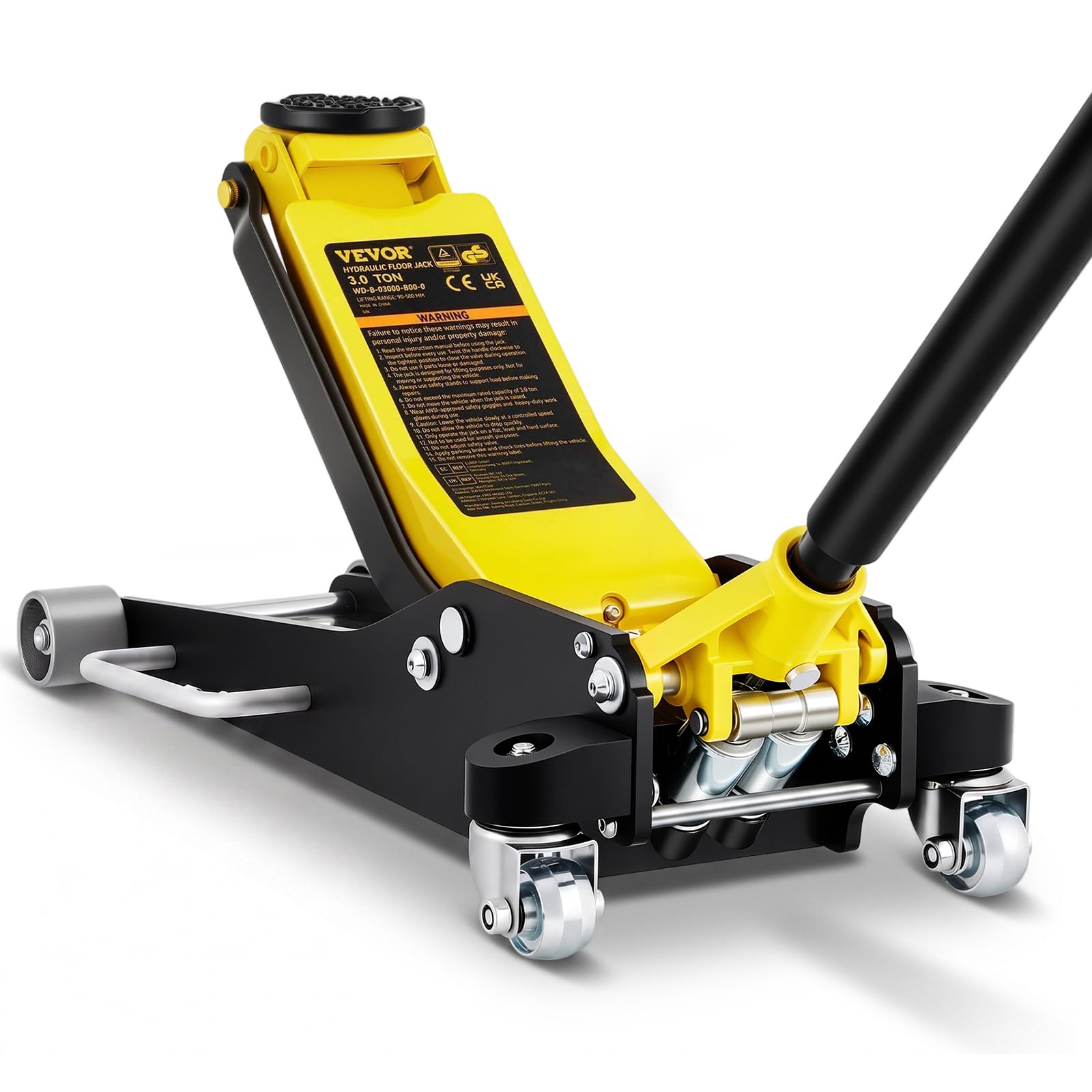
A tall-reaching hybrid jack that lifts to the top in seven strokes.
The headline here is the reach — a maximum height of 19.68 inches, the tallest on this list, paired with a dual parallel pump system that the maker says lifts to full height in 7 strokes. The minimum height is 3.54 inches, so it still fits low-profile cars, and the 3-ton (6,600-pound) capacity covers family cars, trucks, and SUVs. The aluminum-and-steel build keeps it sturdy yet light to carry, and the 45-inch long handle uses leverage to make the pumping easier. It complies with CE and UKCA certifications and the ASME PALD-2014 standard.
Owners like the speed and the lightness — one notes it is easy to pick up without straining your back, and it holds pressure well. The two-piece handle disassembles for compact storage, and the 4 wheels, two of them universal, make it easy to steer. It has lifted a Tesla Model S Plaid for wheel swaps without trouble.
Durability is the caveat. There is at least one detailed account of a unit leaking down under load after five months, and another replacement jack failing in similar fashion. That is not the majority experience, but it is enough that you should test the hold under load early and keep your jack stands ready. Keep it away from water, too — one owner notes it dislikes it.
What stands out: a 19.68-inch maximum height and a 7-stroke lift make it the fastest way to get a tall vehicle up.
What to test early: verify it holds load without creeping down, since a few units have reported leak-down over time.
Worth considering if: you need the tallest lift and fast pumping for trucks and SUVs, and you’ll verify it holds pressure.
Better to look elsewhere if: you want the simplest, most proven long-term build on this list.
11. Torin T83505W

A low-slung steel racing jack that fits under a lowered Mustang.
The BlackJack is aimed at lowered and specialty cars — a 3.7-inch minimum height gets under a lowered 22 Mustang or a ’69 Camaro, and the lift range tops out at 18.07 inches, so it still reaches jack-stand height. Capacity is 3 tons on a high-strength steel frame, and a single piston quick-lift pump raises the jack with fewer strokes. A foam bumper on the handle protects the vehicle from dings while you work.
Owners describe the frame as solid and durable, and the jack does its job without drama. It is built for people working on low cars, and the low-profile access and tall reach cover both ends of that job. The single-piston pump means a little more pumping effort than a dual-piston design, which is the trade for the simpler build.
There are two honest quirks. The frame assembly can arrive imperfect — at least one owner found the frame welded crooked so the jack ran on three wheels without a load, so check it on flat ground on arrival. And it is heavy to move, with several noting it is not a featherweight. For lowered cars it earns its keep; for a casual user who wants easy portability, its weight asks more.
Why it fits the lowered-car job: a 3.7-inch minimum and 18.07-inch top end cover both ends of low-car work on a 3-ton steel frame.
Check on arrival: confirm the frame sits flat and rolls on all four wheels before you trust it.
Best suited to: lowered cars and specialty builds where low-profile access plus tall reach matters.
Less suited to: casual users who want a lightweight jack or won’t verify the frame on arrival.
Know the Specs
Lift range (minimum to maximum height)
This is the two-number span you see on every jack listing, and it is the most important spec for fit. The minimum height is how tall the saddle sits when collapsed — it has to be lower than the gap under your car’s jack point, or the jack will not slide in. The maximum height is how high the saddle reaches, and it needs to clear your vehicle far enough to get the tire up and a jack stand underneath. A jack with a 3.4-inch minimum and 14.6-inch maximum suits sedans; a truck usually needs 18 inches or more at the top. Check both ends against your car, not just the capacity.
Capacity and load margin
Capacity is the weight the jack is rated to lift, written in tons or pounds. A 2-ton jack handles 2 tons, a 3-ton jack handles 3 tons — but you are not lifting the whole car, only one corner at a time, so a jack rated well above the corner weight leaves a safety margin. The catch is that capacity does not fix a height mismatch: a strong 3-ton jack can still be too tall to fit under a low car. Match capacity and height together, and always lower the car onto jack stands before you put any part of yourself under it.
Common Questions
Will a low-profile floor jack fit under my lowered car?
Is a 3-ton floor jack strong enough for my truck?
Do I need jack stands if I have a floor jack?
What is the difference between a single piston and a dual piston pump?
Why is my new floor jack not lifting?
Can I use a floor jack on a gravel or dirt driveway?
How much does a floor jack weigh, and does it matter?
What is a low-profile floor jack actually for?
Can I leave a car on a floor jack overnight?
Do these floor jacks come assembled?
The Bottom Line
For most people, the best cheap floor jack is the ARCAN 3-Ton Hybrid — its 4-inch-to-18.5-inch range covers a low sedan and a full-size truck in one unit, and the aluminum-and-steel frame keeps 58 pounds manageable to move around the bay. If you drive a low car and want the widest owner following for the money, the AV Steel 2.5 Ton Low Profile is the sedan specialist, with a 3.4-inch entry height that fits low noses a taller jack scrapes. And for a garage that holds both a low car and a tall truck, the LARBANKE 3 Ton pairs the lowest 3.15-inch entry here with an 18.31-inch reach. Whichever you pick, match its lift range to your car’s jack points and pair it with rated jack stands — that combination, not the tonnage alone, is what keeps you safe under the car.
How we choose
We do not accept paid placement. Every pick is matched to a real buyer and a real use-case; we do not hands-on test units.
Sources
Specifications: manufacturer listings and product documentation. Review insights: verified customer reviews, as of October 2026. Pricing: not shown on this page (it changes often); check the current price via the retailer link.
As an Amazon Associate, Aappliancez earns from qualifying purchases. This does not affect which products we feature.