Disclosure: Some links in this post are affiliate links. As an Amazon Associate I earn from qualifying purchases, at no extra cost to you. Learn more
Specs are compiled from manufacturer listings and verified buyer reviews and can change over time — please confirm the key details on the product page before buying.
You want one small block that tops up your iPhone fast, fits in a pocket, and does not hog the wall outlet. The tricky part is that the word “fast” means nothing on the box — a charger either pushes enough wattage for your specific iPhone or it does not. This guide separates the blocks that genuinely keep up from the ones that quietly trickle, so you can pick once and stop thinking about it.
This guide is built by comparing the manufacturers’ published specifications and the patterns across verified customer reviews, so you get each pick’s real strengths and trade-offs instead of marketing spin.
You will see the wattage each block delivers, how many ports it offers, and whether its plug folds away for a bag. The crowd favorite here holds 4.5+ stars across 20,000+ owners, and each pick below suits a different kind of charging day. Here is the shortlist that earns its place as the charging block for iphone.
Top Picks

How To Choose The Best Charging Block for iPhone
Your iPhone charges fastest when the block delivers enough wattage (power output), has the right port for your cable, and fits where you plug it in. Nail those three and you can stop thinking about it.
Start with wattage, not with looks
An iPhone charges fastest when the block can deliver at least 20W over USB-C. A 20W block gives you the standard fast charge. A 30W block like the Anker Nano 3 pushes harder and can also top up an iPad or trickle a MacBook Air. A 45W block like the Nekmit gives you headroom for tablets and laptops too. Under 20W, you are back to slow overnight-style charging.
Check the port your cable uses
Newer iPhones charge over USB-C, so a USB-C port with Power Delivery (the fast-charging standard iPhones speak) is the one you want. A USB-A port is handy for older cables, watches, and accessories. Dual-port blocks let you charge two things at once — but on many models, using both ports at once drops the power each one receives, so plan for that.
Match the plug shape to your outlet
A folding plug (prongs that tuck away) is the travel-friendly choice — it slips into a bag without snagging. A flat, low-profile plug sits flush against the wall and is the better pick for tight spots behind furniture or a sofa. Figure out whether you charge mostly at a desk, on the road, or behind a piece of furniture, and pick accordingly.
Side-by-Side Comparison
| Model | Best For | Max Wattage | Ports | Plug Type | Amazon |
|---|---|---|---|---|---|
| Anker Nano 3 (30W)★ Best Overall | Everyday carry and travel | 30W | 1 × USB-C | Foldable | Amazon |
| Qwinjwin Ultra Thin Flat 40WBest for Tight Outlets | Tight outlets behind furniture | 30W USB-C / 20W USB-A | 1 × USB-C + 1 × USB-A | Foldable | Amazon |
| Costyle Slim Flat 50W | Flat-against-wall setups | 30W USB-C / 18W USB-A | USB-C + USB-A (2-pack) | Foldable | Amazon |
| Anker 20W Dual Port | Two-device charging with cables included | 20W | 1 × USB-C + 1 × USB-A | Fixed | Amazon |
| Nekmit Flat 45W | Laptop and tablet top-ups | 45W USB-C / 18W USB-A | 1 × USB-C + 1 × USB-A | Fixed, 3-prong | Amazon |
Detailed Reviews
1. Anker Nano Phone Charger
Our pick — 4.5+★ from 20,500+ verified ratings; the strongest balance of quality and price.
A block barely larger than the old Apple cube that still charges your iPhone at full speed.
This is the pick that covers nearly every charging day you will have. GaN technology (a semiconductor material that lets a charger run cooler and stay smaller) is what shrinks this 30W block down to pocket size. Anker says it is 70% smaller than the original chargers, and its narrow body leaves the neighboring outlet free. The prongs fold flat, so it drops into a jacket pocket or a small purse without catching on anything. If you want one block that lives in your bag, this is it.
What wins people over here is the overall build quality, followed closely by how quickly it tops up a phone. Buyers report PPS fast charging bringing an iPhone to 50% in around 30 minutes. It will also run an iPad, AirPods, and even trickle-charge a MacBook Air when you are out of options. PowerIQ 3.0 (Anker’s auto-detect tech that matches the right power to the device) sorts out what your iPhone needs without you touching a setting. For the money, it is the default choice for most people.
One thing to know: the charger reaches 30W, and the Qwinjwin and Costyle blocks below top out lower on their USB-C port — so this Anker holds the higher single-port ceiling of the sub-20-dollar-league picks. The two-port blocks win on versatility, but the Anker wins on that raw single-device speed. The catch is heat: an owner using it with a magnetic pad noticed both the phone and the block getting noticeably warm, and it cooled off once a plain USB-C cable was used instead. The durability feedback is a touch mixed over the long haul — treat it as a solid daily driver rather than a bombproof travel tank.
Why it earns the top spot
- 30W GaN output keeps iPhone charging at full speed instead of trickling.
- Folding prongs and a near-cube footprint make it a genuine travel block.
- Runs AirPods, iPad, and even a MacBook Air in a pinch.
- Does not block the next outlet over.
What to weigh first
- Only one USB-C port, so no simultaneous second-device charging.
- Can run warm when paired with a magnetic charging pad.
- Cable is not included, so budget for a USB-C cable.
Reach for this if: you want one compact block that fast-charges an iPhone everywhere you go, from the office to a hotel room.
Think twice if: you routinely charge a phone and a tablet at the same time — a dual-port block below serves that better.
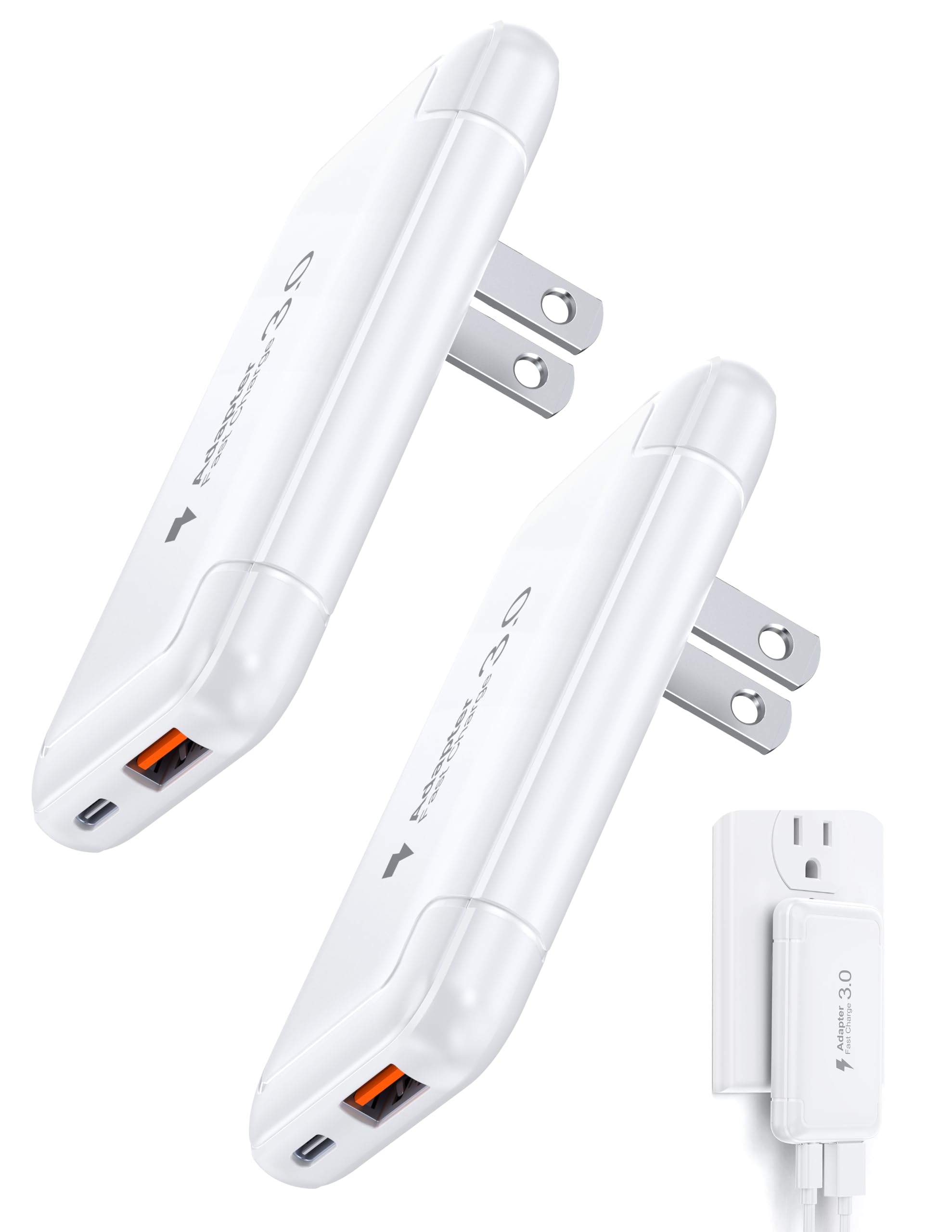
2. Qwinjwin 2-Pack USB Wall Charger
The block that disappears behind the sofa and still powers your phone and a second device.
If your outlet lives in an awkward spot — tucked behind a couch, a stove, or a washer — this thin 40W block is built for exactly that. It lies almost flush against the wall instead of jutting out two or three inches like a standard brick, and the folding plug keeps it snag-free in a bag. You get two of them in the pack, so one can stay planted behind the furniture while the other rides in your travel kit. The mix of one USB-C and one USB-A port means your newer iPhone and an older accessory can both find a home.
The functionality is what people talk about most, and it holds up: reviewers use it to power a Ring Stick Up Cam, a work flashlight, and all the usual phone-and-tablet stuff without fuss. Charging speed lands in the same breath — the maker quotes 0% to 58% in 30 minutes on an iPhone. The flat design also means it does not muscle out the neighboring socket, which is a quiet win in a crowded power strip.
The honest caveat is longevity. An occasional unit gives up its post after a few months of travel duty, so it is the kind of block to keep an eye on rather than trust blindly for a decade. For the flat profile and the travel convenience, it is still a strong second carry — just keep the receipt.
Profile-first design: sits nearly flat to the wall and folds away, the two things this block does better than the rounder competition.
The trade-off: one traveler had a unit stop working after several months — rare, but worth knowing before you rely on it as your only block.
Best for: anyone with a recessed or furniture-blocked outlet who needs the cord to lie flat.
Look elsewhere if: you need a single block to survive years of hard daily travel — a sturdier single-port pick may suit you better.
3. Costyle 2-Pack USB C Wall Charger
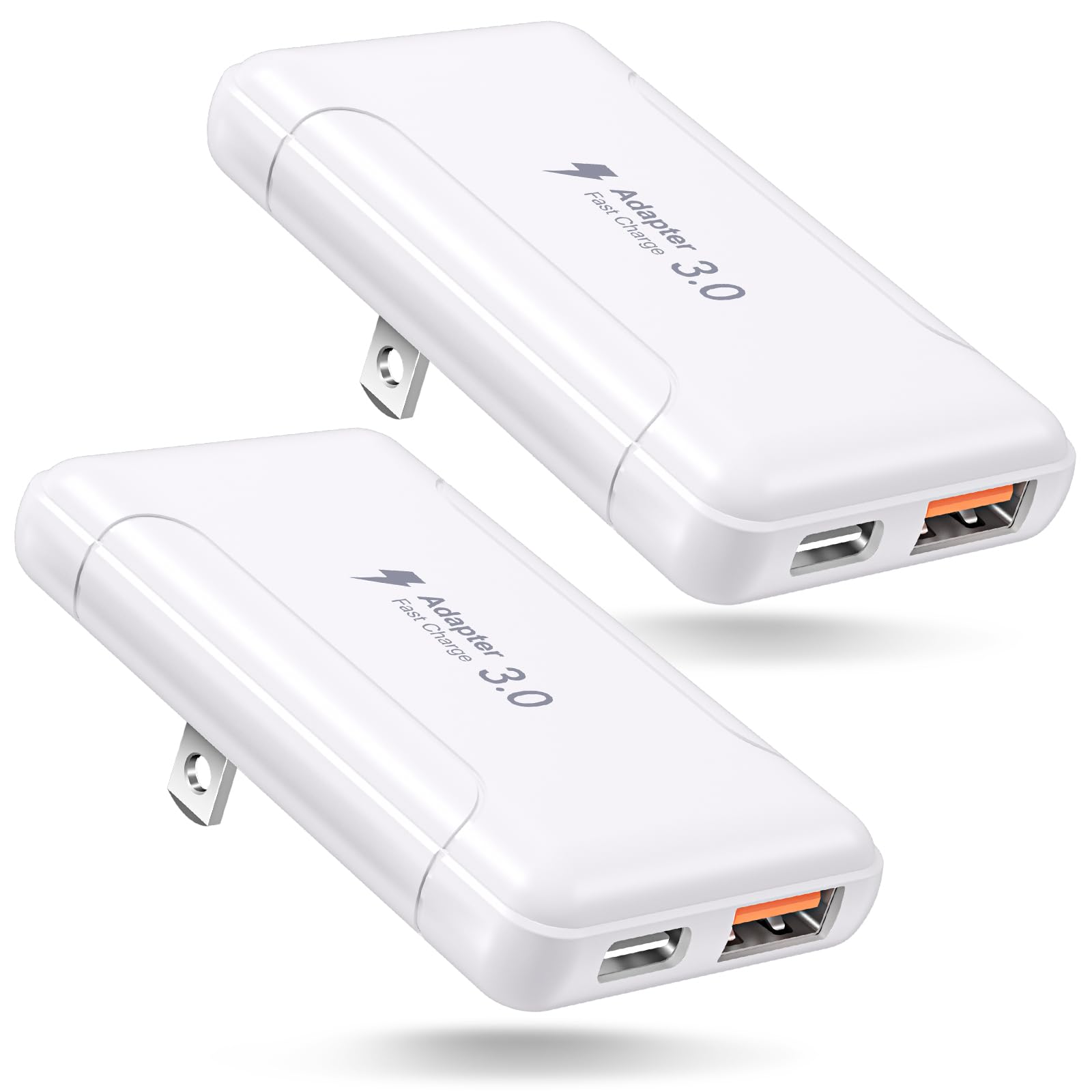
Two paper-thin blocks that sneak behind a nightstand and still hand your iPhone a fast charge.
The headline here is the body: it measures just 0.6 inch thin, which is about as close to flat-against-the-wall as a charging block gets. That thinness is the whole point — it slides behind a dresser, a headboard, or a side table where a chunky block would never fit. You can also flip which way the cords leave, top or bottom, so the cable runs cleanly to your phone instead of looping awkwardly. The pack gives you two identical blocks, so one can live at home and one can travel.
Compatibility is the aspect buyers lean on most, and it is broad — the maker lists iPhone 17, 16, 15, 14, and 13 families alongside iPads and Galaxy models. The USB-C port carries 30W of Power Delivery with PPS, aimed at the latest iPhones, while the USB-A port offers 18W of Quick Charge (a fast-charge standard used mostly by non-Apple devices). GaN inside keeps the heat down and the size small. For a paired set at the value end, that combination is genuinely useful.
Here is the fair warning: power delivery is the mixed part. Some users get the fast charge they expect; a few found theirs only trickled, and one measured well under the advertised wattage. Treat the 30W figure as a ceiling that depends on your cable and your iPhone model, and set your hopes accordingly. The other small catch is durability — this is a value pair, not a lifetime buy.
Slimness wins: at 0.6 inch thin with a flip-able cord direction, it fits spots no brick charger can reach.
Speed varies: the fast charge is real for many, but not guaranteed on every unit — this is a pair to keep as a spare, not your only lifeline.
An easy yes for: flat-outlet setups where a low-profile body matters more than maximum speed.
Pass if: guaranteed full-speed charging on every single unit is non-negotiable for you.
4. Anker Phone Charger, 20W USB C Charger Block with Cables

The only block here that hands you two cables in the box, ready to go the moment it lands.
Two things set this one apart from the pack. First, you get a matching pair of 5-foot USB-C to USB-C cables included, so you are not hunting for a cord after checkout. Second, it splits 20W across one USB-C and one USB-A port, letting you charge a phone and, say, a Switch or a second phone at once. Anker’s safety suite covers overvoltage protection, temperature control, and the usual guardrails, and the compact body travels easily. It is the no-second-guessing starter kit for a new iPhone.
Speed is the one dial to watch. At 20W this block gives a standard fast charge rather than the higher ceiling of the Nano above. A buyer reported an iPhone 15 going from 1% to 55% in under 30 minutes on that port. The same buyer flagged the important nuance: use both ports together and the fast charge drops, because the wattage is shared between them. So single-device speed is solid; two-device speed is convenient but slower.
For anyone who wants the simplest “buy it, plug it in, done” setup, this is the calm choice. The Anker Nano 3 above pushes 30W versus this block’s 20W when you charge one thing, so pick the Nano for the fastest single-phone top-ups and this one for the two-cables-in-the-box convenience.
Where it shines
- Two 5-foot USB-C cables included, so it works on day one.
- USB-C and USB-A ports handle two devices at once.
- Compact, lightweight body for home and travel alike.
Where it holds back
- 20W max, so slower per-phone than the higher-wattage picks.
- Fast charging switches off when both ports are in use.
The safe pick if: you want a complete kit — block plus cables — without buying anything else.
Consider the Nano instead if: raw charging speed for a single iPhone is what you are after.
5. Nekmit Flat USB C Wall Charger
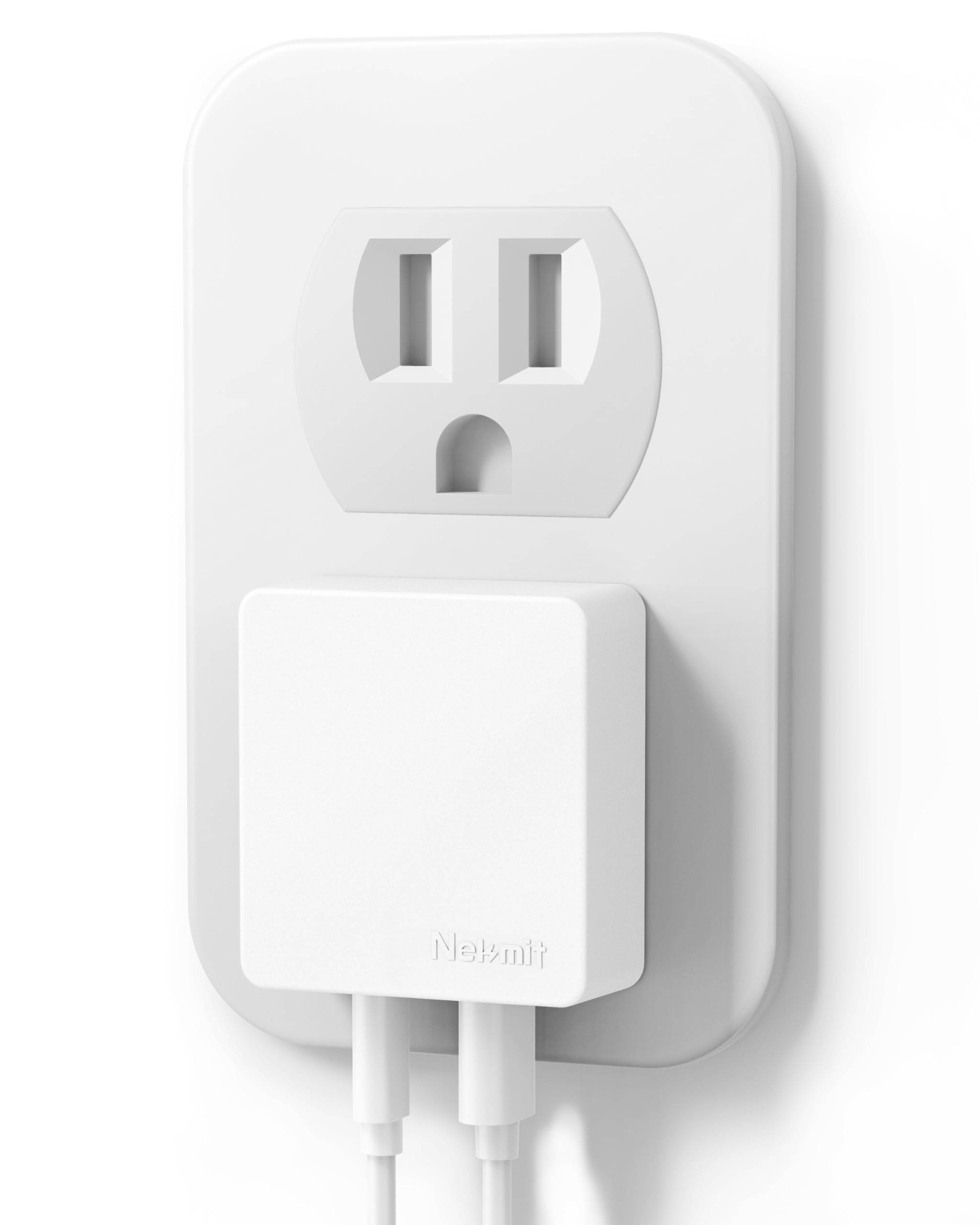
A flat block with enough headroom to charge your iPhone and a MacBook Air from the same outlet.
The 45W USB-C port is the reason to pay more here. The maker says the USB-C port alone charges an iPhone 17 from 0% to 50% in 20 minutes — the fastest quoted figure here. That same full 45W can top up a Samsung Galaxy or a MacBook Air, so this block earns its keep beyond the phone. The flat body sits flush against the wall and the 3-prong plug grips the outlet firmly, so it does not sag or pull loose the way a floppy two-prong brick can.
The bottom-of-block port placement is a small detail that pays off daily: gravity pulls the cable straight down, which eases stress on the cord where it meets the plug. Owners put it to work in genuinely tight spots — behind a sectional sofa, in a recessed floor outlet, even in a small-plant corner where the cord had to stay flat. It weighs 81 g, light enough to ignore but substantial enough to feel solid in the hand. If you are charging a laptop and a phone around the same desk, this is the tidy answer.
The trade-off is portability. The prongs do not fold, so if you toss it loose in a pouch the plug can jab into things — one buyer learned that the hard way. It is best treated as a stay-at-home or dedicated-desk block rather than a travel companion. When both ports are busy, the USB-C drops to 20W and the USB-A to 18W, so it is no longer a 45W charger at that point. Charge one big device, or two smaller ones, but not two hungry ones at full speed.
Power leader of the flat pack: 45W on a single port is the highest ceiling here, enough to move past phones into tablet and laptop territory.
The honest catch: the plug is fixed and non-folding, so this is the wrong one to fling into a travel bag.
Built for: a desk or tight wall outlet where you charge a phone plus a tablet or laptop and want one tidy block.
Not for: frequent flyers who need their charger to fold flat and pack without the prongs poking around.
Know the Specs
Wattage and why it decides your speed
Wattage is the amount of power a block can push into your phone. Your iPhone takes a fast charge once it sees at least 20W over USB-C. A 30W block like the Anker Nano charges a single device faster than a 20W block, and it has spare power for an iPad. A 45W block like the Nekmit can even run a MacBook Air. Higher wattage does not hurt your phone — the device only draws what it needs — but the extra headroom buys you the ability to charge bigger gear later.
Power Delivery, PPS, and shared ports
Power Delivery (PD) is the fast-charging standard iPhones speak, and PPS is a related handshake that lets some phones fine-tune the power they receive. When a block has two ports, watch the total: a 40W block split across both ports often means each device gets less, and some blocks switch fast charge off entirely when both are in use. If speed matters, charge one device at a time, or pick a block whose combined wattage still feeds both comfortably.
Common Questions
What wattage do I need to fast-charge my iPhone?
Will a 45W charger damage my iPhone?
Can I charge two devices at once without slowing down?
Do I need a special cable for fast charging?
Is a foldable plug better than a flat one?
Will these blocks fit behind my sofa or dresser?
How do I know a charger is a GaN charger?
Can these charge an iPad or MacBook Air too?
Why does my block get warm while charging?
Which of these is best for travel?
The Bottom Line
For most people, the charging block for iphone worth buying is the Anker Nano 3. It packs 30W of GaN power (gallium nitride, a chip material that keeps chargers small) into a block whose prongs fold flat, so it slips into a pocket. Want a full kit with cables and a second port? Take the Anker 20W two-port set. Charging a phone and a laptop from one desk outlet? Reach for the Nekmit 45W flat plug.
How we choose
We do not accept paid placement. Every pick is matched to a real buyer and a real use-case; we do not hands-on test units.
Sources
Specifications: manufacturer listings and product documentation. Review insights: verified customer reviews, as of October 2026. Pricing: not shown on this page (it changes often); check the current price via the retailer link.
As an Amazon Associate, Aappliancez earns from qualifying purchases. This does not affect which products we feature.