Disclosure: Some links in this post are affiliate links. As an Amazon Associate I earn from qualifying purchases, at no extra cost to you. Learn more
Specs are compiled from manufacturer listings and verified buyer reviews and can change over time — please confirm the key details on the product page before buying.
If sitting makes the backs of your legs go numb and your lower back burn by lunchtime, the chair is usually doing the damage — not your spine. For spinal stenosis, prioritize a backrest that locks past upright and a lumbar pad that adjusts to your own curve. This guide covers eight chairs that get those two things right, from budget-friendly big-and-tall picks up to premium mesh and smart-tracking models.
This guide is built by comparing the manufacturers’ published specifications and the patterns across verified customer reviews, so you get each pick’s real strengths and trade-offs instead of marketing spin.
If upright sitting aches within minutes, the fix is recline range, lumbar height, and seat depth matched to your body — not a higher price. That is what this breakdown of the best chair for spinal stenosis shows you.
Top Picks

How To Choose The Best Chair for Spinal Stenosis
A stenosis-friendly chair takes weight off your lower back instead of pressing into it. That comes from three things working together — a backrest you can lock open past upright, lumbar support that sits in your own curve, and a seat deep enough to hold your thighs flat. Everything else is decoration.
Recline range and lock positions
An open recline angle is the single biggest comfort lever on this list. Tipping the backrest past upright unloads your spine and eases the canal pressure that builds in an upright slouch. Look for a chair that locks in several positions rather than floating free. The ELABEST gives you three separate recline stages plus a locking mechanism, while the Steelcase Leap holds whatever angle you set through a four-position lever.
Lumbar support that adjusts to you
A fixed pillow sits where the maker guessed your curve should be. An adjustable lumbar pad moves up and down, and often in and out, so it lands in your own lower-back hollow. The ELABEST’s 3D lumbar locks in at plus or minus 1.6 inches of depth, plus or minus 2 inches of height, and 15 degrees of rotation. The Nouhaus offers five lumbar settings. That adjustability is what turns a chair from “fine for an hour” into one you can live in.
Seat depth, seat width, and weight rating
A seat that is too deep forces you to perch forward to keep your knees bent, which throws your back into the slouch you are trying to avoid. Too shallow and your thighs dangle. Pair that with a real weight rating and a strong central column — a Grade-4 gas cylinder is the sturdier class — so the chair does not sag under you over time. The VITESSE holds up to 500 lbs, the EXCEBET 400 lbs, and the FAMIC series carries a 700 lbs rating.
Side-by-Side Comparison
| Model | Best For | Weight Capacity | Backrest Width | Assembly Time | Amazon |
|---|---|---|---|---|---|
| ELABEST X100 Ergonomic Mesh Office Chair★ Best Overall | All-day support with heat and airflow | 300 lbs | 20.2 inches | 15 minutes | Amazon |
| VITESSE 500lbs Heavy Duty Office ChairBest Value | Heavier sitters who want a rock-solid base | 500 lbs | 21 inches | 20 minutes | Amazon |
| EXCEBET Big and Tall 400lbs ChairMost Spacious | Cross-legged sitters and wide-seat comfort | 400 lbs | Not listed | 20-30 minutes | Amazon |
| 700lbs Big and Tall Executive Chair | Heaviest sitters and tall desks | 700 lbs | 28.74 inches | Not listed | Amazon |
| Nouhaus Ergonomic Office Chair | Five-point full-body support | Not listed | Not listed | 20 minutes | Amazon |
| Ergohuman Eurotech ME7ERG GEN2 | Long-term owners who want mesh durability | Not listed | 20.67 inches | 10-15 minutes | Amazon |
| Hbada X7 Smart Ergonomic Chair | Self-tracking lumbar and heated comfort | Not listed | Not listed | About 30 minutes | Amazon |
| Steelcase Leap Office Chair | No-assembly premium back support | Not listed | Not listed | None required | Amazon |
Detailed Reviews
1. ELABEST X100 Ergonomic Mesh Office Chair
Our pick — over 4.5★ from 1,000+ verified ratings; the strongest balance of quality and price.
The mesh chair that tracks your lower back as you shift, then reclines you flat for a break.
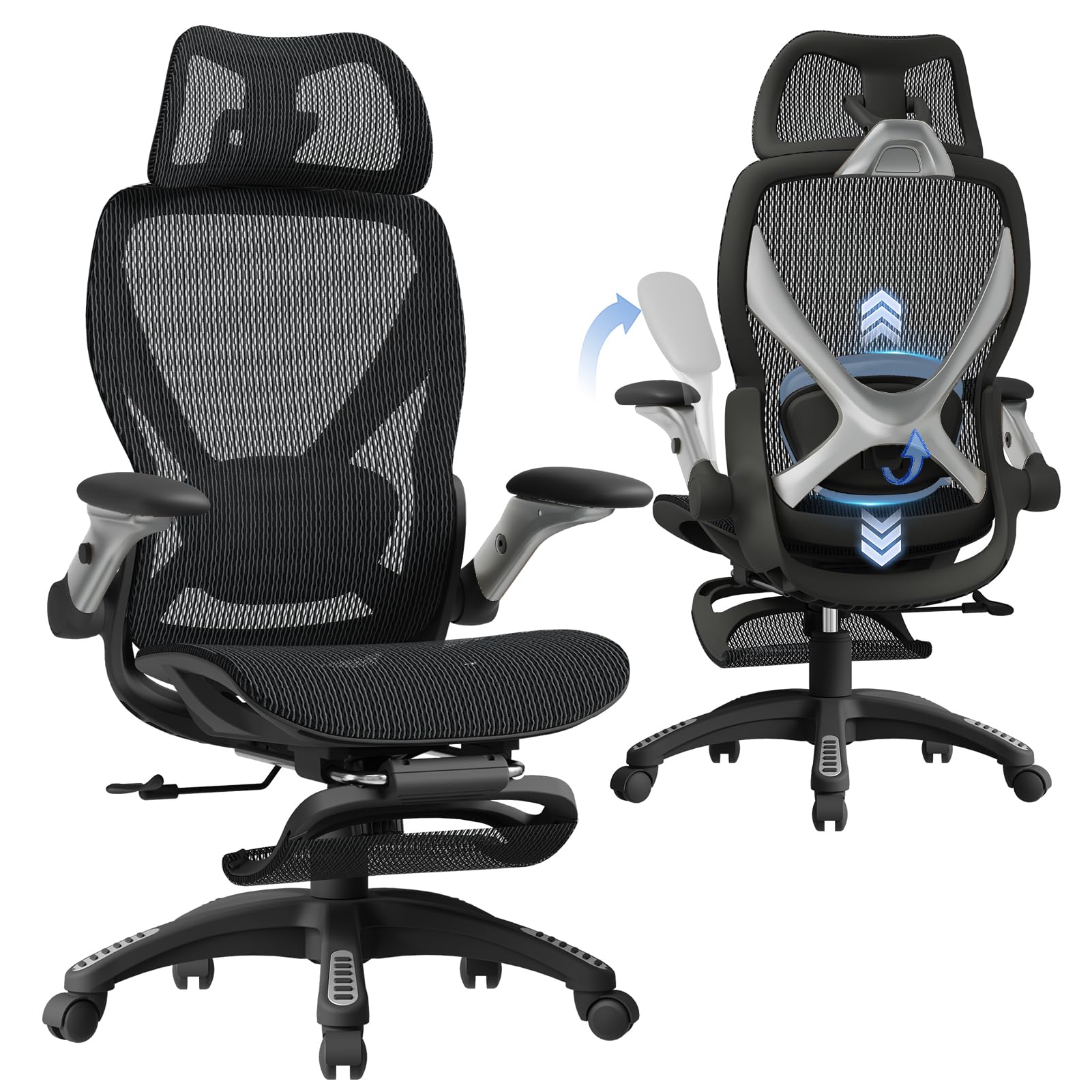
The X100’s standout feature is a lumbar pad that moves with you instead of sitting frozen. It locks in at plus or minus 1.6 inches of depth on spring-loaded auto-tracking (the pad follows your back on its own springs), plus or minus 2 inches of height, and 15 degrees of rotation. So it presses into your own lower-back hollow rather than the maker’s guess. For stenosis, that means you can find the one spot that takes pressure off your spine and keep it there all day.
Second, it reclines in three stages and pairs that with an 18-inch extendable footrest that angles in two positions. Reclining with your feet extended opens a narrowed canal, and the 18-inch footrest lets you hold that position at your desk. The 5D flip-up armrests tuck under a standard desk when you fold them, and the 27% denser EVA foam on those arm panels means they do not dig in when you lean.
The honest catch is the seat cushion. It arrives on the firm side and softens with break-in, so plan on a few days before it feels broken in. If you are very light and want plush from minute one, budget for a seat pad. Also worth knowing: at 300 lbs capacity it is the lowest-rated chair here, so heavier sitters should look at the VITESSE or the 700 lbs FAMIC below.
What earns it the top spot
- 3D lumbar locks at three settings instead of one fixed curve
- Three-stage recline plus 18″ footrest for a real back-unloading position
- 15-minute tool-free assembly and ten minutes less than the VITESSE
- 300 lbs capacity with a Grade-4 central column and BIFMA-certified frame
What to know before you buy
- Seat cushion starts firm and needs weeks to break in
- Lowest weight rating in this lineup at 300 lbs
- Mesh surface needs periodic vacuuming to stay clean
Best for: average-to-tall sitters under 300 lbs who want adjustable lumbar without paying premium prices.
Consider the bigger chairs below if: you need a higher weight rating or a chair that starts soft on day one.
2. VITESSE 500lbs Heavy Duty Office Chair
Five hundred pounds of capacity and a layered seat that spreads weight instead of concentrating it.
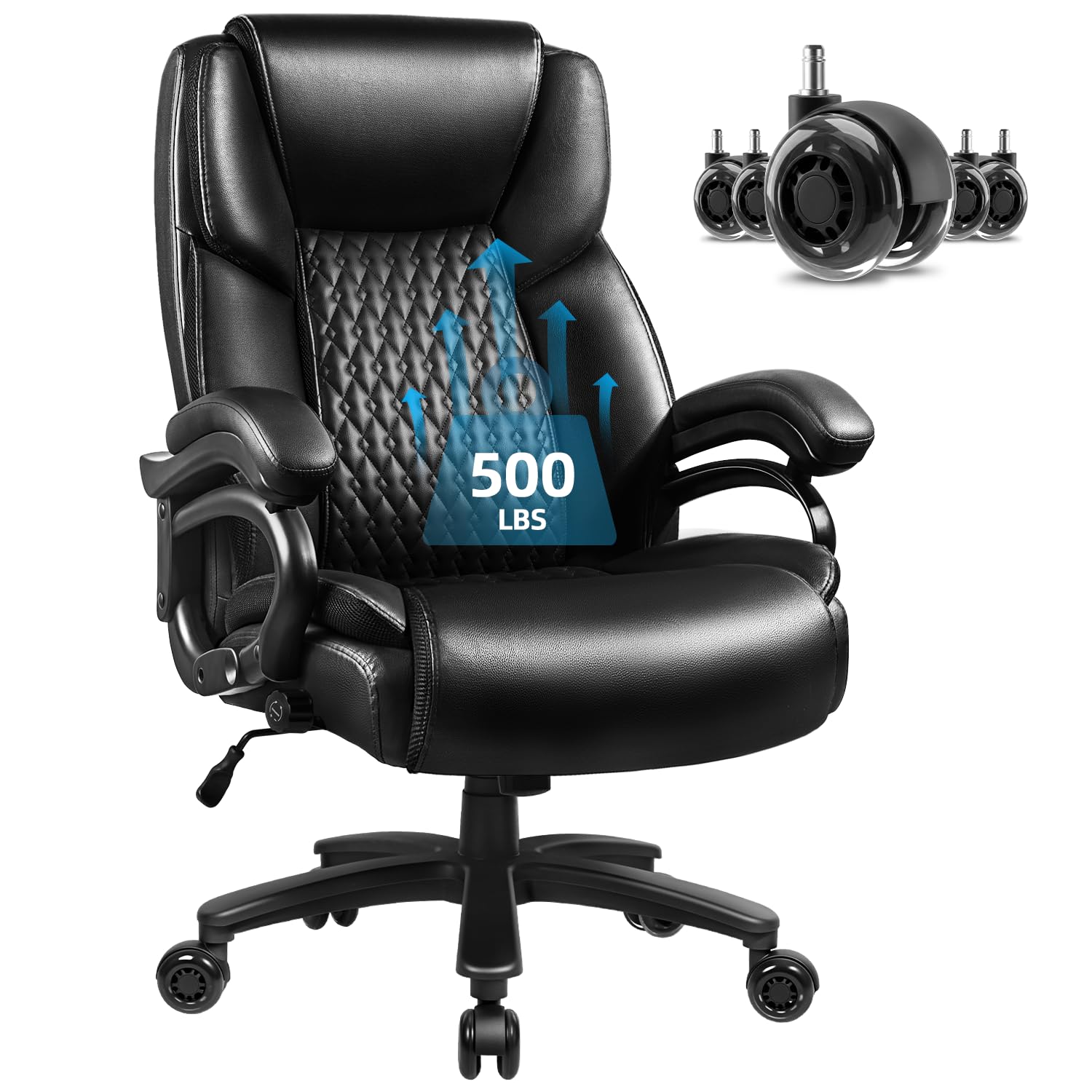
If you are a heavier or taller sitter, the first number to check is the weight rating, and this one carries a tested 500 lbs — versus the ELABEST’s 300 lbs. The backrest is 21 inches wide, about an inch wider than the ELABEST’s 20.2 inches, so broader shoulders sit fully on the panel. Setup runs about 20 minutes, or roughly five minutes longer than the ELABEST, and it is entirely tool-simple.
What sells it to buyers is the seat construction. VITESSE builds in what it calls a layering system — a cushion stack that keeps support even under heavier weight rather than collapsing into a single soft spot. Comfort and overall quality are the two things owners praise most, and the chair rolls easily across carpet. One owner describes the fit simply: “I spend 8+ hours per day in the chair and it is super comfy snd sturdy, I weight 250 pounds and I am 6 feet tall.”
Two things will shape your decision. First, there are no arms — this is an armless design, so if you like arm support at your desk you will need to add the ELABEST or the Nouhaus instead. Second, this is a rocking base rather than a swivel-only setup, which some sitters like and others find makes the chair wobble back and forth.
The case for it: the strongest weight-to-price math on this list — 500 lbs capacity with a plush layered seat at a budget-friendly price.
Where it gives ground: no armrests and a more basic adjustment set than the ergonomic picks above. Plan on a lumbar pillow if you want more targeted lower-back pressure relief.
Reach for this if: you are a larger or taller sitter who wants broad, plush support without premium pricing.
Look elsewhere if: you rely on armrests to keep your shoulders relaxed while you type.
3. EXCEBET Big and Tall Office Chair 400lbs
A wide saddle seat that lets you sit cross-legged, wrapped in smooth bonded leather.
For stenosis, changing position helps more than holding one posture. This chair’s saddle-shaped seat is wide enough that sitters can cross their legs without the edges cutting in — exactly the kind of shift that takes pressure off your lower back. The cushion and backrest both use a thick, soft elastic sponge, and the leather is a scratch-resistant bonded PU that wipes clean with a cloth.
The reclining back, height-adjustable seat, adjustable armrests, and retractable footrest all let you find your own angle. Underneath sits an SGS-certified class 4 gas cylinder and a BIFMA-approved metal base rated for 400 lbs, with an FSC-certified wood cushion frame. That is a heavier-duty build than the ELABEST’s 300 lbs rating, though it lands under the 500 lbs VITESSE.
Two honest notes. The bonded leather is comfortable but warmer than mesh, so long summer sessions can get sticky — the dual-stripe mesh on the ELABEST does not have that problem. And on some tile floors the rubber wheels roll imprecisely. Assembly runs 20 to 30 minutes, the longest window here except the Hbada.
What won me over: the wide saddle seat gives cross-legged sitters room to shift their hips. Shifting your hips every hour keeps stenosis pressure down through a long workday.
Worth flagging: bonded leather gets warm, and the rubber wheels feel less precise on hard tile than they do on carpet. Choose this over mesh if you prefer a cushioned leather feel.
Best for: sitters who want to move their legs around on a wide, cushioned seat and prefer a leather finish.
Not for: anyone who runs hot and wants a breathable mesh back.
4. 700lbs Big and Tall Office Chair
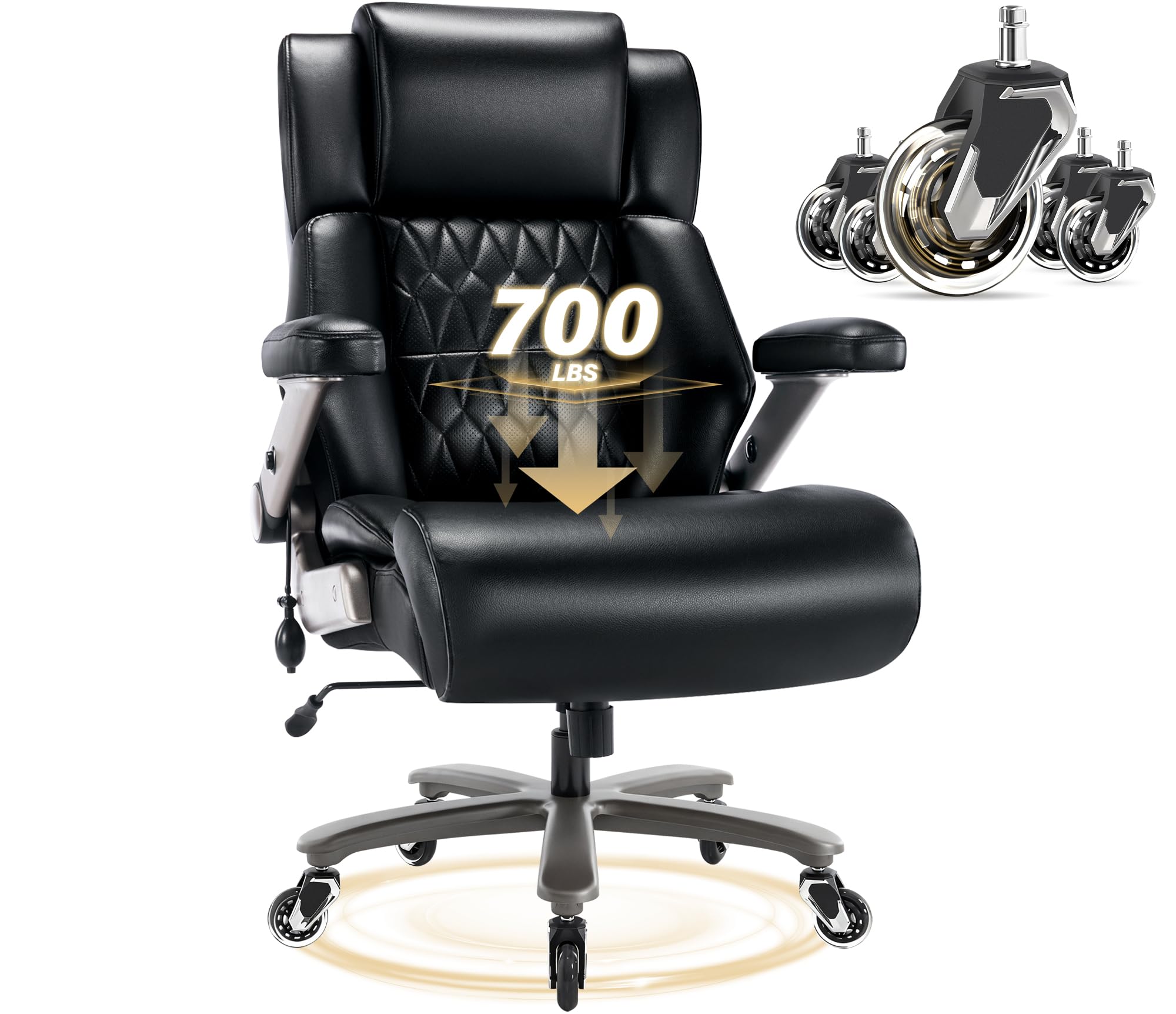
Seven hundred pounds of capacity and an inflatable lumbar pad you dial in to your own curve.
This is the highest weight rating on the page — 700 lbs — and the backrest is the widest too, at 28.74 inches. That extra width means tall sitters with broad shoulders sit fully on the panel, where narrower chairs leave you half off the edge. The maker tested it with a 290kg (640lbs) stamp over 6,000 continuous impacts, so the frame is built to hold that load without sinking.
For stenosis specifically, the inflatable lumbar airbag is the standout. You pump it up or let it down until it matches your lower-back curve — an active fit rather than a single fixed shape. It sits over a mattress-grade spring pack cushion designed to resist flattening under long sessions. The perforated tech-leather back has thousands of tiny ventilation holes to move heat out, and the polyurethane-coated wheels are built not to mark your floor.
The straightforward caveat: multiple sitters find the seat sits high, and shorter users report their feet do not reach the floor. That is a fit note, not a flaw — if you are around 5’3″ or shorter, measure your floor-to-knee height first. It also arrives unassembled with a strict return policy, so keep the packaging neat until you are sure.
The build in a sentence: the widest, highest-capacity chair here, with an inflatable lumbar that actually shapes itself to your back.
One thing to plan around: the height. This chair suits taller desks and taller sitters — shorter users typically need a footrest.
Fits you if: you are a heavier or taller sitter who has been burning through flimsier chairs, or you want the widest backrest listed here.
Think twice if: you are shorter than about five-foot-three and need your feet flat on the floor.
5. Nouhaus Ergonomic Office Chair Premium Leather

Five lumbar settings and a 135-degree recline make this the easiest chair here to tip back and breathe.
Five levels of lumbar adjustment is more granularity than most chairs on this list offer — only the ELABEST’s 3D locking system edges it on depth and rotation. Combined with adjustable height, tilt, and flip-up arms, the Nouhaus gives you five support points across your head, back, lumbar, hips, and hands. Both the backrest and cushion are contoured to follow your spine’s natural curve, which is what keeps the lumbar contact steady rather than spotty.
The 135-degree recline is the number that matters most for stenosis. At 135 degrees with the tilt open up, your spine decompresses. The leather has a soft, breathable finish with a glossy look, and it is BIFMA-certified for safety and durability. Assembly is about 20 minutes with tools and detailed instructions included.
There is one recurring gripe: the plastic piece holding the wheels has broken within days for a few sitters. It is not a universal issue, but it is worth checking that mount when the chair arrives. The large-diameter rollerblade casters glide cleanly on wood and carpet when they are intact.
Why it is on the list: the flip-up arms, five lumbar positions, and deep recline give you more ways to sit than almost anything else in this lineup.
Honest limit: the wheel-mount plastic is the weak point. If it ever gives, contact Nouhaus — the company backs the chair with a five-year part-replacement plan.
Choose this if: you want maximum recline and lumbar fine-tuning without losing arm support.
Skip this if: you need a chair rated for heavier sitters — the capacity is not published here.
6. Ergohuman Eurotech ME7ERG GEN2 High Back Mesh Office Chair

Eight ergonomic adjustments and a limited lifetime warranty — mesh durability taken seriously.
If you want to buy once and forget it, this is the chair that reference point keeps pointing to. Eight adjustments cover the headrest, arm height and yaw, lumbar height and tilt, and seat height, depth, and tilt. The mesh is US-manufactured with a sturdier weave, and it holds up — one long-term owner sits at roughly 5,400 hours of use with no visible wear. The previous version lasted 15 years before needing a single hydraulic cylinder replacement.
Assembly runs 10 to 15 minutes, and you will want a 5mm hex wrench on hand. Against the ELABEST, this chair trades smart features and a footrest for build longevity and a lifetime warranty. Its backrest is 20.67 inches wide, slightly wider than the ELABEST’s 20.2 inches.
Two fit notes worth knowing. Some owners feel the upright lock tips you slightly forward rather than holding a perfect vertical, and the armrests do not lock firmly in place, so they drift. Firmness is also polarizing — a few sitters want a plusher seat or a more aggressive lumbar push. This is a firm, posture-focused chair, not a sink-in recliner.
The pitch: premium mesh construction at a lower price than the Steelcase Leap, with the longest warranty here.
The reality check: firm seating and a slight forward lean when locked upright. If you want a lazy recline, look at the Nouhaus instead.
Worth it if: you sit long hours and want a mesh chair that will still be working a decade from now.
Reconsider if: you need a plush, sink-in cushion or an aggressively padded lumbar.
7. Hbada X7 Smart Ergonomic Chair

The chair that reads your posture and moves its lumbar pad to follow — no manual fiddling needed.
Sensors, a control system, and an automatic tracking mechanism mean the X7 continuously adjusts its lumbar support as you lean forward, sit upright, or recline. If you shift positions constantly — which many stenosis sitters do — you never have to stop and reset a pad. There is also a manual mode if you prefer to dial it in yourself.
Then there is the comfort layer. An 8D biomimetic massage (a multi-node massage built into the seat), graphene heating, and red light warm up the seat — the maker pitches it as recovery between meetings and long sessions. That is a real perk for cold-weather work-from-home days, though it does not replace rest or movement for actual back relief. Three ventilated seat levels keep air moving too. Add a 4D headrest (adjusts in four directions), 720-degree armrests (they swing a full circle), and adjustable seat depth, and this is among the most adjustable chairs here.
The obvious caveats: at 75 pounds this is the heaviest chair on the list and the hardest to move between rooms, and if you are six feet or taller, the included cylinder will not let you sit ergonomically. That is a genuine fit ceiling — some tall buyers end up buying a replacement cylinder. At 27.5 inches deep it also needs a real spot under your desk, not a nook.
Standout feature: hands-free lumbar tracking that moves with you — a genuinely different approach from the manual-dial chairs above.
Tough reality: heavy at 75 lbs and the stock cylinder is short for tall sitters. Consider the 700 lbs FAMIC if you are over six feet.
Makes sense if: you fidget and shift constantly, want auto-adjusting lumbar plus heated seating for work-from-home comfort.
Look elsewhere if: you are over six feet tall or need something light enough to drag to a different room.
8. Steelcase Leap Office Chair, Ergonomic Back Support, Onyx

Arrives fully assembled, so you unbox it and sit down without touching a single bolt.
Three things make the Leap different from everything else here. First, it uses a Natural Glide System where the seat slides back as you recline, keeping you close to your desk and your posture guided at the same time. Second, the 3D LiveBack backrest flexes to follow the shape of your spine as you move, rather than holding one fixed frame. Third, a lower-back firmness dial lets you set exactly how much lumbar push you want.
For stenosis, the LiveBack’s continuous contact matters more than any single feature — it flexes as you shift, so lumbar support never breaks. The leap from the base to the seat depth adjustment is also unusually deep; sitters often pick this over an Herman Miller Aeron specifically for that. It arrives fully assembled, no tools required.
Two things to weigh. The fabric is a scratchy wool-like weave rather than a smooth mesh or leather, and the seat padding is relatively shallow, not plush. Squeaks have been reported but a little lubricant clears them. The Leap is also the most expensive chair in this lineup, so if you are shopping for value there are cheaper options above that cost a fraction.
Why people pay the premium: the flexing LiveBack and sliding seat give continuous, moving support that boxier chairs cannot match.
What to accept: shallow padding and textured fabric. This is a posture chair, not a cushion chair, and the price tag reflects that.
Buy it if: you want top-tier back support, no assembly, and you plan to keep the chair for a decade.
skip it if: you want a plush, sink-in cushion or prefer to spend a fraction of the price.
Know the Specs
Recline angle and lock
Two numbers decide how well a chair handles stenosis: how far back the backrest tips, and how many firm positions you can lock it in. For spinal stenosis, more backward range (often 120 degrees and beyond) frequently feels easier than sitting fully upright. Lock positions matter more than a free-floating recline, because they let you hold a supportive angle without fighting the chair.
Lumbar depth and height range
A good lumbar pad moves vertically and often horizontally so it lands in your own lower-back hollow. The best adjustments offer separate measurements — for example, the ELABEST locks in at plus or minus 1.6 inches of depth and plus or minus 2 inches of height. Fixed pads rarely match a curved spine and tend to land either too high or too low.
Seat depth and seat width
Seat depth is how far back your hips sit before the chair’s edge meets the backs of your knees. Too deep and you must perch forward to keep your knees bent; too shallow and your thighs hang unsupported. Pair that with width — 20 to 22 inches fits most adults, and the 700 lbs chair here is 28.74 inches wide for broader users.
Weight capacity and cylinder grade
The weight rating tells you how much the base and cylinder are rated to support before they sag. A Grade-4 cylinder is the sturdier of the common gas-lift classes. Ratings here range from 300 lbs (ELABEST) up to 700 lbs (the FAMIC executive model), and the higher ratings usually come with a wider, thicker seat frame.
Common Questions
Will a big and tall chair help with spinal stenosis?
What recline angle works best for lower back pain?
Does lumbar support need to be adjustable?
Is mesh or leather better for a chair you sit in all day?
How much weight should a chair for spinal stenosis support?
Should I choose a chair with arms or an armless design?
How long does a good ergonomic chair typically last?
Do I need to assemble these chairs myself?
Can a taller sitter use a short-cylinder chair?
What is the difference between a rolling base and a rocking base?
The Bottom Line
For most people, the chair for spinal stenosis winner is the ELABEST X100. Its 3D lumbar that locks where you need it, three recline stages, and 18-inch footrest together do more for a stenosis slouch than any single feature here. If you want auto-adjusting lumbar that moves the instant you do, the Hbada X7 is the one to reach for. And for the heaviest sitters who keep wearing out lesser chairs, the 700 lbs FAMIC executive chair is the sturdiest pick on the page. Whichever you choose, pick a chair that lets your lumbar pad land where it belongs and your backrest tip back when it needs to — that is the whole game.
How we choose
We do not accept paid placement. Every pick is matched to a real buyer and a real use-case; we do not hands-on test units.
Sources
Specifications: manufacturer listings and product documentation. Review insights: verified customer reviews, as of October 2026. Pricing: not shown on this page (it changes often); check the current price via the retailer link.
As an Amazon Associate, Aappliancez earns from qualifying purchases. This does not affect which products we feature.