Disclosure: Some links in this post are affiliate links. As an Amazon Associate I earn from qualifying purchases, at no extra cost to you. Learn more
Specs are compiled from manufacturer listings and verified buyer reviews and can change over time — please confirm the key details on the product page before buying.
If sciatica pain (aching, burning, or shooting along the lower back into the leg) is what keeps pulling you out of your chair every twenty minutes, the fix is almost never a softer seat — it is a chair that supports your lower spine and lets you change position instead of locking you into one. The right chair for sciatica pain needs a lumbar support you can actually move and lock in place, a seat that doesn’t go flat under you, and enough adjustability to fit your body instead of the other way around. Below are nine chairs worth buying, sorted by how well each handles long sitting without flaring your nerve pain, with the standing specs and the real-world trade-offs spelled out in plain English.
This guide is built by comparing the manufacturers’ published specifications and the patterns across verified customer reviews, so you get each pick’s real strengths and trade-offs instead of marketing spin.
Sciatica flare-ups rarely care about brand names, which is why this breakdown focuses on what you can adjust and measure rather than hype. The picks below cover every budget tier and body type so anyone hunting for the best chair for sciatica can narrow it down fast.
Top Picks


How To Choose The Best Chair for Sciatica
Sciatica is nerve irritation that runs from your lower back down through your leg, and the way you sit either calms it or wakes it up. Most office chairs are built for a generic average body — which rarely matches yours. The four things below separate a chair that helps you sit through a workday from one you’ll push into a corner by lunchtime.
Movable lumbar support versus a fixed pad
A fixed lumbar bump built into a chair’s backrest sits in one spot. If that spot isn’t where your lower spine actually curves, it presses in the wrong place. Look for a lumbar pad you can move up and down, or in and out — the ELABEST X100 offers three directions of lumbar movement (height, depth, and a 15° rotation), and the MOLENTS lets you slide its lumbar pad up, down, forward and backward. That movement is what lets you dial the support into your own back instead of fighting a one-size pad.
Why the seat matters as much as the back
Your sciatic nerve runs under your glutes and down each leg, so seat shape and firmness matter just as much as lumbar height. A seat that’s too hard presses on the nerve path; one that’s too soft collapses and leaves your pelvis tilted. The ELABEST X100 ships a seat pad that buyers and customer service have upgraded, and the Herman Miller Embody uses four distinct support layers under a pixelated matrix. Test for a seat edge that doesn’t dig into the back of your thighs — one verified 5’2″ buyer praised the ELABEST X100 for hypermobility but found its hard seat edges dug into her knees until she got used to it.
Height, depth and the 90-degree rule
When you sit, your hips should be level with or slightly above your knees — this opens the angle at the front of the hip and takes tension off the sciatic path. That’s why adjustable seat height and depth are on almost every pick here. Kneeling chairs go further: the NYPOT kneeling chair shifts your weight forward so your hips stay open, and it works with most standard home and office desks 29 to 35 inches tall. If a kneeling chair puts you much higher than your old seat, plan on a monitor arm so your screen stays at eye level.
Weight capacity, tall frames and material
If you’re over 220 lbs, weight capacity isn’t a marketing number — it’s a durability guarantee. Chairs here range from 250 lbs up to 700 lbs, and the top-capacity options use metal bases and thicker foam to avoid sagging over long days. And for warm rooms, breathable mesh (a woven fabric that lets air pass through) keeps you from sweating against the foam, which matters because heat plus sitting still is a recipe for stiffness.
Side-by-Side Comparison
| Model | Best For | Weight Capacity | Lumbar Adjustability | Recline Range | Amazon |
|---|---|---|---|---|---|
| ELABEST X100★ Best Overall | All-day long sitting with footrest | 300 lbs | 3D (height, depth, 15° rotation) | 3-stage recline | Amazon |
| MOLENTS Mesh Office ChairTop Performer | Big and tall support without the markup | — | 4-way (up/down, forward/back) | 3 positions, 90°–120° | Amazon |
| CASASIO Virgin Foam ChairBest Value | Neck and head support first | 300 lbs | 2D adjustable lumbar cushion | Tilt and rock | Amazon |
| SIHOO M18 | Wide range of body heights, budget price | 150 kg (~330 lbs) | Adjustable lumbar pad | 3-position recline lock | Amazon |
| Steelcase Leap | Custom lumbar firmness for any body | — | 3D LiveBack + firmness dial | Natural Glide recline | Amazon |
| FAMIC 700lbs Heavy Duty | Large frames up to 700 lbs | 700 lbs | Inflatable airbag lumbar | — | Amazon |
| Branch Verve | Six-point adjustment and 3D knit airflow | — | Height adjustable lumbar | Tilt with tilt lock | Amazon |
| Herman Miller Embody | Pressure distribution and automatic adaptation | — | Backfit spinal alignment | Tilt limiter | Amazon |
| NYPOT Kneeling Chair | Posture reset for standing-desk setups | 250 lbs | Adjustable seat and knee pads | Gentle rocking motion | Amazon |
Detailed Reviews
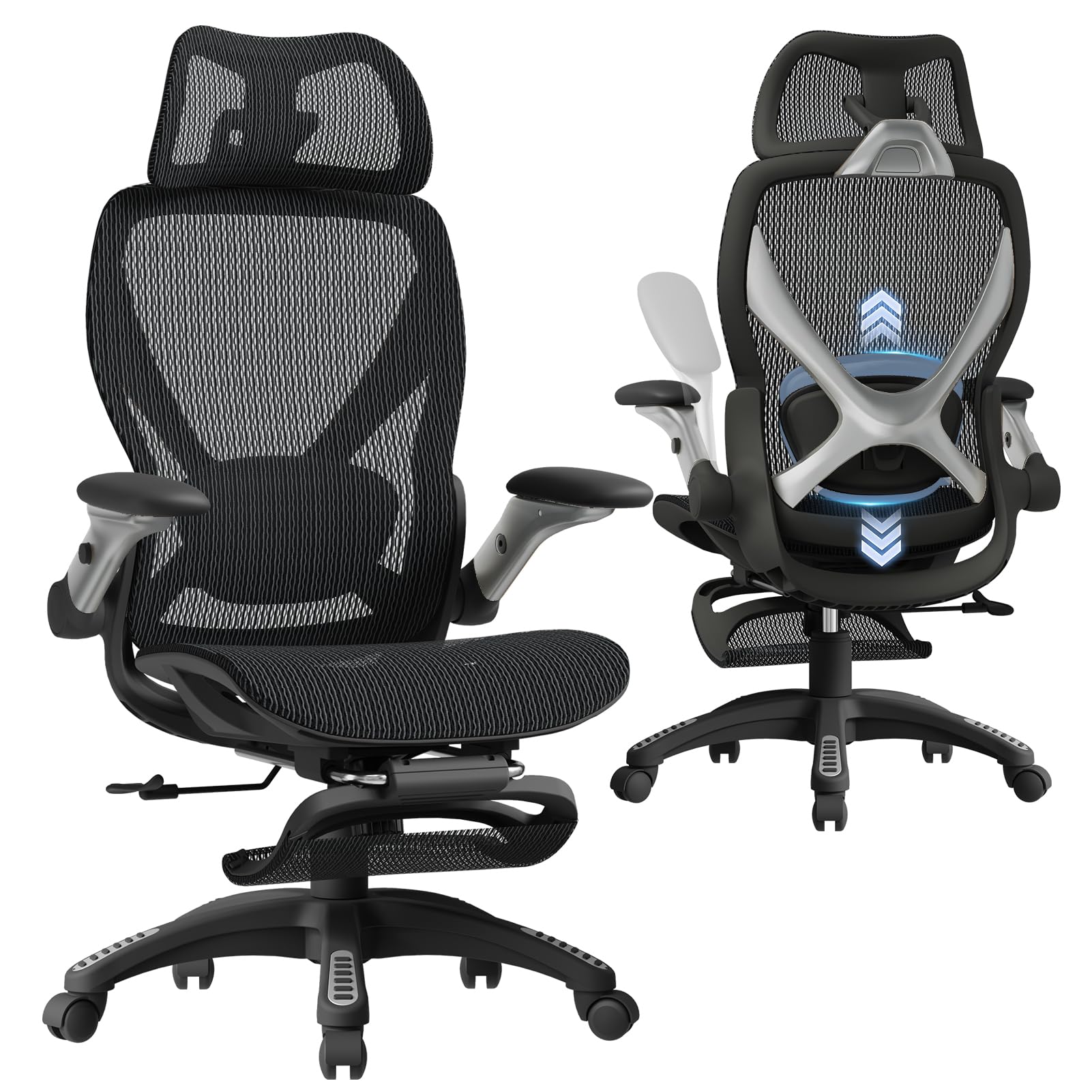
1. ELABEST X100 Ergonomic Mesh Office Chair with Footrest
Our pick — 4.5+★ from 1,000+ verified ratings; the strongest balance of quality and price.
A three-direction lumbar pad that tracks your spine, plus an 18″ footrest for the afternoon slump.
If your sciatica flares worst after hour three of sitting, this is the one to start with. The X100’s lumbar pad moves in three directions — up and down through ±2″, in and out through ±1.6″ of depth with spring-loaded auto-tracking, and a 15° rotation — so you can dial it into your lower back instead of accepting whatever angle the factory chose. Its Dynamic Spine Alignment System was developed with California-based orthopedic specialists, and the brand states the lumbar system is AEP-certified for 12hrs+ fatigue reduction. The chair itself holds up to 300 lbs and sits on a BIFMA-certified structure with a Grade-4 central column.
For sciatica specifically, the two features that do the heavy lifting are the synchro-tilt lumbar (which moves with your spine as you shift) and the 18″ extendable footrest that flips out with 2-position angle adjustment. Raising your feet takes pressure off your lower back and legs — the exact spot sciatica bites. The 5D flip-up armrests adjust in six ways (height, width, forward/back, rotation, and flip), which means the arms come up to support your shoulders or tuck all the way under a standard desk when you’re done. The seat height range is 18.3″–23″, and setup takes around 15 minutes with no tools required.
The breed of mesh matters here too. The Dual-Stripe AirMesh back is rated by the brand at 38% better airflow and 25% higher elasticity than standard mesh, and the listing claims the headrest cuts neck strain by 31%. Buyers report the assembly stickers make the build obvious, and that a 5’10″–5’11” user at 270 lbs fits comfortably. That user also swapped the stock casters for larger rubber ones with no effect on stability, and one long-term owner called it the most comfortable chair in 51 years.
Where it wins
- Three-direction lumbar adjustment (height, depth, 15° rotation) that tracks your spine as you shift — the single most useful feature for sciatica relief.
- 18″ extendable footrest with 2-position angle adjustment takes load off your lower back and legs.
- BIFMA-certified frame rated for 300 lbs, plus a 5-year support commitment from the brand.
- Headrest curves to fit the neck, and the mesh breathes so you don’t overheat and stiffen up.
Where to be careful
- The footrest is stiff to extend at first — it loosens with use, but expect a little push.
- One shorter buyer (5’2″) found the seat’s hard edges pressed into her knees before she adjusted her sitting position.
- The lumbar auto-tracking forces you to sit back to feel it work; leaning forward disengages it.
Reach for this if: you’re dealing with daily sciatica and need the lumbar pad to fit your spine exactly, not the other way around.
Look elsewhere if: you prefer a chair with no footrest, or you sit far forward and won’t use the recline feature.
2. MOLENTS Ergonomic Office Chair
Built for six-foot frames and 200-pounds-plus bodies that need real support without the specialist markup.
Taller buyers get left out of a lot of “one-size-fits-all” ergonomic chairs, and sciatica makes that worse because a too-short seat forces you to slump. The MOLENTS handles it: seat height runs 19.5″ to 23.3″, seat depth is 18.9″, seat width is 19.8″. The lumbar pad slides up and down and forward and backward — a four-way adjustment you won’t find on most chairs at any price. A 6-foot-plus, 200-lb-plus buyer reports no creaking on this frame, which matters for sciatica because a squeaking chair is usually a wobbling chair, and wobble makes you brace your lower back.
The backrest reclines through three positions between 90° and 120°, so you can break up the sitting angle that sciatica loves. The mesh is taut and skin-friendly with a shaping sponge cushion that holds its shape. The three-dimensional armrests move forward, back, left, right, and up, which absorbs shoulder strain when you’re typing for hours. Overall chair height runs 38.6″ to 42.4″. Assembly is a one-person job in about 15 minutes — just remove part B (the base leg) from inside part G (the seat frame) since they ship in the same bag.
Where this beats the ELABEST is on raw capacity for bigger frames — the MOLENTS is explicitly tuned for 6-foot-plus and 200-lb-plus users, while the ELABEST plays to a slightly larger all-round audience. Both give you a moving lumbar pad, but the MOLENTS’s forward-back slider is a different adjustment axis that lets you push support deeper into your lower back when your pain runs high. Its tilt tension is strong enough to feel controlled when you lean back.
Once you’re past the usual assembly quirks, this chair settles in fast. The main thing to know: there’s no seat-depth adjustment like the Branch Verve offers, so if you have very long legs, the seat may not slide far enough forward for a perfect hip-to-knee angle.
The right call if: you’re six feet or taller, carry extra weight, and want lumbar support you can push deeper into your back when pain spikes.
Think twice if: you have especially long thighs and need a sliding seat pan, which this chair does not offer.
3. CASASIO Ergonomic Office Chair
If your pain runs up into your neck and head as much as your lower back, this is where you start.
Sciatica doesn’t live alone — most people dealing with it also fight neck and shoulder tightness from the way they brace themselves. The CASASIO attacks that with a 3D adjustable headrest that moves in three ways (height, depth, and angle) so you can cradle your neck instead of leaving it hanging. The lumbar cushion moves in two directions — up-and-down and in-and-out — for customization at the lower back. The seat uses virgin foam that distributes weight evenly to prevent soreness over long sessions, and the whole chair is rated to 300 lbs on a reinforced metal base.
The rock-and-tilt function is where this quietly shines for sciatica. You can rock gently forward and back with adjustable tension, which keeps your lower spine moving instead of locked into one compression angle. Different from the MOLENTS (which offers three distinct recline positions with a hard lock at each), the CASASIO favors continuous motion between positions — a better match for bodies that need to keep moving. The flip-up armrests tuck the whole chair under a standard desk.
Assembly is quick and the tools are included. Owners mention the lumbar support is a genuine relief and the seat cover is soft and removable for cleaning. One verified five-star buyer with lower back pain said the lumbar support was why she no longer hurts sitting in it. Another buyer who assembled it alone finished in under an hour and praised how soft the cushion felt under her.
The honest caveat: two verified reviews noted the seat is firm and one user with sacral or tailbone pain specifically found the seat intensified discomfort. If your pain centres on the very bottom of your spine rather than the sciatic path, this chair is not the match. For everyone else, it’s an easy pick.
The rock-and-tilt advantage: continuous motion with adjustable tension keeps your lower spine moving instead of pinned to one angle — different from chairs with discrete lock positions.
Where it needs care: the seat firms up quickly, and buyers with tailbone or sacral pain report it’s not the right surface for them.
Perfect for: pain that runs up your back into your neck, with a preference for gentle rocking motion.
Not the one for: a tailbone-first problem area, where a softer seat pan is often a better fit.
4. SIHOO M18 Ergonomic Office Chair
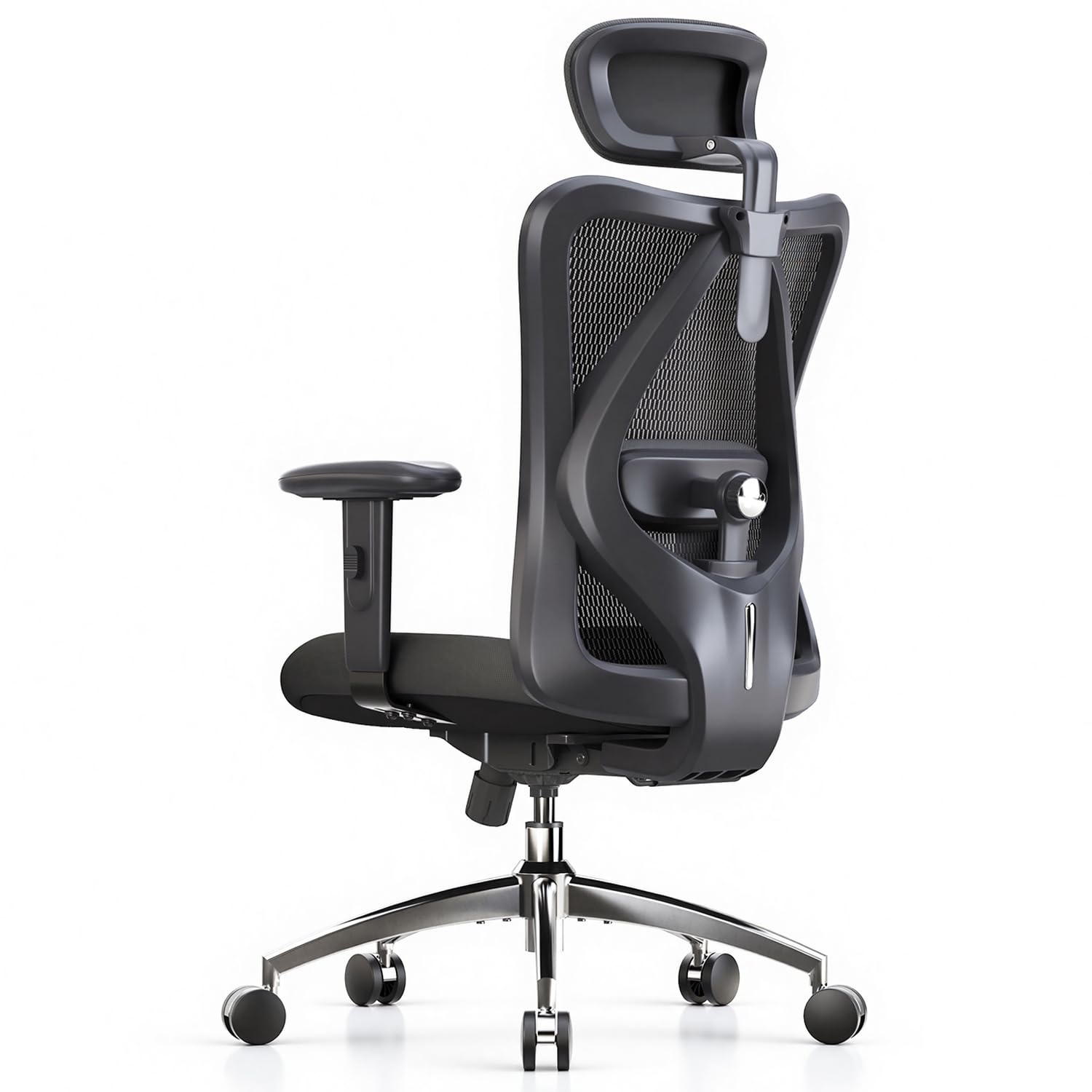
Four support points — head, back, hips, and hands — with a movable lumbar pad and a metal base, all under budget.
Sciatica relief doesn’t require a premium price tag, and the SIHOO M18 proves it. The ergonomic design gives you four support points — head, back, hips, and hands — plus a proper lumbar pad you can move to match your lower back. The chair fits people 5’6″ to 6’2″ tall, which covers most of the adult population. The BIFMA-tested frame and 1136kg static pressure test (a lab check where nearly a metric ton of weight is pressed onto the structure) mean the base won’t sag under regular use. The weight capacity runs up to 150kg.
The breathable mesh backrest keeps air moving so you don’t stew in your own heat during long sits — which matters for sciatica because heat plus inactivity is a fast track to stiffness. The chair reclines and locks in three positions with adjustable resistance. The padded armrests move up and down (but not forward or backward, unlike the three-dimensional armrests on the MOLENTS above). Assembly is broken into eight easy steps, and the lumbar support arrives as a separate part that screws into the back frame.
Buyers consistently report the mesh stays cool in hot climates, the metal base legs hold up heavier bodies, and sitting for six-plus hours is doable. A 5’6″, 200-lb verified buyer reports being able to sit for over six hours and nap reclined. The recline lock in three positions gives real flexibility. There’s a small assembly quirk worth knowing: the wheels-to-base connection can be stiff to push in — with a rubber mallet or a firm press, it plugs in. And when your lumbar pad does arrive cracked — a rare, reported shipping issue — SIHOO’s support team replaces it within about a week.
Why it’s loved
- Four-point support (head, back, hips, hands) with adjustable lumbar and headrest.
- Breathable mesh keeps your back cool during long sits.
- BIFMA-tested with a 1136kg static pressure pass — proven sturdy at a budget-tier price.
- Fits 5’6″ to 6’2″ with seat height, headrest, lumbar, and back support adjustments all included.
Worth knowing
- Armrests move up and down only — no forward/back or sideways adjustment.
- Some buyers find the rear seat edges catch on their thighs at first.
- Wheels can be stiff to install into the base; requires a firm push or mallet tap.
Solid pick if: you want the most adjustability per dollar and your body height sits anywhere between 5’6″ and 6’2″.
Keep looking if: you need armrests that move in every direction, or you’re above 6’2″.
5. Steelcase Leap Office Chair, Ergonomic Back Support, Onyx

A spine-shaped LiveBack that reshapes as you move, with a dial that turns lumbar firmness up or down.
What separates the Leap from almost everything else on this list is the combination of 3D LiveBack technology (a backrest that changes shape as you move) and a lower-back firmness dial. The LiveBack mimics the natural shape of your spine and contours to whatever position you’re in, while the firmness dial lets you add or subtract lumbar pressure with a twist — exactly the control you want when sciatica days vary in intensity. A lower back that’s over-pushed can flare pain just as easily as one that’s under-supported, and the Leap is the only chair here with an on-the-fly firmness adjustment.
The Natural Glide System is the other star feature: as you recline, the seat glides forward so your eyes stay the same distance from your screen. That means you can lean back and give your lower spine a break without breaking your typing posture. Build quality leans on 70+ years of research, and the chair uses 100% polyester fabric over a polished finish. There’s no assembly required — it ships fully built.
The honest trade-off: some verified buyers mention issues finding the right height adjustment or that the ergonomic curve doesn’t suit their particular back shape. That’s the reality of any chair with this much shape molded into it — it fits most bodies beautifully, and a small minority find the contour too aggressive. Not a defect; a fit question.
The dial that changes everything: a lower-back firmness dial plus 3D LiveBack technology means the lumbar support reshapes with you — a feature no other chair on this list offers.
Fit reality check: the deeply shaped backrest is designed around a specific spine curve, so buyers with atypical posture sometimes need a week of adjustment.
Buy this if: you want a chair that gives you direct control over how much lumbar pressure you feel, and you value shipping fully assembled.
skip it if: you prefer a flat-back chair or need maximum padding — the Leap’s shape does most of the work, not its foam.
6. FAMIC 700lbs Big and Tall Office Chair
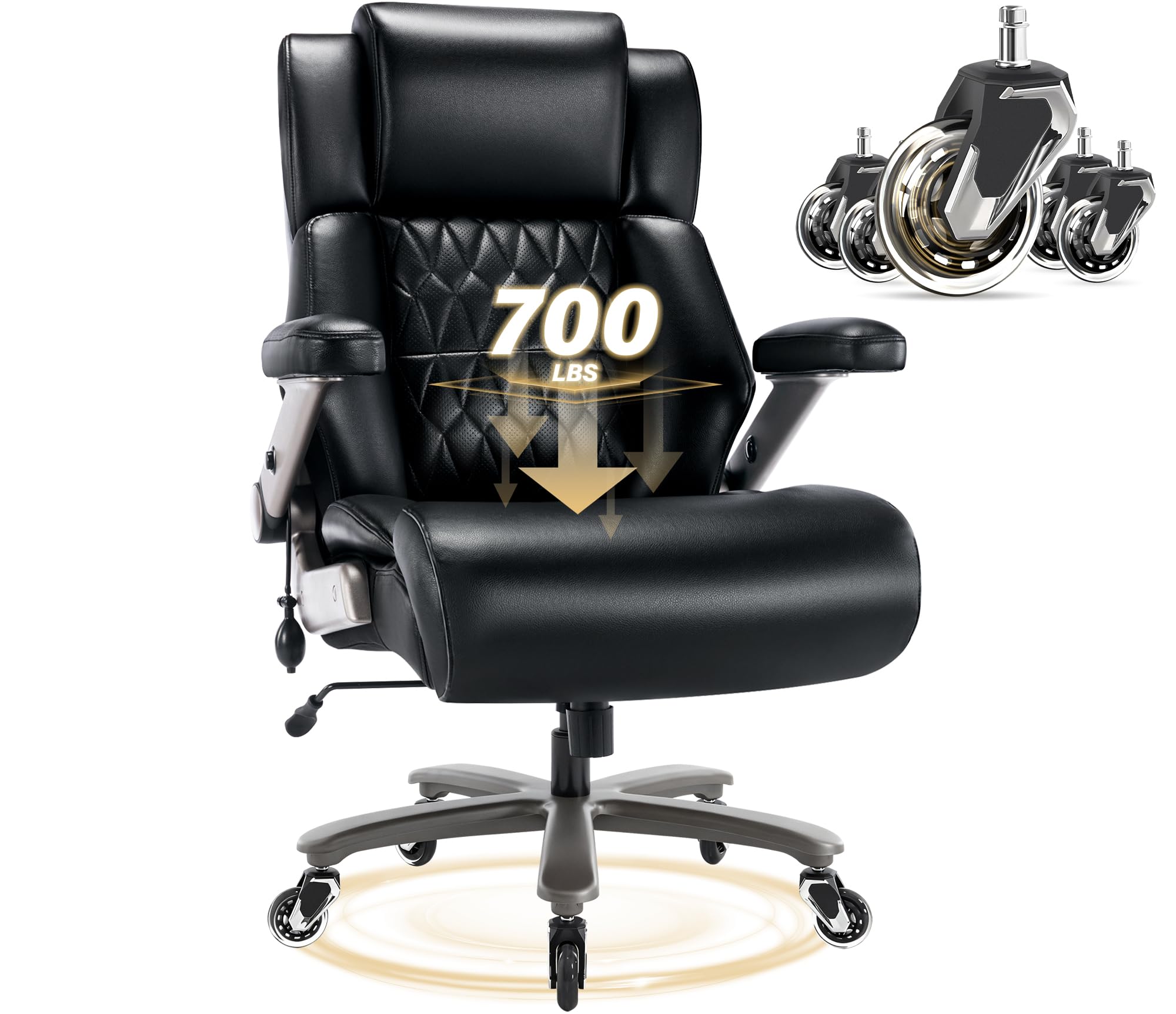
The only chair here rated to 700 lbs, with an inflatable lumbar airbag you can pump up or release as pain changes.
For larger bodies dealing with sciatica, weight capacity isn’t a nice-to-have. The FAMIC’s 700-lb rating is the highest on this list — and the brand states the chair was lab-tested with a 290kg (640-lb) weight stamp over 6,000 continuous impacts, delivering a 98% success rate in preventing sinking or wobbling. A sturdy metal base and thick polyurethane-coated wheels keep the chair stable and protect your floor. The tech-leather outer is micro-perforated — thousands of tiny invisible holes that let air move through, keeping the seat cooler than standard leather.
The headliner for sciatica support is the inflatable lumbar airbag. You can pump it up to push outward on your lower back, then release air when it’s too much. Paired with a mattress-grade spring pack cushion that resists flattening, it stays supportive as you sit. Its backrest is extra wide at 28.74 inches — the widest surface on the list — and the seat accommodates large height and weight without the padding collapsing.
Customers note this chair works for large users in ways others don’t, and that even when one wheel broke or the gas lift cylinder gave way after 16 months, FAMIC’s support sent replacement parts (including a full wheel set two years post-purchase) without asking questions. That kind of tech support matters because the chair is heavy and awkward to ship back. The one honest limit: at 5’3″ one buyer reports her feet don’t touch the floor, so shorter adults should measure their leg length against the seat height before ordering.
What you get
- 700-lb capacity with a lab-verified 290kg/6,000-impact test stamp — the strongest base on the list.
- Inflatable lumbar airbag you can tune to your pain level, day by day.
- Micro-perforated tech-leather with built-in ventilation to reduce heat buildup.
- Two-tier protection: 1-year component warranty and 5-year technical support plan.
Before you buy
- As with any big-and-tall chair this size, it’s heavy and shifting it takes effort.
- Shorter users (around 5’3″) may find the seat too tall — feet don’t reach the floor.
- The deep recline suits tall or gaming users better than shorter sitters who prefer upright work posture.
Made for: large and tall bodies that need a base that won’t falter, and a lumbar pad that can be inflated or deflated as pain changes.
Look elsewhere if: you’re on the shorter side — this seat height is tuned for bigger frames.
7. Branch Verve Chair, High Performance Executive Office Chair

Six points of adjustment plus a V-shaped sculpted back that hugs your spine whatever angle you choose.
Sciatica responds well to dialing the chair into your exact proportions, and few chairs offer more control than the Branch Verve. Six adjustment points include seat height, seat depth, tilt, tilt lock, lumbar height, and armrest height — every important dimension to get your hips, knees, and lower back into the right alignment for a long sitting day. The V-shaped suspended back has built-in spine support that adjusts to your posture. The backrest is engineered for 8 or more hours of continuous use, which is the sort of number that matters when you’re trying to avoid a flare-up.
The seat includes high-density foam, and the back uses a ventilated 3D knit that moves air through it — different from the ELABEST X100’s Dual-Stripe AirMesh and the SIHOO M18’s standard mesh fabric, the 3D knit is knit-textured for stretch. The sculpted contoured seat plus the V-shaped back create a cradle effect that most buyers sitting in warm rooms appreciate. Build is aluminum over powder-coated finish — a lighter base than the FAMIC’s heavy-duty metal.
A quirk worth knowing: some verified reviewers point out that the seat runs smaller than expected, and taller users especially note that the seat depth doesn’t quite fit longer thighs. Its adjustability is excellent for average-height frames but isn’t tuned for 6’3″-plus sitters. Arm height runs at 30 inches, which pairs with most standard desks.
Well-suited to: average-height sitters who want maximum control over tilt lock and seat depth to dial in their own lower-back angle.
Not the one for: very tall sitters whose thigh length exceeds the seat’s depth.
8. Herman Miller Embody Ergonomic Office Chair, Black Rhythm

The chair tuned by more than 20 biomechanics and physical therapy experts to distribute your weight like nothing else.
More than 20 physicians and PhDs in biomechanics, vision, physical therapy, and ergonomics helped guide the Embody’s development, and its backrest flexes with your micro-movements instead of holding one fixed shape. The seat and back use a dynamic matrix of “Pixelated Support” — thousands of tiny support points that flex as you shift, changing your weight distribution as you sit. There’s a central spine and flexible ribs in the backrest, plus a Backfit adjustment that lines the backrest up with your spine’s natural curve. When your sciatica pain runs from your lower back down your leg, moving pressure off the affected path is the goal — and the Embody’s matrix does exactly that.
The seat uses four distinct support layers with different material properties, engineered with airflow so you don’t build up heat. Features include tilt limiter, adjustable seat depth, fully adjustable arms, and carpet casters. Rhythm fabric is tight, smooth, and soft to the touch while preventing heat buildup. No assembly is required. It comes in black with a graphite base and frame over steel alloy.
The trade-offs are real. This is the priciest chair on the list, and its 3.5+ rating shows some buyers find the fit doesn’t match their body. If you want a deeply cushioned, puffy seat, this chair’s structured surface feels very different from that. The Embody is a support-first chair — make sure that’s what you’re after before you commit.
Unique design point: Pixelated Support technology — a dynamic matrix of tiny seat and back points that reshape to your body’s micro-movements, reducing pressure across your sciatic path.
Who this is not for: buyers who want thick, plush cushioning or a chair that feels “cradled” — this surface is firm, structured, and built to move with you.
Worth it for: buyers who’ve tried foam chairs and gotten nowhere, and want a chair that adapts to their movements instead of asking them to sit still.
Just be honest with yourself about: whether a structured, firm, unsupported-feeling seat surface is what you actually want to sit on all day.
9. NYPOT Ergonomic Kneeling Chair with Adjustable Seats
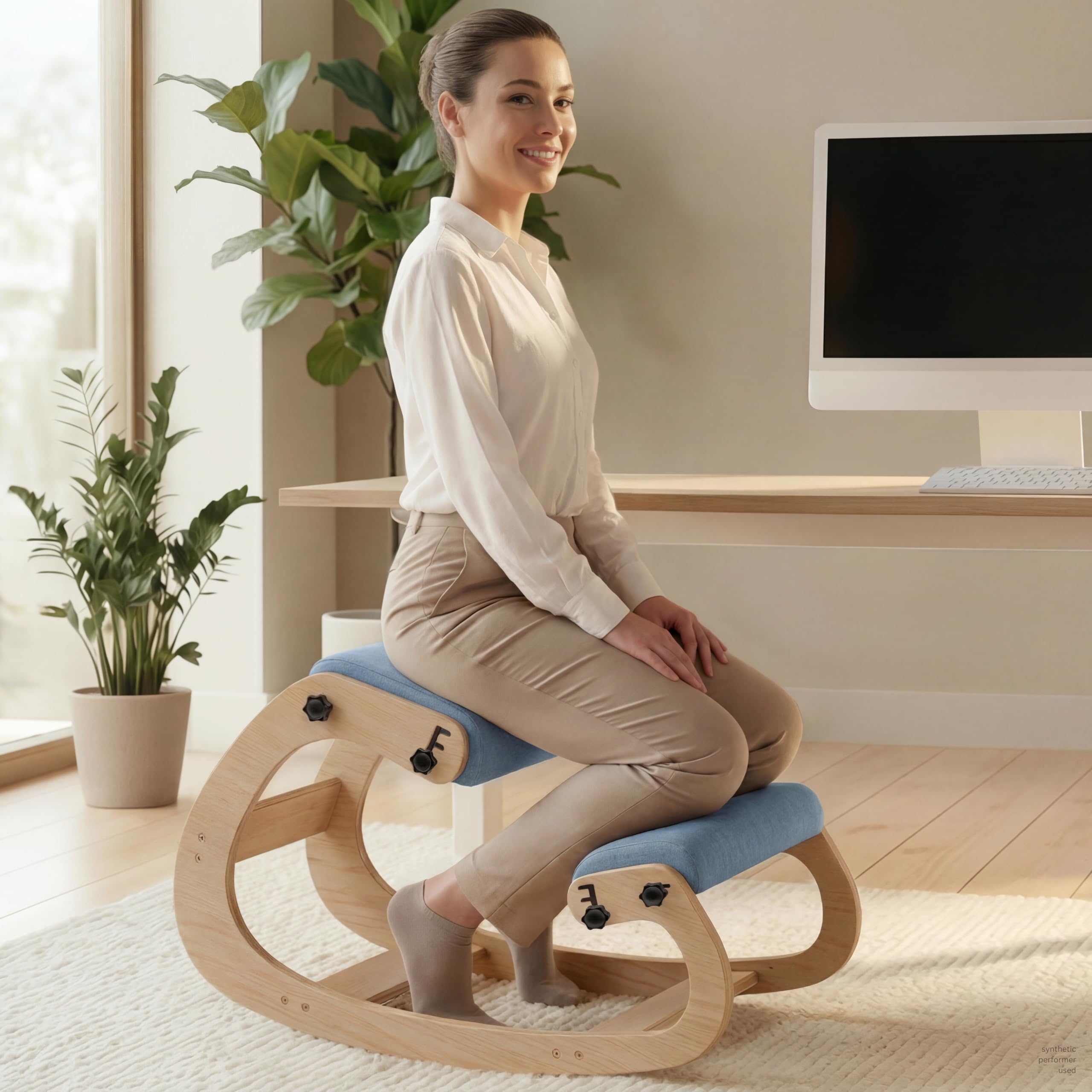
A kneeling chair that shifts your weight onto your hips and legs, off the sciatic path.
The NYPOT kneeling chair takes a completely different approach: instead of putting weight through your glutes and into your lower back, it shifts your body’s load forward onto your hips and legs. That means less pressure on the sciatic path. The seat pad and knee pad are both adjustable for height, so you can dial in the exact posture you want, and the whole chair works with standard home and office desks measuring 29 to 35 inches tall. The wood frame supports up to 250 lbs, and the thick high-density foam cushions hold their shape through long sessions.
The gentle rocking motion is the feature buyers single out the most. It shifts your pressure points automatically, so you don’t sit locked in one position hour after hour. It can also be used as a cross-legged chair, meditation chair, or yoga seat, which makes it flexible in a home office where the chair has to serve more than one role. The five-year warranty is one of the longest on this list. Some shoppers say the chair wobbles slightly side to side from the design, so if you’re prone to vertigo or you just want rock-solid stability, a different chair may feel better.
There’s an adjustment period here — the brand itself warns that new kneeling chair users may feel pressure on their shins or lower back until they find their ideal seat and desk height match. One verified user reports that after ten days of use, lower back pain reduced but new knee pain developed, and recommended using it only with a high desk. Another user reports instant lower back relief but acknowledged her knees needed time. This is a chair that works well for some sciatica patterns and less well for others — a personal-physiology mismatch, not a defect.
Why kneelers change the game
- Shifts weight onto hips and legs, taking direct pressure off the sciatic path.
- Adjustable seat and knee pads plus a rocking motion keep your body moving.
- Fits standard desks 29″–35″ tall and works cross-legged or kneeling.
- Five-year warranty — the longest coverage on the list.
What to expect
- Kneeling chairs come with a learning curve — the shins and lower back may complain before they adapt.
- Designed for short sessions rather than eight-hour marathons; long use can cause knee or shin soreness.
- Sits higher than a regular office chair, which may require a monitor arm to keep your screen at eye level.
Great for: people whose sciatica originates low in the pelvis and worsens with the classic glute-compression sitting posture.
Maybe not for: anyone who wants all-day sitting comfort or already deals with knee or shin sensitivity.
Know the Specs
Lumbar support type and adjustability
The lumbar support is the pad that presses into your lower back, and its adjustability is what separates a chair that helps sciatica from one that doesn’t. A fixed lumbar pad sits in one spot — if that spot isn’t where your spine curves, it presses wrong. What you want is motion. The ELABEST X100 moves its pad in three directions (up/down, in/out, plus a 15° rotation). The MOLENTS slides its lumbar pad up, down, forward, and backward. The FAMIC uses an inflatable airbag you pump up or release. The Steelcase Leap goes further with a firmness dial that lets you turn lumbar pressure up or down on demand. The more ways a lumbar pad can move, the better your odds of matching your exact pain pattern.
Seat height, depth, and the sciatica angle
Seat height determines the angle of your hips. When your hips sit higher than your knees, the front of the hip opens and takes tension off the sciatic nerve path. When your hips sink below your knees, the nerve gets compressed. The MOLENTS runs its seat from 19.5″ to 23.3″; the ELABEST X100 runs 18.3″ to 23″. The Branch Verve adds a seat depth adjustment that slides the seat pan forward and backward — a feature the MOLENTS lacks. If you’re a taller sitter, you need more depth so your thighs are supported all the way, not left hanging off the front edge. That’s why the Branch Verve’s seat size gets mixed feedback from tall sitters.
Common Questions
What is the best chair for sciatica if I sit 8 or more hours a day?
Will a mesh chair or a foam chair be better for sciatica pain?
How high should my seat be to reduce sciatica pressure?
Is a kneeling chair better than a regular office chair for sciatica?
What weight capacity should I look for in a chair for sciatica?
Does a chair’s reclinesetting affect sciatica?
Can a chair help with sciatica pain that runs down my leg?
Is a headrest important on a chair for sciatica?
Should I buy a big and tall chair for sciatica if I’m under 220 pounds?
How long does it take to adapt to a new ergonomic chair for sciatica?
The Bottom Line
Sciatica doesn’t get fixed by a label on a chair, it gets managed by a chair you can adjust into your body’s exact shape. The most important things to look for are a lumbar pad that moves in more than one direction, a seat height that keeps your hips at or above your knees, and a weight capacity that matches your body with a margin. Of every chair reviewed here, the ELABEST X100 does the best job across the widest range of sciatica patterns — its three-direction lumbar adjustment, 300-lb BIFMA-certified frame, and extendable footrest make it the chair to pick first if you want one that fits most bodies and most pain days.
If you need maximum lumbar control, the Steelcase Leap gives you a firmness dial no other chair here offers. If your frame runs past 220 lbs, the FAMIC 700lbs is the one built for you. If your sciatica originates low in the pelvis and you want to change your sitting posture instead of the padding, the NYPOT kneeling chair is worth trying — just plan on a two-week adjustment period. And if you’re on a tight budget but still want an adjustable lumbar, headrest, and metal base, the SIHOO M18 delivers the most value on the list.
Whichever you choose, set the seat height first, then the lumbar pad, then the armrests. Small adjustments in the right order change more than any single feature. And if the pain doesn’t improve after a couple of weeks of daily use, that’s a conversation for a doctor, not a chair. The point of a good chair isn’t to cure anything — it’s to stop making a hard day harder.
How we choose
We do not accept paid placement. Every pick is matched to a real buyer and a real use-case; we do not hands-on test units.
Sources
Specifications: manufacturer listings and product documentation. Review insights: verified customer reviews, as of October 2026. Pricing: not shown on this page (it changes often); check the current price via the retailer link.
As an Amazon Associate, Aappliancez earns from qualifying purchases. This does not affect which products we feature.