Disclosure: Some links in this post are affiliate links. As an Amazon Associate I earn from qualifying purchases, at no extra cost to you. Learn more
Specs are compiled from manufacturer listings and verified buyer reviews and can change over time — please confirm the key details on the product page before buying.
Most neck traction devices fail for one of two reasons: the pull is too weak, or the collar does not fit your neck measurements. That is the whole difference in this category: some devices gently lift your skull off the shoulders, some just prop your head up, and one is actually just a pillow. The picks below cover all three, with the honest trade-offs spelled out.
This guide is built by comparing the manufacturers’ published specifications and the patterns across verified customer reviews, so you get each pick’s real strengths and trade-offs instead of marketing spin.
Two things decide whether a device helps you or gathers dust: how the tension is applied and whether it fits your neck measurements. Below you get both checked against the real numbers, so you buy once. Here are the strongest options for a cervical traction device.
Top Picks
How To Choose The Best Cervical Traction Device
The first thing to understand is that “cervical traction” gets used loosely. A real traction device pulls your head away from your shoulders to open the space between vertebrae. A neck pillow supports your curve while you sleep and does not pull at all. Both belong in a neck-care routine, but only one is traction — and mixing them up is the most common reason people buy the wrong thing.
Check your neck measurements before anything else
Rigid collars are built to a size range, and a device that is too small cannot do its job. The air-pump stretcher here spells out its window plainly: height range 3.2-4.7 inches and neck circumference 13.7-16.8 inches, with the maker stating it is not recommended for thicker necks. The adjustable collar runs 8.27″ to 10.43″ circumference and 4.72″ to 5.91″ in height. Measure with a soft tape before you click buy — it takes a minute and saves a return.
Decide where you will actually use it
Door-anchored systems need a standard-height door and a spot to squat. Air-pump and collar designs let you sit and watch television. Cordless massagers go anywhere and need a charge. Be honest about which one fits your day, because a device you dread setting up is a device that ends up in a closet.
Give it weeks, not days
Owners who report the biggest changes are the ones who kept a schedule. That means roughly 10-20 minutes per session, 2-3 times a day for 10-20 days on the air-pump model, or a consistent daily stretch with the door device. Pain that has built up over months does not unwind in one sitting.
Side-by-Side Comparison
| Model | Best For | Traction Method | Fit / Size Spec | Portability & Power | Amazon |
|---|---|---|---|---|---|
| Authentic Pettibon System★ Best Overall | Body-weight door traction at home | Over-door, self-controlled body weight | Height adjustable for any user | 2.5 lb, no power needed | Amazon |
| Neck Stretcher Cervical Traction (Holniva)Best Adjustability | Adjustable multi-angle support at a desk | 3 manual knobs, open-frame collar | 8.27″–10.43″ circumference; 4.72″–5.91″ height | Lightweight, no power needed | Amazon |
| Fisher Traction | Portable doorknob decompression | Patented bungee stretch-release strap | Under 1 lb; 30–35° traction angle | Under 1 lb, no power needed | Amazon |
| Alphay Electric Air Pump | Hands-free sitting or lying decompression | Electric air pump, 8 inflatable columns | Height 3.2–4.7 in; circumference 13.7–16.8 in | 2.2 lb, rechargeable lithium ion | Amazon |
| Upalled Heated Neck Massager Pillow | Heat plus airbag lift during a 15-minute break | Airbag inflation with 3 massage modes | 16.7” x 10.6” pillow footprint | 2.25 lb, cordless rechargeable | Amazon |
| Bespillow Cervical Neck Pillow | All-night curve support, not traction | None — contour support only | Two heights: 5.5″ and 3.7″ | 24.7″L x 14.6″W bed pillow | Amazon |
| FliKEZE Neck Stretcher | Heat, red light and massage combination | Dynamic traction with 5 massage modes | 4.28 lb device body | 4.28 lb, USB rechargeable (5V, 2A) | Amazon |
Detailed Reviews
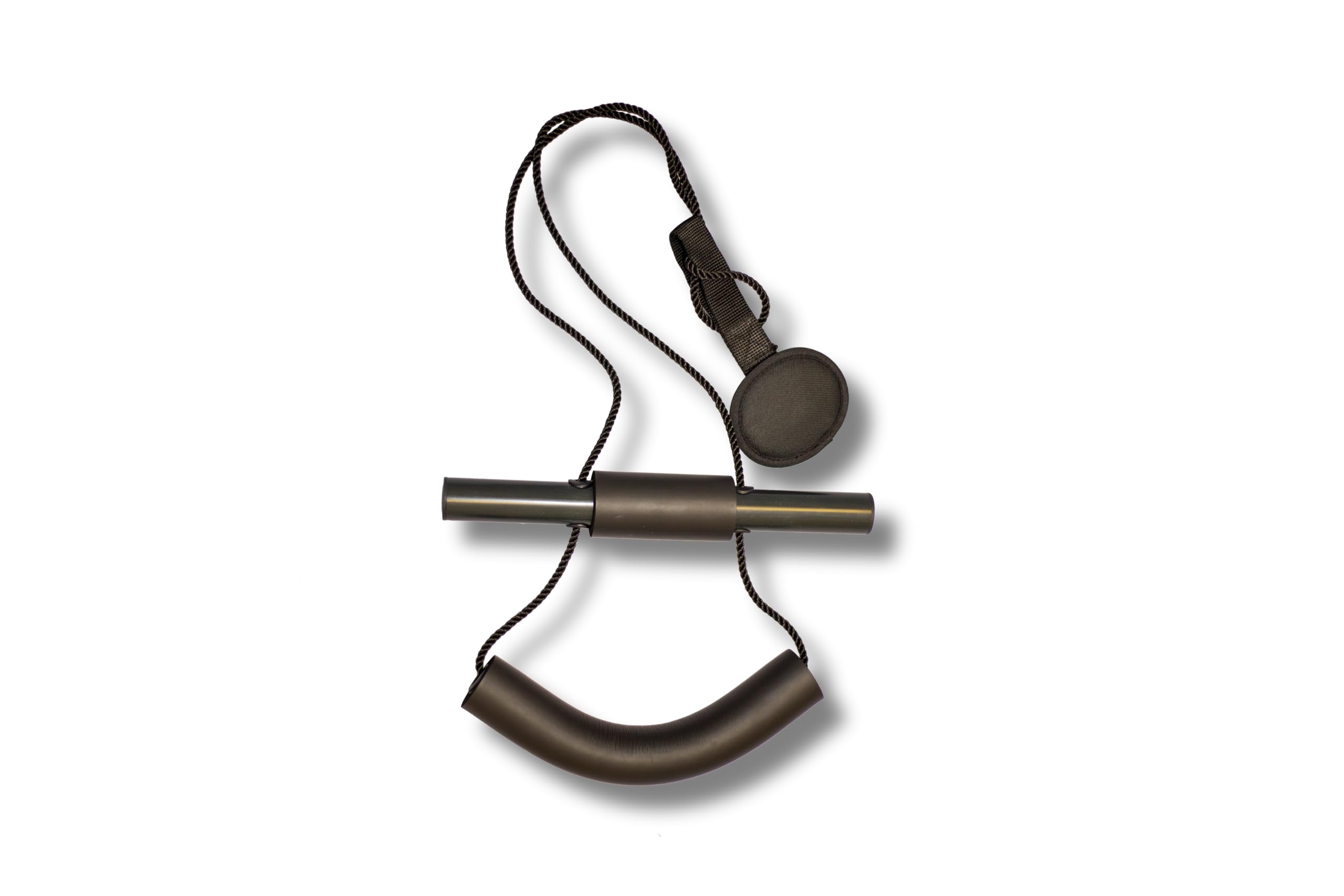
1. Pettibon System Portable Cervical Neck Traction
Our pick — 4.5+★ from 400+ verified ratings; the strongest balance of quality and price.
The door-mounted classic that lets your own body weight do the pulling.
If you want the closest thing to a clinic stretch in your own hallway, this is the device the rest of the list is measured against. It hangs over a standard-height door and you control the intensity with your own legs — the maker notes a fabric doorstop is included and setup runs six quick steps. Packages at 2.5 pounds, so it travels in a suitcase without complaint. The manufacturer has been supplying chiropractic clinics for over 30 years, and that lineage is why it feels more like equipment than a gadget.
The tension is entirely yours to dial. You squat until the pull is right and hold — buyers report a routine of holding a squat at max tolerable pressure for 10 seconds across 10 reps, saying consistent use loosens and straightens the spine. Effectiveness is the thing that wins people over above anything else, followed closely by how well it supports the neck. One detail worth knowing before your first session: wash your face first. Face oils let the top bar slide, which throws off your angle.
Expect a learning curve before it feels natural. Some owners find the neck portion a touch thick for their head shape, notice a slight rubber smell at first, and describe the device leaning to one side — body geometry varies, and the door-hang piece is too thick for a few door frames. It is also the heavier of the two door-anchored picks here: at 4.28 pounds the FliKEZE stretcher outweighs this one by a wide margin against its 2.5 pounds.
What earns its keep
- Your own body weight sets the pull, so intensity scales to you in real time
- Height adjustable so different people in one house can share it
- 2.5 pounds packs into a bag for travel or the office
- Six-step setup over a standard door with the included fabric doorstop
Know before you hang it
- Needs a door and floor space — not a sit-and-watch device
- A few buyers find the neck bar thick or the hanger tight on their door
- The stretch angle depends on clean, oil-free skin contact
Reach for this if: you want a genuine decompression pull at home and have a door to hang it on.
Look elsewhere if: you want to work on your neck sitting on the sofa — the air-pump pick below was built for that.
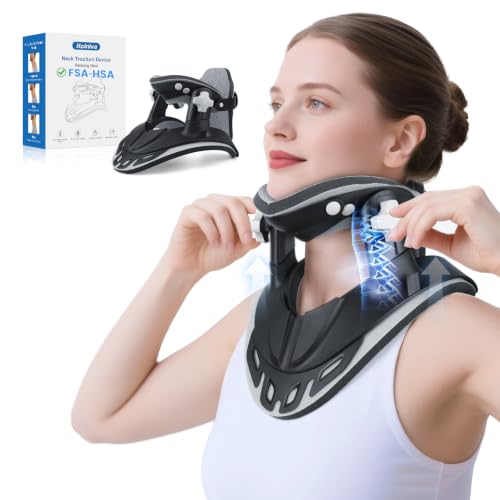
2. Holniva Neck Stretcher Cervical Traction
Three dials, one open frame, and a whole lot of airflow behind your neck.
Three manual knobs — left, right and back — let you set support angle by angle instead of one fixed position. That is the appeal for anyone whose stiffness comes from hours at a screen. It is also FSA and HSA eligible, which matters if you are spending a health account balance on it.
The hollow frame is the part you feel in a long session. Traditional collars trap heat behind your neck; this one leaves the back open so air moves, and the removable chin pad is washable so it stays fresh. Sizing is the number to check: it fits necks from 8.27″ to 10.43″ around and 4.72″ to 5.91″ tall, and the maker asks you to measure before you buy.
Durability of the setup is fine — build quality draws steady praise and the traction force is easy to dial up in small steps. Less settled are comfort and stretchiness, which split opinions, and one buyer with cervical hypermobility found the front dials pushed the jaw up and set off clenching. People with fused vertebrae still reported less stiffness after a few days, though that group needed an adjustment period and found the device somewhat bulky. One verified buyer put it plainly: “Could use better instructions but it does relieve my pinched nerve in my neck so it’s a good product.”
Where the design pays off: the open back keeps you cool across a long stretch, and three knobs give you finer control than a one-size collar allows. It is inexpensive to try compared to the pump and door systems.
The fit conversation: if your jaw is sensitive or your neck sits outside the stated circumference range, this is not the pick. Comfort is the most-split subject in its feedback, so buy from a seller with an easy return window.
Solid choice for: desk workers who want multi-angle support they can wear while working or reading.
Think twice if: your neck measures outside 8.27″–10.43″ around or you carry a jaw or TMJ sensitivity.
3. Fisher Traction Cervical Neck Traction Device
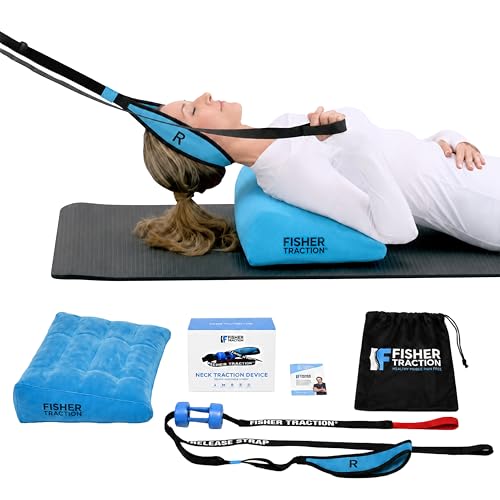
A doorknob anchor, a bungee strap, and a pull intensity you set yourself.
Fisher’s system hooks to most standard doorknobs instead of a door top, and that changes the angle of the pull. Its in-house bungee design lets you cycle tension on and off, and the maker states it applies traction at 30–35°, an angle it describes as decompressing the greatest number of cervical segments. The whole kit weighs under 1 lb and packs into a box around 8″ x 10″ x 4″ — small enough for a carry-on.
What comes through strongest is build quality, with the comfort and support landing just behind it. Owners describe the doorknob anchor as quick to adjust and effective at relieving pressure in the neck. The caution is the same for anyone who overdoes it: one reviewer noted a muscle spasm and an opposite hip misalignment after pulling too hard, so start light and build.
Here is the trade-off you will hit. The strap setup takes fussing — scooting to find tension, then working out the fit while holding it. The head strap bears on the skull and some find it creeps into a cramped neck, and the padded valve hole is loose enough to lose some air when you inflate. In the neck-to-lower-back range, owners mention it shines on the neck and lumbar while offering little on the mid or upper back. Price is the other honest note: it is the most expensive device here, so the case rests on the portability and the bungee cycle.
The case for the bungee
- Under 1 lb — easily the lightest carry-up-a-flight option here
- Stretch-release cycling instead of a constant static pull
- Neck wedge included to set a proper curve angle
- Anchors to most standard doorknobs
Worth knowing upfront
- Takes body positioning to dial the pull — not click-and-forget
- The head strap can press on the skull during a long session
- Little to no effect reported outside the neck and lower back zones
Pick it for: travel and small spaces where a door-and-bungee setup beats a bulky machine.
The catch: the head strap and the fiddling are real, so a patient temperament goes a long way with this one.
4. Electric Air Pump Cervical Neck Traction Device
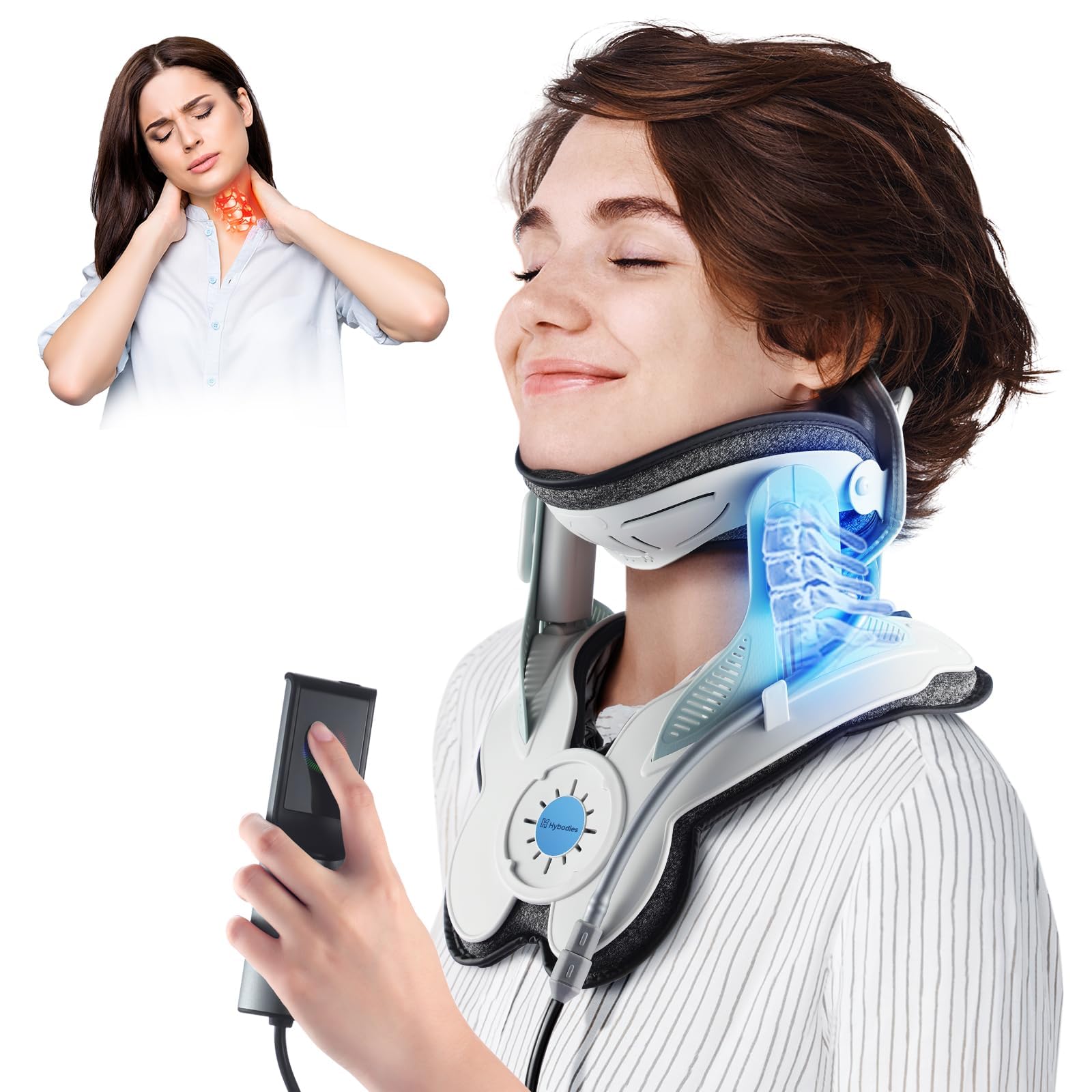
Touch the screen and eight air columns lift your chin off your shoulders.
The rear airbag carries 8 inflatable columns shaped to the 20-degree curve of the cervical spine, so the lift arrives evenly across both sides of your neck. A pair of side knobs turns 180 degrees counterclockwise each click to raise and push the spine in step. That means you can sit and watch television, or lie in bed, while the pressure does the work.
Measure your neck before you buy, because fit decides whether this works for you. The maker states a height range of 3.2-4.7 inches and a neck circumference of 13.7-16.8 inches, and flatly says it is not recommended for thicker necks. In a session, plan on 10-20 minutes, 2-3 times a day for 10-20 days before you judge the result. That schedule matches what owners actually do: within 10 days of twice-daily 10-minute sessions, one user with neck popping reported full movement without the pain.
Effectiveness is the standout here, and adjustability follows closely. Owners describe the two side knobs as easy to reach mid-session and easy to fine-tune one click at a time. The fit is the weak point, and it shows up as the most-discussed negative — several necks simply measure past the ceiling. Shoulder shape plays a role too. Set your expectation that this is a sitting-up machine rather than a strap around the skull, and the 2.2-pound weight makes it easy to move from chair to bed.
What the setup gives you: electric inflation at the tap of a screen, even push on both sides of the neck, and no chin strap to pull against your throat.
The line to respect: if your neck circumference lands above 16.8 inches, the collar will not clamp correctly. Measure before you buy — the wrong size here wastes the design.
Best fit for: anyone who wants decompression while seated, hands-free, with a rechargeable pump doing the work.
skip it if: your neck runs larger than the stated 13.7–16.8 inch window.
5. Upalled Cordless Heated Neck Massager Pillow

Heat, vibration and an inflating airbag combined in a pillow you can use anywhere.
Three massage modes — gentle relaxation, percussion, and a combination setting — pair with an airbag that inflates to lift and realign the neck. You also get three heat levels at 95°F, 110°F and 122°F, each with a 15-minute auto-shutoff so you can doze off without worry. The shell is 98% breathable contour memory foam with a 3D mesh cover, and it measures 16.7” x 10.6” across your shoulders.
What wins people over is the build and the value, with pain relief close behind. Owners describe the 122°F heat setting as spot-on, the airbag lifting the neck to the right angle, and the vibration easing tension without the buzzy, tooth-rattling feel of cheaper massagers. The overnight-charge routine is worth getting used to: the maker asks for a 4-hour charge when it arrives, and a few customers note the charge is slow and that it cannot run while plugged in.
Functionality gets mixed reports. The massage delivers pulses rather than a kneading feel, and a couple of owners find it reaches only one side. Battery life holds up for regular sessions but not all day. Plenty of people who expected to dislike the vibration ended up converted because the results arrived. It is 2.25 pounds, cordless, and glides from sofa to bed without an outlet.
Why the combo lands
- Three heat levels up to 122°F, each with a 15-minute auto-off
- Airbag lift adds a real traction element to a pillow form
- Cordless and 2.25 pounds, so it works anywhere
- 3D mesh cover and breathable memory foam keep it cool
Set your expectations
- The massage is pulses, not deep kneading, and may favor one side
- No battery indicator, and a slow charge that cannot run plugged in
- Not a true hard-traction device — the lift is gentle
Go here for: a comfortable evening wind-down that combines gentle lift with heat and vibration.
Pass if: you want firm clinical decompression — the air-pump pick delivers a harder pull.
6. Bespillow Cervical Neck Pillow
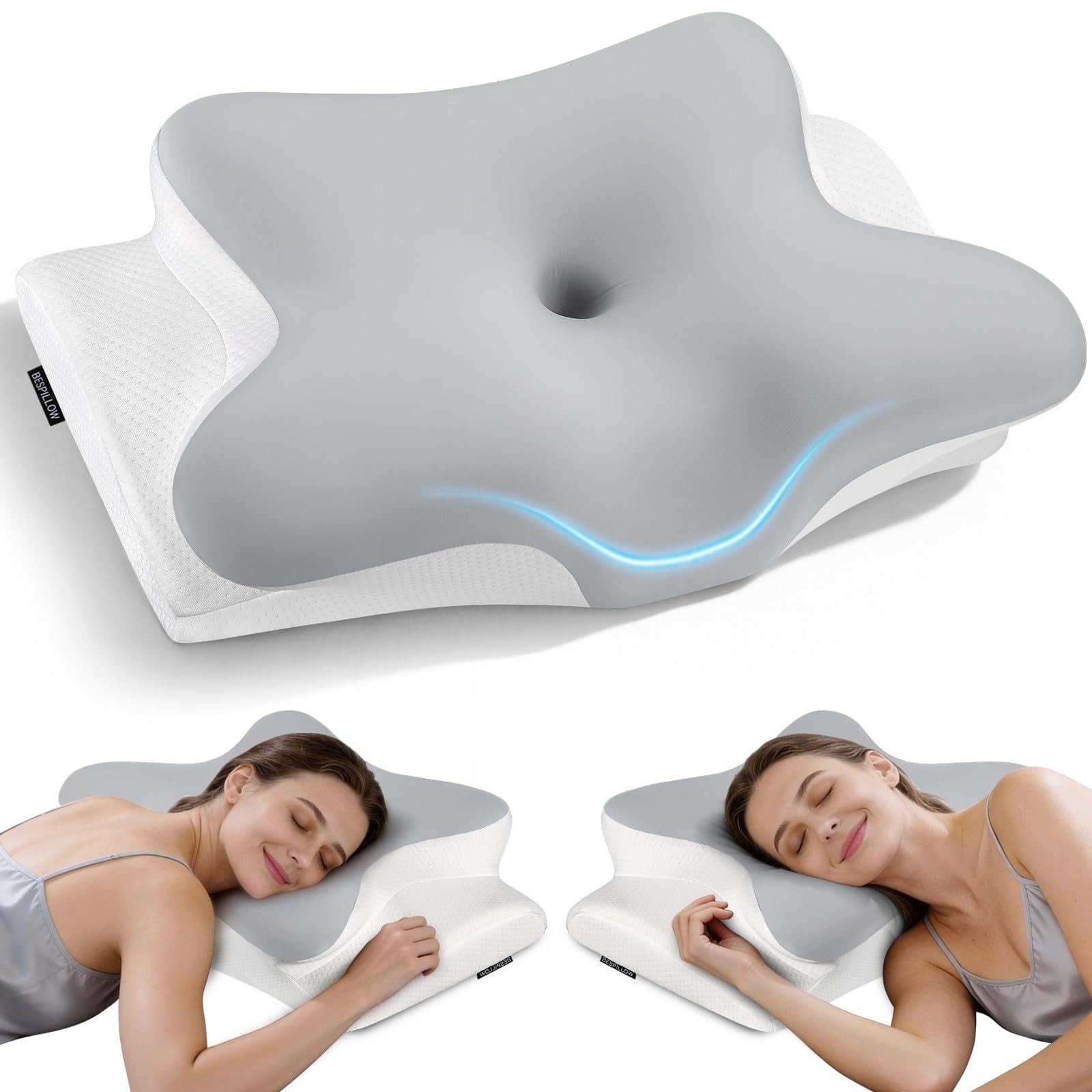
Not traction at all — but the eight-hour support your neck gets between sessions.
Be clear about what this is: a contour pillow, not a pulling device. Its job is holding your neck’s natural curve while you sleep, so it pairs with any traction device on this list rather than replacing one. The 15° angled hollow surface cradles your head, and the butterfly shape spreads pressure while an armrest zone gives your arm somewhere to go. The fill is high-density CertiPUR-US and Oeko-Tex certified slow-rebound memory foam.
The two-height design is the smart part. Rotate the pillow 180 degrees to switch between 5.5″ for side sleepers and 3.7″ for back and stomach sleepers — no flipping mid-night, no waking with a numb neck. The ice silk cover is removable and machine-washable. Neck pain is what wins people over here above all, with build quality and pillow quality in close pursuit.
Not every report is a home run. Reviewers with degenerative disc disease report waking without neck or lower back pain after two nights, and one spine practitioner recommends the pillow to clients and family. Others want the foam a touch softer and slightly thinner, and call it a solid beginner ergonomic pillow rather than a custom fit. That is the fair read: firm support by design, which some necks take a week to accept.
The overnight payoff: two heights in one pillow mean side and back sleepers in the same bed get a proper angle, and the washable ice silk cover keeps the whole thing cool.
Where it falls short of your expectations: it won’t pull or decompress anything, and the firm memory foam takes a few nights to feel right.
Worth it for: anyone whose neck stiffens overnight and who wants curve support for a full night’s sleep.
Don’t expect: traction. If you want a stretch, pair this with a door or air-pump device.
7. FliKEZE Neck Stretcher with Red Light and Heat Therapy
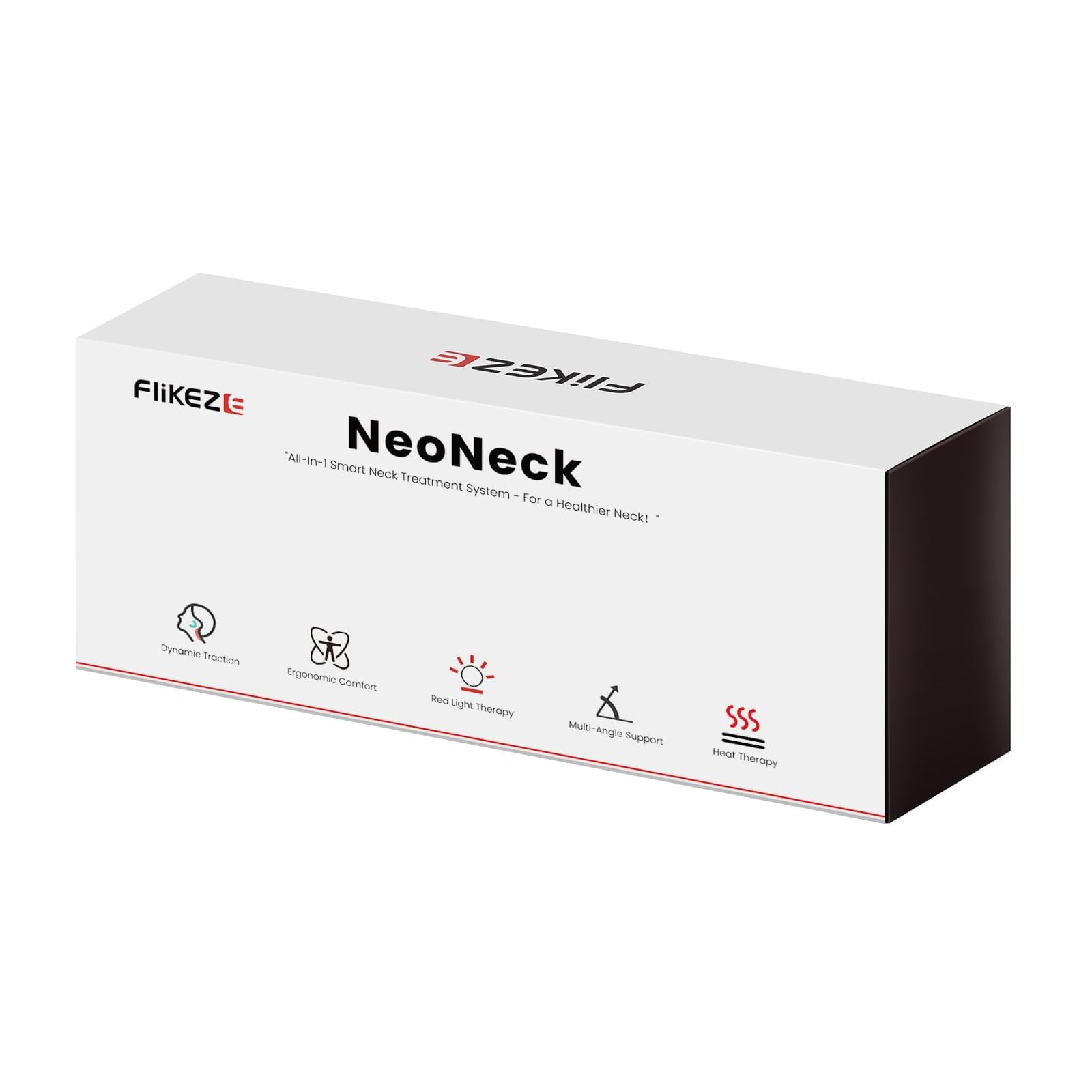
Red light, three heat levels and five massage modes, all in one bulky collar.
FliKEZE packs more into one device than anyone else on this list. Red light therapy joins three heat levels and five massage modes, and dynamic traction lets you pick up-and-down or left-and-right movement by hand. The maker suggests 10-15 minutes a day and specifically warns against using it all night.
At 4.28 pounds it is the heaviest device here — heavier than the 2.5-pound Pettibon by a wide margin — and that weight is the flip side of all the hardware inside it. When the combination works, neck relief is what people praise most: the gentle rhythmic lift paired with the massage and light delivered a real difference for chronic tech-neck pain after a couple of weeks of consistent use. The warming effect is relaxing at moderate settings, and the controller makes it easy to switch between modes.
Reliability is the real risk here. A whole cluster of reviewers point out units that quit after a couple of months or, in one case, after ten months of light use — it would not power on or accept a charge, and it cannot run while plugged into the wall. Other complaints run to the red light’s unclear benefit, the heat landing on two small pads, and the device’s size lifting the head rather than stretching the neck. It is the fussiest pick here, and the one that asks the most patience.
If you want the most modes: no other device here offers red light, heat and five massage patterns together, and the movement mimics a lifting stretch rather than a static brace.
The real gamble: battery and durability complaints are the loudest theme in its feedback, and there is no plugged-in mode to fall back on.
Reach for it if: you want a warm, moving, multi-mode stretch and will commit to a daily 10-15 minute routine.
Think twice if: you need a device that runs reliably for years — the rechargeable hardware is its weakest link.
Know the Specs
Traction method
This is the core of any device here. “Body-weight” means you squat or lean to create the pull yourself, as with the Pettibon door unit. “Bungee or strap” means a springy band cycles tension on and off, as with Fisher. “Air-pump” means inflatable columns push your chin up and away, as with the Alphay and Upalled units. A contour pillow pulls nothing and only supports. Pick the method that matches your body and setting, then accept that each one has a learning curve.
Neck measurements
Rigid collars are sized, not universal. The Alphay device lists 3.2–4.7 inches in height and 13.7–16.8 inches around, and says plainly it is not for thicker necks. The Holniva collar fits 8.27″ to 10.43″ around and 4.72″ to 5.91″ tall. A soft tape measure at the base of your neck, plus the vertical distance from shoulder to jaw, tells you whether a device will fit before it ships.
Session time and schedule
Traction is cumulative, not instant. The Alphay guidance is 10-20 minutes per session, 2-3 times a day for 10-20 days. The FliKEZE asks for 10-15 minutes daily. The Pettibon reps call for 10-second holds at max tolerable pressure. Build a schedule you can keep — a device used twice is a device that never helps.
Heat and massage extras
Heat relaxes tissue; massage moves it. The Upalled runs three heat levels at 95°F, 110°F and 122°F with a 15-minute auto-off. The FliKEZE adds red light and five massage modes. These extras feel good and make a session easier to stick with, but they do not replace the pull of a true traction device. Use them as comfort, not cure.
Common Questions
Will an over-door cervical traction device work in my apartment?
How do I measure my neck for a rigid traction collar?
Is cervical traction the same as a cervical neck pillow?
How long before I feel anything from a neck traction device?
Can I sleep with a heated neck stretcher on?
Is a rechargeable traction device convenient, or does the battery get in the way?
Does an electric air-pump stretcher replace the clinic?
Are these devices safe to use every day?
Which traction device is easiest to travel with?
Can a traction device fix my neck’s curvature, or just ease pain?
The Bottom Line
If you want a real, controlled pull from a cervical traction device, the Authentic Pettibon System earns the top spot. Your own body weight sets the intensity, it hangs over a standard door with the included doorstop, and it has been in chiropractic clinics for over 30 years. The 2.5-pound weight and height adjustment mean a whole household can share it. If you want to work on your neck sitting up, the rechargeable Alphay Electric Air Pump gives you hands-free lift with 8 inflating columns, as long as your neck measures inside its 13.7–16.8 inch range. For a full night of support between sessions, the Bespillow Cervical Neck Pillow rounds out the routine with two heights in one pillow — and the crowd has already done the sorting, with 4.0+ stars across 1,300+ ratings backing it.
How we choose
We do not accept paid placement. Every pick is matched to a real buyer and a real use-case; we do not hands-on test units.
Sources
Specifications: manufacturer listings and product documentation. Review insights: verified customer reviews, as of October 2026. Pricing: not shown on this page (it changes often); check the current price via the retailer link.
As an Amazon Associate, Aappliancez earns from qualifying purchases. This does not affect which products we feature.