Disclosure: Some links in this post are affiliate links. As an Amazon Associate I earn from qualifying purchases, at no extra cost to you. Learn more
Specs are compiled from manufacturer listings and verified buyer reviews and can change over time — please confirm the key details on the product page before buying.
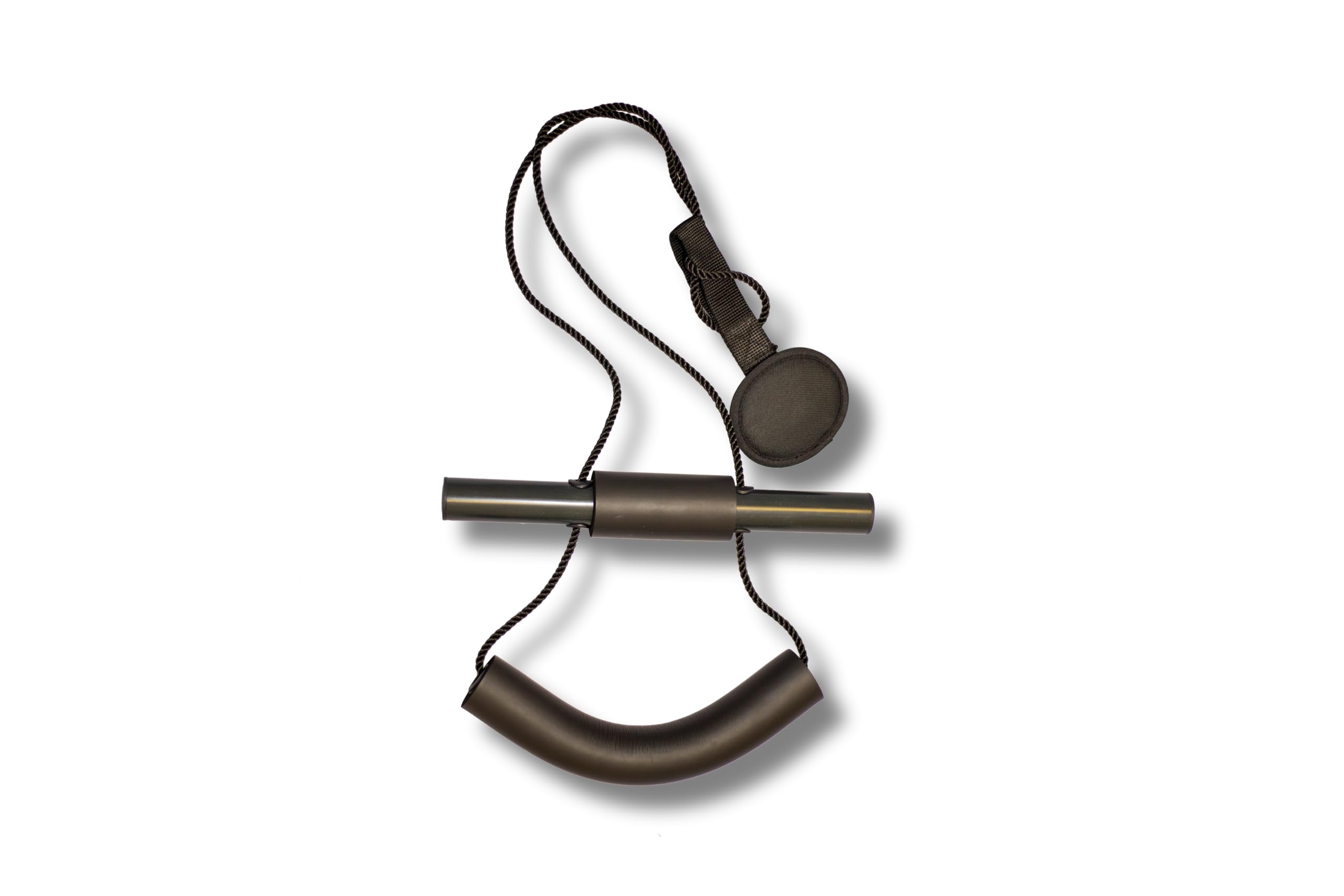
The quick answer: if you want the pull of a clinic session at home and you want your jaw left alone, the Pettibon over-door traction device is the one to start with. It hangs on a standard-height door, you squat into the pull, and your own body weight does the stretching. No chin strap digging into your teeth, no electric pump to fail, no battery to recharge. The rest of this list covers the air collars, memory-foam pillows and hand-pump stretchers that solve the same problem in different ways — and the trade-offs that decide which one actually suits your neck.
This guide is built by comparing the manufacturers’ published specifications and the patterns across verified customer reviews, so you get each pick’s real strengths and trade-offs instead of marketing spin.
Most people buy a decompression device after months of stiffness, so the deciding factors are fit and how you control the pull. This breakdown of the best cervical decompression device covers the exact pull limits, height ranges and neck circumferences each pick is built around.
Top Picks
How To Choose The Best Cervical Decompression Device
The first thing to settle is what you actually want the device to do. A traction device actively pulls your neck upward and apart to take load off the vertebrae. A shaped memory-foam pillow instead holds your head in a supported position while you sleep, so the work happens passively over eight hours. They are not interchangeable, and plenty of buyers order the wrong type. Decide between active stretching and overnight support before you look at any other spec.
How the pull is generated
Decompression force comes from one of four sources: your body weight leaning against an over-door frame, a hand bulb you squeeze yourself, a side knob you crank, or an electric pump. Body weight gives you a strong pull with zero parts that can break. A hand pump lets you add pressure in small steps and stop the second anything feels wrong. An electric pump is the easiest on your hands but is the one extra component that can stop working. Choose the source that matches how much fiddling you are willing to do each day.
Fit numbers to check before ordering
Collar-style devices sit on your shoulders and lift under your jaw and skull, so they either fit your neck or they do not. Look for a stated height range and a stated neck circumference. The air-collar pick here lists a height range of 3.2 to 4.7 inches and a neck circumference of 13.7 to 16.8 inches, and the maker notes it is not recommended for thicker necks. If your neck falls outside those figures, a collar is the wrong shape for you and an over-door or hand-pump stretcher is the safer buy.
Session length and how often
These devices are built for short, repeated sessions, not one long stretch. Start lighter than you think you need and work up as your neck tolerates it. A few minutes a day, used consistently, is the pattern the manufacturers and reviewers describe again and again. Skip the heroic single session.
Jaw pressure and breathing room
Traditional traction uses a chin strap that cradles your jaw. Some buyers end up with sore teeth or heavy jaw pressure from that design. Look for a device that lifts under the skull or supports the forehead instead, so your jaw stays free and you can breathe and talk normally while you stretch.
Side-by-Side Comparison
| Model | Best For | Type | Force Source | Stated Fit / Size | Amazon |
|---|---|---|---|---|---|
| Authentic Pettibon System Portable Cervical Neck Traction★ Best Overall | Best Overall | Over-door traction | Body weight squat | Height adjustable | Amazon |
| Cervical Neck Pillow by DorefoxMost Adjustable | Adjustable overnight support | Memory-foam pillow | None (passive) | 22.19″L x 13.68″W | Amazon |
| HighBeds Cervical Neck Pillow | Cooling side-sleeper pillow | Memory-foam pillow | None (passive) | 3.74″ & 4.33″ heights | Amazon |
| Neck Traction Device by Air Collar | Desk-side manual collar | Wearable collar | Side knobs + air bladder | Up to 20 lbs pressure | Amazon |
| Cervical Neck Traction Device with Electric Air Pump | Touchscreen electric stretch | Wearable collar | Electric air pump | 13.7–16.8″ circumference | Amazon |
| CALLIXE Original TheraPillow | Heat and vibration combo | Powered pillow | Traction + heat + vibration | 19″L x 17″W x 7″H | Amazon |
| Posture Pump 1400-D Dual Disc Hydrator | Neck and upper back together | Hand-pump stretcher | Hand pump, two air cells | 1 lb, no assembly | Amazon |
Detailed Reviews
1. Pettibon System Portable Cervical Neck Traction
Our pick — 4.5+★ from 400+ verified ratings; the strongest balance of quality and price.
Two and a half pounds of padded bar that turns a doorway into a traction frame.
The Pettibon hangs a padded, rigid curved neckbar over a standard-height door, and you set the pull by squatting against it with your own body weight. That means the force is entirely in your hands — you can back off instantly by standing up. It sets up in six steps with the included fabric doorstop, and the bar is height adjustable to accommodate any user. At 2.5 pounds it packs into a bag for work or travel, which is more than most traction hardware can claim.
What wins people over is that it feels like the clinic version rather than a home imitation. Buyers report the same squat-and-hold routine they learned at a chiropractor’s office, and the relief that follows: “I had a stiff neck for years. This really helps relieve the tightness.” Posture Pro says chiropractors have used this system in their clinics for over 30 years, and this is the original rather than a copy. The maker frames it around restoring the natural curve of the neck through cycles of compression and traction.
The catch is the learning curve and the guidance. The honest consensus is that starting too hard is a mistake — go light until you find a pain-free stretch, and wash your face first, because skin oils make the bar slip. Some buyers also find the neck portion sits thick or catches a rubber smell out of the pack. It rewards patience rather than promising a five-minute fix.
Where it earns its keep
- Pull is set by your own squat, so you control the intensity — good for beginners and advanced users alike
- Uses body weight rather than pumps or batteries, so there is no motor or bladder to fail
- Padded yet rigid curved neckbar for supported, comfortable traction
- Height adjustable, sets up in six steps, and travels at 2.5 pounds
What to go in knowing
- Technique matters — too much pull too soon is the recurring complaint
- Skin oils on the bar cause slippage, so a quick wash first helps
- Neck padding runs thick for some head shapes
Reach for this if: you want clinic-style traction at home and you are willing to learn the squat-and-hold routine properly.
Look elsewhere if: you want something you can wear while answering email — an over-door frame needs a door and both hands free.
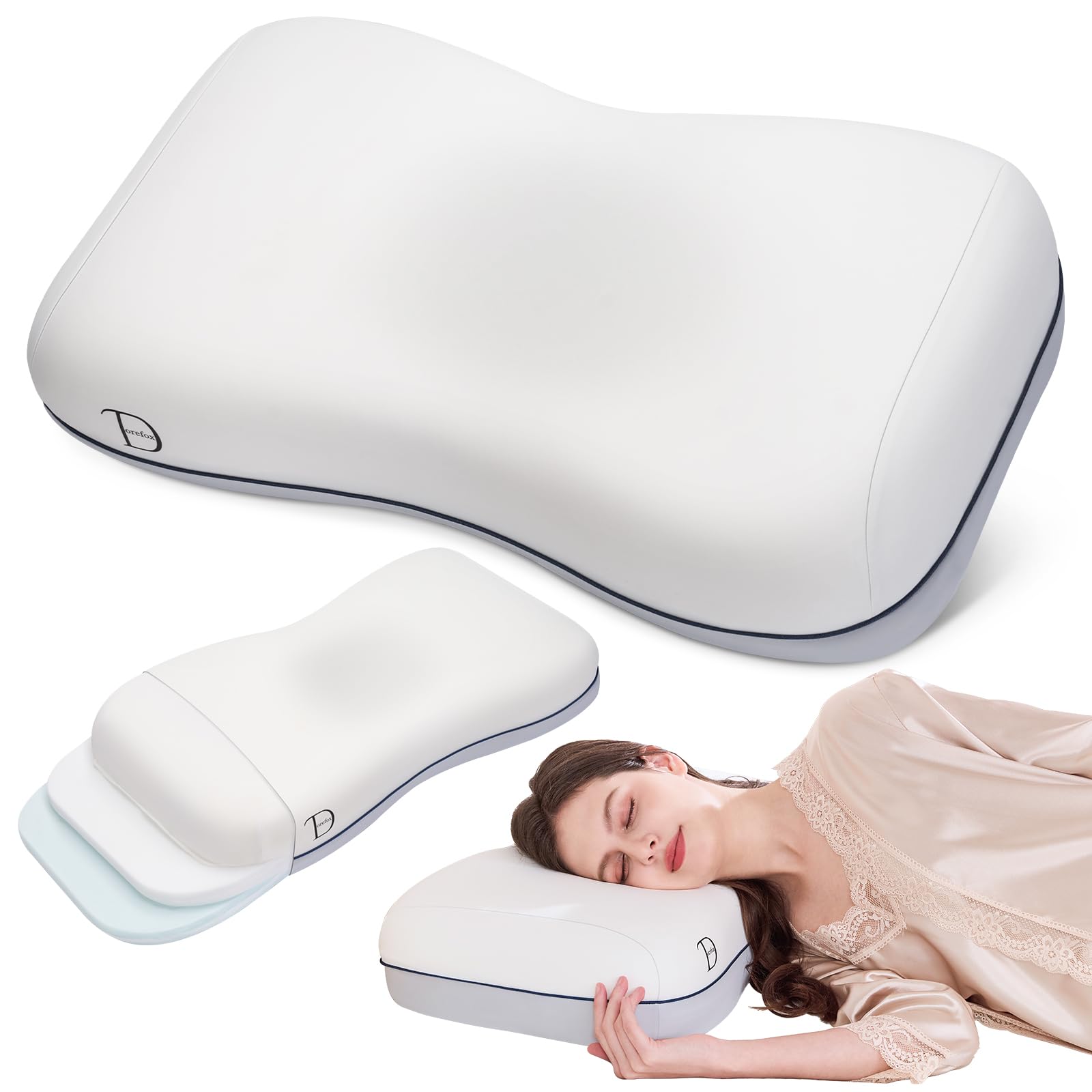
2. Cervical Neck Pillow for Neck & Shoulder Support by Dorefox
Three foam layers you can add or pull out until the loft finally matches your neck.
Dorefox’s approach is customization over brute support. The pillow stacks a patented three-layer memory-foam system with different densities, so you tune both firmness and height — remove layers, combine layers, find your loft. It offers three height options to cover side, back, stomach and combination sleepers. A soft inner cover sits between the layers so they do not tear or stick during all that adjusting, and the machine-washable outer cover mixes nylon and spandex with polyester side panels.
The foam carries CertiPUR-US certification, which is a third-party program for foam content and emissions. That is the kind of paperwork buyers with chemical sensitivity tend to hunt for. The pillow measures 22.19 inches by 13.68 inches and stands 4.25 inches tall at full stack.
Here is the honest limit: this is a support pillow, not a traction device. It will not pull your vertebrae apart the way an over-door frame or an air collar will. And the adjustable design cuts both ways — the removable layers suit tinkerers and frustrate people who want the pillow to be right on night one. Some sleepers find the medium-firm foam too rigid and end up fiddling with layer combinations that leave their neck at an awkward angle. Those looking for a firm pull should look at the Pettibon or the Posture Pump. Those who want overnight curve support without hardware should start here.
The real draw: three firmness and height combinations in one pillow is more flexibility than most cervical pillows offer, and the inner cover means the layers survive repeated changes.
Set expectations on: expect a break-in period. The foam is medium-firm and the layers take some trial and error, so give it a week before you judge.
Best for: sleepers who toss between positions and want to dial in loft rather than accept one fixed shape.
Think twice if: you want active decompression — this supports your curve, it does not stretch it.
3. HighBeds Cervical Neck Pillow for Side Sleepers
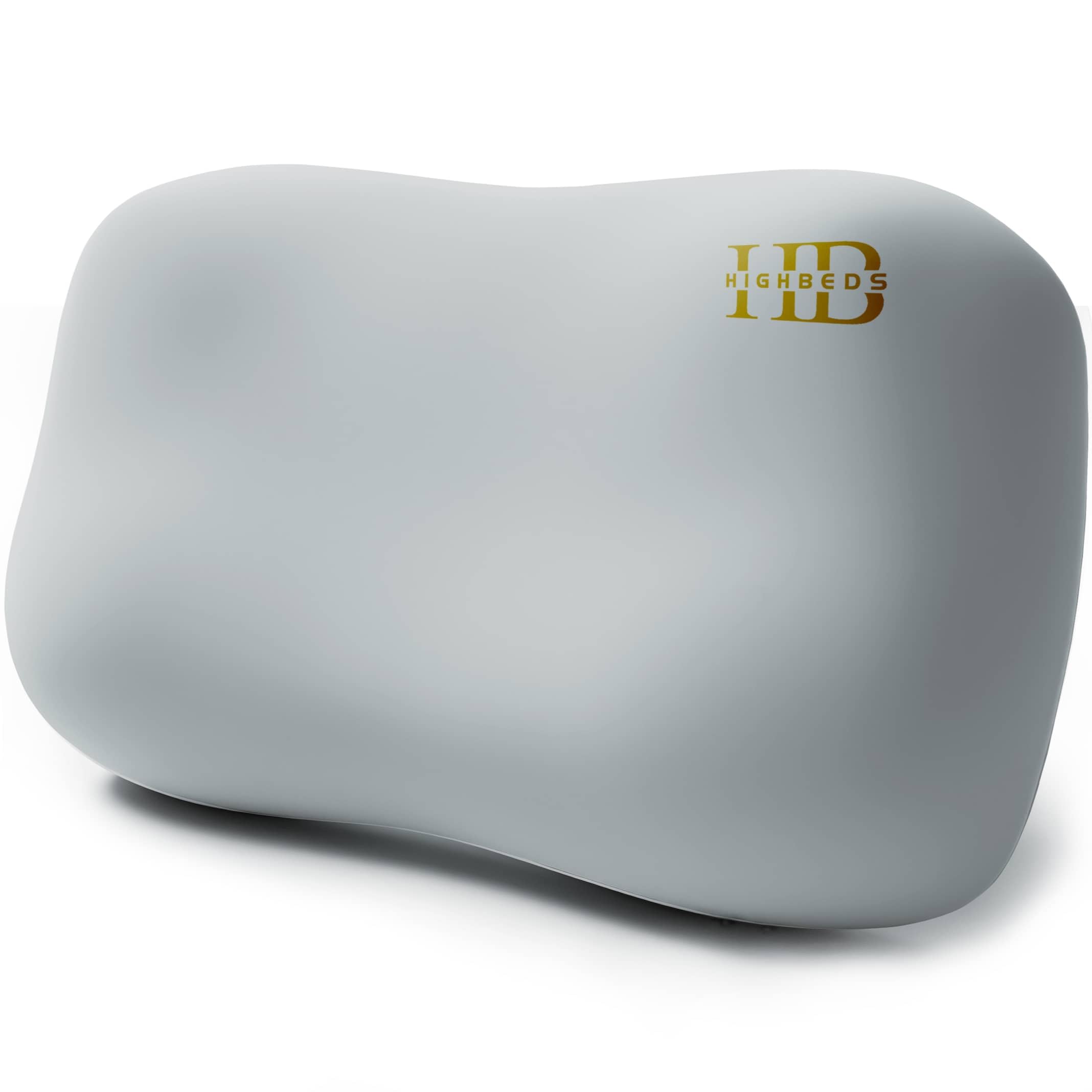
A pillow that stays cold through the night and gives you two heights to choose from.
HighBeds builds this around a dual-height design — 3.74 inches on the low side and 4.33 inches on the high side. The lower profile suits petite frames and side sleepers, and the taller side supports broad shoulders and back sleepers. A zipperless ice-silk cover keeps the pillowcase from digging in, and BASF’s temperature-responsive gel keeps the surface cool rather than letting it turn into a heat trap. At 3.3 pounds it is not a travel pillow, but it stays put on the bed and holds its shape.
The thing everyone raves about is the cooling. Warm sleepers who normally flip to find the cold side of a pillow find they stop flipping entirely with this one. The maker says the smart-support foam rebounds at 60% and firms to 92% within 10 seconds, so your head sinks in and then locks into place. The manufacturer states the foam lost just 3% of its height across 80,000 compression tests and meets OEKO-TEX Standard 100 plus CertiPUR-US certification.
The recurring gripe is not the pillow but the fit. The firmness is softer than some buyers expect, and a few find neither height lands at the right spot for their neck — one describes waking with a back ache while the neck felt stable. That is a body-shape mismatch, not a build problem. If you are between the two heights and cannot decide, the Dorefox above lets you add and remove foam layers instead.
What buyers talk up
- Gel-infused surface runs cool, so hot sleepers stop flipping for the cold side
- Two heights (3.74″ and 4.33″) cover side and back sleepers in one pillow
- Fabric stays cool without a zipper digging into your cheek
- The maker says the foam resists sagging far longer than standard memory foam
Honest caveats
- Firmer than the word “soft” suggests — not for sleepers who want a plush feel
- Neither height may suit a neck that falls between the two profiles
- It is a sleep-support pillow, not a stretching tool
Made for: hot side sleepers who want cooling and a shaped neck channel instead of a flat pillow.
Not the one if: you are looking for traction force — this holds your head in position, it does not pull.
4. Neck Traction Device by Air Collar — 2nd Gen Manual

A collar you wear at the desk that cranks up to 20 lbs of pull.
This is the wearable option. The Air Collar sits on your chest and shoulders, and you turn the precision knobs on the left and right sides to dial in traction strength up to 20 lbs of pressure. A rear air bladder lifts your cervical spine with vertical air columns, and the ergonomic frame uses memory foam with a removable chin pad that cleans easily. It is soft, breathable and light enough to wear during a work session instead of only on a mat.
What it does well is fit in your routine. Because you wear it, you can sit at a desk for a few minutes and stretch rather than block out a whole session. The build quality draws consistent praise, and the effectiveness of the design lands on a majority of buyers. One desk worker with a C6-7 pinched nerve used it daily for several minutes and credited repeated use with relaxing the neck.
Start with the honest limit: this collar either fits your neck or it does not. A man over six feet tall found it did not extend enough, and a buyer of average build at five foot nine reported the same shortfall even cranked fully up. There is no size chart field in the listing to check against, so measure before you order. The rear knob is also awkward to reach, and the chin pad can press hard on the jaw. If those sound like deal-breakers, the Posture Pump below lifts under the forehead instead and avoids the jaw entirely.
Why it works for desk days: the side knobs and the air bladder let you add pull in small increments, and you can wear the collar while you work rather than setting aside a block of time.
The fit question: height is a real constraint here. If you have a larger neck, look at the over-door or hand-pump stretchers instead of a collar.
Suits: office workers who want minutes-a-day neck stretching they can do at the desk.
Not ideal for: larger necks or anyone whose jaw needs to stay free of pressure.
5. Cervical Neck Traction Device with Electric Air Pump
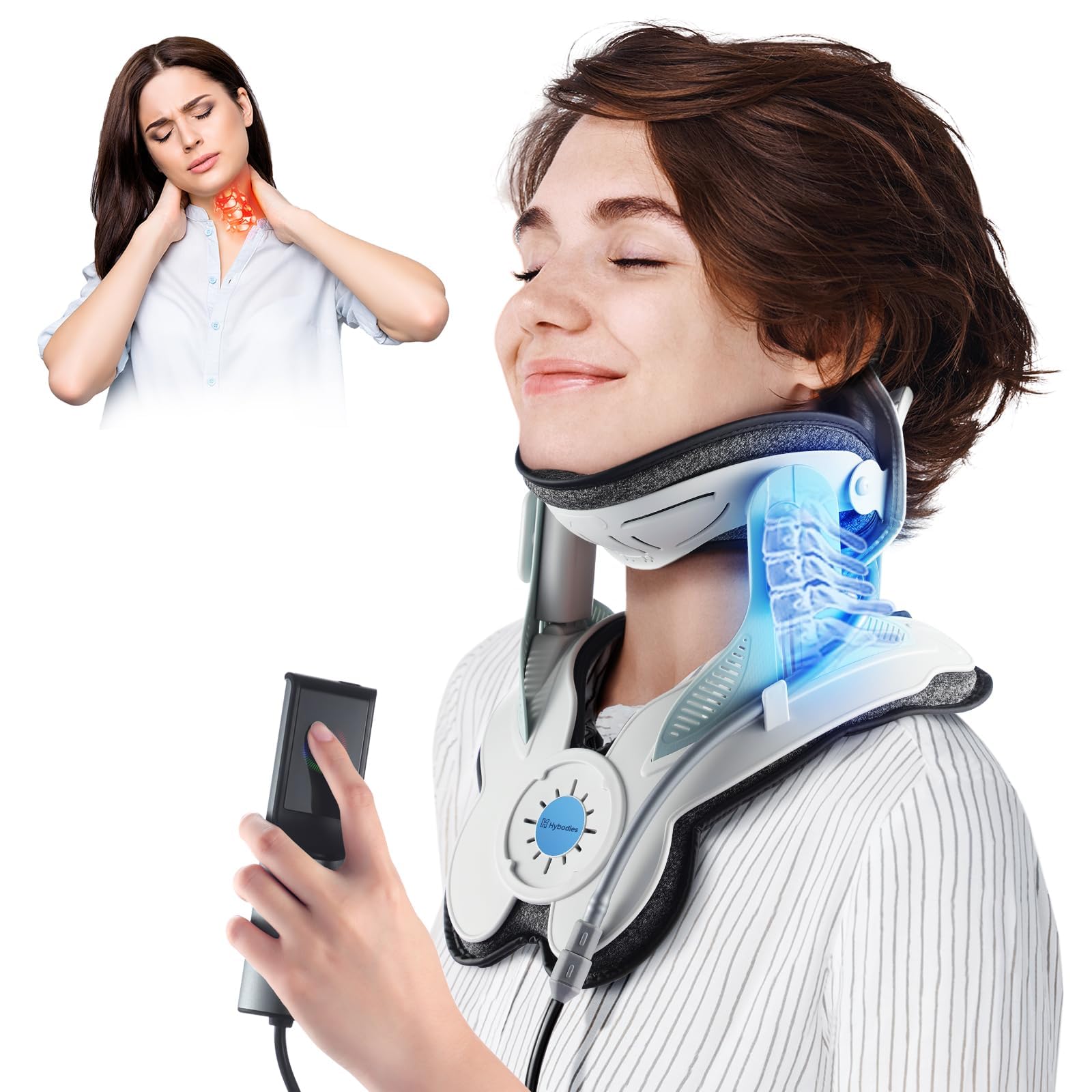
Touch a screen and eight airbags lift your skull off your shoulders.
This one replaces the hand pump with electronics. A built-in lithium-ion battery powers an electric air pump that inflates eight rear air columns at a constant speed when you touch the LCD screen. Those columns are shaped to mimic the 20-degree curvature of the cervical spine, so the lift is even on both sides. Two side knobs also turn 180 degrees to push the cervical synchronously. It weighs 2.2 pounds, and the chin pad is open enough that your throat stays free — you can breathe and speak while it stretches.
Effectiveness is what carries this device. Buyers describe the rear-bladder lift as taking pressure off the base of the neck, and several credit consistent use with real change over weeks rather than days. A hairdresser with years of bending and twisting booked immediate relief on the first use. One owner sums up the ceiling of any of these devices: “It’s not a quick fix—consistent, long-term use is what really delivers the results.”
Before you order, check the two numbers the maker puts right in the listing: the height range is 3.2 to 4.7 inches and the neck circumference is 13.7 to 16.8 inches. The maker states plainly that it is not recommended for thicker necks. A handful of buyers found exactly that — the breast and shoulder plate does not one-size-fits-all every body. And a few say the pull is not enough for their physiology, which makes it a poor match for anyone who needs a hard stretch.
What makes it easy to live with
- LCD touchscreen inflates at a constant speed, so the pull builds smoothly rather than jerkily
- Eight rear air columns leave your throat untouched, so you can breathe and talk normally
- Two side knobs turn 180 degrees to keep the lift even on both sides
- Rechargeable battery and 2.2-pound body make it usable away from an outlet
The fit check you must do
- Built around a 13.7–16.8 inch neck circumference — too small for thicker necks
- The shoulder plate does not suit every body type
- Some buyers find the pull too gentle for their needs
Go for it when: you want electric, hands-free inflation and your neck circumference lands inside the stated range.
Pass if: you have a thicker neck or you need a firm, aggressive pull to feel anything.
6. CALLIXE Original TheraPillow 3-in-1 Neck Massager
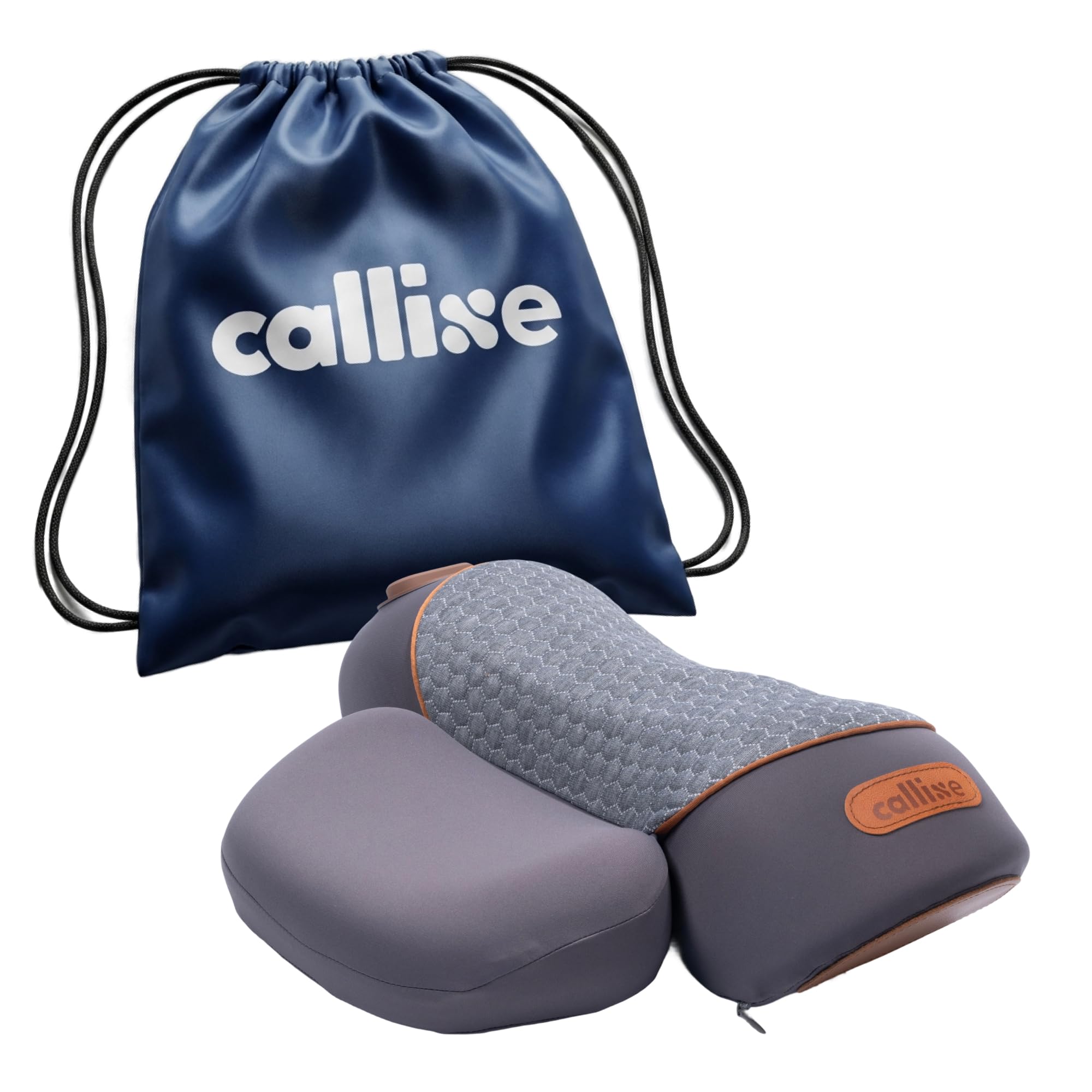
Traction, warmth and vibration folded into one wireless pillow.
This is the comfort-first entry on the list. It combines gentle cervical traction at a 26-degree lift angle with steady warmth and vibration massage modes, all in a memory-foam pillow measuring 19 by 17 by 7 inches. The massage runs through rhythmic pulse patterns, pumping cycles and a continuous hum. It is fully wireless, charged by USB-C with a 90-minute charge time, and it shuts off automatically for safety. Think of it as a maintenance tool between adjustments rather than a clinical stretcher.
People who sit at a desk all day tend to be the ones it clicks with. The traction eases forward-head posture from screen and phone use, and the warmth loosens the trap muscles. A hairstylist of many years called it a neck-saver. The best way to run it is the combined cycle that stacks vibration, heat and traction at once — the individual modes are less convincing on their own.
The honest catch is the battery and the heat. The charge is the most-discussed shortcoming, with some units needing a top-up before each session, and the heat runs on the mild side or, on the other end, too warm for some. Vibration intensity is not adjustable. Give it a rest between sessions and plug it back in. If you want a reliable pull with no charging at all, a manual device above is a safer bet.
The comfort angle: the 26-degree traction lift combined with warmth is a softer, more spa-like stretch than a collar or frame.
The charge reality: plan on recharging before each session. This is the one pick where a dead battery changes your plan.
Pick this for: desk-worker tension you want to unwind with warmth and vibration, not a heavy clinical stretch.
Look elsewhere if: you need a strong, dependable pull you do not have to charge.
7. Posture Pump 1400-D Dual Disc Hydrator

One hand pump that works the neck and the upper back in a single session.
The 1400-D’s advantage is coverage. Two angled air cells decompress and stretch the neck and the upper back together, encouraging the natural curve of the cervical spine. You work the included hand pump yourself, so you set the pressure and the pace. A Comfort Visor rests on your forehead instead of clamping your chin, so nothing pulls on your jaw. It weighs 1 pound, needs no assembly, and is made in the USA by Posture Pro, which says it has sold over 3 million Posture Pump units.
Pain relief is what this one is known for. Buyers describe years of neck, shoulder and arm trouble easing with about 15 minutes a day, and the effect building cumulatively rather than in one session. The build is real — an engineer buyer specifically praised the injection-molded fiberglass frame and the pump, air bags and valves as high-quality rather than cheap. This is the pick if your trouble sits at the base of the neck and between the shoulder blades, an area a neck-only collar never reaches.
The honest trade-off is the fit and the money. A buyer at five foot eleven and 170 pounds found the frame pressed like hard plastic and aggravated the pain, so this is a device that rewards a test-drive period. And value is genuinely contested — some buyers feel the cost is justified by years of use, others balk at the asking figure for what is essentially molded plastic and rubber. If budget is tight, the Pettibon above delivers body-weight traction for less.
Why people keep using it
- Two air cells cover neck and upper back, not just the cervical spine
- Hand pump lets you set the pressure and pace yourself
- Comfort Visor takes the pull on your forehead, not your jaw
- 1 pound, no assembly, made in the USA from a durable fiberglass frame
What to watch for
- Fit is body-dependent — a taller, heavier frame may find it presses rather than supports
- Value draws mixed feeling given the materials
- Needs about 15 minutes a day, used consistently, to deliver
Best for: buyers whose pain sits at the neck and upper back together, who want manual control and no batteries.
skip it if: you are on a tight budget or you want a device you can try fast and return if the frame does not fit.
Know the Specs
Traction Force (in lbs or body weight)
Traction force is simply how hard the device pulls your skull upward to take load off the vertebrae. Air-collar devices state it in pounds of pressure — the Air Collar tops out at 20 lbs. Over-door and hand-pump devices do not quote a number because your body weight or your own pumping sets the pull. The rule for every type is the same: start light and build. The strong reviews come from people who used short, gentle sessions daily, not one hard session.
Neck Circumference and Height Range
For any collar-style device, these two numbers decide whether it fits or fails. The electric air-pump pick lists a height range of 3.2 to 4.7 inches and a neck circumference of 13.7 to 16.8 inches, and the maker notes it suits thinner necks. If you are outside that window, a collar will feel loose, too tight, or too short to lift properly. Over-door and hand-pump stretchers are not built around circumference in the same way, which makes them the safer pick for larger frames.
Pillow Height and Firmness Layers
For the passive memory-foam picks, height and firmness matter in place of traction force. A dual-height pillow gives you two fixed profiles — HighBeds offers 3.74 inches and 4.33 inches. A removable-layer pillow like the Dorefox lets you add or pull foam to fine-tune both loft and firmness. Neither stretches your neck. Both hold your head in a supported position so the curve is maintained overnight, which is the gentler half of the decompression picture.
Heat, Vibration and Cooling
The powered picks add comfort features that do not stretch but do help muscles let go. The TheraPillow pairs warmth and vibration with its traction and runs wireless on USB-C. The HighBeds pillow uses gel-infused foam to stay cool rather than warm. Decide which direction you want — warmth that loosens, or cooling that lets you stay asleep — because no single device here does both.
Common Questions
How long should I use a cervical decompression device each session?
Will a traction collar fit a larger neck?
What is the difference between a decompression device and a cervical pillow?
Do these devices pull on my jaw or my skull?
Can I use a traction device while working at my desk?
How long until I notice results from neck traction?
Is traction better than going to a chiropractor?
Why does my traction device need a charge or a recharge each time?
Should I sleep on my cervical pillow every night?
Is a two-cell device worth it over a single-cell stretcher?
The Bottom Line
For most people, the cervical decompression device to start with is the Pettibon over-door traction device — because body weight gives you a real, controllable pull with nothing to charge and nothing to break. If your pain reaches into the upper back and you want one hand pump for both, the Posture Pump 1400-D covers the neck and shoulders together. And if you want a device that sits on your desk and inflates with a touch, the electric air-pump collar is the easiest way to fit neck stretching into a workday.
Whatever you choose, start light and use it daily. These tools reward patience — the change comes over weeks, not in one session — and that is the single thing every long-term owner agrees on.
How we choose
We do not accept paid placement. Every pick is matched to a real buyer and a real use-case; we do not hands-on test units.
Sources
Specifications: manufacturer listings and product documentation. Review insights: verified customer reviews, as of October 2026. Pricing: not shown on this page (it changes often); check the current price via the retailer link.
As an Amazon Associate, Aappliancez earns from qualifying purchases. This does not affect which products we feature.