Disclosure: Some links in this post are affiliate links. As an Amazon Associate I earn from qualifying purchases, at no extra cost to you. Learn more
Specs are compiled from manufacturer listings and verified buyer reviews and can change over time — please confirm the key details on the product page before buying.
Clean PRP depends on one thing most listings bury: whether the spin force and the rotor adaptors (the holders that grip your tubes) match the tubes you already buy. Every pick below reaches the low-speed range PRP work needs, so the real difference is tube fit, memory programs, and how steady the base sits when the rotor gets going. The top pick holds the highest score here at 4.5+ stars across 50+ ratings, and it does the whole job with 6-tube capacity and a maximum of 2600xg (xg is the spin force, the push that separates the layers).
This guide is built by comparing the manufacturers’ published specifications and the patterns across verified customer reviews, so you get each pick’s real strengths and trade-offs instead of marketing spin.
You will see how rotor adaptors decide whether your 15ml tubes even spin, which timers make repeat protocols easy, and where a swing-out rotor beats a fixed-angle one. Every pick here is a bench machine built for separating plasma, so the choice is about fit rather than raw muscle — the right centrifuge for PRP is simply the one that matches your tubes and your protocol.
Top Picks


How To Choose The Best Centrifuge for PRP
The machine itself is simple: a rotor spins your tubes fast enough to push heavier red cells outward and leave the lighter plasma and platelets where you want them. What separates a good PRP centrifuge from a frustrating one is whether it fits the tubes in your drawer, holds its speed without shaking across the bench, and lets you repeat the same spin tomorrow.
Match the rotor to the tubes you already use
Every machine here ships with a fixed rotor and a set of adaptors (the small sleeves that let one rotor hold different tube sizes). A 6-tube rotor may hold 15ml, 10ml, 7ml, and 1.5-5ml sizes only if the adaptors for each are included. Check your actual tube size against the listed capacity before you buy — buying a 15ml machine when your protocol uses 10ml vacuum tubes means a wasted order.
Read the g-force, not just the RPM
RPM counts how many turns the rotor makes per minute; RCF (relative centrifugal force, measured in ×g) is the actual force pressing your sample down. Two machines can spin at the same RPM and still separate differently if their rotor radius differs. PRP protocols are usually written in g-force, so a machine that displays both RPM and RCF lets you follow a protocol directly without converting anything yourself.
Decide how much hands-off repeatability you need
Memory programs save a speed-and-time combination so the next spin is one button press instead of a fresh setup. Two programs cover a standard double-spin PRP protocol well. Nine programs suit a clinic running several different protocols across different tube types. More programs mean less chance of a human error between runs.
Side-by-Side Comparison
| Model | Best For | Speed Range | Max RCF | Tube Capacity | Amazon |
|---|---|---|---|---|---|
| ONiLAB Lab PRP Centrifuge 6X15ml★ Best Overall | Mixed tube sizes | 300-5000rpm | 2600xg | 6 tubes (15/10/7/1.5-5ml) | Amazon |
| ONiLAB Lab PRP Centrifuge DM0506Also Great | Everyday PRP prep | 300-5000rpm | 2600xg | 6 tubes (15/10/7/1.5-5ml) | Amazon |
| Cekegon PRP Centrifuge CK-0506Budget Entry | Budget bench entry | 300-5000rpm | 2600xg | 6 tubes (5/7/10/15ml) | Amazon |
| CGOLDENWALL Benchtop Centrifuge | Smaller 8-tube runs | 100-4000rpm | 1880xg | 8 × 15ml | Amazon |
| LAB FISH LC-6S | Highest spin force | 500-5000rpm | 3074 xg | 6 tubes (10/15ml or 2/5/10ml) | Amazon |
| JOANLAB LC-12S | Batch blood tubes | 500-4000rpm | 2220 xg | 12 tubes (5/15ml) | Amazon |
| JOANLAB LC-8S | Mixed-size batches | 500-5000rpm | 3074 xg | 8 tubes (2/5/10/15ml) | Amazon |
| LABHOUSE LC500-8 | Saved protocols | 500-4000rpm | 1967×g | 8 tubes (15/10ml or 2-5/10ml) | Amazon |
| ONiLAB Swing-Out Low Speed | Gentlest layer separation | 100-3500rpm | 2260×g | 12×10ml + 12×15ml | Amazon |
Detailed Reviews
1. ONiLAB Lab PRP Centrifuge 6X15ml
Our pick — 4.5+★ from 150+ verified ratings; the strongest balance of quality and price.
The same six-tube ONiLAB platform, now seasoned by years of bench duty and owner feedback.
This is the earlier version of the number-one pick, and it runs the identical core recipe: 300-5000rpm, a maximum 2600xg, and a fixed rotor that takes 15ml, 10ml, 7ml, and 1.5-5ml tubes, six at a time. Where it differs is the control layout — programs are set with a knob and held in P1 and P2, so the stored speed and time come back the moment you power on.
Owners come back to the same two strengths: the separation works, and the machine is not fussy to run. The performance side carries the most agreement — the plasma layer comes out clean run after run, which is exactly what you want from a machine doing PRP prep. Ease of use trails just behind, and the repeated point is that PRF and PRP prep stop feeling like a chore once P1 and P2 are set. It also carries CE, cTUVus, and FCC safety markings, plus a maintenance-free brushless DC motor.
The one caveat worth knowing before you buy: this machine has a service history behind it, and a unit can give out after long use. The single most-quoted complaint on the listing is a machine that stopped working after about a year of regular spinning — worth factoring in if you run it daily and need absolute uptime. Set against that, the noise figure stays at ≤56dB and the door interlock releases automatically after each run, so the daily ritual is smooth while the unit is healthy.
What it gets right: a fully proven six-tube rotor across four tube sizes, stored P1/P2 programs, an overspeed detector, and a lid that will not open until the rotor stops.
What to plan for: long-term reliability is the question mark — if this is the only machine in your workflow, a spare or a warranty check makes sense before you lean on it daily.
Fits best: anyone who wants a dial-driven ONiLAB with a long track record and does not mind the same tube-size list as the top pick.
Worth knowing: the lid lockout and auto-release come standard, but a dead unit after heavy yearly use is the honest risk in the reviews.
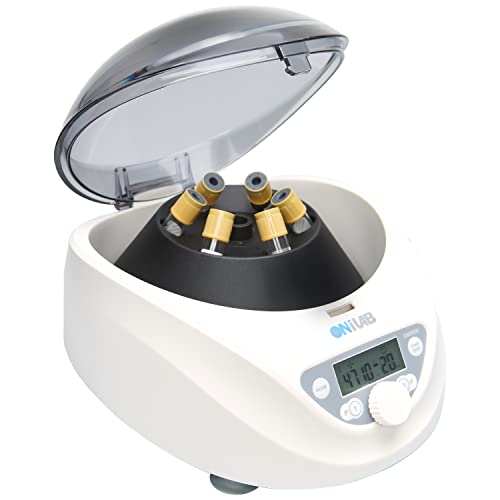
2. ONiLAB Lab PRP Centrifuge DM0506
The bench machine that covers every tube size you already own without a single adaptor order.
If your PRP workflow runs on a mix of 15ml, 10ml, 7ml, and 1.5-5ml tubes, this is the one to start with. The fixed-angle rotor with its adaptors holds up to six tubes across all four sizes, so you are not buying a second machine the day your tube supplier changes. It spins at 300-5000rpm and reaches a maximum 2600xg, which covers the low-speed range most plasma protocols call for.
What wins people over is how little thinking the machine asks for. The display shows speed in either RPM (revolutions per minute) or g-force, so you can follow a protocol written in xg without doing the math yourself. Two program keys, P1 and P2, store a speed-and-time combination and run it on one button press the next morning. The timer runs from 30 seconds to 99 minutes or continuous mode, and the run ends with a sound alert and a lid that open up itself — you are not standing over it watching for the rotor to stop.
The trade-off: tube flexibility rests entirely on the included adaptors, and no other sizes are listed. ONiLAB states plainly that the rotor fits 15/10/7/1.5-5ml sizes, and nothing else is listed — so a protocol using an odd tube size needs checking before you commit. The other thing to weigh: the base is cast iron with vacuum suction feet, and the machine weighs 11.4 pounds, so it stays put on the bench. That same weight means it is a bench fixture, not something you tuck into a bag for off-site work.
What earns its spot at number one
- Four tube sizes (15ml, 10ml, 7ml, 1.5-5ml) in one six-place rotor — no adaptor shopping later
- Switches the display between RPM and g-force so protocols in xg are followed directly
- Two stored programs plus a self-locking lid that releases automatically after each run
- Noise capped at ≤56dB — quiet enough to sit beside a workbench without shouting over it
- Overspeed detector and automatic self-test at power-on guard each spin
Where it asks something of you
- Tube fit is limited to the four listed sizes — check a non-standard tube before ordering
- At 11.4 pounds with suction feet, it is a fixed bench machine rather than a portable one
Reach for this if: your rack holds different tube sizes and you want one machine to handle all of them with saved programs.
Think twice if: your whole protocol sits on one tube size — a simpler single-size rotor may suit you just as well.
3. Cekegon PRP Centrifuge Machine 6x15mL
Six tubes, two saved programs, and a weighted base that keeps the spin steady in tight spaces.
For a first bench centrifuge, the Cekegon keeps the essentials and drops the extras. You set speed (300-5000rpm), centrifugal force (2600xg), and time (30 seconds to 99 minutes, or continuous), then store your favourite combination in P1 or P2 for one-press repeats. It handles 5ml, 7ml, 10ml, and 15ml tubes with the included adaptors — four sizes from a single rotor.
The build details are where the value shows. A weighted base holds the unit still in field environments, so it does not wander across the bench mid-spin. A brushless DC motor keeps it quiet at ≤56dB, and the LCD shows real-time control so you can watch the numbers rather than guess. The lockable lid opens by itself once the rotor has stopped, and an overspeed detector cuts in if the spin gets out of range.
At 13.57 pounds it is lighter than the 19.58-pound LABHOUSE LC500-8 and heavier than the ONiLAB DM0506, so it sits mid-pack on weight. It is not a travel unit. The Cekegon is a solid entry bench for PRP prep, with P1/P2 memory and four tube sizes but no features you will never touch.
Go for it if: you want a straightforward six-tube machine with P1/P2 memory and adaptors for four tube sizes.
skip it if: you need a portable unit — the weighted base is there to keep it planted, not to travel.
4. CGOLDENWALL Centrifuge Machine 8x15ml
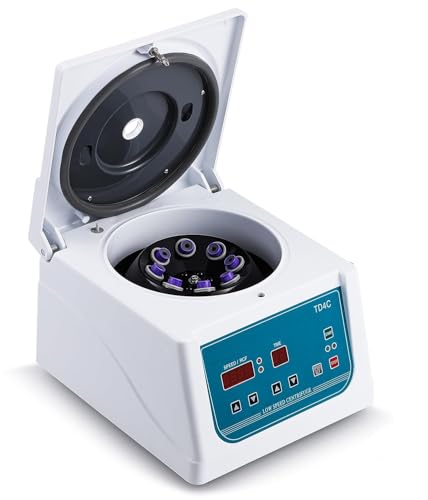
The slower-spinning eight-tube option for smaller runs where a gentle force is enough.
Not every PRP protocol needs maximum force. The CGOLDENWALL tops out at 1880xg and 4000rpm (revolutions per minute), which is well short of the 2600xg other machines here reach — but for simpler separations on 5-10ml vacuum collection tubes or 10-15ml centrifuge tubes, that gentler ceiling is more than enough. Eight tube slots let you spin a small batch in one go rather than two rounds.
The timer is the thoughtful part: you can set it anywhere from 1 to 99 minutes or run continuously, and the countdown only starts once the machine has reached your set speed. That last detail matters because it means your actual spin time is honest — the machine is not quietly burning seconds while it ramps up. The LED display adjusts time, speed, and RCF, and the lid lock holds the rotor closed while also cutting down noise and air resistance, kept to 65dB.
Here is the trade-off a buyer should weigh: the lower 1880xg ceiling and the 65dB noise figure both sit below the faster machines on this list. If your protocol is written around a stronger g-force, this one will not reach it. For routine hospital-lab qualitative work such as urea and biochemical analysis, 1880xg is enough, and eight tube slots mean fewer spins per shift.
The honest verdict: a steady, well-timed eight-place machine for teams who value consistent short runs over raw spin force, with a timer that only counts once the rotor is up to speed.
Best for: smaller-batch separations where gentler g-force and an honest timer are the priorities.
Not for: protocols written around a stronger g-force — this machine’s 1880xg ceiling will not reach them.
5. LAB FISH LC-6S Centrifuge, 6×2/5/10/15ml Tubes

The one that builds the most force on this entire list, with an aluminum rotor to take it.
Speed is where the LAB FISH makes its case. It spins from 500-5000rpm and reaches a maximum relative centrifugal force of 3074 xg — well above the CGOLDENWALL’s 1880xg and ahead of the ONiLAB’s 2600xg. If you have ever had a sample that needed a heavier spin to drive the separation clean, the extra force is exactly what you want.
The control side is friendly: an LCD display adjusts time and speed directly, timing runs from 10 seconds to 99 minutes 59 seconds, and a Short-Spin button gives you an instant burst of centrifugation while you hold it. The fixed-angle rotor is aluminum alloy and takes 6 × 10ml/15ml centrifuge tubes or 6 × 2/5/10ml vacuum collection tubes. The maker is direct that you should not buy this for other tube sizes if you are unsure whether they fit — a useful warning.
Its one hard limit is reliability over the long haul. A one-year limited warranty is the stated coverage, and the roughest report on the listing is a machine that failed just past the year mark. At 14.3 pounds with a secure electronic lock and auto-opening lid, it is built like the other bench units here — the question is simply whether the extra spin force is worth the fact that the service history shows a machine can eventually quit.
Standout strengths
- 3074 xg at 500-5000rpm — the highest spin force in this lineup
- Short-Spin function for quick pulses without setting a timer
- Aluminum alloy fixed-angle rotor with auto-opening lid
Trade-offs to accept
- The rotor fits only the listed 2/5/10/15ml tube sizes
- The manufacturer’s own warranty is a one-year period, so plan for a unit that eventually wears out
Pick it when: you need the hardest spin here and your tubes are on the approved list of sizes.
Look elsewhere when: your protocol relies on non-standard tubes — the maker warns against using other sizes.
6. JOANLAB LC-12S Centrifuge, 12×5/10ml Tubes

Twelve tubes at once, so a full rack goes through in a single quiet pass.
The LC-12S answers a very specific problem: too many tubes for one spin. Its built-in aluminum alloy rotor holds 12 tubes of 5ml or 15ml — twice the six-tube machines on this list — so a busy clinic clears a full patient rack without breaking the runs into two. It spins 500-4000rpm and reaches a maximum relative centrifugal force of 2220 xg, and a brushless motor keeps things steady.
The control panel is built for quick work: the LED display sets spin time from 10 seconds to 99 minutes 59 seconds and speed in one place, and the Short-Spin (Quick Sep) button drops an instant centrifugation in without any setup. The intelligent electronic lid lock opens itself when the cycle finishes, and a malfunction alarm sounds if anything goes wrong.
The service story is where this model has room to prove itself. Owner experience suggests the quiet, steady performance is the draw, and the after-sales record is the standout: when a panel fault knocked a machine out, the seller shipped a replacement to keep the buyer working. A stuck lid is the one recurring complaint — an emergency pulley is there for exactly that. At 14.32 pounds it sits happily on a bench corner.
Why it earns a place: twelve tubes per cycle, a quick Sep button, and a service record that backs up the machine when a fault appears.
Where to be careful: the lid mechanism is the part to watch — keep the emergency pulley reachable and you will not be locked out of your samples.
Make it yours if: volume matters and you want a 12-tube rotor with a strong support story behind it.
Otherwise: a six-tube machine will suit a smaller workflow with less bench space to spare.
7. JOANLAB LC-8S Benchtop Centrifuge, 8×2/5/10/15ml Tubes
The eight-slot sibling that takes four tube sizes without giving up raw spin force.
Where the LC-12S commits to 5ml and 15ml, the LC-8S spreads wider: eight slots for 2ml, 5ml, 10ml, and 15ml tubes, all from one aluminum alloy rotor. Speed runs 500-5000rpm and force reaches 3074 xg — the same top-end muscle as the LAB FISH, but across eight mixed-size positions instead of six. That combination of spin and size flexibility is what makes it a strong bench all-rounder.
It shares its operating logic with its bigger sibling: an LED display handles time (10 seconds to 99 minutes 59 seconds) and speed, and the Short-Spin button gives an instant burst without setup. The electronic lid lock opens itself at the end of each cycle and a malfunction alarm flags trouble. A brushless motor drives the rotor, and the quiet, steady running is the most-praised quality in owner feedback.
The caveat is the same as the LC-12S: the lid button can jam. The lid button can jam, and an emergency pulley is fitted so you can open the machine when it does. It is a rare annoyance rather than a pattern, but on a daily-use machine it is worth knowing before you buy. If a jammed lid would throw your protocol off, keep the emergency pulley within reach so you can clear it and finish the run.
Take this one if: your tubes span several sizes and you want 3074 xg of spin across eight of them.
Look at the LC-12S instead if: your rack is all standard 5ml or 15ml tubes and you need twelve slots.
8. LABHOUSE LC500-8 PRP PRF Centrifuge
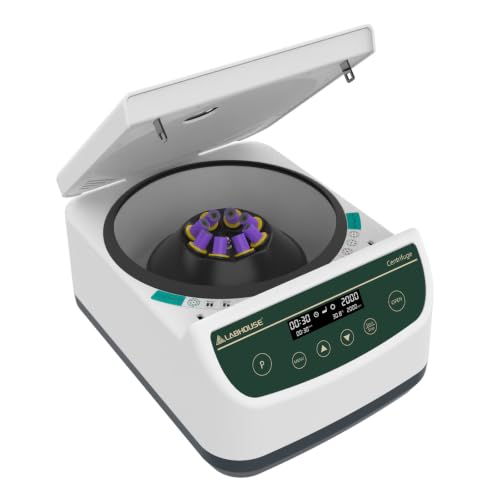
Nine stored speed-and-time programs — the pick for a lab running several protocols a day.
The LC500-8 turns repeatable PRP prep into a memory exercise. Nine custom program slots store a speed-and-time combination each, so a clinic running different protocols across the day recalls the right one in a tap instead of rebuilding it from scratch. It spins 500-4000rpm and delivers up to 1967×g at a claimed high separation accuracy, with a timer that spans 30 seconds to 99 minutes.
Tube capacity is eight: either 15ml/10ml centrifuge tubes or 2-5ml/10ml vacuum tubes, held in an eight-well angular rotor. Two safety systems are aimed at protecting the machine and your samples. A vibration cut-off automatically powers the unit down if vibration crosses a safe threshold — the maker’s own tip is to balance tube solutions symmetrically before every run. And a dedicated chamber ventilation design pulls heat away from the rotor to protect the sample from thermal damage.
The weight is the trade-off to plan for. At 19.58 pounds, this is the heaviest benchtop unit in the eight-tube class on this list — noticeably heavier than the CGOLDENWALL at 14.72 pounds and the Cekegon at 13.57 pounds. That extra mass helps it stay put during high-force spins, but it is not a machine you shift around the bench casually. If the bench space is fixed and the run is daily, the mass is an asset, not a burden.
Where it shines: nine memory programs, a vibration cut-off, and a ventilation design built to keep samples cool make it a well-considered PRP/PRF machine.
Where it weighs on you: nearly twenty pounds on the bench means you pick its spot once and leave it there.
Right for you if: multiple protocols in a day and you want a nine-program memory to keep each run consistent.
Not ideal if: you need to move the machine between rooms — the 19.58-pound body is meant to stay put.
9. ONiLAB Low Speed Centrifuge Swing-Out Rotor
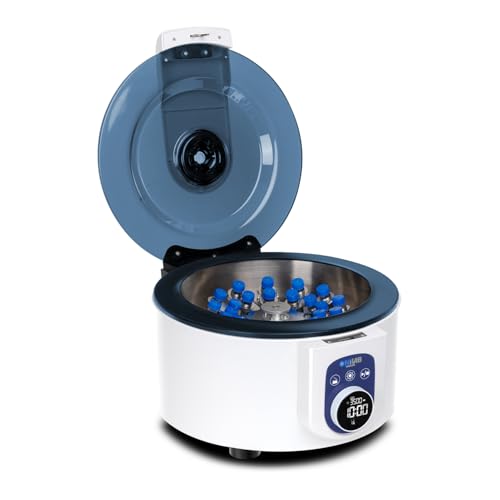
The swing-out rotor that swings tubes flat to keep your plasma layer calm.
Most machines here use a fixed-angle rotor, where tubes sit at a tilt and the separated layer lands at an angle. The ONiLAB swing-out rotor is different: the bucket swings the tubes outward and flat as it spins, so the centrifugal force is applied evenly and the separated layer settles straight across the bottom. The manufacturer’s stated aim is exactly this — minimizing sample disturbance during sedimentation for blood and PRP preparation.
The specs match that gentle brief. Speed runs 100-3500rpm in 100rpm increments, at 170W of power and up to 2260×g of force. A 6-stage braking system lets you pick how hard the rotor slows down, which is where sample disturbance happens most — a lighter brake keeps the layer you just built intact. The rotor holds 12 × 10ml plus 12 × 15ml tubes, so a full rack spins in one pass. Noise is ≤55dB(A), the lowest on this list.
Here is what the high-end build costs you in practice: at 36.9 pounds it is by far the heaviest machine here, and it is clearly intended for a fixed clinical or research bench. A metal rotor, dynamic balancing, reinforced hinges, and a status-diagnostics system for both operator and sample safety round out the package. If your bench has a dedicated spot, the mass is exactly what keeps it steady at speed.
Settle on this if: a swing-out rotor, 6-level braking, and the quietest running here fit a fixed clinical bench.
Steer clear if: you need to stow the machine between sessions — 36.9 pounds is not something you lift daily.
Know the Specs
RPM vs RCF (the ×g figure)
RPM is the count of rotor turns per minute, and RCF is the real force pressing your sample toward the bottom of the tube. Two machines spinning at the same RPM can produce different force if the rotor radius differs, which is why PRP protocols are usually written in ×g. A machine that displays both lets you dial the force directly. The gap matters: the LAB FISH LC-6S tops out at 3074 xg, while the CGOLDENWALL reaches 1880xg — a real difference at the hard end of the spin range.
Fixed-angle vs swing-out rotor
A fixed-angle rotor holds tubes at a tilt, and the separated layer collects along the side wall at an angle. A swing-out rotor swings tubes flat as it spins, so force applies evenly and the layer settles straight — the design the ONiLAB swing-out model uses to reduce sample disturbance during sedimentation. Fixed-angle rotors are more compact and can reach higher g-force. Swing-out rotors hold more tubes and treat the separated layer more gently.
Common Questions
Can a lab centrifuge really prepare PRP, or do I need a dedicated plasma machine?
What is the difference between RPM and RCF on a centrifuge?
Will a 15ml centrifuge fit 10ml tubes?
Do I need a swing-out rotor or a fixed-angle rotor for PRP?
How do I keep a bench centrifuge from vibrating across the surface?
What happens if I open the lid while the rotor is still spinning?
How many tubes can I spin at once for a full clinic rack?
Can I run a centrifuge for continuous mode instead of a timed spin?
What does the ±g figure on the spec sheet actually tell me?
Do I need a spare emergency pulley on a PRP centrifuge?
The Bottom Line
For most people preparing PRP, the centrifuge for prp that fits the widest range of tube sizes and protocols is the ONiLAB DM0506 — it covers four tube sizes, shows both RPM and xg, and stores two program keys so a morning spin is one button away. If your workflow needs the hardest spin, the LAB FISH LC-6S reaches 3074 xg, the highest force on this list. And if your day runs several different protocols, the LABHOUSE LC500-8 stores nine of them and cuts power the moment vibration crosses its threshold. Owner reviews back the ONiLAB machines for daily bench work, with the highest star rating here and repeated praise for clean, steady separation.
How we choose
We do not accept paid placement. Every pick is matched to a real buyer and a real use-case; we do not hands-on test units.
Sources
Specifications: manufacturer listings and product documentation. Review insights: verified customer reviews, as of October 2026. Pricing: not shown on this page (it changes often); check the current price via the retailer link.
As an Amazon Associate, Aappliancez earns from qualifying purchases. This does not affect which products we feature.