Disclosure: Some links in this post are affiliate links. As an Amazon Associate I earn from qualifying purchases, at no extra cost to you. Learn more
Specs are compiled from manufacturer listings and verified buyer reviews and can change over time — please confirm the key details on the product page before buying.
If your ceiling vent hums, whistles, or drops cold air straight onto your face at night, the fix is usually the grille, not the furnace. A ceiling register is the metal or plastic faceplate that covers the hole where conditioned air enters a room. Getting the right one is mostly about two things: measuring the actual duct opening and choosing louvers (the angled slats that direct airflow) you can aim. The best ceiling registers below all do that job without rattling loose or looking like a leftover from the previous owner’s renovation. The Decor Grates ST610W is the crowd favorite — 4.5+ stars across 600+ owners — and it is the cheapest register here.
This guide is built by comparing the manufacturers’ published specifications and the patterns across verified customer reviews, so you get each pick’s real strengths and trade-offs instead of marketing spin.
You will see exactly how each size is measured, which louvers actually redirect air, and where the mounting holes will and will not line up with your existing ceiling cutout. Everything below is here to help you land the best ceiling registers for your rooms on the first order.
Top Picks

How To Choose The Best Ceiling Registers
The single most common mistake with a ceiling register is ordering by the size of the old grille instead of the size of the hole behind it. Every pick on this list uses the duct opening as its listed size, and every one of them is wider than that opening on the outside so the face can overlap the drywall. Get that measurement right and installation is a ten-minute job.
Measure The Hole, Not The Old Faceplate
Pull the old register down and measure the rectangular or round opening in the ceiling itself. A 6×10 register, for example, is made for a 6-inch by 10-inch opening — the Decor Grates ST610W measures 11.5 x 7.5 inches across its face, so it overlaps the cutout on all sides. Ordering by the face size instead of the hole is how people end up with a grille that hangs over the paint line or drops through.
Decide if you need To Aim The Air
A plain grille drops air straight down. A diffuser with individually adjustable blades lets you push that air toward the middle of the room instead of against a wall. If your ceiling vent sits near a wall or above a bed, the adjustable type is worth the extra few dollars. If it is already centered in the room, a fixed-louver register is simpler and cheaper.
Check The Screw-Hole Spacing Before You Drill
Mounting holes are pre-drilled at a fixed spacing, and they do not always match the holes your old register left behind. One Handua buyer measured 9-inch centered holes against an existing 8.5-inch centered pattern and had to drill fresh holes in the wall. Hold the new grille up to the old holes before you commit — it saves patching drywall later.
Look At The Damper Box Material
The damper is the flap behind the grille that opens and closes the airflow. Metal damper boxes rust and seize over time, which is why Decor Grates builds theirs from high-impact plastic. Plastic dampers stay smooth to open and close and do not corrode in a humid ceiling cavity.
Side-by-Side Comparison
| Model | Best For | Duct Opening | Outer Face Size | Weight | Amazon |
|---|---|---|---|---|---|
| Decor Grates ST610W Scroll★ Best Overall | Best overall look and fit | 6×10 | 11.5 x 7.5 in | 1.12 lb | Amazon |
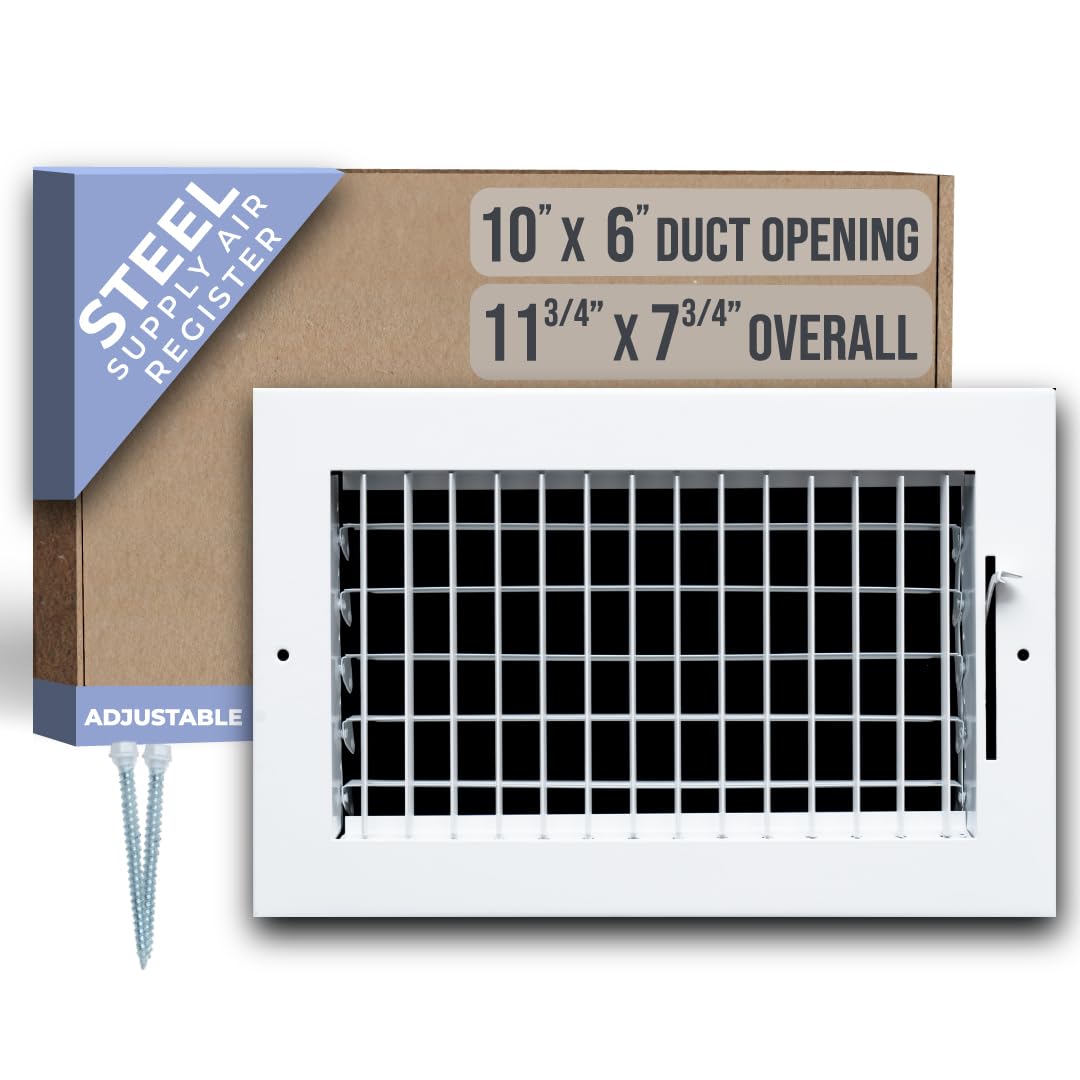
| Handua 10×6 Adjustable SteelBest Adjustable | Aiming air away from a bed or chair | 10×6 | 11.75 x 7.75 in | 1.83 lb | Amazon |
| Decor Grates AJL612W-NKL Oriental | A brushed nickel decorative finish | 6×12 | 13.5 x 7.5 in | 1 lb | Amazon |
| Handua 8×8 Two-Way Diffuser (2 Pack) | Several matching ceiling vents at once | 8×8 | 9.75 x 9.75 in | 3.14 lb (2 pack) | Amazon |
| HVAC Premium 10″ Round Diffuser | A round ceiling vent opening | 10 in round | 14 in diameter | 1.28 lb | Amazon |
Detailed Reviews
1. Decor Grates ST610W Register
Our pick — 4.5+★ from 650+ verified ratings; the strongest balance of quality and price.
The black scroll grille that makes an old ceiling vent look deliberate instead of leftover.
What wins people over here is the appearance — it is the thing this register is known for, and a textured black powder-coat finish is why. A powder coat is a baked-on paint layer, so it reads as a flat matte black rather than a shiny-coated metal plate. It covers a 6-inch by 10-inch duct opening and measures 11.5 x 7.5 inches across the face, so it hides the drywall edge and any paint line you miscut years ago.
Open and close is where cheap registers fall apart, and this one avoids that trap. The damper box behind the faceplate is made from high-impact plastic instead of metal, so it does not rust shut in a humid ceiling cavity the way steel ones do. The tabs slide smoothly, and replacing a 16-year-old broken register with this one is the exact job it was built for — buyers report it fits the old ducts perfectly and stays easy to move open and shut.
Two things to know before you order. At 1.12 pounds it is light enough to mount without drywall anchors, but the included screws have small heads that can pull through the holes if you over-tighten them. And there are no mounting holes on the grille body itself in some installs, which means HVAC air pressure can push a closed vent upward and cause a light rattle — a strip of double-sided tape settles it. Those are small fixes, and the finish earns its keep. The scroll face is the detail that turns a functional hole in the ceiling into something you do not mind looking at.
What Earns Its Place
- Powder-coated textured black finish that reads matte, not glossy
- Plastic damper box will not rust or seize like metal ones
- 11.5 x 7.5-inch face covers a 6×10 duct opening with overlap
- Light 1.12 pounds mounts without drywall anchors
Where It Needs Care
- Included screws have small heads that pull through if over-tightened
- Air pressure can lift a closed vent and cause a light rattle
- Duct interior is visible when the diffuser is removed
Best for: anyone replacing a tired black or dark-finish vent and wanting a flat, matte look that hides the cutout.
Look elsewhere if: your ceiling opening is 6×12 rather than 6×10, or you need a bright white faceplate.
2. Handua 10×6 Steel Air Supply Grille
A ceiling vent you can actually aim, so the cold air misses the bed and hits the room.
The feature that matters here is the louver set. Unlike the fixed scroll face on the Decor Grates above, this grille has vertically adjustable blades you can deflect individually, so you can push air left, right, up, or down. If your vent sits near a wall and half your airflow is bouncing straight back at you, this is the fix. It covers a 10-inch by 6-inch duct opening, and the outer face runs 11.75 x 7.75 inches — 1.75 inches wider than the hole on every side.
At 1.83 pounds it is the heaviest single grille here, and that weight is the steel. The body is stamped powder-coated steel with no sharp edges, and the maker describes it as noise free. Owners mention it looks and installs as well as the name-brand grilles at the big-box stores, and one buyer in a 1,900 sq. ft., 3BR, 2BA townhouse reports the room runs cooler after redirecting the louvers. Customers note the install takes about 60 seconds once the duct opening is measured correctly.
Here is the catch a buyer will hit: the screw holes sit at 9-inch centers, which is wider than the 8.5-inch centers some older drywall cutouts use. Reviewers point out having to drill a new hole in the wall to seat it. Measure your old hole spacing before ordering and this register is a straightforward, well-finished upgrade you can aim in any direction.
The real draw: individually adjustable vertical blades let you direct airflow left, right, up, or down, and the 11.75 x 7.75-inch face overlaps a 10×6 duct opening by 1.75 inches on every side.
Measure twice: the screw holes are set at 9-inch centers, so an existing 8.5-inch hole pattern needs a fresh drill point.
Worth grabbing if: air from your ceiling vent lands where you sit or sleep and you want to redirect it without adding a deflector.
Think twice if: you want to reuse the exact screw holes already in the ceiling.
3. Decor Grates AJL612W-NKL Register

A brushed nickel face that dresses up a high wall vent nobody wants to look at.
This is the register you buy for the finish. The Oriental pattern in brushed nickel is the pull here, and it is what makes it a step above a plain white plate on a wall you actually see. It covers a 6-inch by 12-inch duct opening and measures 13.5 x 7.5 inches across the face — that 13.5-inch span is the widest of the rectangular picks on this list, which matters if your cutout runs long.
It also happens to be the lightest of the group at 1 pound, so it sits flat against the wall without sag. The damper box (the adjustable flap that controls airflow) is made from recycled high-impact polystyrene rather than metal, which is the same anti-rust logic Decor Grates uses across its line. Shoppers say it goes up fast and screws into the ceiling with minimal effort. The brushed nickel finish takes paint cleanly if you want to match a trim color — a cabinet roller covered it in two passes with no touch-ups. Buyers report it mounts about 66 inches up a wall and looks like a major upgrade over the old cover.
The honest limit is the fit. The vent mechanism needs a true 6-inch by 12-inch rectangular opening, and owners mention a slightly tight fit into older ductwork that had drifted out of square. Measure the hole itself, not the old faceplate, and check that the corners are genuinely square before you order.
Choose this when: the vent is up high on a visible wall and you want a nickel finish that looks intentional.
Pass it over if: your ceiling cutout is not a true 6×12 rectangle, or you need a matte black or plain white face.
4. Handua 2 Pack 8×8 Air Supply Diffuser

Two matched ceiling diffusers in one box, so your hallway and bedroom vents finally match.
If you have more than one ceiling vent to replace, buying them separately is how you end up with two slightly different whites. This pack ships two identical 8-inch by 8-inch two-way diffusers, each with a white powder-coated steel face that measures 9.75 x 9.75 inches across. Two-way louvered fins push air in two directions instead of straight down, which spreads the flow across a room rather than pooling it under one spot.
The thing buyers comment on most is the fit, and the numbers back up why. The face is 1.75 inches wider than the 8×8 opening, so it covers the drywall edge cleanly and screws down snug. The included screws are color-matched white, and customers note the whole thing installs quickly with a clean finished look. The stamped steel has no sharp edges, so you are not slicing a finger while you hold it overhead.
At 3.14 pounds for the pair, each grille is a substantial piece of steel rather than a flimsy plate. The one thing to plan around is the screw-hole placement — a handful of buyers found the pre-drilled holes did not line up with their old ceiling pattern, which is the same story as the single Handua above. Measure the 8×8 opening and the old hole spacing before you order and this two-pack is the tidy way to match a whole floor.
Why two at once: matched white steel faces and color-matched screws give you a consistent look across every 8×8 ceiling vent in the house.
The catch: the factory screw holes may not match an older ceiling cutout, so check spacing before drilling.
Made for: a whole-floor refresh where you have two or more 8×8 ceiling openings to cover and want them uniform.
Not for you if: you only have one vent to replace, or your openings are rectangular rather than square.
5. HVAC Premium 10” Round Steel Ceiling Diffuser, White

A round ceiling diffuser for the circular duct openings the rectangular plates cannot cover.
Round ceiling vents are a different animal from the rectangular registers, and this is the one to reach for when your opening is circular. The listed 10-inch size refers to the duct opening, but the total outer face measures 14 inches in diameter — a full 4 inches wider than the neck. That overlap is what lets the disc sit flush against the ceiling and hide the cut edge of the drywall.
The face is a smooth powder coat that reads glossy and wipes clean, and the whole grille weighs just 1.28 pounds. Reviewers point out it drops into a 9-inch opening, makes the ceiling vent far less noticeable, and leaves airflow unrestricted. The white face and included screws make it a five-minute install in most ceilings.
Two things to know. The grille does not include the valve or key to open and close the vent, so if you want to damper the airflow you need to add that separately — it is not pictured in the description. And the screw holes are pre-drilled at a fixed pattern, so a few installs found them misaligned with the existing ceiling holes. Measure your opening carefully, since one buyer measured the old diffuser instead of the actual hole and ordered the wrong size entirely. Get the measurement right and this disc is the clean, flush answer for a round ceiling vent.
Reach for this if: your ceiling opening is round rather than rectangular, or you want a flush disc that blends into a white ceiling.
One caveat: the open-and-close valve is sold separately, so budget for it if you need to damper the flow.
Know the Specs
Duct Opening Size Versus Outer Face
The listed size on a ceiling register is the hole it fits, not the plate you see. A 6×10 register covers a 6-inch by 10-inch opening, but the ST610W face is 11.5 x 7.5 inches — 1.5 inches wider and 1.5 inches taller than the hole. That overlap is what hides the cut edge in the drywall. Always measure the actual opening in the ceiling, never the old grille, because the old face was wider than the hole too. Order by the hole and the overlap takes care of itself.
Louvers, Diffusers, and Back Dampers
Three features control where the air goes. Louvers are the angled blades that deflect airflow — fixed louvers push it one way, adjustable louvers let you aim it left, right, up, or down. A diffuser is a grille designed to spread air in two or more directions instead of a single straight drop. A back damper is the flap behind the face that opens and closes the flow. Adjustable blades and a back damper are worth having when the vent sits near a wall or over a bed, where straight-down air is uncomfortable.
Damper Box Material
The damper box holds the flap that opens and closes the vent. Steel boxes rust and seize in a humid ceiling cavity, which is why some makers build theirs from high-impact plastic or recycled polystyrene instead. A plastic damper box stays smooth to operate over the years and will not corrode. When you compare registers, check what the box is made from — it is the part that fails first on a cheap grille, long before the face shows wear.
Mounting Holes and Weight
Pre-drilled mounting holes are set at a fixed spacing, and that spacing does not always match the holes your old register left in the wall or ceiling. Screws are usually included and color-matched to the face, but the hole centers are what trip people up — one Handua install needed a fresh hole because the new grille was set at 9-inch centers against 8.5-inch centers already in the wall. Weight tells you how substantial the grille is: lighter plates mount easily overhead, heavier steel plates sit flatter and resist flex.
Common Questions
How do I measure my ceiling vent to order the right register?
Can a ceiling register go on a wall or only in a ceiling?
Why does my ceiling vent rattle when the air kicks on?
What is the difference between a register and a diffuser?
Do the pre-drilled screw holes match my old register?
Can I paint a ceiling register to match my ceiling?
Why do some ceiling registers use a plastic damper box instead of metal?
What size register do I need for a round ceiling opening?
Does a ceiling diffuser come with a valve to close the vent?
The Bottom Line
For most rooms, the ceiling register winner is the Decor Grates ST610W Scroll because it pairs a matte powder-coat face with a plastic damper box that will not rust shut, and it fits a 6×10 opening cleanly. If you want to aim the air away from a bed or chair, grab the Handua 10×6 Adjustable Steel, whose adjustable blades let you push flow side to side. And for a round ceiling vent, the HVAC Premium 10-inch Round Diffuser is the one to reach for.
The honest nudge: measure the hole first, check your old screw-hole spacing second, and the rest sorts itself out. Every pick here is worth buying for the right opening — the only real mistake is ordering by the old faceplate. Match the size to the duct and you will have the best ceiling registers for your house, not someone else’s.
How we choose
We do not accept paid placement. Every pick is matched to a real buyer and a real use-case; we do not hands-on test units.
Sources
Specifications: manufacturer listings and product documentation. Review insights: verified customer reviews, as of October 2026. Pricing: not shown on this page (it changes often); check the current price via the retailer link.
As an Amazon Associate, Aappliancez earns from qualifying purchases. This does not affect which products we feature.