Disclosure: Some links in this post are affiliate links. As an Amazon Associate I earn from qualifying purchases, at no extra cost to you. Learn more
Specs are compiled from manufacturer listings and verified buyer reviews and can change over time — please confirm the key details on the product page before buying.
If you just want your CDs, your radio and your phone playlists to come out of one box that sits on a shelf and sounds good, buy the Panasonic SC-PM270. It is the sensible all-rounder here. Its 20W of stereo output (10W per channel, which means two separate speakers sharing the power evenly) fills a living room or bedroom clearly, and it does not push you through a maze of menus to play a disc. Everything else in this list earns a place by being better at one specific thing — more disc capacity, a battery you can carry outside, a tape deck, or far more power for a big room.
This guide is built by comparing the manufacturers’ published specifications and the patterns across verified customer reviews, so you get each pick’s real strengths and trade-offs instead of marketing spin.
The seven systems below split cleanly into three jobs: a small-room all-in-one, a multi-disc changer for people with a big collection, and a portable unit for the garden or a picnic. The one thing every buyer should check before ordering is whether the built-in speakers are actually included and wired — a handful of these shelves look like complete stereos but ship as a bare head unit. Here is the honest rundown of the cd player with speakers that are actually worth setting up.
Top Picks


How To Choose The Best CD Player With Speakers
Most people shopping this category have the same story: a stack of discs in a cupboard and a phone full of playlists, and they want both out of one unit without a separate amplifier and a nest of speaker cable. The trap is assuming “stereo system” on the box means speakers are in the box. Some of these units are head units with separate bookshelf speakers you wire up yourself; a few are described as full systems but reviewers report one channel dead out of the crate. Read the built-in media list before you commit.
The watt rating, explained without the jargon
RMS watts (the steady, honest power figure, rather than a peak number measured for a split second) is the number to compare. A 20W RMS system like the Panasonic and a 40W RMS boombox like the Greadio are not in the same league for a large room, but in a bedroom or a kitchen the 20W unit will sound clean long before it runs out of headroom. Watts also do not describe tone. A system with a small woofer and a tweeter (a tiny speaker for high frequencies) can sound warmer than a bigger one with a single full-range driver.
Single disc or five-disc changer
A single-slot tray plays one CD at a time — fine if you listen to one album start to finish. A changer holds several discs at once, which matters for audiobook listeners, dance classes, or anyone who wants background music for a whole afternoon without getting up. The Sharp is the multi-disc pick here, holding 5 CDs with MP3 compatibility, and reviewers who own large collections single that feature out.
What else is on the shelf, and what is missing
Check the input list for the thing you need. The Panasonic has Bluetooth and a USB port but no aux-in, no headphone jack, and no optical input — so a turntable or a TV will not connect. If you need a tape deck, only one unit here has one. If you want internet radio (stations streamed over your home Wi-Fi rather than through the air), the Philips is the only system that does it. And if the unit is going outdoors, the rechargeable battery in the Retro portable is the only cordless option in the group.
Where the speakers sit
Two speakers in one cabinet (a true shelf system) means you accept a slightly narrow stereo image — the left and right channels are inches apart. Detachable speakers, like the Greadio’s wooden pair, let you widen the image by placing them either side of a sofa. Built-in is tidier; detachable sounds bigger. Pick by how much space you are willing to give up.
Side-by-Side Comparison
| Model | Best For | Power Output | CD Capacity | Connectivity | Amazon |
|---|---|---|---|---|---|
| Panasonic SC-PM270★ Best Overall | Small rooms and living rooms | 20W (10W+10W) | Single disc | Bluetooth, USB, FM | Amazon |
| Sharp CD-BH350Best For Collectors | Large CD collections | 50W RMS | 5-disc changer | Bluetooth, USB, 3.5mm, FM | Amazon |
| Retro Leather Portable | Garden, picnics, travel | 20W RMS (max) | Single disc | Bluetooth 5.3, USB, AUX, FM | Amazon |
| WISCENT WTB-797 | Vintage looks on a budget | 30W max (2 x 15W) | Single disc, top-loading | Bluetooth, USB, AUX, headphone, FM | Amazon |
| Greadio GB-W18 | CD and cassette combo | 40W RMS | Single disc | Bluetooth 5.1, USB, TF, AUX, FM | Amazon |
| LONPOO LP-816 | Bedrooms and offices | 40W RMS (20W x 2) | Single disc | Bluetooth, USB, AUX, headphone, FM | Amazon |
| Philips TAM8905/37 | Open-plan rooms and streaming | 100W | Single disc | Wi-Fi, Bluetooth, USB, AUX, Spotify | Amazon |
Detailed Reviews
1. Panasonic Compact Stereo System SC-PM270PP-K
Our pick — 4.0+★ from 600+ verified ratings; the strongest balance of quality and price.
One box for disc, radio and phone, with no confusing menu to learn.
This is the pick for someone who wants a stereo on a shelf by the end of the evening, not a weekend project. The numbers behind that: 20W of RMS output split evenly as 10W + 10W across two speakers, plus a 10cm woofer (the driver that handles low bass) and a 6cm tweeter (the small driver that handles high detail) with a bass reflex port — the tuned hole in the cabinet that lets low notes out without a muddy thump. In a living room or bedroom that translates to vocals you can hear over a kettle and bass you feel without the cabinet buzzing.
The connection list is where it earns the top spot. Bluetooth with re-mastering (Panasonic’s own processing that compensates for the detail lost when streaming compresses a track) means a phone playlist does not sound thin next to a CD. A USB port plays music straight off a flash drive, so a whole library fits on a stick and one button starts it. The remote controls everything from across the room, and there is a big volume knob on the front for anyone who would rather not hunt for a button. As buyers put it: “the sound is clear and loud and adjustable, no static and Bluetooth” — and that two-year mark matters, because these units get left on all day.
Where it gives ground: no aux-in, no headphone jack, no optical input. A turntable, a TV or a set of wired headphones will not plug in. The remote also needs a single AA battery that is not in the box, so budget for that on day one. And if you own a 60-disc collection, the single tray will feel slow next to the Sharp below — this plays one disc at a time.
What it gets right
- Two speakers and 20W RMS built in — nothing else to buy or wire
- Bass and Treble buttons plus “My Sound” presets let you tune the tone to the room
- Bluetooth re-mastering keeps streamed tracks from sounding flat next to CDs
- USB flash-drive playback, so an entire library runs off one stick
Where it falls short
- No aux-in, headphone jack or optical input — turntables and TVs cannot connect
- Single-disc tray only
- Remote needs one AA battery, sold separately
Reach for this if… you want one tidy box for CDs, FM and phone streaming in a normal-sized room, and you do not need to plug anything else into it.
Look elsewhere if… your CD collection runs to dozens of discs or you want to hook up a turntable — the Sharp and the Greadio cover those jobs.
2. Sharp CD-BH350 Micro Audio Component System
Load five discs at once and the afternoon plays without you getting up.
Five discs in one tray is the whole reason this one exists on the list. If you have a shelf of albums, a stack of audiobooks, or a dance class that needs ninety minutes of music without a break, this ends the routine of swapping discs every forty minutes. It handles MP3 discs too, so a burned disc packed with files counts as one of the five. What wins people over is the capacity itself — it is the only changer in this group, and the reviews read like relief that anyone still makes one.
The power figure is the biggest here short of the Philips: 50W RMS against the Panasonic’s 20W, which is why this is the unit that fills a kitchen and a living room with sound from a corner. It is also the heaviest at 15 pounds, so plan a shelf that can take that weight and a spot where the disc tray has clearance to open. The 50W also carries a trade-off — the same wattage that gives you volume also reveals a weaker built-in speaker, so do not expect audiophile bass from a shelf box.
The honest caveat is the control scheme rather than the sound. Owners describe a power-on routine that takes more than one press, and a manual that does not spell out that a sequence only needs doing once. Read the instructions properly on day one and most of that frustration disappears. There is also a small number of reports of units that would not power back on after being left off, usually fixed by unplugging and replugging — rare enough to be a bad-luck unit rather than a pattern, but worth knowing if you are buying for someone who will not troubleshoot.
The changer advantage: 5 CDs plus MP3 compatibility in a 15-pound cabinet means a whole afternoon of music without touching the machine — nobody else here does that.
The catch worth naming: the power-on sequence takes a few presses and the manual is thin on explaining it. Set it up yourself before handing it to an older parent.
Best matched to: households with a real disc collection and a room that needs genuine volume.
Think twice if: the unit will be operated by someone who will not read a manual — the multi-press power routine will annoy them daily.
3. Retro Leather Premium Portable CD Player System

The only battery-powered unit here — a leather-wrapped box you can carry to the garden.
Take a portable stereo seriously and it stops being a novelty. This one carries a built-in rechargeable battery charged over Type-C, and the maker states roughly 5-10 hours of playback after a 3-hour Type-C charge — enough for an afternoon in the garden or a picnic with a full album run, with no extension lead trailing across the lawn. At 4.85 pounds it is genuinely liftable in one hand, and the removable carrying strap means it is not a two-trip job.
The sound hardware is more specific than you would expect from a retro shell: a 1-inch silk dome tweeter (a soft-dome high-frequency driver that keeps cymbals from turning harsh) paired with a 3-inch woofer, rated at a maximum 20W RMS. The signal-to-noise ratio is listed at 85 db (the gap between the music and the background hiss, so a higher figure means a quieter floor). Owners describe a small unit that punches above its size, and it is loud — one buyer’s note that it is “very LOUD even on volume level one” is a fair warning if the neighbours are close.
Everything connects: CD, MP3, CD-R and CD-RW discs, Bluetooth 5.3 from a phone or tablet, FM from 87.5 to 108 MHz over a tuning dial, plus USB and a 3.5mm aux input for a turntable or laptop. There is a headphone jack for late-night listening and a resume-point function that picks a disc back up where you left it. The catch is on the desk: the USB port reads FAT32 drives only and will not touch an NTFS-formatted stick. It also wants 2 AAA batteries for the remote, and you get FM only — no AM band.
What earns the carry strap: a 5-10 hour rechargeable battery and a 4.85-pound body turn this into the one system you can move room to room or out the back door without hunting for a socket.
The honest limit: 20W in a plastic-and-leather box will not pressurise a big room the way the Philips does, and the volume dial’s first notch is already loud.
The one to carry: garden listening, picnics, a spare room, or anyone who moves their music between rooms.
Pass on it if: your USB sticks are NTFS-formatted or you need AM radio, because neither will work here.
4. WISCENT WTB-797 Nostalgic Bluetooth Stereo System

A silver front panel and wood veneer cabinet that read as furniture, not electronics.
Two things make this worth a look. The first is the top-loading CD lid — you see the disc go round, and you press it down by hand rather than feeding a tray, which is half the charm of the thing. The second is the finish: a silver metallic front on a wooden veneer cabinet, which is why so many buyers mention how it looks in a room. It plays CD, CD-R/RW and MP3 discs, with 3 repeat modes (one, all, random) and 5 EQ presets — flat, classic, rock, pop and jazz — for shaping the tone.
Power is 2 x 15W, listed as 30W max. In an apartment that is enough, and the reviews describe it doing exactly that: filling a flat with sound without straining. Bluetooth handles phone playlists, USB takes MP3 and WMA files, and 3.5mm aux plus a headphone jack round out the options. FM tuning runs 87.5 to 108 MHz with manual tuning or auto-scan storing up to 30 stations for one-touch recall — but not AM.
Buy it for the look and the format-friendly disc tray, not for tweaking. There is no bass and treble control, so you shape the sound by picking an EQ preset and living with it — one reviewer noted the flat setting was the only sensible one once the bass boost kicked in. The remote is the weaker part of the package; replacements are easy to find, but expect to rely on the buttons on the unit eventually. And if your taste runs to classical music, be aware the reviews call the sound acceptable rather than rich, so audition big orchestral pieces before you commit.
Reasons it earns the shelf
- Silver metallic front and wood veneer cabinet that reads as furniture
- Top-loading lid shows the disc spinning — far easier to load than a slot
- 5 EQ presets and 3 repeat modes give you some control over tone and order
- FM stores up to 30 preset stations for one-touch recall
Trade-offs to accept
- No bass or treble knobs — you get what the preset gives you
- Single disc only, no changer
- The remote is the weakest component and may need replacing
Pick this one when: the stereo has to look good on open shelving and you play a mix of bought CDs and burned MP3 discs.
Skip it when: you want to dial in the bass by hand or you mostly listen to large-scale classical works.
5. Greadio GB-W18 Stereo System

The only unit here with a cassette deck — and it records onto tapes from CD, radio, USB or Bluetooth.
Nine functions in one small box, and one of them is a cassette deck. That single feature makes this the pick for anyone with a shoebox of tapes that never got digitised, and it goes further: you can record to a blank tape from CD, aux, USB, Bluetooth or the radio. If a family member’s voice is on a cassette and you want a second copy, this is the machine that does it. It plays CD, CD-R, CD-RW, MP3 and WMA discs with normal, single-cycle, full-cycle, random and A-B repeat modes.
Power is 40W RMS, split as 30W of bass (15W x 2) and 10W of treble (5W x 2) — a genuinely bass-forward tuning that suits the boombox feel. The speakers are detachable wooden bookshelf units, which means you can widen the stereo image or plug them into a computer and use them separately. Bluetooth 5.1 connects a phone or tablet, and it also transmits — so a private listen through wireless headphones or earbuds works without a cable, which is unusual at this level.
Two things to plan for. It runs on AC only, so there is no battery and no moving it to the garden. And several buyers describe the sound as clear rather than loud — the treble share of the power is modest, so a big open room will feel under-filled even at volume. The cassette deck is also the most delicate mechanism in the box; one report of tapes getting chewed is a reminder to keep your irreplaceable tapes away from it and record onto blanks first.
Why it is here: a working cassette deck with recording from CD, radio, USB or Bluetooth, plus detachable wooden speakers — nothing else in this list touches tapes at all.
The reality check: 5W of treble per channel means modest volume and no cordless use. Treat it as a bedroom or study unit.
The right fit for: cassette collections, recording old tapes to fresh blanks, and small rooms that need a bit of nostalgia.
Not for you if: you want to take music outside — it is mains-only.
6. LONPOO LP-816 40W Bluetooth Stereo System
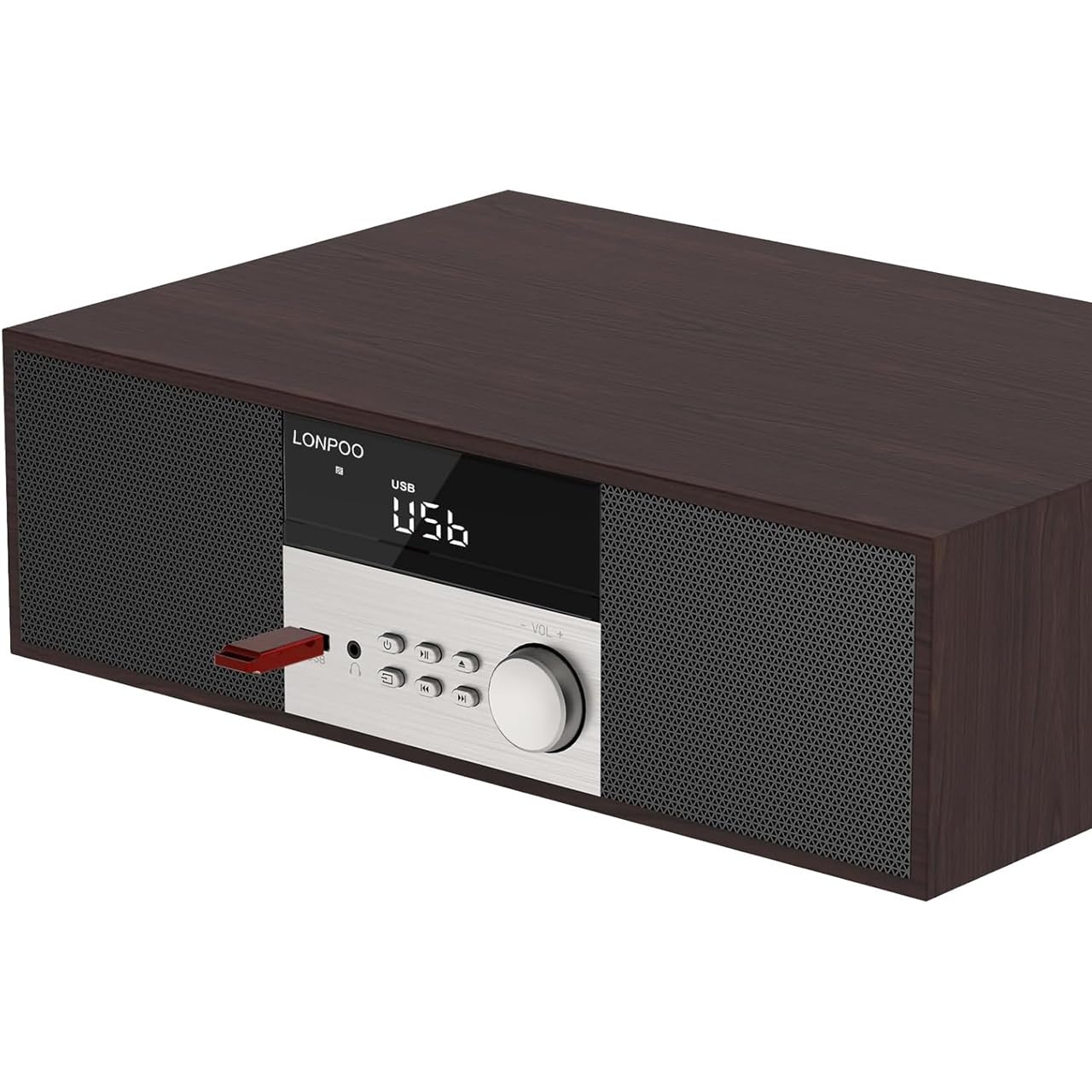
Forty watts of stereo in a cabinet that fits on a bookcase shelf.
The number that sells this one is 40W RMS, delivered as 20W per channel, in a compact black-and-brown cabinet small enough to sit on a bookcase. That is double the Panasonic’s 20W, and it is the reason this fills a bedroom or office with real weight rather than polite background sound. DSP sound technology (digital processing that shapes the signal before it reaches the speakers) does the work of keeping vocals clear while the bass stays present — notably, it holds that bass even at low volume, which is where cheap systems usually collapse into a thin, tinny whisper.
The rest of the list is complete enough for the money. CD, CD-R, CD-RW and MP3 discs all play. FM covers 87.5 to 108 MHz with up to 30 preset stations on a white backlit display you can read across the room. Bluetooth takes a phone or tablet, USB covers flash drives, 3.5mm aux handles an external player, and there is a headphone jack for late-night listening — a combination the Panasonic at the top of this list does not offer.
Two limits to know before you buy. The first is the buttons: six identical keys with faint labels catch people out, and you may need a week to learn which is which. The second is radio reception, which is the most common complaint in this unit’s reviews — a few buyers could not pull in local stations even after extending the antenna. Signal strength is a location problem as much as a hardware one, but if FM is the main reason you are buying, plan for it. Owners also flag that discs sometimes skip until the EQ is set to “Flat”, which is a quick fix once you know it.
The case for it
- 40W RMS as 20W x 2 — the most power per inch here short of the Philips
- Bass stays present at low volume, so quiet listening does not sound thin
- Bluetooth, USB, aux and a headphone jack cover every everyday source
- 30 FM presets on a clear backlit display, all controllable from the remote
What to weigh against it
- Six identical buttons with faint labels take getting used to
- FM reception is the weakest link and the most frequent gripe
- Single-disc tray only
Suits you when: you want the biggest sound from the smallest footprint in a bedroom, office or study.
Choose differently if: you are buying mainly for radio — check reception where it will stand before committing.
7. Philips TAM8905/37 Bluetooth and Wi-Fi Stereo System

Five times the Panasonic’s power, plus internet radio and Spotify without a phone in reach.
100W drives this, across dome tweeters and 5.25-inch woofers with bass-reflex ports — the largest drivers in this guide, and the reason it is the only system here meant for an open-plan living room. Where the Panasonic’s 20W keeps a bedroom comfortable, this is built to push sound across a whole floor. Add wooden speaker cabinets and a matte aluminium central unit and it reads as proper hi-fi on a sideboard rather than a box on a shelf.
The feature that separates it from everything else: Wi-Fi. It connects to your home network for internet radio and Spotify Connect, so your phone becomes a remote rather than the source — you can leave it in another room and the music keeps playing. Bluetooth covers the rest with up to 30 feet of range, and there is still a CD tray, a USB port, aux-in and a headphone jack. The colour display shows album art, artist and track name, and a digital tuner holds FM presets. The frequency response is listed at 50 Hz to 20,000 Hz — it reaches meaningfully lower than a small shelf box can.
Now the part that keeps it from being the top pick. Setup is the biggest split in this unit’s reviews: the internet radio and Wi-Fi configuration defeats some buyers outright, and a few report the internet radio stopping after working initially. Build quality on the details is also lighter than the price implies — thin speaker cables, wobbling plastic knobs, a remote with hidden volume controls. The speakers themselves are the weakest link in the chain; running it through a Hi-Res player lifts the sound well past what the built-in sources deliver. It is a system that rewards someone willing to configure it properly, and frustrates anyone expecting plug-and-play.
Where it stands alone: 100W and 50 Hz – 20,000 Hz from 5.25-inch woofers, with Wi-Fi internet radio and Spotify Connect built in. Nothing else here streams without a phone.
The honest caveat: setup is fiddly and the internet radio is the function most likely to misbehave. Budget an evening with the manual.
Worth it for: a large lounge or open-plan space, and anyone who wants internet radio and Spotify running independently of a phone.
Look elsewhere for: simple plug-and-play use — the Panasonic at the top gets you music in minutes with none of the network setup.
Know the Specs
RMS watts versus peak watts
RMS (root mean square) is the steady power a system can deliver continuously, and it is the only figure worth comparing across brands. Peak or “max” figures describe a momentary burst that no music ever sustains. When a shelf system says 20W RMS, expect it to fill a bedroom or kitchen comfortably; a 40W or 50W unit will stay clean at higher volumes in a larger room. Wattage never tells you tone — a small woofer and tweeter pair can sound warmer than a bigger single driver at the same rating.
Woofer and tweeter, in plain terms
A woofer is the larger driver that moves the low notes; a tweeter is the small one that handles high detail like cymbals and vocals. Systems with both, such as the Panasonic’s 10cm woofer and 6cm tweeter, separate the frequencies so bass does not smear the top end. A bass-reflex port is a tuned opening in the cabinet that reinforces low notes so the box can play deeper without a bigger driver. A single full-range driver, used in simpler boomboxes, is one speaker trying to do both jobs.
Bluetooth re-mastering and DSP
Streaming over Bluetooth compresses the audio, which throws away detail. Bluetooth re-mastering (Panasonic’s term) and DSP processing (digital signal processing, used by LONPOO) both attempt to rebuild some of that lost detail before it reaches the speakers. In practice it means a phone playlist does not sound noticeably thinner than a CD played on the same machine. Neither can add detail that was never there, so a lossless source still wins.
Signal-to-noise ratio and frequency response
Signal-to-noise ratio (SNR) measures the gap between the music and the background hiss, quoted in decibels — the Retro portable lists 85 db, which means a quiet floor between tracks. Frequency response describes the range of notes a system can produce; the Philips covers 50 Hz to 20,000 Hz, with the low figure telling you how deep the bass goes. A higher bottom number means less low-end reach, which is why small portables sound lighter than a floor-standing system.
Common Questions
Do these CD players with speakers come with the speakers included?
Will a CD player with speakers connect to my phone over Bluetooth?
What is the difference between RMS and peak wattage on a shelf stereo?
Can I play MP3 files burned onto a CD-R or CD-RW disc?
How do I connect a turntable or a TV to a stereo system like these?
How long does the battery last on a portable CD player system?
Why does my CD skip until I change the sound setting?
Is a five-disc changer better than a single-disc player?
Why can I only get FM radio and not AM on these systems?
Can I use wireless headphones with a stereo system that has a CD player?
The Bottom Line
For most people, the cd player with speakers that solves the whole problem is the Panasonic SC-PM270 — 20W of clean stereo, a real disc tray, FM and Bluetooth that keeps streamed music sounding full, all in a box you set up in minutes. It carries the group’s highest rating, 4.0+ stars across 600+ owners, earned on sound quality and ease of use rather than a single gimmick.
If your shelf is full of discs, the Sharp CD-BH350 is the only changer in this group, and 50W gives it the headroom for a bigger room. If portability, tapes or vast power are what you need, the Retro portable, the Greadio and the Philips each deliver that one thing better than anything else here — just accept that no single box in this guide does all of it at once.
How we choose
We do not accept paid placement. Every pick is matched to a real buyer and a real use-case; we do not hands-on test units.
Sources
Specifications: manufacturer listings and product documentation. Review insights: verified customer reviews, as of October 2026. Pricing: not shown on this page (it changes often); check the current price via the retailer link.
As an Amazon Associate, Aappliancez earns from qualifying purchases. This does not affect which products we feature.