Disclosure: Some links in this post are affiliate links. As an Amazon Associate I earn from qualifying purchases, at no extra cost to you. Learn more
Specs are compiled from manufacturer listings and verified buyer reviews and can change over time — please confirm the key details on the product page before buying.
Mice do not need a door. A gap the width of a pencil is a hallway to them, and once they find it they will chew it wider or simply walk back through the foam you sprayed last winter. The fix that holds is steel wool packed tight into the opening, since the fibers are too hard to chew through; a pest-block foam sprayed over the wool locks it in place. The five picks below cover both routes, from coarse wool rolls you cut to fit to pest-block foam cans designed to keep rodents from eating the seal itself.
This guide is built by comparing the manufacturers’ published specifications and the patterns across verified customer reviews, so you get each pick’s real strengths and trade-offs instead of marketing spin.
Match the filler to the hole: coarse steel wool for gnawing resistance, pest-block foam for speed and insulation. Knowing which of these five earns a spot in your crawlspace, garage, or siding line is exactly what this roundup of the best caulk for mice is here to settle.
Top Picks

How To Choose The Best Caulk for Mice
The part most people get wrong: ordinary latex caulk does not keep mice out. Mice chew through soft sealants without slowing down, and a bead of silicone in a hairline crack does nothing once the gap behind it is wide enough for a shoulder to fit. What works is a filler the rodent cannot bite through — coarse metal fibers are the classic answer — or a sealant that carries a pest-deterrent additive so the foam itself is unappealing. Many homeowners combine both: wool pushed deep into the void first, then foam sprayed over it to lock the wool in place and stop drafts.
Grit and fiber type decide whether it gets chewed through
Steel wool comes in numbered grades, and for blocking holes you want the coarse end of the scale. A #1 designation (grit number 1) sits near the roughest end, where the individual strands are thick enough to resist being pulled apart. Coarse grades also pack tighter into an irregular crack because the fibers catch on each other instead of sliding through. Fine finishing grades are for polishing woodwork, not for stopping a rodent that is actively chewing.
Coverage math beats a big-sounding roll
What matters is the total usable feet in the box, not the roll count. A 6-roll set listed at 78 feet total gives you roughly double the material of a 4-pack that adds up to 52 feet of coverage, which changes how far one purchase stretches across a whole foundation line. Check the total feet in the listing rather than the roll count, because packaging varies.
Foam-only plans need a pest-block formula
If you would rather spray and be done, choose a can whose label says it contains a pesticide additive. Plain expanding foam is soft and mice chew straight through it. A pest-block formulation is designed so the cured foam resists being eaten away, and you can still paint or sand it once dry. Hold the can upside down if the instructions call for it, and thread the straw adapter on tight — a loose straw is the usual reason a can leaks and plugs itself.
Side-by-Side Comparison
| Model | Best For | Type | Grit / Formula | Count | Amazon |
|---|---|---|---|---|---|
| Steel Wool Mice Control, #1 Coarse, 3.1 inch x 13 ft, 4 Pack★ Best Overall | Cracks, vents, and pipe gaps | Steel wool roll | #1 Very Coarse | 4 Count | Amazon |
| Dap Touch’N Foam Mouse Shield Foam SealantBest for Interiors | Interior gaps you want painted | Pest-block foam | EPA-registered pesticide | 1 Can | Amazon |
| JINGTONG 78 Feet Steel Wool Mice Control (6 Rolls) | Whole-house siding and foundation lines | Steel wool roll | Medium grit | 6 Count | Amazon |
| Kraken Bond Gaps & Cracks Expanding Foam Sealant | Windows, doors, and big cavities | Expanding polyurethane foam | UL certified | 2 Count | Amazon |
| 2 PK Great Stuff Smart Dispenser Pestblock | Reusable touch-ups around crawlspaces | Pest-block polyurethane foam | Expands to 1″ | 2 Count | Amazon |
Detailed Reviews
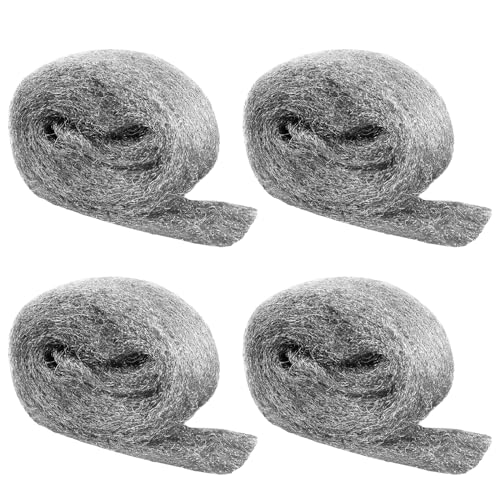
1. Steel Wool Mice Control, #1 Coarse, 3.1 inch x 13 ft, 4 Pack
Our pick — 4.5+★ from 250+ verified ratings; the strongest balance of quality and price.
Coarse enough that mice hit a wall of metal instead of a soft snack.
The grit number is what matters here. Shineboc rates this wool at grit number 1 with a very coarse grit type, meaning thick, grabby strands that jam into a crack and stay there rather than pulling loose. Roll it into a tube, work it into the gap with a screwdriver handle, and the fibers interlock into a plug no rodent is going to chew through. The brand’s own grade range runs from #3 (coarsest) down to #00000 (finest), so this sits well toward the rough end where hole-blocking lives.
You get real distance out of one box. Four rolls at 13 feet each adds up to 52 feet of coverage, which is enough to run a perimeter of vents, pipe penetrations, and foundation sill gaps in one pass. By contrast, the JINGTONG 6-roll set later in this list carries a longer 78 ft total — a 6.0x gap against this pack’s single-roll length and a substantial stretch advantage overall, so if you are lining an entire house exterior, that one goes further. For the common job — a handful of openings around one garage, basement, or crawlspace entry — this four-pack is the cleaner buy.
It is not a one-tool product, and buyers should know that going in. The wool is flexible and bendable, so it shapes to uneven and curved surfaces, and it will also work on woodwork, countertops, and metal as a cleaning and finishing abrasive. Wear gloves while cutting, because the strands bite skin. The recurring gripe is rust — damp crawlspaces will see it discolor and eventually break down, so dry the area first or plan to refresh the plug later.
What earns it first place
- #1 very coarse grit resists gnawing far better than fine grades
- 52 feet across 4 rolls covers a full run of vents and pipe gaps
- Bendable enough to shape into uneven and curved openings
- Doubles as a sanding and polishing abrasive once the job is done
Where it falls short
- Rusts relatively quickly in damp crawlspaces and basements
- Requires gloves — the strands cut bare hands easily
- Needs a secondary sealer if you also want draft and insulation coverage
Reach for this if: you want one box that fills every crack, vent, and pipe gap around a single structure.
Look elsewhere if: the openings sit in a permanently wet space, where the rust issue will shorten how long the plug holds up.
2. Dap Touch’N Foam Mouse Shield
The one foam can here with an EPA-registered pesticide in the formula.
Most spray foam is just a gap filler, and mice treat it like insulation they can chew straight through. This can is different: Dap builds it with an EPA-registered pesticide to protect the cured foam from attack by mice and other pests. That is the whole reason it belongs on a mouse-control list at all. For small interior openings — the weep hole behind a sink cabinet, the gap at a baseboard, the utility penetration in a closet — it fills the void fast and stays sealed.
The working time is short, which suits a quick job. It is tack-free in 15 minutes and fully dry in 4 hours, then paintable and sandable so the repair disappears under a coat of trim paint. It is for interior use only and low odor, so you are not airing the house out afterward. The 12-oz size makes it a one-area can rather than a whole-foundation solution — compare that to the Kraken Bond two-pack, which doubles the can count to 2 at 12 ounces apiece, whereas this ships as a single can. For a couple of problem gaps, one can is plenty.
The honest catch is delivery risk. A can that arrives with foam already leaking and curing can plug the nozzle threads before you ever press the trigger, and a few buyers have hit exactly that. Handle it gently on arrival and check the straw seat. Buyers also mix this with steel wool rather than trusting foam alone — the review pages sum it up: “Foam with steel wool prevents mice chewing through.” Hold the can upside down for best results, and screw the straw adapter on tightly or it leaks at the collar.
Why it makes the cut: the EPA-registered pesticide additive is what separates this from ordinary expanding foam, and the 15-minute tack-free window plus 4-hour full cure keeps a repair moving.
The part to plan around: it is an interior-only, single-can product, and a leaky can in transit can cure and clog the nozzle before first use.
Best for: tight interior gaps in cabinets, baseboards, and utility penetrations you intend to paint over.
Think twice if: you are sealing an exterior foundation line — this is rated for interior use only, so the larger wool and foam sets make more sense there.
3. JINGTONG Steel Wool Mice Control (6 Rolls)
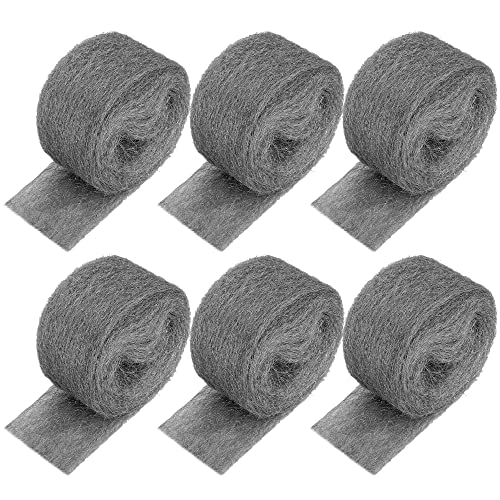
Six rolls and 78 feet of metal fiber — enough to run a whole-house perimeter.
If your job is bigger than one crack, this is the pack that matches the scale. The set carries 6 rolls and 78 feet of total length, against the 4-pack’s 52 feet of coverage — a 50% more gap in material count and a clearly longer run. That difference is exactly what you want when the plan is tucking wool under siding, around a sill plate, and into the gaps between foundations and frames across an entire property line.
What wins people over is simply that it does the job: it blocks the pathway rodents use, and it is soft and flexible enough to cut to size with ordinary scissors for holes and cracks of all shapes. The fibers are packed dense, so a properly stuffed gap becomes a barrier a small animal cannot chew through. It is rated medium grit, which trades a little of the coarse bite for a softer, more compressible fill — handy for irregular cavities where you need the wool to mold to the shape rather than sit stiff.
Two honest limits show up repeatedly. The rolls are thinner than you might expect when unrolled, so pack them tighter than feels necessary — a loose fill leaves channels. And rust resistance draws complaints, meaning any damp location will degrade the wool over time and call for a re-pack. It also demands gloves, and the manufacturer warns to keep it away from pets and children for the same cut risk. One buyer summed the job neatly — “These are a bit thin unrolled but work perfect to tuck under my siding around my entire house.”
The value read: 78 feet across 6 rolls stretches this purchase across far more openings than the smaller wool packs, which is why it suits a full exterior walk rather than a single fix.
Bring this home when: your mouse problem runs along a siding line, foundation, or barn wall and you need enough length to seal all of it.
Leave it on the shelf if: you only have one or two interior gaps — the smaller coarse pack is easier to manage for a job that size.
4. Kraken Bond Gaps & Cracks Expanding Foam Sealant – (2x12oz)
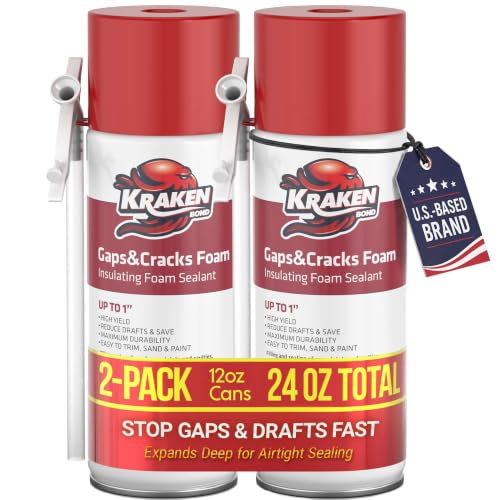
Two big cans of fast, high-expansion foam for the openings wool cannot fill alone.
Where the wool products block a gap, this expanding foam fills the whole cavity. The polyurethane formula is a single-component, moisture-curing aerosol that self-expands as it sets, so a modest squeeze grows to fill window and door frames, large cavities, joints, and wall penetrations. Each can weighs 12 ounces and the pack ships with 2 cans — a 2.0x gap against the single-can Dap Mouse Shield in count terms, giving you double the foam before you need to reorder.
It is also the most credentialed can in this group. Kraken Bond states the sealant is UL certified against safety and performance standards, and the usage guidance is refreshingly specific: bring the can to 68°F before you start, and expect good application anywhere from 41°F to 86°F. In cold weather, let it sit indoors to warm up rather than spraying a chilly can. Note this is plain expanding foam, not a pest-block formula, so pair it with wool in the void if mice are the actual target.
Two things bite first-timers. The foam comes out fast, so a slow hand overshoots — go ready and control the trigger. And the value picture is genuinely mixed: the review pages split between owners who find it works well and owners who report the can clogs and gives up only a trickle before quitting. Adhesion is the other watch point, with foam occasionally falling out of a slick vertical gap. Paintable and sandable once dry, but wear gloves and glasses because the uncured foam sticks hard to skin.
Where it delivers
- Two 12-oz cans — double the count of the single-can Dap option
- Rapid, high-expansion fill for windows, doors, and deep cavities
- UL certified, with a clear 41°F to 86°F working range
- Self-expanding formula reaches into awkward penetrations wool cannot
What to watch
- Diagnosed clogging leaves some cans giving only a small amount of foam
- No pest-deterrent additive — not a stand-alone mouse barrier
- Vertical slick gaps can shed the cured foam, so it needs a backing
Pick this for: sealing broad energy-wasting gaps around window and door frames, then adding wool where rodents test the line.
Skip the assumption that: the foam alone will stop mice — this can is a cavity filler, not a rodent deterrent.
5. 2 PK Great Stuff Smart Dispenser Pestblock

A pest-block can you can set down and pick back up for weeks of follow-up repairs.
The smart dispenser is the feature that earns this a spot. Great Stuff builds this can to be reusable up to 30 days with no drip and less mess, so you can seal one gap, set the can aside, and return weeks later when you find the next entry point. That is a real difference from a single-use foam that hardens in the straw the moment you stop. The Pestblock name points at the pest-deterrent role, and the formula expands to fill, seal, and insulate gaps up to 1″ (25mm) — the light gray color dries indoors as advertised.
It performs best as a partner to metal, not as a solo fix. The experienced take from long-time exclusion work is blunt: foam will not stop a determined rodent on its own, so pack the gap with copper mesh or steel wool first, then foam over it. Owners who did exactly that — wooI sealed in behind the foam — reported scratching noises going quiet and the problem ending. In tight crawlspaces it flows into plumbing penetrations well, though it is sticky and gooey to handle, so bring disposable gloves and clothes you do not care about.
One cosmetic note: the set is gray, and outdoors it cures to a yellow tone rather than staying light gray. It is paintable, so a coat of paint hides it, and the finish holds fine indoors where it dries as described. Two cans at 12 ounces each keep the follow-up work going, and the sealed dispenser means the second can is still usable when the next gap turns up. What it is not is a permanent one-and-done closure for soft foam in a crawlspace — reinforce it and re-check it seasonally.
Why it earns a place: the 30-day reusable Smart Dispenser plus the pest-block buildup makes this the can you keep on a shelf for the next gap you spot, not the one you use up and throw away.
Pair it, don’t trust it alone: back the foam with copper mesh or steel wool, because raw expanding foam is chewable without a metal core.
Suits you if: you are hunting mice entry points over several weekends and want one premium can that survives between visits.
Overkill if: you just need one quick interior seal — a single pest-block can handles that without paying for the reusable dispenser.
Know the Specs
Grit Number and Fiber Grade
Steel wool is sold by grit number, and the number runs the wrong way from what beginners expect: #1 is very coarse, while the fine finishing grades carry more zeros, out to #00000 at the finest end. For blocking animal entry, coarse strands matter because they resist being pulled apart and catch on one another to form a dense plug. Fine grades slide and compress too easily — great for a glossy worktop, useless against a rodent testing the edge of a hole.
Pest-Block Formula
Not every can of spray foam is built to be left alone against mice. A pest-block sealant carries a pesticide additive that keeps the cured foam from being eaten away, and the Dap can here names an EPA-registered pesticide specifically for that protection. Plain expanding foam, like the Kraken Bond can, is a filler and insulator — it is not designed to deter rodents, so it belongs over a wool or mesh backing rather than by itself. Read the label for the pest wording before you count on foam alone.
Coverage Length and Roll Count
A bigger-sounding quantity is not always more material. Compare total feet and roll count rather than a single number: a 4-pack can offer 52 feet of coverage, while a 6-roll set lists 78 feet. The longer set stretches further across a siding line or foundation, but leaves you storing more wool. Match the total length to how many openings you actually have, and keep a little spare for the second gap you always find after the first.
Working Temperature and Cure Time
Foam behaves differently in cold weather. The Kraken Bond can lists an optimal starting temperature of 68°F and an effective application range of 41°F to 86°F, so a can stored in a freezing garage should warm up indoors before use. Cure speed matters too: the Dap Mouse Shield is tack-free in 15 minutes and fully dry in 4 hours, which sets how soon you can paint, sand, or load the sealed area. Warming a chilly can and respecting the cure window are the two easiest ways to avoid a failed seal.
Common Questions
Does steel wool actually stop mice, or do they chew through it?
Can I use spray foam by itself to block mice?
How much steel wool do I need for a whole house perimeter?
Will the steel wool rust and stop working?
How long should I wait before painting or sanding foam sealant?
Why did my foam can arrive clogged or leaking?
Should I warm the can before spraying foam in cold weather?
What gap size can each product realistically fill?
Can I paint the foam once it cures?
The Bottom Line
For most people dealing with mice, the caulk for mice winner is the Steel Wool Mice Control, #1 Coarse, 4 Pack because the very coarse #1 grit and 52 feet of coverage let you jam every crack, vent, and pipe gap tight without paying for more material than you need. If your problem runs along the whole exterior, grab the JINGTONG 78 Feet Steel Wool (6 Rolls) for its longer 78-foot run across six rolls. And for interior gaps you want to paint over, the Dap Touch’N Foam Mouse Shield is the can to reach for, since its EPA-registered pesticide addresses the exact reason plain foam fails — the moment you’re ready, both the coarse wool and the pest-block foam together are what actually ends the problem.
How we choose
We do not accept paid placement. Every pick is matched to a real buyer and a real use-case; we do not hands-on test units.
Sources
Specifications: manufacturer listings and product documentation. Review insights: verified customer reviews, as of October 2026. Pricing: not shown on this page (it changes often); check the current price via the retailer link.
As an Amazon Associate, Aappliancez earns from qualifying purchases. This does not affect which products we feature.