Disclosure: Some links in this post are affiliate links. As an Amazon Associate I earn from qualifying purchases, at no extra cost to you. Learn more
Specs are compiled from manufacturer listings and verified buyer reviews and can change over time — please confirm the key details on the product page before buying.
If rainwater is finding its way past a window frame, the fix usually depends on one thing: the bead of sealant filling the gap between frame and siding. The right exterior caulk flexes with the frame as temperatures swing, resists UV and rain, and stays bonded for years. The wrong one chalks, cracks, and needs redoing by next spring.
This guide is built by comparing the manufacturers’ published specifications and the patterns across verified customer reviews, so you get each pick’s real strengths and trade-offs instead of marketing spin.
Below are five exterior sealants sorted by joint-movement rating, wet-surface adhesion, and UV resistance. The Sashco Lexel leads the pack at 4.7 stars across 1,700+ ratings, and it seals wet surfaces, handles up to 700 percent joint movement, and takes paint. This is the shortlist of caulk for exterior windows that holds up to sun, rain, and seasonal frame movement.
Top Picks

How To Choose The Best Caulk for Exterior Windows
Exterior windows are brutal on sealant. Sun bakes one side, rain hits the other, and the frame itself expands and contracts with every temperature shift. That movement kills cheap caulk: it goes on fine, then splits down the middle after its first winter. Choosing well means matching the formula’s elasticity, adhesion, and UV rating to the joint and the weather it faces.
Movement capability first
Any gap between a window frame and trim or siding will open and close as the seasons turn. A sealant’s joint movement rating tells you how much of that flex it can absorb without tearing. High-elasticity formulas stretch and recover; basic acrylics have very little give. If your gap is wider than a quarter inch or your climate swings hard, pick a sealant rated for high joint movement.
Wet or dry application
Some sealants stick to wet wood, wet concrete, and damp metal — a real advantage when a leak appears mid-storm and you cannot wait days for a dry window. Others need a clean, dry surface. If you’re patching an active leak, check this before you buy.
UV resistance and color stability
The sun is what turns clear silicone yellow and white acrylic chalky. UV-resistant formulas hold their color longer on sun-facing frames. Clear sealants are great for glass and finished trim you want to disappear; white is better where you plan to paint.
Side-by-Side Comparison
| Model | Best For | Full Cure Time | Maximum Gap Fill | Material Type | Amazon |
|---|---|---|---|---|---|
| Sashco Lexel Clear 5 oz Pack of 2★ Best Overall | Wet or dry repairs on tough joints | 7 days | 2 inches | Synthetic Rubber | Amazon |
| Transparent Waterproof Coating Invisible Waterproof SealantBest for Large Repairs | Large-area invisible sealing on masonry | 24-72 hours | — | Rubber | Amazon |
| GE GE500 Clear 2-Pack | Small glass and frame touch-ups | 24 hours | 12.7 millimeters | Silicone | Amazon |
| Flex Caulk Clear 1-Pack | Quick no-gun resealing jobs | 24 hours | — | Hybrid Polymer | Amazon |
| Stanley S501 Acrylic Latex Caulk White – (12×10.1 fl. oz.) | Whole-house trim and frame painting projects | 24 hours | — | Acrylic Latex | Amazon |
Detailed Reviews
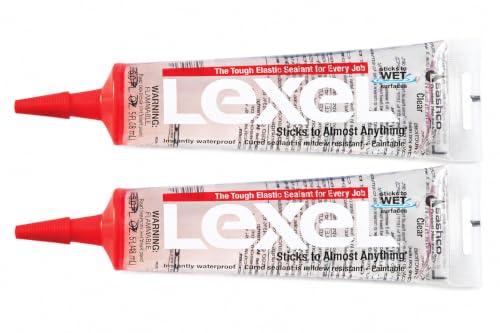
1. Sashco Lexel Clear 5 oz Pack of 2
Our pick — over 4.5★ from 1,500+ verified ratings; the strongest balance of quality and price.
The elastic workhorse that seals a leaking frame even while it is still wet.
The Lexel earns its top spot on the strength of a single number: it handles up to 700 percent joint movement. That means this synthetic-rubber sealant — a flexible rubbery compound rather than a rigid one — stretches as the window frame expands in summer and contracts in winter, then springs back instead of splitting. On an exterior window frame that flexes every season, that elasticity is the whole game. This is the highest-rated pick here at 4.7 stars across 1,700+ ratings.
What really sets Lexel apart is that it grabs wet surfaces. You can apply it to a damp frame, a wet sill, or even a leaking threshold without waiting for a dry day — a real advantage when a storm has just found its way in. It fills gaps up to 2 inches and holds service temperatures from negative 30 to 200 degrees Fahrenheit, so it survives both a deep freeze and a hot sun-facing wall. It starts hardening in 30 minutes and fully cures in 7 days.
The trade-off is a strong solvent smell and fussier cleanup — you’ll want mineral spirits or a citrus degreaser rather than a damp rag. A few owners also note it can be tricky to tool into a perfectly smooth, pretty edge when they use it purely as an adhesive. It is worth knowing that unlike the acrylic latex option further down the list, Lexel is not a soap-and-water cleanup job.
What owners keep raving about
- Handles up to 700% joint movement without cracking, holding tight through seasonal swing
- Sticks to wet or dry surfaces and fills gaps up to 2 inches
- Paintable with latex in 24 to 48 hours, unlike standard silicone
- Resists yellowing better than silicone and stands up to UV on sun-facing frames
Where it asks for patience
- Strong solvent smell and cleanup needs mineral spirits or a citrus degreaser
- Full cure takes 7 days, so plan around the weather
- Hard to tool into a smooth cosmetic edge when used as a pure adhesive
The right call for: anyone patching a leak on a wet sill, a textured frame, or a joint that moves a lot.
Know before you buy: the solvent smell and mineral-spirits cleanup mean you will want ventilation and a dedicated rag.
2. Transparent Waterproof Coating Invisible Waterproof Sealant
A big jug of brush-on clear coating for covering a lot of surface at once.
Where the Lexel is a precision bead, this is a spray-on style liquid you brush across a whole area. It comes in a 16-fluid-ounce bottle with a brush and gloves included, and the math is striking — that is far more volume than the GE silicone tube, which holds 2.8 fluid ounces. If you are treating a broad weathered window band, a wall joint, or several frames in one go, this covers far more ground per bottle.
It is water-based, which means no harsh solvent fumes and easy soap-and-water cleanup, and it dries fully transparent so the repair does not stand out against your trim. The process takes a little diligence: brush it evenly onto a clean, dry surface and build up 2-3 coats, letting each dry to the touch before the next. A proper waterproof layer forms within 24 to 72 hours.
Honesty matters here, because this one is genuinely mixed on the core job. Effectiveness and quality are what buyers praise most, and a sunroof leak that had been causing mildew is the kind of fix people describe — “no more leaks,” as the review pages put it, after three coats. But water resistance draws split feedback, with durability the recurring concern, and a 16-ounce bottle runs low fast if you are covering a large wall. It is not a gap-filler, either — it is for sealing surfaces, not plunging into a deep open joint between a frame and a sill.
Best when you are coating, not filling: this shines across broad surfaces like window bands, concrete, and walls where you want an invisible, odor-free layer and you are patient enough to apply those 2-3 coats. Note the water-based formula means it is less toxic and cleans up with soap and water.
Where it gives you pause: the mixed word on water resistance — some buckets and some leaks hold, others do not — plus the sheer volume its small 16-ounce bottle uses if your project is large. For a deep structural gap, look to the Sashco above instead.
Reach for this if: you want an invisible, low-odor coating for a big, flat exterior surface and you’ll do the multi-coat routine right.
Look elsewhere if: your leak is a wide physical gap that needs a flexible bead, or you need spot-on reliability in one pass.
3. GE GE500 Clear 2-Pack

The pocket-sized squeeze tube you grab for one small glass or frame gap.
GE’s silicone comes as two 2.8-fluid-ounce squeeze tubes you work by hand — no caulk gun, no setup. That is a fraction of the volume in the transparent brush-on coating, but for a hairline gap around one window pane or a spot where the trim meets glass, a full cartridge is overkill. The silicone dries clear, cures in 24 hours, and fills gaps up to 12.7 millimeters (about half an inch), which covers most small window seams.
What wins people over is the long-term pliability. Owners describe tubes staying usable years after opening — a tube several years old set up exactly as it should, and it does not harden inside the nozzle between jobs. As buyers report, it holds fast “even on HOT days,” which speaks to how it behaves on sun-baked glass. The functionality and overall quality are what buyers praise most here.
The catch is shelf life, and it’s a real one to plan around. Shelf life draws mixed feedback, so buy this for a job you are doing soon rather than stashing it in a drawer indefinitely. Prep also matters more than people expect — one owner found that skipping proper surface prep lets pieces pull apart easily, so clean and dry the frame first. And note the tiny 2.8-ounce tubes mean this is a touch-up tool, not a whole-house project.
Suits: anyone fixing a single small pane gap, a glass craft, or a spot seal where a squeeze tube beats a gun.
Think twice if: you are covering a whole window run — the 2.8-ounce tubes run out quickly, and the short shelf life makes stockpiling unwise.
4. Flex Caulk Clear 1-Pack

Squeeze-and-go sealing with a trigger nozzle that sizes the bead for you.
Flex Caulk skips the caulk gun entirely. Its adjustable trigger-flow nozzle lets you squeeze out a bead and dial the width as you go, and a Snap & Save cap seals the tube back up so leftover product does not dry out. For a first-timer nervous about loading a cartridge and controlling a trigger, that removes a lot of the fiddling. It starts hardening in just 10 minutes and cures fully in 24 hours.
The hybrid polymer formula — a blend engineered to grab a wide range of materials — adheres to nearly any surface, wet or dry, and it is UV and chemical resistant. It also stays paintable and, per the maker, will not shrink, crack, or turn brittle, which is what you want on an exterior frame facing sun and rain. A truck owner sealed a windshield leak with a small bead and reported no further water getting into the cab, applied smooth and almost odor-free.
Here is the honest snag: cleanup inside the tube. Because the formula hardens where it sits, scraping out the partly-set product before the next use takes real effort — the one thing people flag as annoying. It is also a single 6.6-ounce tube, so it is built for small-to-medium jobs rather than a full exterior repaint of every window on the house.
The beginner-friendly pick: no gun to buy or fumble with, a nozzle that controls bead width, and a resalable cap that fights waste — plus a 10-minute initial set and 24-hour full cure. That combination makes it the smoothest first-timer option on this list.
Not for long runs: the 6.6-ounce tube is modest, and the hardening-in-tube cleanup grumble means you’ll want to finish the job rather than leave it partly used for weeks.
Pick this if: you want a gun-free, resealable tube with an adjustable nozzle and fast setup, and your job is a window or two.
skip it if: you are sealing a dozen frames at once or you dislike cleaning hardened sealant out of your applicator.
5. Stanley S501 Acrylic Latex Caulk White – (12×10.1 fl. oz.)
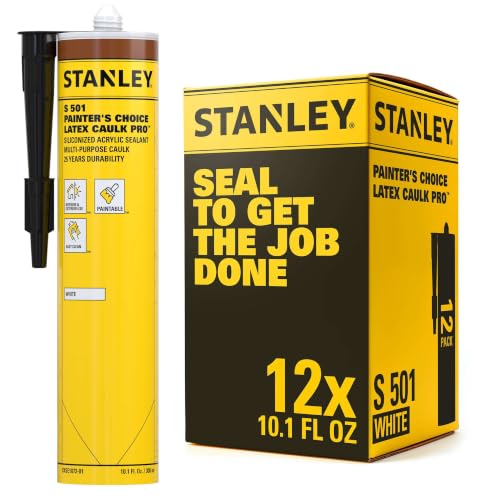
Twelve full cartridges of paintable white latex for tackling every frame at once.
Buy this one when the job is the whole house. You get 12 cartridges at 10.1 fluid ounces each, all in paintable white acrylic latex — a water-based formula that cleans up with soap and water. The white color is the point: it takes paint beautifully for a clean, professional finish on window and door frames and siding joints, so you seal and then paint over it smoothly.
The formulation is an acrylic emulsion reinforced with silicone emulsion — which blends the forgiving, easy-tooling nature of latex with better adhesion and flexibility than plain acrylic alone. It works on wood, concrete, drywall, masonry, and more, and the maker states it is low-odor and solvent-free, which matters for indoor trim work around bedrooms.
Owners mention it dries fast and works as well as any latex caulk they have used. The realistic limit is joint movement: acrylic latex is the least elastic option here, so it is best on stable trim and frame joints rather than gaps that flex hard with the seasons — for those, the 700-percent-flex Sashco above is the stronger fit. It is also white and intended to be painted, so it is not the invisible clear-seal choice for exposed glass.
Why it fits big paint projects
- 12 cartridges at 10.1 fluid ounces each cover a whole-house repaint
- Paintable white finish blends cleanly under topcoat paint
- Cleans up with soap and water, low-odor and solvent-free
- Works across wood, concrete, drywall, masonry, and more
- Fast drying and easy to tool with a standard gun
Where it comes up short
- Acrylic latex is the least elastic pick here — not the choice for hard-flexing joints
- White only, and meant to be painted rather than left as an invisible clear seal
- Requires a caulk gun and proper surface prep to bond well
Built for: the homeowner sealing and painting every window and trim run in one go, who values easy cleanup and a paintable finish.
Pass if: your gap is a hard-flexing exterior joint — the elastic synthetic-rubber pick handles that movement better.
Know the Specs
Joint Movement (Elasticity)
This tells you how much a sealant can stretch and recover as the gap it fills opens and closes. A frame moves with the seasons, and a high-elasticity formula absorbs that flex rather than tearing. Standard acrylic latex has the least give; a synthetic-rubber or hybrid-polymer sealant has far more. Match the elasticity to how much your window joint actually moves.
Cure Time and Hardening
Initial hardening is when the skin forms and it stops running — often inside an hour. Full cure is when it reaches final strength and weather resistance, which can take a day or, for solvent-based formulas, up to 7 days. Plan re-painting or exposure to heavy rain around the full-cure window, not the setup time.
UV and Color Stability
Outdoor sealant faces sun that yellows and chalks lesser formulas. UV resistance (protection from ultraviolet sunlight) keeps clear sealant transparent and white caulk bright over time. Clear formulas disappear against glass and finished trim; white is for joints you intend to paint. Choose based on if you want the seam to vanish or to be painted over.
Wet-Surface Adhesion
Some formulas bond to damp wood, wet concrete, and damp metal; others demand a clean, dry surface. If you are stopping an active leak, wet-surface adhesion lets you act immediately instead of waiting days for a dry spell. It is a small spec that makes a big difference in an emergency repair.
Common Questions
Can I apply exterior window caulk to a wet frame?
Silicone or acrylic latex for exterior windows — which should I use?
How long before I can paint over exterior caulk?
How much movement can exterior caulk handle before it cracks?
Does clear exterior caulk turn yellow in the sun?
How wide a gap can exterior window caulk fill?
Can I use one exterior caulk on both windows and other surfaces?
Do I need a caulk gun for exterior window sealing?
How do I clean up exterior caulk after applying it?
Will exterior caulk stay flexible through freezing winters?
The Bottom Line
For most people sealing exterior windows, the caulk for exterior windows winner is the Sashco Lexel Waterproof Caulk & Sealant Clear, 5 oz, Pack of 2, because it is the only pick here rated for 700 percent joint movement while grabbing wet surfaces and holding up to UV without the yellowing that dogs standard silicone. If your job is a whole house of paintable trim, reach for the Stanley S501 acrylic latex 12-pack. And for a quick first-timer fix on one or two windows with no caulk gun, the Flex Caulk hybrid polymer is the easiest way in.
How we choose
We do not accept paid placement. Every pick is matched to a real buyer and a real use-case; we do not hands-on test units.
Sources
Specifications: manufacturer listings and product documentation. Review insights: verified customer reviews, as of October 2026. Pricing: not shown on this page (it changes often); check the current price via the retailer link.
As an Amazon Associate, Aappliancez earns from qualifying purchases. This does not affect which products we feature.