Disclosure: Some links in this post are affiliate links. As an Amazon Associate I earn from qualifying purchases, at no extra cost to you. Learn more
Specs are compiled from manufacturer listings and verified buyer reviews and can change over time — please confirm the key details on the product page before buying.
Gingivitis in a cat shows up as a thin red line along the gum, then pink on the toothbrush — and it will not clear up on its own. What you actually need is a paste your cat will tolerate long enough for it to reach the gumline, plus a brush small enough to get there. This guide covers the five picks worth your money, what each one is genuinely good at, and which cats each one suits.
This guide is built by comparing the manufacturers’ published specifications and the patterns across verified customer reviews, so you get each pick’s real strengths and trade-offs instead of marketing spin.
You will see the flavor, texture, and brush sizes laid out in plain terms, so you can match one to your own cat instead of guessing. Below is the breakdown of the cat toothpaste for gingivitis picks, sorted by what each one does best.
Top Picks

How To Choose Cat Toothpaste For Gingivitis
With gingivitis, the goal is simple. You want a paste that reaches the spot where the tooth meets the gum and stays on long enough to do its job. Two things decide that in practice: whether you can brush at all, and whether your cat will let the paste near its mouth.
Brushability Beats Ingredients On Paper
A paste with a long list of active ingredients does nothing if your cat clamps its jaw shut. Enzyme-based pastes are formulated to be swallowed without rinsing, so you brush a few teeth and stop. A short session like that, done daily, is what keeps the gumline clear.
What “No Brushing Necessary” Actually Means
Some products, like a gel, are applied without a brush at all — you just get the gel onto the teeth and gums. This is a real option for a cat that fights the brush. The trade-off is that a brush physically removes the soft film, while a gel works chemically. For established gum inflammation, the brush is usually the stronger tool, but a gel you can actually apply beats a paste you cannot.
Finger Brush Or Dual-Ended Brush
A finger brush slips over your fingertip, which gives you the most control and the best sense of where you are. A dual-ended brush with a large and a small head lets you pick the head that fits a cat’s mouth. Cats are small; the small head is the one that gets behind the back teeth.
Read The Flavor Before You Buy A Multi-Pack
Cats are pickier than dogs about taste, and a flavor a dog gobbles can send a cat backing away. Poultry flavor tends to land well with cats. If you are buying a three-pack to save money, remember that three tubes of a rejected flavor are three tubes of nothing — buy one first, check the reaction, then stock up.
Side-by-Side Comparison
| Model | Best For | Capacity | Form | Brush Included | Amazon |
|---|---|---|---|---|---|
| Nylabone Dental Advanced Oral Care Tartar Control★ Best Overall | Stocking up for a dog household | 7.5 ounces (3-pack) | Paste | No | Amazon |
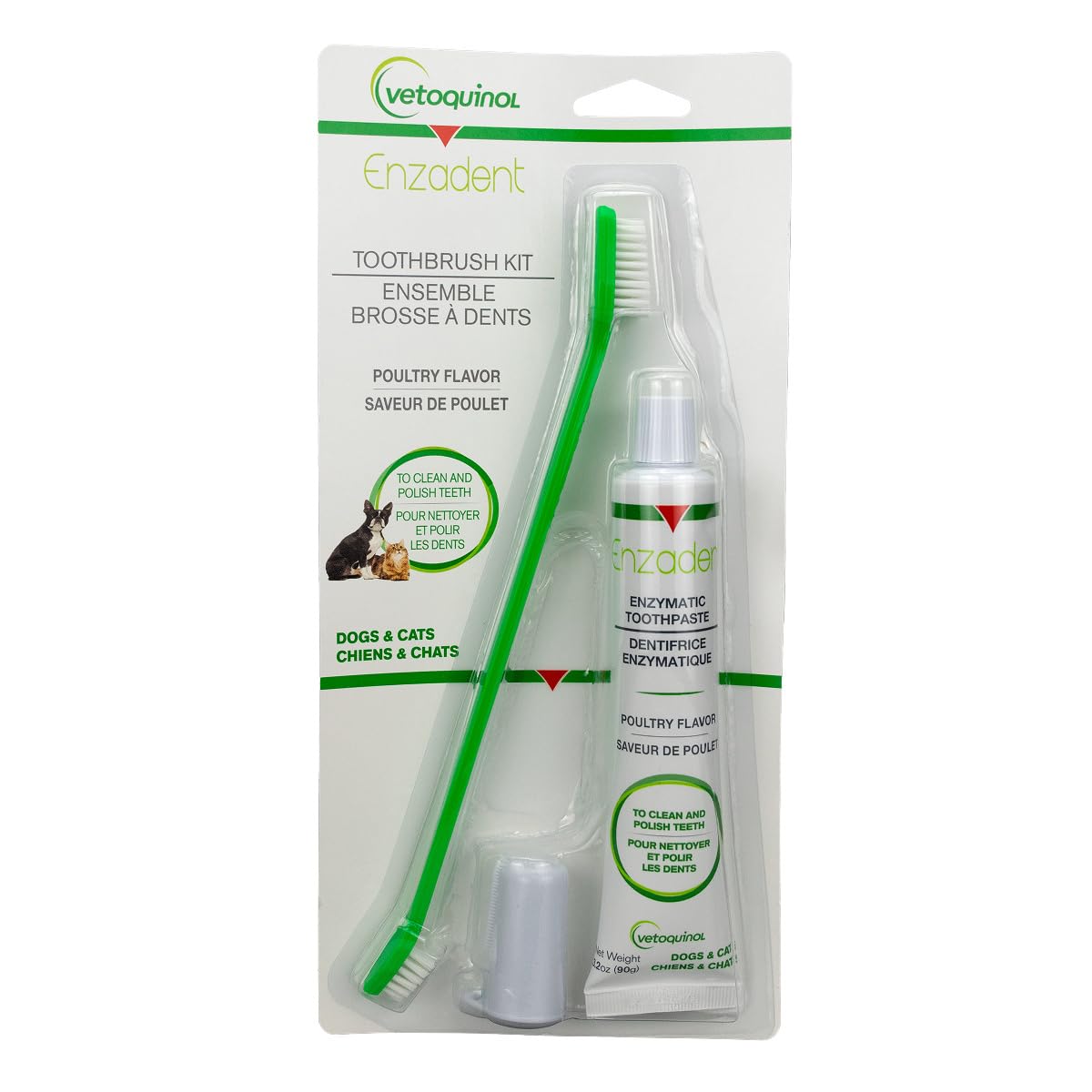
| Vetoquinol Enzadent Toothpaste KitFull Kit Pick | Cats that need the full brush-in routine | 3.2 ounces | Paste | Finger brush + dual-ended brush | Amazon |
| Petsmile Teeth Brushing Kit | Picky eaters and cats that dodge the brush | 2.5 ounces | Paste | 45° angled brush | Amazon |
| Maxi-Guard Dental Cleaning Gel | Multi-pet homes and cats that refuse a brush | 118 ml | Gel | Not needed | Amazon |
| HomeoPet Feline Purr Dental | Cats you cannot handle at all | 15 ml | Liquid drops | Not needed | Amazon |
Detailed Reviews
1. Nylabone Dental Advanced Oral Care Toothpaste Pack of 3
Our pick — 4.5+★ from 250+ verified ratings; the strongest balance of quality and price.
The crowd favorite for a reason — 7.5 ounces of paste that dogs actually accept, across 3 tubes.
The thing everyone raves about here is dental health, and 7.5 ounces of paste spread across three tubes means you are not rationing it. A small dab per brushing lasts a long time, and the sweet dog-bone flavor is what gets it into a dog’s mouth in the first place. As one buyer summed it up, it “Works great on our Yorkies teeth. Great improvement in the film on their teeth and breath.”
On the tartar front, the paste is formulated to reduce plaque and tartar and clean the teeth, with vitamin C in the ingredient list and a cruelty-free material claim on the label. It is a paste, not a gel, so it needs a brush to do its job. That is fine for a dog that has been brushed before, and it is where the third tube earns its keep — you can keep one at home, one in the car, and one wherever your dog spends the day.
The catch: this paste is dog-formulated. The flavor is a sweet dog-bone profile, and cats are far less forgiving than dogs about sweet flavors. If your household is cats only, look at the Vetoquinol kit or the Petsmile kit instead. If you have a dog and a cat and want one tube to serve both, this is not the one to bet the cat on.
Where This Paste Pulls Its Weight
- 7.5 ounces across three tubes — a long supply for daily brushing
- Formulated to reduce plaque and tartar as part of a daily routine
- Flavor dogs accept, which is the real barrier to daily brushing
- Cruelty-free material claim on the label
Where It Stops Short
- Dog-oriented sweet flavor — cats are unlikely to accept it
- No brush or finger brush in the box, so you buy that separately
- Paste form means it does nothing for a cat you cannot brush
Reach for this if: you have a dog with tartar film and want three tubes of a flavor it will take willingly.
Look elsewhere if: your cat is the patient — the sweet dog-bone flavor is built for a dog’s palate.
2. Vetoquinol Enzadent Toothpaste Kit with Brushes
Enzyme paste plus two brushes in one box, sized for a cat’s mouth and a struggling owner’s patience.
This is the most complete box on the list. You get 3.2 ounces of poultry-flavored enzymatic paste, a finger brush, and a dual-ended toothbrush with a large head and a small head. The paste is non-foaming and made to be swallowed without rinsing, which is the only way a cat brushing session ever finishes. The poultry flavor is the leader among the reviews, and reviewers describe cats settling in and letting the brush work rather than fighting it.
The brush control is where this kit earns its place for gingivitis specifically. A finger brush lets you feel the gumline, and the small end of the dual-headed brush gets behind the back teeth where a cat’s tartar builds. Compare that with the Petsmile kit, whose 2.5-ounce tube is smaller than this 3.2-ounce one — you get more paste here, plus two brushes instead of one.
The catch is the brushes themselves. The plastic finger brush gets called out as too hard and not useful, and the large end of the dual-headed brush is too big for most cats. Plan to use the small end and, if your cat hates the finger brush, pick up a soft silicone one. The paste is the part that works; the included brush accessories are the weak link.
The paste does the heavy lifting: a triple enzyme formula, poultry flavor, non-foaming, safe to swallow — that combination is what makes daily brushing realistic with a cat.
The brush caveat: treat the included plastic finger brush as a spare. The small end of the dual-headed brush is the one worth using on a cat.
The one-box answer: anyone starting from zero on a cat with gum inflammation — paste, small brush, and finger brush all arrive together.
But know this: the large brush head and the stiff finger brush will not suit a cat’s mouth, so budget for a soft silicone alternative.
3. Petsmile Teeth Brushing Kit Rotisserie Chicken
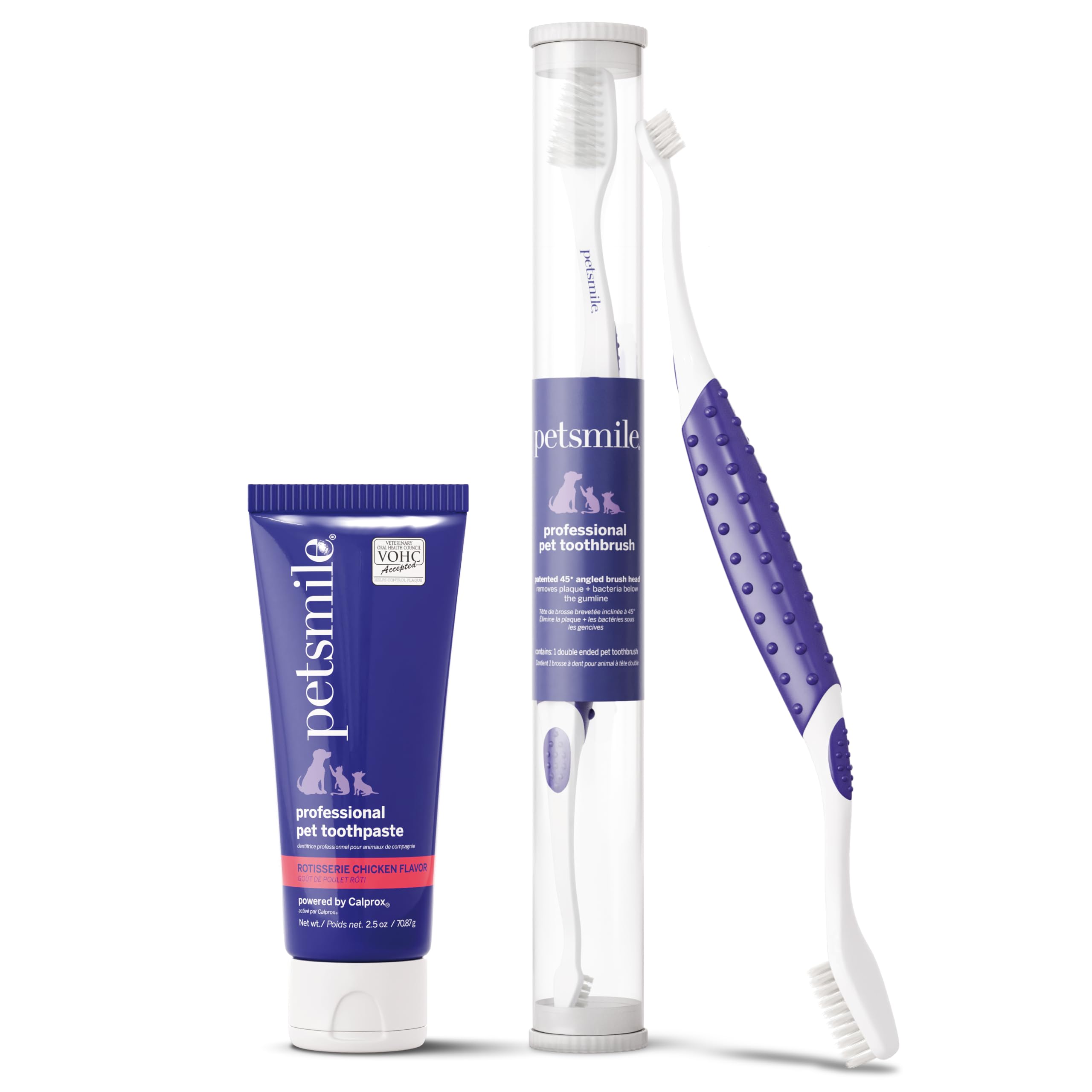
The only VOHC-accepted paste here, and the flavor that wins over cats that turn their nose up at everything.
VOHC stands for the Veterinary Oral Health Council, which reviews pet dental products and accepts those that meet its standard. This paste is the one VOHC-accepted option on this list, which matters when you are trying to actually address gum inflammation rather than just freshen breath. Its Calprox formula is designed to dissolve the biofilm where plaque and stains begin, with calcium, magnesium, and phosphates for enamel support.
The brush is the other half of the pitch. It has a patented 45° angled head with soft bristles meant to reach below the gumline, which is exactly where gingivitis lives. Pair that with the rotisserie chicken flavor — described as warm roasted bird with a hint of crispy skin — and you have a kit that gets a fussy cat to the brush in the first place. The flavor comes from artificial flavoring with no animal proteins, so a cat with food allergies can still use it.
The honest limit is size and brush fit. The brush also runs large: a 17-lb Siamese owner found it hard to reach the back teeth, and a 25-lb dog owner needed the small side of a dual-headed brush to get there. For a small cat, plan on a smaller brush.
Why It Costs More And Earns It
- VOHC-accepted paste — evaluated against a dental standard, not just sold as one
- Calprox formula targets the biofilm where plaque and stains begin
- Rotisserie chicken flavor gets picky cats to the brush
- 45° angled brush head with soft bristles aimed below the gumline
- No animal proteins in the flavoring
The Small Print
- 2.5 ounces is the smallest tube in this comparison
- The included brush is too large for a small cat’s mouth
- Paste traps in the bristles, so the brush needs a thorough rinse
Built for: the cat that snubs every other flavor and the owner who wants a paste with a real dental standard behind it.
Trade-off accepted: a smaller tube and a brush you may need to swap for a cat-sized one.
4. Maxi-Guard Dental Cleaning Gel 4oz

A gel you apply without a brush — the workaround for a cat that will not open its mouth for anything.
At 118 ml, this is a far bigger supply than the 15 ml HomeoPet bottle, which makes it the practical pick for a multi-pet house where one tube has to serve a dog, a cat, and whatever else lives there. The gel formula uses zinc and vitamin C for oral hygiene and periodontal defense, and it targets plaque, tartar, and bad breath. No brushing is required, which is the entire reason it exists.
The gel form is a real answer for a cat with sore gums. Brushing an inflamed gumline hurts, and a cat that has been hurt once will not sit still twice. Applying a gel lets you get something onto the teeth and gums without the fight. It is not as thorough as a brush at lifting the soft film, so think of it as the tool for a cat that cannot be brushed, not a replacement for brushing a cat that can.
The honest catch: it is a gel with an unfamiliar flavor profile, and a cat that licks it once may refuse the second application. It is also sold as a broad multi-species formula rather than a cat-specific one, so the flavor is not tuned to a feline palate. If your cat rejects it, you have not lost much ground — the supply is large and the method is quick to try.
The practical read: 118 ml of brush-free gel is the best fit for a household with a dog, a cat, and a horse or exotic animal all needing dental upkeep from one bottle.
Where it gives ground: no brush means no mechanical film removal, and the multi-species flavor is a coin flip with a picky cat.
Go here when: brushing is not physically possible and you still want to get an active gel onto the gums every day.
Not for: a cat that will tolerate a brush — you get more out of the Vetoquinol kit in that case.
5. HomeoPet Feline Purr Dental, Water Additive, 15 Milliliters

Drops in the water bowl — dental care for the cat that disappears when the toothbrush comes out.
Fifteen milliliters of unflavored liquid goes into the water bowl, the food, or straight into the mouth twice a day, and that is the whole routine. For a cat that hides under the bed at the sight of a brush, this is the only method left standing. The drops are tasteless and low-odor by design, so a picky cat has less to object to, and the bottle stores in a cool dry space without refrigeration.
Effectiveness is the part people talk about most, and the format is why. There is no handling, no restraint, and no gum contact to fight over. HomeoPet was founded by a veterinarian, Thomas Farrington, and his brother Daniel, on European homeopathic traditions, and the drops are made with homeopathic ingredients with no known side effects according to the maker. The maker lists it as safe for all life stages, so one treated bowl can serve a senior cat and a young cat together.
Be clear about what it is not. It is not a paste and it does not brush anything — it is a supplement added to water, and the maker’s own wording is that it “may help.” Fifteen milliliters is also a small bottle, the smallest capacity here, so you will replace it more often than a 118 ml gel. And the mixed reports on whether cats will drink treated water are real: some lap it, some turn their nose up and you never know if the dose landed.
What Makes It The Easiest Option
- No brushing, no handling — drops in the water bowl twice a day
- Unflavored and low-odor, so there is less for a picky cat to reject
- Stores without refrigeration and suits all life stages
- Multi-cat household friendly — one bowl, one dose
What To Expect Going In
- 15 ml is the smallest bottle in this comparison
- No mechanical cleaning, so it cannot replace a brush for established tartar
- Some cats refuse treated water, and then the dose never lands
Reach for this if: your cat will not be handled and the water bowl is the only surface you control.
Pair it with: a brush-based kit once your cat calms down — drops alone do not lift tartar off a tooth.
Know the Specs
Enzymatic vs Plain Paste
An enzymatic paste uses enzymes — proteins that break down food residue and plaque — to clean without scrubbing hard. That is why the Vetoquinol and Petsmile pastes can be swallowed without rinsing: the enzymes keep working after the brush leaves. A plain paste relies more on the physical brushing action. For a cat with gingivitis, the enzymatic route gives you a second chance at cleaning even on a rushed brushing session.
Capacity In Ounces And Milliliters
Capacity tells you how long a tube lasts, and the range here is wide. The HomeoPet bottle is 15 ml, the Maxi-Guard gel is 118 ml, and the Nylabone pack totals 7.5 ounces across three tubes. A daily brushing uses a pea-sized dab, so a small tube lasts weeks, not days. If you are testing a flavor with a fussy cat, a small tube is actually the smarter buy — you find out quickly whether the cat accepts it before committing to a larger supply.
VOHC Acceptance Explained
The Veterinary Oral Health Council reviews pet dental products against a standard and accepts those that meet it. A VOHC-accepted label means the product was evaluated by a body focused on dental health, not just sold with a dental-sounding name. Only the Petsmile paste on this list carries that acceptance, so if a formal dental standard is your deciding factor, that is the pick.
Finger Brush vs Dual-Ended Brush
A finger brush fits over your fingertip and gives the most direct control — you feel exactly where the bristles are against the gum. A dual-ended brush gives you a large head and a small head in one handle. For a cat, the small head is the useful one; the large head is built for a dog’s mouth. Whichever you use, the brush is what lifts the soft plaque film, which is the part a gel cannot do.
Common Questions
Can I use dog toothpaste on my cat with gingivitis?
Is brushing really necessary or can I just use the water drops?
How do I know if my cat actually has gingivitis?
Does the Petsmile kit really have VOHC acceptance?
Which brush should I use on a cat — the finger brush or the small toothbrush head?
How much paste should I put on the brush?
My cat hates the toothbrush — is the gel or the water drops the better backup?
Should I stop brushing if my cat’s gums bleed?
How long does a toothpaste tube last with daily brushing?
Can I use one toothpaste for both my dog and my cat?
The Bottom Line
For most cat owners fighting gingivitis, the cat toothpaste for gingivitis winner is the Vetoquinol Enzadent Kit because it puts an enzymatic poultry paste, a finger brush, and a dual-ended brush in one box — everything you need to start brushing today. If your cat is the picky type that snubs everything, grab the Petsmile Kit and its rotisserie chicken flavor and VOHC-accepted paste. And if your cat will not be handled at all, the Maxi-Guard Gel is the brush-free fallback that still gets an active formula onto the gumline.
One honest nudge: whatever you pick, start with the smallest tube and one daily session before you stock up. A flavor your cat accepts matters more than any ingredient list, and only the first brush tells you.
How we choose
We do not accept paid placement. Every pick is matched to a real buyer and a real use-case; we do not hands-on test units.
Sources
Specifications: manufacturer listings and product documentation. Review insights: verified customer reviews, as of October 2026. Pricing: not shown on this page (it changes often); check the current price via the retailer link.
As an Amazon Associate, Aappliancez earns from qualifying purchases. This does not affect which products we feature.