Disclosure: Some links in this post are affiliate links. As an Amazon Associate I earn from qualifying purchases, at no extra cost to you. Learn more
Specs are compiled from manufacturer listings and verified buyer reviews and can change over time — please confirm the key details on the product page before buying.
If your cat hacks, crouches, and leaves a wet fur tube on the rug, the fix is usually simpler than you think: a daily fiber source that moves swallowed hair through the gut instead of back up. The five picks below all do that job, but they do it in very different forms — crunchy chews, a malt paste you squeeze from a tube, a liquid you drop into wet food, and a cat-grass biscuit. The right one for your cat depends on one question: what will your cat actually swallow every day?
This guide is built by comparing the manufacturers’ published specifications and the patterns across verified customer reviews, so you get each pick’s real strengths and trade-offs instead of marketing spin.
A hairball is matted fur your cat cannot digest, so the goal is to keep it moving down and out rather than back up onto your floor. Below you’ll find the pick that suits a fussy eater, a long-haired shedder, and a multi-cat house, all under the banner of the cat hairball remedy.
Top Picks


How To Choose The Best Cat Hairball Remedy
Hairballs are not really a fur problem — they are a transit problem. A cat grooms, swallows loose hair, and that hair either moves through the digestive tract or gets coughed back up. A good remedy adds bulk and lubrication so the hair keeps traveling the right direction. So the first thing to check on any label is the fiber source, not the flavor name on the front.
Look at the fiber source before anything else
Psyllium husk is the most common fiber in this category, and it works by soaking up water and swelling so swallowed hair slides through. Apple pomace and apple fiber do a similar job with a gentler, food-like texture. Cat grass and barley seedling powder give a cat the raw plant fiber it would normally nibble outdoors. A formula built around one or more of these is doing real work; a treat that only lists “chicken” and “natural flavor” is mostly a snack.
Match the format to what your cat will actually take
The best formula in the world fails if your cat refuses it. Crunchy chews with a creamy center suit food-motivated cats who already beg for treats. A malt paste works for cats that will lick straight from a tube or off a finger, but the same paste can be a wrestling match for a cat that turns its nose up. A liquid drops-and-mixes format hides easily in wet food or broth, which is the quiet route for a suspicious cat. Cat-grass biscuits are the closest thing to a plain snack and work well as a topper.
Check for petrolatum if you want to skip the gel route
Older hairball gels lean on white petrolatum, a mineral-oil base that lubricates the gut. Plenty of cats do fine with it, but many owners deliberately look for a petrolatum-free option and prefer a fiber-and-herb formula instead. If that matters to you, read the ingredient panel — some pastes and chews advertise it plainly, others bury it.
Side-by-Side Comparison
| Model | Best For | Format | Key Fiber/Active | Flavor | Amazon |
|---|---|---|---|---|---|
| Pet Honesty Vet Backed Chews★ Best Overall | Long-haired daily shedders | Crunchy chews | Psyllium husk, apple pomace | Chicken | Amazon |
| Pugalo Hairball Remedy GelBest Paste | Tube-lickers and gel fans | Malt paste | Psyllium husk, malt, slippery elm | Malt | Amazon |
| Rocco & Roxie Hairball Treats | Multi-cat households | Crunchy chews | Slippery elm, psyllium husk, apple fiber | Chicken | Amazon |
| SANTKOL Hairball Liquid | Picky cats and wet-food feeders | Liquid drops | Psyllium husk, flaxseed, cat grass | Cat Grass | Amazon |
| Wellix Cat Grass Treats | Indoor cats that miss real grass | Crunchy biscuits | Barley seedling powder, catnip | Cat Grass | Amazon |
Detailed Reviews
1. Pet Honesty Vet Backed Cat Hairball Remedy Chews, Chicken
Our pick — 4.5+★ from 7,000+ verified ratings; the strongest balance of quality and price.
A daily chicken chew that hides a hairball remedy inside a crunchy shell and creamy middle.
For the cat that already comes running at the sound of the treat bag, this is the easiest route to daily fiber. Each chew carries psyllium husk — the fiber that swells with water so swallowed fur slides through — plus apple pomace for gentler digestion and omega-rich fish oil from ingredients like fish oil and lecithin. The dual texture, a crunchy shell around a creamy center, means a treat-motivated cat treats hairball care as a snack rather than medicine. It’s 3.7 ounces of chews, and Pet Honesty reports that 9 out of 10 cats ate the chews in its own feeding study — a manufacturer figure, but the pattern holds across the review pages.
The part that wins people over is how fast the long-haired, over-grooming cats turn around. One owner’s cat passed a large hairball the day after the first dose and then stopped; another reported a 4-inch hairball clearing in about a week, with shedding down and the coat softer. A cat vomiting hairballs several times a day settled within two days, and a one-year-old kitten stopped hacking once six chews a day were mixed into its food. That blend of results, plus a flavor cats chase down the hallway, is why this one leads a crowded field.
The honest catch: a smaller share of cats simply won’t eat them, and a few owners noticed the only side effect was stinkier stool. A pet-food retailer would charge more per ounce too — the chews run at a premium for the category. But the consistency of the fiber load, the petrolatum-free formula, and the 9-of-10 acceptance rate in that study makes it the safest first pick for treat-motivated cats. It leads the shortlist for a reason.
What Sells It
- Psyllium husk, apple pomace, and fish oil in one chew for a real fiber hit
- Crunchy shell wraps a creamy center — cats chase it like a treat
- Petrolatum-free, no messy gel or paste to squeeze down a cat’s throat
- Works on long-haired over-groomers and shorthair shedders alike
The Fair Caveats
- Premium per-ounce cost versus a plain bag of treats
- A subset of cats refuse the taste despite the study results
- Some owners note softer or smellier stool as the fiber kicks in
Go for it if: your cat already begs for treats and sheds like it’s a full-time job — this makes the daily dose a reward, not a wrestle.
Reach elsewhere if: your cat turns its nose up at crunchy textures; the liquid and paste picks suit a suspicious eater better.
2. Pugalo Cat Hairball Remedy Gel 100ml Malt Paste
A malt-flavored paste that licked off a finger turns hairball care into a treat-time ritual.
Where the chews reward a food-motivated cat, this 100 ml tube suits the cat that will lick something off your fingertip but ignores a biscuit. The formula pairs psyllium husk with malt to move ingested fur along, then adds pumpkin powder and slippery elm bark — both known for soothing the digestive tract and easing the constipation that can come with hairball backups. A 100 ml tube lasts through daily dosing, and it’s marketed for kittens, adults, and seniors of any breed, so you’re not shopping around as your cat ages.
What sells it is the taste. Cats that treat a gel like a battle will often lick this straight from the tube, and the pleasant malt flavor makes the daily routine quick. There’s a genuine relief in not having to shove anything into a cat’s mouth. One owner with an 18-year-old cat managing IBD sought out the full ingredient list first and found the formula clean enough to feel safe trying; that cat, like many here, loved the taste. Others describe a picky cat purring and eating immediately, then going hairball-free, with the added bonus of firmer stools on a grain-free raw diet.
Here’s the thing to plan for: cats are not guaranteed to like it. Some turn their nose up at the first, second, or fourth hairball product, and this paste lands in that same risk. The ease-of-use splits both ways — one cat licks it happily off a finger, another needs it coaxed in. If your cat falls into the second group, the liquid drops in the next pick hide more easily in food. For the cat that takes to it, though, this is as low-fuss as hairball care gets.
Clean formula read: psyllium husk, malt, pumpkin powder, and slippery elm bark, with no white petrolatum — one of the reasons owners hunting for a gel alternative keep landing here.
Who it fits: cats that already lick things from a spoon or finger, and owners who want a paste instead of a crunchy chew. If your cat refuses gels, no formula will fix that — reach for the liquid instead.
Point it at a tube-licker: the cat that treats a finger-dab like a delicacy will take this without drama.
Know the risk: a cat that refuses pastes on principle won’t be won over by the malt flavor alone.
3. Rocco & Roxie Hairball Control Cat Treats, Chicken, 300 Ct
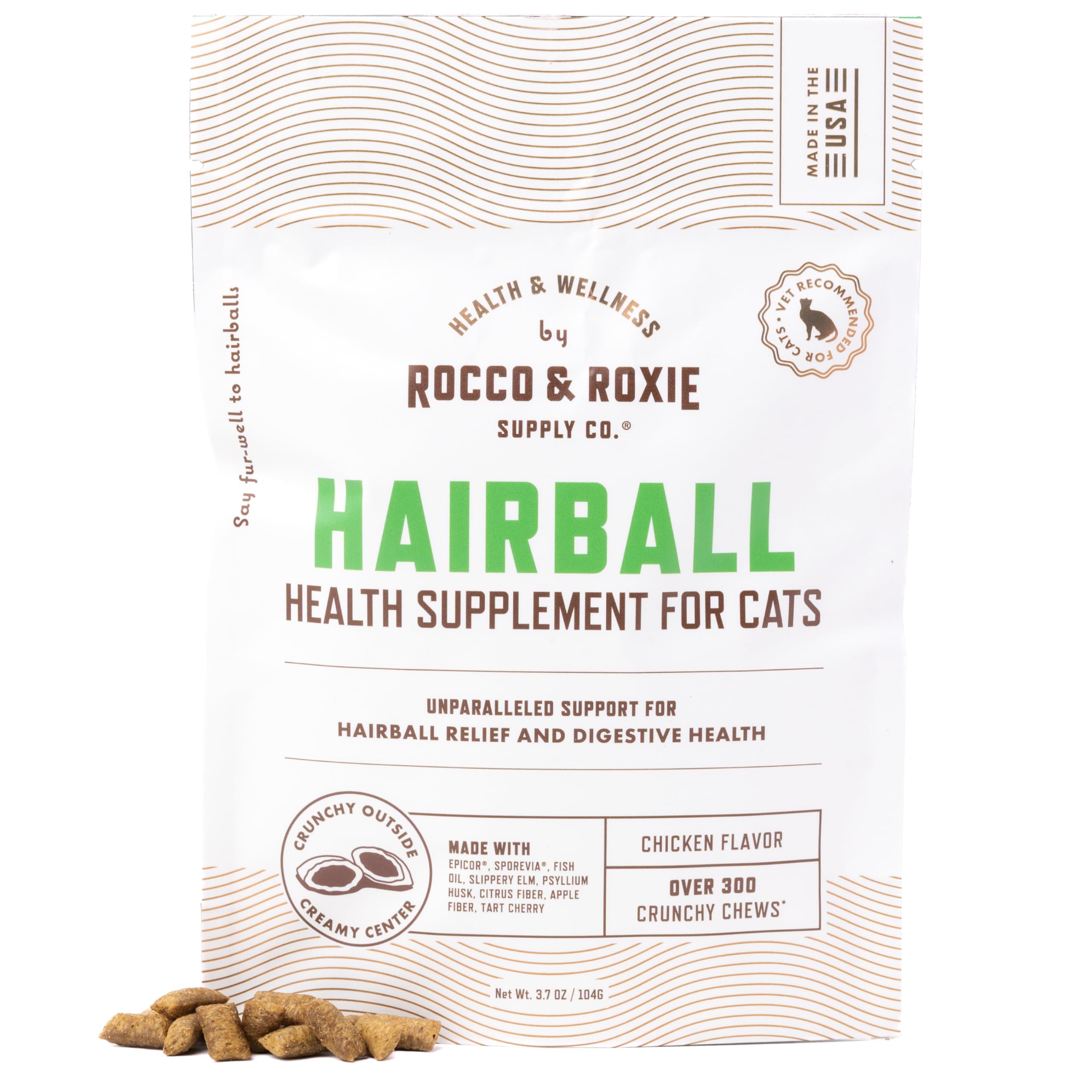
A 300-count bag that turns daily hairball care into a morning ritual your cat won’t let you skip.
If you have more than one cat, or a cat that needs a dose every single day, the sheer count here matters. Rocco & Roxie packs 300 crunchy chicken chews — compared with a 30-day supply of the Pet Honesty chews, that’s 300 pieces versus a single unit, a difference any multi-cat house will feel. The chew layers slippery elm (a bark that coats and soothes the stomach lining), psyllium husk (a plant fiber that helps swallowed hair pass comfortably), and apple fiber (which supports normal stools), plus a Sporevia probiotic that the maker says survives stomach acid to feed healthy gut bacteria.
Cats devour it. Owners describe cats waiting by the spot each morning, making the daily dose a priority, and one Siberian that shifts from winter coat to summer coat took to them immediately once the dose matched body weight. A kitten’s daily hacking cleared up on six treats a day mixed into food, and a cat vomiting several times a day stayed clear on four pieces each morning. The crunchy-outside, creamy-center texture does the heavy lifting there. One recurring theme across the pages is the pleasant surprise at how far a bag stretches for the cost — it reads as a practical staple rather than a boutique supplement.
The recurring gripe is taste tolerance, and it cuts both ways. Most cats here love them, but a cat on a hairball formula plus Laxatone already is a cat that might resist one more thing. One owner’s cat who loved the taste started vomiting on them, stopped when the treats did — a mismatch worth watching for, not a reason to write off the product. For a cat that takes to the chicken flavor, few chews in this category give you this much mileage per bag.
Where the value lives: 300 chews with slippery elm, psyllium, apple fiber, and a probiotic in every bite, at a per-chew rate that undercuts most single-supply bags.
The odd one out: not every cat tolerates every treat. If yours is sensitive, introduce a few pieces at a time and watch, rather than switching cold to a full daily dose.
Built for: multi-cat homes and long-term daily dosers who want a big, dependable supply without restocking every month.
Worth pausing for: sensitive-stomach cats, since a treat that disagrees will show up fast — start small and build.
4. SANTKOL Hairball Treatment Liquid with Natural Ingredients

The quiet route — a few drops in wet food, no wrestling, no treat negotiation.
This is the pick for the cat that refuses chews and turns up its nose at paste. It’s a 60 ml liquid, dosed by drops you mix directly into wet food, water, or broth, so a suspicious cat never sees it coming. The formula is one of the more stacked in the lineup: psyllium husk (a plant fiber that helps hair pass) at 100 mg, safflower seeds and flaxseed at 50 mg each, inulin (a prebiotic fiber that feeds gut bacteria) at 100 mg, Bacillus subtilis (a probiotic bacteria) at 100 mg, cat grass at 0.5 mg, plus lysine (an amino acid) at 500 mg and vitamins A and D3. It’s grain-free, gluten-free, dairy-free, and soy-free, and the cat-grass flavor is designed to suit even picky cats. It arrives in a 2-fluid-ounce bottle that buyers report stretches further than expected.
What the review pages reward here is raw effectiveness on the toughest cases. One cat that hacked up a hairball daily stopped entirely once the drops went into its wet food. A senior cat that had failed gels and hairball foods went weeks without a cleanup on the drops. The texture complaint is common enough to note: the liquid is thick and sticky, which makes precise dosing awkward at first and can gum up the bottle’s opening over time. Owners’ workaround is simple — run the bottle under warm water before and after use to loosen the thick ingredients, and it dispenses cleanly again.
One caution worth sizing honestly: a single owner whose cat still had weekly hairballs and developed daily diarrhea stopped the supplement and stopped the problem, which is the signal to check with your vet if a new addition triggers stomach upset. For most cats, though, the drops do their job without fuss, and the no-drama administration is worth the slight stickiness for owners who’ve tried everything else. It’s the best-selling of the liquid options for a reason.
Why It Earns Its Spot
- Drops mix into wet food, water, or milk, so a picky cat takes it undetected
- Full ingredient panel: psyllium, flaxseed, inulin, probiotics, lysine, vitamins
- 60 ml bottle lasts longer than expected across daily dosing
- Grain-, gluten-, dairy-, and soy-free formula
What To Expect
- Thick, sticky texture can clog the bottle opening over time
- Precise dosing is fiddly at first until the warm-water trick becomes habit
- Some cats still throw hairballs — and a sensitive cat may show stomach upset, which is a vet-check signal
Perfect for: cats that view treats and gels as an insult, and owners who want to slide hairball care into the wet-food bowl without any negotiation.
Not for: cats with a known sensitive stomach — start slow, watch for upset, and stop if it shows.
5. Wellix Cat Grass Treats with Catnip, 13.05 oz
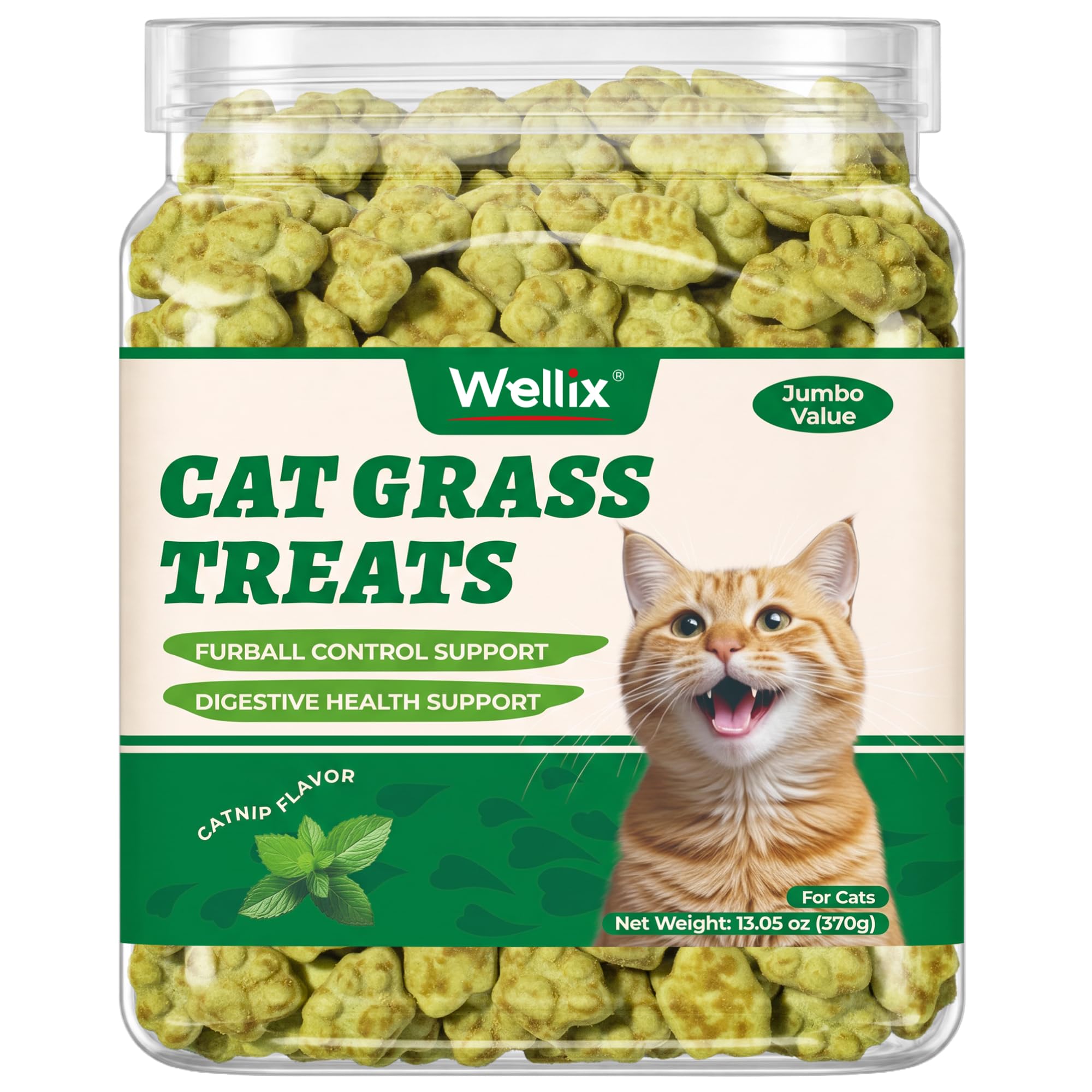
An indoor cat’s answer to the grass patch it can’t reach — crunchy biscuits in a resealable tin.
For the cat that nibbles outdoor grass and comes back inside to hack, this is the closest match to what it’s already reaching for. The biscuits are built on barley seedling powder (the cat-grass part) and catnip powder, with salmon rounding out the flavor, and the maker says it’s free of sugar, artificial flavors, and colorings. Each treat carries just 1.3 calories, so you can top a bowl, sprinkle into water to encourage drinking, or hand them out as a reward without worrying about weight gain. It comes as 13.05 ounces in a resealable tin that keeps the crunch fresh for multi-cat homes.
The part owners rave about most is simply that cats want them. Indoor and food-motivated cats treat the paw-print shapes as a genuine snack — a nice size, no off-putting smell, and a cracker-like texture that eases chewing. A picky cat that had vomited hairballs nearly daily stopped entirely after three weeks of daily biscuits. Others use them as a straight substitute for fresh grass when there’s none in the yard, and the see-through canister makes it easy to see when to reorder. Digestion support comes through the natural plant fiber rather than an added psyllium, which some owners prefer as the gentler route.
The fair caveat is taste rejection: these biscuit treats split a room. Some cats go crazy for them; others, including indoor/outdoor cats that have real grass outside, reject them outright. If your cat already has outdoor access, it may see no reason to switch. And with catnip in the mix, it’s worth introducing one biscuit at a time to see how your cat reacts. For the indoor cat missing its grass fix, though, this tin is a clean, low-calorie daily solution.
The strongest pitch: 1.3 calories per biscuit means the dose is a snack, not a diet decision, and the 13.05-ounce tin covers a multi-cat household for weeks.
The fair trade: cats either love these or ignore them. It’s a cheap experiment compared with a paste tube, but it works best on cats already fond of grass and nip.
Hold this for: indoor cats that nibble grass and shed heavily, plus multi-cat homes that want one resealable tin to go around.
Second thought if: your cat has outdoor grass access or has never shown interest in catnip — this one lives or dies on feline preference.
Know the Specs
Fiber Source (Psyllium, Apple, Cat Grass)
Fiber is the working part of any hairball remedy. Psyllium husk absorbs water and swells, which turns swallowed hair into something that slides through the gut rather than backing up. Apple pomace and apple fiber do a similar job with a softer, food-like texture. Cat grass and barley seedling powder give a cat raw plant fiber — the thing it instinctively nibbles when its stomach feels off. When you compare labels, the amount and type of fiber tells you far more than the word “hairball” on the front.
Format: Chew, Paste, Liquid, or Biscuit
The delivery format decides whether the remedy ever makes it into your cat. Crunchy chews suit food-motivated cats that treat dosing as snack time. Malt pastes work for cats that lick straight from a tube or finger, but become a struggle with a resistant cat. Liquids dosed by drops into wet food hide the taste entirely, which is the quietest route. Biscuits double as a plain snack and a grass substitute, but rely on the cat liking the flavor. Match the format to your cat’s habits before you study the ingredient panel.
Calories and Daily Dosing
Hairball care is a daily habit, so the calorie cost per dose adds up. Biscuits that run 1.3 calories each let you top a bowl without a weight concern. Chews require you to follow the body-weight direction — a 300-count bag gives you space to dose each cat accurately. Liquids and pastes are dosed by volume, so a bottle’s fluid-ounce size tells you how many days of supply you’re actually getting. Read the label’s dosing line and do the math before you buy, especially in a multi-cat house.
Petrolatum-Free vs Gel Formulas
Traditional hairball gels lean on white petrolatum, a mineral-oil base that lubricates the digestive tract. It works for plenty of cats, but some owners deliberately steer away from it and prefer a fiber-and-herb formula instead. Pet Honesty builds its chews without petrolatum, and Pugalo’s paste uses malt, pumpkin, and slippery elm rather than mineral oil. If skipping petrolatum matters to you, scan the ingredient list first — some brands state it plainly, while others leave it out only in the fine print.
Common Questions
How long does a daily hairball remedy take to work?
Can I use these hairball remedies on a kitten?
What is the difference between a hairball chew and a hairball gel?
Why is my cat still throwing up hairballs after starting a remedy?
Do these hairball remedies contain petrolatum?
Can multiple cats share one container of hairball treats?
Is a liquid hairball remedy better for a picky cat?
How many calories does a cat-grass hairball treat add?
Will a hairball remedy help with shedding, too?
The Bottom Line
For most cat owners, the winner in the cat hairball remedy shortlist is the Pet Honesty Vet Backed Chews, because it packages a real fiber load — psyllium husk (a plant fiber that helps hair pass), apple pomace (the fiber-rich solids left after juicing), and fish oil — inside a treat food-motivated cats chase down the hall. If you want a paste for a cat that licks from a tube, reach for the Pugalo Gel. And for an indoor cat missing its grass fix, the Wellix Cat Grass Treats are the low-calorie biscuit substitute to keep in the tin. Match the format to your cat’s habits first, and the daily dose becomes a habit nobody dreads.
How we choose
We do not accept paid placement. Every pick is matched to a real buyer and a real use-case; we do not hands-on test units.
Sources
Specifications: manufacturer listings and product documentation. Review insights: verified customer reviews, as of October 2026. Pricing: not shown on this page (it changes often); check the current price via the retailer link.
As an Amazon Associate, Aappliancez earns from qualifying purchases. This does not affect which products we feature.