Disclosure: Some links in this post are affiliate links. As an Amazon Associate I earn from qualifying purchases, at no extra cost to you. Learn more
Specs are compiled from manufacturer listings and verified buyer reviews and can change over time — please confirm the key details on the product page before buying.
Your Wi-Fi drops every time two people stream at once, and the cheapest fix is one wired run — not a new router. Three things decide which Cat 6 cable is worth buying: how far the signal has to travel, whether it has to survive weather, and how thick a jacket you can hide. Get those three wrong and you either lose speed over distance or wrestle a stiff cable that will not bend around a door frame.
This guide is built by comparing the manufacturers’ published specifications and the patterns across verified customer reviews, so you get each pick’s real strengths and trade-offs instead of marketing spin.
You do not need an IT background to choose well here. You need one thing: to know which spec actually matters for your run. The picks below cover 100-foot indoor runs, flat under-carpet installs, shielded server-room work, and weatherproof outdoor runs, all filtered through what buyers report after months of use, so this guide to the best cat 6 cable keeps you from overspending on hype.
Top Picks

How To Choose The Best Cat 6 Cable
Every Cat 6 cable prints “10Gbps” on the label, and that is exactly why so many buyers assume they all perform the same. They do not. Two cables can both promise 10 Gigabits per second (10 billion bits of data every second) and still behave very differently once you stretch them across a room or push them through a wall. Check these four things before you buy.
Bandwidth in MHz is the number that separates them
Look at the bandwidth rating first, because it tells you how much headroom the cable has. That rating is written in MHz (megahertz, the frequency range the cable can carry cleanly). A 550 MHz cable carries more signal range than a 250 MHz one, which matters most on long runs where the signal weakens. Bridging two devices sitting side by side? A lower MHz rating is often fine. Snaking a cable across a whole floor? More bandwidth buys you stability.
Wire gauge controls how bendy the cable feels
Gauge is written in AWG (American Wire Gauge, where a lower number means thicker copper), and it decides how the cable feels in your hands. A 24 AWG cable has thicker conductors than a 30 AWG one, so the signal holds stronger over distance — but the cable is stiffer and harder to route around tight corners. Thin flat cables use smaller-gauge wire so they slide under carpet and along baseboards, and the trade-off is less copper carrying the signal. Match the gauge to your install, not the spec sheet.
Shielding is for noisy environments, not every desk
Shielded cable wraps the internal wire pairs in a conductive layer that blocks electrical interference from nearby power lines or machinery. Running cable through a server room, a workshop, or alongside mains wiring? Shielding earns its keep. In a normal bedroom or home office run, an unshielded cable behaves just as well and stays more flexible.
Outdoor and burial runs need a tougher jacket
Standard indoor jackets crack under UV light and absorb water over time. If any part of your run goes outside — through a wall, along a fence, or underground — you want a weather-resistant outer sheath that handles rain and sun. Running an indoor-rated cable outdoors is the most common mistake in this category, and it usually shows up as a dead connection a season later.
Side-by-Side Comparison
| Model | Best For | Bandwidth | Length | Gauge | Amazon |
|---|---|---|---|---|---|
| Cable Matters 10Gbps Snagless Cat 6, 100ft, Black★ Best Overall | Long indoor runs that never drop | 550 MHz | 100 feet | 24 AWG | Amazon |
| Jadaol Cat6/Cat6A Flat with Clips, 50FT, BlackBest for Hiding | Hiding the cable along baseboards and carpet | 250 MHz | 50 feet | 30 AWG | Amazon |
| Monoprice Cat6A 25ft Blue, Double Shielded S/FTP | Noisy rooms and PoE camera installs | 500 MHz | 25 feet | 26 AWG | Amazon |
| 10Gsupxsel Cat 6 Outdoor and Indoor 50FT, Black | A flexible weather-rated run at a budget tier | 550 MHz | 50 feet | 26 AWG | Amazon |
| Lysymixs Cat6a Slim 100ft Waterproof LLDPE, White | Long outdoor and burial runs where thickness matters | 500 MHz | 100 feet | 28 AWG | Amazon |
Detailed Reviews
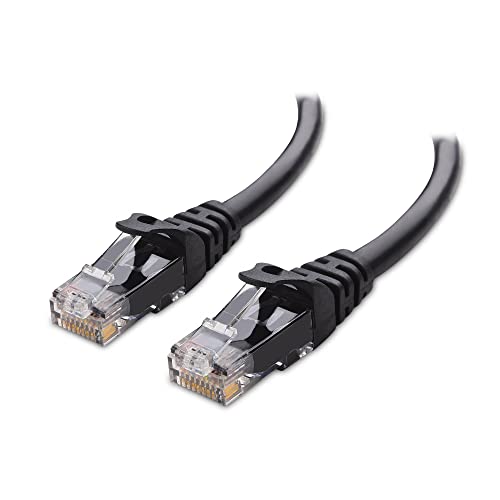
1. Cable Matters Cat 6 Ethernet Cable 100ft
Our pick — 4.5+★ from 22,500+ verified ratings; the strongest balance of quality and price.
The 100-foot heavyweight that carries 550 MHz without flinching.
Running a line from the router to the far side of the house is the job this cable was built for, and its 550 MHz bandwidth rating is the highest in this group. That headroom is why the signal keeps its shape across the full 100 feet. The 24 AWG copper core is the thickest wire here too, so full speeds arrive intact at the other end.
Against the Jadaol flat cable, the numbers tell the story plainly. This one runs 550 MHz versus 250 MHz, and stretches 100 feet versus 50 feet. You are paying for longer reach and more signal headroom, not a fancy label.
The gold-plated RJ45 contacts (the metal pins inside the standard network plug) resist corrosion over time, and the snagless boots keep the little release tab from snapping off when you pull the cable through a wall. Owners mention the 24 AWG copper feels solid and delivers consistent speeds without drops. The trade-off is stiffness — the same thickness that protects your signal makes this cable firm to bend, so plan your corners before you start taping. If your two devices sit a few feet apart, you would be paying for copper and reach you never use.
100ft snagless run
- 550 MHz bandwidth — the widest signal range in this lineup
- 24 AWG bare copper conductors for stable, consistent throughput
- Snagless strain-relief boots protect the clip during tight routing
- Gold-plated contacts resist corrosion at the connector
bulky coil storage
- The thick 24 AWG jacket is stiff — awkward through sharp corners
- 100 feet is more cable than a single-desk setup needs
long permanent runs: your run crosses a floor or wall and you want full speed at the far end.
tight corner turns: you only need to bridge two devices sitting a few feet apart.
2. Jadaol Cat6/Cat6A Ethernet Cable 50FT
The flat one that vanishes under carpet and behind baseboards.
A cable you can see is the problem this pick solves. The flat 50-foot profile slides under carpet, tucks behind baseboards, and follows corners without bulging, covering a typical room-to-room hop between a modem and a home-office PC. Mounting clips come in the box, so the whole run finishes neat without a trip to the hardware store.
The honesty note is in the wire itself. This cable uses 30 AWG conductors, and the Monoprice uses 26 AWG — meaning the Jadaol packs in less copper per strand. The bandwidth rating shows the same pattern: 250 MHz here against 550 MHz on the Cable Matters. For gaming, streaming, and everyday file transfers that gap rarely shows. Reviewers report steady speeds with no disconnects or packet loss.
What wins people over is how fast the install goes — the flat shape “made the install quick and easy,” as one homeowner put it after rewiring their house. The recurring gripe is a stiffener: bend it too sharply and you risk pinching the conductor. Keep your turns gentle around door frames and this cable does its job quietly for years. Someone who needs maximum bandwidth over a long backbone run is better served by the 550 MHz round picks above.
flat under carpet: The clips and flat build turn a messy wall-run into a ten-minute job you can hide completely.
clips sold separate: At 250 MHz and 30 AWG it carries less signal range than the round 550 MHz pick, so reserve it for shorter interior runs rather than long backbone work.
wall fishing: you want the cable gone from sight along walls, under rugs, or through a tight doorway.
heavy shielding need: your run needs maximum bandwidth over a long distance.
3. Monoprice Cat6A 25ft Patch Cable

Shielding that blocks interference before it reaches your data.
Double shielding is the reason this cable wins its spot: a room crowded with electrical noise — a server cabinet, a workshop bench, or a rack sharing space with power supplies — is where it belongs. S/FTP means a foil layer around each twisted pair plus a braided shield over the whole bundle, and that blocks outside electrical interference from reaching your signal. The 26 AWG pure bare copper conductors and 500 MHz bandwidth round out a short-length patch cable built for clean connections.
The gold-plated contacts are specified at 50µm (micrometers, a measure of the plating thickness), and the molded RJ45 ends survive repeated plugging. Reviewers report stable 10G speeds, zero drops, and consistent ping on this double-shielded bare-copper run. One buyer used it specifically to boost wifi camera signal strength over a PoE run.
Understand what it is not built for: at 25 feet it is a patch cable, not a whole-house run, and its Cat 6A rating is a step above the standard Cat 6 label on the other picks. If your noise problem is real, this fixes it. If you are just bridging a router to a desk, you are paying for shielding you will never notice.
noisy server rooms: crowded racks, PoE camera lines, and any run near power cables.
simple home desk: your cable crosses an empty room with nothing electrical nearby.
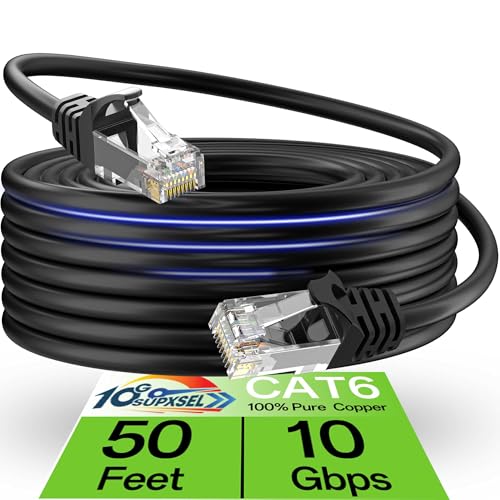
4. Cat 6 Ethernet Cable 50FT
A 550 MHz run that handles inside and out without breaking stride.
You get the top rating in this lineup here without paying for extra length: 550 MHz bandwidth, the same as the Cable Matters, across a 50-foot run in half the length. The 26 AWG pure copper core keeps speeds steady. It complies with the ANSI TIA 568.2 D standard (the published wiring benchmark for this category) and supports IEEE802.3at and IEEE802.3af PoE protocols, so one cable can power a security camera or access point while carrying data.
The snagless plug protects the release tab when you thread it through cable managers, and the flexible jacket bends into tight spots more easily than a thick round cable. Owners put it to work across the map — patch panels on a rack, a long run from a gaming system downstairs, even the whole NVR cabinet. Owners consistently report sturdy construction and firm connectors that plug and unplug cleanly.
Value is what owners mention most, and the honest caveat is small: at 26 AWG it carries less copper per strand than the thicker 24 AWG Cable Matters. For most home and office runs that difference never surfaces. For a super-long flagship backbone run, the thicker cable still has the edge.
buried conduit: you want 550 MHz performance and a flexible jacket for indoor or covered outdoor use.
indoor baseboards: your installation is a permanent underground burial that demands a dedicated weather jacket.
5. Cat6a Slim Ethernet Patch Cable 100ft

The slim, weather-proof run built to leave the house and come back.
Rain and sun are what this cable is built to shrug off — modem to garage, house to outbuilding, or a line that drops down an exterior wall. The waterproof LLDPE outer sheath (a tough plastic jacket that resists rain, snow, and harsh sunlight) is the reason it can live outdoors. It travels 100 feet, the same reach as the Cable Matters, but in a slim 28 AWG build that slides through conduit and along door frames without a fight.
Customers note the LLDPE jacket surviving months of exterior exposure while the cable stayed flexible. The slim profile disappears in plain sight, running under carpet and up walls so a bare foot barely registers it. Its 500 MHz bandwidth carries 10 Gigabits per second without lag or signal loss.
Know the trade: the thin 28 AWG conductors are the smallest of the five picks here, and the genuinely slim jacket is the reason. Reviewers point out it as really thin, and a light build demands care around sharp bends — keep turns gentle and avoid kinking. It is also rated for moderate outdoor use, so direct burial is a job better suited to a dedicated burial-rated line.
high density racks: your cable leaves the building and you need something slim, flexible, and weather-resistant.
rough handling: you plan to bury it permanently underground rather than run it along a surface.
Know the Specs
Bandwidth in MHz
Bandwidth is written in MHz, which measures the frequency range a cable can carry cleanly. Higher numbers mean more signal headroom, which keeps speeds stable over longer distances. In this lineup you see ratings from 250 MHz up to 550 MHz. A short patch run works fine at a lower number. A full-floor installation needs the higher figure to protect against signal falloff.
Wire Gauge (AWG)
Gauge is written in AWG (American Wire Gauge, where a smaller number means thicker copper). A 24 AWG conductor carries more signal strength than a 28 or 30 AWG one, which helps over long runs. The catch is that thicker copper is stiffer, while slim gauges bend easily for tight routing. Choose high gauge for easy hiding, low gauge for maximum signal integrity across distance.
Shielding Types
UTP (Unshielded Twisted Pair) is the plain build and works for most home runs. Shielded cable adds a conductive layer to block interference from nearby electrical sources — useful in server racks, workshops, and any run beside power lines. In a quiet room, shielding adds cost without a benefit you will notice.
Indoor vs Outdoor Jacket
An indoor jacket is not built for weather and can crack under UV (ultraviolet light from the sun) or absorb water. An outdoor-rated sheath resists rain, snow, and harsh sunlight so the cable lasts through seasons. Only the outdoor-rated picks here should leave the building, and direct-burial jobs deserve a jacket rated for the ground itself.
Common Questions
Does a higher MHz rating actually make my internet faster?
Can I run an indoor Cat 6 cable outside?
Will a Cat 6 cable work with my existing Cat 5 or Cat 5e setup?
What is the difference between Cat 6 and Cat 6A?
Do I need a shielded cable for a home office?
How long can I run a Cat 6 cable before I lose speed?
What do the four wire-pair acronyms like UTP and S/FTP mean?
Can these cables carry power to a security camera as well as data?
A flat cable or a round one for going under carpet?
Is the slim 28 AWG outdoor cable strong enough for a long run?
The Bottom Line
For most people, the cat 6 cable that earns its place first is the Cable Matters 100ft — the widest 550 MHz bandwidth in this group, a 24 AWG copper core, and a 100-foot reach that solves a whole-floor run in one purchase. If hiding the cable matters more than raw bandwidth, the Jadaol flat 50FT slips under carpet with clips in the box. And when your run leaves the building, reach for the Lysymixs slim 100ft and its waterproof LLDPE jacket.
How we choose
We do not accept paid placement. Every pick is matched to a real buyer and a real use-case; we do not hands-on test units.
Sources
Specifications: manufacturer listings and product documentation. Review insights: verified customer reviews, as of October 2026. Pricing: not shown on this page (it changes often); check the current price via the retailer link.
As an Amazon Associate, Aappliancez earns from qualifying purchases. This does not affect which products we feature.