Disclosure: Some links in this post are affiliate links. As an Amazon Associate I earn from qualifying purchases, at no extra cost to you. Learn more
Specs are compiled from manufacturer listings and verified buyer reviews and can change over time — please confirm the key details on the product page before buying.
Your starter is bubbling and your shaping is clean, yet the loaf comes out flat, pale, and tough. That gap is almost never your technique — it is the vessel. Sourdough needs a sealed, heavy chamber that traps steam in the first minutes, so the loaf springs upward before the crust sets. Cast iron does that better than any other material because it holds heat and gives it back slowly.
This guide is built by comparing the manufacturers’ published specifications and the patterns across verified customer reviews, so you get each pick’s real strengths and trade-offs instead of marketing spin.
These picks are grouped by shape and capacity, not by marketing tier. A loaf pan and a round Dutch oven solve the same problem in two very different ways, and picking the wrong one is the most common reason a bake disappoints. If you only have room for one piece of cast iron, start with the Best Cast Iron for Sourdough Bread that matches the loaf you actually bake.
Top Picks


How To Choose The Best Cast Iron for Sourdough Bread
Start by deciding which loaf you actually bake most weeks. A long oval batard and a tall sandwich loaf want different pans, and a pan that fights your natural shaping habit will frustrate you no matter how well it holds heat. Once you know the shape, three specs settle almost every decision: the lidding, the heat ceiling, and the interior finish.
Lid design decides your crust before anything else
A lid that sits tight traps the steam your dough releases, and that steam is what keeps the crust soft long enough for the loaf to expand upward. A loose or shallow lid lets the moisture escape early and you get a dense crumb with a crust that sets too soon. Look for a lid described as fitted, snug, or self-basting rather than one that merely rests on top. Some pans go further and let the lid double as a skillet, which is useful but only if the fit is still tight when used as a cover.
The oven-safe temperature ceiling
Sourdough is usually baked hot, and you want headroom above your recipe. A pan rated to 500°F lets you preheat aggressively and still bake a dark, caramelized crust without worrying about the finish. A pan rated lower still works — you simply cap your oven temperature to match it. Always check this number rather than assuming cast iron handles anything, because enamel coatings and lid knobs are the parts that set the limit, not the iron itself.
Enamel versus pre-seasoned raw iron
Enamel is a glass-like coating fused onto the iron. It wipes clean, needs no seasoning, and will not react with your dough — but it can chip if you bang it or use metal tools inside it. Pre-seasoned raw iron is bare iron finished with oil; it builds a natural non-stick layer over time, tolerates metal scrapers, and can be re-seasoned at home, but it wants hand washing and a quick dry on the stove. Neither is better in the abstract — enamel suits bakers who want low maintenance, raw iron suits bakers who want a surface they can repair themselves.
Capacity, weight, and where it will live
Heavier iron holds heat more steadily, but a 15- to 20-pound piece is a two-handed lift from a hot oven every single time. Be honest about your wrist, your oven rack, and your cabinet height. Capacity matters too: a 5-quart round oven fits a boule with room to spare, while a 9×5 loaf pan suits a sandwich-shaped loaf. If you bake two loaves at once, a double-space design saves you a full oven cycle.
Side-by-Side Comparison
| Model | Best For | Capacity | Oven Limit | Weight | Amazon |
|---|---|---|---|---|---|
| Articasting 11×5 Sourdough Pan★ Best Overall | Oversized batards and big family loaves | 5.8 quarts | — | 13.3 pounds | Amazon |
| Bachdomc 9×5 2-in-1 Loaf PanSmallest Footprint | Small kitchens and everyday sandwich loaves | — | 500 °F | 4.58 kg | Amazon |
| Northriver Casting 9×5 SetBest for Storage | Storing flat between bakes | 3.4 quarts | — | 10 pounds | Amazon |
| Flavehc Enameled 9×5 | A pop of color on the shelf | 1.6 quarts | 500 °F | 4.17 kg | Amazon |
| CAROTE 5QT Enameled Dutch Oven | One pot for bread and weeknight stews | 5 quarts | 500 °F | — | Amazon |
| Flavehc Bread Oven Cloche | Round boules with a domed rise | 5 quarts | 500 °F | 5.28 kg | Amazon |
| Overmont 5.5QT Dutch Oven | Bakers who want a single do-everything pot | 5.5 quarts | 500 °F | 12 pounds | Amazon |
| EDGING CASTING 2-in-1 5QT | Campfire and grill baking | 5 quarts | — | — | Amazon |
| Lodge Double Dutch Oven | A pot and skillet that never wears out | 4.75 liters | — | 13.1 pounds | Amazon |
| VORRINGARD 5QT Bread Oven | First-time sourdough bakers | 5 quarts | 500 °F | 5.73 kg | Amazon |
| CRUSTLOVE 5QT Starter Set | Gifting a complete bread kit | 5 quarts | — | — | Amazon |
| Nuovva Double Loaf Pan | Two loaves in one oven cycle | 4 quarts | 500 °F | — | Amazon |
| Sxmprail Cloche Loaf Oven | Very large rustic loaves | 9.5 quarts | — | 15.4 pounds | Amazon |
| KUHA Oval Bread Oven | Long oval batards with clean scoring | — | 500 degrees F | 15 pounds | Amazon |
| Challenger Bread Pan | Bakers chasing a repeatable artisan bake | 0.28 cubic feet | 500°F | 20 pounds | Amazon |
Detailed Reviews
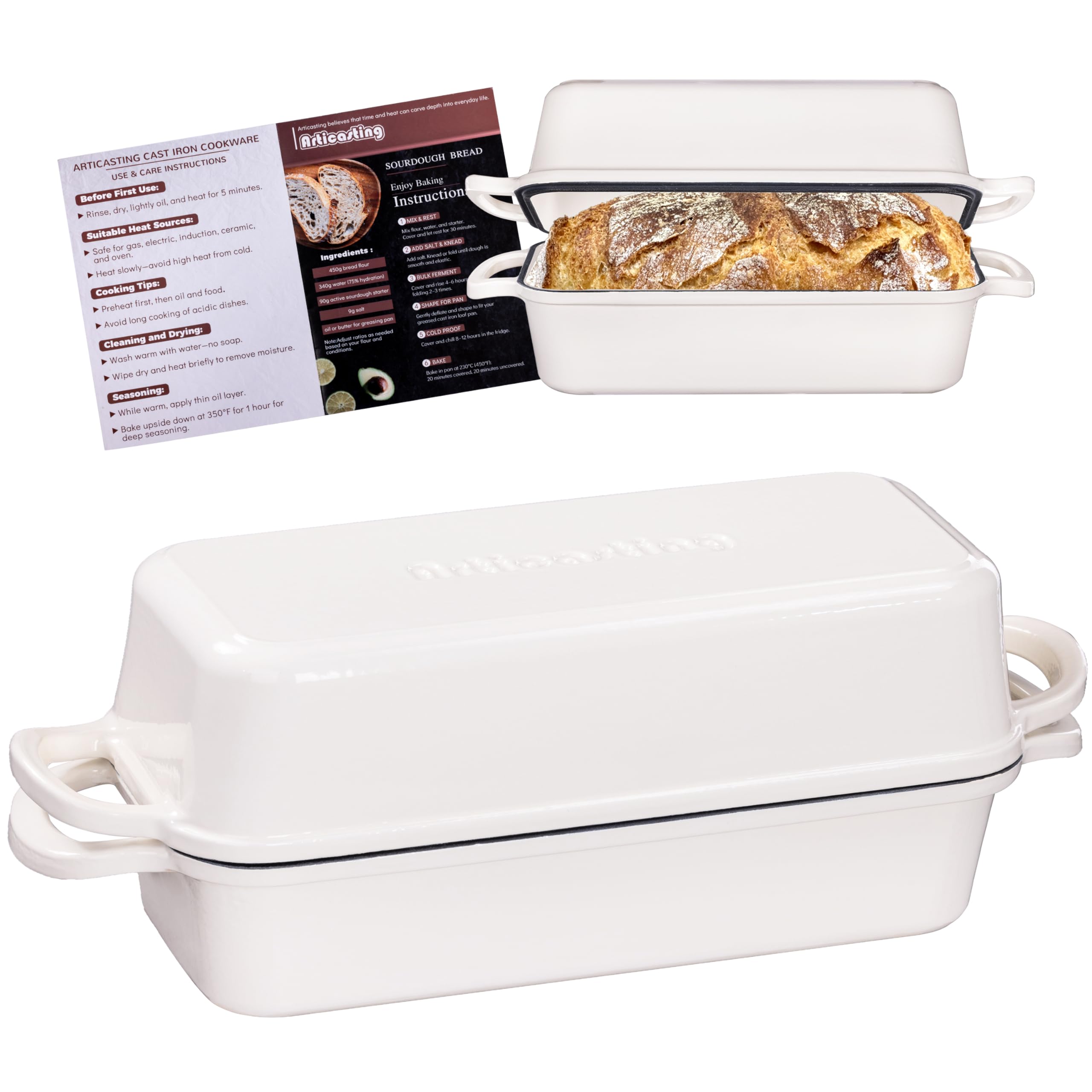
1. Cast Iron Loaf Pan with Lid, 11×5 Inch 5.8 Qt Sourdough Pan
Our pick — 4.5+★ from 750+ verified ratings; the strongest balance of quality and price.
The oversized loaf pan that gives a big batard room to actually spring.
Most loaf pans top out around 1.6 quarts. This Articasting holds 5.8 quarts, which in plain terms means your dough gets roughly three and a half times the room of a standard 9×5 pan. If you have ever watched a well-shaped batard push against the walls of a small pan and bulge sideways, that extra volume is the fix. It also holds about 3 pounds of dough, so a large family loaf or a double batch fits with room to spare.
The build is cast iron with an enamel finish, and the fitted lid turns the whole thing into a sealed steam chamber — the same idea as a Dutch oven, just pressed into a long rectangular shape. The edges meet closely enough that the moisture stays inside where it does the work, and the result is the crackly crust and open interior that a loaf like this is meant to have. Enamel also means you skip seasoning entirely: wash it by hand, dry it, done. What wins people over most is simply how it bakes — the performance is the reason this one sits at the top of the list rather than the middle.
Lifting a loaded pan out of a hot oven needs both hands and a steady grip. It is also long, at 14.4 inches deep, so measure your oven rack and your cabinet before you commit. Owners who bake large loaves weekly consider that a fair trade; anyone with wrist trouble should look at the smaller pans further down.
Where it earns its keep
- 5.8 quarts of interior space — room for oversized batards and party-sized loaves
- Lid seals into a steam chamber for a crisp crust and a soft, open crumb
- Enamel finish needs no seasoning and wipes clean by hand
- Buyers report it handles regular bakes at 450°F and above
What to weigh before buying
- 13.3 pounds empty — a two-handed lift every time
- 14.4 inches deep, so it needs a wide oven rack
- Hand wash only, no dishwasher
The one to buy: bakers who shape big batards or bake for a crowd, and want a pan that does the work of a Dutch oven in a loaf shape.
Think twice if: you bake single small loaves or have limited counter and oven space — the smaller 9×5 pans below will serve you better.
2. Cast Iron Loaf Pan With Lid, 9×5 in
A two-in-one loaf pan that doubles as a small Dutch oven when the lid goes on.
Bachdomc built this as a 9×5 loaf pan first and a mini Dutch oven second, and both jobs work because of the fitted lid. Use the base alone for sandwich bread, banana bread, or a meatloaf, then clamp the lid on when you want the trapped steam that gives sourdough its crackly shell. It carries an oven rating to 500 °F, which is real headroom above the 450-degree range most sourdough recipes call for, so you can preheat hard without worrying about the finish.
The surface arrives pre-seasoned, meaning the iron has already been oiled and baked so it starts out with a natural release layer rather than bare metal. That layer keeps improving as you use it, which is why you hand wash and skip the dishwasher. The build quality is what carries the reputation here — craft and bread quality are the two things bakers talk about most, and the non-stick release earns its own steady stream of approval. Sourdough loaves slide out instead of tearing, and cleanup is a quick wipe rather than a soak.
The thing to plan around is interior room. The footprint is genuinely compact — this is the smallest pan in the lineup — and that compactness cuts both ways. Several bakers find the baking area tighter than they expected, and the iron itself is on the heavy side for its size. Think of it as a dedicated single-loaf pan for a household of two or three, not a pan for oversized artisan boules.
The practical read: this is the pan for a small kitchen that wants Dutch oven steam without a Dutch oven footprint, and the 500 °F ceiling makes it genuinely versatile.
Size it up first: if your typical loaf is large or you bake for a crowd, the tighter interior will frustrate you — the 5.8-quart Articasting above is the better match.
Great match for: solo bakers and couples who want one compact pan that bakes bread, roasts, and slow-cooks.
Pass it by if: you routinely bake loaves that need a wide, long floor to spread out.
3. 9×5 Inch Cast Iron Loaf Pan with Lid
Two pieces that nest together so a heavy pan does not eat your cabinet.
Northriver Casting solves a problem nobody mentions in the photos: what you do with a 10-pound pan between bakes. The two pieces are designed to sit on top of one another, so the whole set stores as a single compact stack instead of two awkward slabs. The curved handles are shaped for a real grip, and the top piece doubles as the lid when you want the sealed environment that produces a crisp crust.
Full cast iron, no enamel, which means it works on gas, electric, ceramic, induction, and even a campfire — the kind of range that turns a bread pan into a camping pan. Capacity runs 3.4 quarts, comfortably above a standard loaf, and the interior handles sandwich loaves, black rye, banana bread, and small casseroles without complaint. The loaves release cleanly and the pan holds up to a 450-degree preheat and bake without drama, which is exactly what you want from raw iron.
Raw iron does ask something of you. Every use ends with a hand wash, a dry over low heat, and a light coat of cooking oil — no dishwasher, no air drying, no shortcuts. Skip that routine and the surface gets tacky. Bakers who enjoy maintaining a pan find it meditative; bakers who want to load the dishwasher and walk away should choose an enameled option instead.
Why it earns a slot: the stacking design is the standout here — a genuinely useful feature on a piece of iron this heavy, and one most competitors ignore.
The maintenance note: plan on the dry-and-oil routine after every single bake, or the natural finish will degrade.
Pick this one if: cabinet space is tight and you are happy to tend a raw iron surface.
Better elsewhere if: you want zero-maintenance cleanup — the Flavehc enameled pan handles that.
4. Bread Pan Cast Iron Loaf Pan with Lid 9×5 Inch
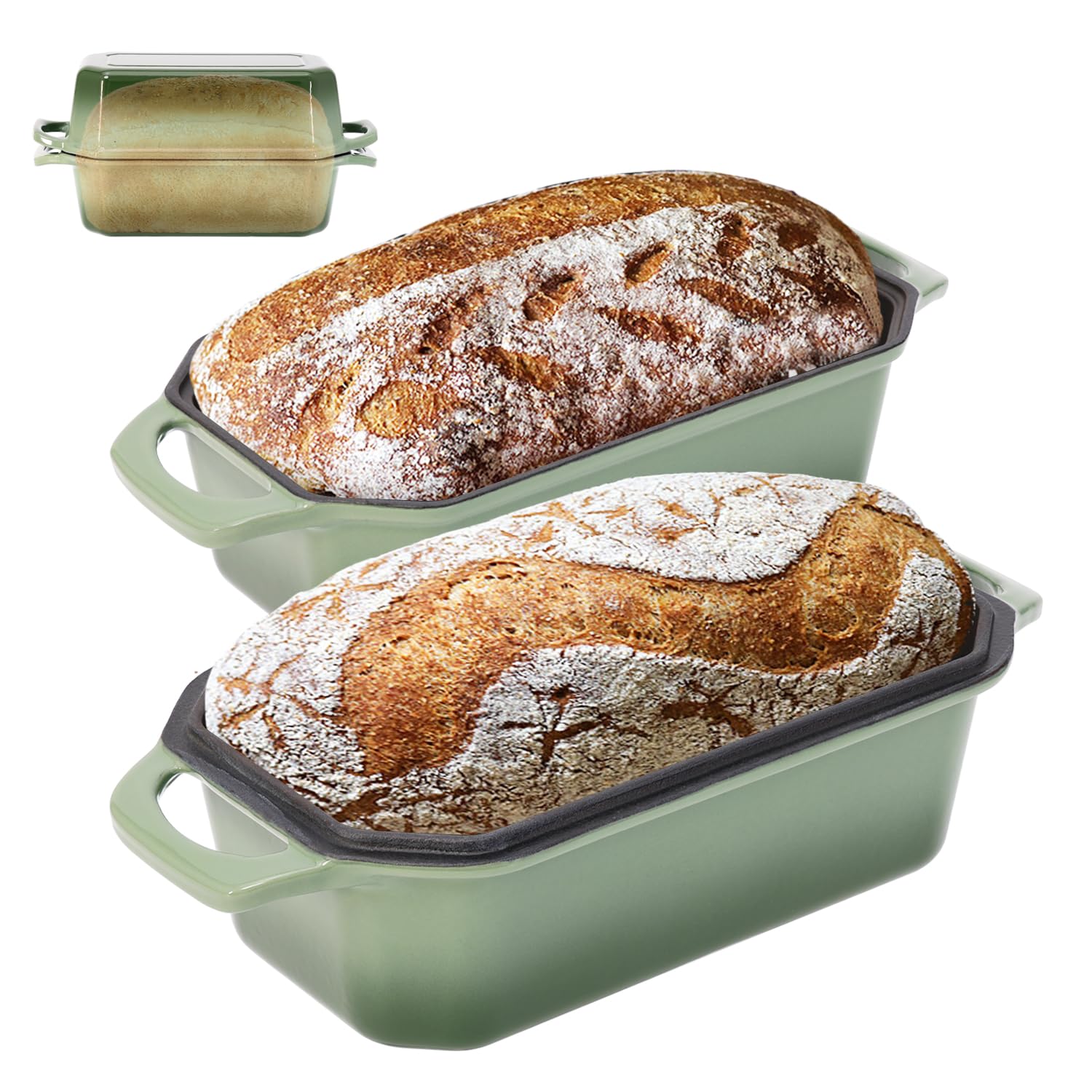
An enameled loaf pan that looks as good on the table as the bread does.
Flavehc takes the standard 9×5 loaf pan and gives it a matte black enamel interior with a colored exterior in AquaGreen. The matte interior is the practical half of that pairing — it releases bread cleanly and wipes down with warm soapy water and a nylon brush. The colored shell is the half you notice, and it is why owners talk about appearance almost as much as baking. It also browns the sides of a loaf nicely, giving the crust an even color rather than a pale band where the bread touched the metal.
Heat handling runs to 500°F, and the cast iron spreads that heat without hot spots, so a sandwich loaf or a pound cake comes out evenly baked from end to end. You can use the second pan as a lid for steam baking, which is where sourdough gets its open crumb. The pan also works on gas, electric, ceramic, and induction cooktops, so it moves from the burner to the oven without switching vessels. Craft is what buyers notice most, with the baking results close behind.
One thing worth knowing before you buy: at 1.6 quarts, the interior is smaller than the capacity figure might suggest, and the pan is heavier than its size implies. If your shaped dough tends to spread wide, it may feel like a squeeze. Reserve a soft brush too — the enamel scratches if you go at it with metal tools.
The color payoff: an enameled exterior that makes the pan worth leaving out, paired with a matte interior that releases loaves cleanly.
Mind the volume: 1.6 quarts is a modest interior, so shape smaller loaves or accept a snug fit.
Made for you if: you want an enameled pan that bakes evenly and looks good enough to serve from.
Look at the bigger pans if: you bake large loaves that need room to spread.
5. CAROTE 5QT Enameled Cast Iron Dutch Oven Pot with Lid

A round 5-quart enameled pot that earns its place on bread night and every other night.
What Carote gets right is the lid. The dome has raised nodes on the inside, and those nodes catch condensation and drip it back onto the food as it cooks — that is what self-basting means in practical terms. Instead of water running down the walls and pooling at the bottom, the moisture returns to the surface. For bread, that same sealed dome holds the steam your loaf needs. For a braise, it keeps the meat from drying out. The 5-quart capacity suits four to six people and handles a whole chicken, a batch of stew, or a round boule.
The enamel surface is smooth and needs no seasoning at all, so there is no maintenance ritual and no worrying about rust between uses. It is rated oven safe to 500°F and works on gas, electric, ceramic, and induction, which means it moves across your whole kitchen without a second pan. Two handles give a secure grip on a heavy loaded pot, and cleanup is a warm soapy wipe rather than a scrub. The value story here is the standout — this is the thing bakers bring up most when they talk about this pot.
The trade-off is the coating. A smooth enamel glaze (a glass-like layer fused to the iron) is tougher than plain iron in some ways and more fragile in others. The recurring note on this pot is chipping and wear on the finish over time, and rust resistance is a weak point. Treat it kindly: no metal utensils, no thermal shock from a hot pot straight into cold water, and a medium-low start before you push the heat up. That routine keeps the glaze intact far longer.
Where the value sits: a self-basting domed lid that bastes and steams in the same motion, at a price that undercuts most round Dutch ovens here.
Care it wants: the enamel is the part that ages, so warm-up slowly, cool it before washing, and keep metal tools out of the pot.
Reach for this if: you want one pot that bakes round sourdough and cooks dinner the rest of the week.
Look elsewhere if: you want a pan you never have to think about — raw iron forgives more abuse than any glaze.
6. Bread Oven Cast Iron Bread Dutch Oven with Cloche Lid

A wide dome over a shallow base — the shape that makes loading a fragile loaf easy.
The base here is deliberately shallow, and that is not a cost-cutting move. A low wall means you can lower a proofed, delicate dough in with two hands instead of dropping it over a high rim and watching it deflate. The dome then goes over the top and gives the loaf vertical room to climb, so the spring goes up rather than out. Once the dome is on and the seal is tight, steam stays inside and does the work on the crust.
Under the dome, the cast iron spreads heat through the base and sides evenly, which is why loaves come out with an even golden shell rather than a pale top and a burnt bottom. The pan is rated to 500°F and works on gas, electric, ceramic, and induction, so it can go from a stovetop sear into the oven. The matte black interior enamel is easy to wipe down, and the colored exterior in Dark Cyan is what buyers notice first when it comes from the start.
It is a heavy pan at 5.28 kg, and the round shape takes up real shelf room — worth checking before you buy. The enamel also wants a nylon brush rather than metal, because scratches show. Neither is a reason to skip it; both are things to know.
What makes it work
- Shallow base lets you set a proofed loaf down gently instead of dropping it
- Dome lid gives the dough headroom for a tall, even rise
- Oven safe to 500°F and works on induction, gas, electric, and ceramic
- Owners mention the same even rise and crust on loaf after loaf
Worth knowing
- 5.28 kg — a heavy lift from a hot oven
- Round shape needs a wide shelf to store
- Enamel scratches if you use metal tools inside
The pick for you: bakers whose dough is fully proofed and fragile, and who want a loading step with less risk of deflating it.
Look at a loaf pan instead if: your oven shelf is narrow — the round dome takes real space.
7. Overmont 5.5QT Enameled Cast Iron Dutch Oven

The pot that already lives in thousands of kitchens and bakes bread on the side.
Overmont’s 5.5-quart is the biggest round pot in this lineup, and its popularity is the loudest signal: the quality of the build is the thing bakers bring up more than anything else, by a wide margin. The enamel is fused to solid cast iron in one piece, so there are no seams to leak or fail, and the heat spreads and holds the way a heavy pot should. That even retention is what makes a sourdough boule bake through without a scorched base.
The lid has the same self-basting idea as the Carote — condensation gathers and drips back down instead of running off. Overmont goes one step further with a cotton heat-resistant cap that goes over the handle, so you can lift the lid without hunting for a mitt. It is oven safe to 500°F (260°C) and works on gas, electric, ceramic, and induction. The enamel wipes clean with a soft sponge. It arrives with a cookbook, a small extra for anyone new to the pot.
Two honest notes. It weighs 12 pounds, so a loaded lift is a deliberate act. And the durability side gets mixed feedback — some customers note wear on the coating over time, which is the general risk with any enamel glaze. Warm it slowly, cool it fully before washing, and it will hold up.
Why it is the safe bet: a one-piece enameled body with even heat and a self-basting lid, backed by a level of buyer confidence few pots here match.
The coating caveat: enamel is the wear point on any pot of this type, so avoid cold-water shocks and metal utensils.
Best for: bakers who want one pot to do bread, stews, and roasts, and who value a proven track record over a niche shape.
Not for: anyone who wants the very lightest pan — 12 pounds is real weight.
8. EDGING CASTING 2-in-1 Pre-Seasoned Cast Iron Dutch Oven, 5 Qt

Take the bread oven outside — the lid is a whole skillet of its own.
Most bread pots live indoors. This one is built to travel. The lid flips over into a shallow skillet, so one piece of kit gives you a baking pot and a frying pan. The handles are integrated loop handles that stay catchable even with thick gloves on. The whole thing is pre-seasoned with vegetable oil rather than coated in enamel, with no synthetic coatings or chemicals on the surface. That means it tolerates a campfire or a grill where a glazed pot would never go.
The 5-quart body holds a good-sized boule with room to rise, and the 10-inch cooking surface on the skillet side is useful for searing, sauteing, or finishing a loaf face-down. Owners consistently describe it as a heavy-duty pot that holds up against high heat, and the versatility of that double-duty lid is the feature people bring up most. Unlike the enameled pots above, there is no coating to chip — the surface is iron all the way through.
Raw iron demands the routine: hand wash in warm water, dry thoroughly over medium heat on the stove, then a very thin coat of oil wiped down with a cloth. Too much oil and the surface goes sticky. It also is not dishwasher safe. If you are committed to that ten-minute habit, it will outlast almost anything else in your kitchen.
The outdoor case: a skillet-lid design and pre-seasoned raw iron make this the pick for grill, campfire, and BBQ baking where enamel stays home.
The routine it wants: hand wash, stovetop dry, thin oil coat — every use, no exceptions.
Choose it if: you bake outdoors, travel with your gear, or want a pot that survives a campfire.
Skip the raw iron if: you would rather not tend a surface after every bake.
9. Lodge Cast Iron Double Dutch Oven, 5 Quart

Iron and oil, nothing else — the pot that outlives everything else in the kitchen.
Lodge makes this from only iron and oil, and the PFAS-free listing matters if you are avoiding synthetic coatings on cookware that sees high heat. There is no enamel to chip, no finish to degrade, and no seasoning layer you cannot rebuild at home. The dual-handle lid doubles as a skillet, so you can sear a roast, bake a boule, or fry potatoes with one vessel and one fewer cabinet shelf to worry about. The lid-as-pan trick is the feature owners bring up most, and the value is close behind it.
Heat distribution is the steady, forgiving kind that cast iron does well — it softens hot spots and holds temperature through the whole bake, which is why sourdough and this pan tend to get along. At 5 quarts it fits a full loaf with room, and the same pot fits a whole chicken with vegetables for dinner. It moves from oven to stovetop to grill to campfire without complaint. Two-in-one use is the other big draw here, and the lid handles make the switch easy.
The honest note is weight. At 13.1 pounds, this is not a casual lift — it is a two-handed, clear-the-rack maneuver, and the same heaviness that makes it stable makes it awkward. That is the price of a pot that will not wear out.
The long view: bare iron you can re-season forever, with a lid that works as a skillet, making this the last bread pot most people will need to buy.
The lift: 13.1 pounds demands two hands and a clear oven rack every time.
Pick it if: you want a pot you will never replace and you are comfortable with raw iron care.
Choose enameled instead if: you want to skip the seasoning routine entirely.
10. VORRINGARD Enameled Cast Iron Sourdough Bread Oven, 5QT, Red
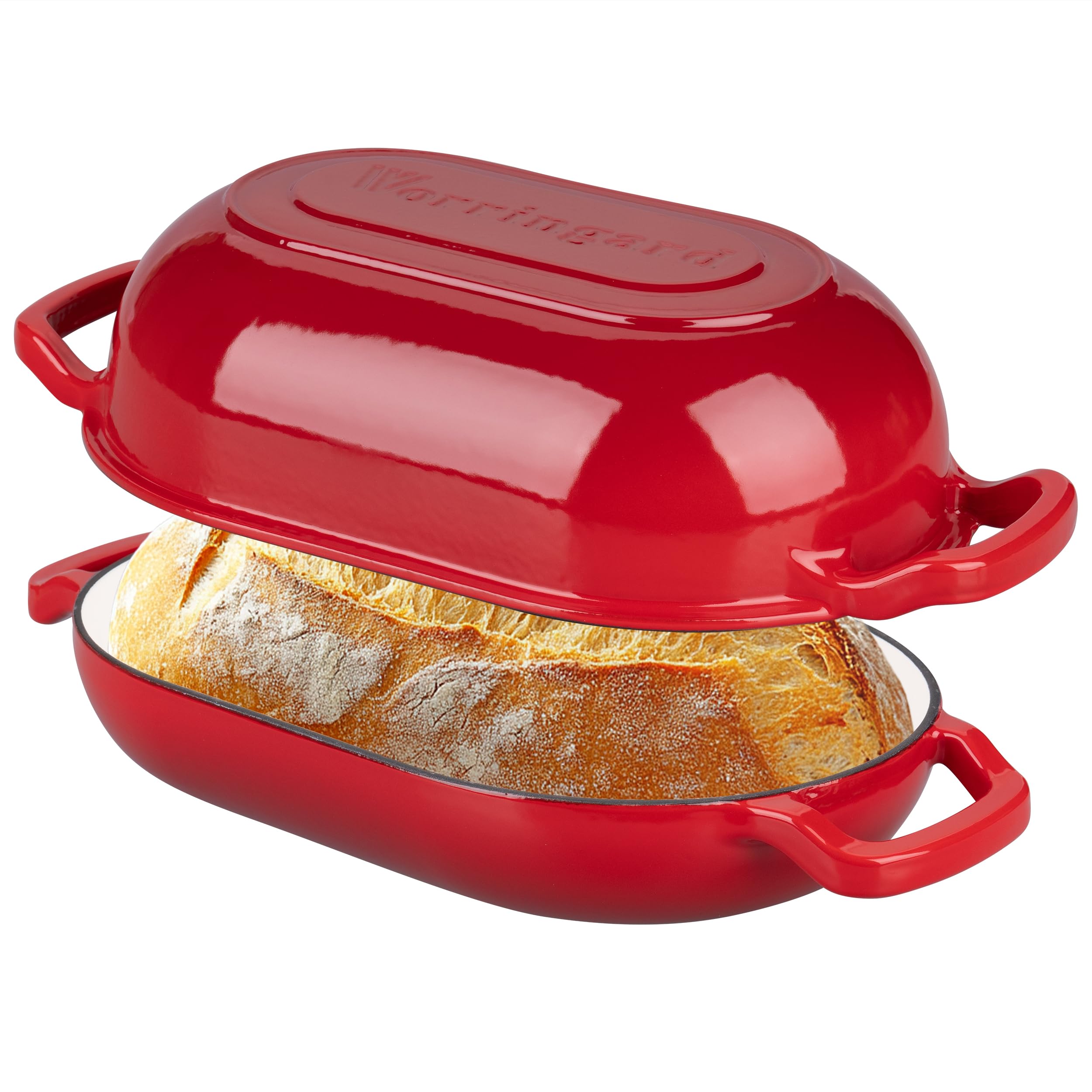
A straightforward round bread oven for bakers who just want their first boule to work.
Vorringard keeps the spec sheet simple: a 5-quart round enameled pot, rated oven safe to 500 degrees F, with looped handles and a lid. That is enough for sourdough, because the 5-quart interior gives a boule room to spring and the sealed lid traps the steam for the crust. The heavy base holds heat so the loaf does not scorch before the middle sets. It also handles slow-cooking, braising, roasting, and boiling, so it is not a one-trick bread pot.
It works on gas, electric, ceramic, and induction cooktops, which is not universal across this category, and it moves from fridge to stovetop to oven to table without a transfer. The enamel wipes clean with warm soapy water and a quick dry. Use wooden or silicone utensils inside, because metal pads or tools will scratch the glaze and once it is scratched there is no fixing it.
The one thing to watch is the coating. Some pots come through fine and some arrive with enamel that cracks on the first use, which is the classic risk of any glazed pot. Inspect it when it lands, follow the no-metal-tools rule, and bake with it rather than over-firing it on an empty burner.
Solid points
- 5 quarts and a sealed lid — the right basics for a boule
- Oven safe to 500 degrees F with induction compatibility
- Enamel wipes clean with warm soapy water
- Reviewers point out the heavy, sturdy build and the easy wipe-down cleanup
Handle with care
- The enamel is the weak link — inspect on arrival
- Metal tools will scratch the glaze permanently
- No dishwasher, hand wash only
Made for you if: you want a simple, induction-friendly round pot for your first sourdough attempts.
Consider a loaf pan if: your loaves are shaped long rather than round.
11. CRUSTLOVE 5 QT Pre-Seasoned Dutch Oven

The one box that turns a kitchen into a bread bakery with almost no add-ons.
Most guides assume you already own a proofing basket, a scoring blade, and a sling. This set does not. Alongside the pre-seasoned 5-quart cast iron pot you get a banneton proofing basket, a silicone bread sling, a scoring lame, a dough whisk, a metal and plastic scraper, a brush, and a recipe booklet in English and Spanish. For someone starting from zero, that is the whole supply list in one purchase and one gift box.
The pot itself is a pre-seasoned round 10-inch cast iron oven, and the seasoned surface gives a natural release that improves as you use it. The 5-quart interior handles a boule (a round loaf) comfortably, and the lid traps steam for the crispy crust. Shoppers say the quality of the pot is what they come back to praise, with the completeness of the kit right behind it. They also say the lidded pot turns out better-flavored, more evenly baked bread than their unlidded bakes.
Two weights on the scale. The tools are the softer part of the bundle — the dough whisk is known to break, so treat it as the disposable piece and keep the pot. The recipe booklet divides opinion as well. The pot is the durable investment; the accessories are a bonus, not the reason to buy.
The full-package case: a quality 5-quart pot plus every bread tool a beginner needs, arriving as one ready-to-gift box.
The soft spot: accessories like the whisk wear out first, so plan to keep the iron and replace the small stuff.
Ideal for: a new baker or a gift for someone starting sourdough, and anyone who does not want to shop for six tools separately.
Not needed if: you already own a proofing basket and a lame — the pot alone serves you.

Two round loaves, one oven cycle — the pan for bakers who never bake just one.
Nuovva built this with two separate round loaf spaces, each 16.5 centimeters across, so a single batch produces two small boules at the same time. If you have been baking one loaf, waiting for the oven to cool, then baking the second, this halves the time an oven cycle costs you. The two cavities are separate rather than shared, so each loaf gets its own sealed little chamber and its own even browning. Buyers report both loaves browning golden in 40 minutes and releasing cleanly from the cavities.
The body is cast iron under a reinforced enamel coating, rated oven safe to 500°F and compatible with gas, electric, ceramic, and induction cooktops. The enamel is the practical piece: it resists chips and cracks under normal use and wipes down without a soak. The cast iron keeps the heat steady through the bake, which is what prevents one loaf browning faster than the other. Size is a genuine strength here — two smaller loaves are what most people actually want for toast, sandwiches, and freezing half.
What it is not is a pan for a big artisan batard. The individual loaf spaces are small by design, and if you want one large oven-spring showstopper this will feel restrictive. It is also genuinely heavy in the hand, which is the standard cost of a double cast iron pan. Buy it because you want two, not one.
Where it shines: two 16.5cm loaf spaces in one pan mean two evenly baked boules per cycle, and the enamel makes the cleanup a wipe.
Where it limits you: small loaf spaces rule out large single loaves, and the pan carries real weight.
Choose this pan if: you bake in pairs and prefer two smaller loaves over one big one.
Look to a single-space pan if: your whole bake is one large loaf.
12. Sxmprail Cloche Loaf Dutch Oven, 9.5QT

A 9.5-quart oval cloche that bakes a loaf big enough to carry a family dinner.
At 9.5 quarts, this is easily the biggest vessel on this list, more than twice the capacity of the largest loaf pan here and well beyond any 5-quart round oven. It is an oval cloche, meaning a shallow base with a domed cover that slides over the top, and that design gives a long rustic loaf room to spread and rise the way a bakery batard does.
The iron is thick and pre-seasoned with natural vegetable oil, with no chemical coatings. The lid distributes radiant heat downward so the top of the loaf browns as evenly as the base, and it fits snugly enough to lock in steam for a caramelized crust. It works on gas, ovens, and induction, and the kit includes a metal and plastic scraper, a silicone bread sling, a scoring lame with leather sheath, a cleaning brush, and a dough whisk. Sourdough bakers report perfect loaves every time, and one pan still looked new after 50+ bakes.
The weight is the thing to plan for. At 15.4 pounds, this is one of the heaviest pieces in the lineup, and handling a wide oval of hot iron with one hand is not realistic. The handles also divide opinion — some find the angle awkward when pulling the lid clear. Both are worth knowing before you commit to a pan this size.
Why it deserves a look
- 9.5 quarts on an oval floor — the best option for very large rustic loaves
- Pre-seasoned raw iron with no chemical coatings
- Ships with a full set of bread tools, from sling to lame
- Ergonomic handles on both the base and the lid
Be ready for
- 15.4 pounds — a genuinely heavy lift
- Handle placement splits opinion on a pan this wide
- Oval shape needs a wide oven rack and shelf
The right call for: bakers producing long, large artisan loaves and anyone feeding a crowd from one bake.
Not the right call for: small kitchens or anyone who wants a pan they can move with one hand.
13. KUHA Cast Iron Bread Oven with Lid

An elongated oven built around one job: giving a batard a cleaner rise and an easier score.
Oval is not a fad shape — it is the shape of a batard, and Kuha leans on that. The 12.2-inch interior length means a shaped oval loaf is not pressing against end walls, so the spring is even along the whole length instead of bunching in the middle. That even expansion is what produces a more symmetrical loaf and, in practice, a score line that opens the way you cut it rather than dragging. If your scoring has always come out lopsided, the pan shape may be the reason.
The fitted lid seals down to trap moisture, and the trapped steam is what gives deep color, a crackly shell, and a soft interior. The surface arrives pre-seasoned with natural oil for an easier release from the start, and it gets better with continued use as the finish builds into a stronger natural non-stick layer. It is oven safe to 500 degrees F and works on gas, electric, and induction cooktops. Owners describe beautiful sourdough and perfect loaves, and single out how evenly the oval base holds and spreads heat.
It is a substantial pan at 15 pounds, and the wide oval footprint takes a full oven rack. Wide handles help you lift it safely, and they are worth using properly — get both hands under it. Heavy iron is the trade for steady heat, and this one is fully in that bargain.
The shape advantage: a 12.2-inch interior length lets a batard expand evenly end to end, which supports a cleaner score and a more even rise.
The handling demand: at 15 pounds it wants two hands and a cleared rack every time.
Pick it if: you bake oval batards and care about how a loaf springs along its whole length.
Look at a round oven if: you bake boules — the oval would limit your shaping.
14. Challenger Bread Pan Cast Iron Loaf Pan with Lid
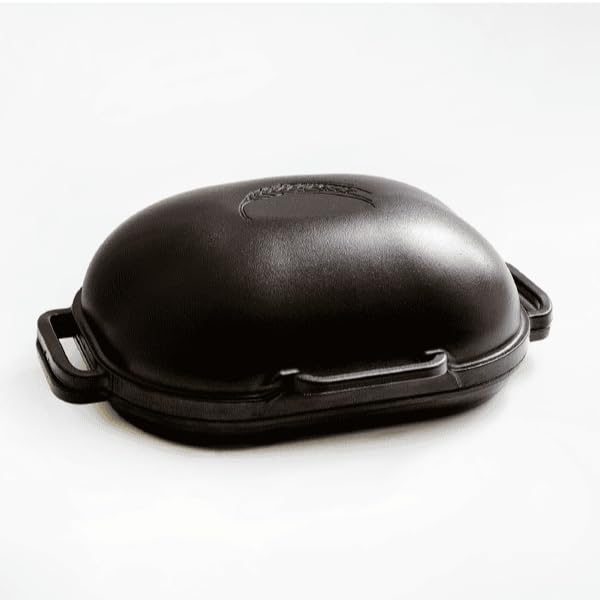
The bread pan built around the one moment Dutch ovens make dangerous: getting the dough in.
Challenger’s whole design argument is safety and repeatability. The base is shallow, so you set your scored dough down gently instead of dropping it over a hot wall. Then the precision-fit lid goes on. The handles sit on the lid and are shaped for bulky oven mitts, so you carry the hot weight with a grip that actually fits your hand. Around the fifteen-minute mark you invert the lid into the base, which lifts the loaf off the direct floor — the maker’s stated reason is to help prevent a burnt bottom.
The pan measures 15.5 inches long by 10.5 inches wide by 5.5 inches high and takes oven temperatures up to 500°F, sized to fit most home ovens while still giving an artisan loaf a long floor. It comes pre-seasoned with grapeseed oil, which develops a natural non-stick surface with time and proper care. Quality is what owners bring up most, with the baking performance close behind, and it earns fresh praise for crust quality, lid handles, and versatility — focaccia bakes in it easily, not just sourdough.
The obvious question is the 20-pound weight, the heaviest pan on this list by a clear margin, and you pay a premium for the patented design. The flip side is a bake that repeats: same spring, same crust, same release, batch after batch. If consistency is the thing you are chasing, the design earns its price. If you bake occasionally, a simpler pan will do the same job.
The case for the premium
- Shallow base and mitt-sized handles make loading a proofed loaf safer than a deep Dutch oven
- Inverted-lid step helps prevent burnt bottoms, per the maker
- 15.5 x 10.5 inches at 500°F, sized for a long artisan loaf in a home oven
- Repeatable crust and release, bake after bake
Before you commit
- 20 pounds — the heaviest pan here by a wide margin
- The highest investment on this list by a clear step
- The flip-and-invert step adds a maneuver to learn
The one for repeat bakers: sourdough regulars who want the same result every week and will pay for a pan designed around that.
The reason to pass: you bake a few times a month — the weight and cost are hard to justify over a standard Dutch oven.
15. Sxmprail Cloche Loaf Dutch Oven, 15.4 LBS
A 9.5-quart oval cloche that bakes a loaf big enough to carry a family dinner.
At 9.5 quarts, this is easily the biggest vessel on this list, more than twice the capacity of the largest loaf pan here and well beyond any 5-quart round oven. It is an oval cloche, meaning a shallow base with a domed cover that slides over the top, and that design gives a long rustic loaf room to spread and rise the way a bakery batard does.
The iron is thick and pre-seasoned with natural vegetable oil, with no chemical coatings. The lid distributes radiant heat downward so the top of the loaf browns as evenly as the base, and it fits snugly enough to lock in steam for a caramelized crust. It works on gas, ovens, and induction, and the kit includes a metal and plastic scraper, a silicone bread sling, a scoring lame with leather sheath, a cleaning brush, and a dough whisk. Sourdough bakers report perfect loaves every time, and one pan still looked new after 50+ bakes.
The weight is the thing to plan for. At 15.4 pounds, this is one of the heaviest pieces in the lineup, and handling a wide oval of hot iron with one hand is not realistic. The handles also divide opinion — some find the angle awkward when pulling the lid clear. Both are worth knowing before you commit to a pan this size.
Why it deserves a look
- 9.5 quarts on an oval floor — the best option for very large rustic loaves
- Pre-seasoned raw iron with no chemical coatings
- Ships with a full set of bread tools, from sling to lame
- Ergonomic handles on both the base and the lid
Be ready for
- 15.4 pounds — a genuinely heavy lift
- Handle placement splits opinion on a pan this wide
- Oval shape needs a wide oven rack and shelf
The right call for: bakers producing long, large artisan loaves and anyone feeding a crowd from one bake.
Not the right call for: small kitchens or anyone who wants a pan they can move with one hand.
16. KUHA Cast Iron Bread Oven, Oval Dutch Oven
An elongated oven built around one job: giving a batard a cleaner rise and an easier score.
Oval is not a fad shape — it is the shape of a batard, and Kuha leans on that. The 12.2-inch interior length means a shaped oval loaf is not pressing against end walls, so the spring is even along the whole length instead of bunching in the middle. That even expansion is what produces a more symmetrical loaf and, in practice, a score line that opens the way you cut it rather than dragging. If your scoring has always come out lopsided, the pan shape may be the reason.
The fitted lid seals down to trap moisture, and the trapped steam is what gives deep color, a crackly shell, and a soft interior. The surface arrives pre-seasoned with natural oil for an easier release from the start, and it gets better with continued use as the finish builds into a stronger natural non-stick layer. It is oven safe to 500 degrees F and works on gas, electric, and induction cooktops. Owners describe beautiful sourdough and perfect loaves, and single out how evenly the oval base holds and spreads heat.
It is a substantial pan at 15 pounds, and the wide oval footprint takes a full oven rack. Wide handles help you lift it safely, and they are worth using properly — get both hands under it. Heavy iron is the trade for steady heat, and this one is fully in that bargain.
The shape advantage: a 12.2-inch interior length lets a batard expand evenly end to end, which supports a cleaner score and a more even rise.
The handling demand: at 15 pounds it wants two hands and a cleared rack every time.
Pick it if: you bake oval batards and care about how a loaf springs along its whole length.
Look at a round oven if: you bake boules — the oval would limit your shaping.
17. Challenger Bread Pan Cast Iron Loaf Pan, Made in USA
The bread pan built around the one moment Dutch ovens make dangerous: getting the dough in.
Challenger’s whole design argument is safety and repeatability. The base is shallow, so you set your scored dough down gently instead of dropping it over a hot wall. Then the precision-fit lid goes on. The handles sit on the lid and are shaped for bulky oven mitts, so you carry the hot weight with a grip that actually fits your hand. Around the fifteen-minute mark you invert the lid into the base, which lifts the loaf off the direct floor — the maker’s stated reason is to help prevent a burnt bottom.
The pan measures 15.5 inches long by 10.5 inches wide by 5.5 inches high and takes oven temperatures up to 500°F, sized to fit most home ovens while still giving an artisan loaf a long floor. It comes pre-seasoned with grapeseed oil, which develops a natural non-stick surface with time and proper care. Quality is what owners bring up most, with the baking performance close behind, and it earns fresh praise for crust quality, lid handles, and versatility — focaccia bakes in it easily, not just sourdough.
The obvious question is the 20-pound weight, the heaviest pan on this list by a clear margin, and you pay a premium for the patented design. The flip side is a bake that repeats: same spring, same crust, same release, batch after batch. If consistency is the thing you are chasing, the design earns its price. If you bake occasionally, a simpler pan will do the same job.
The case for the premium
- Shallow base and mitt-sized handles make loading a proofed loaf safer than a deep Dutch oven
- Inverted-lid step helps prevent burnt bottoms, per the maker
- 15.5 x 10.5 inches at 500°F, sized for a long artisan loaf in a home oven
- Repeatable crust and release, bake after bake
Before you commit
- 20 pounds — the heaviest pan here by a wide margin
- The highest investment on this list by a clear step
- The flip-and-invert step adds a maneuver to learn
The one for repeat bakers: sourdough regulars who want the same result every week and will pay for a pan designed around that.
The reason to pass: you bake a few times a month — the weight and cost are hard to justify over a standard Dutch oven.
Know the Specs
Capacity in quarts and liters
Capacity tells you how much dough the vessel can hold, and it matters more than the wall thickness for how your loaf rises. A 5-quart round oven fits a standard boule with room to expand, while a 1.6-quart loaf pan is a snug single-loaf shape. Bigger is not always better — a pan far wider than your dough leaves too much open floor, and the loaf spreads instead of climbing. Match the capacity to the loaf you shape most often. Note that brands mix quarts and liters in their listings; a 4.75-liter pan and a 5-quart pan are close but not identical, so confirm which unit you are reading before you compare two models.
Oven-safe temperature rating
This number is the ceiling for the whole pan, including the lid and any handle or knob. Sourdough recipes often call for a hot oven, and a pan rated to 500°F gives you headroom above that, which lets you preheat hard and bake for a dark crust. The rating usually reflects the finish and fittings rather than the iron itself — enamel coatings and lid knobs are the parts that set the limit. Stay at or under the stated number, and if your recipe asks for more heat than your pan allows, lower the oven and bake slightly longer instead.
Enamel coating versus pre-seasoned iron
Enamel is a glass-like layer fused to the cast iron. It wipes clean, needs no seasoning, and will not react with acidic doughs, but it can chip and it scratches if you use metal tools inside. Pre-seasoned iron is bare iron finished with oil. It develops a natural release that improves with use and can be re-seasoned at home if the surface wears. It does ask for hand washing, thorough drying, and a thin oil coat after each bake.
Lid fit and steam retention
The lid is what turns a pan into a steam chamber. During the first part of a bake your dough releases moisture, and if that moisture is trapped, the crust stays soft long enough for the loaf to expand. A lid described as fitted, snug, or self-basting serves that purpose. A lid with interior nodes, or one designed to let condensation drip back down the center rather than run off the sides, spreads that moisture more evenly. A lid that merely rests loose lets the steam escape early.
Common Questions
Can I bake sourdough in a loaf pan instead of a round Dutch oven?
Does cast iron need to be seasoned before the first sourdough bake?
How do I stop my sourdough from sticking to a cast iron loaf pan?
What oven temperature can an enameled cast iron bread oven take?
Is an oval bread oven better than a round one for sourdough?
How much does a cast iron bread oven weigh, and does it matter?
Can I use metal utensils in an enameled cast iron pan?
Why does my bread burn on the bottom in a Dutch oven?
Does a cast iron bread oven work on induction, gas, and electric cooktops?
Do I need a lid for sourdough baking in cast iron?
The Bottom Line
For one decent-sized loaf most weeks, with a lid you want sealed and a pan you can lift without a struggle, the Articasting 11×5 Sourdough Pan is the one to own. It carries more interior room at 5.8 quarts than any loaf pan here, the lid does the steam work, and the enamel means no seasoning ritual. It also sits at the top of the ratings among the loaf-shaped options, which is the pattern you want backing a first purchase.
If your bake is a round boule and you want a pot that pulls double duty for dinner, the Overmont 5.5QT Dutch Oven is the safest call. The Lodge Double Dutch Oven is the one to buy if you want a lid that works as a skillet and iron you can re-season forever. For long oval batards (football-shaped loaves), the KUHA Oval Bread Oven matches the shape you already produce.
And if you want a pan designed from the first cut around the loading moment, the Challenger Bread Pan is the one experienced bakers keep coming back to. Whichever you pick, buy the shape you actually bake. That single decision matters more than any other spec in this guide.
How we choose
We do not accept paid placement. Every pick is matched to a real buyer and a real use-case; we do not hands-on test units.
Sources
Specifications: manufacturer listings and product documentation. Review insights: verified customer reviews, as of October 2026. Pricing: not shown on this page (it changes often); check the current price via the retailer link.
As an Amazon Associate, Aappliancez earns from qualifying purchases. This does not affect which products we feature.