Disclosure: Some links in this post are affiliate links. As an Amazon Associate I earn from qualifying purchases, at no extra cost to you. Learn more
Specs are compiled from manufacturer listings and verified buyer reviews and can change over time — please confirm the key details on the product page before buying.
If your cassette collection has been sitting in a shoebox for twenty years, the hardest part is not finding a deck — it is finding one that will not chew, warp, or dull the tapes you cannot replace. Most brand-new decks sold today use the same basic transport mechanism, so the real differences come down to how well that mechanism is built and what it lets you do with the audio. This guide covers eight decks that actually play tapes back safely, from pocket-sized portables to dual-well studio workhorses.
This guide is built by comparing the manufacturers’ published specifications and the patterns across verified customer reviews, so you get each pick’s real strengths and trade-offs instead of marketing spin.
You will see which decks handle Type I and Type II tapes, which ones send audio to a computer for archiving, and which ones are really just nostalgic furniture. Every pick here is judged on the things that matter for playback and recording, so you can spot the right cassette tape deck for your shelf without guessing which specs are marketing noise.
Top Picks

How To Choose The Best Cassette Tape Deck
Almost every new cassette deck uses the same budget tape transport, a mechanism often called a Tanashin clone (a low-cost copy of a classic tape drive design). So the deck you pick won’t sound dramatically different from the rest in raw fidelity — what changes is the build around that mechanism, the tape types it supports, and the connections for getting audio out of it.
Tape Transport And Wow And Flutter
Wow and flutter is the speed wobble that makes a held piano note drift slightly sharp or flat. Lower is better, and metal flywheels (weighted spinning wheels inside the deck) help steady the tape speed. A deck with a stiffer mechanism also keeps tape-to-head contact even so the music does not sound thin or hollow.
Type I, Type II, And Type IV Tapes
Type I normal tapes are the everyday ferric cassettes. Type II chrome tapes have a different chemical coating that needs a different recording bias setting, and Type IV metal tapes are the highest-output stock. A deck that only records to Type I is still useful, but you will want one that at least plays Type II and Type IV so your old chrome tapes sound right.
Noise Reduction And Digital Output
Dolby B noise reduction was the standard hiss suppressor of the cassette era. Most modern decks offer decode-only support, meaning they can play Dolby B tapes cleanly but cannot record with it. A USB output is a separate feature: it sends the audio straight to your computer so you can save tapes as files instead of relying on analog cables.
Side-by-Side Comparison
| Model | Best For | Tape Support | Archiving Output | Deck Style | Amazon |
|---|---|---|---|---|---|
| Tascam 202MKVII★ Best Overall | Archiving tapes to a computer | Plays Type I/II/IV, records Type I | USB Type B | Dual well | Amazon |
| TEAC W-1200BTop Performer | Recording and dubbing new tapes | Records Type I/II, plays Type IV | USB digital output | Dual well | Amazon |
| Pyle PT659DUPremium Pick | Basic home playback on a budget | CrO2 selector, Type I/CrO2 | USB to computer | Dual well | Amazon |
| LoopTone 10 in 1 | One box for vinyl, CD, and tape | Not stated | USB recording | All-in-one | Amazon |
| HONGUT HF-638PBT-1 | Multi-format home system | Dual cassette well | Not stated | All-in-one | Amazon |
| FiiO CP13 | Portable listening on the move | Not stated | None (headphone only) | Portable | Amazon |
| Supersonic SC-2121BT | Boombox-style tape playback | Dual cassette recorder | USB input only | All-in-one | Amazon |
| MONODEAL CD1013 | Casual all-in-one listening | Single cassette well | USB input only | Compact combo | Amazon |
Detailed Reviews
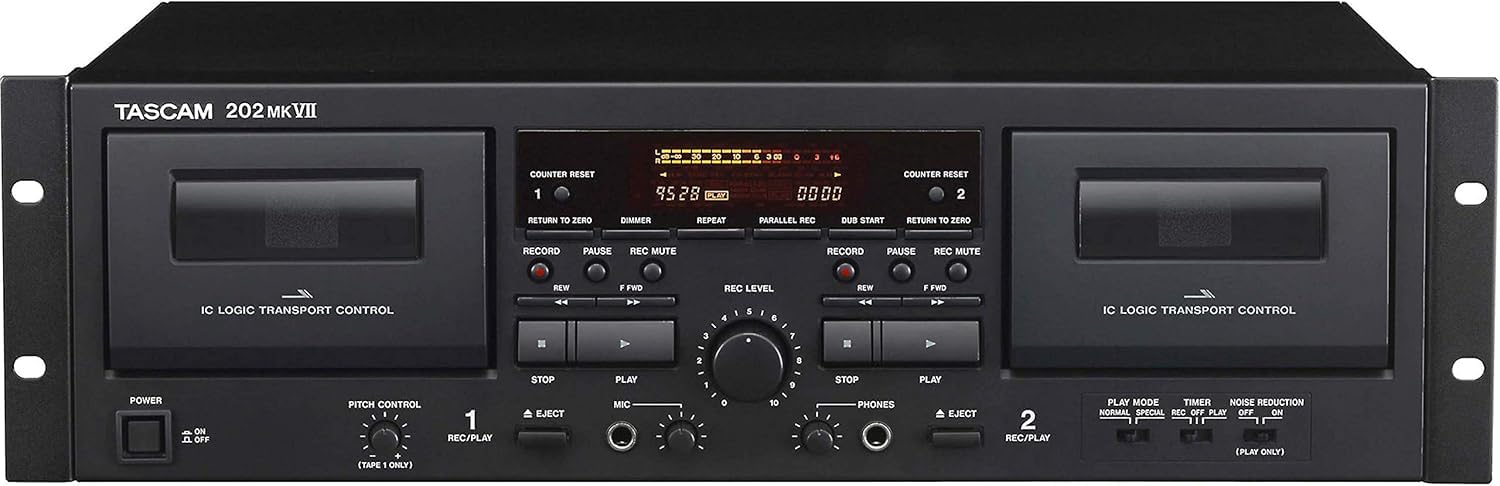
1. Tascam 202MKVII Double Cassette Deck Recorder
Our pick — 4.5+★ from 150+ verified ratings; the strongest balance of quality and price.
Two tape wells, metal flywheels, and a USB port that sends your tapes straight into recording software.
The thing that makes this Tascam worth its spot at the top is the rear USB Type B port. Unlike Tascam flash-drive decks that are locked at low 128kbps, this deck connects to your PC or Mac and captures audio into recording programs like Audacity or Studio One. You then save at any bitrate, such as 320kbps, or as lossless WAV or FLAC. For degrading family recordings or rare tapes, that USB capture is what lets you save a lossless copy before the tape gives out.
Both tape wells record, and both are full-logic controlled on a metal chassis. The metal flywheels — weighted wheels that keep the tape spooling at a steady speed — cut down on wow and flutter, so voices stay on pitch. This deck plays Type I, Type II, and Type IV tapes, records to Type I only, and offers decode-only Dolby B-compatible noise reduction. Deck A has pitch adjustment, which helps if an old tape was recorded slightly fast or slow.
This Tascam measures 22 x 15 x 9 inches, which is a real shelf commitment — the comparison facts here say it is a 2.2x gap in size versus the compact MONODEAL combo at 10 x 5 x 3.5 inches. But you get a real machine for that space. What wins people over is overall quality, and the recurring gripe is narrower: auto-reverse is absent, so you flip tapes yourself at the end of a side, and the tape counter reads in seconds only. Doors need a firm push too. As owners put it, this is the best of what is available new, not a match for the 1980s audiophile decks.
Where this deck earns its price
- Rear USB Type B recording into a computer at any bitrate or lossless WAV/FLAC
- Dual decks for dubbing, with both wells recording
- Metal flywheels keep wow and flutter low for steady pitch
- Plays Type I, Type II, and Type IV tapes; Deck A has pitch adjust
The catches worth knowing
- No auto-reverse, so you flip each tape manually
- Tape counter measures seconds, not minutes and seconds
- Records to Type I only, with no bias or EQ adjustment
Right call for: anyone with irreplaceable tapes who needs a clean digital copy without spending on a vintage service-grade deck.
Reconsider if: you mostly want to sit back and listen — the manual flip at every side end wears thin.
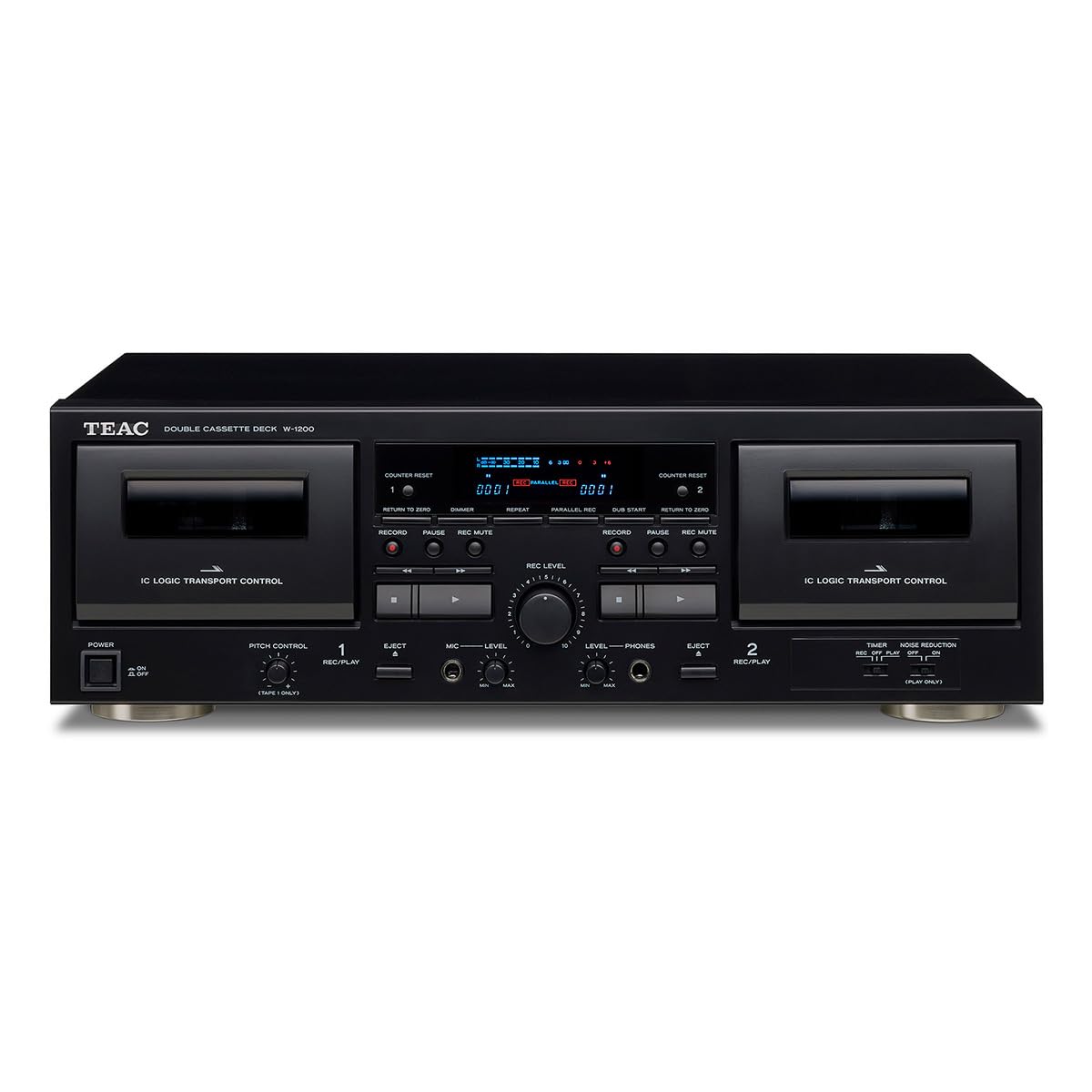
2. TEAC W-1200B Dual Cassette Deck
The deck that puts tape recording back in reach, complete with parallel dubbing and a mic input.
Owners walked 300+ tapes out of storage and discovered this deck could play them bright and crisp again. Two independent mechanisms let you record to both wells at once, so a single pass makes two identical copies. One-touch dubbing speeds up the copy, and a 12% pitch control plus A-B repeat add flexibility for timing a mix or matching a tape recorded slightly off-speed.
On the tape-support front, this is the friendlier machine for recording: it records and plays Type I normal and Type II chrome tapes with auto-detect, and it plays Type IV metal tapes with auto-detect too. The noise reduction system works during playback, matching Dolby B. A USB output sends audio to a PC or Mac at CD-quality 48kHz/16-bit PCM. There is a 6.3mm stereo headphone jack, RCA inputs, a karaoke mic input with mic mixing, and a remote in the box — this W-1200B is a fuller recorder than the Tascam, which records Type I only.
What owners go back to is functionality — the dual wells, parallel recording, and the one-touch dubbing all work without fuss. The honest trade is that a few decks arrive with one bay sounding muffled until the azimuth (head alignment) is adjusted, which may be covered under warranty. There is no auto-reverse and the deck does not switch wells automatically when a side ends, so a long tape stops rather than flips itself. The one-year parts and 90-day labor warranty covers the long haul.
Recording first: if you plan to cut new tapes from CDs or digital files, the dual record wells, Type II support, and mic mixing give you tools no other deck here offers.
The honest limit: twenty-plus-year-old features like three heads and dual capstans are gone, so this is about as good as new hardware gets — not an equal to the vintage high-end.
Go for it if: making mix tapes or dubbing a collection in parallel is the whole point.
Hold off if: you need auto-reverse hands-free playback for hours of listening.
3. Pyle PT659DU Dual Stereo Cassette Tape Deck
A no-frills dual deck that revives a stack of cassettes for a home stereo without a lot of menu diving.
For a basic home-stereo revival, the pitch here is simplicity. Two wells, normal and high-speed dubbing, an RCA output for an amplifier or receiver, and a USB cable for sending tapes to a computer as MP3. The CrO2 tape selector means your 30-year-old Maxell chrome tapes get the right playback EQ instead of sounding dull.
Simplicity cuts both ways, and that shows in the spec sheet. There is no headphone jack, no Dolby, and only CrO2 play/record settings — no bias or EQ adjustment. Only deck B records and dubs. The record level meters are described by owners as not fully accurate. Build quality is thin plastic by all accounts, and the auto-stop function can miss very old, worn tapes, letting a tape run to the end. One owner who reported a broken tape stopped at a small fraction of use, so treat long-term expectations as modest.
The deck does what it promises for playback — pre-recorded tapes come through clear into a receiver — and the CrO2 support rescues older chrome stock. Measured against the Tascam’s metal chassis and metal flywheels, the Pyle is lighter and less substantial. It suits playback with occasional MP3 archiving over USB; for recording new tapes with bias and level control, look at the TEAC.
Realistic read: the price-to-feature balance works for a short-term revival project, especially if the deck spends most of its time playing rather than recording.
What to weigh: the plastic build and lack of a headphone jack push this toward a fixed home-stereo setup rather than a flexible recorder.
Pick this when: you want a simple dual deck to connect to a receiver and play a box of old tapes.
Look elsewhere when: you plan to record or dub frequently with precise level control.
4. LoopTone Vinyl Record Player 10 in 1

One cabinet for vinyl, cassette, and CD — with a tape deck built in rather than tacked on.
If the goal is a single box that plays everything, this is the strongest package here. A 3-speed turntable handles 33-1/3, 45, and 78 RPM records, a CD player and cassette deck sit alongside it, and there is an AM/FM radio with a digital LCD display. Bluetooth works both directions — stream from your phone into the built-in speakers, or send the turntable’s audio to Bluetooth earphones. RCA line-out lets you feed a home stereo, and there is a USB recorder for capturing vinyl to MP3 or cassette.
The cassette side is honest about what it is: a working transport that plays tapes at the correct speed in a compact retro-styled cabinet. What wins people over is build quality and the compact size — enough that owners move it between rooms without a fuss. Sound quality is the most-discussed point in the reviews, and the consensus is mixed: clean enough for casual listening, and better once you swap the stylus and add studio monitors. The built-in preamp cannot be boosted externally, so tape and record rips come out quieter until you raise them in a recording program.
Two quirks to plan around. The remote does not control volume, and the turntable wants a steady surface so the tape deck does not wobble.
What you gain in one box
- Turntable, cassette, CD, and AM/FM radio in one compact cabinet
- Bluetooth in and out, plus RCA line-out for a home stereo
- USB recording to MP3 or cassette from vinyl
Where it asks patience
- Remote skips volume control
- Built-in preamp cannot be boosted, so rips land quiet
- Tape sound is decent, not a hi-fi recorder
Made for: the person with a few records, a few tapes, and a small room who wants one tidy unit.
Not the fit for: anyone chasing studio-grade tape recording — that is the TEAC’s territory.
5. HONGUT Bluetooth Vinyl Stereo Record Player System

A full stereo tower that stacks two cassette wells and a three-CD changer in one cabinet.
Setup is the part owners like best here. Everything — turntable, dual cassette, CD changer, FM radio — arrives ready to play, and the 3-speed turntable handles 33, 45, and 78 RPM records across 7, 10, and 12-inch sizes with an auto-stop feature. FM radio stores up to 20 AM and 20 FM stations through memory. Bluetooth 3.0 lets you stream from a phone, and a 45RPM adaptor handles the small 7-inch records.
The dual cassette deck places two cassettes at once for dubbing. It is a playback-focused deck rather than a recorder with setting control — no separate tape-type selector is documented. The CD player holds up to 3 discs with play, pause, fast-forward, rewind, record, and stop controls. Sound is described as better than other comparable Amazon all-in-ones but below a pre-2000 component stereo. The tonearm lacks a lift lever, which owners note makes stopping mid-record awkward.
Two practical niggles show up again and again. The speaker wires are short, so room-wide placement needs extensions, and the remote only responds from a straight-on angle. Its turntable, dual cassette wells, and 3-CD changer share one cabinet, so records, tapes, and CDs play without swapping cables.
What stays strong: FM, CD, and phonograph playback all get solid comments, and a 70-year-old owner called the setup easy to complete alone.
Where to be careful: the stock needle benefits from an upgrade, and the tonearm’s missing lift lever makes record handling rougher than it should be.
Best for: a den or living room where records, cassettes, and CDs all want to play in one spot.
Skip if: you need a tape deck for making recordings rather than playing them.
6. FiiO CP13 Cassette Player (Transparent)

Pocket-sized, all-metal, and built around one of the steadiest modern tape motors you can buy.
Wow and flutter is the number that matters for a portable, and the CP13 posts an unusually low 0.13% in testing by an experienced tape enthusiast. That number means a held note stays reliably on pitch rather than wavering. The motor runs quiet, the amp is strong enough that 20% on a pair of Koss Porta Pro headphones is loud, and the speed and azimuth are factory-calibrated with external adjusters for dialing in further. An 1800mAh lithium battery runs over 13 hours of continuous playback with over 268 days of standby.
The housing is full aluminum with a two-tone clear finish and a “zero” visible-screws design. Controls are large oval buttons on one side, a volume dial on the other, plus a USB-C port and a 3.5mm headphone jack. For sound quality in a modern portable, reviewers rank it near a well-kept 1980s Walkman and ahead of some pricier boutique portables.
Two honest limits. The EQ is flat with no bass boost, so thin bass is the regular comment — pair it with bass-heavy headphones and it opens up. There is also no belt clip and no carrying case included, and the deck lacks auto-stop on fast-forward and rewind. Playback on the move can shift, so it is at its best on a desk or a still lap. A professional-audio critic argued the cassette door does not press tapes firmly enough against the head, though other owners found the sound perfectly clean — a fit-and-finish point, not a defect for most buyers.
Why audio fans gravitate here
- Tested 0.13% wow and flutter — very steady pitch
- 1800mAh battery with over 13 hours of playback
- Full aluminum body with USB-C charging
Plan around these
- Flat EQ means thin bass on neutral headphones
- No belt clip or case in the box
- No auto-stop on fast-forward or rewind
For the tape revivalist: a pocket deck that makes old cassettes sound better than you remember, without the fragility of vintage hardware.
Not for the gym: movement throws the playback off, so keep it stationary.
7. Supersonic SC-2121BT Bluetooth Entertainment Audio System

A throwback boombox that records tapes from radio, CD, and Bluetooth — and runs on batteries.
What makes this Supersonic different from the other combo systems is that it records to cassette. The double cassette recorder captures audio from CDs, the AM/FM radio, or the built-in mic, so you can make custom mixes without a separate deck. Bluetooth 5.0 streams from phones and tablets, there is a top-loading MP3/CD player, a USB input for flash drives, and dual high-performance detachable speakers on a frequency response of 125-6300Hz. It runs on AC or batteries for playback anywhere.
Sound is the honest sticking point — the reviews split between good bass comments and reports of the speakers buzzing after a week. Construction is lightweight and shifts under button presses, the CD player loads only one disc at a time, and the antenna is a protruding rod rather than a wire. The remote also does not power the system on, and the speaker wires are short enough to limit room-wide placement. Durability is where the deck asks for realistic expectations: several all-in-one units like this stop loading discs after a period of use.
For copying old tapes to a computer or playing audiobooks, it does the job, and the seller’s customer service earned praise for replacing a faulty unit quickly. The dual cassette recorder with mic is the feature that separates it from the compact combos — just treat it as a casual tool rather than a long-term investment.
The reason to pick it: tape recording from any input is rare in a boombox, and this one includes a built-in mic for personal recording.
Set expectations: lightweight build and a remote that requires line of sight; the deck is best for light use, not daily heavy playback.
Worth grabbing for: a casual boombox that can cut a tape from the radio and runs on batteries for the garden.
Look elsewhere if: you want a durable dual deck for a stack of cassettes — the Pyle or TEAC will hold up better.
8. MONODEAL CD Player & Cassette Tape Player with Bluetooth
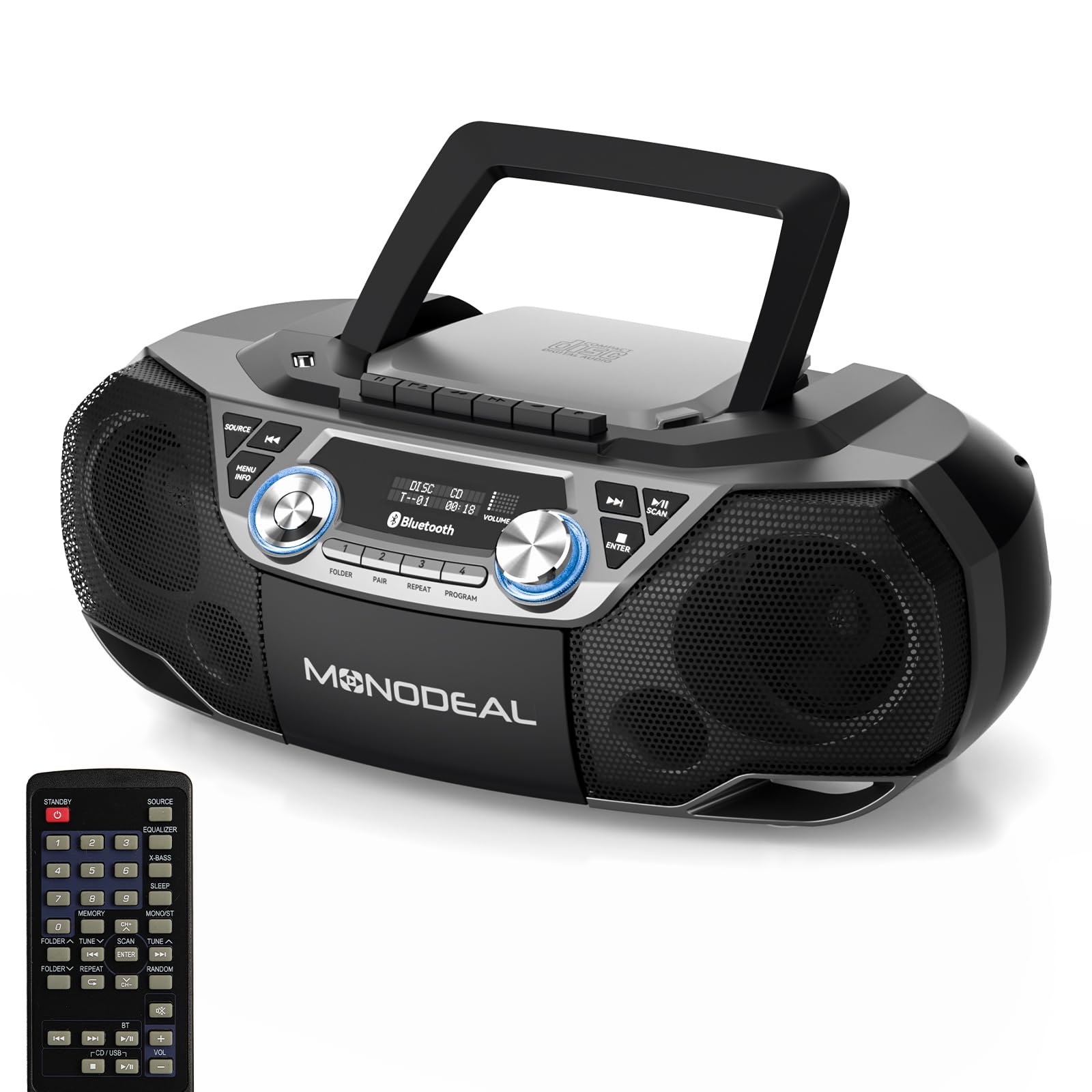
A compact combo that plays the tapes and CDs you forgot you owned, and it fits almost anywhere.
At 10 x 5 x 3.5 inches this is the smallest all-in-one here — about a shelf box, easy to move from room to room. The cassette deck records from CD, radio, and voice through the built-in mic, which is more than most players this size offer. Dual 3W stereo speakers with an X-BASS system push out a punchy low end, and the FM radio stores up to 20 stations for quick recall. USB and AUX inputs let you plug in a phone or flash drive, and there is a sleep timer for bedside listening.
Sound and construction deserve a straight read. The bass is noted as punchy for the size, but the tape deck sounds thin and records poorly by several accounts, and the volume distorts at high levels. CD-Rs can skip, and the USB input is picky about format. The FM tuner favors strong local stations and struggles with weaker ones. The sleep timer and remote are convenient touches when they work, but one reviewer noted the volume disappearing after four months with no useful support response. Treat this as a light-use player, not a daily workhorse.
The Bluetooth streaming works, and it plays CDs, cassettes, radio, and USB all from one small unit. Compared with the larger Supersonic at 26.3 inches wide, this MONODEAL is a fraction of the footprint but gives up speaker size and build heft for that convenience. At 10 x 5 x 3.5 inches, it suits a nightstand or kitchen counter where a full-size deck won’t fit.
Small-space charm: the compact size, built-in tape recording, and Bluetooth make this an easy fit on a nightstand or kitchen counter.
Know before buying: the tape deck and durability are the weak spots — this is for occasional playback, not a collection you play daily.
Best fit for: a small room, a nightstand, or a casual listener who wants tapes back without a big cabinet.
Think twice if: your tapes are precious enough to deserve a dedicated deck — this one is for fun, not preservation.
Know the Specs
Wow And Flutter (%)
This is the measure of how much the tape speed wobbles. A lower number keeps a piano note from drifting flat or sharp, and portable players like the FiiO CP13 reach a tested 0.13%, which is hard to hear at all. Steady speed also means a tape recorded on one deck will not pitch-shift when played on another.
Tape Type (I, II, IV)
Type I is the everyday normal tape, Type II is chrome, and Type IV is metal. Each needs a different recording setting. A deck that records only Type I will still play chrome and metal tapes, but the recording will not match the tape’s ideal settings. Check that the deck supports the tapes you actually own.
USB Output Vs USB Input
A USB output sends the audio from the tape into your computer as a digital file. A USB input, by contrast, just lets you plug a flash drive for playback. In the table above, the Tascam and TEAC list USB outputs for archiving; the Supersonic and MONODEAL list USB inputs for playback only. This is the spec that decides whether you can save a tape permanently.
Dual Well Dubbing
Dual wells let you play one tape and record another in the same pass. High-speed dubbing copies faster but can sound rougher than normal speed. The TEAC and Tascam both offer dual record for parallel copies, while the Pyle limits recording to deck B only.
Common Questions
Does a modern cassette deck record Type II chrome tapes?
Can I connect a cassette deck to my computer to save old tapes?
What is wow and flutter and why does it matter?
Will a dual cassette deck play tapes that have been stored for years?
Do I need a cassette deck with auto-reverse?
Can a cassette deck play Dolby B tapes without Dolby onboard?
How long should a cassette deck last?
What if I want to digitize a whole collection, not just a few tapes?
Can a cassette deck record from a turntable or CD?
What headphones work best for a portable cassette player?
The Bottom Line
For most people hunting a cassette tape deck, the winner is the Tascam 202MKVII because its USB Type B output and metal flywheels let you rescue a full tape collection at whatever bitrate you choose. If you plan to make new tapes or dub in parallel, the TEAC W-1200B is the more capable recorder. And if space is the limit and you want one tidy unit for records and tapes, the LoopTone 10 in 1 packs the most into the smallest footprint. Pick the deck that matches how you listen: USB archiving, parallel dubbing, or one-box playback.
How we choose
We do not accept paid placement. Every pick is matched to a real buyer and a real use-case; we do not hands-on test units.
Sources
Specifications: manufacturer listings and product documentation. Review insights: verified customer reviews, as of October 2026. Pricing: not shown on this page (it changes often); check the current price via the retailer link.
As an Amazon Associate, Aappliancez earns from qualifying purchases. This does not affect which products we feature.