Disclosure: Some links in this post are affiliate links. As an Amazon Associate I earn from qualifying purchases, at no extra cost to you. Learn more
Specs are compiled from manufacturer listings and verified buyer reviews and can change over time — please confirm the key details on the product page before buying.
If your well water leaves orange rings in the sink and a metallic taste in your coffee, the filter is the part that fixes it — not the softener, not a pitcher on the counter. Here is the short answer: a carbon block stage handles taste and odor, and a sediment stage in front of it keeps that carbon from clogging in weeks. Every pick below is a real replacement set or system built for well water, and each one is here because it does a specific job better than the rest.
This guide is built by comparing the manufacturers’ published specifications and the patterns across verified customer reviews, so you get each pick’s real strengths and trade-offs instead of marketing spin.
Well water punishes generic filters, so match the cartridge to your actual problem — iron, sediment, sulfur smell, or hardness — before you spend a cent. The right carbon filter for well water depends on what your test kit says, not on what the box promises.
Top Picks

How To Choose The Best Carbon Filter for Well Water
Well water is not city water with extra grit. It carries iron, manganese, sulfur, and fine sediment that a municipal plant would have settled out before it ever reached a tap. That changes what you buy: the carbon stage still handles taste, odor, and chlorine-family compounds, but it needs protection and it needs the right housing size.
Match the cartridge to your worst problem first
Pull a water test before you shop. If iron is the headline, a plain carbon block will load up fast and you want a media stage or a system rated for iron reduction. If the water runs cloudy after a storm, a fine sediment stage in front of the carbon is the fix. Buying a carbon cartridge to solve a hardness problem wastes money, because carbon does nothing for calcium and magnesium.
Check the housing size before you fall for a filter
Cartridges come in two common sizes: the slim 10-inch by 2.5-inch body and the fat 10-inch by 4.5-inch body, plus taller 20-inch versions. A 4.5-inch-diameter cartridge holds far more carbon, which means more contact time with the water and a longer stretch between changes. Measure your existing housing canisters before ordering, because a 20-inch cartridge will not sit in a 10-inch canister no matter how good the specs look.
Read the gallon rating against your real water use
A filter rated for 50,000 gallons sounds enormous until you count laundry, showers, and dishwashing. Ratings also assume decent feed water; heavy sediment or high iron shortens real life well below the printed number. Treat the gallon figure as a ceiling, not a promise, and buy a spare set so a clogged cartridge never leaves you bypassing the housing.
Side-by-Side Comparison
| Model | Best For | Cartridge Size | Rated Capacity | Stages / Count | Amazon |
|---|---|---|---|---|---|
| iSpring F4WGB21B★ Best Overall | Replacement set for an existing iSpring housing | 10″ x 4.5″ | 50,000 gallons | 4 cartridges (2 sediment, 2 carbon) | Amazon |
| PUREPLUS 2-StageIron Fighter | Iron and sediment in one compact system | 10″ x 4.5″ | 30000 gallons | 2 stages | Amazon |
| PRO+AQUA Replacement Set | Heavy metals in a 20-inch housing | 20″ x 4.5″ | 100,000 gallons | 3 stage | Amazon |
| Waterdrop WHF3T-PG | Whole-home system with steady flow | System with 3 cartridges | 100000 gallons | 3-stage system | Amazon |
| Home Master HMF3SdgFeC | High iron and sulfur smell | Oversize housings, 1″ ports | 100000 gallons | 3 stage | Amazon |
| Aquasure 64,000 Grain Bundle | Hardness plus drinking water | Softener plus 75 GPD RO | 64,000 grains | Softener + RO bundle | Amazon |
Detailed Reviews
1. iSpring F4WGB21B Filter Pack
Our pick — 4.5+★ from 250+ verified ratings; the strongest balance of quality and price.
Four cartridges in one box — two sediment stages to guard the two carbon blocks behind them.
This is the pack that turns a tired iSpring WGB21B housing back into a working well water filter, and it does it with a straight-forward two-step design. The two FP15B polypropylene sediment filters rate at 5 microns (a micron is one millionth of a meter, so 5 microns catches dirt, sand, silt, dust, rust, and scale particles you can see as grit). The two FC15B carbon blocks behind them use coconut shell carbon and knock out cloudiness, bad taste, and odors. That ordering matters: grit gets caught before it can bury the carbon and kill your water pressure.
The carbon side is not decorative. iSpring states the CTO filter removes up to 99% of chlorine and works on organic compounds such as herbicides and industrial solvents. What wins people over here is build consistency — the run of reviews is short and blunt, mostly variations on water that stays clean batch after batch, and the complaints are rare enough to read as outliers rather than a pattern. As one long-time buyer put it after a second purchase: “I’ve bought this set of filters twice now and have been very pleased with performance, quality reliability.”
Two things to know before you click. First, compatibility: this is the official replacement set for the iSpring WGB21B and it fits standard 10-inch whole house housings, but it will not fit a 20-inch canister or a slim 2.5-inch housing. Second, the honest catch is the value question. The recurring gripe in the feedback is that the set feels pricey for four cartridges — and a budget-conscious buyer can absolutely find cheaper filters. Where you get that money back is the rated life: iSpring puts the pack at up to 50,000 gallons depending on use and feed water quality, with a 3-6 month swap recommended for best performance. Heavy iron or silt will pull that 3-6 month window tighter, so buy a spare set rather than run a spent cartridge.
One structural note in its favor: it ships as four pieces, so the two sediment filters are the cheap sacrificial layer that protects the two expensive carbon blocks. That is the design most well owners actually want, and it is why the quality and performance lines in the feedback stay positive.
Where this pack earns its place
- Four cartridges — two 10″x4.5″ sediment (FP15B) and two 10″x4.5″ carbon blocks (FC15B) — in one sealed set
- Up to 50,000 gallons of rated filter life, with a 3-6 month replacement window
- Individually sealed cartridges stay fresh on the shelf
- Backed by a 30-day money-back guarantee and lifetime support from the manufacturer’s Atlanta team
What to weigh before ordering
- Fits 10″x4.5″ housings only — a 20-inch canister takes a different set
- The four-cartridge set is a real outlay, and the cost per change is the most-debated point in the feedback
- Rated life shrinks fast with heavy sediment or iron, so budget for spares
Already running a WGB21B: buy this pack and change it on the 3-6 month clock — the sediment-first layering is what keeps your pressure healthy.
Different housing: measure the canister diameter and height first, because this set is built for 10″x4.5″ only.
2. PUREPLUS 2-Stage Whole House Filter
One canister does iron and grit, the second handles taste — with a gauge so you stop guessing.
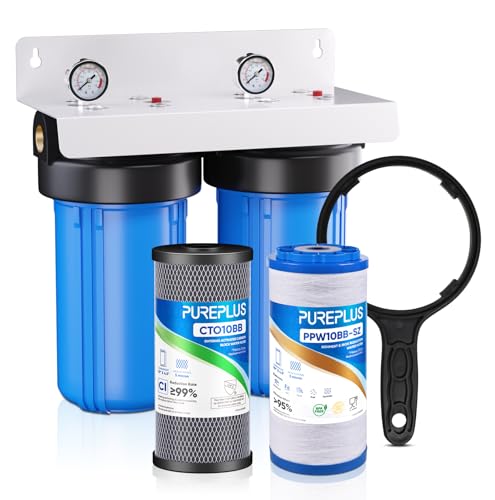
Here is the case for this one in a single line: the first cartridge is a dual-function composite that pairs a PP (polypropylene) filter with iron removal media, and the second is a carbon block cartridge for chlorine, odor, and organic compounds. That combination is aimed squarely at the orange-water problem, and the field reports back it up. Buyers report that a week on a well turned cloudy, discolored water clear — the exact outcome you are shopping for.
The design detail that earns its keep is the pressure gauge. You watch the gauge, and when the needle drops you know the cartridges are loading up, so you change on evidence instead of on a calendar guess. The body is a standard 10-inch by 4.5-inch footprint, so it slides into the space most whole-house setups already have, and the inlet/outlet is 1 inch. Rated capacity is 30000 gallons. Materials are food-grade polypropylene, iron removal media, and natural coconut activated carbon, and the box includes the wrench and the gauge.
The honest follow-up question every buyer asks is about installation, and here the record is split — the setup goes together easily for plenty of households, while others call the plumbing the hardest part of the whole job. Plan a spare afternoon and a few fittings. The other note to size properly is fit: this is a single system, not a cartridge four-pack, so the 2-stage body is 16.3 inches long and 7.5 inches wide and needs a mounting spot with room behind it. The consistent praise across the feedback centers on functionality and build — heavy-duty housings that hold up once they are in.
The recurring weak point in the notes is the small red pressure relief button, which is easy to break if you lean on it, and one buyer had to chase a replacement. Treat that button gently and you avoid the whole issue.
The iron payoff: an iron-reducing composite stage plus a carbon block in one compact 10″x4.5″ system is the cleanest way to beat rust-colored water without a full softener rebuild.
Straight trade-off: it is a single setup, not a replacement multipack, and the sheet lists no separate carbon-only spare — so order spares early if your well runs dirty.
Reach for this if… your well water comes out brown or cloudy and you want iron reduction plus taste handled by one compact two-stage unit.
Look elsewhere if… your housing is already a 20-inch big blue, because this system and its cartridges are sized for 10″x4.5″.
3. PRO+AQUA 3 Stage Filter Replacement Set

Twenty inches of media that targets lead, mercury, and chromium — not just taste.
Most carbon filters handle taste and call it a day. This set is aimed at the well owner whose water test came back with metal readings, and it is rated at up to 100,000 gallons before replacement. That is the longest claimed life in this group — it runs 3.3 times the 30000-gallon rating of the PUREPLUS 2-stage above, though the PRO+AQUA does it in a taller 20-inch housing rather than a 10-inch one.
The stage stack is sediment, a KDF/blend stage (KDF is a granulated metal alloy media used to pull dissolved metals out of water), and a carbon block, all at 5 microns. The manufacturer’s list of targets runs long: sediment, chemicals, heavy metals, chlorine, water-soluble lead, mercury, nickel, chromium, iron, rust, dirt, sand, fungi, sulfur, silt, turbidity, aluminum, copper, VOCs, cadmium, cloudiness, and odors. The filter quality is what the feedback keeps coming back to as the strongest point, and households running a dedicated 3-stage system describe the water as clean with a taste that holds up over years of use. Installation is straightforward — unscrew the casing, drain it, drop in the new cartridge in each canister.
Now the part that decides whether this fits your setup. These cartridges are 4.5 inches across and 20 inches tall and need standard 4.5″x20″ housings, so they are universal across 3-stage systems built to that size but completely incompatible with a 10-inch canister. Fit is the most-mixed topic in the feedback for exactly that reason — some report a mismatch with their existing 3-stage well water system. Measure before you buy. Replacement timing is the other variable: the guidance leans toward every 6 months, and 3-6 months appears in the feedback, shifting with how hard your water runs. These cartridges are physically substantial, and the two heaviest stages carry real weight in the hand.
What it solves: a KDF blend stage ranks this above plain carbon sets for dissolved metals — a real difference if your test flags lead or mercury.
What to check first: the 20-inch housing requirement, because a 10-inch canister turns a great cartridge into a return.
Best fit: a 3-stage whole-house system with 4.5″x20″ housings and a water test showing heavy metals.
Skip the gamble: if your canisters are 10 inches tall, these cartridges will not seat — confirm the housing size first.
4. Waterdrop WHF3T-PG 3-Stage System
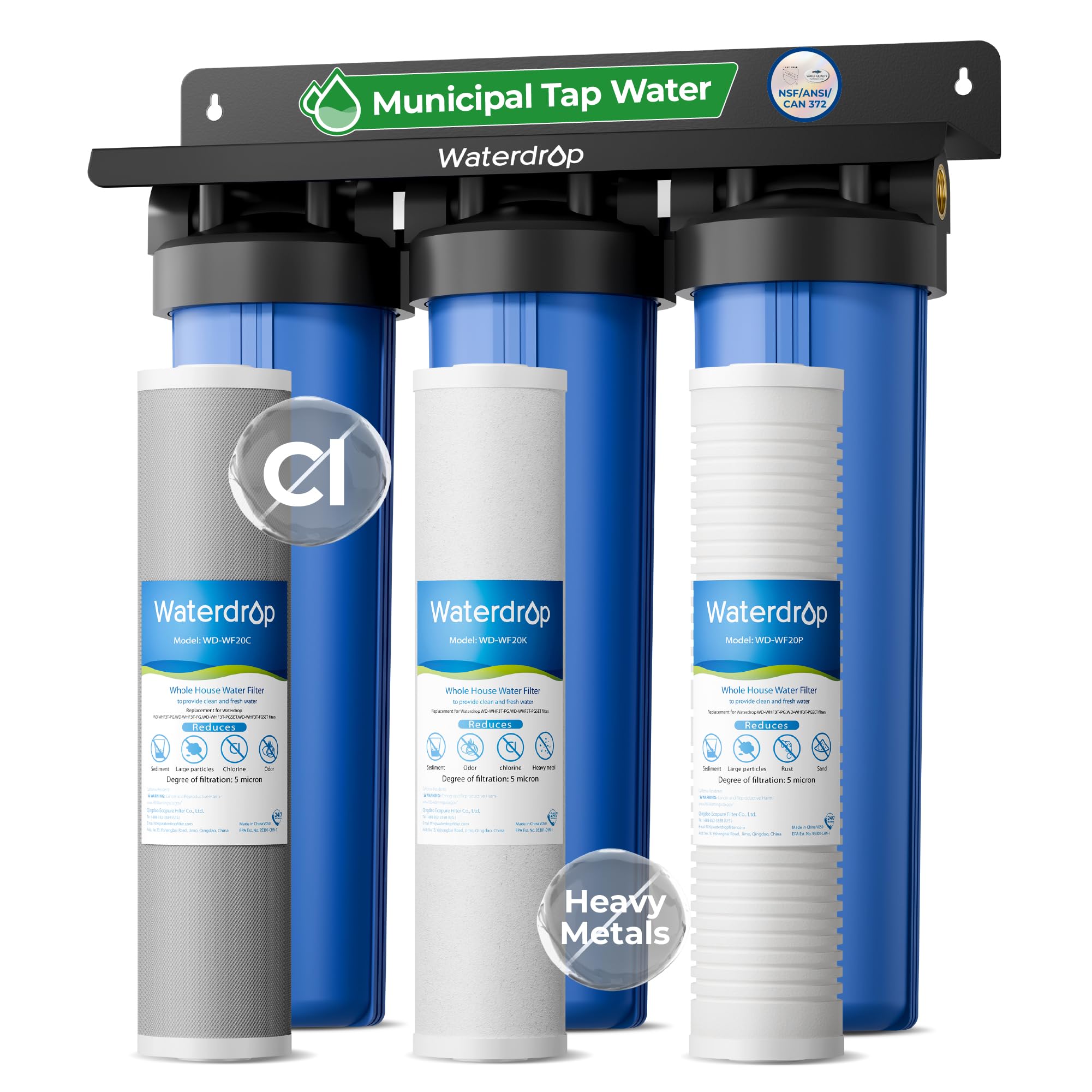
Fifteen gallons a minute, so the shower upstairs does not die when the washer starts.
Flow is where most whole-house filters quietly disappoint, and this one puts a number on it: 15 GPM (gallons per minute, meaning how much water can pass through at full pressure). That is a rated steady flow across the whole house, and the system is designed to work on both well and municipal sources. The filtration combines multi-layer PP filters, KDF media, granular activated carbon, and carbon fiber, with a stated reduction of up to 98% chlorine alongside heavy metals, sediment, and odors.
The safety paperwork here is the most thorough in this lineup. It is certified by IAPMO R&T to NSF/ANSI/CAN 372 for lead-free materials, the materials are SGS-tested to REACH SVHC and RoHS requirements, and the KDF media meets NSF/ANSI 42 requirements with TÜV SÜD safety and sensory testing behind it. The cartridge set is rated for 12 months of filter life and up to 100000 gallons of capacity. One discrepancy worth flagging honestly: the listing copy calls it both an 11-stage filtration process and a 7-stage filtration mention appears in the highlight line, so treat the stage count loosely and judge it on the media actually inside.
What wins people over in the field is the clarity of the water after the swap. Households that replaced a failing big blue or a cheap hardware-store unit describe clearer water, no chlorine smell, better-tasting water than bottled, fresher laundry, and softer hair and skin — and the install itself is the most-praised aspect in the feedback. It is an easy DIY job for anyone comfortable with basic plumbing. Expect to spend real time if you have to reroute pipe, and flush the carbon cartridge before you trust the first tap, because the instructions call for that step.
Size and layout matter here. The unit measures 22.9 inches long, 8.46 inches wide, and 26.1 inches tall, and it weighs in at a genuinely heavy figure that needs two hands and a solid wall. Installation is called the strongest point overall, with value right behind it, though a few reports of leaks exist — mostly cured with generous Teflon tape on the brass-lined inlet and outlet. One buyer hit a wrong-size O-ring on a cartridge and the support line shipped a replacement.
Standout strengths
- Rated 15 GPM flow keeps pressure across the entire house
- Multi-layer media: PP filters, KDF, granular activated carbon, and carbon fiber
- NSF/ANSI/CAN 372 lead-free certification plus SGS and TÜV SÜD testing on materials
- Stated up to 98% chlorine reduction and 12 months of filter life
Honest caveats
- Heavy and large enough that a two-person, plumbed-in install is the realistic plan
- Leak reports exist, so budget extra Teflon tape at every threaded joint
- The listing’s stage count is inconsistently stated, which makes the spec hard to compare on paper
The system to buy: whole-home protection with a 15 GPM flow rating and the strongest certification trail in this group.
Where it costs you: a heavy, space-hungry unit that rewards a careful install and plentiful Teflon tape.
5. Home Master Three Stage Filtration System
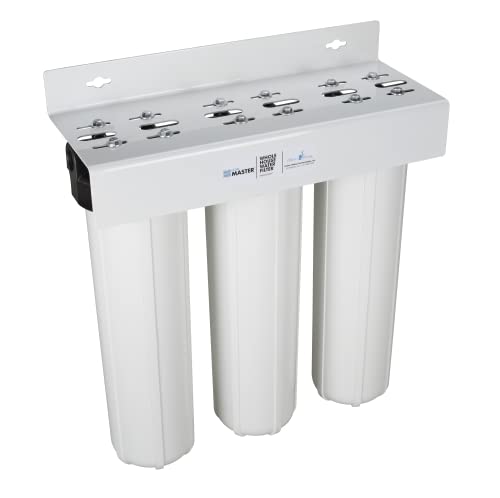
Built for wells that stain the grout orange — iron removal is the whole point here.
Home Master engineered this one specifically for well water, and it states up to 95% removal of iron, manganese, sediment, and chemicals. That is a narrower target than the Waterdrop’s chlorine focus above, and it is the right target if your sinks and toilet bowls wear rust rings. Capacity is 100000 gallons. The housings are oversize with 1-inch ports and a maximum flow rate of 15 gpm, so pressure across the house stays strong even when a second tap opens.
The sediment stage is the clever part. It is a 4-layer 25-10-5-1 micron replaceable filter, meaning it steps down through four screens from coarse to fine — that layered build holds more dirt before it blinds over, which means fewer change-outs on a gritty well. The system takes up to 3 PPM combined load of the contaminants it targets, and the box includes the assembled unit, a heavy steel bracket, and a filter wrench.
What owners actually report is the payoff on the worst water. Households running deep-well water with sulfur smell and brown stains describe the odor gone instantly, the water softer, and the staining fading. High iron staining white grout came down to almost nothing after the install, and one home that had been fighting hard water saw water pressure climb to normal for the first time. A homeowner in the pump house found the water pressure increased drastically once the unit was in line. The consensus praise clusters on functionality and water quality, which is exactly the pair you want for this kind of problem.
Set aside real time to install it. Most field reports describe a day’s work with PVC cutting, gluing, and valves on both sides, and the unit itself is a substantial 48 pounds, so a solid mount and a second set of hands are wise. The recurring gripe is the O-rings — they stretch and can be fussy to seat, so keep spares on hand and a little plumbing grease. Filters also trim pressure over time, and a pre-filter plus pre/post pressure gauges are the pro-move tips worth copying. Replacement intervals realistically land in the several-months range for the fine sediment stage on a dirty well.
The iron verdict: up to 95% iron removal, 15 gpm flow through 1-inch ports, and a 4-layer sediment filter that handles the grit — the complete package for stained fixtures.
Plan to work for it: a 48-pound system and a day of PVC plumbing, with O-ring seating as the one recurring fiddly bit.
Pick this one if rust rings and sulfur smell are your daily reality and you want the iron handled at the source.
Consider a different route if your well is hard rather than iron-heavy — that is a softener job, not a filtration one.
6. Aquasure 64,000 Grains Water Filter Bundle

A softener and a drinking-water RO in one bundle, sized for a house full of bathrooms.
This is a different animal from the cartridge sets and filtration systems above. It is a water softener rated to treat 64,000 grains of hardness, paired with a 75 GPD RO (reverse osmosis, a membrane process that pushes water through a fine barrier to strip dissolved solids) drinking system. The build targets homes with 4 to 5 bathrooms and up to 6 family members. Hardness is the calcium and magnesium that leaves scale in kettles and spots on glass — carbon does nothing about it, which is why a hard-water household needs this instead of a bigger carbon block.
The Aquatrol control head meters your actual usage and regenerates on that basis rather than on a fixed clock, which the maker says saves water and cuts maintenance cost. Construction is high-strength materials with built-in safety features meant to protect the system during downtime, and the warranty runs up to 5 years with lifetime tech support. Two separate units are in the box: the softener and the RO drinking system, each plumbed into the main line at its own point.
Water quality is what owners talk about most, and the transformation stories are the vivid ones. One household that described its water as the rustiest on earth found it running clear and rust free after the softener went in, like city water out of the tap. Another saw hardness drop sharply with testing before and after, and a third replaced a bulky salt-hungry unit and freed up garage space. Taste gets consistent praise on the RO side, and the skin and hair reports are equally positive. The install is approachable — buyers describe following the manuals and using plug-in fittings like SharkBite without any soldering, and one self-installer saved the quoted labor by doing it himself.
The honest catches are specific. This is a softener first, so it is for hard water, not for someone whose only complaint is a metallic taste — that is a filtration job. The RO tank takes up real space, so measure the cabinet before you commit. The directions are the weakest link for a few buyers, and the RO water line benefits from a soak in very hot water to soften it before it will seat on the faucet. If you have hard well water and want filtered drinking water on the same ticket, this bundle covers both in one purchase.
Why it earns the top-tier slot: 64,000 grains of softening plus a 75 GPD RO drinking system covers hardness and taste together, at a scale built for a large household.
The trade-off to plan around: two units, two install points, and a roomy footprint — the RO tank needs cabinet space and the manuals run thin in places.
Suits a big household: 4 to 5 bathrooms and up to 6 people on hard well water that also needs clean drinking water.
Not the right tool if iron or taste is your only problem — that calls for a filtration cartridge, not a softener.
Know the Specs
Micron Ratings
A micron rating tells you the size of particle a filter will catch — a 5-micron filter blocks particles down to 5 microns, which covers visible grit, rust flecks, and fine silt from a well. A finer number catches more but clogs faster and drops your pressure sooner. The smart pattern on well water is a coarser stage first (say 25 or 10 microns) and a finer one behind it, so the cheap filter takes the beating.
Carbon Block vs. Granular Carbon
A carbon block is compressed carbon formed into a solid, so water is forced through the material rather than around loose granules — that gives more contact time and more consistent taste and odor removal. Granular activated carbon is loose media and is often paired with KDF in a heavy-metals stage. For well water taste and smell, a carbon block in a fat 4.5-inch body does more work than a slim cartridge.
Gallon Ratings and Real-Life Life
A capacity figure like 50,000 or 100,000 gallons is a rated ceiling measured against decent feed water. Heavy sediment and high iron shorten that window well before the printed number. Read the gallon rating as the best case, and use the manufacturer’s suggested replacement interval as the real clock, adjusting down for gritty or iron-rich water.
Flow Rate and Pressure Drop
Flow rate is measured in GPM (gallons per minute) and tells you how much water can move through the system at pressure. A rating of 15 gpm with 1-inch ports supports multiple taps at once; a smaller cartidge setup with narrow ports can starve a shower when the washer fills. Watch your pressure over time too — a drop signals a loaded filter, which is why an inline gauge is worth having.
Common Questions
Will a carbon filter remove iron from well water?
What micron rating should I use for a well with fine silt?
Will a 20-inch cartridge fit my 10-inch whole house housing?
How often should I change a whole house filter on well water?
Do I need a softener as well as a carbon filter?
Can I install a whole house filter myself?
Why did my water pressure drop after installing a filter?
What is KDF media and do I need it?
Will a whole house filter remove the sulfur smell from my water?
The Bottom Line
For most well owners running a standard whole-house housing, the carbon filter for well water winner is the iSpring F4WGB21B — four sealed cartridges in one set, a sediment stage ahead of each carbon block, and a rated 50,000 gallons that keeps your pressure and your water clean without a rebuild. It is a replacement set, not a system, so it rewards you the moment you own the matching WGB21B housing.
If your water comes out brown or cloudy, grab the PUREPLUS 2-Stage for its iron-reducing composite and the pressure gauge that tells you when to swap. For heavy metals in a 20-inch setup, the PRO+AQUA set brings a KDF stage and 100,000 gallons of rated life. And for the household on hard well water that also wants clean-tasting drinking water, the Aquasure bundle covers 64,000 grains and 75 GPD in one purchase.
How we choose
We do not accept paid placement. Every pick is matched to a real buyer and a real use-case; we do not hands-on test units.
Sources
Specifications: manufacturer listings and product documentation. Review insights: verified customer reviews, as of October 2026. Pricing: not shown on this page (it changes often); check the current price via the retailer link.
As an Amazon Associate, Aappliancez earns from qualifying purchases. This does not affect which products we feature.