Disclosure: Some links in this post are affiliate links. As an Amazon Associate I earn from qualifying purchases, at no extra cost to you. Learn more
Specs are compiled from manufacturer listings and verified buyer reviews and can change over time — please confirm the key details on the product page before buying.
The hardest part of buying a car interior camera is not picking one — it is figuring out which of the near-identical triple-camera listings actually works after dark. A camera that reads a plate in a sunlit parking lot is easy; a camera that still reads a face in a dark cabin at 11 p.m. is the one you want. This guide sorts six interior-capable dash cams by what they really capture, night vision included, and by whether the parking and app features you are paying extra for actually hold up.
This guide is built by comparing the manufacturers’ published specifications and the patterns across verified customer reviews, so you get each pick’s real strengths and trade-offs instead of marketing spin.
Cheap cabin cams usually fail in one of two places: the interior camera washes out under headlight glare, or the WiFi app refuses to connect when your head unit is grabbing the network. Both are fixable by choosing the right pick, and the shortlist below does exactly that. Before buying any car interior camera, check whether the cabin lens uses infrared LEDs for night rides.
Top Picks

How To Choose The Best Car Interior Camera
The cabin lens is the whole point of this purchase, yet it is usually the weakest camera in a three-camera kit and the one listed last. Most listings lead with the front resolution and mention the interior channel in a single line. Read the interior spec first, then work backward to the front, because a 4K front lens means nothing if the cabin channel turns into a blurry smear once the sun goes down.
Start with the interior channel, not the front lens
An interior camera needs infrared LEDs (small bulbs that illuminate without visible light) to capture anything after dark. Without them, your cabin footage is a black rectangle with headlights streaking across it. Check two things on the listing: whether the cabin camera is rated 1080P, and whether IR is actually named as a cabin feature rather than buried in general night-vision marketing. One pick here uses a 1080P interior channel paired with four infrared LEDs, which is the combination that keeps a passenger’s face identifiable in an unlit car.
Match the memory card to how you drive
A three-channel camera writes three video streams at once, so it fills storage far faster than a single-lens cam. A 64GB card included in the box gets you started, but several picks here accept far more — one supports up to 512GB, another caps at 256GB, and one lists a 128GB ceiling. Higher capacity means more days of footage before the oldest clip gets overwritten, which matters if you only review the card after a dispute that happened last week.
Decide up front if you want parking surveillance
Nearly every camera on this list offers 24-hour parking monitoring, and nearly every one of those listings adds the same small print: you need a separate hardwire kit to keep power flowing while the ignition is off. Plan for that extra part before you buy rather than discovering it later. Budget-tier kits often skip this feature entirely, so if street parking is your normal routine, that is the single upgrade worth stretching for.
Check that the app and your phone can share the airwaves
You get your clips by connecting your phone to the camera’s own WiFi network (a short-range wireless link the camera creates itself). That is where frustration often starts — if your car also runs wireless CarPlay or Android Auto (phone-to-dash mirroring systems), both want the same connection. If fast downloads matter to you, pick a camera with higher-bandwidth WiFi (a wider data pipe for quicker transfers), and expect to toggle your phone’s network settings each time you want to pull a clip.
Side-by-Side Comparison
| Model | Best For | Interior Channel | Front Resolution | Max Card Support | Amazon |
|---|---|---|---|---|---|
| galphi M2 2.5K 3 Channel★ Best Overall | Best overall value | 1080P with IR lights | 2.5K | 512GB | Amazon |
| Nanoby M1 4K 3-ChannelTop Performer | Fast WiFi transfers | 1080P, f/1.6, 4 IR LEDs | 4K | 256GB | Amazon |
| Huntermax J12 3 Channel | Suction-cup mounting | 1080P with 4 IR LEDs | 4K | 128GB | Amazon |
| WECOOL 4K UHD 3 Channel | Daytime clarity | HD interior channel | 4K | 256GB | Amazon |
| 70mai T800E 4K HDR | Low-light front footage | 1080P interior camera | 4K | 512GB | Amazon |
| AZDOME M550 Max | Rear detail and GPS | IR cabin camera | 4K | 512GB | Amazon |
Detailed Reviews
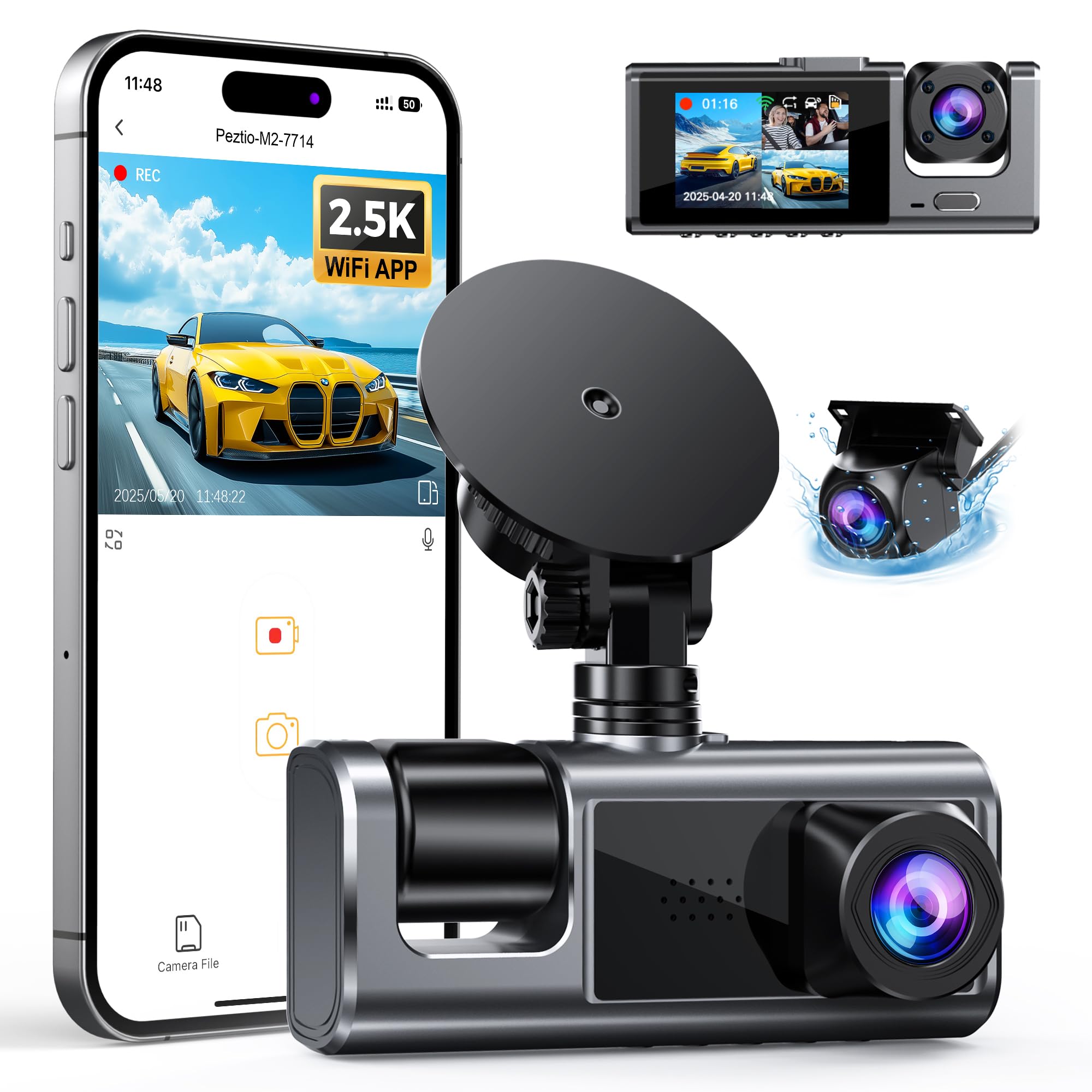
1. galphi M2 2.5K 3 Channel Dash Cam Front and Rear Inside
Our pick — 4.0+★ from 700+ verified ratings; the strongest balance of quality and price.
Three cameras, a hidden profile, and the lowest entry point of any triple-channel kit here.
The galphi M2 earns the top spot because its cabin camera uses IR lights (infrared LEDs that light up the interior without visible glare) to keep faces and gestures visible on a night drive instead of dissolving into a dark rectangle. It records three streams at once — a 2.5K front lens (2560×1440 pixels, sharper than standard 1080P), a 1080P rear camera, and a 1080P infrared cabin camera — so the road ahead, the traffic behind, and the person in your passenger seat are all covered in the same clip. That cabin channel is what separates it from the Huntermax J12, which also has an interior camera but a lower-resolution front lens.
Installation is genuinely simple, and the small size helps. The whole camera is roughly an inch in each direction and weighs 168 g, so it tucks behind the mirror without eating your forward view. The three lenses rotate independently, which lets you angle the cabin camera toward the back seat instead of straight at the headliner, and the suction mount means no adhesive residue if you move it between vehicles. Running the rear cable is the slow part of any three-camera install, and the generous cord lengths make hiding that cable along the trim a one-afternoon job rather than a weekend project.
What wins people over is the picture. Owners consistently report making out license plates and faces, and that is the practical test — a plate you can read is the difference between a dispute you win and one you do not. The app handles live view and clip downloads without a subscription, and there is no monthly fee hiding behind the WiFi connection. Storage runs to 512GB via a microSD card, though the card is not in the box, so budget for one before you mount anything.
What earns it the top spot
- Three simultaneous channels — 2.5K front, 1080P rear, 1080P infrared cabin — for full coverage in one recording
- Accepting microSD cards up to 512GB, the joint-highest ceiling in this lineup
- No-fee WiFi app for live view, settings changes, and clip downloads to your phone
- 168 g and roughly an inch in each direction, so it hides behind the rearview mirror
- Three independently adjustable lenses and a suction mount that leaves nothing behind
Where it asks you to compromise
- No memory card in the box — factor a separate microSD purchase into the plan
- 24-hour parking monitoring needs a Type-C hardwire kit sold separately
- In direct summer sunlight the camera can shut itself down to protect its internals, so expect gaps in parking-lot footage on the hottest days
Reach for this if: you want complete front, rear, and face-level cabin coverage without paying premium prices, and you are happy to buy your own memory card.
Look elsewhere if: you park in full sun on very hot days and need uninterrupted footage, or you want a card already in the box.
2. Nanoby M1 4K 3-Channel Dash Cam Front Rear Inside
The clip you need lands on your phone in seconds, not minutes, thanks to 5.8GHz.
Pulling footage off a dash cam is the chore nobody thinks about until they need it. The Nanoby M1 addresses that directly with 5.8GHz WiFi, which the maker rates at downloads up to 8MB/s — four times faster than the 2.4GHz band the galphi M2 uses. In practice that turns a two-minute wait into a thirty-second one, and it matters most when you are standing at the side of the road trying to show an officer what happened.
The front lens is 4K, with 1080P rear and 1080P interior channels behind it, and the coverage angles are wide — 160 degrees at the front and 155 degrees for both the cabin and rear cameras. The cabin lens gets real night-vision hardware: an f/1.6 aperture (a wider opening that lets more light reach the sensor) plus four infrared LEDs and WDR processing. That aperture figure is the number to watch, because it is what keeps faces legible in an unlit interior rather than a dark blur.
You can start recording the moment it is mounted because a 64GB card comes pre-inserted, and the included charger carries an extra USB port so you are not choosing between powering the camera and charging your phone. GPS is built in and logs speed, route, and coordinates you can replay on a map. The one real surprise for most buyers is the housing: at roughly 4.5 inches wide and 1.5 inches tall, the 3.18-inch IPS screen (a small color display on the back) takes up more windshield than the app-only cameras here — one buyer flagged the size but called it not a dealbreaker. A date and time bug that reset the clock also surfaced in reviews, with owners reporting fast replacements when they contacted support.
The transfer-speed argument: if you review footage often — rideshare work, regular route disputes, a fleet of two or three cars — the 5.8GHz radio and the included 64GB card justify the step up from the galphi M2. But the galphi accepts 512GB of storage where this one caps at 256GB, so if you prefer recording weeks of driving before you think about the card, that trade flips.
Best fit: anyone who wants 4K detail up front plus genuinely fast phone downloads, with a card already installed.
Worth knowing: the display makes this a noticeably larger unit on the glass than the low-profile alternatives, and clock settings have needed a fix on some units.
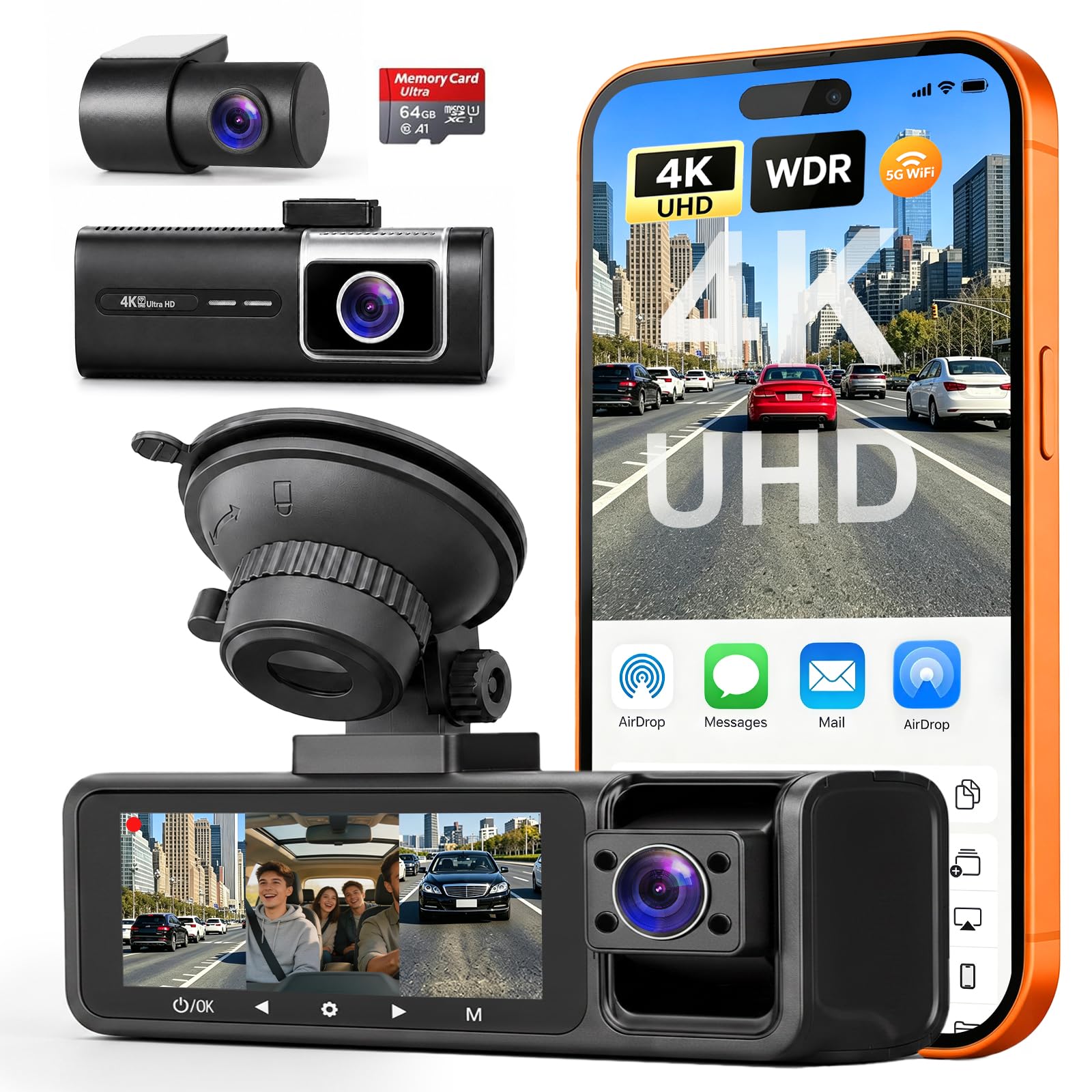
3. Huntermax J12 3 Channel 5G WiFi Dash Cam
Widest front lens in the lineup, and the mount twists off without a trace of glue.
The Huntermax J12 is the pick if your worry is the blind spot at the edge of the windshield, because its 170-degree front lens (a very wide field of view that catches more of the road edges) is the joint-widest here alongside the WECOOL. It pairs that with a 150-degree interior camera and a 120-degree rear. The interior camera carries four infrared LEDs (small lights that illuminate the cabin in the dark) for low-light cabin work, and the whole system leans on WDR processing (wide dynamic range, which balances bright and dark areas in one frame) to keep headlights and shadows both readable instead of blowing out one to save the other.
It records three streams simultaneously at 4K front, 1080P interior, and 1080P rear, and it ships with a 64GB card, a card reader, trim tools, and cable clips. The rear cable runs nearly 20 feet, and owners who routed it behind the glove box, up the pillar, and across the windshield report that length is what makes a clean hidden install possible. The suction mount twists off by hand and leaves no adhesive mark, which is a meaningful advantage if you move the camera between cars or park in a neighborhood where a visible unit invites attention.
The honest catch is the WiFi handshake (the moment your phone and the camera try to connect). This camera runs its own network, and that clashing with wireless CarPlay is the most consistent complaint — owners describe having to disable one function to use the other. The plastic housing also reads as modest for the tier, with a bulky, noticeable profile once mounted. On the plus side, the manual lock button holds up its end: one press secures the current clip so loop recording (which automatically overwrites old footage) cannot erase it, which is the feature you will actually want in the ten seconds after a bump.
Mount flexibility — the twist-off suction cup is what sets this one apart. The AZDOME M550 Max below uses a magnetic bracket and the WECOOL ships both a suction bracket and a 3M adhesive mount, but if you want an install you can undo with one hand and no sticky residue left on the glass, this is the one.
Choose this if: you want the widest possible front coverage, a card in the box, and a mount you can remove without scraping adhesive off the glass.
Think twice if: your car runs wireless CarPlay heavily, since sharing the WiFi band takes some toggling, or you want a camera that disappears into the trim.
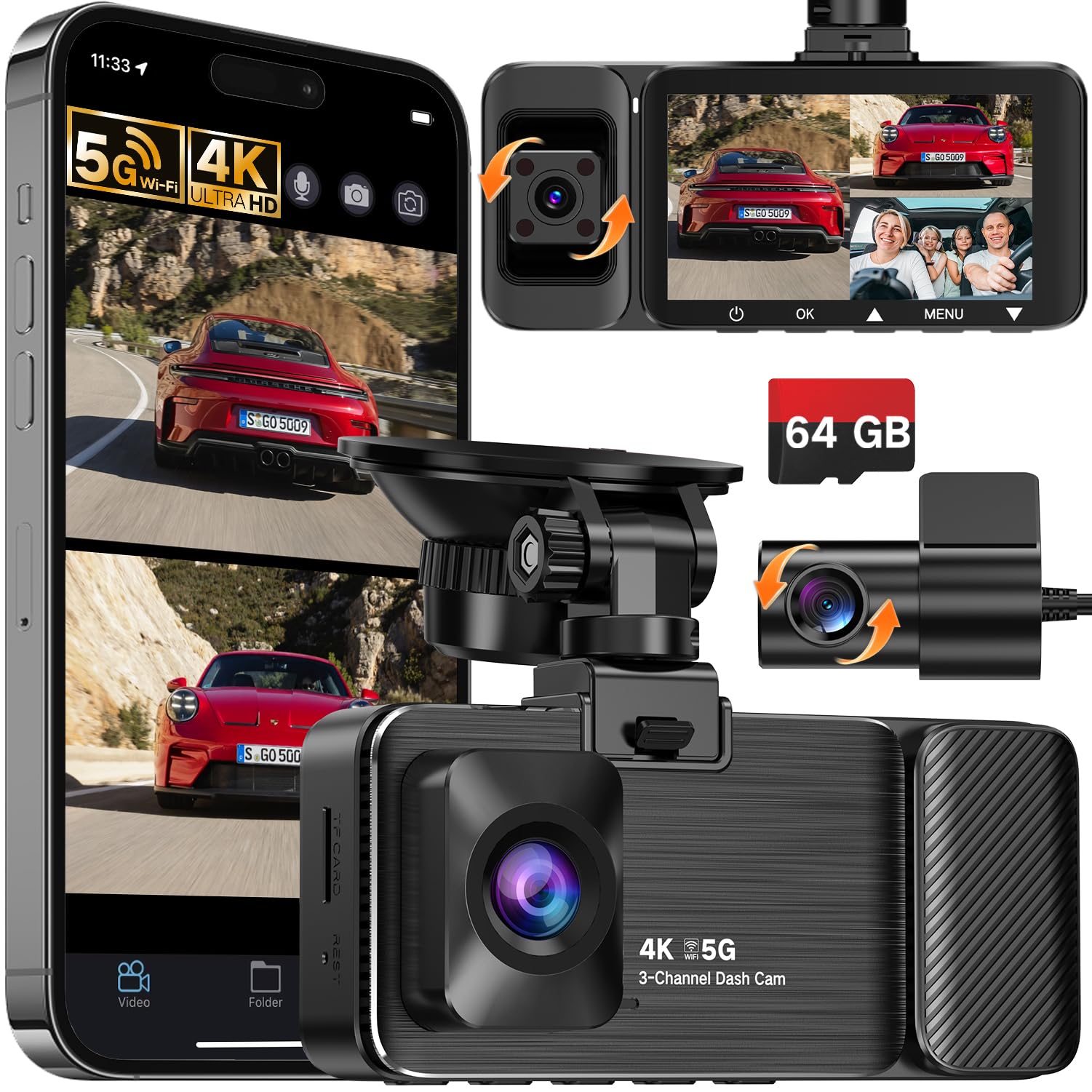
4. WECOOL 4K UHD 3 Channel Dash Cam Front and Rear Inside
Excellent in sunlight, and the one pick here where night footage is a real gamble.
WECOOL covers the angles aggressively: a 170-degree front lens, a 150-degree cabin camera, and a 150-degree rear, which the brand markets as 470° of combined coverage across three directions. The front records in 4K, and the included 64GB card means nothing else needs buying on day one. Owners who use it in daylight are happy — clear video, a sensible file system, and two units running across two cars through months of use, including long stretches parked in heavy sunlight.
That is where the good news ends, and it is worth being straight about it. Dark conditions are this camera’s weak point: oncoming headlights wash out the footage, backlit signs become unreadable, and reading a plate on a night drive is unreliable. If you do most of your driving after dark or you are buying specifically for cabin night vision, this is not the pick — the galphi M2 and the Nanoby M1 both handle low light far more convincingly.
The app has its own quirks. It can clash with CarPlay’s WiFi the same way the Huntermax does, and some buyers report the connection dropping to a few minutes of usable time. Others note that continuous recording stops after about ten minutes and needs a button press to restart, and a few buyers would rather pull the card and use a reader than fight the app. The rear-camera angle and the bracket system are otherwise solid, and the fitment list is the broadest of the group — the brand states compatibility with all vehicle models.
Why daytime drivers like it
- 4K front recording that owners describe as clear and well-organized in file structure
- 64GB card included, plus support for microSD cards up to 256GB
- Listed as fitting all vehicle models, the most open fitment statement in this lineup
- Wide angles across all three channels — 170° front, 150° cabin, 150° rear
The trade-offs you should weigh
- Night vision is the recurring weak point — glare and backlighting degrade the image badly
- The companion app has drawn consistent complaints about WiFi stability and CarPlay conflicts
- Continuous recording has needed a manual restart on some units
Pick this one for: daylight commuting and parking-lot incidents, where the 4K front lens and included card are strong value.
Pass on it for: night driving or rideshare work, where reliable low-light footage is the entire reason you are buying.
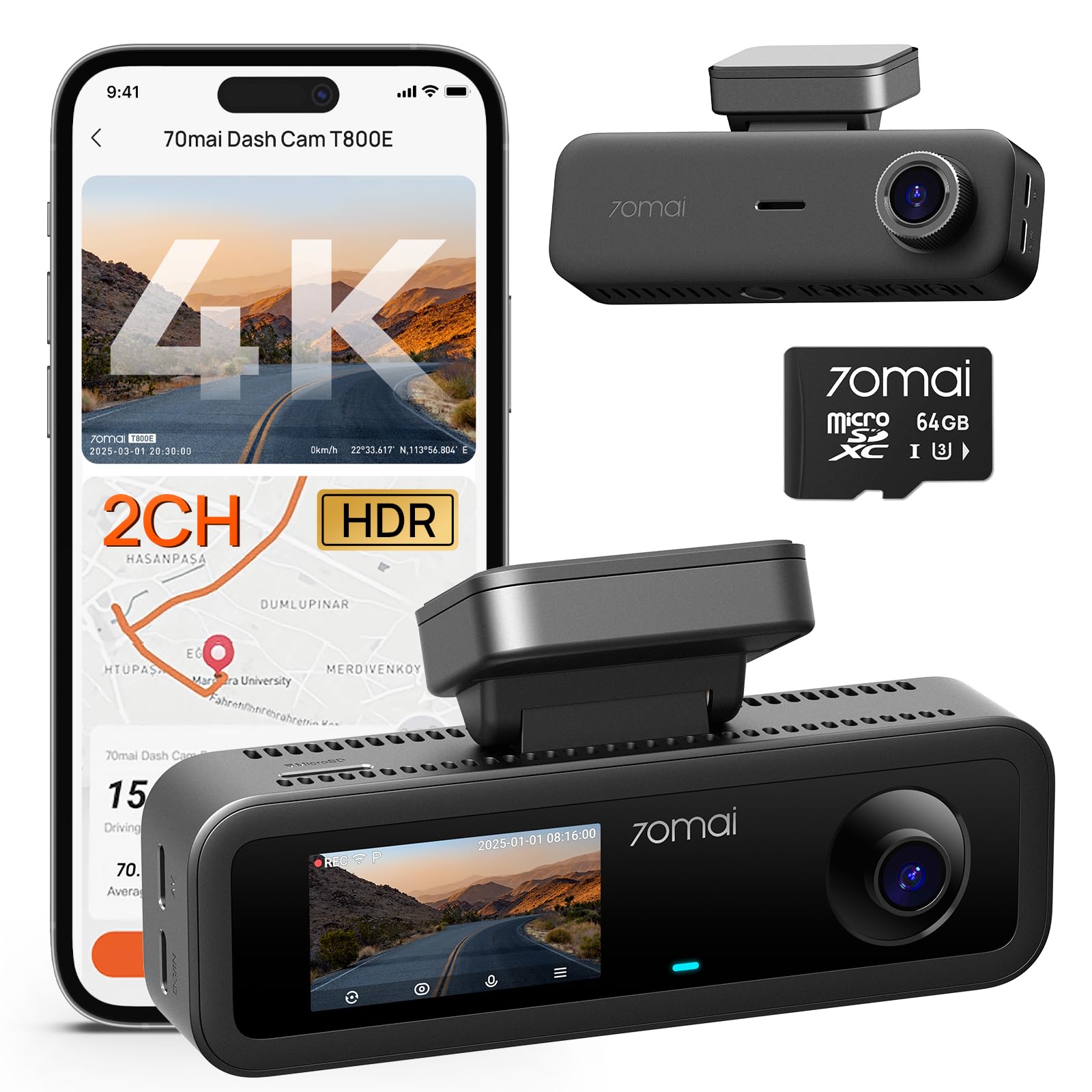
5. 70mai T800E 4K HDR Dash Cam Front and Interior
Two channels instead of three, aimed squarely at winning the darkest roads.
This is the specialist in the group, and it says so plainly: a 4K front camera and a 1080P interior camera, no rear channel at all. That front lens runs HDR and an F1.55 aperture — the widest opening here, which is the spec that decides how much light reaches the sensor when streetlights are thin. 70mai pairs it with two named processing modes, MaiColor Vivid+ for color and contrast in messy lighting, and Night Owl Vision for reducing noise and holding detail in the dark.
The cabin camera is what buyers come for. Owners describe clear interior coverage without glare or distortion, which is the exact failure mode that ruins cabin footage on weaker kits, and the low-light performance draws praise for a front-and-interior setup at this level. The front lens covers 166 degrees, and the unit is small — approximately 5.12 inches wide by 1.61 inches tall — so it sits on the glass without dominating it.
Wi-Fi 6 is the other thing you are paying for. It is the newer wireless standard, so previews and downloads move smoothly and the connection holds better than on older 2.4GHz-only cameras. Voice control lets you start and stop recording hands-free, GPS logs your speed and location, and the 64GB card comes in the box with support up to 512GB. There is also a heat-resistant supercapacitor instead of a lithium battery, which is a genuine durability argument in a hot car. The honest limitation is coverage: with no rear camera, tailgating and rear-end disputes are not recorded, so this suits drivers whose concern is the cabin and the road ahead. The single mixed signal in the data is connectivity — WiFi pairing earns a mixed verdict overall, so expect to be patient the first time your phone and the camera meet.
Made for: night commuters, taxi and rideshare drivers, and anyone whose priority is the clearest possible image of the cabin and road ahead after dark.
Not the one for: rear-end coverage — there is no rear camera, so a three-channel pick like the AZDOME M550 Max covers that angle instead.
6. AZDOME M550 Max 4K 3 Channel Dash Cam
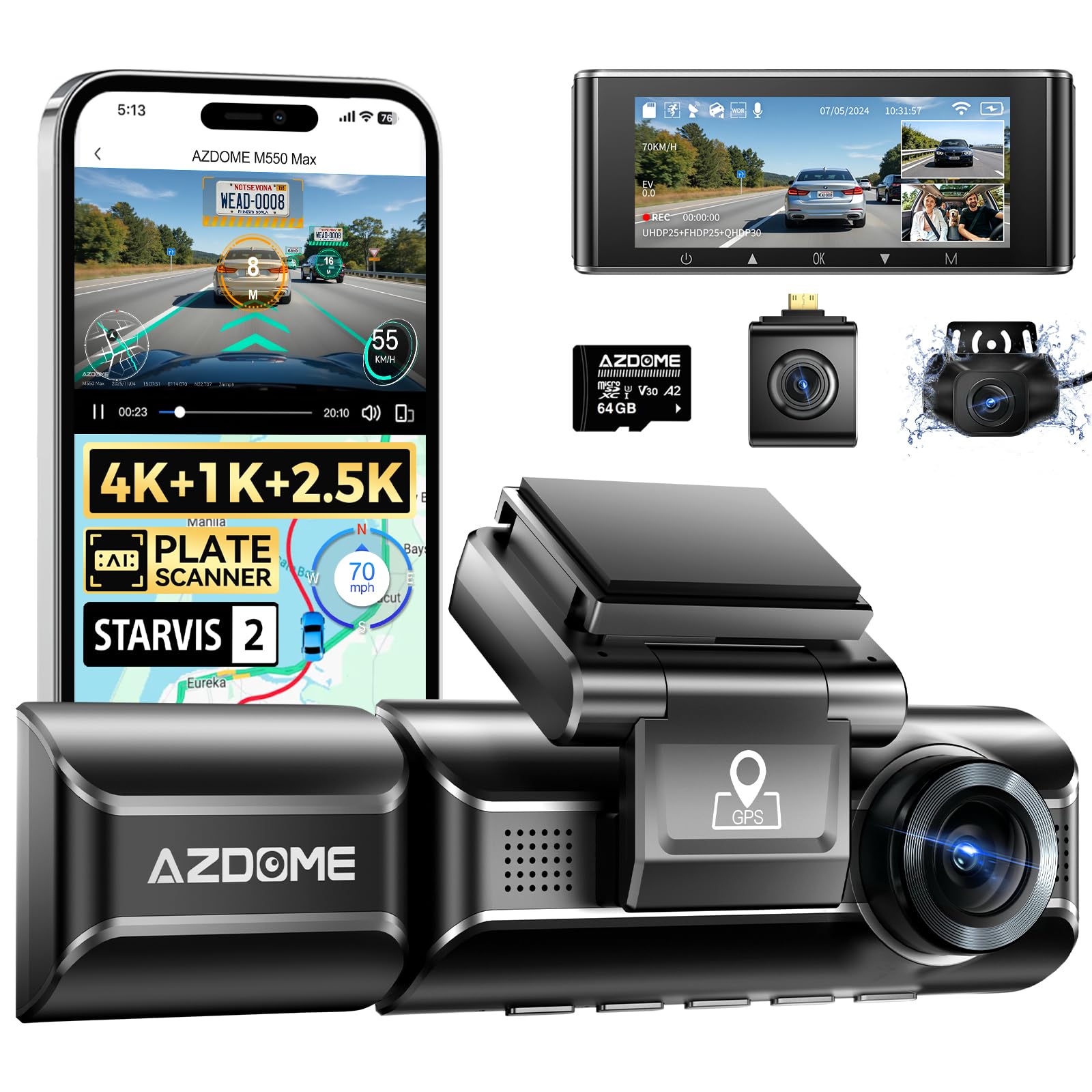
The only pick that pushes rear detail past 1080P, and the cabin gets six IR LEDs.
The AZDOME M550 Max is the only pick here that records 2.5K behind you, and that matters because most triple-camera kits quit at 1080P for the rear channel — exactly where tailgating and parking-lot contact shows up. It puts a 2.5K rear camera behind its 4K front lens (3840×2160 pixels, the sharpest front resolution in this group) and a 1080P cabin camera, so the detail behind you holds up in a rear-end dispute instead of turning into a smear of shapes. That is the single strongest argument for stepping up to this tier.
The sensor hardware backs it up. Dual STARVIS 2 sensors — an IMX675 and an IMX662 — paired with WDR keep detail readable through backlit roads, garage exits, and fast-changing light. Cabin night recording uses six infrared LEDs, and the interior camera is aimed squarely at rideshare work: Uber, Lyft, and taxi driving all appear in the compatibility list, and a fatigue reminder assists on long late-night shifts. The rear camera carries an IP68 rating, meaning it is sealed against water and dust, so rain and road spray off the tires are not a concern.
What owners appreciate most is the mounting. The magnetic bracket lets you pull the camera off the glass and snap it back in seconds, and the secure hold has drawn praise against OEM suction mounts that slowly give up. GPS logs speed and route into the AZDOME app with map playback, and the app adds AR overlays (on-screen graphics layered over the live view) — plate recognition, lane assistance, distance monitoring — with the brand claims up to 99.8% recognition accuracy for those overlays. Two things to know before ordering: the 24-hour parking mode needs the AZDOME hardwire kit for constant power, and front-camera angle has been a real pain point on steep windshields, with one owner in a 2018 Ford Fusion finding it filmed sky and buildings until a replacement bracket arrived. The 3.19-inch screen eases setup, a 64GB card ships in the box, and support up to 512GB gives you the same storage ceiling as the galphi and the 70mai.
Rear coverage, plainly: the M550 Max and the galphi M2 both record three channels, but they do not record them the same way. This one holds 2.5K behind you while the galphi, the Nanoby, the Huntermax, and the WECOOL all settle for 1080P. If a rear plate number is what you need after an incident, that difference is the whole decision.
The right call for: high-mileage drivers, fleet operators, and anyone who wants the sharpest rear footage plus GPS trip logging and app-based AR tools.
One caveat to plan around: budget for the hardwire kit if you want overnight parking protection, and test the front angle on a steep windshield before you commit to the position.
Know the Specs
Aperture rating (F1.55, f/1.6)
An aperture is the size of the opening that lets light reach the camera sensor, written as an f-number where a smaller figure means a wider opening. The 70mai T800E runs an F1.55 front lens and the Nanoby M1 uses an f/1.6 cabin lens — both are wide openings that gather more light so faces and plates stay readable after dark. A narrow aperture forces the camera to brighten the image artificially, which smears detail and turns headlights into white blobs.
Channel count versus coverage
A channel is one camera stream. A three-channel kit records front, rear, and cabin at once, which is what you want if rear-end collisions or passenger disputes are a concern. A two-channel kit like the 70mai T800E covers front and cabin only — no rear view — but stays cheaper to run and easier to install. Decide which angles you actually need before chasing resolution numbers.
Supercapacitor versus lithium battery
A supercapacitor stores and releases power without the chemical cell inside a lithium battery, and it tolerates heat far better. The 70mai T800E ships with a heat-resistant supercapacitor, while several picks here list lithium polymer battery cells instead. In a car that sits in summer sun, that material choice is the difference between a camera that keeps working and one that shuts itself down — a behavior the galphi M2 has shown in direct sunlight.
Memory card ceiling and clip retention
The card ceiling is the largest microSD capacity a camera will address, and it sets how many days of three-stream footage you keep before the oldest clip is overwritten. Three picks here reach 512GB (galphi, 70mai, AZDOME), two cap at 256GB (Nanoby, WECOOL), and the Huntermax lists a 128GB maximum. Loop recording then overwrites the oldest open up file automatically, while a G-sensor locks the clips around an impact so they survive the cycle.
Common Questions
Will the interior camera record clearly at night without any cabin lights on?
Do I need a hardwire kit for the parking mode to work?
Why does my dash cam shut off when the car sits in hot sunlight?
Can I use the camera app while my phone is connected to CarPlay?
Is the included 64GB card enough for three-channel recording?
What does the G-sensor actually do when I hit something?
Will a three-camera setup fit my truck or minivan?
Is a 4K front camera worth it over a 2.5K one?
How do I hide the rear camera cable without tearing up the trim?
What is the difference between the WiFi bands these cameras use?
The Bottom Line
The best car interior camera for most drivers is the galphi M2, because it pairs a 2.5K front lens with a 1080P infrared cabin camera that keeps faces readable after dark, and it accepts up to 512GB of storage for long retention. Need the sharpest rear detail for tailgating disputes? The AZDOME M550 Max is the only pick that records 2.5K behind you, and it adds GPS logging plus AR tools in the app. For the toughest low-light work, the 70mai T800E runs the widest F1.55 aperture here (a wider lens opening lets in more light) with Wi-Fi 6 for fast transfers. And if your car lives on wireless CarPlay or you swap the camera between vehicles, the Huntermax J12 brings a 170-degree front view and a suction mount that twists off without residue. The M2 carries the highest rating and the largest ownership base in this group.
How we choose
We do not accept paid placement. Every pick is matched to a real buyer and a real use-case; we do not hands-on test units.
Sources
Specifications: manufacturer listings and product documentation. Review insights: verified customer reviews, as of October 2026. Pricing: not shown on this page (it changes often); check the current price via the retailer link.
As an Amazon Associate, Aappliancez earns from qualifying purchases. This does not affect which products we feature.