Disclosure: Some links in this post are affiliate links. As an Amazon Associate I earn from qualifying purchases, at no extra cost to you. Learn more
Specs are compiled from manufacturer listings and verified buyer reviews and can change over time — please confirm the key details on the product page before buying.
Your outside unit clicks, the compressor hums and then quits, and the house just gets hotter. Nine times out of ten that is a run capacitor that has bulged or drifted off its rating, and the fix is a small metal can you swap yourself. This guide covers the dual-run capacitors worth buying, how to read the microfarad and voltage numbers on the old one, and which pick suits a budget repair versus a long-haul replacement.
This guide is built by comparing the manufacturers’ published specifications and the patterns across verified customer reviews, so you get each pick’s real strengths and trade-offs instead of marketing spin.
A capacitor swap is one of the few HVAC repairs a careful homeowner can finish in minutes, provided the rating matches and the power is off. Below you get the full breakdown of the capacitor for ac options that actually match common condensers.
Top Picks

How To Choose The Best Capacitor for AC
Buying the wrong can wastes a weekend and leaves the house hot. You can settle it by reading three things straight off your old capacitor before you order: the two microfarad numbers (the capacitance values, which set how much charge the part stores), the voltage rating (the highest voltage it can safely handle), and the physical size that fits the bracket. Get those right and the swap is a screwdriver job.
Match the microfarad numbers, not the brand
A dual-run capacitor carries two ratings in one can, printed like 45/5 or 30/5. The first number is the microfarad (the electrical size) for the compressor motor; the second is for the outdoor fan motor. Pick a can with the same pair and the motors get the surge they were built for. A mismatch in either figure is the most common reason a fresh capacitor hums instead of starting.
370V or 440V — know which you need
Most home condensers run fine on a 370V-rated can, and a 440V-rated one is a safe step up because it is built to handle a higher ceiling. Check the old label: if it reads 370V, either rating works; if it reads 440V, buy 440V. Never go down in voltage.
Check the can size against the bracket
The diameter and height determine whether the new can drops into the strap or rattles loose. Measure the old one — common round sizes land near 2 inches wide by 4 inches tall. A slightly smaller can still works, but it needs a wire tie or a snug strap so vibration does not wear the terminals.
Side-by-Side Comparison
| Model | Best For | Capacitance | Max Voltage | Size (W x H) | Amazon |
|---|---|---|---|---|---|
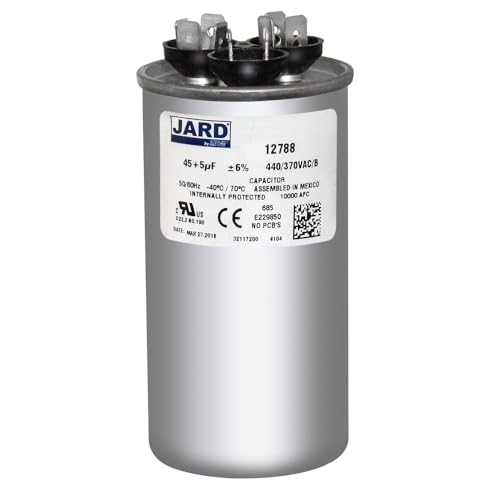
| Jard # 12788 Dual Run★ Best Overall | All-round home AC repair | 45 microfarad | 440 volts | 2″W x 3.75″H | Amazon |
| Fiada 30/5 MFD CBB65Best for Heat Pumps | Heat-pump and condenser fan duty | 30 microfarad | 440 volts | 2.13″W x 2.13″H | Amazon |
| BOJACK 30+5uF CBB65 | Budget-friendly 30/5 swap | 35 microfarad | 440 volts | 1.97″W x 3.94″H | Amazon |
| COOLWAY 45/5 uF CBB65 | Wide OEM cross-reference fit | 45 microfarad | 440 volts | 1.96″W x 4.52″H | Amazon |
| VEXUNGA 45/5 uF CBB65 | Premium pick for high-heat climates | 45 microfarad | 440 volts | 2.36″W x 3.35″H | Amazon |
Detailed Reviews
1. Jard # 12788 Round Dual Run Capacitor, 45 + 5 uF
Our pick — 4.5+★ from 650+ verified ratings; the strongest balance of quality and price.
The workhorse dual-run can that most home condensers ask for by number.
If your old capacitor reads 45/5 MFD at 370V or 440V, this Jard is the direct swap. That 45 microfarad compressor rating matches what a large share of residential condensers use, and the 440-volt ceiling covers both 370V and 440V systems so you do not have to hunt for two different cans. It ships as a single round unit 2 inches wide by 3.75 inches tall, so it slots into the standard strap bracket on most outdoor units.
What wins people over is the value of the fix relative to a service call. A condenser that quits on a hot afternoon, compressor humming and fan stalled, often springs back to life the moment a fresh can goes in. Buyers report swapping this in on a 2.5 ton Carrier condenser that had stopped cooling, with the compressor and fan both back up right after. Wire it Herm to compressor, Fan to the outdoor fan motor, C to common, power off first, and the job is usually under half an hour.
The honest caveat is how long it lasts. This is a part expected to wear out eventually, and a few units do not go the distance — one Jard report has it failing inside a week, the risk you accept with any budget capacitor. Order a spare so a second failure is a ten-minute swap rather than another overnight wait. The hardware is sound and the terminals match the labels; the lifespan is simply not something any maker can guarantee.
Why this earns the top spot
- 45 + 5 microfarad dual rating covers the most common residential condenser spec
- 440-volt ceiling works for both 370V and 440V systems
- 2″W x 3.75″H round can drops into standard brackets
- Value for money is the thing buyers rave about — the fix replaces a costly service call
Where it can let you down
- Durability is not guaranteed — an occasional can fails early
- No spare included, so buy two if you want a backup on hand
Reach for this if: your old can reads 45/5 and you want a proven all-round replacement for a home condenser.
Keep in mind: treat lifespan as a wear item and stash a spare, since a small share fail sooner than expected.
2. Fiada 30/5 MFD uF 370/440V CBB65 Dual Run Capacitor
A UL-listed 30/5 can built to shrug off high-heat condenser duty.
The rating that defines this pick is 30/5 MFD, a dual-run setup that pairs a 30 microfarad compressor motor section with a 5 microfarad fan section. That is a common spec on heat pumps and straight-cool condensers. The can runs from -40°C to +70°C, so a rooftop or sun-baked pad in summer does not push it out of its window. It carries UL listing and a 10,000 AFC safety rating, which matters on a part bolted inches from a high-current compressor.
Compare it to the Jard above and the split is clear: this is the 30/5 answer while the Jard is the 45/5 answer, so match the number on your old can before you order either. The Fiada’s three terminals — Herm for the compressor, Fan for the fan motor, C for common — are labeled, which keeps a first-time swap forgiving. When an outdoor fan only spins if nudged by hand, that is this capacitor telling you it is done; drop in a matching can and the fan takes over again.
Durability is the split verdict here. Some cans run a full season without complaint while a minority give up early — one Fiada report has a unit fail within weeks, and a rare listing arrives used. That is not unusual for the category, and the fix is a spare in the garage. At a budget-friendly tier, the trade is straightforward: you get UL listing and a wide temperature range for modest money, and you accept that lifespan varies can to can.
Why it holds up: UL listing, 10,000 AFC protection and a -40°C to +70°C window make this a sensible choice where summer heat punishes a cheap cap.
The honest trade-off: a small number fail well inside the first year, so a second can on the shelf is smart planning rather than pessimism.
Buy it when: your condenser or heat pump runs a 30/5 rating and you want UL-listed internals.
Look elsewhere when: your old label says 45/5 — this is the wrong microfarad for that unit.
3. BOJACK 30+5uF 30/5MFD CBB65 Dual Run Capacitor
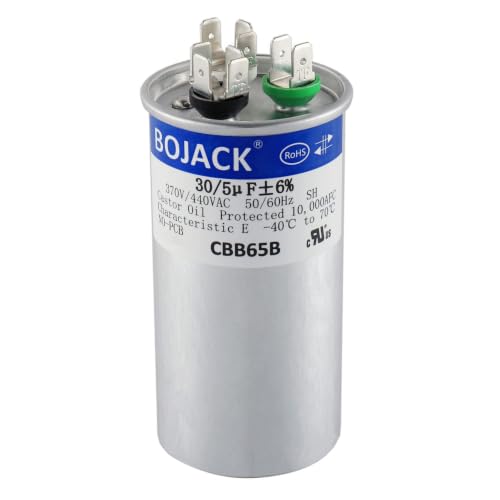
The 30/5 can that gets a humming compressor running again for the least money.
Start with the number that decides most buys: this is a 30+5 uF dual-run cap rated 370V/440V and built to the CBB65 round format. Diameter lands under 1.97 inch with a height of 3.94 inches, which fits the standard bracket on most condensers. The three top terminals are labeled “Herm”/”H” for the compressor, “Fan”/”F” for the fan, and “C” for common, so cross-checking against the old can is a glance rather than a guessing game. Safety-rated at 10,000 AFC, it is built for the short-circuit currents a compressor throws at it.
What this can is known for is simply working when a failed cap has stalled the unit. Functionality is the praise this model earns most, and the pattern is consistent: an 8-year-old 30/5 MFD gives out, the compressor hums and quits, and a matching BOJACK drops in and restores cooling. Owners mention exactly that — the exact match arrived fast, installed easily, and the AC came back on. Cold air from the vents within a few minutes of the swap is the outcome most people are chasing.
The trade-off is documentation and packaging rather than function. The box is minimal and there are no detailed instructions in the wrap, so this suits someone comfortable matching terminal labels and taking a photo of the old wiring before disconnecting. A few BOJACK units last the season and then fail around eight months, the wear risk baked into this price tier. Price-tier value is the draw here: this is the budget-friendly route to a working condenser, and it earns that role well.
What it delivers: a 30+5 uF, 370/440V CBB65 can with labeled Herm, Fan and Common terminals and a 10,000 AFC safety rating.
What you give up: instructions are thin and durability is a coin toss at this tier — fine for a confident DIYer, less ideal for a first-timer.
Pick this one if: you know your way around a condenser and want the low-cost route to a 30/5 swap.
Think twice if: you are brand new to electrical work — the missing guide makes the first install harder.
4. COOLWAY 45/5 uF 45+5 MFD CBB65 Dual Run Capacitor

A 45/5 can with a parts list that matches a huge range of OEM numbers.
What sets the COOLWAY apart is the cross-reference sheet. The maker lists replacements for a long string of OEM part numbers — 97F9895, Z97F995, 27L880, TRCD455, PRCFD455, 12788, RC0114 and more — covering Carrier, Goodman and Lennox condensers. It is a 45+5 MFD dual run rated 370V or 440V, so it handles both voltage tiers. And it carries UL listing against EIA-456-A and IEC 60252-1:2001, the tougher standards for AC motor run capacitors. Against the Jard’s 45 microfarad, this one matches on capacitance but lists a wider OEM footprint for anyone cross-checking a model number.
Size runs 1.96 inches wide by 4.52 inches tall with a ±5% tolerance, and the three terminals are labeled Herm, Fan and C. The ±5% figure means the can’s real capacitance stays close to its printed rating, which is what a compressor wants to see. A multimeter check on arrival is a smart habit here — one COOLWAY owner verified their unit against a Fluke 179 and found the microfarad values exact. Reliability is what this model earns praise for, and the pattern is steady: install it, and the condenser fan and compressor both spin up as they should.
Where this pick asks a little of you is the install itself. The can is taller than some originals at 4.52 inches, so confirm it clears the bracket before you commit. Terminal order on the new unit can also differ from the old, so match the labels rather than mirroring wire position. Do that and the swap is quick; skip it and you are calling a tech to sort the wiring.
The case for it: a 45/5 MFD dual run, UL listed to EIA-456-A and IEC 60252-1:2001, with an OEM cross-reference list that covers a wide spread of Carrier, Goodman and Lennox units.
The catch: at 4.52 inches tall it is longer than some originals, and the terminal layout may not mirror the old can — verify size and labels before installing.
Best for: anyone cross-checking a Carrier, Goodman or Lennox part number who wants a verified UL-listed 45/5 match.
Skip if: your bracket is tight on height — measure the clearance first.
5. VEXUNGA 45/5 uF 45+5 MFD CBB65 Dual Run Capacitor

The no-rewire 45/5 swap for scorching climates and dead-of-summer failures.
This is the premium-tier 45+5 uF dual-run can, rated 370V or 440V and built to CBB65, running -40°C to +70°C at 50/60 Hz. The maker sells it as a direct replacement with no wiring or adapter changes, and the three terminals are color-coded: white for Herm (compressor), green for Fan, black for common. It measures 2.36 inches wide by 3.35 inches tall, a taller and narrower can than the COOLWAY’s 4.52-inch version — worth checking against your bracket before ordering.
What this pick earns its tier on is the day your AC dies overnight. When the house is climbing past a hundred, a capacitor that arrives fast and starts the compressor on the first try is worth every penny. Customers note this VEXUNGA can delivered in under two hours and bringing the condenser right back up. The easy-install reputation is the praise this model earns most, and swapping an exact replacement into a condenser that had stopped is typically a few minutes of work once the power is killed.
The honest trade sits with longevity and fit. A few VEXUNGA cans fail inside three months, a wear risk across the category rather than this brand alone, so keep a spare. Size is also mixed — some units come in noticeably smaller than the original, and one report has a buyer securing a smaller can in a larger bracket with a heavy-duty wire tie. Match your old label’s microfarad and voltage, confirm the 3.35-inch height clears, and the install goes clean; the build quality is the reason this sits at the premium tier.
Where the money goes: a 45/5 MFD, 370/440V CBB65 can with a no-rewire install claim and color-coded terminals — quality leads the praise this model earns.
What to watch: a minority fail inside three months, and some units arrive smaller than the original, so a spare and a wire tie are worthwhile insurance.
Go premium if: your 45/5 label needs a fast, color-coded, no-rewire swap in a high-heat climate.
Stay with the value tier if: you do not need the color-coded terminals and would rather pay less for the same 45/5 rating.
Know the Specs
Microfarad (uF) Rating
The microfarad number tells you how much electrical capacitance the can holds, and it is the figure you must match to the old part. A dual-run capacitor lists two, like 45/5, where the first is the compressor’s rating and the second is the outdoor fan’s. Getting the number wrong is the usual reason a new can hums instead of starting the motor.
Voltage and 370V vs 440V
Voltage is the ceiling the can is built to handle, not what it pushes out. Most home condensers run on 370V, and a 440V-rated can safely covers both. Never go below the rating on the old label — a 440V system needs a 440V cap. Higher voltage headroom adds margin against surges, not performance.
Terminal Labels: Herm, Fan, Common
Every dual-run can has three terminals: Herm for the compressor motor, Fan for the fan motor, and C for the common line. The labels are your wiring map. Photograph the old connections before you pull the wires, and match labels rather than wire positions — new units often arrange terminals differently.
Safety Rating (10,000 AFC) and Temperature
The AFC figure measures how much fault current the can can withstand if something shorts, and 10,000 AFC is the common standard for home condensers. The temperature window — often -40°C to +70°C — tells you how hot or cold the part tolerates. On a sun-baked pad, the wider that window, the longer a cap tends to survive.
Common Questions
How do I know which microfarad capacitor my AC needs?
Can I use a 440V capacitor to replace a 370V one?
Does the physical size of a capacitor matter?
Why does my compressor hum but not start after a capacitor swap?
How long should an AC capacitor last?
Is a dual-run capacitor the same as a run capacitor?
Can I test a capacitor before I install it?
What does 10,000 AFC mean on a capacitor?
Should I buy two capacitors at once?
What safety precautions should I take before replacing a capacitor?
The Bottom Line
For most people, the capacitor for ac winner is the Jard # 12788 because its 45 + 5 microfarad, 440V dual-run build fits the most common home condenser and delivers real value over a service call. If you need the color-coded, no-rewire premium route, the VEXUNGA 45/5 uF covers that with a 370/440V CBB65 can. And for a 30/5 heat-pump or fan fix on a budget, the UL-listed Fiada 30/5 MFD is the one to reach for. Whichever you pick, order a spare — the fix costs far less than the wait for a second can when the first one gives out.
How we choose
We do not accept paid placement. Every pick is matched to a real buyer and a real use-case; we do not hands-on test units.
Sources
Specifications: manufacturer listings and product documentation. Review insights: verified customer reviews, as of October 2026. Pricing: not shown on this page (it changes often); check the current price via the retailer link.
As an Amazon Associate, Aappliancez earns from qualifying purchases. This does not affect which products we feature.