Disclosure: Some links in this post are affiliate links. As an Amazon Associate I earn from qualifying purchases, at no extra cost to you. Learn more
Specs are compiled from manufacturer listings and verified buyer reviews and can change over time — please confirm the key details on the product page before buying.
Buy the wrong can and you get a watery pour with floating white flecks in your curry. Buy the right one and the fat content is high enough to coat a spoon. The difference is rarely the brand name — it is what is printed on the ingredient line and how much fat the can actually carries. This guide walks through five real cans, tells you which one suits curries, which suits coffee, and which one belongs in a smoothie glass instead of a saucepan.
This guide is built by comparing the manufacturers’ published specifications and the patterns across verified customer reviews, so you get each pick’s real strengths and trade-offs instead of marketing spin.
Coconut milk splits into two very different products on the same shelf: thick cooking cans and thin drinking cartons. Knowing which one you are holding tells you whether it will thicken a curry or just thin it out. That single distinction is the backbone of this list of the best canned coconut milk.
Top Picks

How To Choose The Best Canned Coconut Milk
Start with the job, not the brand. A can built for curry and a can built for cereal are not interchangeable, and no amount of good reviews will fix the wrong one in your pan. Before you add anything to a cart, decide which of those two jobs you are actually shopping for.
Match the fat level to the dish
Fat is the number that decides whether your sauce clings or runs. A can carrying 18% fat or more gives you body — it coats a spoon and thickens a curry without a separate thickener. A lite can, by contrast, is deliberately watered down in fat and calories, which makes it pleasant in coffee but thin in a sauce.
Know what guar gum does before you reject it
Guar gum is a plant-based thickener that keeps the coconut fat suspended in the water so the can pours evenly. It is why some cans look uniform and others look split. If you have a sensitive gut, a gum-free can is the safer pick, but its fat will separate, so stir or blend each tin before use.
Treat separation as information, not damage
Real coconut milk separates — the fat rises and the water sits underneath. That is what pure product does. A can that has separated usually just needs warming and shaking. A can that never separates despite being labelled gum-free is worth a second look at the label.
Side-by-Side Comparison
| Model | Best For | Format | Added Gums | Fat Level | Amazon |
|---|---|---|---|---|---|
| Real Coco Organic Original★ Best Overall | Drinking and smoothies | 6 x 1L cartons | Contains xanthan gum | 0g sugar per serving | Amazon |
| Natural Value Coconut MilkBest Value | Everyday curry base | 12 x 13.5 oz cans | No stabilizers listed | — | Amazon |
| Jiva Organics Premium | Rich, clean-label cooking | 12 x 13.5 oz cans | No guar gum | Full 18% fat | Amazon |
| Thai Kitchen Unsweetened Lite | Coffee creamer duty | 6 x 25.36 fl oz cartons | Two ingredients only | 60% less fat than regular | Amazon |
| Nature’s Greatest Foods Coconut Cream | Whipping and desserts | 12 x 13.5 oz cans | No guar gum | 20–22% coconut fat | Amazon |
Detailed Reviews
1. Real Coco Organic Original Coconut Milk Beverage (6-Pack 1L)
Our pick — 4.0+★ from 950+ verified ratings; the strongest balance of quality and price.
Six litres of drinking coconut milk that tastes like coconut instead of a sweetened milkshake.
This is the one for your cereal bowl, your blender, and your glass. It is a beverage, not a cooking can — poured straight from the carton it is smooth and light, with 0g of sugar per serving. Six one-litre cartons give you 202.8 fluid ounces in total, so you are not restocking every week.
What wins people over is the flavour, and by a wide margin — the taste simply dominates every other comment on the product. Buyers describe it as creamy and rich with a light coconut note rather than an artificial one. The ingredient list backs that up: organic, non-GMO, vegan, gluten-free, keto-friendly, and never from concentrate, with the milk produced at the source in Southeast Asia so there are fewer ingredients and minimal processing. It also supplies MCTs and magnesium.
Here is the honest catch, and it is a shipping problem rather than a recipe problem. The cartons are heavy and the caps are fragile in transit — reports of leaking tops and one empty container in a pack are the recurring gripe. If a delivery lands damaged, check the seals before you put the cartons away. Also worth knowing: this is a gum-thickened drink, so it will not reduce into a thick curry sauce the way a full-fat can will.
What earns the top spot
- Clean organic lineup — non-GMO, vegan, gluten-free, paleo and keto friendly
- Smooth, light texture that drinks well and blends into smoothies without grit
- 40 calories and zero sugars per serving, so it fits a low-sugar diet
- Six one-litre cartons totalling 202.8 fluid ounces
Where it asks patience
- Contains xanthan gum, which some buyers actively avoid
- Carton caps survive shipping poorly — inspect every seal on arrival
- Price draws split opinions among buyers
- Too thin for sauces that need to reduce and cling
Reach for this if: you drink coconut milk, blend smoothies, or want a dairy-free pour for cereal and coffee.
Look elsewhere if: your recipe needs a thick, high-fat can that coats the back of a spoon.
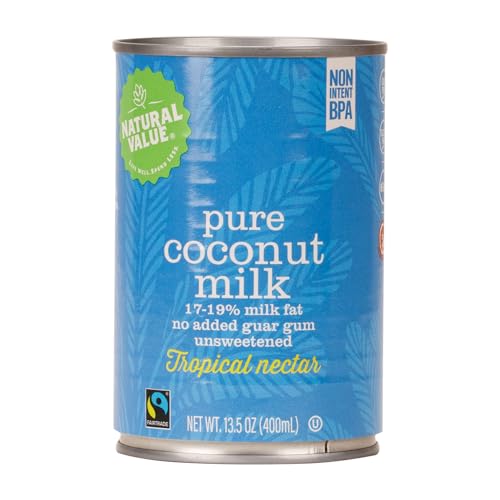
2. Natural Value Coconut Milk, 13.5 oz. Cans (Count of 12)
A twelve-can case of plain coconut milk with nothing added — and a habit of splitting in the tin.
Twelve 13.5-ounce cans, 162 ounces in total, no preservatives and no stabilizers, packed in a BPA-free lining. It is gluten free and vegan. That short ingredient story is the whole pitch, and for anyone who reads labels closely it is a strong one. Buyers who cannot tolerate guar gum single this out as the only can they can use — it is the reason many of them stay.
Set your expectations on texture, though. The cream separates hard, well past three-quarters of the can, so it looks grainy the moment it hits the pan. The taste is unaffected. Shake hard, warm the tin briefly, or run a mini immersion blender through it and you get a smooth sauce back. That is the routine, and once you accept it the can performs well in curries, Asian soups, and smoothies.
Two things to watch. The cans arrive with the occasional dent, though the packaging has moved to a box-in-box design with individual cardboard sleeves to reduce that. And batch consistency is the real wild card — a good case is fresh and delicious, while a weak one turns watery and chunky. If a case disappoints, heating the water about five minutes before mixing restores a creamy texture. A full 12-can case weighs 14.08 ounces per can, so store it somewhere solid.
The gum-free argument: for anyone with a guar gum sensitivity, this is the can that lets them cook again, and that alone justifies the case format.
The stirring tax: you will blend or shake almost every can, so keep a small immersion blender within reach of the hob.
Fits best: home cooks who want a plain, additive-light can in bulk and do not mind prepping each tin.
Think twice: if you expect a can that pours thick and uniform straight from the tin.
3. Jiva Organics Organic Coconut Milk 13.5 Oz

Two ingredients, 18% fat, and the richest clean-label can in this lineup.
The label is the story: coconut and water, nothing else. No guar gum, no preservatives, BPA-free cans, USDA organic coconuts from Sri Lanka in a coconut-only factory. Twelve cans at 13.5 ounces each gives you 162.36 fluid ounces. The 18% fat content is what separates it from the lite options here — that fat is why it turns a curry glossy and why it holds up in soups, sauces, and desserts.
Taste is where it earns its place, and the ingredient list is the second most-praised thing about it. The flavour reads clean, without the chemical or preservative note that shows up in cheaper cans, and buyers happily use it on savoury food. It also stirs into coffee as a dairy swap.
The catch is that pure cans split. This one needs stirring before use, and a few buyers find it does not blend as cleanly as they hoped. A handful of cans arrive thicker than expected while most are consistent, which is normal for an additive-free product. There is also a labelling question worth naming: at least one buyer refrigerated cans to separate the fat for coconut yogurt and found no separation at all, which left them doubting the claim. That is one voice against many satisfied ones, but if absolute purity is your priority, note it. Price is the other split — some buyers find it steep for a can, though it lands in line with other organic, gum-free options.
Why cooks like it: 18% fat plus a two-word ingredient list is a rare combination, and it means no compromise between richness and a clean label.
The prep note: stir every can. Separation is normal here, and the fat needs distributing before it hits heat.
Choose this one: if you cook Thai, Indian, or Caribbean dishes and want an organic, gum-free can that can carry the sauce.
Pass it over: if you want a pour-and-go product with no stirring required.
4. Thai Kitchen Unsweetened Lite Coconut Milk 25.36 fl oz

The carton that replaces half and half in your morning cup without a gum in sight.
Water and coconut. That is the entire ingredient list, and it is the reason this carton appeals to people who react badly to additives. It carries 60% less fat and calories than regular coconut milk, so it pours light. Six 25.36 fl oz cartons come to 152.16 fluid ounces. The full case weighs 11.27 pounds, against 2.11 pounds for the Real Coco six-pack above — a difference you will notice lifting it onto a shelf.
In coffee it behaves like a creamer. The consistency runs thick enough to replace half and half, with a gentle coconut flavour rather than a strong one — which is exactly what you want before your first sip of the day. It also holds up in Golden Milk and in everyday recipes, being dairy free, gluten free, non-GMO, kosher, and sourced from Thailand.
Two honest notes. First, cold weather makes it separate, so soak the box in a bowl of warm water and shake it vigorously before use. Second, carton-to-carton consistency has slipped for some — a carton that should be creamy can arrive clumpy, and straining it just leaves a watery pour. That is a batch issue rather than a formula one, but it is worth knowing before you commit to a six-pack.
The ingredient win: a two-item label with no gums is genuinely uncommon at this size, and it is the main reason buyers keep coming back.
The weather caveat: keep it at room temperature and shake well — a cold carton will split on you.
Best suited to: daily coffee drinkers who want a dairy swap with a short ingredient list.
Not the one: for a rich curry or a dessert that needs body — the lite formula is too thin.
5. Nature’s Greatest Foods Organic Coconut Cream 13.5oz
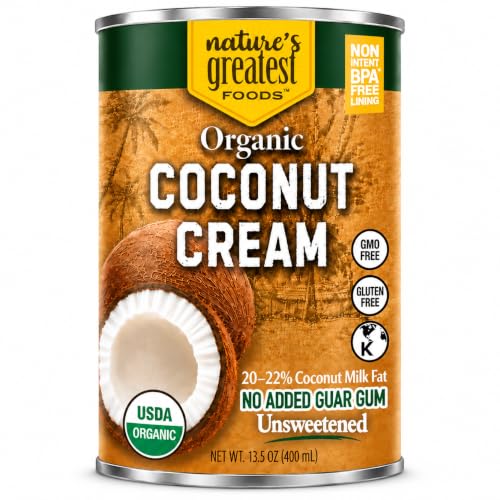
Coconut cream, not milk — the dense one you whip, not the thin one you pour.
Read the label carefully, because this is cream and it behaves like cream. The fat content runs 20–22%, the thickest in this lineup, and that density is what lets it separate for whipping and add real richness to a sauce. Twelve 13.5-ounce cans, 162 fluid ounces total. The ingredient list is short: no guar gum, no carrageenan, no preservatives, no added sugar. It is USDA Organic, Non-GMO, gluten-free, vegan, and Kosher, in BPA-free lined cans.
Flavour is what it wins on, with the clean ingredient list right behind. It tastes of coconut without a cloying sweetness, which makes it useful in both savoury and sweet cooking — curries, soups, smoothies, and dairy-free whipped cream. Buyers who found it after hunting for a gum-free cream tend to stay.
Two things to plan around. Consistency is the running theme: some cans arrive thick and velvety, others pour closer to a milk, and a batch that turns to roughly 40% water has been reported as a quality dip. That inconsistency is the honest trade-off for a gum-free can that relies on the coconut alone to hold together. Ordering in the colder months also risks curdling in transit, so check the cans on arrival and try a single can from the case before you build a dessert around it.
Where it delivers: 20–22% fat and a clean label make this the one to reach for when you need whipped cream or a dense dessert base.
Where it wobbles: can-to-can thickness varies, so taste a can from the case before committing a whole recipe to it.
Worth it for: dessert makers and keto or paleo cooks who need a thick, whippable coconut base without gums.
Skip it for: everyday cereal or coffee — the fat level is far too high for a casual pour.
Know the Specs
Fat Percentage
This is the number printed on the can that tells you how rich the product will be. A can at 20–22% behaves like cream — it whips, it thickens, and a small amount goes a long way. A can at 18% is the classic curry standard. A lite can is deliberately reduced in fat, which suits a coffee cup but leaves a sauce thin. Match the percentage to the dish and you stop buying cans that are wrong for the job.
Guar Gum and Stabilizers
You get an even pour straight from the tin when the can contains guar gum (a plant-based thickener that keeps the coconut fat mixed in). Without it, the fat rises to the top and the water sits below, so you have to shake or blend before use. Neither option is better on its own — it depends on if you want an even pour or the shortest possible ingredient list.
Can Size and Case Count
A 13.5-ounce can is the standard cooking size — close to two cups of liquid once opened. A 25.36 fl oz carton is roughly double that, so it suits a household that uses coconut milk daily. Case counts of six or twelve change your storage needs as much as your cooking: twelve cans is a shelf commitment, while six is a trial run.
BPA-Free Lining
The inside of a can is coated so the metal does not react with the food. A BPA-free lining is the coating some buyers specifically look for. It appears on several cans in this list. If the lining matters to you, check the label before buying a case, because it is not universal across brands.
Common Questions
Why does my canned coconut milk look separated or grainy?
Is coconut cream the same as coconut milk?
Can I substitute lite coconut milk for full fat in a curry?
What does no guar gum actually mean on a label?
How should I store a case of canned coconut milk?
Why did the coconut milk arrive curdled or leaking?
Is canned coconut milk keto friendly?
Can I whip canned coconut milk instead of buying cream?
Does a BPA-free can matter for coconut milk?
Which is better for smoothies — a carton or a can?
The Bottom Line
The winner for most kitchens is the Real Coco Organic Original, because it handles the everyday jobs — cereal, smoothies, a straight glass — with a clean organic ingredient list and zero sugar per serving. It is a beverage, so keep a cooking can alongside it. For sauces and curries that need body, the Jiva Organics Premium is the one to reach for, with its 18% fat and two-ingredient label. And if whipping cream for dessert is the job, the Nature’s Greatest Foods Coconut Cream carries 20–22% fat and no guar gum, which is exactly the density that task needs.
How we choose
We do not accept paid placement. Every pick is matched to a real buyer and a real use-case; we do not hands-on test units.
Sources
Specifications: manufacturer listings and product documentation. Review insights: verified customer reviews, as of October 2026. Pricing: not shown on this page (it changes often); check the current price via the retailer link.
As an Amazon Associate, Aappliancez earns from qualifying purchases. This does not affect which products we feature.