Disclosure: Some links in this post are affiliate links. As an Amazon Associate I earn from qualifying purchases, at no extra cost to you. Learn more
Specs are compiled from manufacturer listings and verified buyer reviews and can change over time — please confirm the key details on the product page before buying.
Canada thistle is the weed that keeps winning. It comes back from a root system that runs deeper than your fork, so pulling it just makes it angrier. The fix is a herbicide that moves through the leaf and down into that root, and the five concentrates below all do that job on turfgrass. Which one fits depends on where the thistle grows — a lawn you want to keep, or a driveway you don’t.
This guide is built by comparing the manufacturers’ published specifications and the patterns across verified customer reviews, so you get each pick’s real strengths and trade-offs instead of marketing spin.
Thistle rarely grows alone, so most of these formulas also clear clover, dandelion and spurge. You’ll see which concentrates are safe on which turfgrasses, how fast each one shows damage, and the mixing mistakes that waste a bottle. Every pick here is a concentrate you dilute yourself — that’s the only way to get thistle-killing strength from a homeowner-sized bottle. Here’s how to choose a canadian thistle weed killer that actually reaches the root.
Top Picks


How To Choose The Best Canadian Thistle Weed Killer
Canada thistle is a perennial, which is the whole problem. It stores energy in a horizontal root network, so a product that only burns the top leaves gives you a green patch that dies and a root that sprouts again. You want a herbicide that gets absorbed through the leaf and carried downward — that is what “systemic” means, and every pick in this list is a liquid concentrate you mix yourself for exactly that reason.
Know your grass before you buy anything
Herbicides are selective by grass type, not by brand loyalty. A formula that is gentle on Tall Fescue can set back Bentgrass, and one that is fine on St. Augustine sod may be off-limits on actively growing bermudagrass. Read the label’s turf list, then read it again against your own lawn. If your lawn is a mix of grasses, spot-spray the thistle rather than broadcasting over the whole yard.
Pre-emergent versus post-emergent: which job are you doing
Pre-emergent herbicide stops seeds from sprouting; post-emergent kills plants already up. Thistle that is already standing needs post-emergent action. Some mesotrione products do both, which is why they show up in lawn programs as a spring-and-mid-summer spray. If your thistle is established, prioritize the post-emergent side of the label.
Speed of visible damage is not the same as kill
Contact herbicides brown leaves within hours to a day. Systemic products can take a week to show wilting and two to three weeks for full death. Neither timeline is a defect — a fast burn just means the top died first. Judge a product by whether the thistle stays gone next month, not by how brown it looks tomorrow.
Side-by-Side Comparison
| Model | Best For | Active Ingredient | Bottle Size | Stated Coverage | Amazon |
|---|---|---|---|---|---|
| Quali-Pro MSM Turf Herbicide 8oz★ Best Overall | Small lawns and spot work | MSM (herbicide) | 8 fl oz | Ornamental turf | Amazon |
| Southern Ag Amine 2,4-D Weed Killer, 32ozBig-Lawn Value | Big lawns on a budget | 2,4-D amine salt | 32 fl oz | 5,000 sq ft | Amazon |
| Spectracide Weed and Grass Killer Concentrate 32 Oz | Driveways and fence lines | Diquat Dibromide | 32 fl oz | 1,350 sq ft | Amazon |
| Liquid Harvest Mesotrione 8oz | Spring prevention plus cleanup | Mesotrione | 8 fl oz | Full (per label) | Amazon |
| Fertilome Weed Free Zone 32 oz | Tough broadleaf on fine turf | Dicamba blend | 32 fl oz | Full (per label) | Amazon |
Detailed Reviews
1. Quali-Pro MSM Turf Herbicide 8oz
Our pick — 4.5+★ from 1,000+ verified ratings; the strongest balance of quality and price.
An 8-ounce bottle that treats far more lawn than its size suggests.
If you have one lawn to keep clean and you are tired of buying jugs that barely make a dent, this is the pick. The active ingredient is MSM, a sulfonylurea herbicide (a granular-acting chemical that interferes with a plant’s growth process rather than burning its leaves on contact). You mix a very small amount into water and spray the thistle foliage. The bottle is 8 fluid ounces and the label targets broadleaf and grassy weeds on ornamental turf — lawns, parks, cemeteries, golf course fairways and sod farms.
This product wins people over with effectiveness — and the proof is how little you need. One owner mixed about a hundredth of an ounce in two gallons of water, sprayed roughly 200 square feet, and saw dollar weed wilt at one week and die by two and a half weeks. St. Augustine grass regrew and no dollar weed returned. Another buyer reported Bahia grass dying back in a few days after spraying a yard. Virginia buttonweed, which shrugs off most homeowner sprays, is the weed this bottle is best known for killing.
The catch is patience and mixing. This is a slow-acting herbicide, so don’t expect a dead lawn patch overnight — results usually show over roughly ten days, and stubborn species can need a second pass. The mix ratio is where opinions split: some find the measurement simple, others find the label unclear for a homeowner-sized sprayer. Compare that to the Southern Ag bottle below, which is 32 fluid ounces to this one’s 8 — four times the liquid — but this one is dosed in fractions of an ounce, so the small bottle genuinely goes the distance. It holds 4.5+ stars across 1,000+ ratings.
What earns it the top spot
- Dosed in tiny fractions of an ounce, so 8 fluid ounces stretches across many sprayer fills
- Specifically formulated for ornamental turf, including residential lawns
- Strong on hard-to-kill broadleaf weeds like Virginia buttonweed
- Shelf-stable up to 3 years in a sealed, dry storage building
Where it asks more of you
- Slow-acting — expect visible results in about ten days, not hours
- Mix directions on the label leave some homeowners second-guessing the rate
- Meant for turf situations; commercial-scale users will want a larger format
Made for: the homeowner with an established lawn and a recurring broadleaf problem who wants one bottle to last.
Think twice if: you expect the thistle to look dead by tomorrow — this one works underground first.
2. Southern Ag Amine 2,4-D WEED KILLER, 32oz – Quart
Overnight browning on broadleaf weeds, with a drift risk you have to respect.
This is the formula that shows you something is happening by the next morning. The active ingredient is a dimethylamine salt of 2,4-D, one of the oldest selective broadleaf herbicides in use. It kills many broadleaf weeds and woody plants while leaving grass alone, which is why it is labeled for turf, pastures, rangeland, ditch banks and fence lines. One 32-ounce bottle carries a stated coverage of 5,000 square feet at a low use rate of 1 to 4 pints per acre.
The speed is what people talk about. Weeds brown inside 24 hours for a lot of users, and grass stays green while they go. As buyers report: “Kills broadleaf weeds OVERNIGHT. Safe to use on lawns too.” The 32-ounce bottle also more than doubles the Quali-Pro’s 8 fluid ounces, so if you are treating a large lot rather than spot-spraying, you are getting real volume to work with.
Here is the honest part: 2,4-D does not check ID before it works. One buyer sprayed it and browned the weeds in a day, but also killed the perennial peanut and nearby bushes, with the peanut creeping back over roughly three months. That is drift and non-selectivity, not a broken product — it means you spray on a still day, shield what you want to keep, and measure carefully. Results also run a few weeks to a few months before new weeds emerge, so repeat applications are part of the routine rather than a sign something went wrong.
The speed advantage: visible browning inside 24 hours on most broadleaf weeds, with grass unharmed — the fastest confirmation in this group that your mix was right.
The drift caution: this formula does not spare everything green nearby, so keep the spray on target and away from ornamental beds and desirable broadleaf plantings.
Reach for it when: you have a large lawn or fenceline and want the most coverage per bottle, with quick visual feedback that it’s working.
Pass it up if: thistle is growing right beside perennials or shrubs you plan to keep.
3. Spectracide Weed and Grass Killer Concentrate 32 Oz
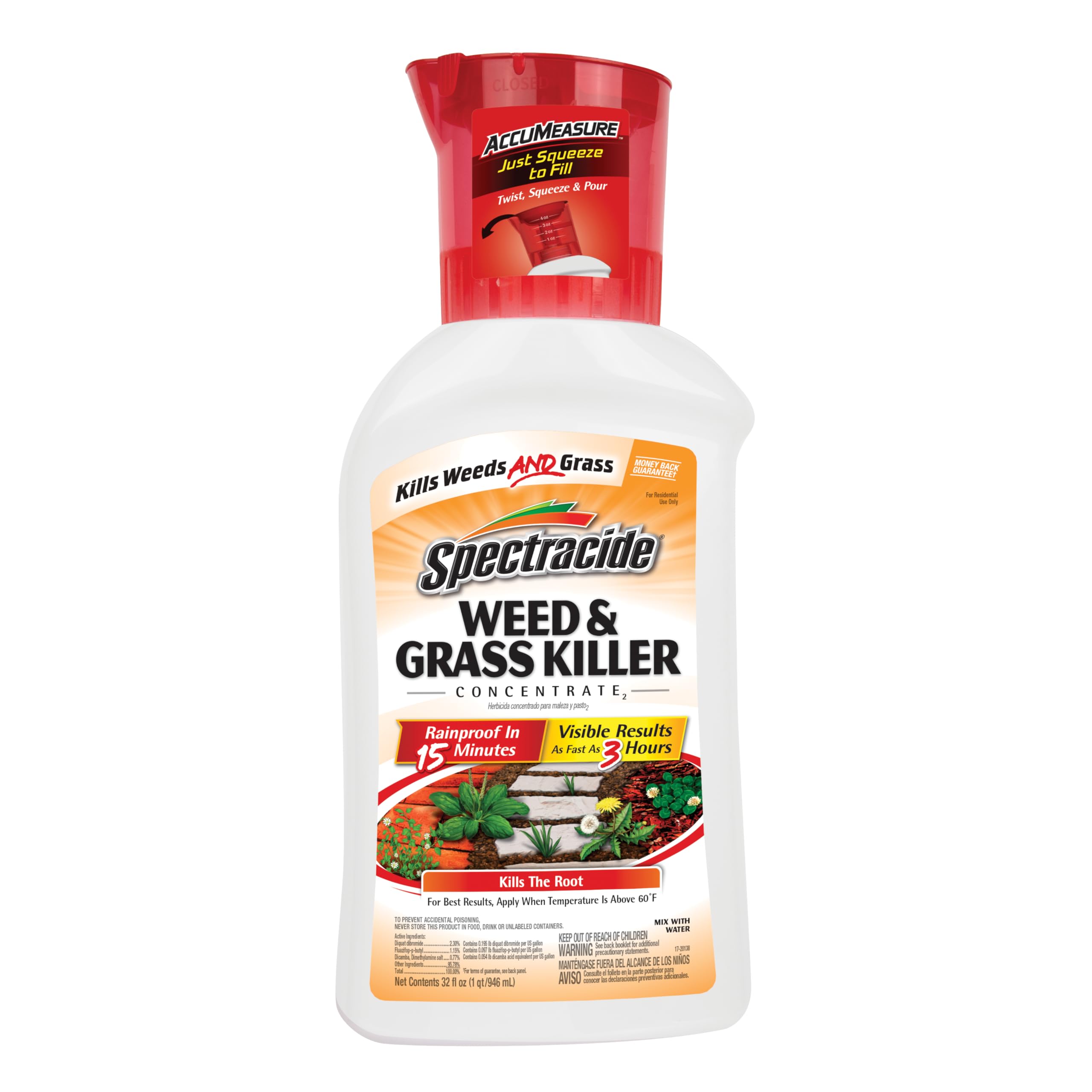
The driveway and patio answer — it kills grass too, so keep it off the lawn.
Thistle in the gravel along a curb is a different job from thistle in a lawn, and this is the bottle for the gravel. The active ingredient is diquat dibromide, a contact herbicide that kills the top growth and is labeled to reach the root, with visible results as fast as 3 hours. It is a non-selective weed and grass killer, meant for driveways, walkways, patios, and around fences, trees, flower beds and shrubs — not for broadcasting over turf you want to keep.
The practical numbers are friendly for a spot job. One 32-fluid-ounce bottle covers a stated 1,350 square feet, and rain 15 minutes after you spray will not wash it away, so a passing shower does not cost you the application. Replanting is possible the same weekend because the label does not lock you out of the bed for a season. The built-in Accumeasure cap lets you twist, squeeze and pour instead of hunting for a measuring cup. As owners mention, mixing it into a reusable one-gallon sprayer killed the weeds along a curb within a day.
Two things to know going in. The self-measuring cap divides opinion — plenty of people like skipping the cup, and a fair number find the mechanism more fuss than it’s worth, so treat it as a convenience you may or may not use. A small handful also run into leakage from the bottle. Since this is non-selective, the real risk is overspray hitting your lawn while you’re aiming at thistle on the edge of it.
Where it shines: hard surfaces and edges where nothing is supposed to grow — 3-hour visible results, 1,350 square feet of coverage, and it stays put through rain 15 minutes after spraying.
Keep on a short leash: because it kills grass as readily as thistle, stray spray on your lawn is the mistake to avoid rather than a defect in the formula.
Right choice for: curb lines, gravel drives and bed edges where a fast, non-selective kill is the goal.
Not the one for: thistle growing in the middle of a lawn you plan to keep green.
4. Liquid Harvest Mesotrione 8oz

The one that stops crabgrass seed now and turns existing weeds white while it works.
Most bottles on this list kill what is already up. Mesotrione does that and one more thing — it stops weed seeds from germinating, so it works as both a pre-emergent and a post-emergent. The label names 46 broadleaf species and grasses it targets, including barnyard grass, carpetweed, chickweed, clover, crabgrass and dandelion. It is 8 fluid ounces, a liquid concentrate like the others, and it needs water to activate: if no rain falls within 10 days of spraying, the label calls for 0.15 inches of water to set it working.
It is also the pickiest about which grass it sits on, and that is worth reading twice. The safe list covers Kentucky bluegrass, centipede grass, buffalo grass, tall fescue, perennial ryegrass, fine fescue and St. Augustine grass in sod form. The label says to avoid bentgrass, Poa annua, kikuyugrass, zoysiagrass, seashore paspalum and bermudagrass — though it can go on dormant bermudagrass to clear weeds. Spray where it belongs and it will not punish you for it.
The color change surprises people. Susceptible weeds go white, which is cosmetic and harmless, but it is visually alarming the first time you see it. Expect a wait, too: the label allows 2-3 weeks for full death, and thistle and crabgrass can need a second coat about two weeks out. A surfactant is worth adding — it helps the spray cling and absorb. Where the Quali-Pro above is a slow systemic that leaves foliage looking normal, this one announces itself in white and does pre-emergent duty the Quali-Pro bottle doesn’t. St. Augustine lawns in Florida report crabgrass cleared this way, with hand-pulling finally retired.
Two jobs in one bottle: stops crabgrass seed germination and kills existing broadleaf weeds, so it handles the thistle crop and the next one sprouting behind it.
The fine print that matters: that long avoid-list — zoysiagrass and bermudagrass among them — is not a suggestion, so confirm your turf type against the label before you spray.
Best fit for: cool-season lawns and St. Augustine sod where you want spring prevention and cleanup from a single bottle.
Look elsewhere if: your lawn is zoysiagrass or actively growing bermudagrass, where the label says no.
5. Fertilome Weed Free Zone Concentrate 32 oz
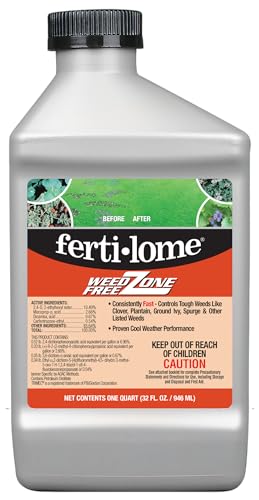
A three-way formula built for the broadleaf weeds that shrug off everything else.
Thistle is named on this label, which is more than most broadleaf concentrates can say. The formula stacks triclopyr, clopyralid and dicamba — three herbicides that attack a plant differently — to control over 80 broadleaf weeds including clover, spurge, chickweed and thistle. It is a 32-fluid-ounce liquid concentrate, and the label reports evidence of injury within hours of application. It is also listed as safe on Kentucky bluegrass, bermudagrass, bahiagrass and zoysiagrass, which matters if you have a warm-season lawn that the mesotrione bottle above can’t touch.
Timing is the lever with this one. The label says to spray when broadleaf weeds are young and actively growing, spring through fall, and to mix with water at the suggested rate and spray the lawn thoroughly. Creeping Charlie and white clover are the weeds it’s best known for clearing, and the lawn comes out looking strong afterward — customers describe the grass looking exceptionally good after treatment. Neighbors preferring it to a paid weed service is the kind of endorsement no label can print.
What it doesn’t do is kill everything, and one honest limitation shows up on stubborn species like wild violet, which can survive a pass. Very tough weeds may need two or three treatments before they give up. You may also see a temporary yellowing of surrounding grass — it recovers in days, but don’t panic at the initial patch. It is the priciest concentrate in this group, and the people who love it tend to have the weeds that cheaper bottles couldn’t finish.
Why lawn owners keep rebuying it
- Thistle is explicitly on the controlled list alongside clover, spurge and chickweed
- Three active ingredients mean several ways to hit weeds that resist single-action formulas
- Injury can show within hours of application
- Labeled safe on Kentucky bluegrass, bermudagrass, bahiagrass and zoysiagrass
Worth knowing before you spray
- Wild violet and similar stubborn species may need two or three treatments
- Some temporary yellowing of surrounding grass is possible before it recovers
- Sits at the premium end of this lineup, so the spread matters for large lawns
Built for: warm-season lawns — especially bermudagrass and zoysiagrass — with tough broadleaf weeds that beat cheaper sprays.
Keep in mind: if your problem weed is wild violet, budget for repeat passes rather than one bottle and done.
Know the Specs
Active ingredient and what it does
The active ingredient is the chemical that actually kills the weed; everything else in the bottle is carrier and mixing aid. 2,4-D amine and dicamba-based blends are selective broadleaf killers that leave grass standing. Diquat is a contact herbicide that kills whatever it touches, grass included. Mesotrione and MSM are slower systemics that interfere with the plant’s internal growth or photosynthesis. The brand on the front matters less than whether that active ingredient is on your turfgrass’s safe list.
Concentrate versus ready-to-use
A concentrate is undiluted herbicide you mix with water yourself. That’s why an 8-fluid-ounce bottle can treat a large area — you’re buying strength, not water. It also means your mixing ratio decides your results, so measure carefully and follow the label rate. Ready-to-use bottles skip the math but cost more per treated square foot. Every pick here is a concentrate, which is the right call for thistle because you can mix a strong spot treatment where the thistle is and a lighter pass elsewhere.
Coverage and sprayer setup
Stated coverage tells you how far one bottle goes. The Southern Ag bottle lists 5,000 square feet and the Spectracide lists 1,350 square feet, so the first suits a large lawn and the second a driveway job. Coverage assumes you spray to fully wet the leaves of the target plants, which is the label’s instruction almost everywhere. A one-gallon pump sprayer with a fan tip covers a fence line cleanly; a battery backpack sprayer makes a whole-yard pass less tiring.
Timing, water and activation
Systemic herbicides need to move into the plant, and that takes time and sometimes water. Mesotrione specifically calls for rainfall or 0.15 inches of water within 10 days to activate. Most others work best when weeds are young and actively growing rather than dormant or heat-stressed. Rainfast timing tells you how long the spray needs to dry — Spectracide holds through rain 15 minutes after application. Spray in the morning on a still day so the product dries and drift stays minimal.
Common Questions
Will these kill Canada thistle without killing my lawn grass?
Why does Canada thistle come back after I spray it?
How long before I see the weeds die?
Can I use mesotrione on my lawn all year round?
What does a surfactant do and do I need one?
How should I store a concentrate between uses?
Can I mix two of these or use them back to back?
How much area will one bottle actually cover?
Will these kill clover and other lawn weeds too?
Is a pre-emergent or post-emergent better for thistle?
The Bottom Line
For most lawns, the strongest pick in this lineup is the Quali-Pro MSM Turf Herbicide. It is an 8-fluid-ounce concentrate that treats far more lawn than you’d expect, because you dose it by the fraction of an ounce, and it’s the bottle owners most often credit with clearing hard-to-kill broadleaf weeds. If you have a big lawn and want the most coverage and the fastest browning, the Southern Ag Amine 2,4-D gives you 32 fluid ounces and a stated 5,000 square feet. And for warm-season grass where thistle stands next to zoysia or bermuda, reach for the Fertilome Weed Free Zone — thistle is on its label, and it’s safe on the grasses the mesotrione bottle isn’t.
What decides your result isn’t the bottle — it’s matching the product to your grass type and spraying thistle while it’s actively growing. Get those two right and one of these five concentrates will finish the thistle.
How we choose
We do not accept paid placement. Every pick is matched to a real buyer and a real use-case; we do not hands-on test units.
Sources
Specifications: manufacturer listings and product documentation. Review insights: verified customer reviews, as of October 2026. Pricing: not shown on this page (it changes often); check the current price via the retailer link.
As an Amazon Associate, Aappliancez earns from qualifying purchases. This does not affect which products we feature.