Disclosure: Some links in this post are affiliate links. As an Amazon Associate I earn from qualifying purchases, at no extra cost to you. Learn more
Specs are compiled from manufacturer listings and verified buyer reviews and can change over time — please confirm the key details on the product page before buying.
A camera cube is a padded box that drops inside the backpack you already own, so your body and lenses stop rattling against a water bottle and a paperback. The one you want has rigid walls that hold their shape and dividers you can actually reposition. Below are seven inserts that do that job, each described by what it physically holds and who it suits.
This guide is built by comparing the manufacturers’ published specifications and the patterns across verified customer reviews, so you get each pick’s real strengths and trade-offs instead of marketing spin.
You will see exactly how many lenses fit in each, how thick the padding runs, and where a cube runs out of room. Those three numbers decide whether a cube fits your pack and your kit.
Top Picks
How To Choose The Best Camera Cube
Start with a tape measure, not a brand name. A cube only earns its place if it slides into your pack and still leaves room for a jacket. Measure the internal cavity of your backpack, then subtract an inch on every side.
Match the interior to your actual kit
A one-camera, one-lens insert and a body-plus-four-lens insert are different animals. Check the listed interior figures, not the photo. A 9.05 x 6.69 x 4.92 inch cavity holds one camera and one lens comfortably. A 8.5W x 8.5H x 4.5D inch cavity takes a body with a 24-70mm attached plus spare glass.
Look for a frame, not just foam
Soft padding protects against knocks. A structural element protects against crushing. Some cubes embed a 3mm steel frame in the lid so the box does not fold flat when a bag is stuffed around it. That difference shows up when your pack is full and something heavy sits on top of the cube.
Decide if you want a shoulder strap
Several inserts include straps and horn buckles so the cube becomes a standalone bag once it leaves your backpack. Others are strictly interior organizers. If the cube stays in your pack all day, a strap is dead weight. If you shoot out of it on location, the strap turns the cube into your carry bag.
Side-by-Side Comparison
| Model | Best For | Interior Cavity | Capacity | Weight | Amazon |
|---|---|---|---|---|---|
| Camera Insert Bag, Size S★ Best Overall | One camera plus one lens | 9.05 x 6.69 x 4.92 in | 5 liters | 1.4 lb | Amazon |
| Peak Design Camera Cube V2, SmediumMost Configurable | Modular mirrorless kits | 22.5 x 31 x 15 cm exterior | — | 300 g with dividers 500 g | Amazon |
| Tenba BYOB 9 DSLR Backpack Insert | Tall packs and top access | 8.5W x 8.5H x 4.5D in | 2-4 lenses | — | Amazon |
| G-raphy Camera Insert Bag | Big kits on a budget | 8 1/2 x 11 1/4 x 4 1/4 in | 10 liters | — | Amazon |
| TARION Padded Camera Insert Bag | Crush-proof in a daypack | 10.2 x 4.9 x 6.3 in | 1 camera, 2 lenses | 320 g | Amazon |
| PGYTECH Medium Camera Insert Protection Bag | Insert that becomes a shoulder bag | — | 1 body, 3 lenses plus extras | — | Amazon |
| Osprey Camera Storage Cube | Hiking with a full frame | 9.8H x 9.8W x 5.9D in | 18 liters | 12.8 oz | Amazon |
Detailed Reviews
1. Camera Insert Bag, Size S
Our pick — 4.5+★ from 150+ verified ratings; the strongest balance of quality and price.
Rigid walls and two zipper doors for the price of a decent strap
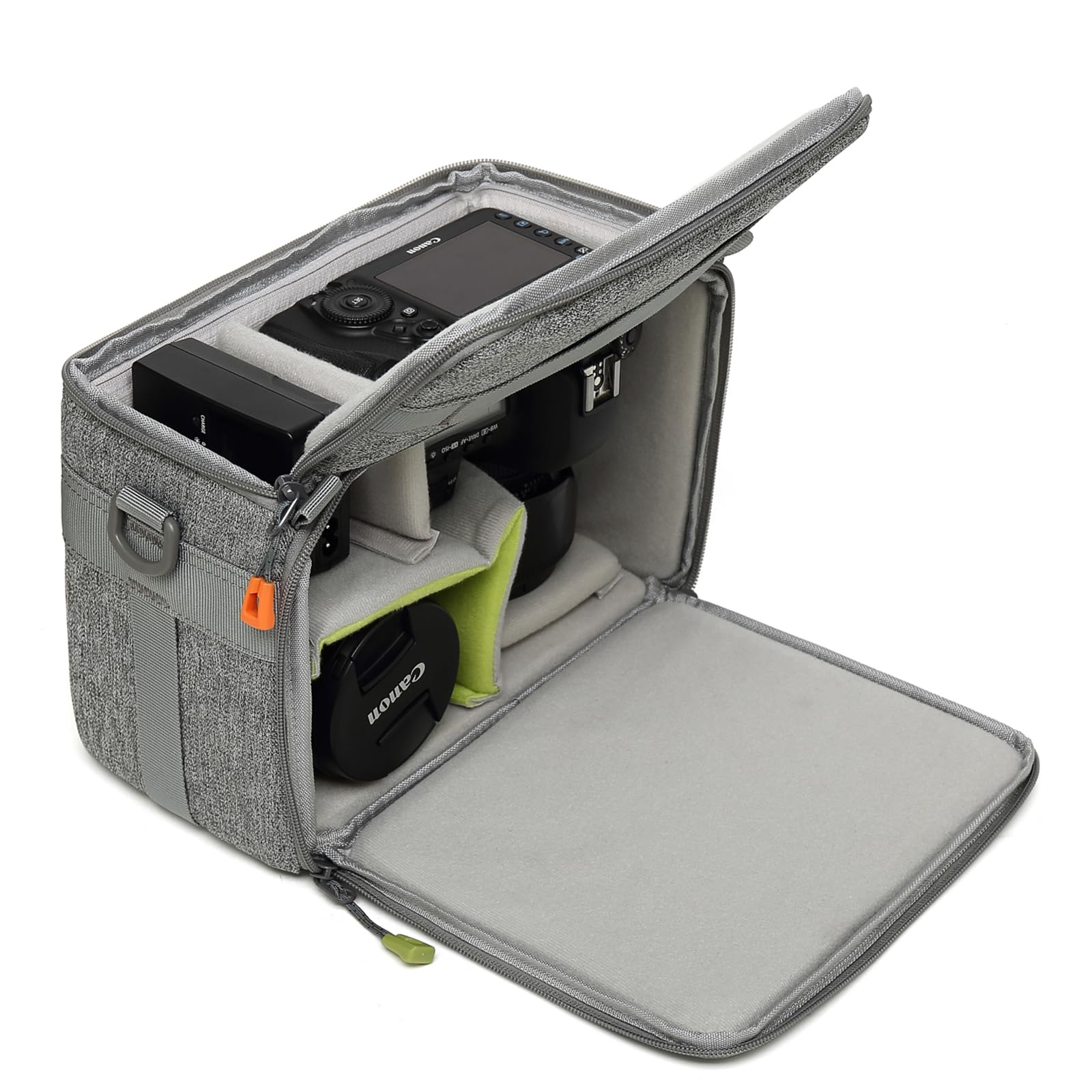
This is the cube that proves an insert can protect gear as well as a dedicated photo bag. It holds a 9.05 x 6.69 x 4.92 inch interior cavity — enough for one camera body with a lens mounted — and it does it inside a 5 liter shell that weighs 1.4 pounds. The structural trick is a layer of ABS plastic sandwiched between soft PE foam on both sides, which is why it can take 6.6 pounds sitting on top without collapsing into your lens.
Where it beats the G-raphy insert below is access. There are two zipper openings, one on top and one on the side, so you can reach a battery or a card without unpacking the whole box. The two 0.5 inch dividers are removable and each one is built from seven layers of PE foam and PP board, so they hold their shape instead of sagging after a month. Buyers report it swallows a 70-200mm f2.8, a 16-35mm f2.8 and a 24-70mm f2.8 along with batteries and filters, which is a lot of glass for a cube this size.
The catch is the same one every cube this compact shares. It is sized for one body and one lens, and the maker’s own compatibility list stops at bodies like the Sony A7 series and Canon R and 5D lines. It will not take a 1DX or a DSLR with a hand grip attached. If you carry two bodies, this is the wrong cube and you should look at the PGYTECH or the Osprey further down. The handles are thin too, so for a heavy load the included shoulder strap is the better carry.
What holds up in daily use
- A 6.6 pound pressure rating backed by ABS panels and PE foam on both faces
- Top and side zipper openings for getting at gear without a full unpack
- Two removable 0.5 inch dividers that stay stiff thanks to PP board cores
- Becomes a sling bag without dividers, or a crossbody with the included strap
Where it runs out of room
- No room or external attachment point for a tripod
- One body and one lens is the ceiling, so two-body shooters should look elsewhere
- Thin carry handles mean heavy loads want the shoulder strap
Reach for this if: you want one camera and one lens protected inside the daypack you already carry, without buying a dedicated photo bag.
Look elsewhere if: your kit includes a 1DX-class body or a DSLR with a hand grip, since the maker lists neither as compatible.
2. Peak Design Camera Cube V2, Smedium (Small/Medium)
The shell that shrugs off rain and the flap that tucks out of your way
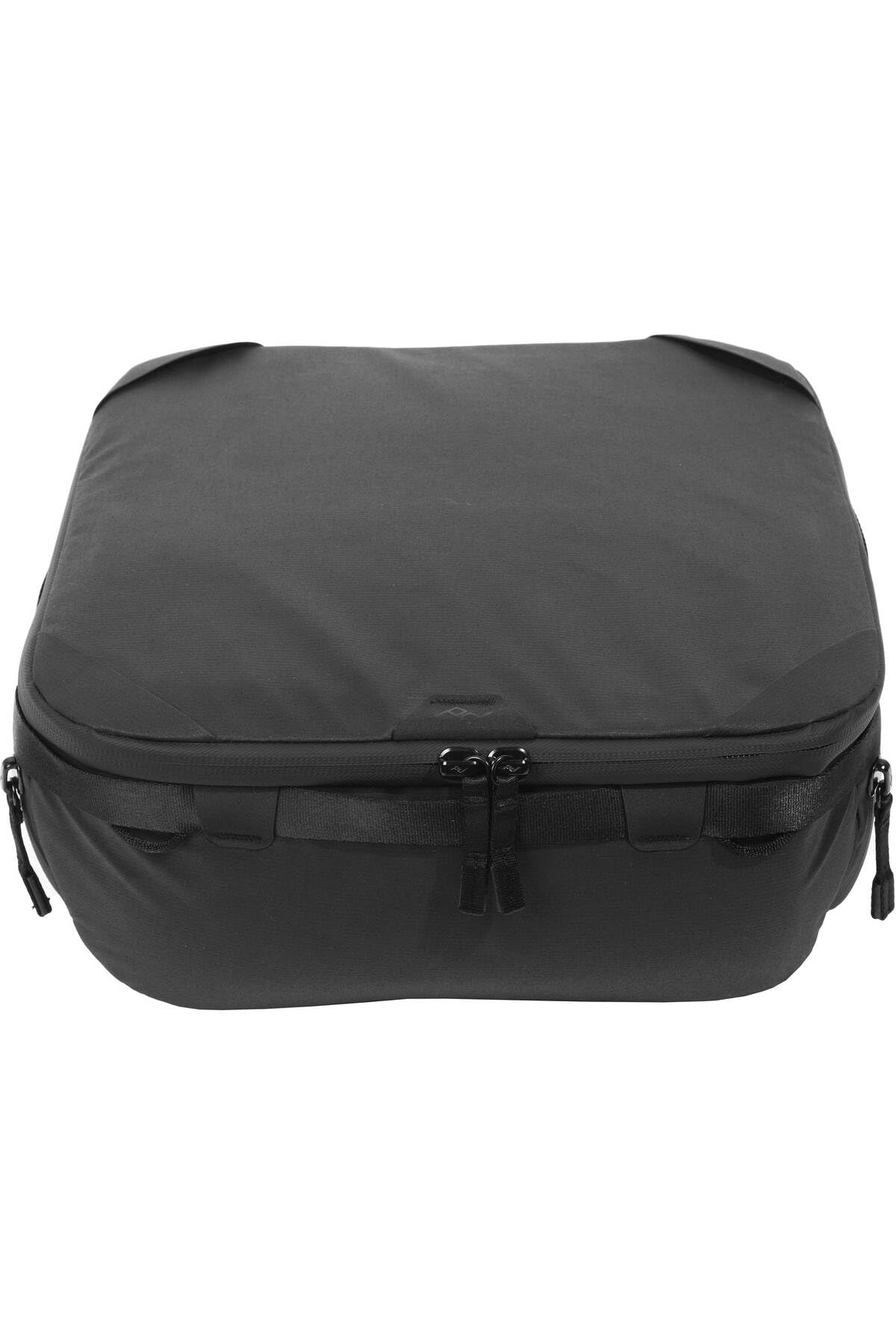
Rain is the reason this one exists. The outer shell is recycled, Bluesign-approved 160D nylon canvas with taped seams and weatherproof #8 Ultra Zips — the zipper tape is the part that usually lets water in on a cheap insert, and here it is sealed. Inside you get FlexFold dividers that fold into shelves rather than just standing as walls, which is how one cube can hold a camera and two lenses one day and a drone and a mic the next.
Peak Design sizes it at 22.5 x 31 x 15cm on the outside and 300g bare, or 500g with the dividers in. The extra-wide main flap tucks away, so when the cube sits open in your pack you see the whole interior at once instead of peering through a slot. Owners mention the smedium takes a camera, two lenses, a spare battery and a few accessories, and several note that the top insert lifts out so the cube can sit open inside another bag. What wins people over is the build — this is the piece that made one shopper say it pairs with their 46L pack without a wobble.
Unlike the Camera Insert Bag above, this one is not built around a hard pressure-rated frame. It is a soft-sided cube with a stiffener, so it organizes brilliantly but does not carry the same crush claim. The other honest limit is interior volume: the smedium is deliberately small, and owners who expected more room are pointed toward the larger sizes. If your kit is a full-frame body with a 70-200mm mounted, measure first. For a mirrorless setup with two primes, it fits cleanly.
The zipper is the story: #8 Ultra Zips with taped external seams are what separate this from every unsealed insert on the page, and they are the difference between a damp shell and a wet sensor.
What it will not do: the soft construction and small smedium cavity mean it organizes and weatherproofs rather than crush-protects, and larger bodies need a bigger size.
The right call for: mirrorless shooters who want modular compartments and a shell that handles a shower on the walk back to the car.
Think twice if: you want a hard-backed cube that keeps its shape under a fully packed 40L bag.
3. Tenba BYOB 9 DSLR Backpack Insert
Built tall so your camera stands up inside a tote instead of lying flat
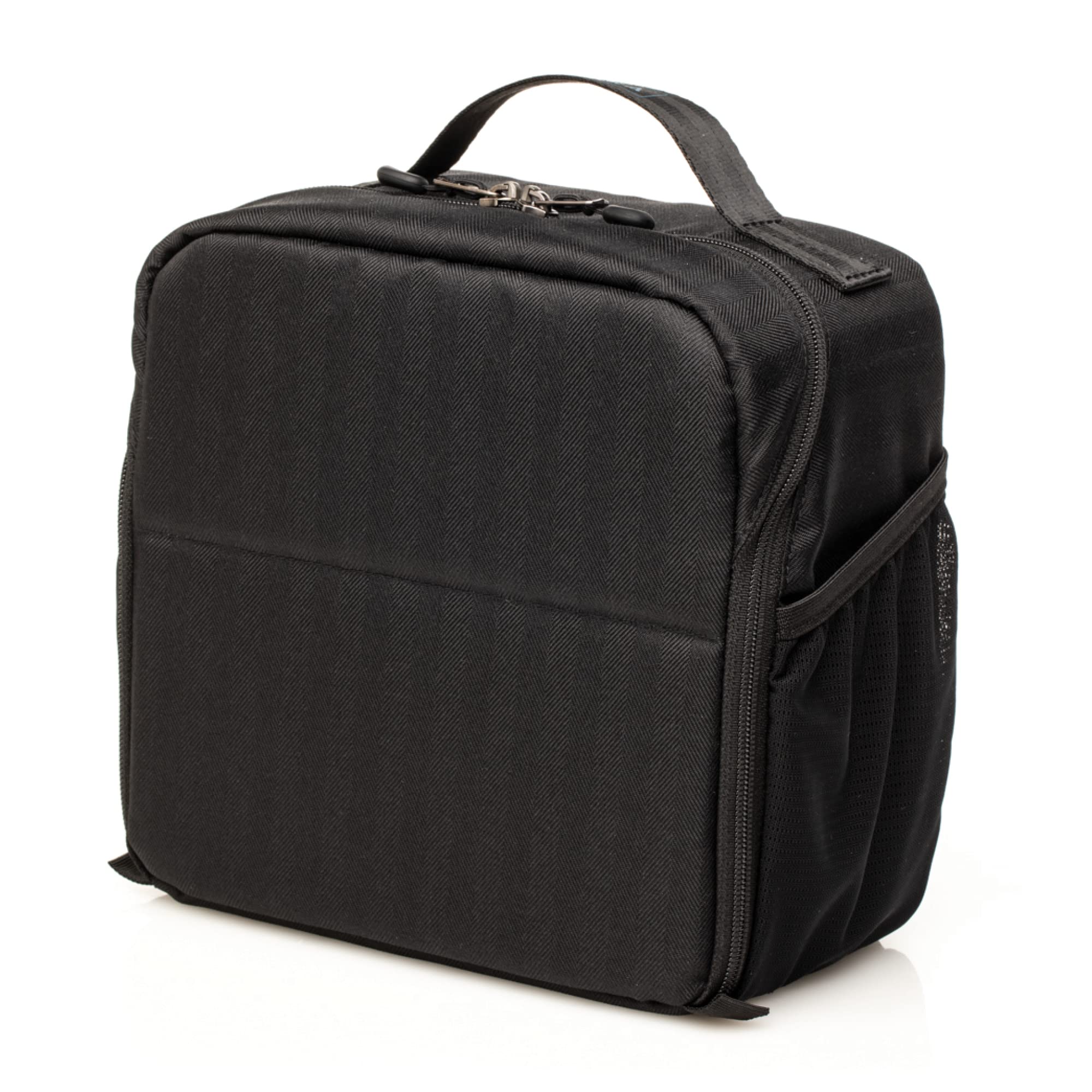
Most cubes are wide and shallow. This one is 8.5W x 8.5H x 4.5D inches inside, which makes it close to square in the vertical plane — and that shape is the whole point. In a tall backpack, a tote or a handbag, a vertical insert lets you reach straight down through a wide top opening and lift the camera out by the grip. A flat cube forces you to pull the whole thing out first.
The capacity claim is a mirrorless or DSLR body with two to four lenses, up to an attached 24-70mm f2.8, plus accessories. That is a real working kit, not a body-and-a-kit-lens box. The exterior is water-repellant 300D herringbone polyester with YKK zippers, and the soft shell molds to whatever bag it sits in rather than fighting the walls. Two stretchy mesh side pockets hold a water bottle or a tabletop tripod. Fit is what earns it the most goodwill among owners, and the 40L pack crowd reports a Canon body, a 75-300mm, an 18-55mm, a charger, dongles and SD cards all going in without a struggle.
The honest trade-off is that a soft, moldable shell is not a crush shield. It protects against knocks and scratches, and the padding is firm, but a heavy load pressing down on a full pack is a different problem than the rigid-frame cubes above and below solve. If your bag gets stacked in a van, go rigid. If it rides on your back all day, the Tenba’s shape and mesh pockets are the more useful design.
Made for: the photographer who carries a tall daypack or a handbag and wants to pull the camera out through the top without unpacking.
Pass on it if: your camera rides in a bag that gets crushed under other luggage, where a framed cube is the safer shape.
4. G-raphy Camera Insert Bag

Ten liters of configurable space for a whole kit, not just a body
If you want volume, this is where you get it. The G-raphy carries 10 liters and lays out one body with a lens attached plus five additional configurable compartments for glass, chargers, batteries and filters. The maker’s own count puts it at 1-2 cameras, 3-4 lenses and a small tripod with room for accessories — a genuine weekend kit rather than a grab-and-go box.
The measured reality is slightly different from the listing, and it is worth knowing before you buy. Owners who put a tape to it report an actual external size of 9 5/8 x 12 3/8 x 5 1/4 inches and an internal cavity of 8 1/2 x 11 1/4 x 4 1/4 inches. It still fits a 25L pack with a laptop, a tablet and accessories alongside, and it drops into a Fjallraven Kanken like it was cut for it. The detachable dividers stick to the liner, so rearranging for a 70-200mm one day and three primes the next takes seconds.
The trade-off is stiffness. Several owners describe the side walls as pliable and flexible — one calls them “very flimsy” compared with a rigid insert — which is fine for scratch and bump protection in a backpack but not a crush rating. There is also no fast access hatch, so you open the top like a suitcase. Padding splits opinion too, with some calling it adequate and others wanting more cushion. Treat this as a soft organizer that protects gear from rubbing in transit, not a hard case, and it delivers a lot of kit space for the outlay.
Why the big-kit crowd likes it
- 10 liters and five configurable compartments handle a body plus three or four lenses
- Fits popular packs by name, including the Fjallraven Kanken and 25L daypacks with a laptop
- Detachable velcro dividers reconfigure in seconds for different lenses
- Ships with a shoulder strap so it works outside the backpack too
What you give up
- Pliable side walls protect from scuffs, not from a heavy bag sitting on top
- No quick-access hatch, only a top opening
- Actual dimensions differ from the listing, so measure your pack against 8 1/2 x 11 1/4 x 4 1/4 inches
Worth it if: you want to move a full kit — body, three or four lenses, a small tripod — into the backpack you already own.
Skip if: your gear rides under stacked luggage, where the flexible walls are the weak point.
5. TARION Padded Camera Insert Bag
A 3mm steel frame in the lid so a stuffed pack cannot flatten your gear
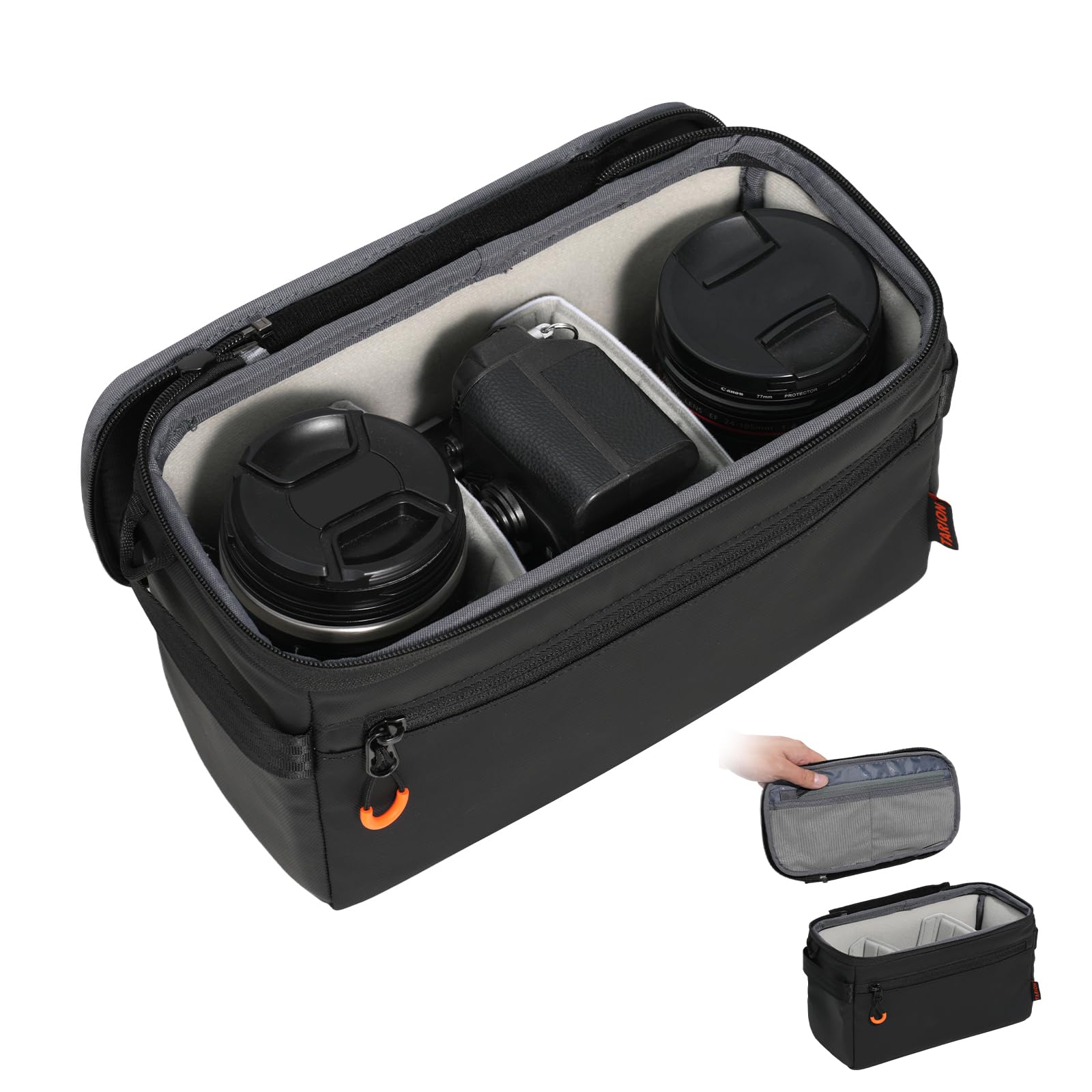
The spec that separates this TARION from a plain padded box is a 3mm steel frame built into the top lid. It stops the cube deforming when it sits in a 15-20L daypack with clothes and a jacket crammed on top — the exact failure that turns a soft insert into a pressed sandwich. Around that frame you get a high-density polyester exterior with pearl cotton padding, at 320g and roughly 10.2 x 4.9 x 6.3 inches, sized for one camera body and two lenses.
There are two adjustable dividers to arrange that camera and pair of lenses, and the top lid comes off entirely. Take the cover off when the cube lives inside a messenger or shoulder bag and you get instant access to the camera. Keep it on in the backpack and the lid adds dust protection plus that steel backbone. Exterior strap connectors let you clip on a shoulder strap you supply and carry it as a standalone bag — the strap is not in the box.
The fair caveat is the one buyers raise about size perception. One described it as bigger and bulkier than expected in a travel backpack, so measure your bag’s internal cavity against 10.2 x 4.9 x 6.3 inches before you commit. It is also strictly a one-body, two-lens design, so a full frame with a 70-200 mounted wants the Osprey. For a street shooter working out of a small daypack, the frame makes it the most protective cube per gram in this group.
Your gear stays protected without weighing you down: a 3mm steel lid insert (a thin metal plate in the top) adds stiffness at just 320g total, so a packed bag won’t crush your body and lenses. That shape also fits a Leica Q or a Ricoh GR next to a mirrorless setup with batteries.
Where it stops: one body and two lenses only, and the cube can feel oversized inside a tightly packed travel pack.
Best fit: street and travel shooters packing a small daypack who want the cube to keep its shape when the bag is full.
Not for: full-frame kits with a long zoom mounted, or anyone who needs four lens slots.
6. PGYTECH Medium Camera Insert Protection Bag

An insert that becomes a shoulder bag and saves you buying a second camera bag
This is the cube for someone who wants one thing that does two jobs. Slide it into an existing crossbody or backpack and it is an insert. Clip on the included shoulder strap using the horn buckles at the sides and it is a standalone camera bag. Owners explicitly say that doubled use is why they chose it, and the saving is the whole argument — you are turning a bag you already own into a photo bag instead of buying a new one.
The frame is the second reason it holds up. A steel frame is embedded at the opening so the mouth does not deform when external force pushes on it, and the body and dividers are high-density foam with a water-resistant surface treatment. Inside, a molded DIY compartment splits into sections so gear does not knock together. The zippers are YKK splash-proof units — sealed against rain spray rather than rated for submersion. Capacity runs to a camera body, three lenses, a mini printer and a tech pouch, which is more than any other cube on this page carries inside a bag.
Two things to weigh honestly. The shoulder strap is described as awkward by some owners and a few find the medium slightly too big and bulky inside a 24L pack, so if you are strictly an insert user the strap is dead weight. The flip side is that the same bulk buys the capacity. Compared with the Peak Design smedium above, this PGYTECH holds noticeably more gear and costs a fraction as much, but it gives up the taped-seam weatherproofing and the FlexFold folding dividers.
Pick it when: you already own a good crossbody or backpack and want to convert it into a camera bag without buying another.
Leave it if: you only ever run an insert inside a pack and want nothing extra to carry.
7. Osprey Camera Storage Cube

Molded foam that grips your camera body and won’t tip over in the pack
Osprey built this for its own packs, and the payoff is a cube that behaves like pack furniture. The body is molded EVA foam that conforms to a camera and stabilizes it, with adjustable molded EVA dividers you shape to your body and glass rather than plastic walls you slide around. It measures 9.8H x 9.8W x 5.9D inches and weighs 12.8 ounces, so it holds a full-frame body with a lens attached without turning into a brick in your pack.
Where it shines is the trail. It drops into the bottom of an Osprey Talon 22 with wiggle room, stands vertical or horizontal without tipping, and the lid folds back for a quick grab without pulling the whole cube out. Owners who took it out in a tropical storm report the gear stayed dry and the cube kept its shape. A full-frame Nikon DSLR with a 17-35mm and a longer prime fits comfortably, and the Fujifilm X-T5 with two or three lenses sits in it with room to spare.
Customers note sizing is the real sticking point. The small runs small and the medium is genuinely large — one owner found the medium needed a 60L pack (a large multi-day backpack) for a two-day trip, and another wanted it about an inch thinner because a camera with an Arca plate (a tripod mounting plate) had too much headroom and slid around. Zipper quality draws mixed notes. The foam grips well enough to make up for it, and if you already carry an Osprey pack the fit is essentially guaranteed. If you carry another brand, measure first.
Your full frame stays put on a hike: molded EVA foam (a firm, shock-absorbing foam) shapes to the body, and adjustable foam dividers hold each lens in place so nothing shifts. At 12.8 ounces it barely adds to your pack weight.
The sizing trap: the medium is large enough to demand a big pack, and an Arca plate can leave the body loose under the lid.
Choose it if: you carry an Osprey pack on hikes and want the camera held firm at the bottom with quick lid access.
Measure first if: your pack is another brand, because the medium wants real volume around it.
Know the Specs
Interior cavity versus exterior size
The exterior number tells you whether the cube fits your pack. The interior number tells you whether your camera fits the cube. A cube listed at 10.23 x 8.46 x 5.90 inches outside may shrink to 9.05 x 6.69 x 4.92 inches inside once the padding and frame are counted, so always size your gear against the interior figure. When a listing gives only external dimensions, look for a measured interior in the reviews before you buy.
Foam density and structural frames
Padding thickness matters less than what the padding is bonded to. Soft PE foam absorbs knocks; a 3mm steel frame, an ABS panel or molded EVA foam holds the shape under load. If your bag gets stacked, look for a frame. If it rides on your back, dense foam alone does the job with less weight. Molded EVA also conforms to a camera body and stops it sliding, which a flat foam wall will not do.
Dividers and how many compartments you need
Removable dividers are the difference between a cube that fits one kit and a cube that adapts. Count your lenses, add one for the body, and check the compartment figure. A five-compartment insert handles a body plus three or four lenses. A two-compartment design is a one-body, one-lens or two-lens box. Stiff dividers with a board core keep their shape; soft velcro spacers collapse under a heavy lens.
Weather resistance and zipper quality
Water-repellant fabric sheds a light shower. Splash-proof and weatherproof zippers seal the seam that lets water in — the tape on the zipper is where cheap inserts fail first. If you shoot outdoors, look for YKK zippers and taped or sealed seams. If the cube never leaves a dry bag, standard zippers save weight and money without costing you anything.
Common Questions
Will a camera cube fit inside a regular backpack?
How many lenses can a camera cube actually hold?
Does a padded insert protect a camera from being dropped?
Can a camera cube be carried as a standalone bag?
Is a rigid frame worth having over plain foam padding?
What is the difference between water-resistant and weatherproof zippers?
Will a cube hold a full-frame DSLR with a 70-200mm attached?
How should I clean a padded camera insert?
Do I need a small or medium cube for a mirrorless camera?
Can I fit a camera cube into a handbag or tote?
The Bottom Line
For most people, the right camera cube is the Camera Insert Bag, Size S. It pairs a 6.6 pound pressure rating (how much crush it handles) with a 5 liter body that fits in a small daypack, and it still converts to a sling when you leave the backpack behind. If a modular layout and a sealed zipper matter more than crush resistance, the Peak Design Camera Cube V2 in smedium is the more configurable pick. And if you want an insert that becomes your only camera bag, the PGYTECH Medium carries a body, three lenses and extras on its own strap.
How we choose
We do not accept paid placement. Every pick is matched to a real buyer and a real use-case; we do not hands-on test units.
Sources
Specifications: manufacturer listings and product documentation. Review insights: verified customer reviews, as of October 2026. Pricing: not shown on this page (it changes often); check the current price via the retailer link.
As an Amazon Associate, Aappliancez earns from qualifying purchases. This does not affect which products we feature.