Disclosure: Some links in this post are affiliate links. As an Amazon Associate I earn from qualifying purchases, at no extra cost to you. Learn more
Specs are compiled from manufacturer listings and verified buyer reviews and can change over time — please confirm the key details on the product page before buying.
Black, sunken bottoms on your tomatoes are not a disease and not bad luck — they are a calcium delivery problem, and the right fertilizer fixes it. Blossom end rot shows up when the fruit cannot pull enough calcium to build a tough skin, often because watering swings or the wrong nutrient mix gets in the way. Below are five calcium-focused tomato feeds that real gardeners keep coming back to, sorted by what each one is genuinely best at: granules you dig in, liquids you dilute, and powders built for hydroponic tanks.
This guide is built by comparing the manufacturers’ published specifications and the patterns across verified customer reviews, so you get each pick’s real strengths and trade-offs instead of marketing spin.
You will see how each formula is applied, what it does for fruit set, and where it falls short before you commit. Here is the practical shortlist of the best calcium fertilizer for tomatoes — picked on how well each one keeps fruit skins firm.
Top Picks


How To Choose The Best Calcium Fertilizer for Tomatoes
Calcium is the nutrient that builds the wall of a tomato — the firm skin and dense flesh that keep a fruit from collapsing at the blossom end. A plant can sit in calcium-rich soil and still show rot, because calcium travels with water through the plant. If watering is uneven, the fruit gets starved even when the ground has plenty. So the fertilizer you pick matters, and so does how you apply it.
Start with the form: granules, liquid, or powder
Granules are dug into the soil or scattered around the root zone and break down slowly, which suits garden beds and raised planters. Liquids are diluted in a watering can and delivered straight to the roots, so you can correct a deficiency fast. Powders are the most concentrated option and are mixed by weight for hydroponic reservoirs or large batches. Pick the form that matches how you already water, because a feed you dread mixing will sit in the shed.
Read the ratio, not just the word calcium
Every bag or bottle carries a three-number ratio — nitrogen, phosphorus, potassium, in that order. A 5-7-3 blend leans toward fruit and root development. A 15.5-0-0 is almost all nitrogen and calcium, which pushes leafy green growth. A 3:8:7 is a tomato-specific balance meant to run across the whole life cycle. Match the ratio to the stage you are in and you will not overload a plant with nitrogen right when it should be setting fruit.
Check the mixing rate before you buy
Concentration changes everything about how far a bag or bottle goes. A liquid mixed at one capful per gallon is easy to control. A powder mixed at 8.6 ounces per 100 gallons is built for a reservoir, not a single patio pot. Knowing the dilution before purchase tells you whether the container will last a season or a weekend.
Side-by-Side Comparison
| Model | Best For | Form | N-P-K Ratio | Weight | Amazon |
|---|---|---|---|---|---|
| FoxFarm Happy Frog Tomato & Vegetable★ Best Overall | All-round garden beds | Granules | 5-7-3 | 4 pounds | Amazon |
| TPS Cal-Mag CompleteFastest Correction | Fast liquid correction | Liquid | 1:200 mix | 2 pounds | Amazon |
| Cz Garden Calcium Nitrate 15.5-0-0 | Raised beds and drip lines | Granules | 15.5-0-0 | 5 pounds | Amazon |
| Farmer’s Secret Tomato Booster | Whole-season liquid feeding | Liquid | 3:8:7 | 2 pounds | Amazon |
| Jack’s Nutrients 15-0-0 Part B | Hydroponic reservoirs | Powder | 15-0-0 | 2.2 pounds | Amazon |
Detailed Reviews
1. FoxFarm Happy Frog Tomato & Vegetable Fertilizer
Our pick — 4.5+★ from 700+ verified ratings; the strongest balance of quality and price.
The 5-7-3 granule that feeds the fruit instead of just the leaves.
If your tomatoes flower heavily but the fruit stalls or blackens at the base, this is the bag to start with. FoxFarm builds it around a 5-7-3 ratio — that is 5 parts nitrogen, 7 parts phosphorus, 3 parts potassium — so the mix leans toward fruit and root development rather than pushing endless green growth. It is the crowd favorite here, holding 4.5+ stars across 700+ ratings, and the strength of that record is why it takes the top slot.
What wins people over is simple effectiveness, and it shows up in the details. The granules carry calcium, which is the mineral that supports firm fruit walls and helps head off blossom end rot. They also include mycorrhizal fungi — beneficial soil organisms that spread out from the roots and help the plant pull in more water and nutrients. One buyer put it plainly: “Outstanding fertilizer from a great company. Easy to use & helped my tomato harvest be my best ever!” That is the experience this bag is built to repeat.
Here is the trade-off. The 4-pound bag draws mixed feelings on size, and some growers find the smell strong when they open it. The good news is the resealable packaging holds that odor in while it sits in storage, so the bag stays a storage asset rather than a garage problem. Spread it around the root zone at planting and again as flowers set, and the calcium arrives right when the fruit needs it.
What the 5-7-3 Ratio Buys You
- A fruit-leaning balance that supports development from flowering onward
- Calcium built in, aimed squarely at firm skins and fewer black bottoms
- Mycorrhizal fungi that help roots reach more water and nutrients
- Granular form that is easy to scatter around beds and containers
Where It Asks More Of You
- Granules feed slowly, so a fast rescue is not its job
- The smell is noticeable on opening
- Bag size splits opinion among gardeners
Reach for this if: you plant in beds or containers and want one granular feed that carries calcium through the whole fruit cycle.
Think twice if: you need same-week correction on a plant already showing rot — a liquid gets there faster.
2. TPS Cal-Mag Complete – Calcium Magnesium Supplement
A 32-ounce bottle that mixes at 1:200 and goes straight to the roots.
When a tomato plant is already showing dark patches, you want calcium in the root zone this week, not next month. This is a liquid calcium and magnesium supplement that you dilute into your watering can and pour in. The concentration is the whole story: the mixing ratio is 1:200 (one part supplement to 200 parts water), so a small pour of the bottle makes a full can of feed. At 32 fluid ounces and 2 pounds, it is the lightest container on this list, roughly a quarter the weight of the 5-pound calcium nitrate pouch.
The blend goes past calcium alone. Magnesium helps the plant move nutrients and build healthy green tissue, and this formula is set up for both soil and hydroponic systems, which means the same bottle works on a raised bed or in an indoor reservoir. Tomato growers report firm fruit and clean harvests when they stay on the schedule. The review pages sum it up as a concentrated feed where a little goes a long way — one indoor grower reported running about 4 cc per gallon on tomatoes, peppers, squash, and lettuce.
The honest catch is that concentration cuts both ways. Overdo the dose and you can throw off the soil balance, so measure rather than eyeball it, and keep the feed to a monthly rhythm during flowering and fruiting. The other note is magnesium-driven: this is a cal-mag blend, not a pure calcium hit, so if you are targeting calcium and nothing else, a simpler formula may suit you better.
Why the bottle works hard: a 1:200 dilution means 32 fluid ounces stretches across many watering cans, and the added magnesium supports the green tissue that keeps a heavy fruit load standing.
The measurement matters: this is a concentrated blend, and dosing past the label risks upsetting the soil rather than helping the plant.
Suits you if: you water by the can and want rapid calcium delivery to fix or prevent fruit problems.
Look elsewhere if: you want a set-and-forget granule or you are feeding only calcium, not cal-mag.
3. Cz Garden Calcium Nitrate 15.5-0-0 Fertilizer

Five pounds of water-soluble calcium nitrate that dissolves fast in a drip line.
For gardeners running drip irrigation on a timer, this is the calcium feed that fits the plumbing. It is a calcium nitrate with a 15.5-0-0 analysis — 15.5 parts nitrogen, nothing for phosphorus or potassium — and the label puts the calcium content at 19%, so the calcium arrives alongside a green-growth nitrogen push. The 5-pound pouch is resealable and built to store between feedings. That 5-pound bag carries two and a half times the weight of the 2-pound Cal-Mag bottle, which matters if you are dosing a whole garden row.
The greenhouse-grade claim is not just a sticker. It is water soluble, which means it dissolves cleanly into the reservoir or irrigation water instead of leaving an oily film — the maker warns against lower-grade agricultural calcium nitrate for exactly that residue. Where this earns its place is on the plant already losing fruit to rot. Tomato growers using it on raised beds report the black ends stopped. One put it well: “It really prevented blossom end rot of my zucchini and tomato plants!” after two prior seasons of the problem.
The question you should ask before buying is about the nitrogen. At 15.5-0-0, this feed pushes leafy growth hard, and that is not what you want if your plants are already a wall of leaves with no fruit. Added calcium needs decent watering to move through the plant, so pair it with a steady schedule. Use it as a targeted calcium and nitrogen top-up, not your only feed all season.
The Case for the 5-Pound Pouch
- Water soluble and greenhouse grade, so it mixes clean for drip and reservoir systems
- 19% calcium alongside 15.5% nitrogen for greener, sturdier growth
- Resealable 5-pound bag lasts a home garden a long stretch
- Dissolves fast, which keeps dosing day quick
What to Watch
- Almost all nitrogen and calcium, with no phosphorus or potassium of its own
- Heavy leafy push can crowd out fruit set if used alone
- Needs regular watering to move the calcium through the plant
Pick this for: raised beds and drip setups where you want a clean, fast-dissolving calcium nitrate that stops rot at the source.
Skip it for: a balanced all-in-one feed — this one wants a companion for the phosphorus and potassium.
4. Farmer’s Secret Tomato Booster Fertilizer
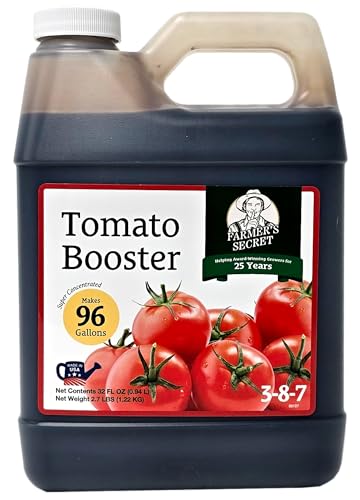
A super-concentrated 3:8:7 liquid built to run the whole tomato life cycle.
Most calcium feeds solve one problem. This one tries to be the only bottle you reach for, and the 3:8:7 ratio is how it does it — 3 parts nitrogen, 8 parts phosphorus, 7 parts potassium, tuned for tomatoes from planting through harvest. It carries calcium plus iron and humic acid, and humic acid is the organic matter that helps soil hold and release nutrients so roots can take them up. The mix is 2 teaspoons per gallon of water, applied weekly.
That weekly rhythm is what the bottle’s users describe: results in a week or two, with flowers setting hard even through a punishing summer. Growers in hot climates note that plants which normally stall in the heat kept flowering and setting fruit. The count here runs high — 1,200+ ratings with a 4.5+ star score — so it is among the most-followed tomato feeds on the shelf. It also carries a tomato-specific label rather than a general-purpose one.
Two things you should know going in. First, it is genuinely concentrated, so follow the two-teaspoon dose and do not free-pour. Second, the bottle design is the recurring gripe — it is prone to glugging and can get messy when you pour, so a small funnel or a measuring cup helps. Neither is a reason to pass, but they are the parts most worth adjusting to.
The draw: a single liquid that covers calcium, phosphorus, and potassium together, so you are not juggling three bottles through the season.
The adjustment: concentrate plus a clunky pour means measuring into a cup first keeps the feed accurate and your hands clean.
Fits you if: you want one weekly liquid that runs the entire season and feeds calcium as part of a full tomato menu.
Pass if: you prefer a granular slow feed or your main goal is calcium alone with nothing else added.
5. Jack’s Nutrients 15-0-0 Part B Calcium Nitrate
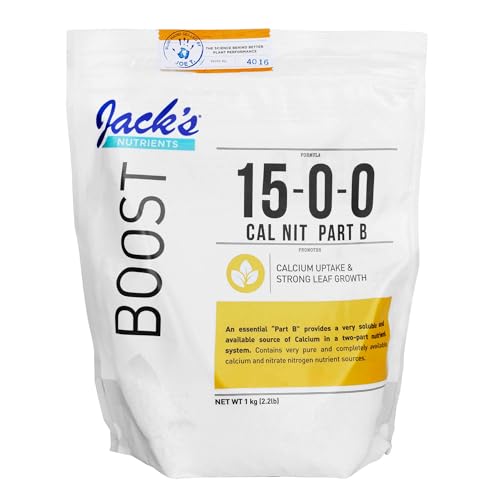
The 2.2-pound calcium nitrate powder for growers running a hydroponic reservoir.
Reservoir growers need calcium that dissolves completely and leaves no sludge in the tank, and that is the job this powder does. It is a 15-0-0 calcium nitrate — 15 parts nitrogen, zero phosphorus and potassium — offering a very soluble source of both calcium and nitrate nitrogen. It is built as “Part B” of a two-part system, designed to run alongside Jack’s 5-12-26 Part A, so together the two parts form the complete feed.
The dosing is where this separates from the rest of the list. It mixes at 8.6 ounces per 100 gallons of water to hit a final feed strength of 100 PPM nitrogen — PPM meaning parts per million, the concentration yardstick hydroponic growers use. That is a reservoir-scale ratio, not a watering-can one, and it is why the 2.2-pound bag punches well above its size compared with a liquid you dilute by the gallon. Hydroponic gardeners describe it as the only calcium nitrate they will use, with clean, consistent quality vegetables and fruit across seasons.
The obvious question is whether it is the right pick for your set-up. If you grow in ground or in patio containers, the 100-gallon dosing makes measuring for one plant awkward. And since this is Part B, it is not a stand-alone feed — you pair it with Part A and add micronutrients yourself for the best result. That flexibility is exactly what reservoir growers want, and exactly what a beginner with three pots does not.
Where the Powder Earns Its Spot
- Very soluble calcium and nitrate nitrogen in one powder
- Powdered concentrate stretches further than liquid by volume
- Dosing is spelled out for reservoir-scale mixing
- Pairs with Jack’s 5-12-26 Part A for a complete program
The Conditions to Know
- 8.6 ounces per 100 gallons is not built for a single pot
- Part B only — it needs Part A to cover the full menu
- Micronutrients are left for you to add separately
Built for: hydroponic and drip growers who mix in reservoirs and want a clean, highly soluble calcium source that scales.
Not aimed at: soil gardeners feeding a few plants by the watering can — the dosing is the wrong size for that job.
Know the Specs
The N-P-K Ratio Explained
Those three numbers on the label are nitrogen, phosphorus, and potassium, always in that order. Nitrogen pushes leafy green growth, phosphorus supports roots and flowering, and potassium helps the plant finish fruit. A 5-7-3 leans toward fruit; a 15.5-0-0 is almost all nitrogen and calcium; a 3:8:7 is a tomato-tuned balance. A high-nitrogen feed used alone can bury you in leaves, so match the ratio to the stage of the plant rather than grabbing the first bag.
Why Calcium Alone Won’t Always Fix Rot
Calcium moves through a tomato plant along with water. If the plant swings between bone-dry and soaked, or the roots are damaged, fruit can starve for calcium even in rich soil. That is why consistency matters as much as the bag. A soluble feed that dissolves cleanly — like a water-soluble calcium nitrate — reaches the root zone with your watering rather than sitting on top of the soil, and steady irrigation carries it up into the fruit.
Granule, Liquid, and Powder Trade-offs
Granules release slowly over weeks and suit beds and containers where you want low fuss. Liquids act fast and correct problems quickly because you dilute them and pour them in. Powders are the most concentrated by weight and are mixed by weight for reservoirs and big batches. None is better across the board — the right form follows how you already water and how quickly you need calcium to arrive.
Reading the Mixing Ratio
A ratio tells you how far the product goes. A 1:200 dilution or a 2-teaspoon-per-gallon dose is easy to control by the watering can. A powder at 8.6 ounces per 100 gallons is meant for a tank, where a single gallon would need an impractical sliver. Before buying, read the ratio and ask whether your normal setup matches that scale — the wrong concentration makes even a good fertilizer hard to use accurately.
Common Questions
Will a calcium fertilizer stop blossom end rot on tomatoes?
Should I use a granular or liquid calcium feed for tomatoes?
How often should I apply calcium fertilizer during fruiting?
Does a 15.5-0-0 calcium nitrate work for potted tomatoes?
Can I use a hydroponic calcium nitrate on garden tomatoes?
Is calcium alone enough, or do tomatoes need magnesium too?
How much area does a 5-pound bag of calcium nitrate cover?
Why is my tomato fruit going black at the bottom even after feeding?
Can I over-feed calcium to my tomatoes?
When should I start feeding calcium to tomato plants?
The Bottom Line
For most tomato growers, the calcium feed that carries the fruit from flower to harvest is the FoxFarm Happy Frog Tomato & Vegetable Fertilizer. Its 5-7-3 blend (5% nitrogen, 7% phosphorus, 3% potassium) includes built-in calcium, and mycorrhizal fungi (beneficial fungi that help roots reach more nutrients) support root health. If you are in the middle of a rot problem and need calcium to arrive this week, reach for the TPS Cal-Mag Complete liquid and dilute it to the 1:200 ratio. And if you run a hydroponic reservoir (a water-and-nutrient tank system), the Jack’s Nutrients 15-0-0 Part B powder is the one to mix into the tank. Whichever you choose, keep your watering steady — calcium only reaches the fruit when the plant has water to carry it — and start feeding ahead of the fruit set so the rot never gets a foothold.
How we choose
We do not accept paid placement. Every pick is matched to a real buyer and a real use-case; we do not hands-on test units.
Sources
Specifications: manufacturer listings and product documentation. Review insights: verified customer reviews, as of October 2026. Pricing: not shown on this page (it changes often); check the current price via the retailer link.
As an Amazon Associate, Aappliancez earns from qualifying purchases. This does not affect which products we feature.