Disclosure: Some links in this post are affiliate links. As an Amazon Associate I earn from qualifying purchases, at no extra cost to you. Learn more
Specs are compiled from manufacturer listings and verified buyer reviews and can change over time — please confirm the key details on the product page before buying.
You need a tent that stays standing when the playa wind picks up at 3 a.m. and hurls grit sideways through camp. That single test — holding shape in hard gusts while keeping the dust out — decides which of these shelters is actually worth hauling to the desert. This guide covers nine options, from six-pound backpacking shells to a cabin you can stand up inside, so you can pick by how you camp rather than by marketing language.
This guide is built by comparing the manufacturers’ published specifications and the patterns across verified customer reviews, so you get each pick’s real strengths and trade-offs instead of marketing spin.
On the playa, wind — not rain — is usually what wrecks a camp. That is why this burning man tent shortlist starts with pole strength, guy-line count (the number of cords tying the tent to the ground), and how much grit each shelter keeps off your sleeping bag.
Top Picks


How To Choose The Best Burning Man Tent
A desert camp punishes a tent in ways a forest campsite never does. Fine alkaline dust works through zippers and mesh like sand through a sieve, the wind arrives in sudden hard gusts rather than steady breezes, and daytime heat turns a sealed shelter into an oven by mid-morning. Pick for those three pressures and the rest of the decision gets simpler.
Stake points and guy lines carry the wind load
How well a tent shrugs off gusts depends on how many places it ties to the ground. The Sundome holds with 7 stake points, so a single pulled stake does not peel the whole wall back. The CORE cabin adds guylines and steel stakes sized for its much bigger footprint, which spreads the load across more anchors. Plan to buy upgraded stakes for any of these — the factory ones bend.
Dust control is a zipper and floor story
Look for a bathtub floor, meaning the floor material curls up several inches where it meets the walls, so grit blowing along the ground cannot slide in under the seam. The Clostnature runs 8-inch bathtub walls and the Gazelle floor holds a column of water without leaking. Taped seams on the rainfly add a second barrier where the fabric is stitched.
Mesh versus solid fabric trade-off
Large mesh ceilings are superb in heat and terrible in blowing dust. The Sundome leans heavily on mesh for airflow, which suits a summer camp with modest wind. A dark-room shelter like the Skydome blocks light and heat, but it also blocks the breeze unless you open the porch screens.
How you get the tent to the playa
Anything over roughly 30 pounds is a car-camp commitment. The Gazelle is heavy and long, and the KNUO inflatable runs 66 lbs, so both assume you are parking next to your site. A 4 lb 1 oz solo shell like the ALPS Lynx 1 is the opposite answer — light enough to walk in with, small enough to fit one person and gear only.
Side-by-Side Comparison
| Model | Best For | Floor Area | Setup Time | Form Factor | Amazon |
|---|---|---|---|---|---|
| Coleman Sundome★ Best Overall | First-time desert campers | 63 sq ft | 10 minutes | Dome | Amazon |
| Clostnature 4 SeasonCold-Weather Pick | Cold and windy trips | 31.33 sq ft | 3 minutes | Dome | Amazon |
| ALPS Lynx 1Solo Hauler | Solo backpacking | 20 sq ft | Easy to Assemble | Dome | Amazon |
| UNICAMPER 12×12 | Group shade and lounging | 144 sq ft | — | Pop-up canopy | Amazon |
| FanttikOutdoor Instant Cabin | Fast family camp | 90 sq ft | Under 60 seconds | Cabin | Amazon |
| Coleman Skydome Dark Room | Sleeping past sunrise | 84 sq ft | 5 minutes | Dome with porch | Amazon |
| CORE Straight Wall Cabin | Big families with gear | 176 sq ft | — | Cabin | Amazon |
| KNUO Inflatable | No-pole air-beam setup | 100 sq ft | 5 minutes | Inflatable | Amazon |
| Gazelle T4 Plus | Long desert stays | 110 sq ft | 1.5 minutes | Hub tent | Amazon |
Detailed Reviews
1. Coleman Sundome Tent
Our pick — 4.5+★ from 11,500+ verified ratings; the strongest balance of quality and price.
The playa-proven dome that flexes in a gust instead of snapping a pole.
The Sundome earns the top spot because its fiberglass poles bow under gust load and spring back instead of snapping. Run it through a real afternoon blow and the poles bow hard but spring back, which is exactly the behavior you want when a wall of dust rolls across the flat. A 10-minute assembly gets it standing, and the 63 square feet of floor handles a queen-size air mattress with room left for a bag and a duffel. It holds 4.5+ stars across 11,000+ ratings, and that volume of consistent feedback is what sells it.
Dust and rain behavior here is better than the price suggests. Owners who rode out steady showers report water beading off the taped rainfly with the interior still dry, and the factory-sealed seams hold at the stitched edges. The floor tarp rises several inches up the wall, so grit skidding along the ground stops at that lip instead of sliding under your sleeping pad. Pre-attached guy lines mean you are not threading cord in the dark while the wind picks up.
The honest limit is the stakes. They bend easily, and one owner testing in 7-8 mph wind with 17 mph gusts called that speed close to the shelter’s ceiling — the poles flexed substantially before recovering. Swap in steel stakes before you leave, add a footprint, and this becomes a far sturdier desert shell than its price tag implies. It is also bulky at around 10 lbs, so treat it as a car-camp tent, not a backpacking one.
What holds up on the playa
- Poles flex and recover in gusts rather than cracking — tested through 17 mph near-limit wind
- Sealed seams and a taped rainfly keep the interior dry in light rain
- Large mesh ceiling and a window keep the air moving in daytime heat
- Cord port and light ring make it liveable once the sun drops
Where it asks for help
- Factory stakes bend easily — replace them before a windy trip
- No footprint included, so buy a ground tarp separately
- Bulky and around 10 lbs, so it stays near the vehicle
- Door is only half-mesh, which cuts some crossflow
Reach for it if: you want a first desert tent that survives a gust without costing much and can sleep two on a queen mattress.
Look past it if: you need to carry your shelter any real distance — the packed bulk and roughly 10 lbs fight you the whole way.
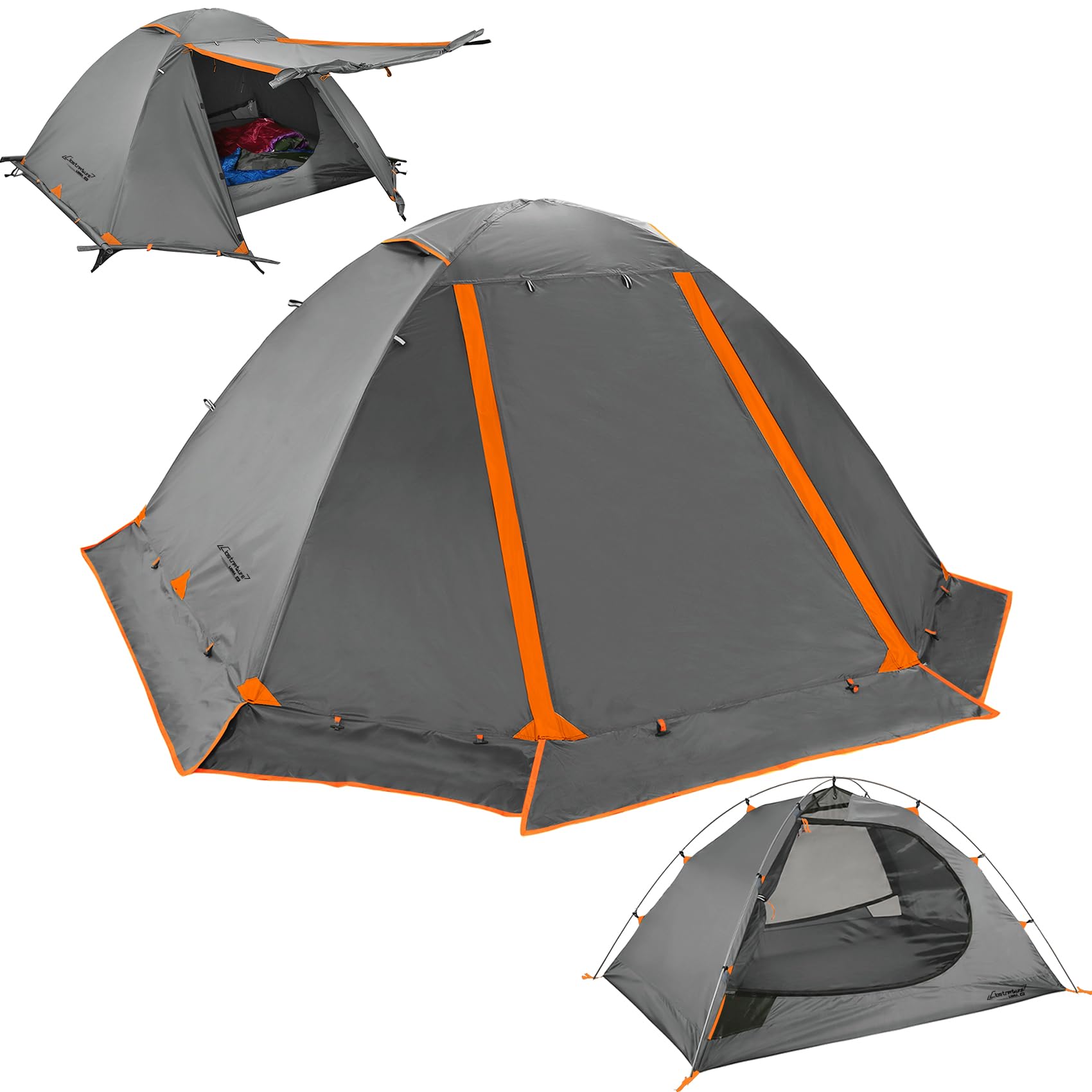
2. Clostnature 4 Season Backpacking Tent
Snow flaps, a sealed shell, and a three-minute pitch for the cold desert night.
Desert nights drop fast, and this is the pick built for that swing. The PU 5000 coating — a polyurethane waterproof layer rated for sustained wet weather — covers the rainfly, groundsheet, and bathtub, and the factory-sealed seams mean you are not painting sealant on before your first trip. Snow flaps seal out spindrift, which in a dusty camp translates to sealing out fine grit that would otherwise funnel in along the base.
What wins people over is the usable space for the size. The interior measures 7’3″ by 4’11” with a 3’10” center height, and it takes two people plus a 100 lb dog according to owners who have done exactly that. Two D-shaped doors and two vestibules give each sleeper their own exit and a dry spot to stash a pack or boots. The double-layer mesh-and-fabric doors vent well enough to cut condensation, which is the difference between a damp sleeping bag and a dry one.
Set against the Sundome, this one pitches in 3 minutes versus 10, but the floor area lands at 31.33 square feet against the Sundome’s 63 — half the footprint for a shelter that still says two-person. Light travelers will like the 6.28 lb total weight and the 5.33 lb minimum trail weight, and the 16.5″ x 5.9″ x 5.9″ packed size drops into a pack without a fight. The recurring gripe is condensation on the fly and a rainfly that is fussy to tighten; the interior stays dry even at 41°F and full humidity, but expect to vent carefully.
Best use case: cold-weather desert camping and shoulder-season trips where the night temperature is the enemy, not the afternoon heat.
Fair warning: the factory stakes bend under pressure and the included footprint is a thin plastic sheet, so budget for both before a high-wind trip.
Better than the big domes for: anyone sleeping in cold conditions who wants a genuinely sealed shell and a fast pitch.
Not the one for: hot-weather lounging — the four-season fabric runs warm in summer sun.
3. ALPS Mountaineering Lynx 1
One person, four pounds, and a vestibule that keeps your pack out of the dust.
If you are walking in rather than parking, the numbers that matter here are 4 lbs 1 oz total and 3 lbs 5 oz minimum weight. That is light enough to carry across a flat without regretting it, and the 17″ x 5″ packed size fits a pack’s sleeping-bag compartment. The floor measures 7’6″ long by 2’8″ wide, which gives a taller sleeper room to stretch without their head or feet brushing the wall.
Weather proofing is where this one punches above its size. The rainfly carries a 1500 mm coating over 75D 185T fabric, and the poly taffeta floor runs a 2000 mm rating — a measure of how much water pressure the fabric holds back before it soaks through. Both are factory-sealed. The freestanding aluminum two-pole frame sets up in about 15 minutes with instructions sewn into the bag, which is a small thing that saves you at a dusty trailhead.
Half-mesh walls are the design choice that splits opinion. They cut condensation on cool nights and let you stargaze with the fly off, but in a dust storm the mesh is the weak point. The interior is tight — owners describe fitting a pad and gear at the feet, and little more. Against the Clostnature’s 31.33 square feet, this 20-square-foot shell is a single-sleeper space with a vestibule rather than a shared one, and the 14-ounce optional footprint adds floor protection. The factory stakes bend like candy canes on rocky ground, so bring your own.
Pick this: for solo walk-in camping where weight is the deciding factor and the vestibule does the gear-storage work.
Leave it: if two people are sharing — the 20 square feet and 2’8″ width are a solo proposition.
4. UNICAMPER 12×12 Pop Up Canopy

Not a sleeper — a 144-square-foot sun block for the middle of the day.
On the playa, the hours between noon and four are the ones that cook you, and this is the shelter for them. The 12-foot canopy spreads 144 square feet of shade, and the 90-inch height means you can stand and move around underneath without stooping. It is a daytime refuge, not a bed — but pair it with a sleeping tent and your camp gets a place to sit out the worst of the heat.
The UPF 50+ fabric blocks ultraviolet rays, which is the difference between shade and false shade, and the 195T taffeta with an 800 mm coating makes the panels opaque from outside so you are not on display. Four large doors and two side walls that combine freely let you chase the sun angle through the day. Buyers report it handles wind well by day, and the 12 ground stakes and 4 guy ropes are the reason.
Here is the catch, and it is a real one for a dusty camp. Fine sand and playa grit do not hold a stake the way turf does, and the factory kit includes only eight 6-inch stakes for grass with no sand weighting. Buy sandbags or weight buckets before you go, or this canopy becomes a kite. Setup is the other split — some find it surprisingly quick, others say it takes at least two people, and the honest read is that first-time assembly with the frame takes learning.
Why it earns a slot: 12 feet of shade, four open doors for crossflow, and a privacy-opaque fabric are a strong combination for group lounging.
Buy the accessories too: sand weights and a second pair of hands turn a fiddly pitch into a five-minute job.
Ideal for: group camps that want a shared shade structure for chairs, coolers, and a dog or two.
Wrong tool for: sleeping or privacy at night — this is a canopy, not an enclosed tent.
5. FanttikOutdoor Instant Cabin Tent
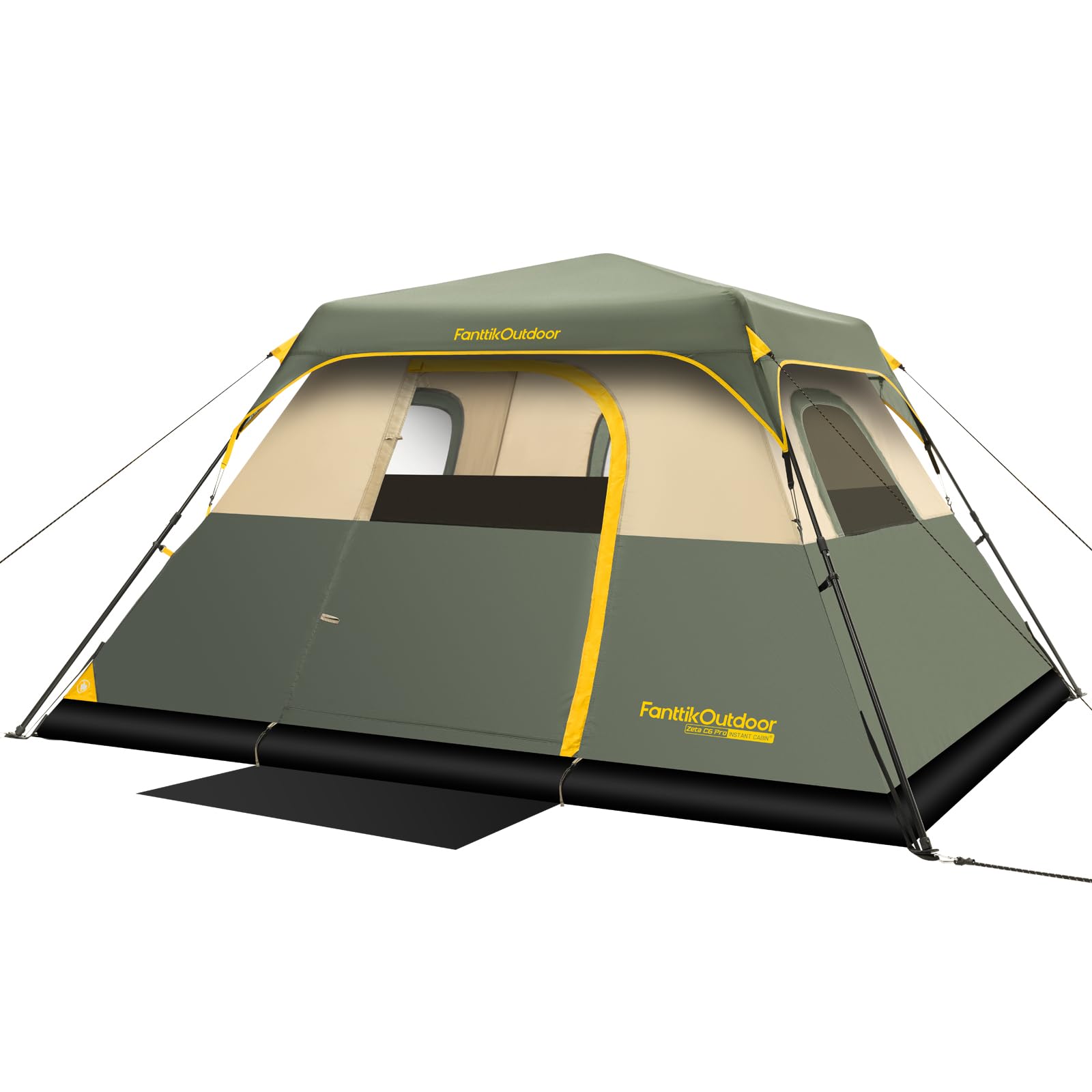
The cabin that pops up in under a minute while everyone else fights a pole sleeve.
Arriving late with the wind already up is the scenario this shelter was built for. Pre-installed poles let it unfold and lock into an instant cabin in under 60 seconds, and the carbon structural steel frame is rated to hold in 35 mph wind with the pegs and adjustable guy lines set. Owners routinely describe pitching it solo in well under a minute, and the 120 by 108 inch floor fits a queen air mattress with the 66-inch ceiling letting most people stand upright.
Ventilation is the part that suits heat. Mesh windows on all four sides, floor-level vents, and a mesh ceiling design move air through the cabin and let you look at the sky at night. The zipper has a drainage channel at the bottom and the base uses a bathe-tube design, which is the detail that stops dust and water from pooling at the doorway. A power cord entrance means you can run a light or a small fan inside.
The catch sits in one specific place in the product notes: the inner tent roof is mesh fabric and is not waterproof on its own. You must run the outer tent over it in wet weather, and if the guy lines go slack, water pools on the fabric and finds a way through. Packing it back into the bag takes effort according to owners who have tried, and the zipper needs a careful pull so fabric does not jam. Set it up right and it is quick, roomy, and stable — set it up sloppy and the rain finds the gap.
Where it wins: a genuinely sub-minute pitch, a stand-up 66-inch ceiling, and four-sided mesh that keeps a summer cabin cool.
Do this before rain: attach and tension the rainfly properly — the inner mesh roof is not waterproof by itself.
Made for: families and late arrivals who want a roomy cabin up before the dust settles.
Think twice if: you need a shelter that repacks quickly — the bag is a tight fit and the rainfly is mandatory in wet weather.
6. Coleman Skydome Dark Room Tent

Blackout walls for anyone who cannot sleep once the desert sun is up.
Sunrise on the playa arrives like a switch, and this is the shelter that lets you ignore it. Dark Room fabric blocks 90% of sunlight, so the interior stays genuinely dark well into the morning, and it cuts heat inside as a bonus. That matters most for light-sensitive sleepers and for anyone who works nights and camps days. The screen porch adds an 8 by 3 ft 6 in weatherproof room that converts into a sleeping spot for one, or a place to stash gear without hauling it into the sleeping area.
Weather protection is thorough for a tent of this class. The WeatherTec tub-like floor with welded corners and a 3,000 mm waterhead fabric — a rating of how much water pressure the shell resists — sits under a rainfly with inverted and taped seams. The frame is tested to hold up to 35 mph winds, and the nearly vertical walls give what Coleman states as 20% more headroom than its traditional tents. Wide door, E-Port for power, gear pockets and a loft round out the liveable details.
Two trade-offs come with the blackout design. First, it works so completely that you need a lantern at midday, and the ventilation leans thin — owners commonly suggest a fan. Second, the pre-attached poles fold to the length of the bag, so packing requires careful folding rather than stuffing. The 4 ft 8 in center height means taller campers will crouch, and the porch is best treated as storage unless you really are sleeping one person there.
Strongest arguments for it
- Blocks 90% of sunlight — real sleep past sunrise
- Screen porch doubles as gear storage or a one-person sleeping nook
- Taped, welded floor with a 3,000 mm waterhead rating
- Frame tested to 35 mph winds
What you give up
- Interior is dark enough to need a light at midday
- Ventilation runs thin — plan on a battery fan
- Pre-attached poles require exact folding to repack
- 4 ft 8 in center height makes taller users stoop
The one to choose when: morning sleep is the whole point and you can accept a dim interior and a fan.
Pass it by when: you want open airflow and easy sight lines — the dark fabric trades both for shade.
7. CORE Straight Wall Cabin Tent

A cabin you can stand up in, with room to walk between four air beds.
Sixteen by eleven feet gives this cabin 176 square feet of floor — the largest footprint in this lineup and close to three times the Clostnature’s 31.33. The 86-inch center height lets a 6’2″ camper stand with a foot of clearance overhead. For a family that brings air beds and gear crates, the nearly straight-wall design turns the tent into a room rather than a taper, and a room divider splits it into two separate sleeping spaces.
Dust and rain handling is built around H20 Block Technology with 1200 mm fabric and a fully taped rainfly. Seams are sealed and the windows zip fully shut, which is what turns a fair-weather cabin into a sealed shell when the grit starts moving. Owners mention staying bone dry through real storms — one describes hours of torrential rain with zero intrusion — and the steel stakes and guylines anchor the 176-square-foot shell through a windy day.
The trade-off is muscle. This is a heavy cabin that wants a helper, and the factory stakes are standard-grade, so drill-in stakes are the upgrade owners recommend for three-season wind. First setup runs around 30 minutes with two people, dropping to about 10 with practice. The zippers and taped seams hold up well, though pole durability draws mixed notes — a few customers note bent or broken poles after hard use.
Best reason to buy: 176 square feet, an 86-inch ceiling, and a sealed rainfly make this the roomiest shelter here that still keeps weather out.
Plan around this: bring a second person for setup and upgrade to drill-in stakes before a windy week.
Built for: families and groups who park at the site and want a walk-around cabin with real headroom.
Skip the idea if: you are working alone and light — the heavy cabin is a two-person pitch.
8. KNUO Large Inflatable Camping Tent

No poles to lose — inflate the beams and the house stands itself up.
In an environment where a missing pole piece can end your camp, a tent with no poles at all is worth a look. The KNUO uses air beams that inflate with the included pump in about 5 minutes, and the maker specs stability for up to 14 days without leakage. The 100-square-foot interior suits 4 to 8 people, and the 1680D Oxford fabric with a PVC-coated bottom gives the shell serious abrasion resistance against a rocky, gritty surface.
The construction details read well for a dusty site. Dual-layer windows and doors let you crack open for air while keeping the interior private, and the rain cover backs up the waterproof shell. Owners who ran it through three days of rain report no leaks at the bathtub floor seam, and the thick PVC-coated floor kept water out even when it pooled around the base. Inflating takes about 3 minutes with the pump, and deflating happens in under a minute once you open the valve.
The trade-offs are real. At 66 lbs, you will not carry this far from your car, and the dark interior cuts daytime light. Durability reports are mixed: a few owners describe air columns (inflatable beams that hold the tent up) sagging or collapsing, and one reports a total column failure mid-camp with poor follow-through from support. Some also note condensation and leaks at the bottom of the roof sleeves. Treat it as a car-camp shelter that needs careful setup and a seam-seal pass — then it gives you a spacious, pole-free house.
Worth a look if: you want a large pole-free shelter and can keep it near the vehicle — at 66 lbs it is not moving far.
Weigh the risk if: you need total reliability in a remote camp — the mixed durability reports are the caveat to accept going in.
9. Gazelle T4 Plus Hub Tent

A 110-square-foot hub that stands through a seven-hour wind and still feels like a room.
For a stay measured in weeks rather than a weekend, the Gazelle is the shelter that earns its keep. The 110 square feet and 78-inch height give a family of four room to stand and move, and the convertible screen room adds a bug-free leisure or sleeping zone on top. The hub design pops into shape fast once you know the motion, and the removable floor and rainfly make cleaning playa dust out of it far easier than sweeping a sewn-in floor.
What holds up under pressure is the shell itself. Owners describe riding out 35-45 mph winds for seven hours plus rain and staying dry, with the roof and side hubs popping back out and resetting easily after each gust. The bathtub floor held a five-inch column of water without leaking in one test, and a second owner reports the interior staying completely dry when rain pooled around the base. Two gear lofts, five gear pockets, and six wall-mounted pouches keep a busy camp organized.
The trade-offs follow from the size. The maker lists a 1.5-minute assembly, but owners consistently describe 10 to 20 minutes of real setup rather than 90 seconds, and the shelter is big and heavy enough that you plan the walk in. Factory aluminum stakes bend under load and the sides can pop in high wind unless you tie them to the fly stakes. Quality of the fabric is the unanimous bright spot; weight is the recurring complaint.
The case for the Gazelle
- 110 square feet with a 78-inch ceiling — stand up and walk around
- Held through 35-45 mph winds and rain for seven hours, dry inside
- Convertible screen room converts into extra sleeping or lounging space
- Removable floor and rainfly make dust cleanup far simpler
What to plan for
- Real setup runs 10-20 minutes, not 90 seconds
- Heavy and long — a car-camp commitment
- Factory aluminum stakes bend easily
- Sides can pop in high wind if not tied down
Go for it when: you are settling in for a long stay and want the most liveable, weather-tested hub on this list.
Leave it for the truck: if pack size and weight rule your trip — this one wants space in the vehicle.
Know the Specs
Waterhead rating and PU coating
Waterhead measures how tall a column of water a fabric holds back before it leaks, and a PU (polyurethane) coating is the waterproof layer applied to the fabric. A 2,000 mm floor and a 1,500 mm rainfly, like the ALPS Lynx 1 carries, tell you the shell is built for sustained wet weather. Higher numbers mean more resistance, but the coating needs care — abrasion and folding wear it down over seasons. For dusty sites, the seam sealing matters as much as the number, since grit finds stitched holes before it finds fabric.
Guy-line and stake points
The number of stake points decides how a shelter handles wind. Each point is a place the force gets transferred to the ground, so a seven-point dome spreads the load differently than a cabin with guylines at every corner. Factory stakes are the weak link on almost every tent in this category — they bend on hard ground and pull out of loose sand. Buying steel or drill-in stakes and adding sand weights is the cheapest upgrade that changes how a tent performs in a gust.
Bathtub floors and dust sealing
A bathtub floor curls up the wall several inches, creating a lip that blown grit and pooled water have to climb to get inside. The Clostnature runs 8-inch bathtub walls, and the Gazelle floor held five inches of water without leaking. Pair a bathtub floor with taped seams on the rainfly and you have the two layers that do most of the dust defense. Zippers are the third — a drainage channel and a covered flap keep the fine stuff from riding through the teeth.
Mesh panels versus dark-room fabric
Mesh moves air, which keeps a hot tent bearable, but it also lets grit through in a blow. Dark-room fabric blocks sunlight and cuts heat, but the trade is a sealed shell with limited airflow, so plan on a fan. The Coleman Skydome blocks 90% of sunlight, while the FanttikOutdoor uses four-side mesh for cooling. Which you want depends on whether you are sleeping past sunrise or sitting out the afternoon heat.
Common Questions
Will a standard dome tent survive wind on the playa?
How do I stop dust from getting inside my tent?
Does a dark-room tent get too hot inside?
Can I use an inflatable tent in a dusty environment?
How many people actually fit in a two-person tent?
Should I bring a footprint or ground tarp?
What setup time should I really expect on arrival?
Are the stakes that come with the tent good enough?
How do I pick a tent for a hot-weather camp?
The Bottom Line
For most campers facing a windy, dusty week, the Coleman Sundome gives you the most with the least risk: it flexes under gust load, keeps rain out with sealed seams, and sets up in 10 minutes with gear pockets and a light ring already in place. If cold nights worry you, the Clostnature 4 Season pitches in 3 minutes and seals out spindrift (wind-blown snow) with its snow flaps. For a long stay where you want a room to stand in, the Gazelle T4 Plus is the hub that rode out seven hours of wind and stayed dry inside.
Whichever you choose, budget for steel stakes and a ground tarp — those two additions change how any of these shelters performs when the dust starts moving.
How we choose
We do not accept paid placement. Every pick is matched to a real buyer and a real use-case; we do not hands-on test units.
Sources
Specifications: manufacturer listings and product documentation. Review insights: verified customer reviews, as of October 2026. Pricing: not shown on this page (it changes often); check the current price via the retailer link.
As an Amazon Associate, Aappliancez earns from qualifying purchases. This does not affect which products we feature.