Disclosure: Some links in this post are affiliate links. As an Amazon Associate I earn from qualifying purchases, at no extra cost to you. Learn more
Specs are compiled from manufacturer listings and verified buyer reviews and can change over time — please confirm the key details on the product page before buying.
If one joint on the side of your foot decides the whole day, the fix is rarely one product. Bunion pain comes from two different places — the bony bump rubbing inside the shoe, and the big toe drifting inward over years. Cushions handle the first. Splints and separators work on the second. So the honest answer to which pad to buy depends on which of those two problems you actually have, and this guide sorts all ten options by exactly that.
This guide is built by comparing the manufacturers’ published specifications and the patterns across verified customer reviews, so you get each pick’s real strengths and trade-offs instead of marketing spin.
Some pads sit quietly against the bump all day, while others gently pry the toes apart for twenty minutes at a time. The right match depends on shoe volume, skin sensitivity, and how slowly you can build wear time. Here is how to choose between them without wasting a season on the wrong shape.
Top Picks

How To Choose The Best Bunion Pads
Start by naming the job you need done. A pad that shields the bump from shoe friction is a completely different tool from a splint that pulls the toe back toward center. Buying the wrong one is the single most common reason people give up on bunion aids after a week — the product is fine, the job was mismatched.
Cushion, separator, or splint — pick the job first
A cushion sits over the bony prominence and takes the rubbing, which is what you want for a day in dress shoes or a long walk. A separator pushes the toes apart passively while you sit, which is a stretching routine rather than a walking aid. A splint straps the whole foot and holds the toe at a set angle, and it is almost always worn at home or overnight, not under a lace-up shoe.
How shoe volume changes everything
A cushion only works if the shoe has room for it. In a snug heel or a pointed toe, a thick pad has nowhere to go and will roll under your foot, so low-profile hydrogel shapes win inside real footwear. Separators and splints are a different story — most are designed for bare feet on the couch, and plenty of buyers report they simply cannot be worn with shoes or socks at all.
Stickiness and skin matter as much as shape
Adhesive pads live or die on how well they cling to skin through sweat and a full day of walking. Self-adhesive hydrogel stays put for many but lifts for some. Reusable gel pads skip the glue entirely but rely on a toe loop that is the first thing to wear out. Neither is wrong — just know which failure you would rather deal with.
Build up your wear time slowly
Anything that changes toe position will feel strange at first. Corrector makers commonly suggest starting with a short session and working up, and that guidance exists because going straight to an hour is how people quit. Buy something you can tolerate for ten minutes before you buy something that promises more correction.
Side-by-Side Comparison
| Model | Best For | Type | Wear Setting | Quantity | Amazon |
|---|---|---|---|---|---|
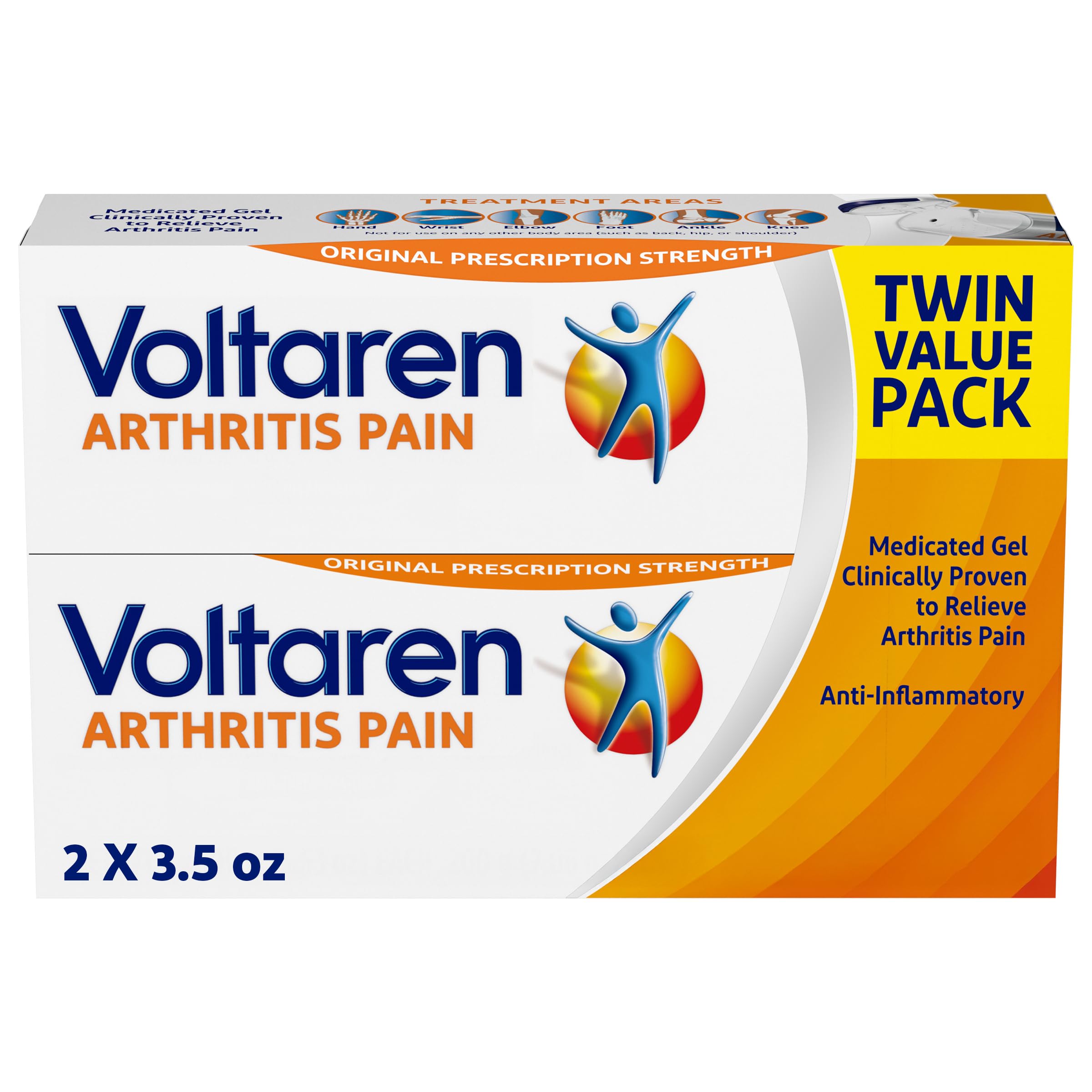
| Voltaren Arthritis Pain Gel★ Best Overall | Joint pain you want to calm before a walk | Topical analgesic gel | Applied to skin, up to four times a day | 100 g, 2 pack | Amazon |
| KTSAY Big Toe Straightener with SplintBudget Multipack | Night-time toe positioning on a tight budget | Soft toe splint | Bare foot, overnight | 8 Count | Amazon |
| Pwithze Bunion Corrector with Adjustable KnobAdjustable Knob | Dialing in a correction angle you control | Knob-adjustable splint | Lounging, reading, sleep | 1 Count | Amazon |
| Silipos Gel Toe Crest | Hammertoe pressure under the ball of the foot | Mineral-oil gel crest | Inside most shoes, all day | 1.69 oz single crest | Amazon |
| Spacer Mobility Toe Spacer | Passive toe splay while you relax | 4-loop silicone spacer | Bare foot, at home | 1 pair | Amazon |
| Caretras Bunion Corrector | Overnight splinting with a cushioned fit | Soft fabric splint | 20 minutes a day plus overnight | L&R pair | Amazon |
| Dr. Scholl’s Bunion Cushions | Discreet bump protection inside shoes | Self-adhesive hydrogel | Inside most footwear, multi-day | 20 cushions | Amazon |
| APEX Adjustable Toe Separators | Aggressive splay with a walkable flat base | Gel-like silicone separator | Bare foot, around the house | 2 pairs (S/M and Large) | Amazon |
| YogaToes GEMS | A daily stretching ritual that lasts | Gel toe stretcher | Seated, 15–20 minutes | Pair, size Small | Amazon |
| YogaToes Gems for Men | Bigger feet that need a wider base | Gel toe stretcher | Seated, 10–15 minutes building to an hour | Pair, men’s 7 and up | Amazon |
Detailed Reviews
1. Voltaren Arthritis Pain Gel 100 g 2 Pack
Our pick — 4.5+★ from 62,000+ verified ratings; the strongest balance of quality and price.
The one pick here that works on the ache itself rather than the rubbing — a gel you rub in before the shoe goes on.
Every other product in this list is a physical barrier or a brace. This is a topical gel you apply to the joint, and that difference explains why it tops the list — it is the crowd favorite at 4.5+ stars across 62,000+ ratings. It comes as a 100 g tube in a two-pack, and the maker describes it as a nonsteroidal anti-inflammatory gel that combines the feel of a cream with the spread of a gel.
What wins people over is how fast it goes to work on a sore joint. Relief is the loudest theme in the reviews, with effectiveness right behind it — buyers describe the sensation as something you can feel settling in rather than a slow burn. One verified buyer put it plainly: “Works well, its like liquid aspirin you can apply right to the sore area.” For anyone who cannot take oral anti-inflammatories (pills that reduce swelling), a rub-on option is the whole point. Owners in that position say the topical route avoids the stomach impact they were worried about.
The honest catch is the label, not the gel. Directions limit use to a set number of applications a day on up to two joints at a time, and more than one buyer has been surprised to find their shoulder excluded from that list. The scent is mild and fades, though it does smell like medicine. The tube is also firm, which is genuinely awkward for hands that hurt — a fair complaint about the packaging rather than the contents.
Where It Earns Its Place
- Rub-on relief that skips the pill bottle entirely
- Absorbs without leaving a greasy film on skin
- Two 100 g tubes, so one can live in a bag and one at home
What To Keep In Mind
- The tube takes real hand strength to squeeze
- Use is capped at specific joints and a set number of daily applications
Reach for this if: the bunion joint throbs and you want to calm it before a walk or a long day standing.
Look elsewhere if: you need a physical barrier between skin and shoe — that is a pad job, not a gel job.
2. KTSAY Big Toe Straightener with Splint (8pcs)
Eight soft splints in one box — the cheapest way to find out whether night-time toe positioning suits you at all.
The count is the story here. This box holds 8 Count where the Pwithze corrector gives you 1 Count — a difference worth stating plainly, since it means a fresh splint whenever one stretches out or goes missing. Each one is a beige toe splint at 0.1 centimeters thick, thin enough to wear in bed without feeling like you are strapped to a board. The brand lists the intended use simply as bunion, for adults.
Comfort at night is the bright spot. Buyers describe easing pain while sleeping and wearing them comfortably inside shoes. But the feedback splits hard, and the split is about the band, not the concept. The recurring problem is that the loop does not grip firmly enough and slides down into the gap between the toes, where it presses and stings — as buyers put it, the band “slides down and cuts into the space between the toes and is painful.” A couple of wearers also ended up with a blister between the toes and stopped.
Read the low score as a shape warning rather than a verdict on toe splints. With a modest number of ratings behind it, this is an unfamiliar product finding its footing, and thin, soft splints like this suit a narrow foot or a light-touch routine. If your toes are wide-set or you know you press hard against braces, the knob-adjustable design below is the safer first buy.
Bottom line: an inexpensive experiment in night splinting, best treated as an eight-pack of trial runs rather than a long-term brace.
Worth a try when: you want several spares on hand and your feet are on the slender side.
Give it a miss when: a band that shifts between your toes would drive you mad by morning.
3. Bunion Corrector Big Toe
A dial at the big-toe joint that lets you set the correction angle yourself instead of accepting one fixed squeeze.
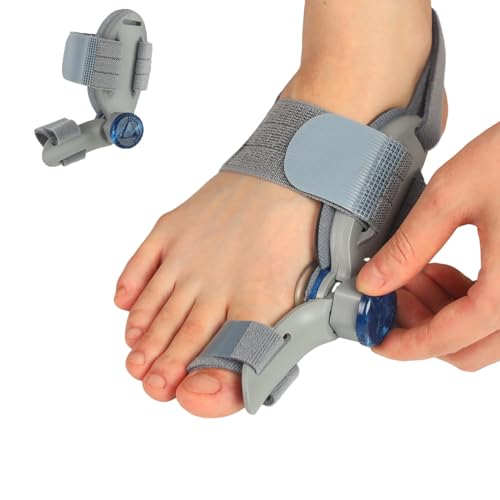
Most splints pull in one direction and that is that. This one puts a rotating knob at the big toe joint, and the joint turns 180° so you can wind the correction in gradually and still move your foot normally. It weighs 0.07 kg and arrives as one gray unit with a large silicone pad set inside the frame. Straps at the toes, sole, and heel fasten with Velcro, and two toe splints — one long, one short — let you match your own toe length.
The maker’s own guidance is the most useful spec on the page: start at 30 minutes a day, build toward a 1 to 3 hour session, and only move to overnight once that feels fine. Owners confirm the early sessions are not pleasant, and the tension eases after a handful of wears. The knob gets credit for making that ramp-up controllable, letting you add a little correction at a time rather than all at once.
Here is the split in the feedback worth knowing before you buy. Rigid-brace-sensitive feet can find the pressure harsh — at least one wearer with a mild bunion returned it as too stiff — and a strap-threading point snapped off on another. Loose Velcro and a thin plastic anchor point are the two wear items to inspect on arrival. Treat it as a graduated tool rather than something you clamp on tight and forget.
Why It Stands Out
- The 180° knob lets you tune the angle to your own comfort, session by session
- Velcro straps at the toe, sole, and heel hold it on without it sliding off mid-session
- Two splint lengths work for short and long toes
- Removable silicone pads and straps rinse clean
What To Watch
- Early sessions feel sharp — the maker’s 30-minute starting point is real advice
- The strap anchor is a small plastic part, so check it over on arrival
Suits you if: you want to control how much correction you get and prefer to ease in.
Think twice if: your feet react badly to rigid pressure — a soft fabric splint is the gentler route.
4. Silipos Gel Toe Crest for Hammertoes & Ball of Foot
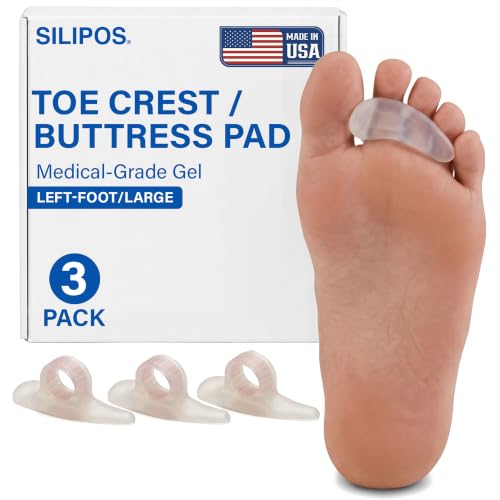
This one is about bent lesser toes, not the big-toe bump — a gel ridge that props them up and takes the pressure off the ball of your foot.
If your second or third toe curls under and the ball of your foot feels bruised by evening, the problem is different from a bunion and needs a different shape. This crest sits under the toes and lifts them, and the elastic loop slipping over one toe keeps it from wandering. The gel is a mineral-oil polymer that releases conditioning oil as it compresses, and the whole crest weighs 1.69 ounces — slim enough that the maker says it fits inside most shoes.
Long-term hammertoe wearers are the ones who rate this highly, and the reason is durability. Owners who have cycled through other brands say the Silipos gel holds its shape far longer than foam or fabric crests and spreads weight evenly across the forefoot. It rinses clean with a nightly wash, so one crest lasts through repeated wear. The maker also notes it contains no natural rubber latex.
Two things to plan around. First, fitting is fussy — the crest wants to sit under the middle toes rather than the big toe, and some buyers find the sizing off for smaller feet. Second, the loop is the wear point. Owners mention the ring eventually tears, with some lasting weeks and some lasting months, so treat the loop as the part you will replace. The maker’s own sizing guidance is worth following rather than guessing.
Our read: buy it for the gel’s longevity and its ability to keep a curled toe from digging into your shoe — and expect the thin loop to be the first thing that gives.
Made for: anyone whose hammertoe or claw toe is the actual source of forefoot pain.
Not the fix for: a bunion on the side of the foot — this pad does nothing for that bump.
5. Spacer Mobility Toe Spacer, 4-Loop Silicone Toe Separators

Four soft silicone loops that leave your pinky toe free — a relaxing stretch rather than a firm correction.
The 4-loop shape is the defining choice here. Leaving the smallest toe unlooped makes the spacer easier to slide on and less fussy during passive wear, which is the whole point of this style. The silicone is soft enough to conform to different foot widths, and the maker sizes it for roughly US women’s 6–12 and men’s 7–13. It is designed for bare feet at home — toe yoga, stretching, recovery — not for walking around in shoes.
Owners use them most for the after-work unwinding that follows hours in narrow shoes. The relief from squeezed, cramped toes is the theme that repeats, and a few wearers work up from the recommended 10-minute session to a good part of an afternoon without trouble. A runner who trains regularly calls them a favorite recovery tool for tight feet. Cleaning is quick and the build feels solid in the hand.
Getting them seated between the toes is where opinion splits. Some feet slip straight in; others find the loops too tight and the process a wrestling match, and a small number report a loop splitting after a few uses. One wearer who bought them hoping to correct a bunionette found the whole exercise too much effort and went back to cheap foam pedicure spacers instead. If your toes are tightly packed, expect to ease them in slowly.
The Case For The 4-Loop
- Soft silicone spreads toes without the hard-plastic feel
- One size covers a wide span of women’s and men’s foot sizes
- Leaves the pinky toe free for a more relaxed fit
- Quick to rinse and reuse
The Honest Limits
- Tightly packed toes make the loops hard to get on
- A minority see a loop tear after limited use
Good for you if: your feet feel cramped by evening and you want a gentle stretch at home.
Look further if: you need real correction force or want to wear a spacer inside shoes.
6. Caretras Bunion Corrector L&R Pair

A soft fabric splint that trades rigid pressure for padding — and comes as a left and right pair.
Where the knob brace above goes firm, this one goes soft. It is built from elastane reinforced with multi-layer stitching, lined with breathable cotton, and padded with shock-absorbing foam plus pressure-release cushioning in three layers. Three non-slip straps wrap the heel, instep, and big toe, and the whole unit weighs 0.35 ounces. The sizing spans women’s and men’s 5–11, and the pair covers both feet.
The fast relief is what owners talk about most — comfort and ease of use rank high in the feedback, and several customers note the ache eased within a week of nightly wear. Wearing it overnight and finding the daytime ache smaller is a common pattern. One buyer whose orthopedic surgeon husband chose it for her called it a “standout” after overnight wear cut her daytime pain. The maker’s own starting point is 20 minutes a day plus overnight use.
The caveat is about expectations, not the product. It will not straighten a bunion — owners who stick with it a month report less pain when running or bending the big toe, not a changed joint. Over-tightening the straps cuts circulation rather than helping, so snug is the target, not tight. The maker backs it with a 30-day refund and a 60-day replacement warranty against manufacturing defects.
Comfort-first design: the cotton lining and multi-layer foam make long overnight sessions bearable in a way a rigid brace rarely is.
What it will not do: reverse a bunion. Owners who stay with it describe lower pain, not a reshaped joint.
Best match for: side sleepers and anyone who wants to splint overnight without a hard brace digging in.
Look elsewhere if: you need firm correction pressure — the soft construction here pulls gently.
7. Dr. Scholl’s Bunion Cushions – 5 Each, Pack of 4

Clear, thin, and self-sticking — the pad you wear inside real shoes and forget is there.
Twenty cushions in one box, five to a pack across four packs, all in a transparent hydrogel that sticks to skin. The clear material is the whole trick: it hides inside a shoe so you are not walking around with a visible patch on your foot. It is water- and sweat-resistant, sized small, and built to stay on through a normal day rather than needing repositioning halfway through.
Owners keep coming back to the low profile. It disappears under a real shoe, and some say they flat-out forget it is on. Both the effectiveness and the quality of the cushion rank high in the feedback, with buyers describing it as the most comfortable of several types they had tried. Sticking power through hosiery and a full day of walking is the other repeated win, and having twenty cushions means one that loses grip is not a lost cause.
The honest limitation is padding depth. This is a thin shield against friction, not a thick gel dome — a wearer or two wished it were a touch more padded. Adhesion is the other variable; most days it holds, but a few wearers find it lifts sooner than they would like. It is also designed for minor to moderate bumps rather than a pronou
What Makes It Discreet
- Clear hydrogel hides inside most footwear
- Sweat- and water-resistant enough for a full day
- Self-adhesive applies in seconds and swaps out fast
- Twenty cushions in one box
Where It Falls Short
- Thin by design — not much padding depth
- Adhesion weakens for some wearers before the day is out
Pick these when: the bump rubs against shoe leather and you want protection nobody can see.
Pass if: you need a thick gel dome — this is a thin barrier, not a cushion pad.
8. APEX Adjustable Toe Separators 2 Pairs
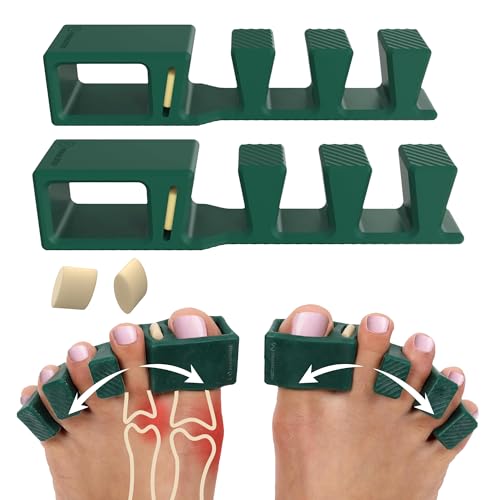
Two sizes in one box so you can dial the stretch up or down depending on how your feet feel that day.
The flat bottom is what sets these apart from loop-style spacers. That flat base means you can actually stand and walk around the house in them, which loop designs like the Spacer Mobility pick above do not encourage. The silicone is gel-like, slightly firmer and less stretchy than the looping kind, and the set ships as two pairs — size S/M for women’s 6–9 and men’s 7–9, and Large for men and women 10 and up.
The maker says these are over 50% thicker and more durable than the standard, and the adjustability is the practical payoff: reach for the Large on a sore day and the S/M when your feet are already loosened up. Owners who walk around in them report good toe spacing and real relief for crowded toes and Morton’s neuroma pressure (nerve pain in the ball of the foot). Comfort gets the most praise of any trait, and relief from forefoot tension comes second.
Two things nobody should be surprised by. These are bare-foot tools — you cannot wear socks, slippers, or shoes over them, and the flat base is for indoor surfaces only. And the between-toe pads run wide, which some wearers find too big for the smaller toe gaps, especially on narrower feet. The tacky surface also picks up lint and hair between uses, so a quick rinse keeps them clean.
Heads-up: a firmer silicone means a more aggressive splay than the soft loop spacers, so start seated before you start walking.
Best of both: getting a small and a large pair in one set lets you match the stretch to the day instead of committing to one.
The right pick if: you want to walk around the house while your toes stretch and a firmer base suits you.
Look past it if: you have narrow feet or tight toe gaps — the wide pads may not seat comfortably.
9. YogaToes GEMS: Gel Toe Stretcher & Separator, Size Small
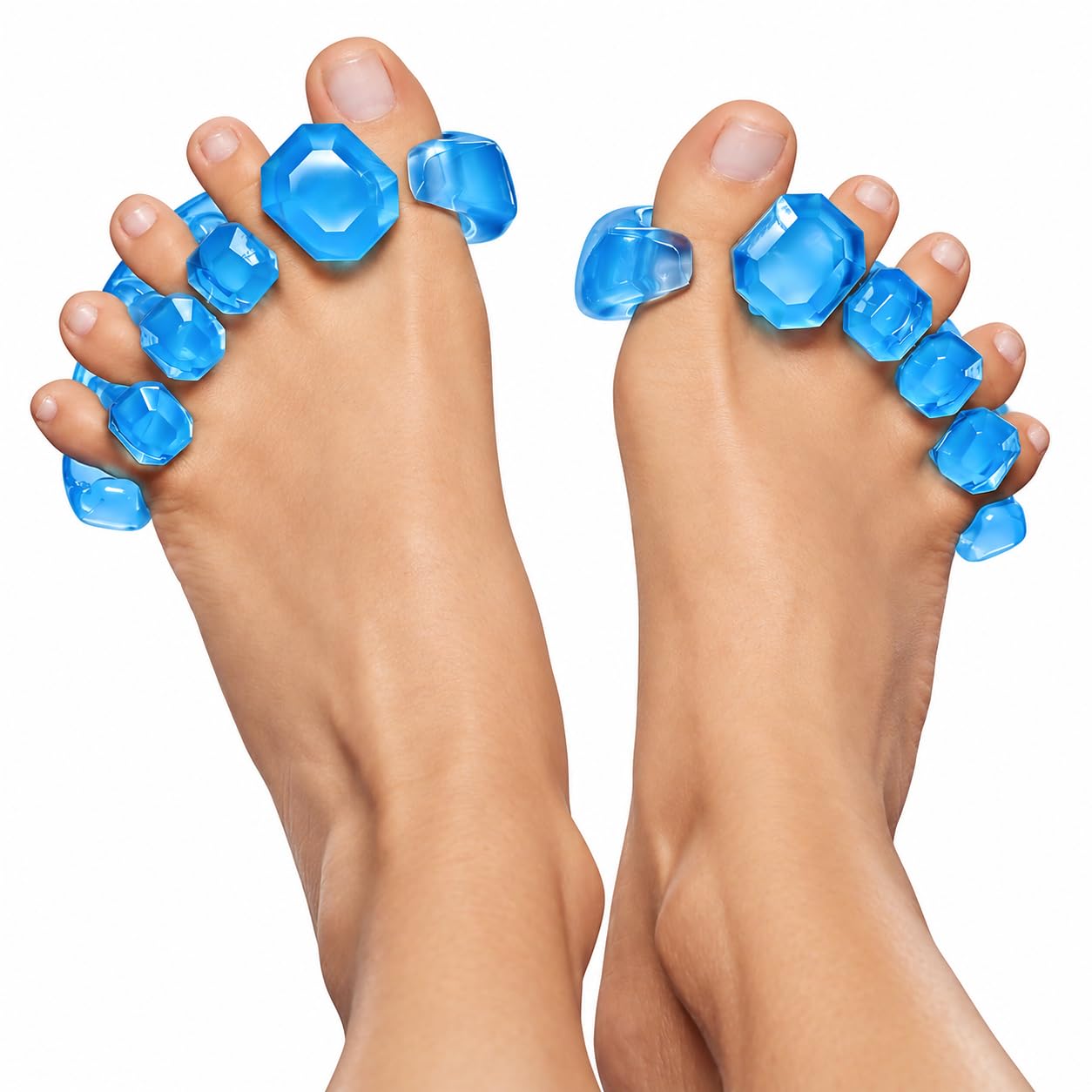
The blue gel classic that made toe stretching a nightly habit — and it has the following to prove it.
The recognizable part is the shape: a trademarked gemstone design in signature Sapphire Blue, made in the USA by YogaToes itself rather than a copycat. This size is Small, cut for women’s shoe size 7 and over and men’s 7 and over, sold as a pair. It is built for seated wear — fifteen to twenty minutes at a time, ideally while the TV is on — not for anything you would do standing up.
Effectiveness is the effect this one is known for, with pain relief running close behind. Regulars describe feet that feel worked and loosened rather than clamped, and a few reviewers point out it eases night-time toe cramps. A skeptical 63-year-old wearer credits daily 15–20 minute sessions with straightening hammer toes and called it funny-looking but worth it. A yoga teacher and runner in the feedback rates it as a favorite tool for foot and leg tension.
Two honest notes. It is aggressive — some wearers can only sit with it for one to two hours before the joints complain, and those with very tight toes are warned to build up slowly with a gentler spacer first. Comfort splits along that same line, with a share of buyers finding it painful at the start. The gel also softens over years of use, so expect to replace it eventually rather than hand it down.
Why It Has A Following
- Gel construction spreads toes evenly and feels like a massage
- Long stretches compared with fabric separators
- Made in the USA by a brand that has been making these for years
- Simple daily routine — 15 to 20 minutes seated
What It Will Not Fix
- Tight toes need a warm-up period before these feel manageable
- The gel breaks down with age and eventually needs replacing
Made for: the nightly-stretch crowd who want a firm, even spread and do not mind starting slow.
Skip if: you have very tight toes and want something gentle from the first wear.
10. YogaToes Gems for Men, Men’s Size 7 & Up
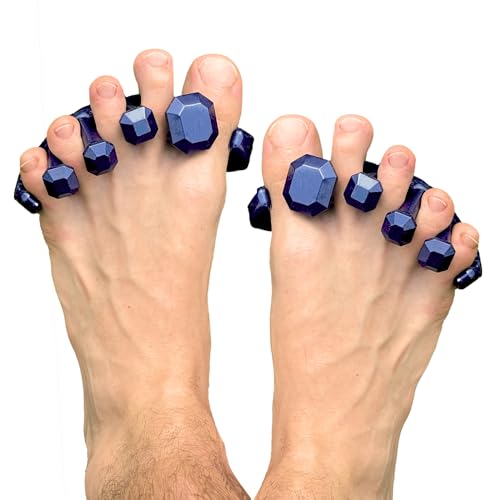
The same gemstone gel stretcher built wider for men’s feet — and it corrects the big toe as hard as any spacer here.
This is the men’s cut of the Gems design, sized for US men’s shoe size 7 and up, in the metallic blue finish. The gel is BPA-free, soft and flexible, and the maker describes it as hypoallergenic. The daily routine is spelled out plainly: 10 to 15 minutes to start, building up to an hour while you relax. It weighs in at 5.64 ounces, so the base is substantial and the spacing is firm.
Quality is the trait it is known for, with effectiveness and toe relief close behind. The design is deliberately thick and bulky, and that bulk is what lets it hold a big toe back where a thinner loop would fold. Owners push the big-toe separation further here than with most spacers on the market, and clearer spacing plus straighter toes is the result most report. One 78-year-old with chronic foot soreness reports real toe spacing and less foot tension. A diabetic buyer noticed better stability and foot sensation after about fifteen minutes a day.
The trade-off is real: this thing is stiff and the base is wide, so it is built for lounging rather than walking. Owners who try to move around much notice joint discomfort inside about an hour. Very tight toes need a warm-up with a softer spacer first — the maker’s own guidance is to go slowly. The fitting nuance: if your feet are small for the men’s range, size down or look at the women’s Small version instead.
Who this is for: men with wider feet or a big-toe gap that needs a firm, even push.
What to know: this is a sit-down tool with a wide base, not something to walk around in.
Ideal if: your feet run wide, you want real big-toe separation, and you stretch seated.
skip it if: your feet are narrow or you like to move while you stretch.
Know the Specs
What “Count” and “Pair” actually mean
A cushion sold as 20 Count gives you twenty separate adhesive pads, so you replace one when it loses grip and carry on. A splint sold as L&R pair gives you one for each foot, which matters if both bunions bother you. A splint sold as 1 Count is a single unit meant for one foot. Always check whether the number on the box is the number of pads, the number of feet, or the number of items inside — a box that says 8 Count may mean eight small splints, not eight pairs.
Why wear time and setting matter
A pad worn inside a shoe needs to be thin, sturdy, and stuck down firmly. A separator worn on bare feet can be thicker and softer, because nothing is pressing it against your toes. A splint worn overnight can apply more correction than anything you would wear during the day. Match the product to the setting first — the wrong setting is the reason most bunion aids end up in a drawer.
Common Questions
Can I wear bunion pads inside tight dress shoes all day?
Will a bunion corrector actually straighten my toe?
How long should I wear a toe separator each day?
Can I sleep in a bunion splint?
What is the difference between a bunion pad and a hammertoe crest?
How often do I need to replace hydrogel bunion cushions?
Can toe spacers be worn with shoes or socks on?
Do I need a bunion pad if my toe is already bent quite far?
Is the pain gel an alternative to bunion pads or a companion?
Why does my toe separator hurt between the toes?
The Bottom Line
For most buyers, the bunion pads answer starts with the Voltaren Arthritis Pain Gel — a two-tube pack you rub into the sore joint to calm the ache before the shoe goes on, and the pick with the deepest review base by a wide margin. If the bump itself is what rubs and you need protection nobody can see, reach for the clear Dr. Scholl’s hydrogel cushions instead. And when the goal is gently retraining toe position at home, the Caretras pair is the soft overnight route while the APEX separators give you a firmer, walkable stretch.
The trick is to stop buying one product expecting it to do all three jobs. Cushion the bump inside your shoes, calm the joint with a rub-on gel when it flares, and spend a few minutes a day with a separator or splint on bare feet. That combination covers the friction, the inflammation, and the alignment separately — which is what actually moves the needle for most people.
How we choose
We do not accept paid placement. Every pick is matched to a real buyer and a real use-case; we do not hands-on test units.
Sources
Specifications: manufacturer listings and product documentation. Review insights: verified customer reviews, as of October 2026. Pricing: not shown on this page (it changes often); check the current price via the retailer link.
As an Amazon Associate, Aappliancez earns from qualifying purchases. This does not affect which products we feature.