Disclosure: Some links in this post are affiliate links. As an Amazon Associate I earn from qualifying purchases, at no extra cost to you. Learn more
Specs are compiled from manufacturer listings and verified buyer reviews and can change over time — please confirm the key details on the product page before buying.
A bullet journal lives or dies on its paper, and that is where most buyers get burned. A book with a gorgeous cover but thin pages will let your fineliners bleed straight through to tomorrow’s spread, and a journal with too few pages forces you to restart your system every few months. This guide compares five dot-grid notebooks on gsm, page count, and binding so you can pick one and start writing.
This guide is built by comparing the manufacturers’ published specifications and the patterns across verified customer reviews, so you get each pick’s real strengths and trade-offs instead of marketing spin.
Start with paper weight, page count, and layout extras — those three decide whether a notebook lasts a full year of daily spreads. Every pick below is judged on those three specs, not on cover design.
Top Picks


How To Choose The Best Bullet Journal
Most people buying their first dot-grid notebook fixate on the cover, the color, or the packaging. Then the first heavy marker stroke bleeds through and ruins the page behind it. Shop by paper weight and page count first; the cover is the last thing that matters.
Paper weight is the number to check first
Paper weight is measured in gsm, or grams per square meter — higher means thicker and more ink-resistant. A 100gsm page handles ballpoint and pencil fine but shows highlighter shadows. A 150gsm page takes gel pens and layered water-based markers without ghosting. If you plan to decorate with tape, stickers, or art, go heavier. If you only write with a fineliner, 100gsm is plenty.
Page count and numbered pages decide longevity
A 160-page notebook fills faster than you think once you build weekly spreads. A 312-page book with pre-numbered pages and a table of contents keeps your index intact for a full year. Numbered pages also mean you can build a real index without handwriting every number yourself.
Layout extras that earn their space
An index page, a key page for your symbols, and a pen test page are small additions that make a huge difference on day one. Center-page markers save you from counting dots on every spread — a concrete time-saver once you have done it a few dozen times.
Size and binding for how you work
A5 (roughly 5.8″ x 8.3″) slips into a bag and suits daily carry. B5 (roughly 7.6″ x 10″) gives more room for weekly spreads but weighs more. A4 (8.5″ x 11″) suits desk work and detailed layouts. Thread-bound or stitched bindings let the book lie flat — essential if you write across both pages.
Side-by-Side Comparison
| Model | Best For | Paper Weight | Page Count | Size | Amazon |
|---|---|---|---|---|---|
| BUKE Dotted Journal★ Best Overall | Gift-worthy black-paper journaling | 150 gsm | 160 | A5 | Amazon |
| OFFIGIFT Bullet Dotted Journal (312 Pages)Most Versatile | Year-long journaling with full index | 100 gsm | 312 numbered (320 total) | B5 | Amazon |
| MALEDEN Dotted Journal 8.5″ x 11″ | Desk layouts and field notes | — | 192 | A4 | Amazon |
| OFFIGIFT Bullet Dotted Journal Kit | Beginners wanting a full starter set | 140 gsm | 188 numbered | A5 | Amazon |
| TIEFOSSI Dot Journal Notebook | Heavy-ink artists and watercolor fans | 160 gsm | 190 numbered | A5 | Amazon |
Detailed Reviews
1. BUKE Dotted Journal
Our pick — 4.5+★ from 450+ verified ratings; the strongest balance of quality and price.
Black pages that make white gel pens glow — and a price that undercuts fancier names.
This notebook is built for you if you journal after dark with a white gel pen. The 160 pages are a thick 150gsm black stock — a measure of paper density where anything above 120gsm typically shrugs off ink bleed — so gel pens, metallic markers, and layered watercolors stay on the side you drew them on. The 5mm dot grid gives you structure without feeling busy, and edge plus center guides let you build a spread without counting dots across the page.
Where this really earns its keep is the packaging and build. The PU leather hardcover has a soft-touch finish, and the stitched thread binding opens flat, so working across a two-page spread is painless whether you are left- or right-handed. Two ribbon bookmarks — one black, one gold — let you flip between your monthly log and daily page, and the expandable back pocket swallows receipts. It arrives in a gold-embossed gift box with three sticker sheets, so it is a legitimate gift straight out of the mailer.
The honest catch is the dot visibility. Several people note the dots on the black paper read brighter and more prominent than on competitor notebooks like Archer & Olive — a mixed point rather than a flaw, since some love the contrast and some want a subtler grid. A gold ribbon also breaks the all-black look, and lotioned hands will leave fingerprints on the cover. Set against that, the value is the loudest signal: 34 buyers single it out as the reason to buy, with page thickness close behind, and the 4.5+ star rating reflects that. Consider if you want bold or faint dots before you commit.
What earns the top spot
- 150gsm black paper holds gel pens and metallic markers without bleed-through
- Thread-bound stitched spine opens completely flat for two-page spreads
- Edge and center guides remove the dot-counting chore
- Arrives boxed with sticker sheets, two ribbons, and a pen holder
Where it asks for care
- White dots are noticeably brighter than some competitor notebooks
- Lotion on hands leaves fingerprints on the matte black cover
- The gold ribbon clashes with the otherwise all-black styling
Reach for this if: you journal at night with white or metallic ink and want a notebook that doubles as a gift.
Think twice if: you prefer a barely-there dot grid — this one is deliberately visible.
2. OFFIGIFT Bullet Dotted Journal B5
Nearly double the pages of a standard dot journal, with an index built in.
For a bullet journal that has to last through a whole year of dailies and monthlies, page count is the number that matters. This one carries 320 pages in total, 312 of them numbered — versus the BUKE above at 160 pages, which is a 2.0x gap in the raw figures. That extra real estate makes a difference when your spreads multiply. It is a B5 size (7.6″ x 10″), so you get noticeably more room for a weekly spread than an A5 book, at the cost of more weight in your bag.
The build is properly thought out. An index, key, and pen test page are all pre-built into the front matter, so your symbol system is set up before you write a single entry. Two subtle markers on the page edge help you find the center of rows and columns without counting. There are eight perforated sheets if you want to tear out a list, a back pocket, two bookmarks, a pen loop, an elastic closure, and two stencils bundled in. The vegan leather hardcover has a textured finish and the thread-bound spine opens flat for either hand.
Now the honest bit: paper weight sits at 100gsm, lower than several rivals here. That is noticeably thinner than the 150gsm BUKE — a 50% more gap in favor of the BUKE — and it shows up in practice. Reviewers consistently mention heavy marker work shadowing through, though the finer 100gsm still beats the competitor they tested against by being less prone to highlighter bleed. The pen loop also runs tight for people whose favorite pen has a fat grip. For a desk journal that lives on a table, that trade-off is acceptable; for a pocket carry with wet markers, it is worth factoring in.
Where the value sits: 40 buyers call out the pen holder as the feature that seals the deal, with paper quality the second most-discussed strength. What wins people over most is the organizing framework already in the book — index, key, test page, and the numbered pages that make a table of contents worth building.
The size question: B5 gives you more room for project-tracking spreads than an A5, but it carries more heft for a bag. If you already know you use fine-tip pens and dry media, the thicker page count wins out. If you want stress-free marker layers, look at the 150gsm or 160gsm options.
Built for: the journaler who runs a complex system across a whole year and wants the index to hold up.
skip it if: you decorate heavily with markers — the 100gsm stock is the lightest on this list.
3. MALEDEN Dotted Journal 8.5″ x 11″

A4 real estate for people whose journal is a desk tool, not a bag accessory.
Big pages change the way you plan. This is a true A4 sheet at 8.5″ x 11″ — more room per page than any A5 or B5 option here — and 192 acid-free pages with a 5mm x 5mm dot grid. If your spread involves multi-column trackers, mind maps, or a kitchen planner for the whole week, the extra width is the whole point. The 180° lay-flat design means you can write on either side without fighting the spine.
Durability is what people come back to. Paper quality dominates the feedback with 93 mentions — the highest count by far for this journal. And it earns them: the sturdier stock is repeatedly described as not tearing easily, even after washi tape, stickers, and glued photos have piled up. The cover is a flexible, wipeable PU leather, which reviewers have pressed back into shape after a thunderstorm — good enough for a field notebook on a job site. Inner pockets, an elastic band, a pen loop, and two ribbons round out the layout.
The thing to weigh is paper weight against layout flexibility. Multiple owners note the pages resist bleed on standard pens, fineliners, and chisel highlighters — but alcohol markers do bleed through, so plan on a barrier sheet if that is your medium. Page thickness also draws mixed reactions: some praise it, others want more. A few note faint ink visibility on the reverse of a heavily inked page. At 192 pages it is also the shortest run on this list besides the BUKE’s 160, so a heavy user will hit the back cover sooner.
What to know about the size: A4 is not a pocket book. This is a desk journal, a kitchen planner, or a workshop log — not something you slip into a coat. With 600+ ratings behind it and a 4.5+ star score, the size trade-off clearly suits the people who bought it.
Best for: anyone whose journal lives on a desk or in a workspace where big spreads matter.
Not the one for: bag-carry journaling or alcohol-marker artwork — the A4 bulk and marker bleed are the two things to accept.
4. OFFIGIFT Bullet Dotted Journal Kit

Everything you need to start journaling today, in one box.
First-timers tend to stall out because they buy a notebook, then discover they need pens, stencils, and tape before they can build a spread. This kit skips that step. Inside you get a 140gsm A5 dot-grid notebook, 12 dual-tip colored pens (a 0.4mm fineliner tip for detail and a 1-2mm brush tip for fills), 10 reusable journal stencils, and 14 washi tapes in 3 different sizes. That is a genuinely complete art kit — one spread and you are journaling.
The notebook itself is properly made. 188 numbered pages with 3 index pages give you a real table of contents, and the vegan leather cover with rounded corners survives bag abuse. It has a back pocket, two ribbon bookmarks, an elastic closure, and a pen loop. The binding is stitched so the pages will not fall out, and the book lays flat. On the page, the 1080 dots per page at 5mm spacing give you a fine grid for detailed layouts.
Bleed is the honest dividing line here. The 140gsm stock is thick enough for writing and lighter marker work, and plenty of people say the pens do not leak through — but heavy ink layers and the included markers themselves will occasionally shadow or bleed on a heavy-handed pass. That is the trade-off of a starter kit: it gives you everything at once, with paper weight in the middle of the pack rather than the top. A couple of quirks come along too: there is no orange in the pen set, and the stencils can transfer onto skin. As a debut kit for a teenager or a gift for a journaling beginner, the package still holds up — with 650+ ratings and a 4.5+ star score, it is a well-loved starting point.
The beginner’s math: priced in the same range as a journal alone, the kit adds pens, stencils, and tape at no extra step — the value story is strongest for someone setting up a system from zero.
Where it stops being enough: once you outgrow the included tools or start layering wet media, you will want heavier paper. The 140gsm is the middle of this list and nobody should expect 160gsm-level art performance from it.
Pick this if: you are gifting a beginner or setting up your first journal and want to skip the shopping list.
Look elsewhere if: you are already stocked on pens and care about maximum paper weight — put the budget into a thicker notebook instead.
5. TIEFOSSI Dot Journal Notebook, 160GSM Paper, 8.3×5.8 IN
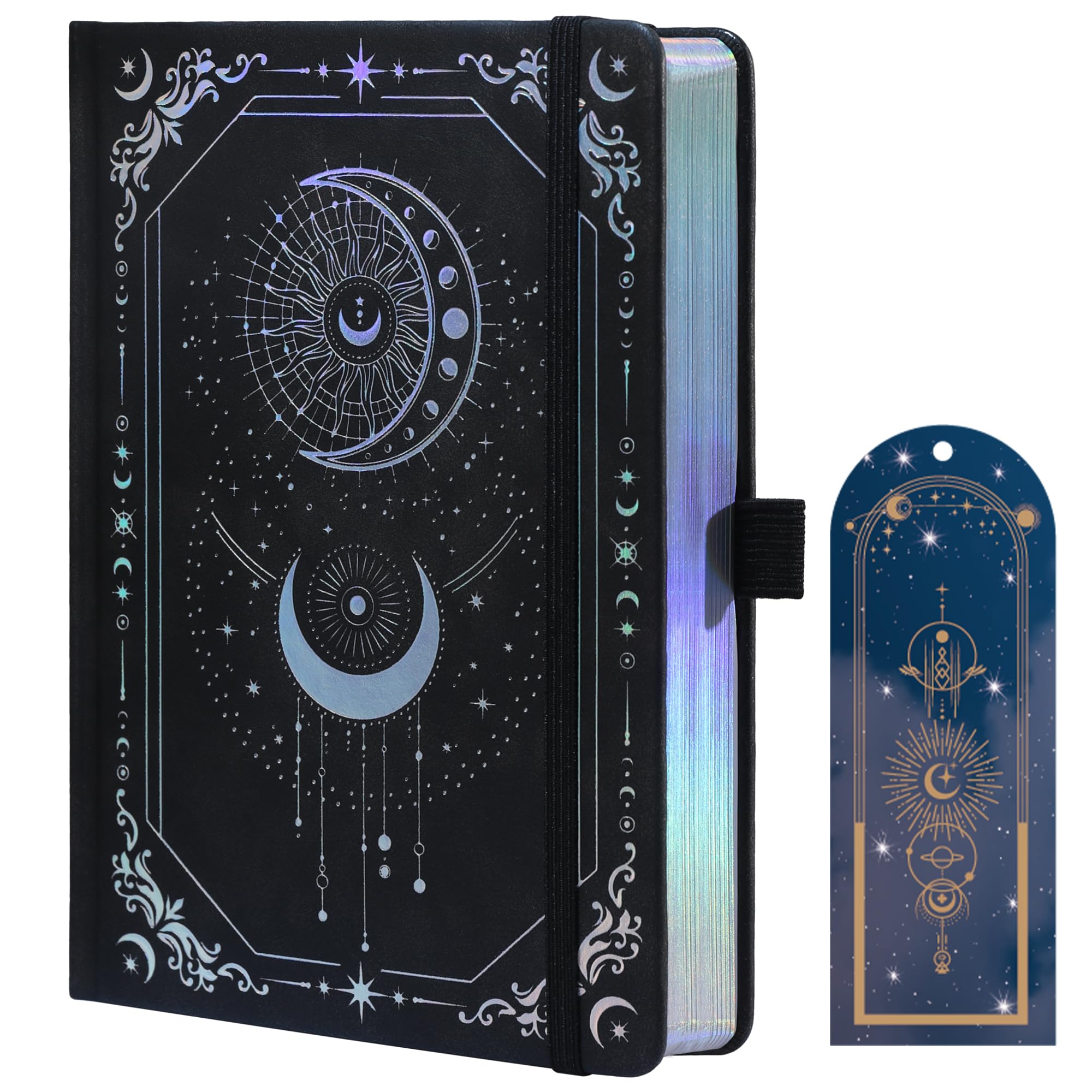
The thickest paper on the list, with center markers that end the dot-counting.
If your journal pages get wet — layered water-based markers, watercolor bounces, glued-in art — this is the notebook to reach for. The 160gsm paper is the heaviest sheet in this roundup, denser than the 150gsm BUKE and well above the 100gsm of the OFFIGIFT 312-page book. There are 190 numbered pages, and the same center-page markers that let you split a spread without counting dots are here too. The hardcover’s hot-stamping embossing gives it a textured, retro look that feels more expensive than its budget-adjacent tier.
The practical layout matches what an experienced bullet journaler wants. Two ribbon bookmarks let you hop between your monthly log and daily page, plus a bonus sun-and-moon themed bookmark in the box. There is a back pocket and an elastic band, a pen holder, and the A5 size (8.3″ x 5.8″) is bag-friendly. The binding on this book is worth calling out — reviewers describe it as sturdy and flat-opening, which matters when you are working across a two-page spread with a ruler.
If you only write with fine-tip pens, 100gsm to 140gsm is enough and you can skip the 160gsm premium. If you layer markers or watercolor, the 160gsm sheet keeps both sides of the page clean. The cover also resists fingerprints better than the matte black BUKE, which matters over hundreds of daily touches.
Why the paper density matters
- 160gsm sheet — heaviest on this list — keeps layered markers and watercolor on one side
- Center-page markers save you from counting dots across the spread
- Two ribbons plus a bonus themed bookmark for daily flipping
- Hot-stamped cover and sturdy binding feel built to last
When it is more than you need
- Fewer pages than the OFFIGIFT 312-page option if you fill spreads fast
- Highest-priced pick on this list
- Heavier stock adds a little weight to a bag carry
The right match: artists and ink-heavy journalers who want the thickest sheet and are happy to trade page count for it.
The wrong match: fine-pen writers with tight budgets — the 150gsm BUKE covers you for less.
Know the Specs
Paper Weight (gsm)
Gsm stands for grams per square meter — the density of the paper. Higher numbers mean the sheet is thicker and less likely to let ink pass to the page behind. A 100gsm sheet handles ballpoint and pencil comfortably, but a 150gsm or 160gsm page is what you want for gel pens, layered markers, and art. If you have ever finished a spread and found shadowy ink on the back of the page, that notebook was too light for your tools.
Dot Grid Spacing
Most dot-grid notebooks here use a 5mm gap between dots — enough structure to draw a box, not so tight it feels like graph paper. A 5mm grid means roughly 1080 dots on an A5 page. Wider spacing gives you looser, more open layouts; tighter would feel more like a math pad. The 5x5mm grid on these picks suits both handwritten notes and drawn layouts.
Page Count and Numbering
A numbered page means you can build a table of contents that actually works — flip to page 47 and your monthly log is there. Without numbering, your index falls apart the moment you add pages. A 160-page book tends to fill within a few months for a heavy user, while a 312-page book can carry a full year of dailies and monthlies.
Binding and Lay-Flat
Thread-bound or stitched binding (rather than glued) lets the book open flat across both pages. That is what makes two-page weekly spreads practical. Glued spines tend to fight back in the middle of a page and eventually crack. A lay-flat binding shows its value the first time you need to write near the inside gutter.
Common Questions
What paper weight do I need for a bullet journal?
Will the dots on black paper be visible enough to use?
Is a B5 journal too big to carry in a bag?
Do the included markers in a journal kit bleed through the paper?
What size notebook is better for bullet journal spreads, A5 or A4?
How long does a 312-page journal last?
Do the bookmark ribbons and elastic bands stay attached over time?
Can I use watercolor in a dot-grid journal?
Is a hardcover or softcover better for a bullet journal?
What is the difference between a dot-grid notebook and a lined journal?
The Bottom Line
For most people the bullet journal winner is the BUKE Dotted Journal, because its 150gsm black pages take gel pens and metallic markers without bleed and it arrives gift-ready. The 4.5+ star rating backs that up — it is the crowd favorite here. If you want a longer run and a full index, the OFFIGIFT 312-page B5 is the one to reach for. And for heavy-ink artwork, the TIEFOSSI 160gsm puts the thickest sheet under your pens. Match the gsm to your pens and markers, and the choice narrows to one or two notebooks.
How we choose
We do not accept paid placement. Every pick is matched to a real buyer and a real use-case; we do not hands-on test units.
Sources
Specifications: manufacturer listings and product documentation. Review insights: verified customer reviews, as of October 2026. Pricing: not shown on this page (it changes often); check the current price via the retailer link.
As an Amazon Associate, Aappliancez earns from qualifying purchases. This does not affect which products we feature.