Disclosure: Some links in this post are affiliate links. As an Amazon Associate I earn from qualifying purchases, at no extra cost to you. Learn more
Specs are compiled from manufacturer listings and verified buyer reviews and can change over time — please confirm the key details on the product page before buying.
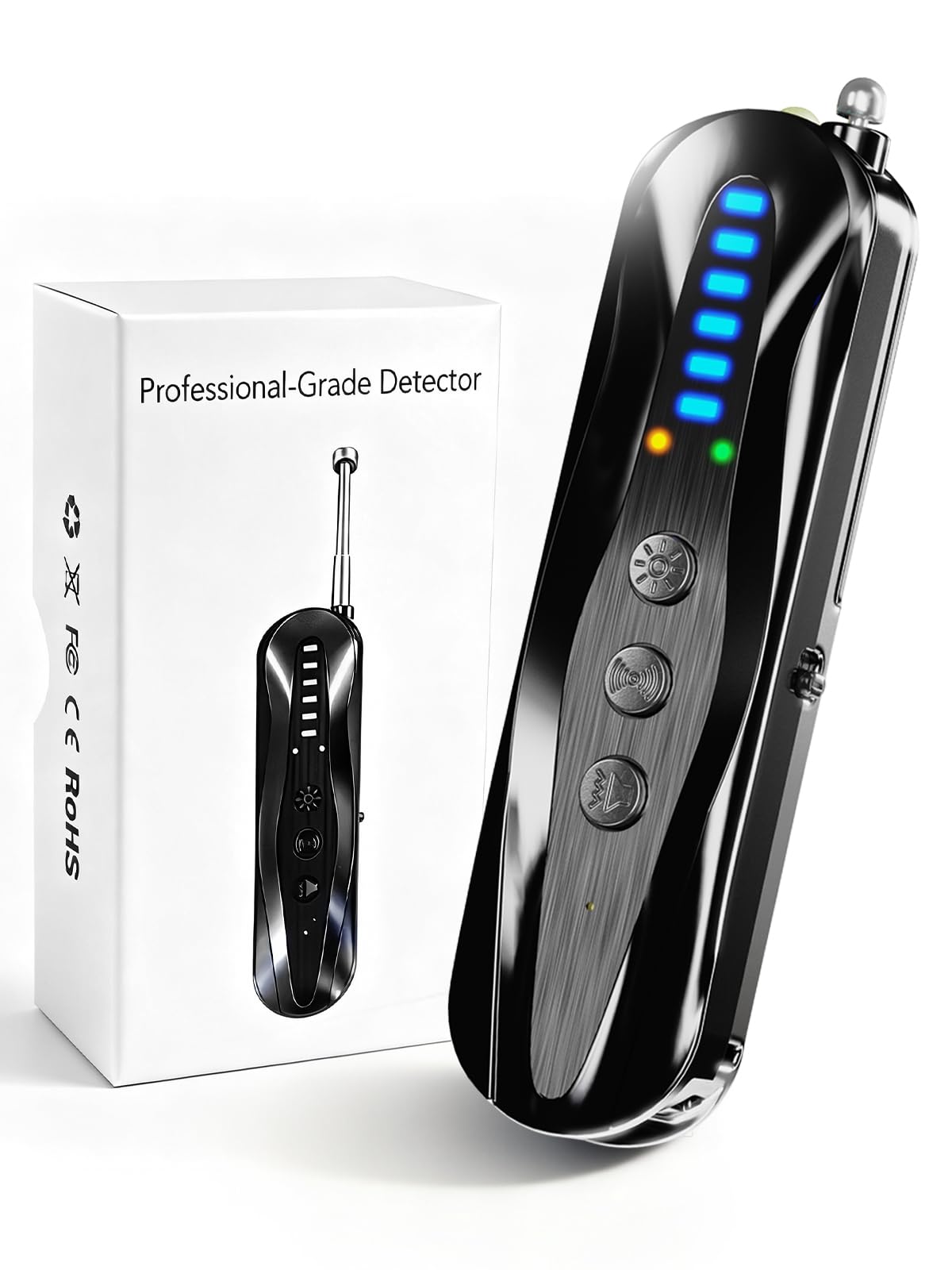
You want to know one thing before you sleep in that rental, change in that fitting room, or talk business in that hotel suite: is something recording me? A bug detector is the pocket tool that sweeps a room for hidden cameras, listening devices, and magnetic GPS trackers. The short answer: the ERYITRDK S620 is the pick for most people, because it combines a wireless signal scan, an infrared lens finder, and a door-handle alarm in one 27.22 g body. Below you get six detectors compared on the specs that actually decide a sweep, plus the real trade-offs owners hit after the box is open.
This guide is built by comparing the manufacturers’ published specifications and the patterns across verified customer reviews, so you get each pick’s real strengths and trade-offs instead of marketing spin.
Some models sweep radio frequencies, some hunt lens reflections in the dark, and a few add a magnetic probe for trackers stuck under a bumper. Knowing which of those jobs you actually need is what separates a useful bug detector from a drawer ornament. My goal here is simple: help you buy the best bug detector for the rooms and cars you actually use, without paying for modes you will never switch on.
Top Picks
How To Choose The Best Bug Detector
Start with the one question that decides everything else: what are you actually trying to find? A wireless spy camera is a radio transmitter, so an RF (radio-frequency) scanner catches it while it is powered on and sending. A camera that records to a memory card sends nothing, so you need the infrared lens finder instead. A GPS tracker stuck to your car may sit silent and magnetic, which is a third, separate job. Most buyers need two of the three, and the picks below split along exactly those lines.
RF scanning versus infrared lens detection
An RF scan listens for the radio chatter a wireless camera or listening device emits, and it usually shows you signal strength as rising beeps or lights. That makes it fast for a broad sweep of a hotel room, but it also hears your own phone, the room Wi-Fi, and Bluetooth speakers. Infrared detection is different: in a dark room you look through a red filter and a hidden lens bounces your light back as a bright pinpoint. That catches a wired or card-recording camera the RF mode would miss entirely.
Why sensitivity control matters more than range claims
A detector that screams at everything is useless. Adjustable sensitivity lets you turn the gain down once you get close, so you can walk toward a signal instead of just confirming that one exists. Several picks here give you stepped sensitivity levels for exactly that reason. The frequency coverage number matters too, because modern wireless gear pushes into higher bands.
Battery, standby, and pocket size
A detector you left on the charger is a detector you do not have. Look for continuous run time measured in hours and standby measured in days, so it survives in a bag between trips. Weight and thickness decide whether it rides in a pocket or stays in the suitcase — and a slim pen-style body is easier to use discreetly in a shared office.
Side-by-Side Comparison
| Model | Best For | Detection Range | Battery / Power | Weight | Amazon |
|---|---|---|---|---|---|
| ERYITRDK S620★ Best Overall | All-round travel sweeps | Wi-Fi / RF with extendable antenna | Up to 25 hours | 27.22 g | Amazon |
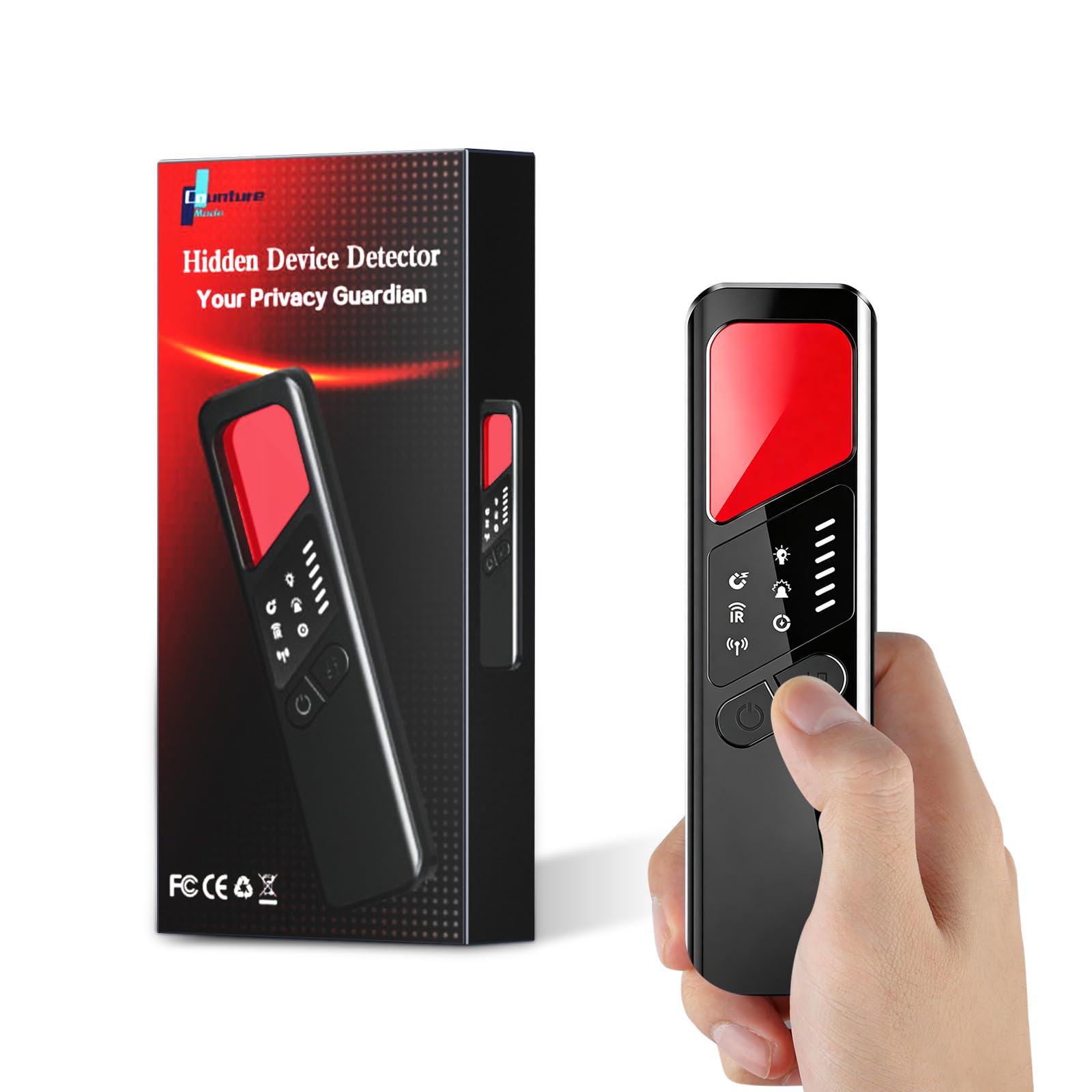
| CountureMode G007 ProTop Performer | Detailed room inspections | 1 MHz–8 GHz | Rechargeable, lithium polymer included | 2 oz | Amazon |
| ganods K18 | Casual confidence | 6.5 GHz | Up to 30 days standby | — | Amazon |
| JMDHKK K68+ | Business and confidential talks | 2.4 GHz, 5.8 GHz | Battery powered, 3.7 volts | 8.8 ounces | Amazon |
| Koilboane S500 | Car and tracker sweeps | 100 MHz–8 GHz | 800 mAh, up to 25 hours | 24 g | Amazon |
| JAXTIN G9 Pro | Gift-style pocket carry | Multimodal scan (no band stated) | 60-min Type-C charge, 72 hours | Under 30 g | Amazon |
Detailed Reviews
1. ERYITRDK S620 Hidden Camera Detector
Our pick — 4.0+★ from 300+ verified ratings; the strongest balance of quality and price.
Three privacy jobs in one 27.22 g body — and it hangs on a door handle while you sleep.
One small tool here covers a lot of jobs. The 27.22 g body (about the weight of a few sheets of paper) runs a wireless sweep with an extendable antenna, so you get a steadier read on signal direction in a large meeting room instead of waving the thing around a corridor. Adjusted sensitivity lets you walk a signal down rather than lose it. Then the infrared scan (a scan that looks for lens reflections) takes over for cameras that never transmit at all. In a dark room, a hidden lens bounces back as a bright spot, which is what catches a pin-hole camera tucked into a smoke detector or a charger.
The anti-theft alarm mode is what separates this pick from every other detector here. Hang it on a hotel door handle and any attempt to open the door triggers an instant alert. Attach it to a suitcase and slight movement sets off a loud alarm. No other detector on this list doubles as a door alarm, and for a solo traveler that is the feature you end up relying on at 2 a.m. The anti-GPS tracking scan is the third string: it senses the magnetic fields (the invisible pull a magnet gives off) that a tracker leaves when it clings to a car. That lets you sweep under seats, along bumpers, and near the inside edge of tires before you drive.
Battery is quoted at up to 25 hours of use, and the pocket-size build means it does not need a wall outlet mid-trip. A quiet detection mode drops the beeps so you can scan a shared office or a hotel room late at night without announcing it. The catch is the honest one for any RF tool: the wireless scan responds to ordinary Wi-Fi and Bluetooth too, so expect it to light up near a router. Buyers report it plainly — “beeps and blue lights increase near Wi-Fi router” — which tells you it is working, not that it found a spy camera. Read rising signal strength as a direction guide, then confirm with the infrared lens.
What earns the top slot
- Wireless sweep, infrared lens scan, and magnetic tracker detection in one device.
- Anti-theft alarm doubles as a door-handle alert and a suitcase motion alarm.
- Up to 25 hours of battery in a 27.22 g pocket-size shell.
- Silent detection mode for discreet sweeps in shared spaces.
Where it asks for patience
- The RF mode reacts to your own Wi-Fi and Bluetooth, so learn to read signal strength.
- Infrared work needs a genuinely dark room to make the lens reflection pop.
Reach for this if: you travel, rent short-stay rooms, or want a door alarm and a camera sweep from one pocket tool.
Worth knowing first: a router in the room will set the wireless mode off, so budget a minute to sweep direction and confirm with the infrared lens.
2. CountureMode G007 Pro 7-in-1 Hidden Camera Detector
The widest frequency net on this list and six sensitivity steps to walk a signal down.
Sheer coverage is the argument for this one. It scans from 1 MHz up to 8 GHz (MHz and GHz are radio-frequency bands, the slices of the airwaves devices talk on), which is the broadest stated band among these six picks. That is wider than the JMDHKK K68+ at 2.4 GHz and 5.8 GHz, and wider than the ganods K18 at 6.5 GHz. Modern wireless gear sits across a lot of bands, so a wider scan catches devices a narrower one can miss. Six adjustable sensitivity levels let you go from a wide sweep of a hotel suite to precise checking of one smoke detector. The 360° scanning and built-in AI chip (a processor that speeds up signal reading) drive those fast reads.
Alerts come three ways: flashing LEDs, strong vibration, and adjustable beeps. In a noisy room you can feel the vibration instead of straining to hear a beep, and in a quiet one you can drop to vibration alone for a discreet pass. Function is the thing owners talk about most, and the package they describe is a device that fits in a purse or backpack and gets used often — the size and portability notes follow close behind. The pen-style body is what makes that carry easy, and a rechargeable lithium polymer battery comes in the box.
Here is the honest limit to plan around. The maker markets it as lab-certified and FCC-tested (FCC is the US agency that regulates radio devices), but that is the manufacturer’s claim, not something these pages can verify. Treat it as a description of how it was tested, not a guarantee that your room is clean. The practical truth of any RF detector (a device that listens for radio signals) applies: it hears the Wi-Fi around it. When the alarm fires constantly, that is the universe of signals, not necessarily a camera. Use the sensitivity steps and get close. If you want the one-device breadth, this is the pick; if you want a simpler tool, the S620 above is easier to read at a glance.
Best-fit buyer: someone who inspects rooms regularly — business travelers, frequent renters, anyone who wants six sensitivity steps and the widest stated band on the list.
The catch worth sizing: RF alerts will fire near ordinary Wi-Fi, and the certification language comes from the maker rather than a test you can run yourself.
Pick it when you want the broadest scan and the finest control over how twitchy it feels.
Pass if you would rather have a simpler detector with a door alarm — the S620 covers that job.
3. ganods K18 Hidden Camera Detector

Charged once, ready for a month — the detector you will still have power in when you need it.
For a casual sweep, the standby number is what sells this one. After charging, standby runs up to 30 days, so it survives in a drawer between trips and is ready when you reach for it. Three functions carry the work: a camera detector for wireless and wired hidden cameras plus eavesdropping devices, a GPS finder that reads the magnetic field a tracker gives off, and infrared detection for night-vision lenses. The LED display and 6.5 GHz frequency support round out the hardware, and it runs on a 3.7 volt supply.
Signal tracking is the part buyers rate most — finding the thing, following the signal, and running down where it hides. Ease of use comes next, helped by adjustable sensitivity and indicator guidance. The controls are two buttons: a mode button and a sensitivity button, and you cycle through the functions with those. A traveler’s verdict in the reviews put it simply: “If you are going to a hotel or going to stay in a unfamiliar place this is a must.” That is the use case it is built for — rental flats, hotel bathrooms, a room that does not quite feel right. If you want a single-purpose sweep tool and nothing else, the extra modes here are more than you need.
The honest catch is that the radio-frequency mode is greedy. It hears phones, Wi-Fi, and Bluetooth, so the sensitivity dial becomes your best friend — turn it down as you close in. The infrared lens finder is described as the most useful single mode, and magnetic GPS detection is short on range compared with a dedicated probe. Novices fine with a learning curve will get on well; anyone expecting a pro scanner should look up the list. It is a value-first pick, and it behaves like one.
Where it lands: the casual peace-of-mind detector — three modes, up to 30 days of standby, and a simple one-button control scheme.
Be ready for this: the RF mode calls out phones and Wi-Fi as readily as cameras, so learn the sensitivity dial before you trust an alert.
The right call for occasional travelers who want a charged, no-fuss detector on hand.
Not for anyone hunting GPS trackers under a car from a distance — the magnetic read is short-range.
4. JMDHKK K68+ Hidden Camera & Bug Detector

Three detection technologies and an auto-scan mode that does the repeating for you.
The standout here is wiring. This unit folds three detection methods into one chassis — wireless RF (radio signals), magnetic field, and infrared (lens reflections) — and it also reads wired bugs as well as wireless ones. The passive signal observation mode is the real differentiator: it keeps watching its surroundings on its own and flags transmissions that only appear at longer intervals. That is the pattern a manual sweep misses, because you are not standing there when the bug transmits. Frequency support covers 2.4 GHz and 5.8 GHz, with an ultra bright LED display and a 3.7 volt battery.
A magnetic probe with its own LED reaches into spots your hands cannot, and the infrared view picks up the flicker of a night-vision camera. Detection is direction-sensitive in the useful way — you point it, you walk the signal, you close in. Alerts come in light, sound, and vibration, which helps anyone who cannot feel a buzz or hear a chirp reliably. The controls are the fiddliest part; the manual and a video make them learnable, and once you have the sequence down it stops being a chore.
This is also the heaviest of the six at 8.8 ounces, so it lives in a bag rather than a shirt pocket. Two honest notes: the build is plastic and scratches easily, and the illustrated control chart in the manual is printed in Spanish, so keep the English text section handy while you learn. It is not the lightest pick, but for a business traveler sweeping a meeting room, the extra coverage and the auto-scan are worth the bulk.
Why a professional would carry it
- RF, magnetic, and infrared detection in one unit, including wired bugs.
- Passive auto-scan keeps watching for intermittent transmissions.
- Multimodal light, sound, and vibration alerts suit different environments.
- Magnetic probe with LED reaches into tight, awkward spots.
What to weigh before buying
- Heavier than the rest of the list at 8.8 ounces, so it rides in a bag.
- The control chart in the manual is printed in Spanish, and the plastic shell marks easily.
Choose this one if you need to sweep a meeting room or a confidential conversation and want wired-bug coverage plus an auto-scan.
Think again if pocket carry is the priority — at 8.8 ounces it is a bag tool, not a keyring.
5. Koilboane S500 4-in-1 Bug Detector
A 24 g stick with a 100 MHz–8 GHz net and a vibration alert for quiet sweeps.
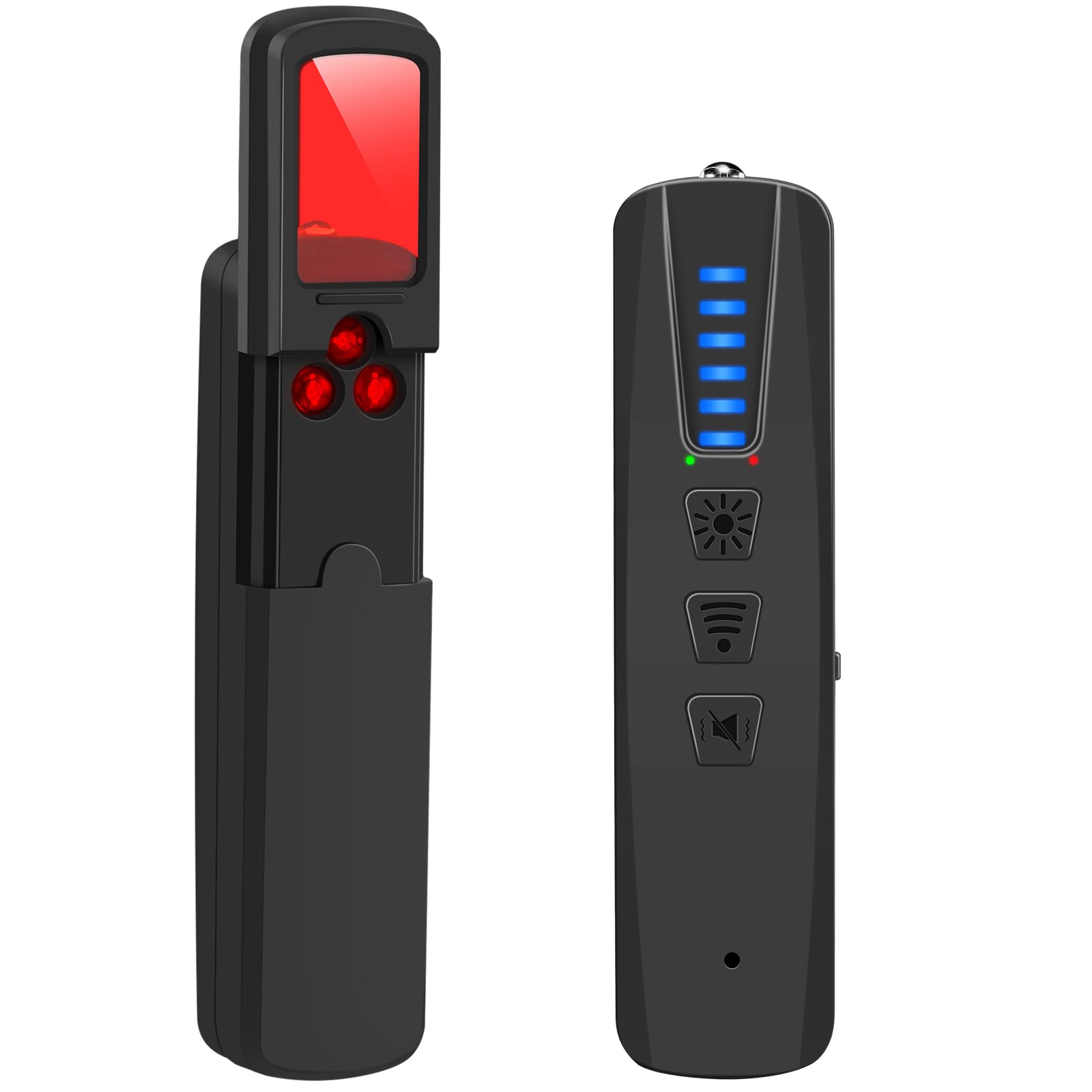
At 24 g, this one disappears into a pocket, purse, or glovebox, and that lightness is the point of the design. The 4-in-1 package brings wireless signal scanning, infrared detection, magnetic GPS tracking, and a built-in flashlight. Frequency coverage runs from 100 MHz to 8 GHz, matching the CountureMode G007 Pro’s stated ceiling, so it is a broad net. Five sensitivity levels let you widen or tighten the scan, and alerts come as either a beep or a silent vibration so you can check a car in a shared garage without drawing eyes.
Battery is a real strength: an 800 mAh rechargeable cell gives up to 25 hours of continuous use after about 2.5 hours of charge, plus 30 days of standby. The trade-off you should know going in is the mixed reliability story — plenty of owners find it works, while others report it does not, and a common theme is that it fires near everyday Wi-Fi and Bluetooth. If your hotel or home is full of smart devices, turn the sensitivity down and work slowly. For tracker hunting, the magnetic mode reports too many false hits and the body is short for reaching under a car without crawling, as a buyer who tried it on a vehicle found.
So treat the S500 as a light, wide-band companion for cameras and signals rather than a long-reach tracker probe. The flashlight and vibration alert make it practical, and the compact size makes it easy to keep with you. If you want the most consistent performance at a similar size, the S620 up top is the safer bet; if you want the lowest weight and a broad band for casual sweeps, this is a sensible pick.
Strong suit: a 24 g body, 100 MHz–8 GHz scan, and 800 mAh battery with up to 25 hours of runtime and 30 days of standby.
The compromise: reliability is mixed, WiFi noise triggers false hits, and the short body makes under-car tracker work awkward.
Its natural home is a light, wide-band casual sweep of a room or car, with vibration alerts for quiet checks.
The honest limit is that daily-life Wi-Fi causes false triggers and the compact length is a poor fit for under-vehicle probing.
6. JAXTIN G9 Pro Hidden Camera Detector
A pocket-sized, gift-boxed detector with 72 hours of runtime on a 60-minute Type-C charge.
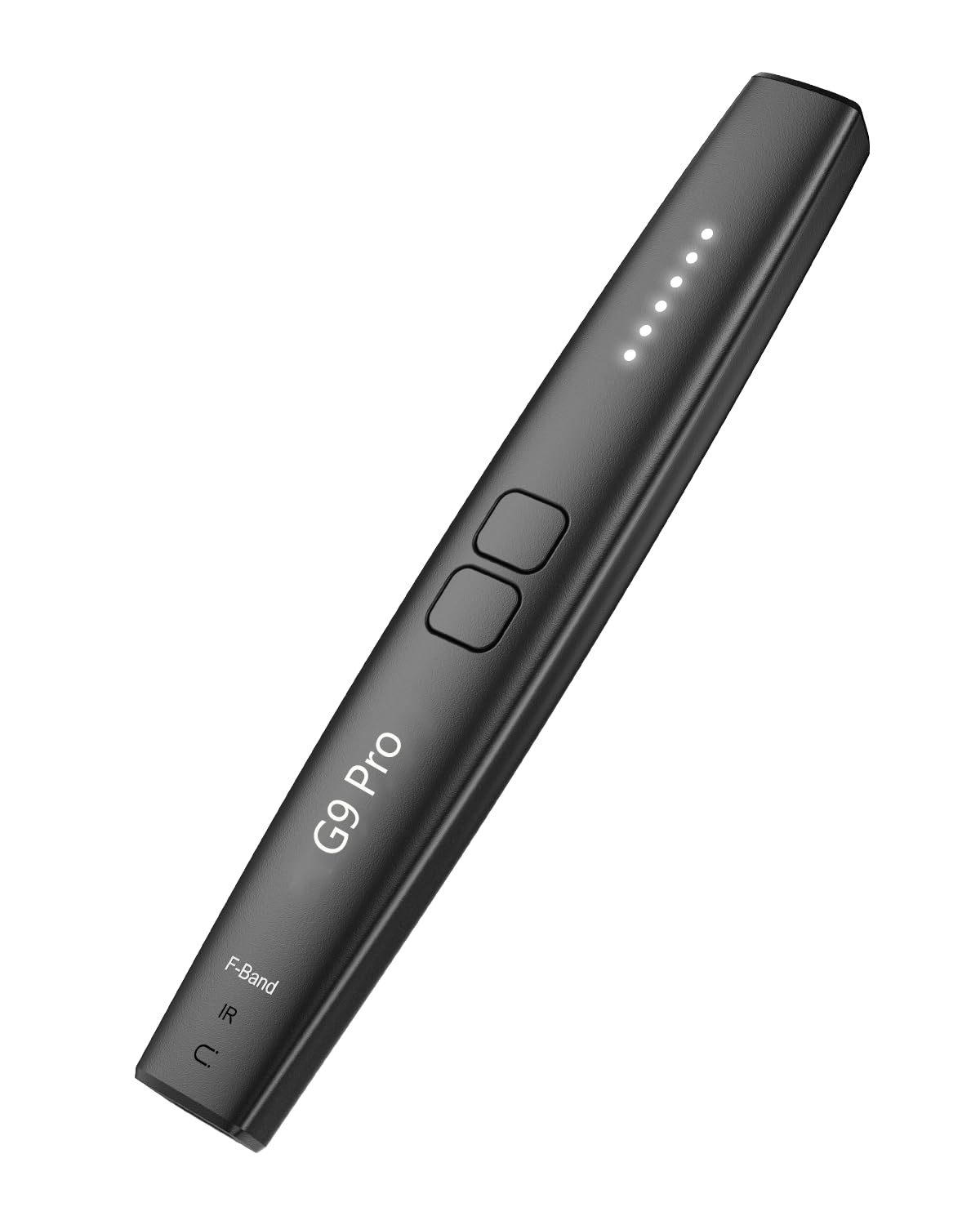
Run time is the headline. The G9 Pro is quoted at 72 hours of power from a 60-minute Type-C fast charge (Type-C is the oval USB plug that fits either way). The maker claims 3000 scans per second and a 40% faster response. It tips under 30 g, so it carries without noticing. Reception is the weak point though: some owners say you have to press right up against a device before it reacts. A few reports are harsher — one noted it failed to catch an active webcam in any mode and fired false alarms near Wi-Fi routers. Treat it as a short-range, lifestyle-minded detector rather than a professional sweep tool.
The controls are laid out simply, with mode and sensitivity buttons and clearer multi-sensory alerts, so it is friendly to a first-timer. That is part of the pitch — a privacy device for someone who would not otherwise buy one. Packaged in a gift box with a manual and dedicated support, it is the one on this list made to be handed over to a less technical relative. Owners who like it tend to like it a lot: “This thing is cool. It picks up devices that are hidden.”
My read: the strongest features are the battery and the portability, not the detection distance. If you want to spot a hidden lens across a dark room, the infrared scan on the S620 is the better route. If you want a tidy, quick-charging detector to drop in a travel bag or pass to a family member as a gift, this one fits that brief.
The pull: 72 hours on a single 60-minute Type-C charge and a sub-30 g body make it an easy carry.
The reality check: it needs close range to detect, and some units misfire near Wi-Fi routers — read it as a short-range tool, not a pro sweep.
It suits first-time promoters of privacy and gift-giving, thanks to long battery life and simple controls.
Look elsewhere if you want to detect a hidden camera across the room — that is a job for the infrared lens on the top pick.
Know the Specs
Detection frequency range
Measured in hertz and its multiples (MHz, GHz), this is the span of radio waves a detector can hear. Wider coverage — such as 100 MHz to 8 GHz — lets it pick up more kinds of wireless camera and bug. Narrower coverage still works, but can miss devices that transmit farther out on the dial. Use this number as a rough measure of how many modern devices it can catch.
Infrared lens detection
This mode is not about radio at all. In a dark room you aim a red-filtered light at surfaces, and a hidden camera lens returns a bright reflection because of its curved glass. It is the only reliable way to find a camera that stores footage locally and never sends a signal. Turn the lights off, scan slowly, and look for the flare.
Battery life and standby
Quoted as continuous run time in hours and standby in days, these numbers say how ready the detector is when you pull it out. Up to 25 hours covers a long trip; up to 30 days of standby means it survives between uses. A larger milliamp-hour cell (mAh) generally buys you more run time but adds a little weight.
Sensitivity and alerts
Sensitivity is how much signal it takes to set the alarm off — adjustable levels let a detector whisper at close range and shout across a room. Alerts come as beeps, lights, or vibration; vibration and silent modes suit public places where a chirp gives away what you are doing.
Common Questions
Will a bug detector find a camera that records to a memory card?
Why does my detector go off near the Wi-Fi router?
Can a bug detector find a GPS tracker under my car?
Do I need to be in a dark room to find hidden cameras?
How far away can a bug detector pick up a hidden camera?
What is the difference between an RF detector and a listening-device detector?
Will a detector find a hidden camera that is switched off?
How long does the battery last on a travel bug detector?
Is a bug detector a replacement for a professional security sweep?
Does the size of a detector matter?
The Bottom Line
For most people shopping for the bug detector, the ERYITRDK S620 is the pick. It brings wireless scanning, an infrared lens finder, magnetic tracker detection, and a door-handle alarm into one 27.22 g body, so one small tool covers the room, the car, and the night’s sleep. If you want the widest frequency band and the finest sensitivity control, the CountureMode G007 Pro scans from 1 MHz to 8 GHz. And if your main worry is a confidential conversation or a wired bug, the JMDHKK K68+ folds in three detection methods and an auto-scan. Whichever you land on, learn its sensitivity dial before your first trip, and it will be the tool you reach for every time.
How we choose
We do not accept paid placement. Every pick is matched to a real buyer and a real use-case; we do not hands-on test units.
Sources
Specifications: manufacturer listings and product documentation. Review insights: verified customer reviews, as of October 2026. Pricing: not shown on this page (it changes often); check the current price via the retailer link.
As an Amazon Associate, Aappliancez earns from qualifying purchases. This does not affect which products we feature.