Disclosure: Some links in this post are affiliate links. As an Amazon Associate I earn from qualifying purchases, at no extra cost to you. Learn more
Specs are compiled from manufacturer listings and verified buyer reviews and can change over time — please confirm the key details on the product page before buying.
You do not need to spend a fortune to make your TV stop sounding like a laptop. The picks below all run a real subwoofer, most connect with a single cable or a quick Bluetooth pairing, and every one of them was chosen because the everyday experience of owning it holds up — clear dialogue in movies, decent bass in music, and a setup you can finish in an evening rather than a weekend.
This guide is built by comparing the manufacturers’ published specifications and the patterns across verified customer reviews, so you get each pick’s real strengths and trade-offs instead of marketing spin.
At this price, most systems skip Dolby Atmos, so driver size, subwoofer quality, and connection stability matter more than format logos. That is exactly what this guide to the budget sound system breaks down for you, one pick at a time.
Top Picks

How To Choose The Best Budget Sound System
Start with your room and couch position, then fit the audio gear around them. A surround kit needs somewhere to put the rear speakers; a single bar does not.
Wired vs wireless speakers
Rear speakers in this price range usually connect wirelessly to the main unit but are linked to each other by a short cable, so you still need to run one wire behind your seating. Wired satellite speakers, on the other hand, need an RCA cable run to each one — more permanent, but a more stable signal. If you want zero cables at all, plan for a single soundbar and accept that the surround effect will be simulated rather than produced by speakers behind you.
Drivers, subwoofers and what the wattage really means
Peak power is the loudest instantaneous spike an amplifier can hit, not the level you listen at. What you actually hear comes from driver size and subwoofer quality. A 5.25-inch down-firing subwoofer moves enough air for a living room; smaller units fill a bedroom. Larger cabinets produce deeper bass, so a big wooden box often beats a slim plastic one at the same wattage.
Getting the connection right
HDMI ARC (Audio Return Channel) lets your TV’s remote control the volume and sends audio down one cable — it is the cleanest connection and the one to prefer when your TV has the port. Optical is a reliable backup with the same cable-everywhere convenience. Bluetooth is the fallback for phones and tablets, but it can lag behind the picture on fast-moving scenes, and quality depends on the codec both devices share. Bluetooth 5.4 is a newer protocol, not a guarantee of signal stability — treat it as a slightly more sturdy link than an older version, not a promise of perfect audio.
Side-by-Side Comparison
| Model | Best For | Channels | Driver Size | Peak Power | Amazon |
|---|---|---|---|---|---|
| Wooden 5.1.2 N512 Sound System★ Best Overall | Everyday 5.1 surround on a shelf | 5.1.2 | 5.25 in | 400W | Amazon |
| Acoustic Audio by Goldwood AA5210Best for Small Rooms | Wall-mount surround with a light show | 5.1 | 6.25 in | 600W | Amazon |
| HiPulse N512 Surround SoundbarBest Setup | Plug-and-play 5.1.2 with no separate amp | 5.1.2 | 5.25 in | — | Amazon |
| Donner MAMP2 Stereo Amplifier | Powering speakers you already own | 2.0 | — | 600W | Amazon |
| Bobtot A55 Home Theater System | Small rooms and tight corners | 5.1 | 5.25 in | 600W | Amazon |
| Pyle PDA77BU Stereo Receiver | Karaoke nights and multi-speaker setups | 4-channel | — | 800W | Amazon |
| DOSS SoundBox Ultra | Portable 2.1 audio with real bass | 2.1 | — | 80W | Amazon |
| ULTIMEA Poseidon M60 | Dolby Atmos with no rear speakers | 5.1 | 18 mm | 300W | Amazon |
| LG S40TR Home Theater Soundbar | Rooms of any shape with true rear speakers | 4.1 | — | — | Amazon |
Detailed Reviews
1. Wooden 5.1.2 Virtual Surround Sound System
Eleven drivers in real wood — a surround kit that fills a whole room without a receiver.
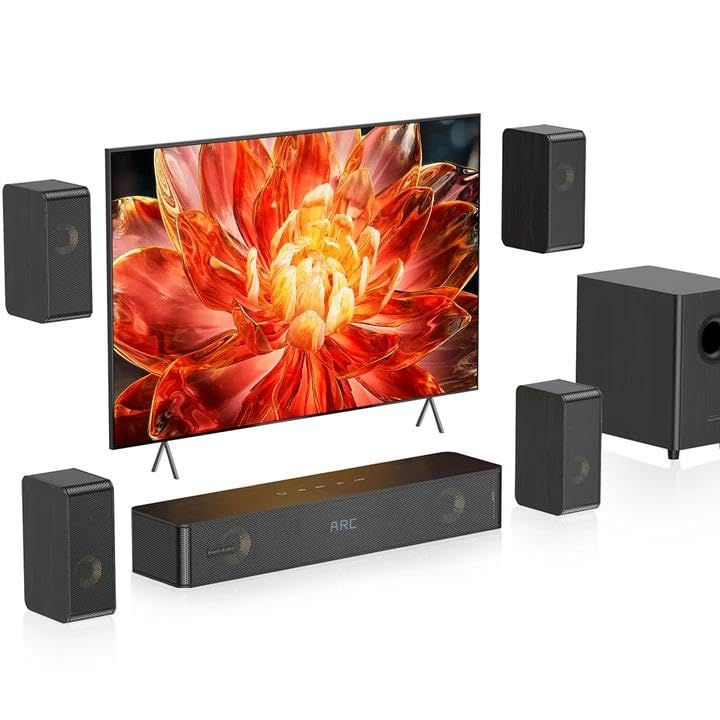
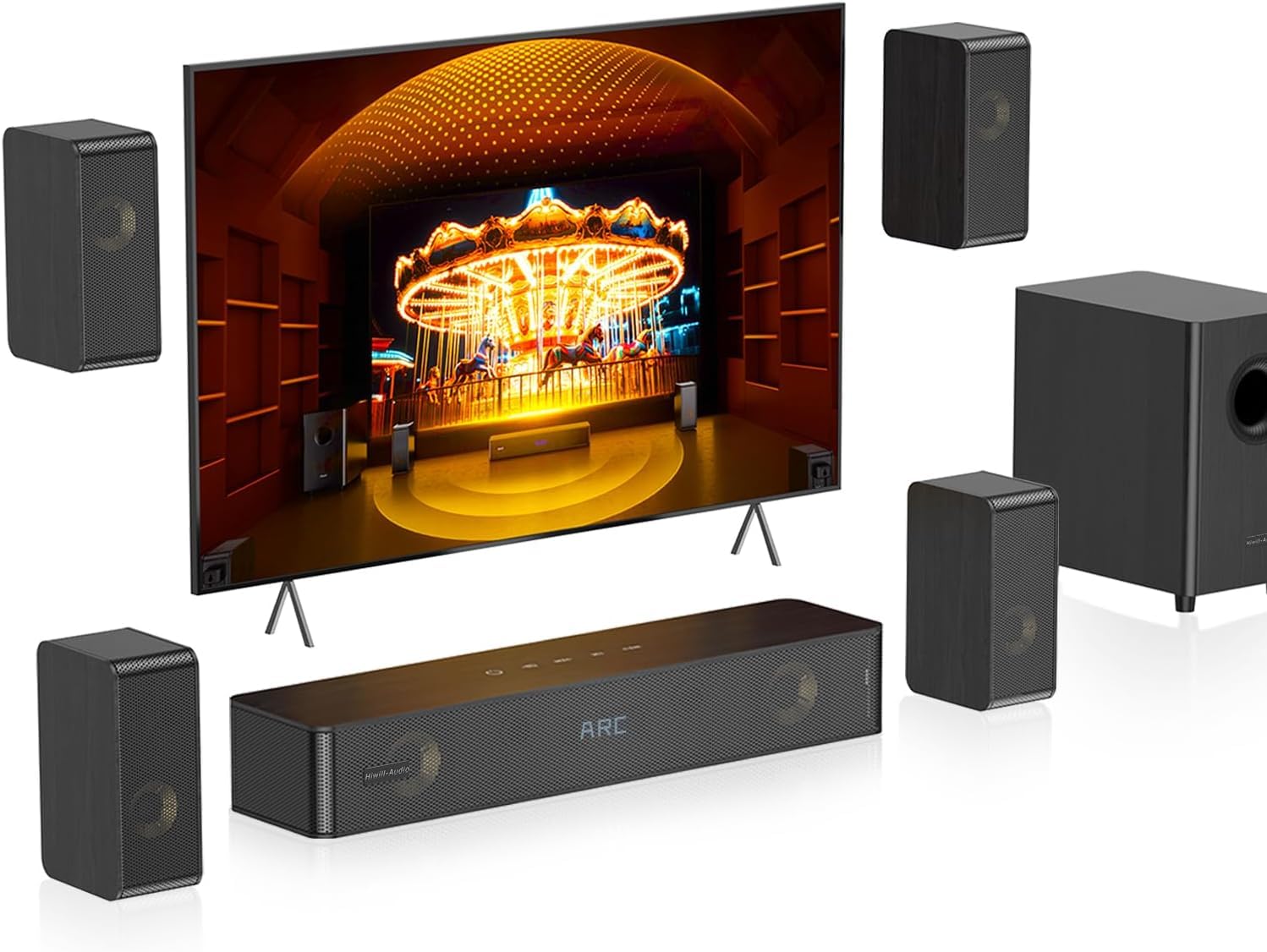
This is the pick for the person who wants a full home-theater feel without adding a separate amplifier box to the cabinet. It runs a 5.1.2 channel layout, which means five surround speakers plus two extra height drivers pointed upward — those top drivers are what spread sound across the ceiling and make a movie feel bigger than the bar in front of you. Inside the solid wood cabinets sit 11 aluminum-magnesium alloy drivers with reinforced ribs, including dedicated tweeters, full-range units, and a 5.25-inch down-firing subwoofer pointed at the floor. The output is rated at 400 watts peak.
The bass is where this system earns its place among the higher-rated picks. That 5.25-inch subwoofer is bigger than the 5.25-inch unit found in the ULTIMEA Poseidon M60, and the down-firing design pushes low frequencies out across the floor rather than firing them straight into a wall. You also get a bass control that runs from -6 to +6, which matters in an apartment — you can dial the thump down without losing the punch entirely. Four preset modes cover Movie, Music, NEWS for dialogue, and Game, and each one genuinely changes how the speakers behave rather than just nudging a tone knob.
Setup is where this one surprises people. The rear speakers connect wirelessly to the main unit but link to each other with a single cable, which the maker calls a hybrid surround design built to avoid the pairing and dropout problems that plague fully wireless setups. Connectivity covers HDMI ARC, Optical, AUX, USB, and Bluetooth 5.3, so a TV, a phone, and a games console can all live on it. The catch worth knowing: a small number of owners ran into an occasional pop from those rear speakers, and a unit that arrives with a fault needs a replacement. Dolby Atmos and DTS are not supported here, so if your library leans heavily on object-based formats, look elsewhere.
What lands immediately
- Solid wood cabinets and 11 alloy drivers instead of the usual plastic-and-paper build
- Two upward-firing drivers widen the soundstage far beyond a straight soundbar
- 4 surround speakers with a hybrid wired-to-each-other rear setup for a stable signal
- Bass adjustable from -6 to +6, so it can live in a small apartment
- HDMI ARC, Optical, AUX, USB and Bluetooth 5.3 all on board
The honest trade-offs
- No Dolby Atmos or DTS support, so those formats pass through untouched
- A handful of rear-speaker pop reports from buyers run into the occasional unit
- Weighs 6.5 kg — it is not a bar you tuck on a floating shelf without thought
The one to buy for most rooms: this suits anyone who wants genuine surround from speakers behind the couch and prioritizes material quality over format logos on the box.
Where it loses: if Dolby Atmos is a must-have for your movie library, the ULTIMEA Poseidon M60 above covers that format — this one does not.
2. Acoustic Audio by Goldwood 5.1 Speaker System AA5210
Wall-mountable satellites and a light-up subwoofer drive a real 600-watt surround rig.
The Acoustic Audio AA5210 is the entry-level pick, and it does something the other surround kits here do not — it fires 600 watts of system power through a set of satellite speakers designed to sit on a wall. Five wired satellites come with the kit, the two front units plus the center run a single 6-foot RCA cable each, and the two rear speakers come with longer 12-foot cables so a room-wide run is covered. That center driver is a 6.25-inch unit, larger than the four surround speakers on the Wooden 5.1.2 model, which is why this one leans toward a fuller body at moderate volumes.
The bass comes from an 11-inch subwoofer with a multi-color LED display, which means the light show reacts as the low end hits — a small detail, but the kind that sells a system in a dark living room. Connectivity is simple: Bluetooth, RCA, USB, and SD card, plus a 3.5mm-to-RCA cable in the box. The Pro Surround function upconverts stereo sources to a 5.1 layout, so an older TV or a music stream does not get stuck in two channels.
Buyers report the system works well in bedrooms and small gaming corners where a full kit feels like overkill. Where it stumbles is clarity and control — the remote forces you through each satellite speaker individually to set its volume rather than offering one master slider, and the rear run depends on the Bluetooth link holding steady, which is a short-range 10-meter signal. A loud buzzing from the subwoofer and one report of a receiver overheating after two years both speak to the reality of an entry-level build — treat this one as a room speaker, not a centerpiece.
Sized for a den, not a hall: wall-mountable satellites and an 11-inch driver mean it fills a bedroom or small living room convincingly. The long RCA rear cables are a genuine convenience for a wall run.
The volume control, honestly: the remote managing each speaker on its own is the trade-off on this tier, and the Bluetooth range is what limits how far you can be from the source.
Reach for this if: you want a wall-mount 5.1 with a light-reactive sub and do not mind learning a fiddly remote.
Think twice if: you need one-button volume across all speakers or a connection that never drops.
3. HiPulse N512 5.1.2 Surround Sound System
A plug-and-play 5.1.2 system where the rear speakers wirelessly sync and just work.
The HiPulse N512 is the plug-and-play sibling of the Wooden system at the top of this list, and it shares the same core hardware — solid wood cabinets, 11 aluminum-magnesium alloy drivers reinforced with ribs, and a 5.25-inch down-firing subwoofer. You get the same two upward-firing drivers that broaden the soundstage, which is why a 5.1.2 configuration here feels larger than the physical bar suggests. Setup is what sets this pick apart: the rear speakers connect wirelessly to the main unit and link to each other with one cable, and the whole thing comes online in minutes without pairing screens or resets.
Tuning is where the N512 flexes. Adjustable bass runs from -6 to +6, the four preset modes cover Movie, Music, NEWS for dialogue, and Game, and the rear surround volume can be pushed independently of the mains. A single remote handles input switching, Night Mode, and turning off the LED display. HDMI ARC, Optical, AUX, USB, and Bluetooth 5.3 handle the sources, so a TV, laptop, and phone can all be plugged in and swapped without crawling behind the cabinet.
The honest catch on the N512 mirrors its twin — the system does not support Dolby Atmos or DTS, so those formats will downmix to standard surround. A handful of buyers have also logged a random pop from the rear speakers and a rare unit that stopped powering on after a couple of months, though the maker has been quick to send replacements in those cases. Treat it as a system you pair with a good HDMI ARC source and leave alone.
Why buyers pick this one: fewer than 15 minutes from box to working surround, with no amplifier to wire in. The wood cabinets and 11-driver array give it a build quality that punches above its tier.
Where it draws the line: no Atmos, no DTS, and a low but real chance of rear-speaker popping. The maker’s support response to failures has been the saving grace.
The verdict: if you want surround sound running by dinner without touching an amp, this is the fastest path in the group.
Not your pick if: Atmos decoding tops your checklist, because that lives on the ULTIMEA M60 further down.
4. Donner Stereo Audio Amplifier MAMP2
A 600-watt stereo brain for speakers you already own — phono, karaoke and all.
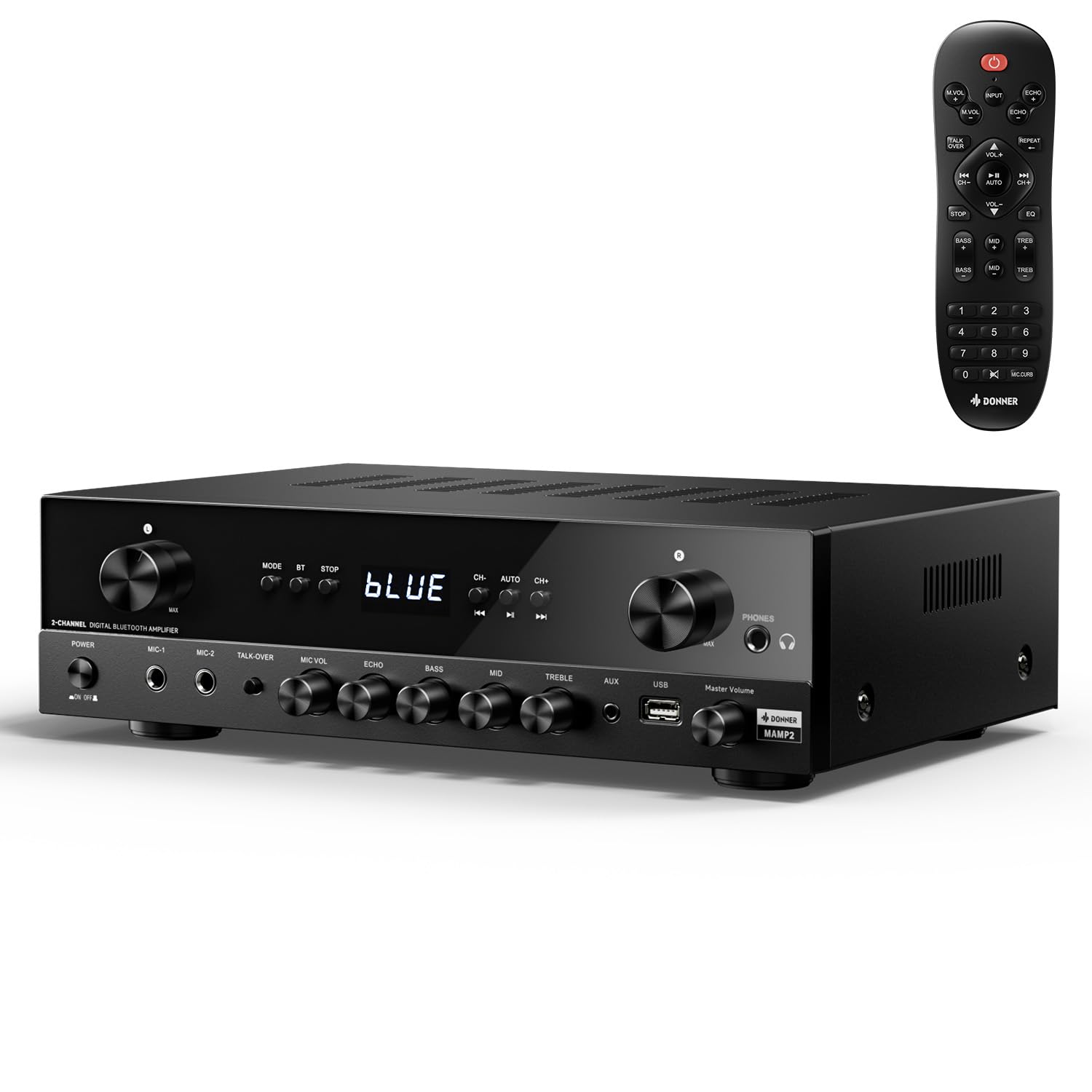
The Donner MAMP2 is the pick for the buyer with a pair of good speakers and no way to drive them. It runs a 2-channel stereo layout rated at 600 watts peak, or 60 watts per channel RMS — the continuous rating, which is what actually matters day to day. Two channels can be controlled independently, driving up to two pairs of 4-to-16-ohm speakers plus one subwoofer, so an old rack of floor speakers and a sub all learn to sing again. A 13.8-inch depth sits flat on a shelf without swallowing it, which is unusual for a receiver at this weight.
The rear of the MAMP2 is where it separates itself — Bluetooth 5.3 for streaming, USB for up to 64GB of files, plus RCA, AUX, two microphone jacks, and FM radio. There is also a dedicated Phono input for a turntable and both Optical and Coaxial connectors for a modern console or TV, though note there is no HDMI input, so ARC-equipped sources will need to go Optical. Two 1/4-inch mic jacks with a Talk Over function lower the background music automatically, which is the difference between a karaoke night working and a karaoke night ending in a feedback squawk.
What owners rave about is simply quality for the money — the treble, midrange, and bass can each be dialed independently, the receiver remembers your last settings across power cycles, and the FM tuner accepts direct frequency entry instead of forcing you through a scan. The trade-off is noise floor — this tier of amplifier can introduce a faint hiss at high gain, and the impedance question of two 4-ohm versus 16-ohm speaker pairs is genuinely confusing to set up blind. Pair it with 8-ohm speakers and you sidestep the issue entirely.
Why it pays off
- 60W per channel RMS drives 4-16 ohm speakers and a subwoofer in one box
- Phono input for a turntable, plus Optical and Coaxial for modern gear
- Dual mic jacks with Talk Over for karaoke parties
- Settings auto-save, so power cycling is a non-event
- Compact 13.8-inch depth and a full-function remote
What to expect
- No HDMI input, so TV audio needs to route through Optical instead
- A faint high-gain hiss is typical of an entry-level amp at this size
- Speaker impedance pairing takes some reading to get right
Made for: rebuilding a stereo from speakers you already trust, or adding karaoke and vinyl into one compact unit.
Leave it on the shelf if: you want surround channels and HDMI ARC in the same box — this is strictly a 2-channel component.
5. Bobtot A55 Home Theater System
Corners, small shelves and bedrooms — the Bobtot A55 fits where big kits do not.
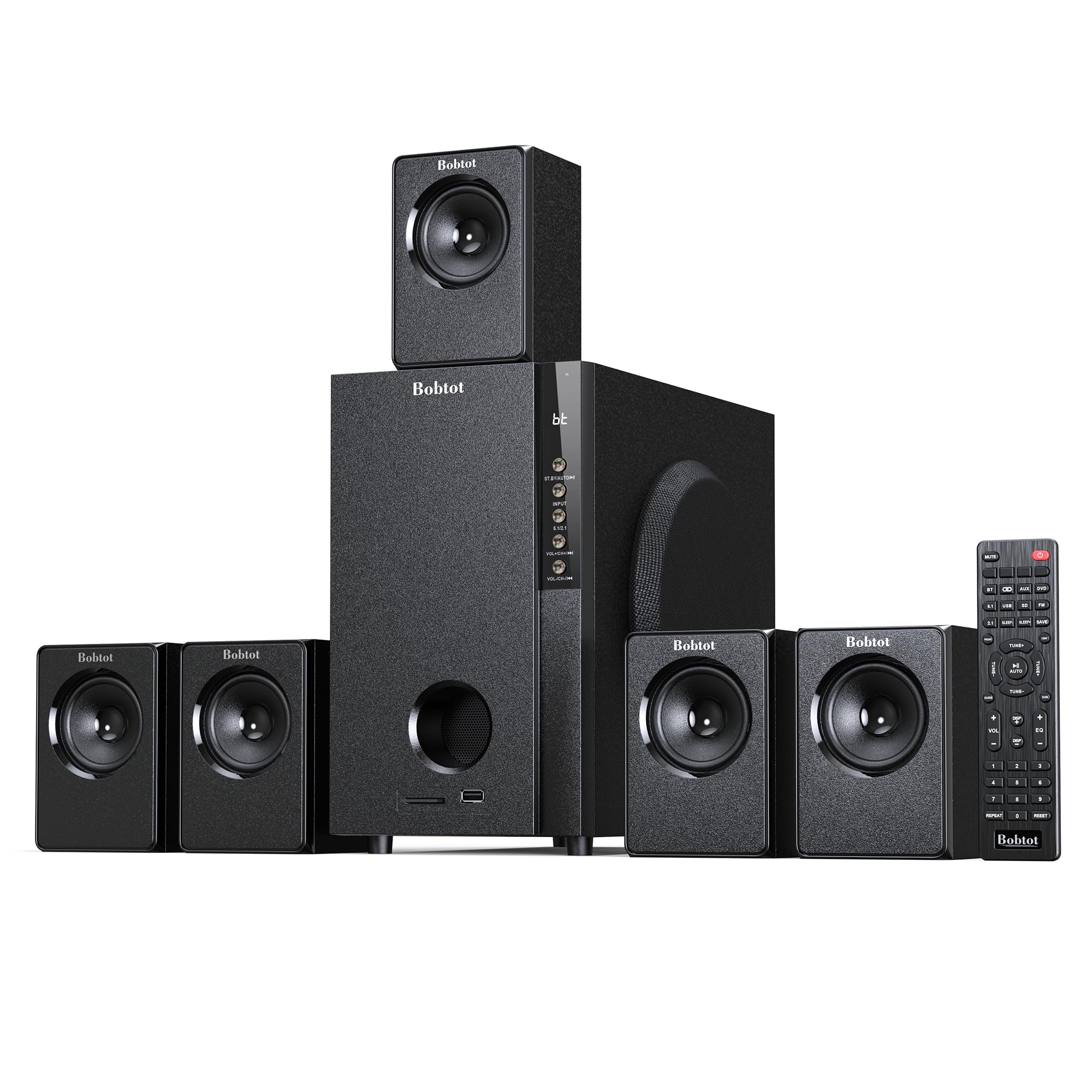
Compact is the whole point of the Bobtot A55. It runs a 5.1 layout with a 5.25-inch subwoofer that houses the built-in receiver, so there is no separate amplifier box eating shelf space. Two front speakers, two rear speakers, and a center sit around the subwoofer, wired back to the main unit for a signal that never drops. Peak power is 600 watts. The system also carries a 360-degree design that sends sound out from every angle, and the maker suggests tucking the subwoofer into a corner where walls naturally boost low frequencies.
You can switch between 5.1 and 2.1 mode on the remote, which is a nice a neat extra for music nights when you want the rears quiet and the bass up. Each speaker — including the subwoofer — has its own volume control on the remote, so a dialogue-heavy movie can have the center pushed up without touching the fronts. Connectivity covers Bluetooth 5.0, AUX, RCA, USB, and SD card, plus an FM receiver with decent reception. Six EQ curves (Rock, Pop, Classic, Jazz, Country) round out the tuning options under USB or SD playback.
The honest caveat: the Bobtot does not support DTS decoding or Dolby Audio and Atmos at all, so check your sources before buying. And the small satellite speakers can sound thin at low volume — a couple of owners mention the treble can feel like a small box projecting sound. But once broken in and tuned with the individual volume controls, several customers note that the wired connection delivers clean sound across all five speakers, with two units bought and both performing. Ease of setup is what most owners actually cite as the reason they kept it.
The standout: a 5.25-inch subwoofer with the receiver already inside, and wired satellite connections for a stable signal in a room that cannot fit a receiver.
How to plan around it: if you want the small speakers to sound bigger, position the sub in a corner, and expect to be running through the setup wizard before the bass clicks in. No DTS or Dolby support is the ceiling here.
Good fit if: you have a tight den or bedroom and want 5.1 without adding a component receiver.
skip it if: Dolby or DTS content is a big part of your library, because this system will not decode either.
6. Pyle Home Stereo Receiver PDA77BU

Dual mic jacks, 800 watts max and Bluetooth that reaches across the house.
The Pyle PDA77BU is the amplifier for the host — the person who wants a karaoke night, a garage party, or a house-wide music stream running from one box. It is rated at 800 watts max, the largest peak figure in this list, and drives up to four channels so four separate speaker zones can live on one unit without extra amps. Bluetooth 5.0 streaming holds past 30 feet, which is why one buyer reports covering a whole house instead of just the living room.
Two 1/4-inch microphone jacks sit on the front with independent volume, echo, reverb, and delay controls, so singing over a track sounds processed rather than raw. Inputs cover USB and SD cards, FM radio, and an AUX, RCA, and 3.5mm line-in trio that accepts just about anything you can plug in — gaming consoles, DVD players, and laptops included. The front panel keeps everything tactile with dedicated knobs and a digital LED display rather than burying settings in nested menus, which is why owners describe the controls as plain and easy to read.
Reviewers point out powering ceiling speakers and four garage cabinets off this single receiver, which is a real-world test of the 800-watt rating, and the build quality gets approving notes for its price. The caveats sit around consistency: a handful of buyers have had a unit fail early — one with a burning smell — while another reports having zero issues running the same amp after years. Bluetooth 5.0 also predates the newer versions found on the systems further up this list, so slight audio latency on live video is possible. Use it for audio first and it serves well.
What buyers keep praising: the simplicity of the front-panel controls — knobs and a display you can read at a glance, not menus nested three screens deep. The delay and reverb on the mics land as genuinely usable, not decorative.
The quality question: powering four zones off one 800-watt box means it works hard, and the reliability record is mixed. Buy from Pyle’s warranty and you are covered.
For you if: you want a karaoke night with proper reverb and a receiver that can wire four zones across a house or garage.
Not for you if: you need the newest Bluetooth version or a receiver you can trust to run for years without flakes.
7. DOSS SoundBox Ultra Bluetooth Speaker

Desktop-sized speaker with a 40W subwoofer and up to 18 hours per charge.
The DOSS SoundBox Ultra is the one you reach for when you want a single speaker you can carry to a different room. It runs a 2.1 channel layout at 80W total — a 40W subwoofer and two 20W inner magnet drivers — and wraps all that in a metal body with faux wood grain on the sides, which gives it a look that fits a bookshelf, a kitchen counter, or a nightstand. Its real draw is the extended playtime: up to 18 hours per charge from a 4500 mAh battery, with a 4.4-hour charge cycle and Bluetooth 5.3 for a stable wireless link.
Two DSP processors inside fine-tune the audio to squeeze the maximum clarity out of the cabinet, and bass reflex ducts at the back manage airflow so the low end stays tight rather than muddy. Pair two SoundBox Ultra units and they work as a stereo pair for a wider stereo image — the speaker fills a corner with punchy bass once that pairing is up. Multiple playback paths include Bluetooth 5.3, 3.5mm aux-in, USB flash drive, and TF card, so it streams from a phone, a laptop, or a memory card with a pile of albums on it.
What owners praise most is the sound quality — clear vocals, lively highs, and enough bass for a small room without the cabinet feeling strained. Where the SoundBox Ultra shows its age is battery consistency and volume headroom: some shoppers say that the battery drains slightly even when idle and prefer to leave it plugged in, and a handful report units that needed a warranty replacement. An occasional buyer notes the volume can feel low against their expectations at higher levels. On the plus side, DOSS support swapped replacements without drama, and the wired aux connection sounds noticeably better to owners than Bluetooth does.
What delivers
- 80W total output from a 40W sub and two 20W drivers
- Up to 18 hours of playtime from a 4500 mAh battery
- Bluetooth 5.3 with aux-in, USB, and TF card options
- Pair two units for stereo and get punchy room-filling bass
- Metal body with faux wood grain — looks good on a shelf
What to plan for
- Battery can lose charge while idle if left off the charger
- Volume at high levels can feel less punchy than the spec implies
- Occasional units need warranty replacement — support is responsive though
Built for: the buyer who wants real bass without taking up a tabletop’s worth of space, and does not want to run any cable for music.
Where it stops short: if you need the speaker to run for a full week on one charge without ever reaching for the cable, the idle drain makes that hard.
8. ULTIMEA Poseidon M60 Sound Bar System

The real Dolby Atmos system — five speakers, a wired sub and no rear pair needed.
The ULTIMEA Poseidon M60 is the answer for a room that cannot take a rear speaker pair but still wants a true surround feel. It builds a 5.1-channel Dolby Atmos layout entirely from the bar itself — five built-in speakers including two side-firing drivers that bounce sound off the walls, and a 5.1 configuration that runs without any speakers behind you. The DSP chip keeps latency under 0.5 milliseconds, which is how it keeps lip-sync tight on fast dialogue. HDMI eARC carries up to 37 Mbps of bandwidth, and full CEC integration means the TV remote controls the bar with no extra remote sloshing around in the cushions.
VoiceMX technology isolates dialogue frequencies in real time, so speech stays separated from music and effects even during explosions. The power figure is 300W of peak output from five full-range drivers plus a wired wooden subwoofer running BassMX, with a rated frequency response of 45 Hz to 18 kHz and a max SPL of 99 dB. The 18 mm high-excursion subwoofer driver inside a 5.3-liter tuned cabinet moves more air than the small sub on the Bobtot kit further down this list, and that shows up as bass that actually supports a low-frequency effect rather than buzzing flat.
What owners keep praising is the dialogue clarity — VoiceMX does the heavy lifting on whisper-quiet scenes and intense action alike, and the Bluetooth 5.4 connection syncs fast and stays stable. The app open up a 10-band EQ, 121 sound presets, and 13 adjustable surround levels, which is a deeper tuning layer than almost anything else in this price range. Where the Poseidon M60 shows a limit is in real-world Atmos height: without ceiling speakers, the height effect is virtual and several buyers report it does not transform a room the way a full-ceiling Dolby Atmos setup would. The included RCA subwoofer cable also runs short for larger living rooms. A handful of units had port issues on first arrival, but ULTIMEA responded by shipping upgrades and one buyer stayed on the platform to give five stars for the service.
Where it beats the alternatives: the app control gives you real 10-band EQ and 121 presets — a huge step up from a simple bass/treble knob. For the price, it is the only pick in this group that carries the Dolby Atmos label.
One honest catch: Atmos height effects work by virtualizing the ceiling rather than having real height speakers, so the experience tops out below a dedicated Atmos receiver setup. A handful of early units also had port reliability issues.
The buyer this fits: someone who wants the Atmos logo, real dialogue clarity, and deep app control without the rear speakers a traditional surround kit demands.
Where it is not enough: if your room can accommodate true rear speakers behind the couch, the physical surround kits higher up this list will feel bigger scene-to-scene.
9. LG S40TR Home Theater Soundbar

LG’s 4.1 bar with wireless rear speakers — a surround system that fits any room shape.
The LG S40TR is the crown of this list, and it does the thing a single soundbar cannot: it puts a dedicated speaker behind each side of your couch. Four channels run through a wireless subwoofer and a pair of rear surrounds, so the soundstage wraps rather than projecting forward from a shelf. Dolby Digital and DTS Digital are supported, and the Clear Voice Plus processing pulls dialogue out of movie mixes so you stop reaching for subtitles. The reed-style metal grill across the bar keeps dust off the drivers and gives it a clean look on a media console.
Where the S40TR pulls ahead is integration — the WOW Orchestra feature plays through your LG TV’s speakers and the soundbar at the same time for a fuller front stage, and the WOW Interface lets one remote control both the bar and the TV, including sound mode selection on screen. The Smart Up-Mixer converts 2-channel audio into a multi-channel experience, so even a stereo source spreads across the room. The LG Soundbar App adds a 3-band EQ for bass, treble, and mid-range, wireless connectivity means no receiver is needed for the rear pair, and HDMI ARC lets the TV remote handle volume and power. A small cable still runs between the two rear speakers, so they are not truly wireless to each other — plan for one run behind the couch.
Owners describe the upgrade over built-in TV speakers as immediate and obvious — suddenly clear voices and the rumble of a subwoofer underneath every scene. For rooms of all shapes and sizes this is the balance, and Cinema mode is the setting most buyers settle on since it boost rear-speaker presence. Two things to know before buying: Bluetooth audio can sound thin compared to HDMI ARC, which delivers noticeably stronger surround in practice, and occasional owners mention the rear speakers dropping connection when they change channels. Both are fixable — use HDMI ARC and enable the rear speakers in the LG App after a Bluetooth pairing — but plan the setup day around it.
Why it earns the top-tier spot
- True 4.1 surround with real wireless rear speakers and a wireless subwoofer
- Dolby Digital and DTS Digital decoding for movie-accurate sound
- Clear Voice Plus improves dialogue for shows and movies
- WOW Orchestra plays TV and soundbar speakers together for a fuller stage
- LG Soundbar App adds a 3-band EQ for bass, treble, and mid-range
What you should know
- Rear speakers are wireless to the bar but joined to each other by a small cable
- Bluetooth connection can sound weak — HDMI ARC is the mode to use
- Some customers note losing rear-speaker connection when switching channels
For most buyers: a room of any shape gets a genuine surround field with real speakers behind the couch, and the LG App makes fine tuning easy.
Skip this pick if: you will not run the single HDMI ARC cable or the short wire between the two rear speakers, because neither the surround effect nor the volume control works well over Bluetooth alone.
Know the Specs
Channels and Speaker Count
Read a “5.1” label as five surround speakers plus one subwoofer — front left, front right, center, and two rears, with dedicated low-frequency from the sub. A “5.1.2” adds two height drivers, usually upward-firing speakers that reflect sound off the ceiling to give a sense of overhead audio. The LG S40TR is a 4.1 system, which is four speakers plus a subwoofer — a simpler kit that still puts sound behind you. More channels usually means more hardware and a bigger footprint, so match the channel count to what your room will actually support.
Connectivity and Signal Stability
HDMI eARC carries the most audio data and lets one cable handle TV-to-system plus remote control through CEC — prefer it when your TV has the port. Optical is a reliable fallback with solid quality and no network to rely on. Bluetooth is the easiest but has the least stable signal under load — expect occasional drops and slight lip-sync offset on live video. A hybrid design, like the Wooden N512’s rear speakers that link wirelessly to the bar but to each other by cable, is a workaround that gets you most of the wireless convenience without the reliability cost of a pure wireless setup.
Common Questions
Do I need a receiver to use one of these budget sound systems?
What is the difference between 5.1 and 5.1.2 surround?
Will a system without Dolby Atmos support still sound good on modern movies?
How long does the battery last on a portable option like the DOSS SoundBox Ultra?
Should I use HDMI ARC or Optical to connect my soundbar to the TV?
Can I add rear speakers to a system that onlyships as a soundbar?
Is a 6.25-inch subwoofer better than a 5.25-inch one for a small living room?
Can I use the Donner MAMP2 or Pyle PDA77BU with speakers I already own?
Why do some rear speakers connect wirelessly but still have a cable between them?
How much power do I actually need for a small bedroom system?
The Bottom Line
For most rooms, the budget sound system winner is the Wooden 5.1.2 Virtual Surround Sound System because it pairs 11 metal drivers and solid wood cabinets with a 5.25-inch down-firing subwoofer and adds two upward-firing height speakers that no straight soundbar can match — and it typically sits right alongside the mid-tier options that beat it on paper. If Dolby Atmos is the feature you will not give up, the ULTIMEA Poseidon M60 delivers real Atmos decoding with HDMI eARC in a setup you can finish in minutes. And for a room of any shape that needs a real speaker behind the couch, the LG S40TR is the one to reach for. Match the pick to your room’s wall space and couch position, not the box art.
How we choose
We do not accept paid placement. Every pick is matched to a real buyer and a real use-case; we do not hands-on test units.
Sources
Specifications: manufacturer listings and product documentation. Review insights: verified customer reviews, as of October 2026. Pricing: not shown on this page (it changes often); check the current price via the retailer link.
As an Amazon Associate, Aappliancez earns from qualifying purchases. This does not affect which products we feature.