Disclosure: Some links in this post are affiliate links. As an Amazon Associate I earn from qualifying purchases, at no extra cost to you. Learn more
Specs are compiled from manufacturer listings and verified buyer reviews and can change over time — please confirm the key details on the product page before buying.
You want drop bars, tires that swallow a dirt road, and a frame that does not rattle your fillings — without paying boutique money. The good news is that entry-level gravel bikes now ship with disc brakes, 40mm tires, and frames that hold up on real fire roads. Aluminum frames with steel or carbon forks, disc brakes, and 40mm tires now cover the same fire roads the expensive bikes do. What you are really choosing between is frame material, gearing range, and how much fettling you are willing to do on day one. Every pick below is backed by verified owner reviews, and each one wins for a specific kind of rider.
This guide is built by comparing the manufacturers’ published specifications and the patterns across verified customer reviews, so you get each pick’s real strengths and trade-offs instead of marketing spin.
Gravel means different things to different riders, so start with the surface you actually ride. If your rides are 60% pavement and 40% hardpack, a road-leaning 700c frame with narrower tread will feel far quicker. Below you will find the budget gravel bikes that get the fundamentals right without asking you to remortgage.
Top Picks


How To Choose The Best Budget Gravel Bikes
Buying cheap in this category is not about accepting fewer features. It is about finding the bike whose compromises land where you can live with them. The frame and fork are what you cannot change later, so spend your attention there. Components like tires, saddles, and brake pads are consumables — plan to swap them and budget your expectations accordingly.
Tire clearance is the whole ballgame
A gravel bike with no room for a wider tire is a road bike with a gravel sticker. Check the stated tire width the frame accepts before anything else. A 40mm tire (the knobby width, measured across the casing) soaks up washboard and loose gravel that a 25mm road slick simply skates over. The bikes here run 40mm as a baseline, and several accept more. On loose-over-hardpack or chunky fire roads, wider rubber at lower pressure is genuinely better.
Frame material versus fork material
Aluminum frames are the budget standard because they are cheap to make and stiff — meaning they transfer your pedal power efficiently but also transfer every pebble. A carbon fork (a carbon-fiber front fork, which flexes slightly under load) softens that buzz at the handlebars without adding meaningful weight. A steel fork does a similar job with more weight but a more forgiving, damped feel. Either is a real upgrade over an aluminum fork on rough ground.
Count your gears before you count your savings
Gearing range decides whether a loaded climb is steady work or a walk. A 2×7 setup gives you 14 gears from a double chainring up front and a 7-speed cassette at the back. A 3×8 gives you 24 gears with a triple chainring — the extra small ring is what saves your legs on a steep ramp with panniers. The 1×7 is a single chainring and 7 cogs: simpler and less to go wrong, but with a narrower range. Pick the range that matches the hills you actually ride.
Dropper posts, mounts, and the things you notice on day two
Mounts seem boring until you want to carry water, a frame bag, or a rack. Bottle cage mounts on the frame and fork give you hydration without a backpack. Rack and fender eyelets turn a weekend toy into a commuter. Look at the mount count on the frame you are considering, because drilling them later is not an option.
Side-by-Side Comparison
| Model | Best For | Frame / Fork | Drivetrain | Brakes | Amazon |
|---|---|---|---|---|---|
| Mongoose Elroy Adventure Bike★ Best Overall | Loaded touring and bikepacking on a tight budget | Aluminum / Steel | 2×7, Shimano Tourney | Mechanical disc | Amazon |
| Mongoose Dolomite Fat TireCrowd Favorite | Snow, sand, and loose terrain on a budget | Alloy steel / — | 1×7, twist grip | Mechanical disc | Amazon |
| Schwinn Phocus 1.6 DiscPavement Pick | Fast pavement-biased gravel and commuting | Aluminum / Carbon | 16-speed, Shimano | Promax caliper | Amazon |
| Tommaso Sentiero | First gravel bike with a shop-tuned setup | Aluminum / Steel | 24 (3×8), Shimano Claris | Mechanical disc | Amazon |
| Tommaso Sterrata | All-terrain riding with a carbon fork | Aluminum / Carbon | 24 (3×8), Shimano Claris | Mechanical disc | Amazon |
| SAVADECK Carbon Disc Road Bike | Lightweight pavement speed on a carbon frame | Carbon fiber / Carbon | 18-speed, Shimano SORA R3000 | Disc | Amazon |
| SAVADECK Carbon Gravel (U6000) | Mixed-surface adventure with hydraulic stopping | Carbon fiber / Carbon | 11-speed, Shimano U6000 | Hydraulic disc | Amazon |
| SAVADECK Carbon Gravel (GRX400) | Serious gravel riders who want a proven groupset | Carbon fiber / Carbon | 20-speed, Shimano GRX400 | Hydraulic disc | Amazon |
Detailed Reviews
1. Mongoose Men’s Elroy Adventure Bike 700C, 54cm
A near-48-pound adventure frame with more bottle mounts than most riders have bottles.
The reason this bike tops the list is not a single headline number — it is the sheer number of places you can bolt something onto it. Mongoose builds the Elroy with an aluminum frame and a steel fork, a combination that keeps the cost down and takes the edge off a rough surface. You get an integrated frame bag with an embroidered patch, a large front rack that carries two panniers and even hides a bottle opener, and a rear rack mount for more. The internal cable routing frees up room for 3 distinct water bottle cage mounts on the frame, plus 2 more on the fork. If your gravel rides involve camping gear or a week of groceries, that layout is the whole reason to buy it.
You get 14 gears to work with: a 2×7 drivetrain (two chainrings up front and a 7-speed cassette behind) running Shimano Tourney derailleurs, with the shifter and brake lever built into one Microshift unit. The Schwinn Phocus 1.6 Disc gives you 16 speeds to the Elroy’s 14 — a 2.3x gap on paper. You will feel a little of that on a steep ramp with a loaded rear rack. For most gravel, 14 well-spaced gears are plenty. Owners who tour with panniers report the low gears ease the climbs and the taller ones still bite on the descents. Mechanical disc brakes handle stopping. The tires are the weak point, so swap them early: a basic 40mm tire ships stock, and a set of 45c or wider rubber is the cheapest upgrade you can make to this frame.
The honest catch is consistency. Mongoose gets the frame right and the finishing touch less so. The ride is heavy — heavier than a road-leaning competitor like the Schwinn Phocus — and it arrives needing real fettling. The brakes in particular are the recurring gripe: they need a shop’s attention from the start before you trust them on a descent. The shifting also divides opinion, smooth for some and finicky for others. None of this is fatal on a bike this capable for the money, but it does mean you should factor in a tune-up at your local shop. What wins people over is the sheer capability — a frame that fits 45c+ tires, real mounts, and a front rack, on a bike that has no direct rival with this kit for the money.
What Earns Its Place
- 3 frame bottle mounts plus 2 fork mounts — hydration without a backpack
- Front rack carries two panniers and includes a bottle opener
- Internal cable routing keeps the frame clean and cables protected
- Aluminum frame with a steel fork for a damped, cost-effective ride
What You Should Know
- Heavy enough that climbing out of the saddle feels like effort
- Brakes need a shop check and adjustment from the start
- Stock 40mm tires are the first thing most owners replace
Built for: riders who want a loaded adventure platform with rack mounts and bottle capacity from day one, not a race bike.
Plan on: a post-delivery tune-up for the brakes and a fresh set of tires — budget both into the purchase.
2. Mongoose Dolomite Fat Tire Mens Mountain Bike
Supersized knobby tires that turn a snowed-in weekend into a ride instead of a rest day.
This is the odd one out on a gravel list, and it earns the slot anyway. The Dolomite is built for mountain terrain with a steel frame, 26-inch wheels, and supersized knobby tires. Fit range is 5’4″ to 6′ tall, with a threadless headset that takes some of the flex out of the front end. Gearing is a 1×7 — a single chainring and a 7-speed cassette — with a twist-grip shifter. Compare that to the 2×7 on the Elroy above: 7 gears versus 14, exactly half the range. That sounds limiting, and on a steep climb it is. What compensates is the flotation. As owners put it, “At 8psi in 3\” snow, rode easily—no slipping, gears sufficient, brakes fine.” Drop the pressure way down and these fat tires stay on top of loose ground instead of digging in.
What wins people over here is raw performance across 614 of the reviews, with value right behind it — this is a sturdy bike that handles a heavy rider without complaint. Alloy rims keep some of the bulk down, mechanical disc brakes sit front and rear, and beach cruiser pedals come standard. It ships 80% assembled and most people report getting it rideable in about 30 minutes. The trade-off is weight and brakes. Fat tires and a steel frame mean a heavy bike, and the disc brakes divide owners — adequate for most, but a few find them soft enough to plan a brake upgrade. The smaller-size cockpit also draws complaints, with grips and saddle swapped out early by many riders. If you want a single bike that works on snow, sand, and fire road, this is the budget answer.
Where the weight goes: 26-inch fat tires and an alloy steel frame trade speed for flotation and durability — the point of this bike is grip, not pace.
The honest read: brake feel is the most-discussed weak spot, so price a set of better pads or calipers into your plan if you ride hilly ground.
Reach for this if: your riding includes snow, sand, mud, or loose dirt and you would rather have float than fast.
The single caveat: it is heavy and the brakes feel soft — if you want a paved-road mile-eater, look upward in this list instead.
3. Schwinn Phocus 1.6 Disc Road Bike, 700c
A carbon fork and 16 speeds for riders whose gravel is mostly packed dirt between tarmac.
The Phocus feels fastest on this list for one reason: it is built for paved roads. An aluminum road frame pairs with a carbon fiber fork, and 700c wheels fit riders from 5’4″ to 6’2″. Its 16 speeds run through Shimano derailleurs and an integrated Microshift shifter and brake lever combo. That is 16 against the Elroy’s 14 — a 2.3x gap nobody notices on flat ground but everybody notices on a climb with weight aboard. The carbon fork earns its keep on chip-seal and washboard, flexing slightly to take the sting out of the handlebars. One owner near 194 lbs reports it holds up really well and shifts smoothly, front and rear. For commuting and mixed pavement, that combination is hard to argue with.
What the owner community raves about is build quality above all, then value. There is a long-term commuter report of 7 years and 15k-plus miles with only wear parts — pedals, seat, chain, cassette — replaced, which tells you the frame is not the weak link. High-profile alloy double-wall rims with paired spokes stay true and light, front quick release makes wheel removal easy, and an alloy crank gives a broad gear range. The road-style tread tires roll fast and smooth. Where it struggles is gravel proper: with narrower road tread and caliper brakes, loose surfaces are not the Phocus’s home ground. If your “gravel” means hardpack rail trails and farm roads, you are fine. If it means chunky rock, look elsewhere.
The recurring gripe here is adjustment, not breakage. Gear shifting divides owners — smooth for many, needing heavy derailleur tuning for others from the start. Brake quality is another fork in opinion, with most happy and a few swapping pads or calipers within a month. Assembly is straightforward, though the smart move is to have a shop check the derailleurs after you build it. The frame geometry is road-biased, which means a slightly more forward position than the upright bikes here — comfortable for fitness riders, less so for someone who wants to sit tall and sightsee.
Why it punches above its price: a carbon fork, aluminum frame, and 16-speed Shimano drivetrain is a lot of bike, and buyers report it standing up to years of hard commuting.
Know before you buy: caliper brakes and road-tread tires cap its gravel ability — great on hardpack and pavement, out of its depth on loose rock.
Choose it for: fast pavement commuting with occasional hardpack, and you want the lightest-feeling ride on this list.
Look elsewhere if: your rides regularly turn off into loose gravel or mud — the road tires and caliper brakes will hold you back.
4. Tommaso Sentiero Sport Performance Aluminum Gravel Bike

The 3×8 drivetrain that drags panniers up a hill without making you stand up.
Three chainrings up front is an old-school answer to a very modern problem: climbing with gear on the bike. The Sentiero runs a 24-speed Shimano Claris setup, a 3×8 triple chainring with 8 cogs at the back. That triple gives you a genuinely tiny granny ring for the steep ramp, while still keeping a workable top gear on the flat. Tire width is 40mm with 700c wheels, and a steel fork smooths the front end at the cost of a little weight. It rolls on mechanical disc brakes and comes with pedals included. For a first gravel bike that has to do double duty as a commute, this is the gearing layout that keeps you out of the car on a bad day.
Ride quality and bike quality are what the owner consensus circles back to, and the fit-and-finish gets noticed — one rider calls it “top-notch” and says a professional shop setup was worth the money. Owners are riding it, not just looking at it: a 5’6″ rider loves the smooth ride and wishes she had ordered the next size down, so size honestly matters here. The most valuable advice from the community is universal on this bike — pay for a shop assembly. A pre-tuned bike from a local shop catches the things a boxed bike misses, and in this price range the mechanic’s eye is worth the fee.
Where the Sentiero asks patience is weight and the occasional rough-out-of-box unit. It comes with a steel fork and a heavier build than carbon competitors, so it is not a featherweight. A few owners mention production misses — one rider received a bike with stripped pedal threads and a warped rotor disk, requiring replacement parts and a return. That happens across the whole budget category, but it is the one thing that would send you back to the seller. Size down if you are between sizes, and get the bike assembled by a shop so any issue is caught before your first ride.
The spec that earns its keep: 24 speeds from a 3×8 Claris system — the triple ring is what makes loaded climbing possible at this level.
Worth knowing: a steel fork adds weight, and occasional shipping defects mean a shop check after delivery is genuinely worth it.
Best for: new gravel riders who want a wide gear range and a shop-tuned start.
Think twice if: you insist on light weight and hate the idea of a post-delivery mechanic visit.
5. Tommaso Sterrata Aluminum Gravel Bike

The Sentiero’s geometry, upgraded with a carbon fork that damps the chatter.
Take the 24-speed Shimano Claris drivetrain and 40mm tires from the Sentiero, swap the steel fork for carbon, and you have the Sterrata. That single change is the reason to step up: a carbon fork (a carbon-fiber front fork that flexes under load) takes the vibration out of washboard without adding weight. Owners notice, and a rider who has spent years on bikes costing several times as much calls the ride “smooth, solid, quiet, responsive” and says assembly took under an hour. Wheels are 700c, brakes are mechanical discs, and you get an upright frame across three sizes. The full Shimano drivetrain, not just the shifters, is what separates this from cheaper hybrids — every gear component comes from the same system.
Build quality is what the owner consensus returns to, and the looks get a mention of their own — the matte black and gold finish draws comments at the shop and on the road. A rider who clocked roughly 1,000 miles reports no stock parts replaced and everything performing well. The triple chainring makes it a hill-climber with panniers, which is the point of gravel gearing. Full setup is partial from the start — front wheel, disc brake, and bars need fitting — and a shop assembly is the recurring recommendation from owners who ride it hard.
The honest catch combines manufacturing consistency and brake feel. Some units arrive needing real adjustment, and the mechanical disc brakes are widely described as only around half-effective without a tune. The shifters are the other soft spot, with some owners reporting they need work from the start. A few riders also find the seatpost long for shorter statures, with one 5’3″ owner having to cut it down. Treat the Sterrata as a bike that rewards a good mechanic and a little patience, and it will reward you back on every gravel ride.
What Makes It Worth the Step Up
- Carbon fork soaks up road buzz the steel version cannot match
- Full Shimano Claris 24-speed drivetrain with a triple ring for hills
- 700c wheels and 40mm tires — real gravel footprint from the start
- Customers note the frame looking and riding like a more expensive bike
The Friction Points
- Mechanical disc brakes often need shop adjustment to feel strong
- Shifters receive mixed feedback on out-of-box smoothness
- Seatpost runs long for shorter riders and may need trimming
The rider who loves this: someone who wants the comfort of a carbon fork on a budget frame and is willing to get it dialed in by a pro.
The trade-off: mechanical brakes and shifter tuning demand attention — not a bike you unbox and ride hard without a check.
6. SAVADECK Carbon Disc Road Bike, Shimano SORA R3000
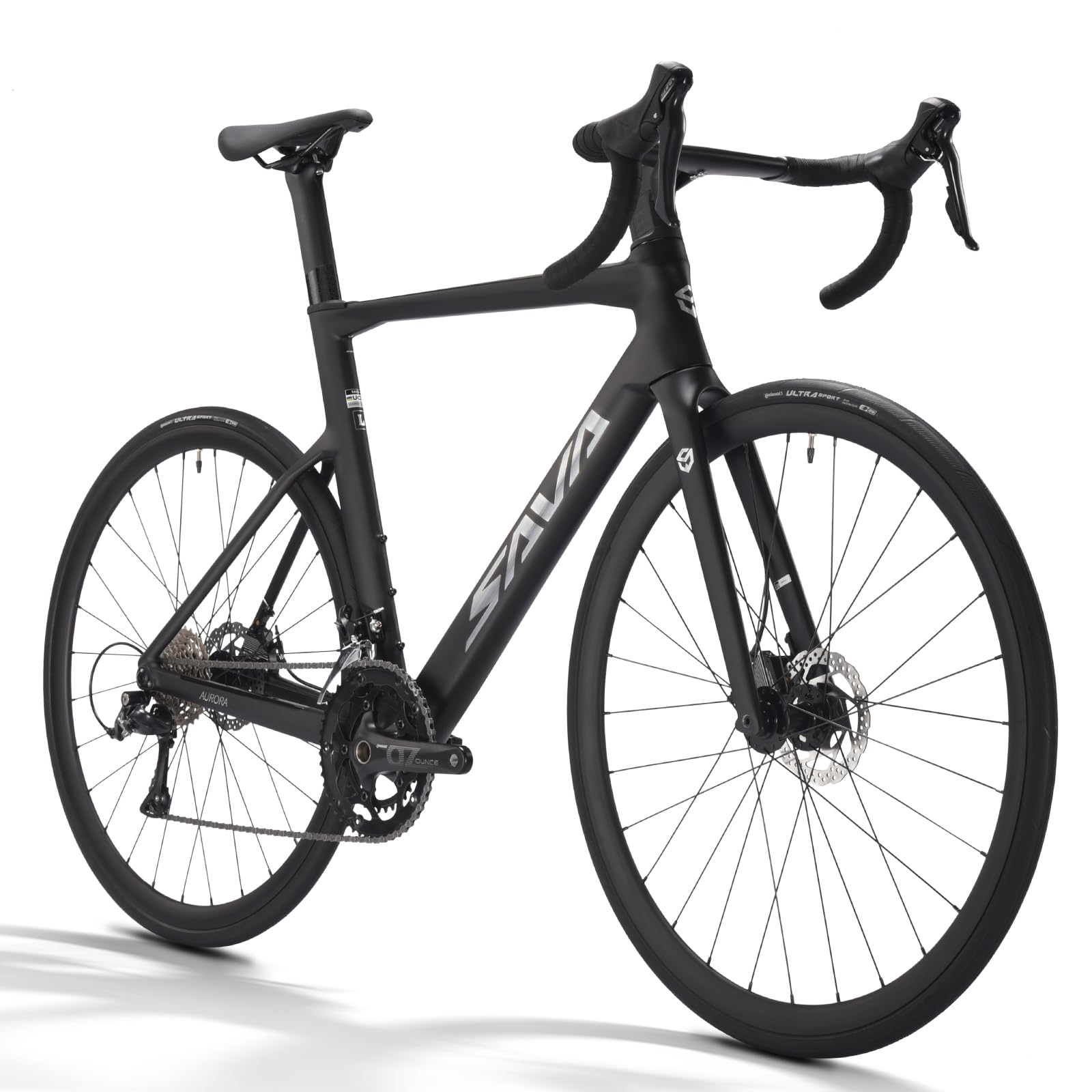
A full carbon frame at 9.6kg (21.1lb) that makes pavement feel shorter.
Here is a number that changes the equation: 9.6kg (21.1lb). That is the complete bike weight, and it is a full carbon build — frame, fork, rims, and seat post all in TORAY T800 carbon fiber. Compared with the aluminum-and-steel budget bikes above, the weight difference is the whole selling point: it climbs and accelerates with an ease those frames simply cannot match on pavement. The frame also runs full internal cable routing, a design that tucks every cable inside for clean airflow and a tidier look, with a tapered head tube stiffening the front end for sharper handling. Continental 700x25C tires come fitted, and the Shimano SORA R3000 18-speed system handles the shifting with SORA lever, front derailleur, and rear derailleur. Disc brakes front and rear pull both sides evenly for a linear, confident stop.
Owners talk about weight first, then looks — a rider on their second SAVADECK calls it simply “Light, fast and beauty.” Speed and smooth operation come up again and again, and one engineer-type owner rates the craftsmanship alongside bikes costing several times the money. Setup is another bright spot: a rider reports being out on the road in under 20 minutes, and the company reaches out before shipping to confirm the right size. For recreational road riding on paved trails, that is a near-frictionless start.
Two things keep this from being the pick for every rider. First, this is a road bike — 25C Continental tires and no gravel-lugged tread mean loose surfaces are not its territory, so if your rides go off pavement, look to the SAVADECK gravel models instead. Second, the integrated handlebar position runs low for some riders, with one 67-year-old who rides 100 miles a week on paved trails describing the bars as feeling low and needing tweaks. If you are a fitness rider who lives on pavement and wants the lightest bike in the room, this is your build.
The headline spec: T800 carbon throughout at 9.6kg (21.1lb) — the lightest complete bike on this list, and you feel every gram saved on a climb.
Know the limit: 700x25C Continental tires are a road choice, so mixed-surface riding calls for a different bike.
Pick it when: pavement is your playground and you want carbon performance without the boutique markup.
The honest limit: narrow road tires and low bars mean this is not the bike for loose gravel or riders who want to sit tall.
7. SAVADECK Carbon Gravel Bike, Shimano U6000, Hydraulic Disc

Forty-five spokes and 40mm rubber make this the bike that stops worrying about the surface.
The spec that jumps out is the wheelset: 45-spoke rims paired with 700x40c all-terrain tires, which the manufacturer says gives 45% improved traction over standard gravel tires. That is a maker claim, but the physical point stands — heavy-spoke wheels and wide rubber flex over chunk rather than skittering. The frame and fork are T800 R21 carbon, the complete bike weighing in at 10.4kg (22.92 lbs), and Shimano’s U6000 11-speed groupset handles shifting via U6000 shifters, U6000 rear derailleur, LG400 cassette, and CN-LG500 chain. Stopping is fully hydraulic, with internal cable routing protecting the lines and keeping the frame aerodynamic. It arrives 90% pre-assembled with tools included, so the first ride comes fast.
Owners consistently describe the ride as light and fast — one review says the bike “arrived fully assembled” and handles road and gravel nicely, while drawing the line at rough mountain-bike trails. Sizing was a bright spot, with buyers reporting the sales team proactively confirming the correct frame size before shipping. The upright frame geometry and tapered head tube are aimed at stability over long distances, which pairs well with gravel’s more relaxed posture than a road race position.
One caveat deserves the spotlight: the smallest size. A rider on the 47cm frame reports serious toe overlap, with pedals too close to the front tire to steer and pedal at the same time. That is a known geometry issue on compact frames generally, but it is worth taking seriously — if you fall into the smallest size, consider a larger frame or a different model. Color also surprises people; the frame reads more off-white than pure white, so wait to see the actual finish before buying matching accessories. Apart from that, this is a strong all-rounder that handles mixed surfaces with confidence.
Why It Handles Everything
- 45-spoke 700x40c wheels built for rough ground, not just smooth gravel
- Full hydraulic disc brakes for reliable stopping in wet or loose conditions
- Internal cable routing protects lines and keeps the frame sleek
- Arrives 90% pre-assembled, so it is rideable quickly
What to Watch
- The 47cm smallest size has reported toe overlap — check if you are short
- Frame color reads more off-white than white — see it before accessorizing
This one is for: riders who want a carbon gravel platform with hydraulic braking and a wheelset built for chunk.
Do check first: if you ride the smallest frame size, the toe overlap is a real concern — size up or test one.
8. SAVADECK Carbon Gravel Bike, Shimano GRX400, 20-Speed

The only pick here with Shimano’s gravel-specific GRX groupset, and it shows.
GRX is Shimano’s dedicated gravel line, and the difference is in the lever ergonomics and the cage tension — this is a 20-speed system built for dirt, not adapted from road. The frame and fork are T800 R21 carbon at a total 10.4kg (22.92 lbs), the bike runs Shimano’s RX400 hydraulic disc brakes, and an RX600 crankset transfers power quietly and efficiently. Tires are 700x40c on 45-spoke rims, matching its stablemate below it on this list. Full internal cable routing and a tapered head tube round out the frame spec. If you plan to race gravel or ride a lot of rough, high-speed descents, the GRX shifters are the reason to spend up.
Ride quality is what the owner consensus names first, with weight a close second and assembly also praised — one owner says all necessary tools were included with the bike. A rider who put over 100 miles on it reports it performed flawlessly with a 20-minute setup, and a 40-year cyclist in the family gave it rare reviews. Another notes the frame and fork share lineage with a major brand’s bike and says it is exceptional value. The ride itself is comfortable and stable, with smooth shifting from the start on the GRX groupset.
The honest friction point here is shipping and documentation, not the bike. One owner had a long-delivery issue with limited tracking, which made planning awkward. Another reports assembly is easy, but the bike arrived with no written instructions — you rely on a hidden Allen bolt under the headset cap that you have to know is there. A minor rear-derailleur misadjustment caused a chain tangle on one bike, easily corrected. If you are comfortable tinkering, this bike is a serious gravel machine. If you are not, plan the shop visit.
what separates it: a genuine Shimano GRX400 groupset — shifters, RX400 front and rear derailleurs, RX600 crankset — is genuinely rare when you are working with a tight budget.
What to prepare for: no written assembly guide and occasional shipping delays — set aside an hour with a mechanic you trust.
Reach for this if: rough gravel, racing, and technical descents are on your calendar and you want the best shifter ergonomics on the list.
The catch: sparse documentation and shipping variability mean you should be ready for a shop check rather than a plug-and-play unboxing.
Know the Specs
Drivetrain Numbers (2×7, 3×8, 1×7, 20-speed)
The first number is how many chainrings sit at the front crank, the second is how many cogs sit on the rear cassette. A 2×7 gives 14 usable gear combinations, while a 3×8 gives 24. The extra small chainring on a triple is what makes loaded climbing possible — think of it as a low-range gear for a hill with weight on the bike. A 1×7 simplifies to a single front ring, which cuts maintenance but narrows your range. More speeds usually means smoother jumps between gears, which matters less on flat ground than on a climb.
Tire Width and Clearance (700c, 40mm)
700c describes the wheel diameter, while the 40mm figure is the tire width across the casing. Wider tires at lower pressure spread your weight over more surface, which is what keeps you moving over loose gravel instead of sinking in. The trade-off is rolling resistance and weight. Clearance is the maximum tire width your frame and fork will accept physically, not the width it ships with. If a frame accepts 45c or wider, you have room to grow; if it tops out at 40mm, you are locked in.
Common Questions
Can a budget gravel bike handle real off-road trails, or is it just for dirt roads?
Do I need hydraulic disc brakes on a budget gravel bike, or are mechanical ones fine?
What frame size do I need if I am between sizes?
Is carbon fiber worth it on a budget gravel bike, or should I stick with aluminum?
How many gears do I actually need for gravel riding?
How much assembly is required from the start?
Can I put wider tires on a 700c gravel bike?
What is toe overlap and does it matter on a gravel bike?
Is a gravel bike or a road bike better for commuting?
How do I know if a bike will fit me without riding it first?
The Bottom Line
For most riders looking at the budget gravel bikes shelf, the Mongoose Elroy Adventure Bike is the one that does the most jobs. It carries panniers, accepts 45c+ tires, and has the mount count to support realcamping and grocery runs, and it costs less than the entry-level road bikes here. If speed on pavement is your main goal, the Schwinn Phocus 1.6 Disc is the quicker, lighter-feeling bike with its carbon fork and 16 gears. And for serious mixed-surface riding where hydraulic braking and a proven groupset matter, the SAVADECK Carbon Gravel Bike with Shimano GRX400 is the strongest build on this list.
One purchase nudge worth giving: the SAVADECK GRX400 model holds the highest rating on this whole page at 4.5+ stars across 25+ ratings — a small but genuinely satisfied owner base for the most capable gravel bike here. Buy the bike that matches the ground you actually ride, then spend the leftover savings on a set of tires and a shop tune-up. Those two moves will do more for your rides than any badge on the downtube.
How we choose
We do not accept paid placement. Every pick is matched to a real buyer and a real use-case; we do not hands-on test units.
Sources
Specifications: manufacturer listings and product documentation. Review insights: verified customer reviews, as of October 2026. Pricing: not shown on this page (it changes often); check the current price via the retailer link.
As an Amazon Associate, Aappliancez earns from qualifying purchases. This does not affect which products we feature.