Disclosure: Some links in this post are affiliate links. As an Amazon Associate I earn from qualifying purchases, at no extra cost to you. Learn more
Specs are compiled from manufacturer listings and verified buyer reviews and can change over time — please confirm the key details on the product page before buying.
You want a dirt jumper you can actually afford, and the good news is that a budget-priced small-displacement dirt bike (a small-engine bike) still gives you a real steel frame, real suspension and real gears — if you pick the right one. The trap is buying on engine size alone.
This guide is built by comparing the manufacturers’ published specifications and the patterns across verified customer reviews, so you get each pick’s real strengths and trade-offs instead of marketing spin.
Some of these arrive mostly assembled and some need a front wheel and brake bolted on, so read the assembly line before you commit. Below you’ll find the exact tire sizes, gearing, frame types and weight limits that decide which budget dirt jumper is worth your money.
Top Picks


How To Choose The Best Budget Dirt Jumper
Start with the wheels, not the engine badge. Wheel diameter is the number that decides whether a growing rider fits the bike next summer, and it sets how much clearance you have under the frame when you roll over a rut. A bigger front wheel rolls over roots and rocks with less of a jolt through the bars.
Automatic versus semi-automatic gearing
An automatic transmission means the bike handles the shifting for you, so a young rider only thinks about throttle and brakes. A semi-automatic transmission (a foot shifter with no clutch lever) lets you pick the gear yourself without learning clutch feathering — a middle step that suits a rider moving up from a small automatic.
Frame construction and what it means on landing
A cradle-type steel tube frame wraps the engine in steel tubing, which the makers describe as lighter and stronger with a longer service life. That matters most on jump landings, where the frame takes the impact. A twin-spar frame uses two beams instead, and it tends to feel stiffer when you are pushing hard through a berm.
The honest cost of “some assembly required”
Crated bikes often arrive needing the front wheel, handlebars, front shock or disc brake fitted before the first ride. Factor in an afternoon and a second pair of hands, especially on the heavier units. Skipping a torque check on the front brake bolts is the one shortcut that genuinely is not worth taking.
Side-by-Side Comparison
| Model | Best For | Engine / Motor | Front / Rear Tire | Transmission | Amazon |
|---|---|---|---|---|---|
| X-PRO X12 110cc★ Best Overall | Young beginners on a tight budget | 110cc gas | 12″ / 10″ | Automatic | Amazon |
| X-PRO Lynx 125ccGearbox Pick | Taller kids and adults wanting gears | 125cc gas | 14″ / 12″ | 4-speed semi-automatic | Amazon |
| PUCKIPUPPY Fat Tire E-BikeBest All-Rounder | Commuting and trail cruising | 960W peak / 48V 15AH | 26″ fat tires | 7-speed derailleur | Amazon |
| Elite BMX Destro 20″ | Freestyle and skatepark tricks | Pedal, single-speed | 20″ | Single-speed freecoaster | Amazon |
| Blitzshark 36V 650W | Kids learning off-road riding | 36V 650W electric | 16″ | Twist-grip throttle | Amazon |
| Gotrax Astra 300W | Kids 6-12 on trails and grass | 300W / 36V 7.8Ah | 16″ pneumatic | 2-speed setting | Amazon |
| QuietEase 3000W | Adults and teens on steep hills | 3000W / 48V 23.4Ah | All-terrain fat tires | 3 speed modes | Amazon |
| HHH DB X18 125CC | Riders wanting a manual clutch | 125cc gas | 17″ / 14″ | 4-speed manual clutch | Amazon |
| RM7 Electric Dirt Bike | Teens and adults on open trails | 2200W peak / 48V 22.5Ah | 14″ / 12″ | 3 speed modes | Amazon |
Detailed Reviews
1. X-PRO X12 110cc Dirt Bike
The no-clutch starter bike that puts a kid on the throttle and keeps both hands free for the brakes.
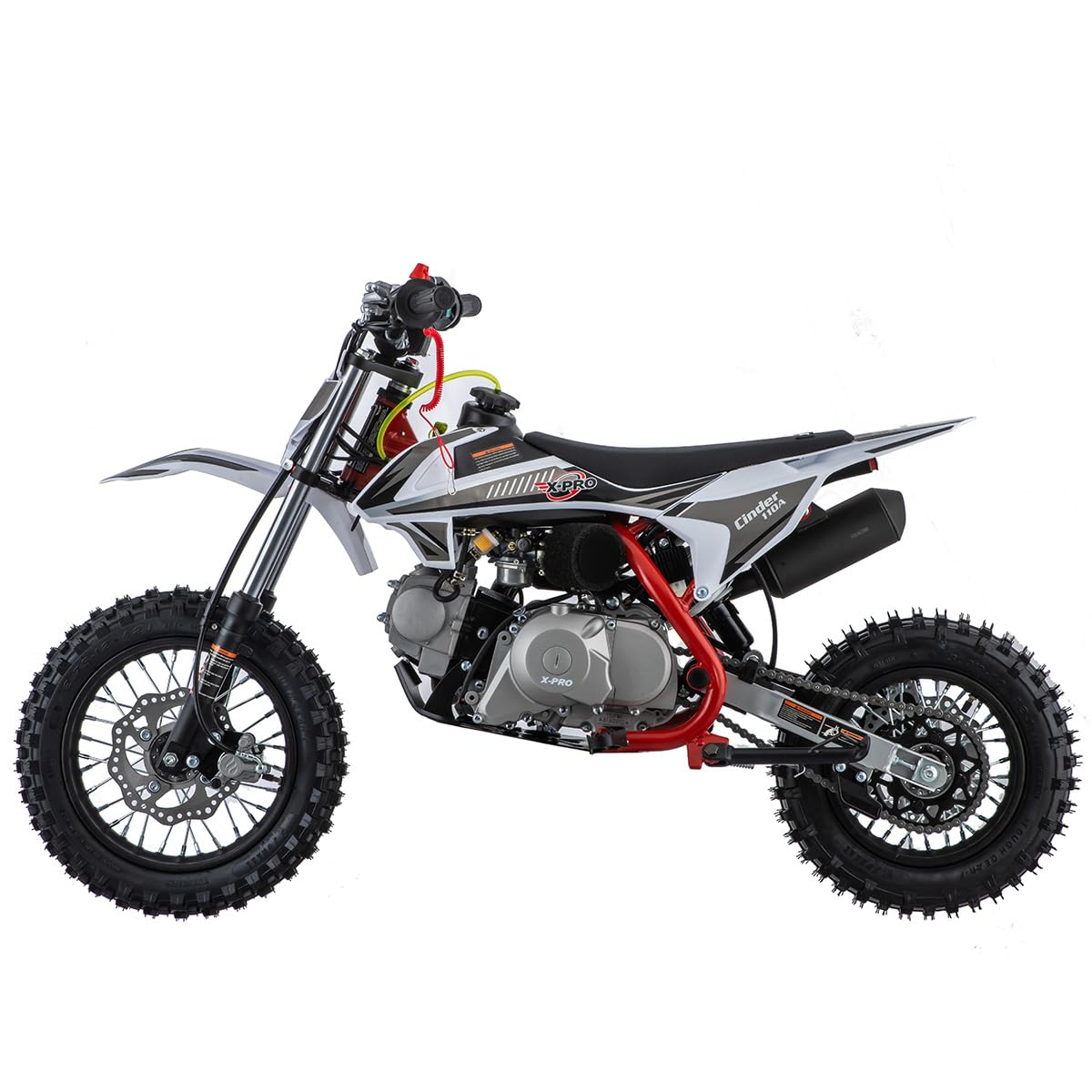
Your first real decision here is gearing, and this X-PRO hands it to you permanently: it runs an automatic transmission with electric start, so there is no clutch lever and no kick to wrestle on a cold morning. Push the button, twist the grip, and your rider is moving. That simplicity is why it suits a youth rider stepping up from a small electric bike rather than an adult chasing a manual gearbox.
The wheels are the giveaway to its size. Front and rear run 12″ and 10″ respectively, which is the compact end of this list — the Lynx below steps up to 14″/12″ and sits noticeably taller. That 12″/10″ pairing keeps the seat low enough for a young rider and makes the bike feel manageable at walking pace. The downside is clearance: it is not a bike you take over serious rocks.
The frame is a cradle-type steel tube design, and the maker describes it as lighter and stronger with a longer service life, which is the construction that makes the bike forgiving on landings rather than sharp. Count on assembly: front shock, front wheels, handlebars and the front disc brake all need fitting. What wins people over is the build — quality is the most-praised thing about this bike, and buyers report roughly 100 hours of sandy trail riding with only the front number plate plastic needing reinforcement. A cheaper automatic like this one is also the sensible first step before you move to a semi-automatic 125cc.
Where it earns its spot
- Electric start plus automatic transmission means a beginner rides on day one.
- 12″/10″ wheels keep the seat low and the bike easy to handle on tight trails.
- Cradle-type steel tube frame built to take jump landings.
- Color-matched rims, bars and frame give it a look that stands out in the neighborhood.
Where it asks patience
- Assembly covers front shock, wheels, bars and front disc brake before the first ride.
- Durability is the recurring gripe on the review pages — some units show loose parts early.
- Mixed reports on carburetor behavior at startup.
- Cannot be sold to California.
Reach for this if: you want a first real gas bike for a young rider who has not learned a clutch yet.
Look elsewhere if: you yourself are tall — the 12″/10″ footprint leaves little room to grow.
2. X-PRO Lynx 125cc Dirt Bike
The one that grows with your rider, thanks to the bigger wheels and a clutchless gear shifter.
Here is the direct size gap that matters most on this whole list. The Lynx runs 14″ front and 12″ rear tires against the X12 above at 12″/10″ — two full inches at each end. The maker claims the 14″/12″ footprint adds ground clearance and buys about two more years of a child’s growth. That is the sentence to remember if your rider is mid-growth-spurt.
The second draw is the transmission. It is a 4-speed semi-automatic, which means a foot shifter you work yourself but with no clutch lever to feather. Think of it as a bridge between a kid’s automatic and a proper manual — you get real gears without the stall-and-restart frustration.
Buyers consistently praise how the Lynx rides, and its 4.0+ star rating is the highest on this list. A 5’6″ rider who raced motocross in younger years calls it “a fun snappy little bike” and admits “it’s a little hard to shift up though.” That matches the broader pattern: the engine is willing, and the gear selection takes a few tries to get used to. The honest catch is the cold start — this is a kick-start bike (you start it with a foot lever, not a button), and it can take several kicks from cold. Budget assembly time for the handlebar brackets, wheels, brakes, number plate and fender, and note this one cannot be sold to California.
What the crate brings: a 125cc engine with 14″/12″ wheels, a cradle-type steel tube frame and a 4-speed semi-automatic gearbox — a step above the entry automatic on every dimension that affects fit and resale.
Buy this over the X12 if: your rider is tall enough that a 12″ front wheel feels cramped.
The trade-off: kick start only, and cold-morning starting takes a few tries.
3. PUCKIPUPPY Electric Bike 960W Peak
Not a dirt bike at all — a fat-tire commuter that quietly does more miles than any pit bike here.
If your idea of a budget dirt jumper is pedals you can actually live with, this is the one that turns the category on its head. It runs a 960W peak brushless motor through a 48V 15AH removable lithium battery, and it delivers up to 60 miles in pedal-assist mode. Switch to pure electric throttle and you get up to 40 miles at 20MPH. Seven-speed gearing gives you something to do with your legs on the climbs.
The 26″ fat tires are the practical heart of it. They spread load over a wide footprint, so the bike is described as gliding over soft beach sand and rolling through broken gravel and road debris. You also get three modes — full electric, pedal assist, and plain bicycle — which is a different riding experience from the gas bikes elsewhere in this article.
Styling is the most-praised thing about this e-bike in buyer reviews. The recurring honest gripe has nothing to do with the ride — it is the instruction manual, which one rider bluntly calls “horrible” and recommends replacing with YouTube videos. The disc brakes work, though a mountain-dwelling owner would swap them for hydraulic ones given how often the pads get replaced. Assembly is reported easy, and a kit including a phone holder, lock, mirror and cover comes with the bike.
The range reality: 60 miles pedal-assist and 40 miles throttle-only from the 48V 15AH pack is more distance per charge than you will cover on any pit bike tank in this article.
Pick it for: commutes, rail trails and mixed pavement that ends in loose ground.
Don’t pick it for: real jump lines — this is a fat-tire e-bike, not a suspension dirt frame.
4. Elite BMX Destro 20″

Twenty inches of pedal-powered jump bike, built for skateparks rather than throttle.
Take the engine out of the equation and the Destro is still a jump bike. The frame is reinforced at every point where impact lands from tricks, which is the construction language that matters when you are learning to bunny-hop a curb. The three-piece Cro-Mo crankset — Chromoly steel arms that flex less than one-piece — is the part that survives repeated stomping.
The freecoaster hub is the detail freestyle riders will spot. Its 6061-T6 aluminum shell runs sealed bearings, a 14mm hollow Chromoly axle and a one-piece Chromoly driver, which is the build that lets the rear wheel roll backward without the pedals forcing you around. You also get a set of pegs, a thick foam padded seat with Elite BMX embroidery and a 25.4mm alloy post with a 28.6mm clamp included.
The weight is 26.2 pounds, which keeps the bike flickable on a quarter pipe but is worth knowing if a younger rider has to carry it home. The one honest issue on the review pages involves the brakes — a rider had the bike serviced because the painted rims let the U-brakes slip. Worth a check at the shop or a break-in period before you trust the rear wheel lock. Most buyers are parents with ten-year-olds who simply love it.
For the skatepark crowd: a reinforced frame, full Cro-Mo crankset and a sealed freecoaster — a complete tricks-ready setup that arrives with pegs already in the box.
The right call for: a kid who wants to learn tricks, not twist a throttle.
Worth knowing first: painted rims can make the U-brakes slip until they bed in.
5. Blitzshark 36V 650W Kids Electric Dirt Bike
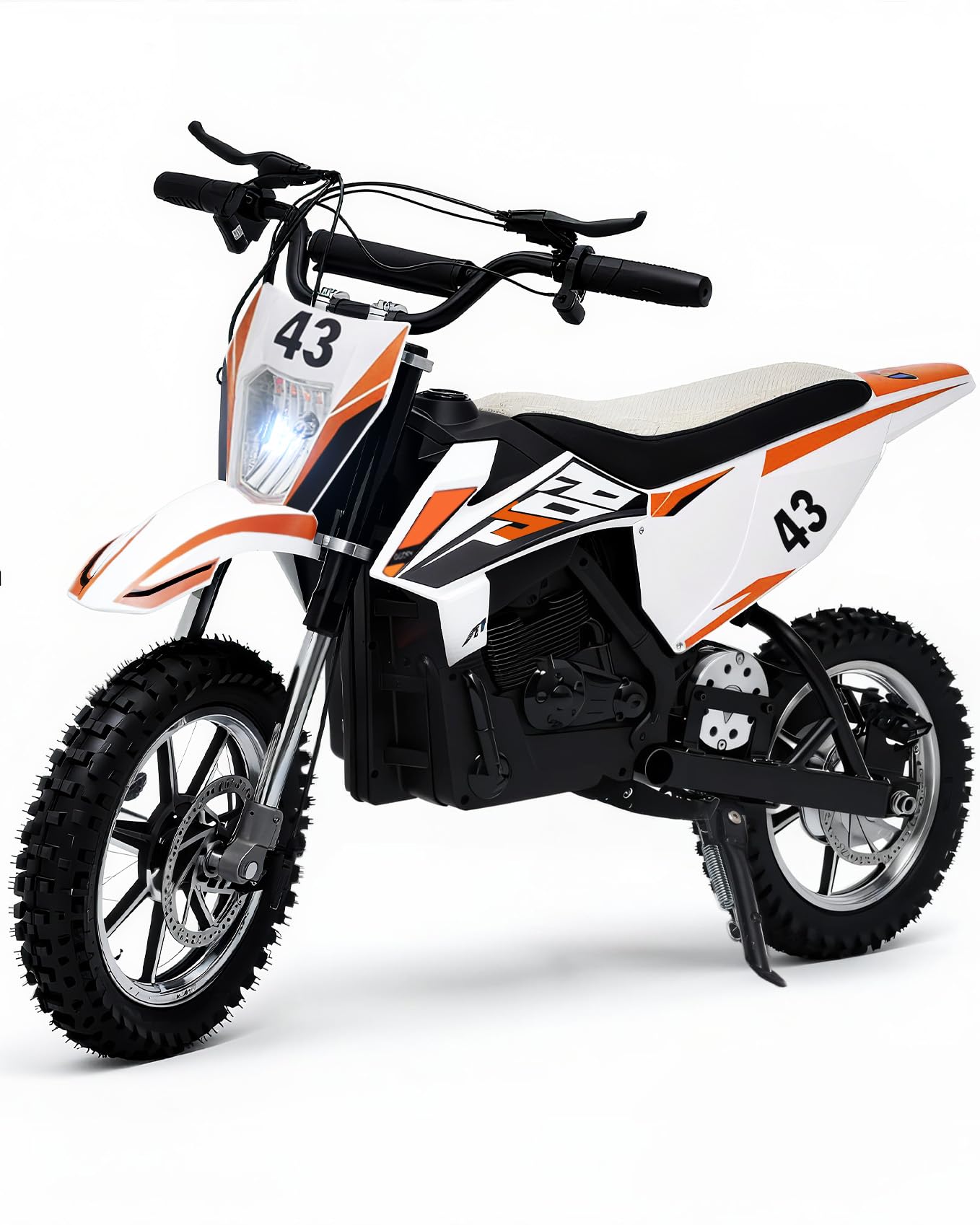
The quiet one: no oil, no kick start, and a top speed slow enough to teach on.
For a first off-road machine the electric route removes half the hassle. This Blitzshark runs a 36V motor rated at 650W, tops out at 17 MPH, and carries two 9AH batteries so it can run up to 30 minutes even at full load and maximum speed. Twist the right grip to go, squeeze with both hands to stop, and a battery indicator on the bars tells you when to plug in.
Its size tells you who it is for. The 16″ rubber wheels pair with an 18.5-inch leather seat over high-density sponge, and the bike is recommended for riders up to 5FT (60″). That makes it a kids’ bike first and a teen bike only at the small end. The front hydraulic shock and rear metal suspension are what take the sting out of ruts, which is the part everyone raves about in practice.
Two practical notes. It weighs 87 pounds and the maker asks for two adults at assembly — respect that, because a dropped front end on a heavy bike is a real risk. And the run time is honest, not generous: buyers describe 50-60 minute sessions and around 3-4 hours on the charger. The recurring real issue is the front fork, which has been reported not staying together — check both sliders are seated and tight before the first ride.
Why it suits a new rider
- 17 MPH top speed keeps the learning curve gentle.
- Hand-operated dual brakes plus front hydraulic shock for control.
- Battery indicator light on the handlebar so charging never surprises you.
- No gas, no oil changes, no cold-start kicks.
What to plan around
- Roughly 1-2 hours of play per charge, shorter under full load.
- 87 pounds means two adults should handle assembly.
- Front fork has been reported as the weak point on some units.
- Recommended height tops out at 5FT.
The clean fit: a family that wants the dirt-bike look without gas-can logistics.
Outgrown quickly if: your rider is already near or past five feet tall.
6. Gotrax Astra 300W Electric Dirt Bike

The 16-mile range is the headline — a day of trail riding on one charge.
The numbers that matter on the Astra are range and charge time, because those decide how long a Saturday lasts. A 300W motor fed by a 36V 7.8Ah battery gives up to 16 miles of riding and around 15.5 mph top speed. Charging takes roughly 5.2 hours, so an overnight plug-in between rides is the natural rhythm.
Where it shines is comfort tuning. The 16-inch pneumatic tires run with air, which absorbs chatter far better than a solid wheel, and front and rear dual shocks soak up the rest. Riders note it stays smooth on rough surfaces and grass. Two gear settings — Gear 1 at 10MPH and Gear 2 at 15.5MPH — let you phase a new rider in before turning the speed up.
Popular with parents of seven-to-ten-year-olds, and the ride quality is the thing that gets consistently praised. There is a rear disc brake and a headlight for evening visibility, plus brakes that owners describe as working well. The honest follow-up: reliability is the uneven part of the picture. Some report a battery that will not hold power, and a bent front brake disc in shipping has been a frustration. When a fault does show up, the reports of support vary from generous — free throttle and controller parts sent out — to a warranty runaround.
Fit and spec read: up to 220 pounds, an LCD screen showing speed, range and battery, a bell, retractable kickstand and mudguard — a complete kids’ package rated to UL-2272 standards.
Suits: a six-to-twelve rider who wants a real suspension feel on grass and gravel.
Ask yourself first: can you handle a brake-disc swap if the crate arrives less than perfect?
7. QuietEase 3000W Electric Dirt Bike

Three thousand watts and 220Nm of torque — the pick that stops treating hills as a problem.
If steep ground is the whole point, this is where the power argument ends. A 3000W brushless mid-drive motor delivers 220Nm of torque (twisting force at the wheel), and the maker claims it climbs 45° slopes at up to 38 MPH. The 48V battery is claimed good for 48 miles per charge, with a 4-5 hour fast charge.
The safety build is the part that makes that power usable. Dual hydraulic brakes handle stopping, full suspension smooths the ride, and a reinforced carbon steel frame supports 289lbs. Three speed modes include a low-speed setting capped at 9.5MPH for beginners. A smart display shows real-time speed, battery level and gear mode while you ride.
The weight is 127.9 pounds, which is a two-person job to move, though it arrives 90% pre-assembled with just the handlebars, front wheel and rear shock to fit. Performance is what wins people over, and the durability report is where the caution sits — the front brake bracket breaking off the mount has come up more than once. Support responds quickly and a one-year motor and battery warranty backs the bike. The bike runs an IP67 rating, which is a water-and-dust protection grade, so rain riding is not a red flag.
The torque case: at 220Nm this out-pulls anything else here, and the 9.5MPH beginner mode means a new rider can share the same machine.
Get it for: hilly trails where other bikes bog down and you want adult speed with a child-safe mode.
Go in expecting: a 127.9-pound machine to wrangle, and a brake bracket worth checking early.
8. HHH DB X18 125CC Dirt Bike

The grown-up’s cheap gas bike: manual clutch, hydraulic disc brakes and a 17-inch front wheel.
This is the pick for a rider who actually wants to learn a clutch. The Apollo RFZ DB-X18 runs a 125cc engine through a 4-speed manual clutch, which means real gear changes, real feathering, and stall risk as part of the learning. Pair that with hydraulic disc brakes rather than cable-pulled ones and you get a bike that stops with confidence on a wet descent.
The chassis numbers are all about clearance and control. A 17-inch front and 14-inch rear wheel, over 13 inches of ground clearance, and a heavy-duty twin-spar frame give you room to clear obstacles. Non-adjustable telescopic forks measure 750mm up front and a 320mm monoshock handles the rear. It arrives 70% assembled inside a metal crate.
Buyers who run this Chinese pit bike alongside Hondas call the value tough to top. Before the first ride, put threadlock (a glue that stops bolts loosening) on the bolts, swap the shipping oil for wet clutch oil, and grease the axles. Small breakages like a chain guide or foot peg are cheap to fix. The honest caution is the extremes: one report of a leaking tank and a slipping chain within a month shows these can arrive with a fault, so check the tank seal and chain tension before you ride it hard.
What you’re paying for
- 4-speed manual clutch teaches real riding skills.
- Hydraulic disc brakes front and left with over 13 inches of ground clearance.
- Heavy-duty twin-spar frame built for obstacles and trails.
- Cheap, easy-to-source replacement parts.
Setup you’ll actually do
- Arrives 70% assembled, so crate work is expected.
- Needs threadlock, an oil change and axle grease before real use.
- Occasional faults on delivery, so inspect tank and chain first.
- Non-adjustable suspension limits tuning.
Ideal for: a mechanically confident rider who wants gas, gears and a clutch on a budget.
Not for: someone hoping to unbox and ride without turning a wrench.
9. RM7 Electric Dirt Bike

Thirty-six to forty-five miles of trail on one charge, with three speeds to tame 37 mph.
The battery is the reason to look here. A 48V 22.5Ah lithium pack rated at 1080Wh gives 36-45 miles of continuous riding and recharges in 6-8 hours. That capacity dwarfs the kids’ bikes above — compare the QuietEase’s claimed 48 miles per charge against this bike’s 36-45 mile window and you can see the range is in the same league on a smaller, lighter machine.
A 2200W peak motor pushes it to 37 MPH and up 30° inclines. Three speed modes at 15, 22 and 37 MPH let you hand the bike to a beginner and keep the top end for yourself. The chassis is built for real trails: an inverted hydraulic front fork with 120mm travel, a rear shock with 35mm travel, and 14×2.7″ front and 12×3.5″ rear tires for grip.
Riders of 13, 16 and 17 all take to it easily, and a 6’2″, 215-pound adult reports plenty of power. It supports up to 265 pounds and sizes for heights from 4′ to 6′. The stopping setup is serious — 1015 PSI hydraulic brakes with 2-piston calipers and 4x190mm discs. What wins people over is quality; the thing to watch is assembly. One rider reports the frame came close to failing, so inspect every weld and bolt during the one-hour build before letting a teen loose on it.
Range you can plan around: 1080Wh from the 48V 22.5Ah pack buys you 36-45 miles of riding, a digital dashboard, horn, turn signals and bright lights, and an IPX6 water resistance rating for mud and rain.
Best fit: a teen or adult who wants e-power, real suspension travel and enough range for a full trail loop.
Inspect before you ride: this is the heaviest bike on this list, so check frame welds and the light mount during assembly.
Know the Specs
Displacement and Motor Wattage
On a gas bike, displacement is the swept volume of the cylinder — 110cc meaning roughly a tenth of a litre, and 125cc a step up in output. The Lynx’s 125cc gives it the edge over the X12’s 110cc. On an electric, wattage is the motor’s output rating, so 3000W in the QuietEase is a serious off-road motor while 300W in the Gotrax is a kids’ bike. Bigger numbers mean more push up a hill, and more push back when you twist too fast.
Wheel Diameter and Clearance
Wheel size sets how a bike rolls over rough ground and how tall the rider sits. A 14″/12″ pairing like the Lynx’s lifts the bike and gives ground clearance, while a 12″/10″ setup like the X12’s keeps the seat low for a beginner. A 17-inch front like the DB X18’s rolls over obstacles more smoothly and gives over 13 inches of clearance.
Common Questions
What does semi-automatic mean on a 125cc dirt bike?
Can a 110cc dirt bike be sold in California?
How much assembly does a crated pit bike need?
How long does a kids electric dirt bike run on a charge?
Is a manual clutch dirt bike too hard for a beginner?
What height rider does a 14 inch front wheel fit?
Are painted rims a problem for BMX brakes?
What does UL-2272 mean on an electric dirt bike?
Do I need to change the oil on a new gas pit bike?
What weight limit do these budget dirt bikes carry?
The Bottom Line
For most families the budget dirt jumper that makes the most sense is the X-PRO X12, because the automatic transmission and electric start let a beginner ride on day one without stalling a clutch or kicking a cold engine. If your rider is tall enough that the bigger footprint matters, the X-PRO Lynx steps up to 14″/12″ wheels (14-inch front, 12-inch rear) and a 4-speed semi-automatic gearbox (you shift by foot but there is no clutch lever) that will fit for years longer. And if you want hill-climbing power without a gas can, the QuietEase 3000W puts 220Nm of torque (pulling force) under a carbon steel frame with a beginner speed mode built in.
One quiet nudge before you decide: the X-PRO X12 sits at 3.5+ stars while the Lynx holds 4.0+ — higher on both fronts. If the budget stretches, the rider’s height should be the deciding vote.
How we choose
We do not accept paid placement. Every pick is matched to a real buyer and a real use-case; we do not hands-on test units.
Sources
Specifications: manufacturer listings and product documentation. Review insights: verified customer reviews, as of October 2026. Pricing: not shown on this page (it changes often); check the current price via the retailer link.
As an Amazon Associate, Aappliancez earns from qualifying purchases. This does not affect which products we feature.