Disclosure: Some links in this post are affiliate links. As an Amazon Associate I earn from qualifying purchases, at no extra cost to you. Learn more
Specs are compiled from manufacturer listings and verified buyer reviews and can change over time — please confirm the key details on the product page before buying.
Your sourdough is fine — the wobbly knife is the problem. If your slices come out wedge-shaped, torn in the middle, or half an inch thick on one end and paper-thin on the other, you’re missing a guide that holds the blade straight. A bread slicer for homemade bread locks the loaf in place, keeps your knife on a fixed path, and gives you the same thickness every single time. Below are eleven real options, sorted by what they actually do well.
This guide is built by comparing the manufacturers’ published specifications and the patterns across verified customer reviews, so you get each pick’s real strengths and trade-offs instead of marketing spin.
Some of these are simple plastic guides you set on the counter. Others are hand-crank machines with suction cups (rubber feet that grip the counter) and a fitted blade. Your pick depends on how often you bake, how wide your loaves run, and if you want to store it in a drawer or leave it out. Here is the honest breakdown of the best bread slicer for homemade bread.
Top Picks
How To Choose The Best Bread Slicer for Homemade Bread
The first thing to settle is what kind of slicer you actually want. A guide is an open frame you drop the loaf into and then cut with your own knife. A hand-crank machine holds the bread on a platform, moves the blade for you, and locks to the counter with suction cups. Guides are cheaper and store flat; machines give you repeatable thickness without any knife skill. Both work — they just suit different bakers.
Guide or hand-crank machine
If you already own a good serrated bread knife, a guide is the smart buy. You keep the blade you like and just add the straight-line control. A hand-crank machine is for anyone who wants the thickness locked in by a knob and doesn’t want to think about blade angle at all. The trade-off is size: machines are bulkier, and they take up counter space you may not want to give up permanently.
How wide and how tall your loaves run
This is where most buyers get caught out. A guide that only fits a small sandwich loaf will not swallow a tall sourdough boule, no matter how good the slicing slots are. Check the width settings and the cutting area before you buy. If you bake in a bread machine, you want a slicer that specifically clears a 2 lb loaf and leaves enough room behind the guides to seat the knife.
Thickness control and what the numbers mean
Slice thickness is usually given in inches. A thin setting around a quarter inch gives you toast and tea sandwiches. Something near half an inch gives you thick sourdough cuts for French toast. The more useful question is whether the slicer holds that setting firmly — a knob that drifts mid-loaf leaves you with a wedge, which is the exact problem you bought the slicer to solve.
Side-by-Side Comparison
| Model | Best For | Slice Thickness | Blade Length | Base / Hold | Amazon |
|---|---|---|---|---|---|
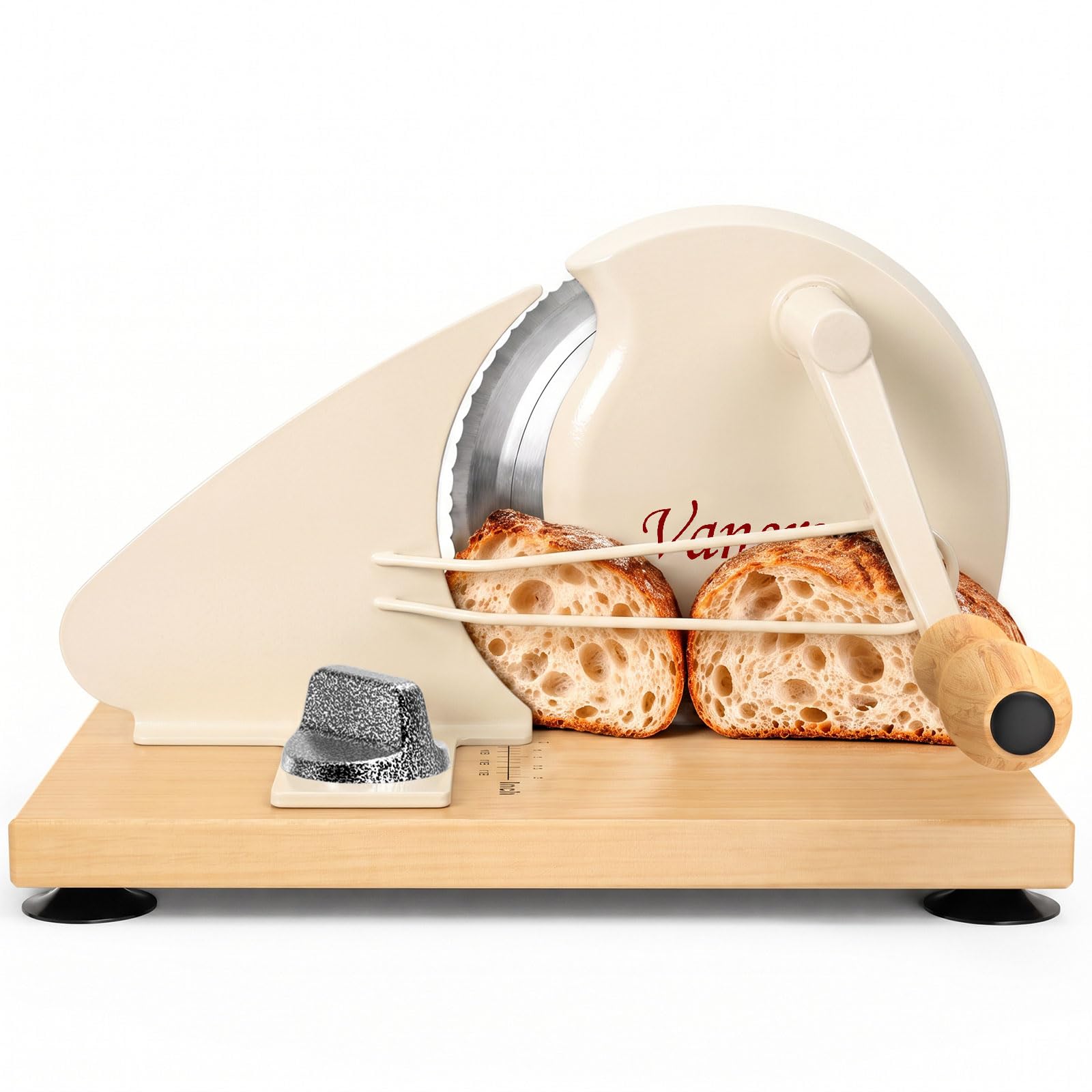
| Manual Bread Slicer for Homemade Sourdough Adjustable Thickness★ Best Overall | Best overall | Up to 0.9 inches | 6.6 inches | Solid wood base, 4 suction cups | Amazon |
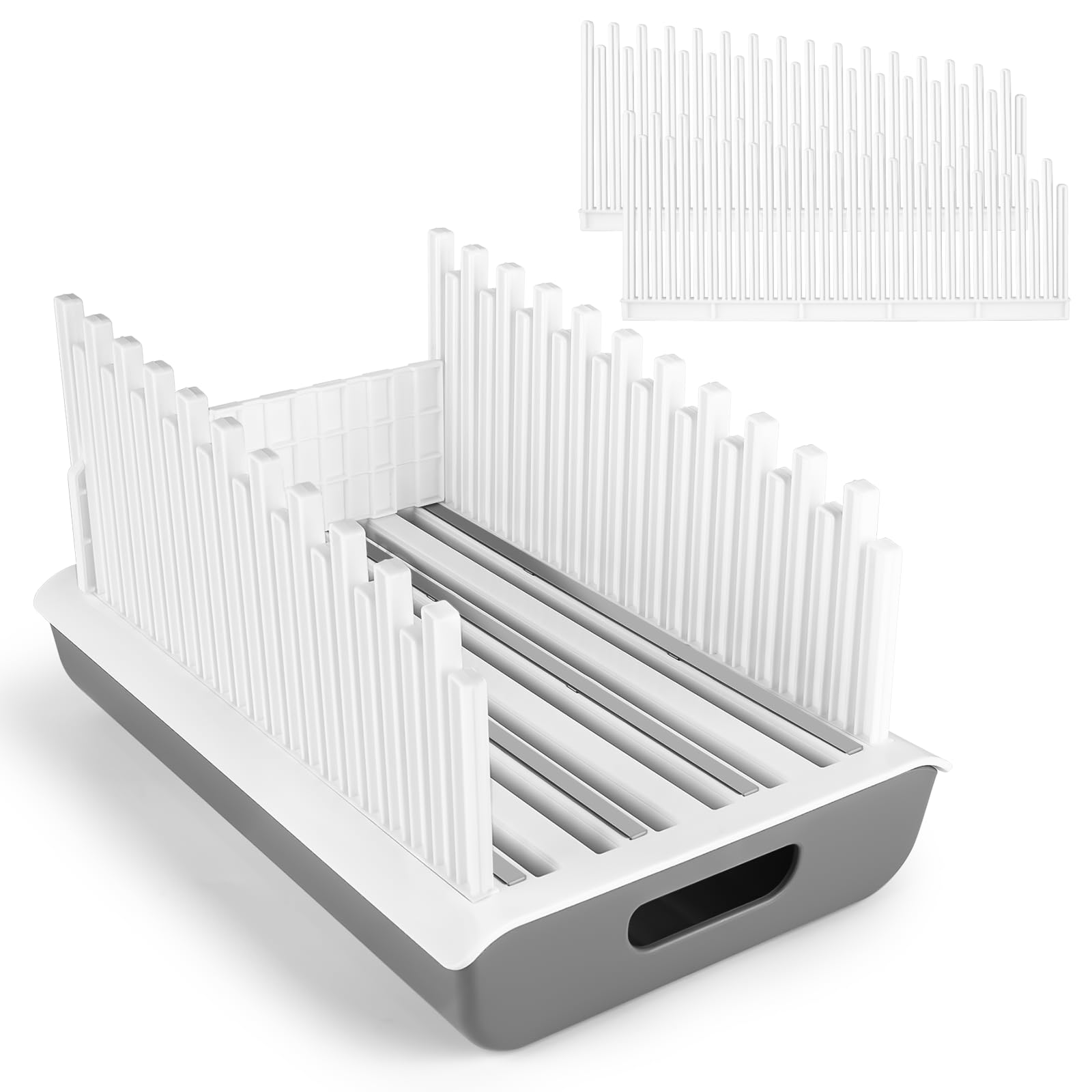
| YONGAIJIA Bread Slicer GuideBest Budget Guide | Budget guide with crumb tray | 1/2″, 1/3″, 1/4″ | — | 4 silicone non-slip pads | Amazon |
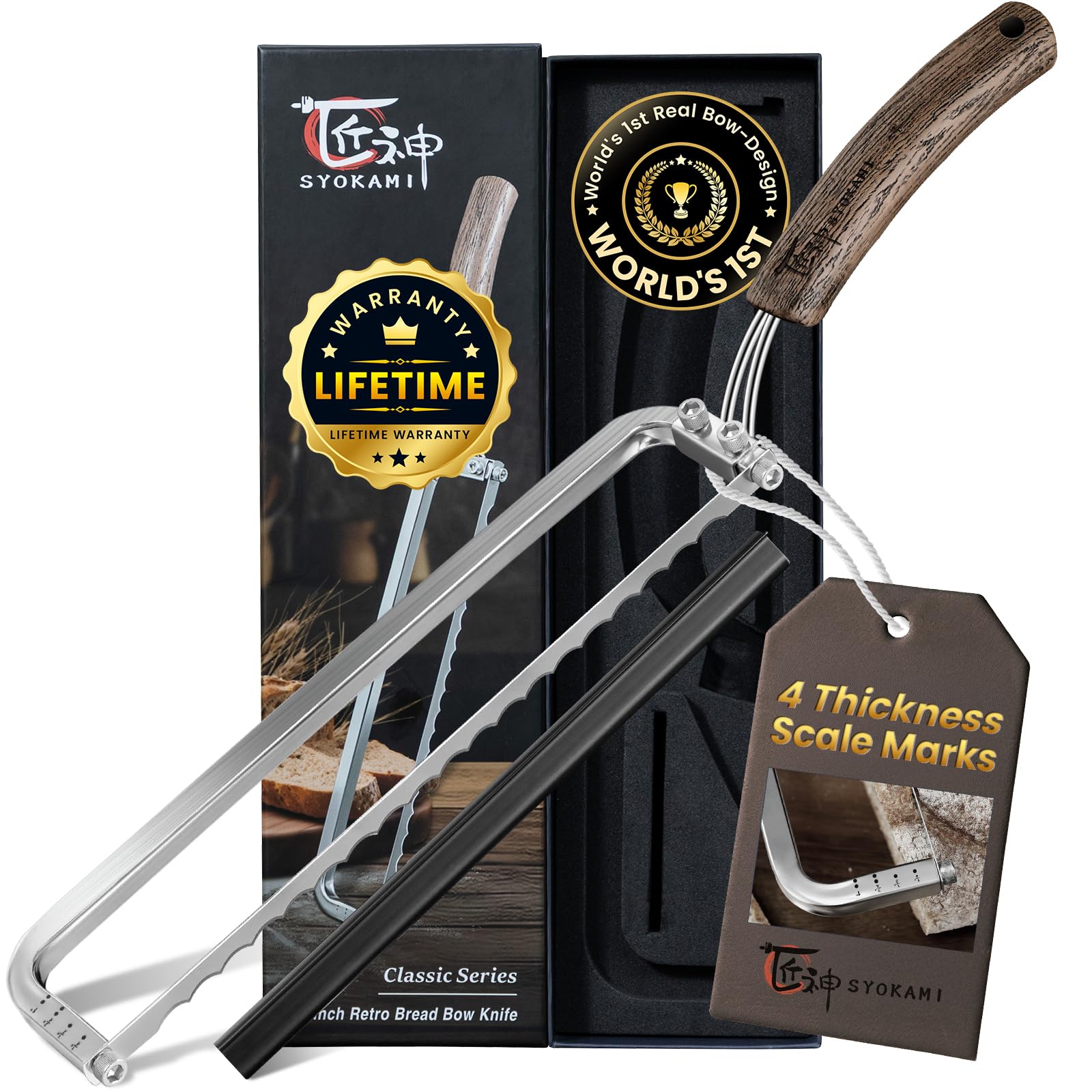
| SYOKAMI Bow-Design Bread KnifeBlade-First Pick | Knife-only slicing precision | 1/4″, 1/2″, 3/4″, 1″ scale marks | 10.7 inches | Offset wood handle | Amazon |
| Kiss Core Adjustable Width Slicer | Bread machine loaves | 0.47 inches | — | Crumb tray base | Amazon |
| Bambüsi Bread Slicer with Knife | Complete kit, folds flat | 0.25, 0.38, 0.5 inches | 8 inches | Silicone feet, crumb tray | Amazon |
| Albert & Grace Bamboo Slicer | Tall boules | 2 thicknesses | — | Non-slip pads, folds flat | Amazon |
| Brvclon Hand Crank with Bread Bags | Long-run home baking | 0.1″ – 0.9 inches | Replaceable stainless | Solid wood base, suction cups | Amazon |
| vanerepok Black Hand Crank Slicer | Daily sandwich loaves | Up to 0.9 inches | 6.6 inches | Wood base, 4 suction cups | Amazon |
| LockTide Matte Black Slicer | Sourdough specialists | Up to 0.9 inches | 6.6 inches | Solid wood base, 4 suction cups | Amazon |
| Brvclon Cream Slicer with Metal Guide | Hard and soft breads | 0″ – 0.9 inches | 6.69 inches | Solid wood base, suction cups | Amazon |
| Zassenhaus Original Classic | Premium German build | Up to 0.7 inches | 18/8 stainless blade | Wood base, anti-slip suction cups | Amazon |
Detailed Reviews
1. Manual Bread Slicer
Our pick — 4.5+★ from 800+ verified ratings; the strongest balance of quality and price.
The kitchen workhorse that turns a crusty loaf into bakery-even slices without you fighting the knife.
This pick earns its spot because you never hold a knife: a hand crank moves a stainless steel blade across the loaf, and one knob sets the cut from 0.3 inches for ultra-thin sandwiches up to 0.9 inches for thick toast. The crank does the pushing, so crusty artisan breads don’t crush and soft white breads don’t tear. If you have watched a sourdough boule collapse halfway through a hand slice, that difference is the whole point.
What wins people over is the cut itself — slice quality is far and away the most-cited thing about this machine, followed by how little effort it takes compared with a knife. It also holds still. Four anti-slip suction cups lock the base to a smooth countertop, so the whole unit stays put while both your hands are busy, and the solid wood base is built to resist cracking over time. Slicing is the aspect owners single out most, and it deserves the reputation: even pressure, even thickness, loaf after loaf.
The catch is storage and cleanup. This is a machine, not a flat board — the body and the 6.6-inch round blade take up real counter or cabinet space, and you wipe the surface rather than dunk it in water. It’s also the 1.05 kg unit in this lineup, so it’s the one you plant on the counter rather than tuck in a drawer. The blade is detachable for deep cleaning and replacement, which softens the upkeep, but you should go in expecting a dedicated spot for it. If you slice a loaf most days, that permanent spot is worth giving up.
Where it pulls ahead
- Cuts 0.3-inch to 0.9-inch slices with one knob, all from the same loaf.
- Hand crank plus stainless blade crushes neither crust nor crumb.
- Four suction cups anchor it so nothing slides mid-slice.
What to plan around
- It’s a 1.05 kg machine — plan a permanent spot rather than drawer storage.
- Wipe-clean only; the body does not go in the sink.
Made for: bakers who slice a loaf most mornings and want the thickness handled by a knob instead of their wrist.
Think twice if: your counter space is spoken for — the flat folding guides further down this list will suit you better.
2. YONGAIJIA Bread Slicer Guide with Adjustable Thickness
A clever guide that lines its slots with steel so your blade never chews into plastic.
The smartest detail here is buried in the frame: four 304 stainless steel strips run along the slicing slots, so when your knife finishes a cut it lands on smooth steel instead of shaving your way through plastic. That single choice is what separates this from the cheap guides that go grooved and grimy after a few months. Double baffles hold the loaf steady on either side, and stepped rails give you three thicknesses — 1/2 inch for French toast, 1/3 inch for everyday sandwiches, 1/4 inch for thin toast.
It also fits almost any loaf you bake. Six width settings run from 1.6 inches all the way to 6.1 inches, inside a 4.5 inch tall by 11.5 inch long cutting area, so bagels, dinner rolls, large boules and 2 lb bread-machine loaves all sit in the frame. Four silicone pads under the freestanding tray keep it from skating across the counter. The tray catches crumbs as you cut, then stores all the parts, so it packs down neatly between bakes.
Here’s the honest part: this is a guide, not a machine, so the straightness of your cut still depends on the hand holding the knife. Buyers report it splits exactly along that line — plenty find slicing easier and straighter, and the crumb tray and pack-away storage draw praise, while others note the cut doesn’t always reach the bottom of the loaf and the sides can shift as they work. Softer loaves are the friendlier match. If you already own a good serrated knife, this is the low-hassle way in.
Steel where it counts: those 304 stainless slot liners mean the blade finishes on metal, so the guide holds its shape and your knife stays sharp longer.
The honest caveat: the loaf still moves if you push hard, so it rewards a steady second hand on the bread rather than a heavy saw.
Reach for this if: you already own a decent bread knife and want a compact, crumb-catching guide that stores inside its own tray.
Look elsewhere if: you want the slicer to drive the blade for you — a hand-crank pick does that job.
3. SYOKAMI 2026 Upgrade Bread Knife, Bow-Design
Skip the frame entirely — this bow-shaped knife cuts to the board on its own.
If you don’t want another bulky gadget on the counter, this is your pick. The knife itself carries the answer: a bow-shaped stainless steel frame with four scale markings at 1/4 inch, 1/2 inch, 3/4 inch and 1 inch, so you line the blade against the mark and press down. The blade runs 10.7 inches and the whole tool measures 16.5 inches, so it clears a full loaf in one movement — that’s a 62% longer blade than the 6.6-inch blades on the hand-crank machines above.
The steel is 420J2, and the maker notes it resharpens easily on a standard household sharpening rod. The blade also extends below the frame, paired with an offset wood handle, which is what lets you finish the cut cleanly at the base instead of leaving that last stubborn half-inch intact. Crusty sourdough and baguettes give way without much pressure. There’s a protective blade cover you can hang on the wall, and the whole thing weighs 0.4 kg — light enough to hang and forget.
The trade-off worth knowing is handedness and blade life. The design is built for right-handed use, and the blade is held under tension with screws you’re told not to loosen. Some owners mention the blade giving out within weeks of steady use, so treat the sharpening routine as part of owning it rather than an optional extra. It’s the sharpest, most precise cutter here — just not the most forgiving one.
Precision without a frame: four scale marks and a blade that reaches below the bow mean consistent thickness and a full cut, with no guide to store.
What to weigh: right-handed design and a blade that some owners find short-lived — buy it for the cut quality and keep a sharpening rod handy.
Best suited to: right-handed bakers who want the cut controlled by the blade, not held by a guide, and who don’t mind keeping it sharp.
Not your match if: you’re left-handed, or you want a blade guaranteed to outlast a busy baking year.
4. Kiss Core Adjustable Width Bread Slicer

Built for the fat 2 lb bread-machine loaf that other guides simply cannot swallow.
If your bread comes out of a machine, this guide is aimed squarely at you. The cutting area measures 12.8 inches long by 7.87 inches wide by 3.94 inches high, with six width settings. The frame is designed so you can still lock the knife against both guides after a tall loaf is seated. That last part matters — most guides force you to start the cut above the walls, which is exactly where a thick machine loaf makes slicing wobble. Here the bread sits down inside, and the guides run the whole height.
The slice thickness is fixed at 0.47 inches, a natural sandwich cut, and you set the width to match whatever you’re cutting rather than chasing a dozen settings. The plastic is a high-grade PP that resists cracking and heat, and the crumb tray underneath catches every scrap so your counter stays clean. It also doubles as a serving tray, and the whole thing disassembles to stack flat in a drawer or on a pantry shelf. What wins people over is the build quality, with functionality right behind it — this guide feels sturdier than the flimsy boards that bow the moment bread presses on them.
The honest follow-up question is durability. Some customers note years of steady use, others find parts coming apart, so the realistic read is that it holds up if you treat it as a cutting guide and not a wrestling opponent. Thickness is also locked at that single 0.47 inch, so if you want a thick slab for French toast, this isn’t the guide for it. For a bread-machine household slicing a standard loaf several times a week, it’s a sensible, low-profile answer.
The bread-machine fit: a 12.8 by 7.87 by 3.94 inch cutting area with six widths means a 2 lb loaf drops all the way in and the knife still locks to both rails.
One thickness only: a single 0.47 inch setting keeps things simple but rules out thick toast cuts.
Pick this one: if you bake in a bread machine and want a guide that seats a full 2 lb loaf properly.
Pass if: you want to change slice thickness from loaf to loaf — this one is fixed.
5. Bambüsi Bread Slicer with Knife

The one-box answer — bamboo guide, matching serrated knife, crumb tray, all in one kit.
Buying a guide usually leaves you wondering whether your own knife will line up with the slots. Bambüsi removes the guesswork by putting the knife in the box: a 13 inch stainless steel serrated bread knife with an 8 inch blade and a steel handle, sized to the guide itself. The bamboo frame takes loaves up to 5.5 inches wide and 5 inches tall, with three built-in slots at 0.25, 0.38 and 0.5 inches for thin toast, medium sandwich cuts or thick sourdough. When you’re done, the knife snaps onto a magnetic slot in the base.
The setup is friction-free. Nothing assembles, nothing plugs in, and the whole thing folds flat on silicone feet so it stays put while you cut. The crumb tray lifts free and doubles as a serving board, and a separate flat cutting guide board is included too. What owners keep coming back to is the material — the solid bamboo looks good enough to leave out on the counter, which is why appearance earns its own steady share of the conversation alongside all that utility.
Two things to know before you commit. Bamboo needs hand washing, not a dishwasher cycle, and the frame has been known to wear over heavy years of use. The bigger caveat is cut quality: some owners find the bamboo slots let the blade wander a touch, so the slice comes out good rather than laser-even. Bakers who slice softer, home-made loaves get the smoothest ride — the maker’s own note acknowledges that softer crusts work best. For a gift box or a first slicer, the kit form is hard to argue with.
What the kit gives you
- Knife, guide, tray and cutting board all matched together.
- Three slots at 0.25, 0.38 and 0.5 inches cover toast to thick cuts.
- Folds flat with a magnetic dock for the 8-inch blade.
Where it asks more of you
- Hand wash only — the bamboo won’t survive the dishwasher.
- Blade guidance in the slots isn’t as tight as a metal or stepped-rail guide.
Worth it for: a first slicer or a gift, since everything arrives matched and the bamboo looks good on the counter.
skip it if: you want razor-even slices from a crusty artisan loaf and nothing in the guide allowed to wander.
6. Albert & Grace Adjustable Bamboo Bread Slicer
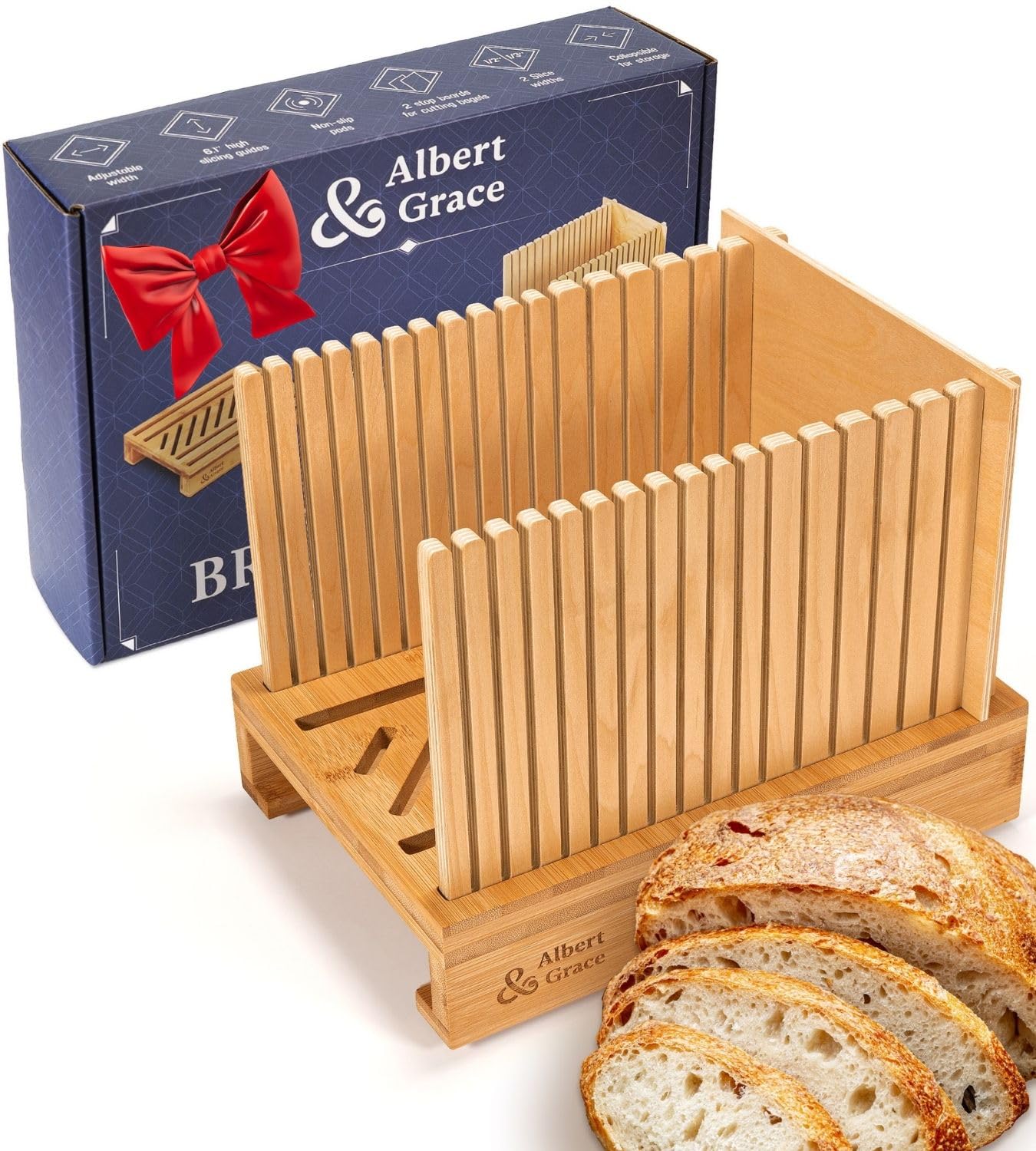
High walls and rounded tops for slicing a towering sourdough boule without a wobble.
The number that matters here is 6.1 inches — the height of the slicing guides. Most flat guides barely clear a sandwich loaf, which is why a tall sourdough boule tips out sideways halfway down. These guides run high enough to hold a boule upright through the whole cut, and the tops are rounded so your knife glides over them instead of catching on a squared edge. You get three width settings at 5.9, 4.6 and 3.3 inches to match anything from a Pullman loaf to bagels and rolls.
It’s built from cross-laminated Moso bamboo, which the maker points to as sturdier, heavier and more stable than the single-layer bamboo boards that flex under pressure. It weighs 3 pounds, and non-slip pads keep that heft planted on the counter. Thickness runs to two settings for sandwich or toast. When the loaf is done, the whole frame folds down to 2.1 inches thick and slides into a drawer — no moving parts, nothing to assemble, nothing to break.
The limitation to know is that this is tuned for a long serrated blade. The maker recommends 10 to 12 inch bread knives and pairs it with their own 10.5 inch knife, sold separately; a short or narrow knife won’t follow the guide tops as cleanly. Hand washing applies to the bamboo. And since the guides are the whole point, check your loaf’s height against that 6.1 inch mark — a short sandwich loaf will still work, but a very tall artisan boule is where this earns its place.
Built for height: 6.1 inch cross-laminated bamboo guides keep a tall boule upright, with rounded tops that let the blade ride smoothly.
The matching requirement: pair it with a 10 to 12 inch serrated knife — the maker’s 10.5 inch model is the intended partner and isn’t included.
Ideal for: sourdough bakers whose loaves are taller and wider than the average guide can hold.
Consider another pick if: you use a short bread knife or want a knife in the box.
7. Brvclon Manual Bread Slicer with 10 Bread Bags
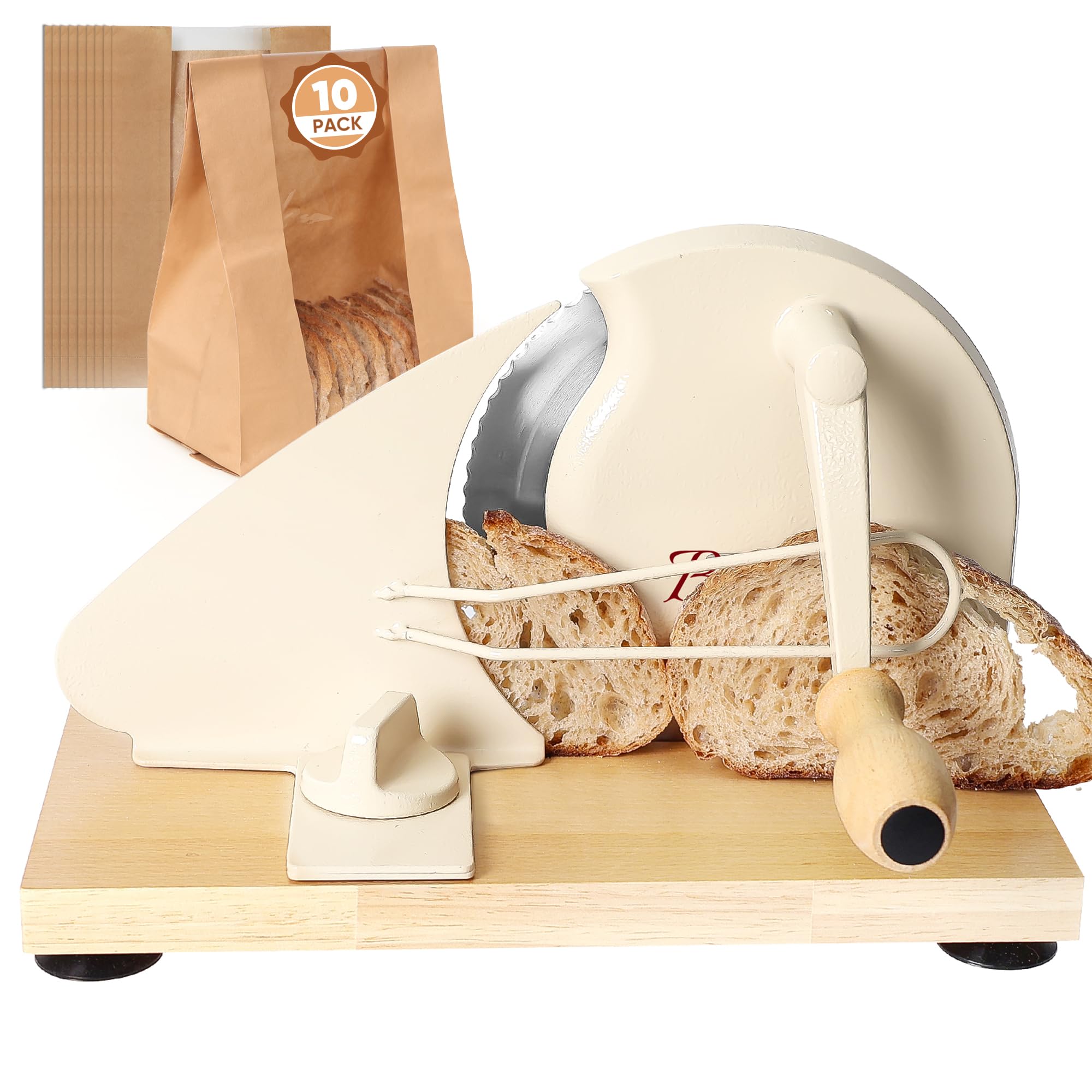
A crank machine that throws in ten bread bags, because slicing is only half the job.
Anyone who bakes in volume knows the second problem after slicing: what to do with the remaining loaf. This unit answers both. The hand crank and stainless steel blade give you multi-level thickness from 0.1 inches up to 0.9 inches, so a thin snack slice and a thick toast cut come off the same loaf with an easy adjustment. The blade is replaceable, which means a dull edge is a part swap rather than a whole new machine.
It handles the whole bread shelf: crusty sourdough, soft sandwiches, bagels, croissants, rye and baguettes all go through the blade evenly. Strong suction cups under the solid wood base hold it to a smooth countertop so the crank stays steady while you work. Cleanup is a wipe of the surface with a cloth or brush, and the compact footprint stores away without eating cabinet space. Ten bread bags come in the box for wrapping what you don’t eat the same day.
The one caution is weight and heft. At 2.53 kg it’s the heaviest pick on this list, so plan for it to live on the counter rather than move in and out of a cupboard. The maker backs it with three years of after-sales service, which is worth knowing given the moving parts. If you bake loaves regularly and want the thickness set with a dial, this is a solid workhorse — just clear a permanent space for it first.
The full package: 0.1 to 0.9 inch thickness, a replaceable stainless blade, and ten bread bags in the box.
Plan the placement: 2.53 kg is a lot to lift, so treat it as counter furniture and not a drawer gadget.
Go for this: if you bake often, want adjustable thickness, and like that spare bags and a swap-in blade come included.
Look past it if: you need something light enough to stash in a cupboard between bakes.
8. vanerepok Manual Bread Slicer, Black Hand Crank
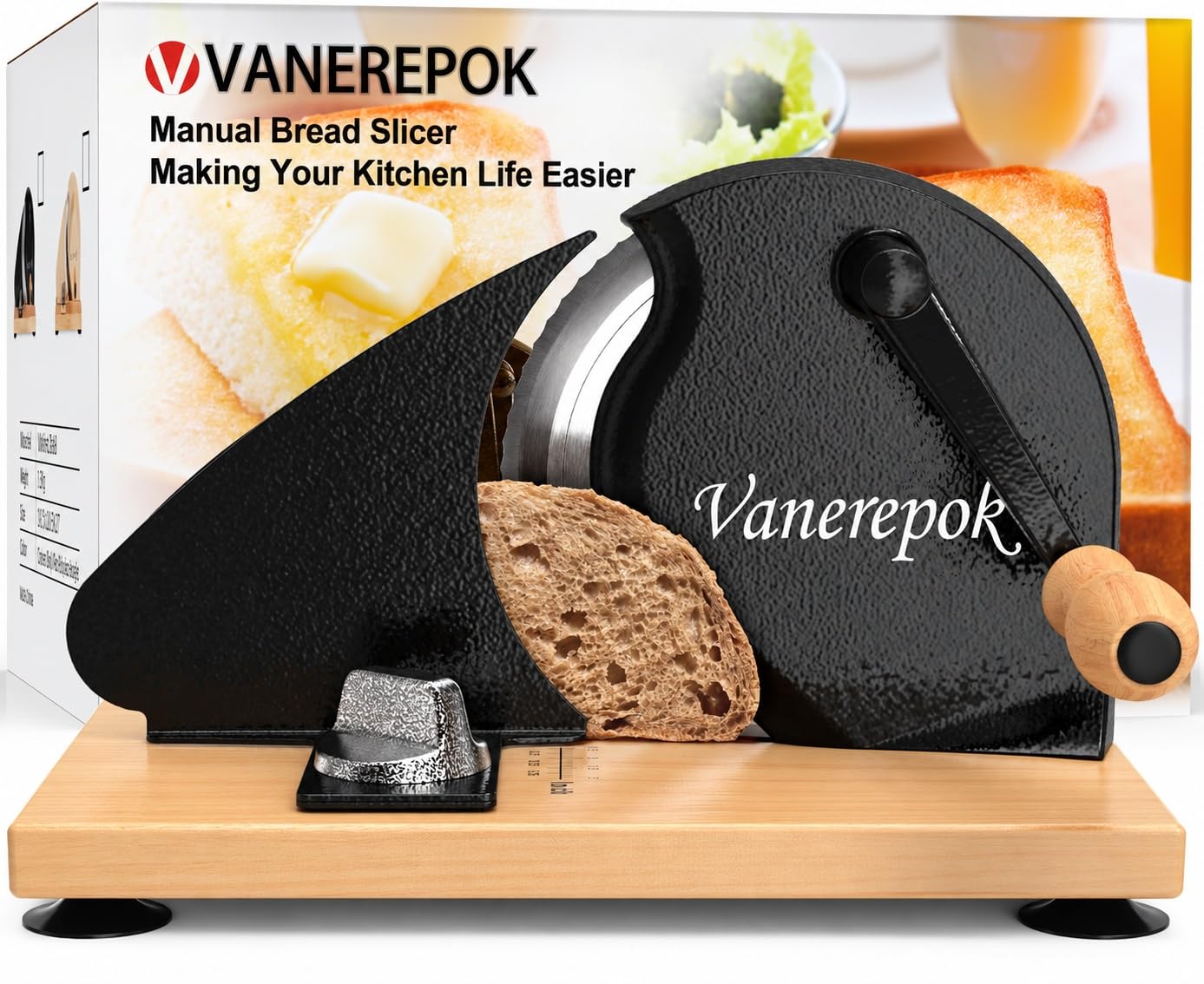
A black-finish crank slicer with a marked knob and a four-year warranty behind it.
What you notice first here is the knob. It’s scale-marked, so you can dial the slice thickness up to 0.9 inches and actually return to the same setting later without eyeballing it. The crank and serrated 6.6 inch stainless blade then do the cutting: thick sourdough and soft whole wheat both come out smooth, with less wrist effort than dragging a knife through a crust. Owners keep pointing to the blade’s edge as the reason it works that well.
The body is an aluminum alloy frame over a solid wood base, finished in black, with four suction cups underneath to hold it to a smooth countertop. It weighs 5 pounds, so it stays put. Cleanup is a wipe of the surface, and the blade detaches for deep cleaning or replacement. The maker backs it with a four-year warranty, which is a longer promise than most of the crank machines here. It also handles more than bread — dense artisan loaves, cakes, bagels, cheese and deli meats all go through the same blade.
The realistic downside is the footprint. It’s a 5 pound machine measuring 13.8 inches long, so it takes up counter room and isn’t a fold-and-store item. Blade durability is the one area where owner feedback is more mixed than the build quality, so keep an eye on the edge if you slice daily. If your counter already has room for a stand mixer, this 13.8-inch machine fits the same slot — a tool that lives out and gets used.
Repeatable thickness: the marked knob takes the guesswork out of hitting 0.9 inches or anything under it.
The space question: a 13.8 inch, 5 pound machine wants a permanent counter spot.
Right for you: if you slice daily, want a marked thickness dial, and value a four-year warranty on a crank machine.
Not for you: if counter space is tight or you’d rather fold the slicer into a drawer.
9. LockTide Manual Bread Slicer for Sourdough
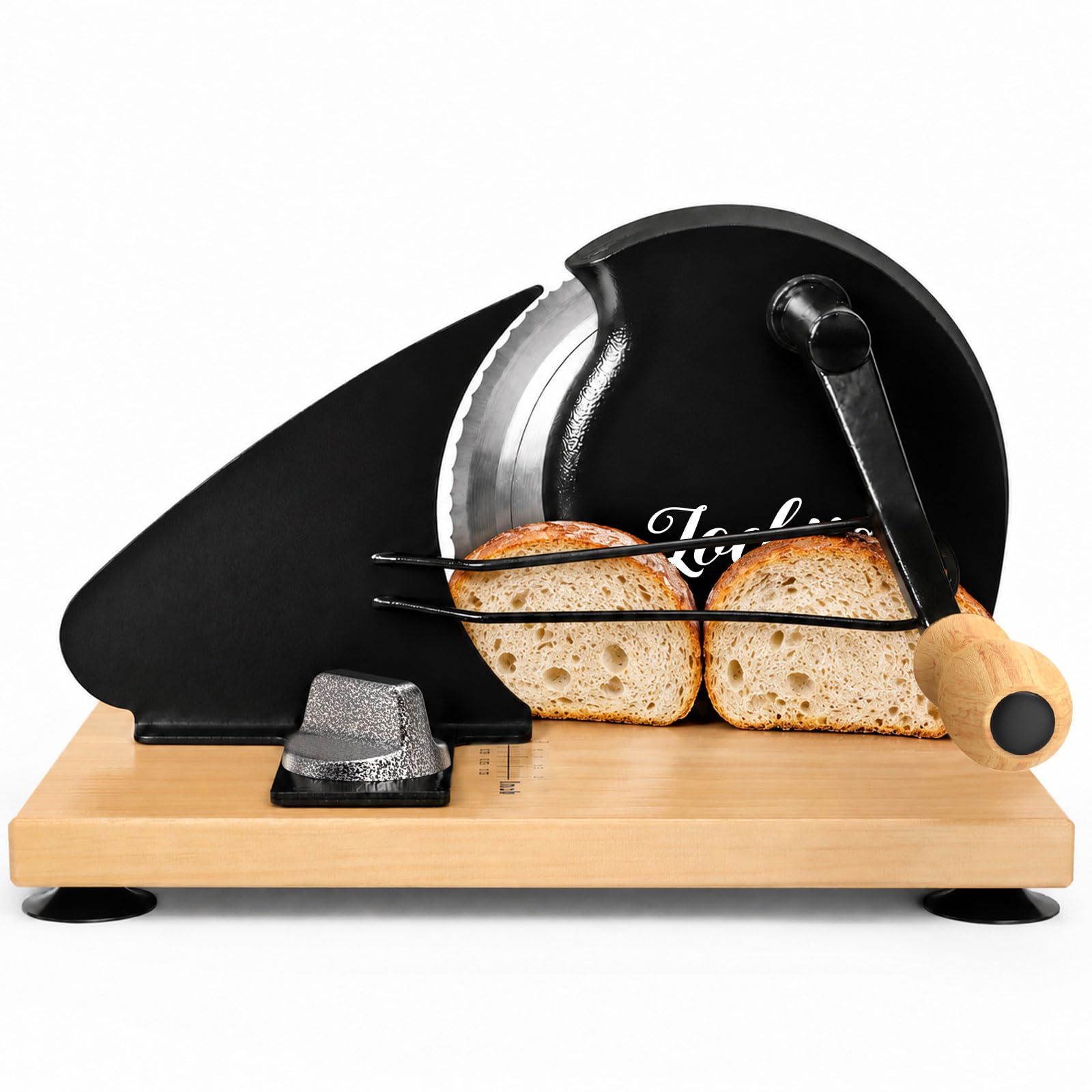
A matte black crank slicer tuned specifically for the crust of artisan sourdough.
Sourdough is the test that breaks most slicers — a hard, dark crust that shatters under a dull blade and a soft, open crumb that tears if you press too hard. This unit is built around that challenge: a food-grade serrated stainless blade on a hand crank, moving through ciabatta and baguette crusts with less effort than a knife, while soft white bread and brioche come out clean rather than crushed. The 6.6 inch blade sits over a solid wood base finished in matte black.
Thickness sets with a rotating knob up to 0.9 inches, and clear scale lines on the knob let you return to a setting instead of dialling by feel. Quality and slice performance are what owners talk about most, and the sharper blade behind that performance earns its own share of the praise. Four suction cups anchor it to a smooth, clean countertop so it doesn’t walk while both hands are on the crank. It handles cakes, bagels, cheese and deli meats as well as bread.
What you should weigh is the storage situation and the blade’s long-term edge. It measures 11.8 inches long and holds to the counter with those suction cups, so it’s built to stay out rather than fold away, and it’s a hand-wipe item. Blade durability shows up as the one mixed note across owner feedback, so a steady sharpening habit is sensible. If your freezer is full of sourdough rounds, that crust-first design is the reason to pick it.
Why sourdough bakers like it
- Designed to clear hard crusts without crushing the soft interior.
- Scale-line knob holds thickness up to 0.9 inches repeatably.
- Four suction cups lock it down for a stable cut.
The honest catches
- Built to stay on the counter rather than fold into a drawer.
- Blade edge needs care over heavy daily use.
Suit yourself to this one if sourdough rounds are your main bake and you want a slicer built for that crust.
Better served elsewhere if you need fold-flat storage or mostly slice soft sandwich bread.
10. Brvclon Manual Bread Slicer with Metal Guide
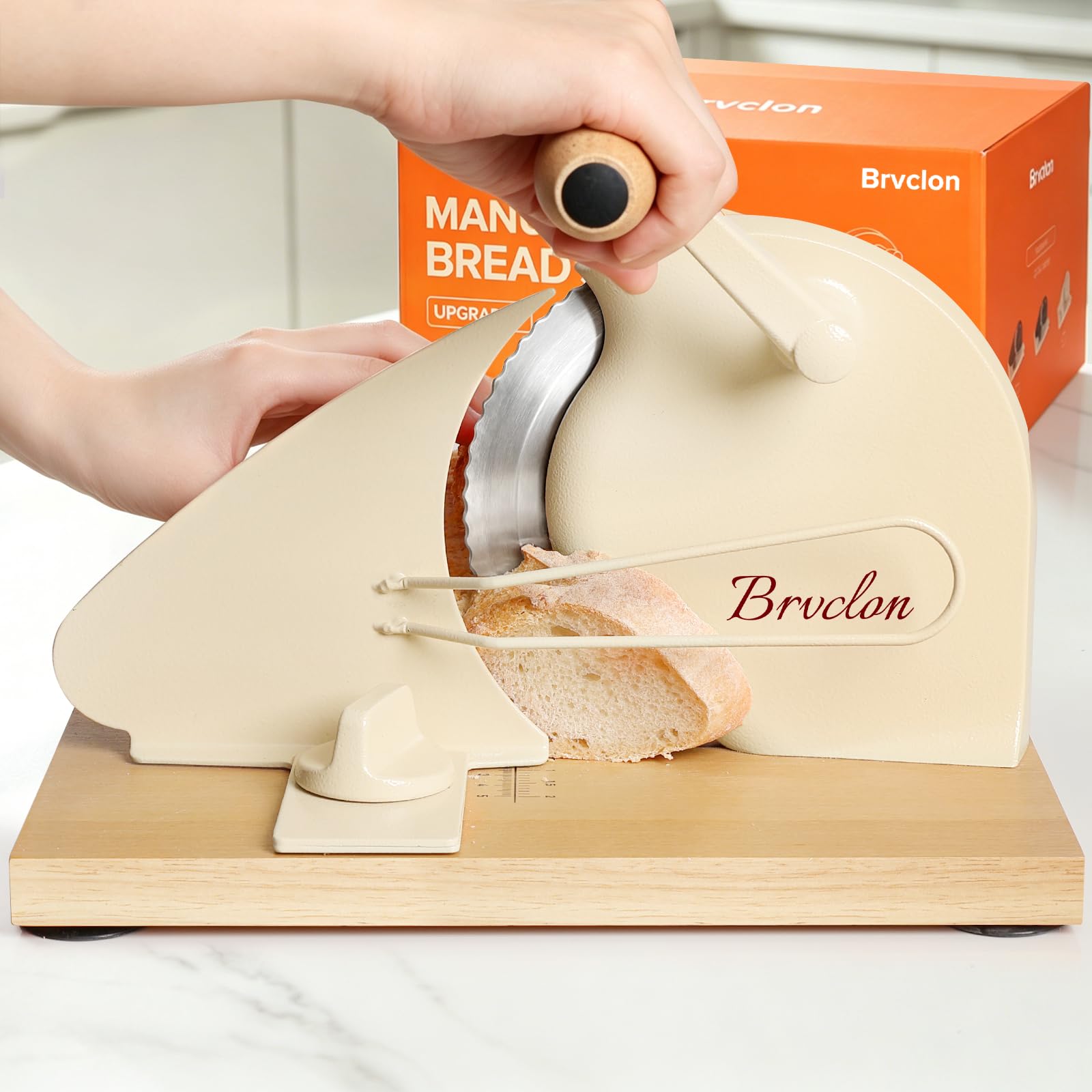
One crank machine that claims equal footing on crusty loaves and tender sandwich bread.
The pitch here is range. Thickness runs from 0 to 0.9 inches with clear scale markings on the knob, and the maker says it handles hard and soft breads alike — sourdough, sandwich loaves, bagels and artisan breads. A hand crank drives a 6.69 inch stainless steel blade, and the frame is built with an aluminum and southern oak wood base. That’s a real wood choice rather than a veneer, and it’s backed by a three-year manufacturer’s warranty.
What owners respond to is uniformity. The whole point of the machine is that every slice comes off at the same thickness, and that’s the thing people keep mentioning — evenly cut sourdough, with far less effort than working a knife through a loaf. Suction cups hold it firmly to the countertop so it doesn’t shift, and both the blade and the thickness dial are adjustable. Cleaning is a wipe of the surface with a cloth or brush, and the blade is removable and replaceable when it dulls.
The trade-off is the setup. It’s a compact 13.8 inch machine, but it’s still a machine — it wants a spot on the counter, and the suction cups mean you’ll clean the surface before mounting it. The fixed 6.69 inch blade suits most home loaves; just don’t expect it to power through a very wide boule the way a longer blade would. For a two-bread household — crusty on weekends, soft for the week — it’s a fair middle path.
One machine, two breads: 0 to 0.9 inch thickness and a stainless blade handle crusty and soft loaves from the same dial.
Southern oak base: a real wood foundation under the aluminum frame, with a three-year warranty behind it.
Fits best: a kitchen that bakes both crusty and soft breads and wants one machine to cover both.
Less ideal: if your loaves are very wide or you need drawer storage.
11. Zassenhaus Original Classic Adjustable Bread Slicer

German-built hardware with a Solingen stainless blade and a heritage name behind it.
If you want a slicer built to be kept rather than replaced, this is the one. The serrated blade is 18/8 stainless steel, crafted in Solingen, Germany — a city with a long reputation for cutting steel — and it sits in a classic aluminum and wood frame with a wood base. Thickness adjusts up to 0.7 inches from the base knob, and anti-slip suction cups hold the unit steady so you can guide the bread along the blade by turning the handle.
The mechanism is manual and deliberate: you set the base knob, seat the loaf, and turn the handle to move it through the blade. That control is why it works with crusty sourdough and freshly baked loaves alike, and why bakers find it simpler than wrestling a knife and board. The wood base looks good enough to leave out, and cleaning is a hand wash with a damp cloth to keep the finish and the blade in condition. It’s a 2.46 kg unit that sits firmly on the counter.
Here’s where you should slow down. Thickness tops out at 0.7 inches, so it won’t give you the very thickest slabs that the 0.9 inch machines will. German craftsmanship and the Solingen blade also make it the most premium item in this lineup by a wide margin, so the reason to buy is long-term build and feel, not extra features. If a slicer you pass down is the goal, this is the pick; if you want the widest thickness range, look at the crank machines above.
What earns the premium
- 18/8 stainless serrated blade crafted in Solingen, Germany.
- Aluminum and wood frame with anti-slip suction cups.
- Deliberate manual control that handles crusty and fresh loaves.
What balances it out
- Thickness stops at 0.7 inches, short of the 0.9 inch machines.
- Hand wash only with a damp cloth.
The premium argument: German steel and a wood-and-aluminum frame built to be kept, not replaced.
Where it falls short: if thick toast cuts above 0.7 inches matter, a wider-range machine serves you better.
Know the Specs
Slice Thickness (the knob or slot setting)
This is the measurement of each finished slice, usually written in inches. A thinner setting near a quarter inch gives you toast and tea sandwiches; something close to half an inch gives you the thick sourdough cuts that hold up in French toast. Machines that run up to 0.9 inches cover both ends from one dial, whilea guide with fixed slots covers only the thicknesses built into its frame. The useful question isn’t how many settings a slicer offers, but whether the setting holds firm while you cut. A knob that drifts mid-loaf leaves a wedge, which is the exact problem you bought the slicer to fix.
Blade Length (how much loaf one stroke covers)
Blade length is how long the cutting edge is, measured in inches. A longer blade clears a full loaf in one movement, so you’re less likely to saw back and forth and leave torn edges. The bow-design knife here runs a 10.7 inch blade on a 16.5 inch frame — that’s 62% more cutting edge than the 6.6 inch blades on the crank machines. A crank machine, by contrast, doesn’t rely on blade length alone; the handle drives the blade forward for you, so a 6.6 inch blade still finishes the cut.
Cutting Area (will your loaf actually fit?)
This is the width, height and length of the space the bread sits in, usually listed as three numbers in inches. It matters more than almost anything else, because a guide that can’t seat your loaf is useless no matter how good its slots are. A tall sourdough boule needs guides high enough to hold it upright. A 2 lb bread-machine loaf needs a wide, deep cutting area so it drops all the way in and the knife still locks to both rails.
Base and Suction Cups (does it stay put?)
Suction cups are small rubber pads that press onto a smooth countertop and hold the slicer in place while you cut. Solid wood and aluminum bases add weight so the whole unit stays steady under pressure. This matters because a slicer that slides turns a straight cut into a crooked one, and it’s also a safety point when a sharp blade is moving. Non-slip silicone feet on folding guides do a similar job in a lighter form.
Crumb Tray (where the mess goes)
A crumb tray is a shallow tray that sits under the slicing area and catches the pieces that fall as you cut. Many of them lift free and double as a serving board, and on folding guides the tray often stores the disassembled parts. If you slice over an open counter, a tray is the difference between a quick wipe and sweeping the whole surface afterward.
Hand Wash vs Dishwasher (how you keep it)
Most bamboo, wood and aluminum slicers are hand-wash only, usually with a damp cloth rather than a soak. That’s because water and heat can warp wood and dull a finish over time. Stainless blades and removable parts are easier to clean and replace. Check the care note before you buy: a wood or bamboo frame that needs hand washing is a different commitment than a removable stainless blade.
Common Questions
Will a bread slicer work with a tall sourdough boule?
Do I need a hand-crank machine or is a slicing guide enough?
What slice thickness should I set for sandwiches versus toast?
Will these slicers fit a 2 lb bread-machine loaf?
Do the suction cups work on every countertop?
How often will I need to sharpen or replace the blade?
Can I slice meat and cheese with a bread slicer?
Are these slicers dishwasher safe?
Will a left-handed person be able to use the bow-design knife?
Do I need a crumb tray or can I slice over a board?
The Bottom Line
For most home bakers, the winner is the Manual Bread Slicer for Homemade Sourdough because it turns thickness into a knob setting and a crank does the cutting — crusty sourdough and soft sandwich bread both come out even, and four suction cups keep the whole unit planted. If you already own a trusty serrated knife and want a compact guide that stores in its own crumb tray, the YONGAIJIA guide is the low-hassle way in. And for tall boules that defeat flatter guides, the Albert & Grace with its 6.1 inch walls is the one to reach for.
If you’d rather not match a knife to a guide yourself, the Bambüsi kit ships an 8-inch serrated blade, a bamboo frame and a crumb tray in one box. If you want a slicer built to be kept rather than replaced, the Zassenhaus pairs a Solingen-crafted 18/8 stainless blade with an aluminum and wood frame.
How we choose
We do not accept paid placement. Every pick is matched to a real buyer and a real use-case; we do not hands-on test units.
Sources
Specifications: manufacturer listings and product documentation. Review insights: verified customer reviews, as of October 2026. Pricing: not shown on this page (it changes often); check the current price via the retailer link.
As an Amazon Associate, Aappliancez earns from qualifying purchases. This does not affect which products we feature.