Disclosure: Some links in this post are affiliate links. As an Amazon Associate I earn from qualifying purchases, at no extra cost to you. Learn more
Specs are compiled from manufacturer listings and verified buyer reviews and can change over time — please confirm the key details on the product page before buying.
Cold kitchens are why so many loaves fail. Yeast slows down when the room drops below the mid-70s, so your dough sits there for hours and never doubles the way the recipe promised. A proofing box fixes that by holding a steady warm temperature around the dough instead of hoping your countertop cooperates.
This guide is built by comparing the manufacturers’ published specifications and the patterns across verified customer reviews, so you get each pick’s real strengths and trade-offs instead of marketing spin.
You will see which boxes hold temperature tightly and which ones drift a few degrees, which fit a 9-inch banneton plus a starter jar, and which fold flat enough for a drawer. Every pick here is chosen to make your rise predictable rather than a gamble — the shortlist below is the fastest route to a reliable bread proofing box.
Top Picks

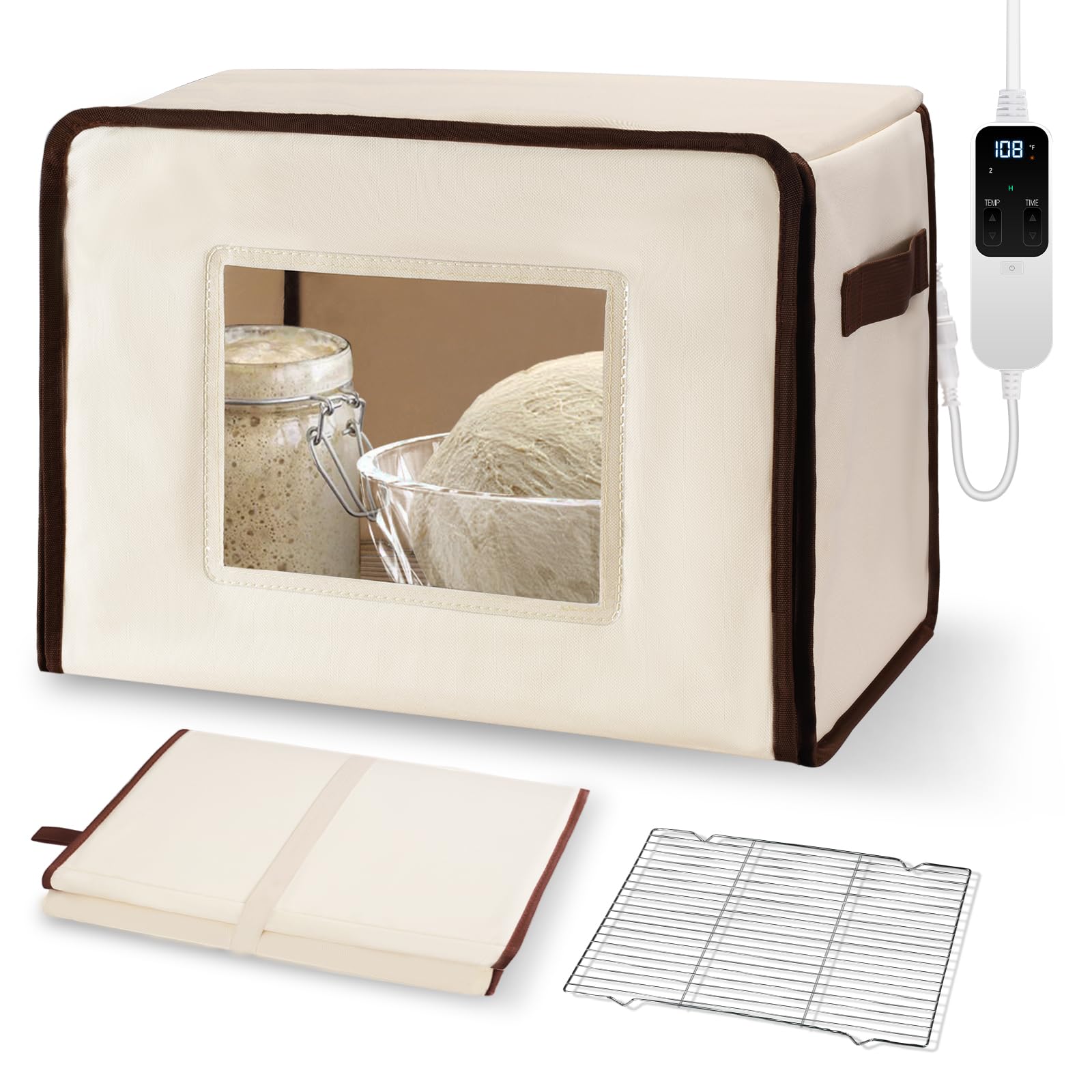

How To Choose The Best Bread Proofing Box
Most people buy a proofing box because their dough stalls in winter. The box does one job: holding the air around your dough at a warm, stable temperature for the hours it takes to rise. Beyond that, it depends on interior fit, storage, and how much babysitting you want. These are the specs that decide whether a box earns its counter space.
Temperature range and how tightly it holds
Sourdough bulk fermentation usually wants somewhere in the high 70s to low 80s Fahrenheit. A box that only reaches 113°F or 115°F covers that easily; one that tops out lower will struggle on a cold morning. The number on the dial is only half the story, though. What matters is whether the box holds that number. A unit with an NTC sensor (a small probe that reads the actual temperature rather than guessing from the heater) keeps closer to your setpoint than a simple on-off pad. A few degrees of drift is normal and rarely ruins a loaf, since dough is forgiving across a small window.
Interior space versus what you are actually proofing
A 9-inch round banneton (the woven basket that holds shaped sourdough) and a 40 oz starter jar are the two things most bakers want inside at once. Boxes with roughly 15 to 16 inches of width and 11 to 12 inches of depth handle that comfortably. If you proof two loaf pans or a 10-inch Dutch oven, check the interior dimensions before you buy — a box that fits one large bowl will not always take two pans side by side.
Folding design and where it lives between bakes
Fabric boxes fold flat in seconds and slide into a drawer. Some have a stitched loop so you can hang them on a wall hook. Hard-sided folding units collapse too, but usually need a cabinet shelf rather than a drawer. This is the trade-off most buyers feel daily: a soft Oxford-cloth box is easier to stash, while a rigid one tends to feel sturdier in the hand and holds its shape when you set a full bowl inside.
Side-by-Side Comparison
| Model | Best For | Temp Range | Timer | Interior / Capacity | Amazon |
|---|---|---|---|---|---|
| Brod & Taylor Folding Proofer & Slow Cooker★ Best Overall | Cold kitchens and year-round bakers | 70–120°F (proof); 85–195°F slow cook | — | 1475 cubic inches | Amazon |
| Suntee Folding Bread Proofing Box (Beige)Small-Kitchen Pick | Small kitchens and beginner sourdough | 68–115°F | 2–48 hours | Fits 9″ basket + 40 oz jar | Amazon |
| PCCIZU Dough Proofer Heating Pad with Warming BoxBudget Starter | Simple, low-cost bread proofing | 6 gear settings | — | 11.8″D x 9.8″W x 2.3″H | Amazon |
| MENGBEI Upgraded Foldable Proofing Box Kit | Beginners who want preset simplicity | 4 color-coded levels | — | Silicone bowl, small-medium loaf | Amazon |
| WOLTBLOOM Bread Proofing Box Kit | Serious bakers who want tools included | 68–131°F | Up to 99 hours | 11.8″D x 15.7″W x 11.8″H | Amazon |
| HEATIDEAS Bread Proofer Warming Box | Large bowls and bulk fermentation | 50–113°F | 0–48 hours | 15.75 x 13 x 9.8 inches | Amazon |
| VONATES Folding Proofing Box (M) | Multiple bowls and yogurt jars | 50–113°F | Up to 48 hours | 36 liters | Amazon |
| Uoxfill Folding Proofing Box | Monitoring rise without opening the lid | 50–122°F | 0–48 hours | 36 liters | Amazon |
| InnovifyHub Bread Proofing Box with Heater | Apartment kitchens and small batches | 50–130°F | 24 hours | Fits one bowl up to 5L | Amazon |
| GIYUDOT Folding Bread Proofing Box | Multi-batch baking and gifts | 50–113°F | Up to 48 hours | 36 liters | Amazon |
| McKesse Folding Dough Proofer | Full kit with basket and sling | 50–113°F | 1–48 hours | 36 liters | Amazon |
Detailed Reviews
1. Brod & Taylor Folding Proofer & Slow Cooker (Proofer)
Our pick — 4.5+★ from 1,000+ verified ratings; the strongest balance of quality and price.
The one appliance that proves dough in a cold kitchen and slow-cooks dinner afterward.
If your house runs cold in winter, this is the box that ends the guessing. It holds a 70–120°F temperature range with digital touch controls, so you dial in 78°F and the dough sits at 78°F rather than drifting with the room. The included water tray adds humidity, which means you can drop the plastic wrap and still keep a crust from forming on your shaped loaf.
What wins people over is the consistency in a genuinely cold home. Buyers report “Consistent 78°F proofing in 67°F home; controls proofing temperature variable” — that eleven-degree gap between room and box is exactly the problem most bakers are trying to solve. It is 8 pounds and measures 16″D x 20″W x 4″H folded, so it lives in a drawer and opens in seconds. The 1475 cubic inch capacity takes a 10×14 focaccia pan, and the 8-inch height under the lid clears an aliquot jar.
Here is the catch worth weighing: it costs more than any fabric box on this list, and a fair number of owners feel the slow-cooker feature they never use is baked into that figure. It does not ship with the accessory shelf — that is sold separately or in the bundle, and without it you are proofing one level rather than batching two trays of rolls. The lid also needs a careful visual check to seat flush, which is a small habit rather than a defect.
fold-and-cook combo
- Holds a set temperature in a cold room instead of chasing the ambient air
- Water tray supplies humidity so you can skip the plastic wrap
- Folds down to 2.75 inches and slides into a kitchen drawer
- Top window lets you watch the rise without lifting the lid
pricey for beginners
- The slow-cook mode (85–195°F) raises the price even if you never stew in it
- Accessory shelf for batch proofing is sold separately or in the bundle
- Lid needs a deliberate check to seat properly
bake and slow cook: your kitchen drops into the 60s and you want a hard-sided box that holds temperature like a thermostat, not a warm mat.
budget too tight: you only proof once a week and want to spend fabric-box money.
2. Suntee Folding Bread Proofing Box with 68-115℉ Temp Control
A fabric box that fits a 9-inch basket and a starter jar at the same time.
Space is the thing this box solves first. The interior takes a 9-inch proofing basket and a 40 oz proofing jar side by side, which is more than most soft-sided boxes manage. It weighs 3.4 pounds and measures 11.8″D x 15.75″W x 11.8″H open — next to the Brod & Taylor’s 20-inch width, that is a noticeably tighter footprint on a crowded counter.
Three heating zones do the work here: top, back, and bottom, which brings dough up to temperature faster than a single under-pad. The external controller runs 68–115°F with a 2–48 hour timer, and the front viewing window lets you check the rise without unzipping and losing the warm air. Interior temps land within a degree or two of the setpoint and hold there, so a bulk ferment becomes a scheduled event instead of a visual guess.
The honest note is the zipper. It is the most-discussed weak point on this box and it rewards a slow, deliberate pull rather than a fast one — treat it gently and it lasts. A small number of units have arrived with a controller that reads warmer than the inside actually is; a separate thermometer settles that question fast. The sealed five-layer insulation and waterproof lining do keep warmth in through winter, which is the whole point.
wide temp range: a small kitchen where one basket plus a starter jar is your whole weekly bake, and you want the box to disappear into a drawer afterward.
steady warm rises: counter space is tight and you want three-sided heat without paying hard-sided money.
counter space short: you plan to proof two full loaf pans at once — this interior is built around one basket.
3. PCCIZU Dough Proofer Heating Pad with Warming Box
Six simple gears and a soft box you fold away when the loaf is done.
This is the entry point into warm proofing, and it keeps things basic on purpose. You get a soft-sided warming box and a heating pad with six gear settings — no digital readout, no timer, no sensor. Set the gear, put your dough in, and let it sit. In a 60–65°F house it activates a sourdough starter and gets dough rising faster than the cold counter would allow.
The size is a genuine plus for small setups. It holds a bowl for roughly 2 pounds of dough, and the soft-sided design packs down and stores more easily than a rigid box. It measures 11.8″D x 9.8″W x 2.3″H, so it tucks away without drama. For pizza dough and simple yeast breads, it does the job it advertises.
The catch is temperature accuracy. The gauges do not map cleanly to the printed range — the low settings run warmer than you would expect, so the actual air can sit well above the number you dialed. There is no thermostat to hold a steady setpoint, which means you check the dough rather than trusting the dial. If you want repeatable 78°F proofing, budget for a separate thermometer and expect to experiment with which gear works in your room.
small dough batches: a first-time proofer who wants a warm box with a couple of pounds of dough and does not mind dialing by feel.
need full enclosure: the gear numbers and the real air temperature do not line up closely, so treat the dial as a starting point.
4. MENGBEI Upgraded Foldable Proofing Box Kit

Four colored buttons replace the temperature dial — pick a color and walk away.
If reading a temperature dial feels like a chore, this one is built for you. Four color-coded settings replace numbers entirely: red for conditions below 30°F, orange for 30–60°F, blue for 60–75°F, and green for anything above 75°F. You match the colored button to your room, and the box does the rest. It is the simplest control scheme on this list, and it covers dough, yogurt, and rice wine all from the same four buttons.
The silicone bowl is the quiet win. It is food-grade silicone, so it wipes and rinses clean where a woven banneton traps flour, and the folding design cuts storage volume substantially for a crowded cabinet. In a cool-morning kitchen the blue setting warms a bowl of dough steadily, and the bottom stays comfortable to the touch rather than hot — heat is directed up into the dough instead of down into your counter.
What you give up is precision. Four broad bands are not a setpoint, so the exact air temperature inside depends on your room, and the included accessories — cutter, bench scraper, silicone brush — are serviceable rather than special. This is a proofing bowl with a warm base, not a fermentation chamber; it will not hold a precise 78°F the way a sensor-driven box does. For casual weekly baking that trade is entirely reasonable.
complete kit included: a new sourdough baker in a cold house who wants one obvious button choice and a bowl that cleans up in seconds.
start from scratch: you want the simplest possible control and a silicone bowl that rinses clean.
want pro gear: you need a precise temperature number rather than four broad bands.
5. WOLTBLOOM Bread Proofing Box Kit with 9-Inch Basket
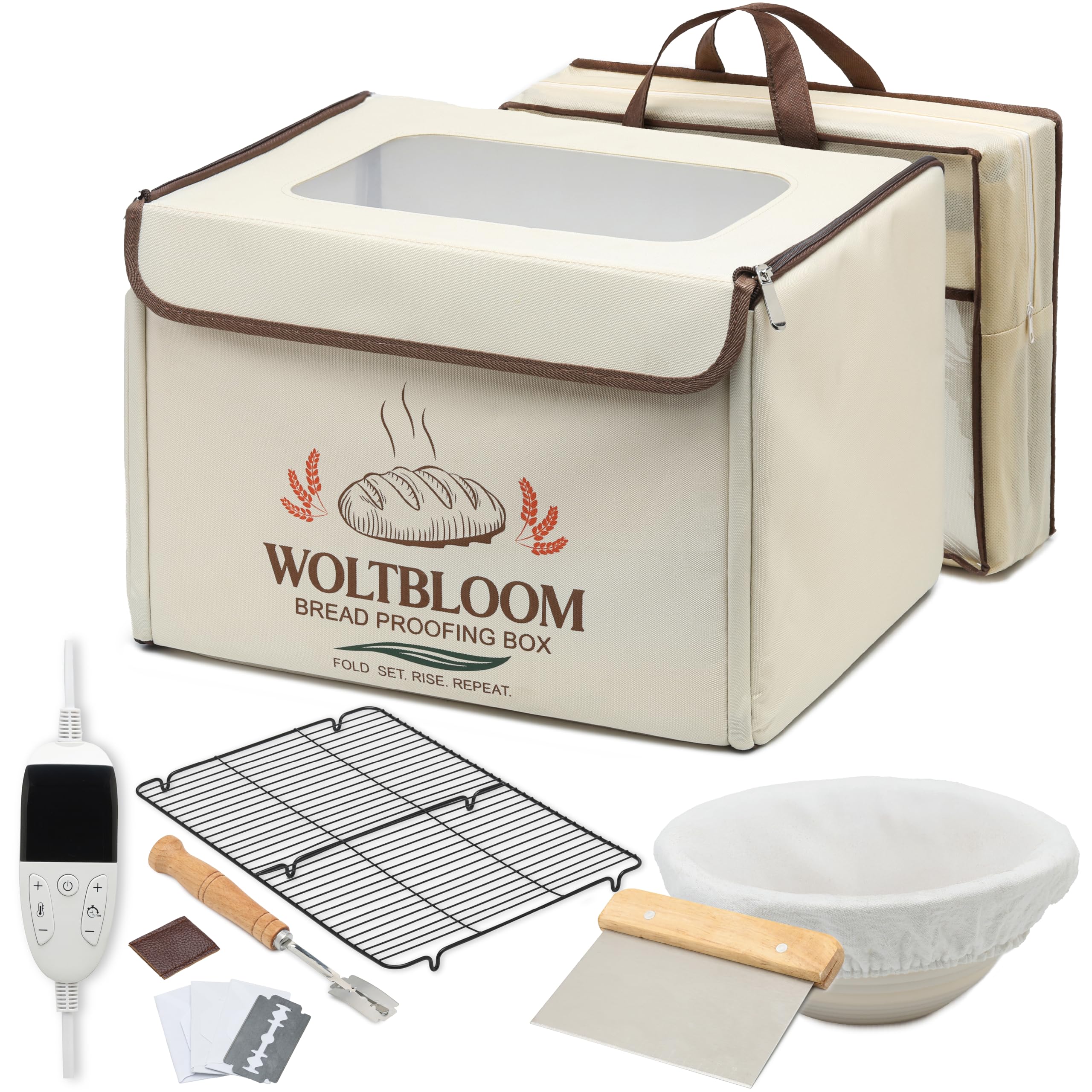
Everything to start sourdough in one box — basket, lame, scraper, and a 99-hour timer.
Buying a proofing box usually means buying the basket and the lame separately. This kit skips that step. Inside you get a 9-inch round silicone proofing basket, a bread lame with 5 blades, a metal scraper, a metal rack, and a recipe ebook with 9 recipes. The box itself runs 68–131°F across three heating zones with a timer that stretches to 99 hours and an automatic shut-off at 194°F to guard against overheating.
You can bake more than one loaf at a time in this folding box. Its interior measures 11.8″D x 15.7″W x 11.8″H, so it fits a 10-inch handled Dutch oven or a 15.5″x10″ roll pan — enough room for dinner rolls and gluten-free cinnamon rolls, not just a single boule. Five layers of insulation (padding that holds the heat in) and a waterproof interior mean you just wipe it clean. The included steel rack lifts your dough off the heating layer, so the bottom of your loaf does not scorch.
The temperature controller is the part to watch. Some units hold a steady temperature for a starter beautifully, while others drift a few degrees and need a nudge — and the first batch from the start has occasionally shown an error code before settling down. The controller sensor sits near the element, so it can read a touch lower than the air around your dough. Give it a test bake before you trust it with an overnight ferment.
proof and shape: you are assembling a sourdough starter kit from scratch and want the tools bundled with the box.
need precise heat: temperature readings can run a little off-set from the real air, so verify with a test bake first.
6. HEATIDEAS Bread Proofer Warming Box with Temperature Timer
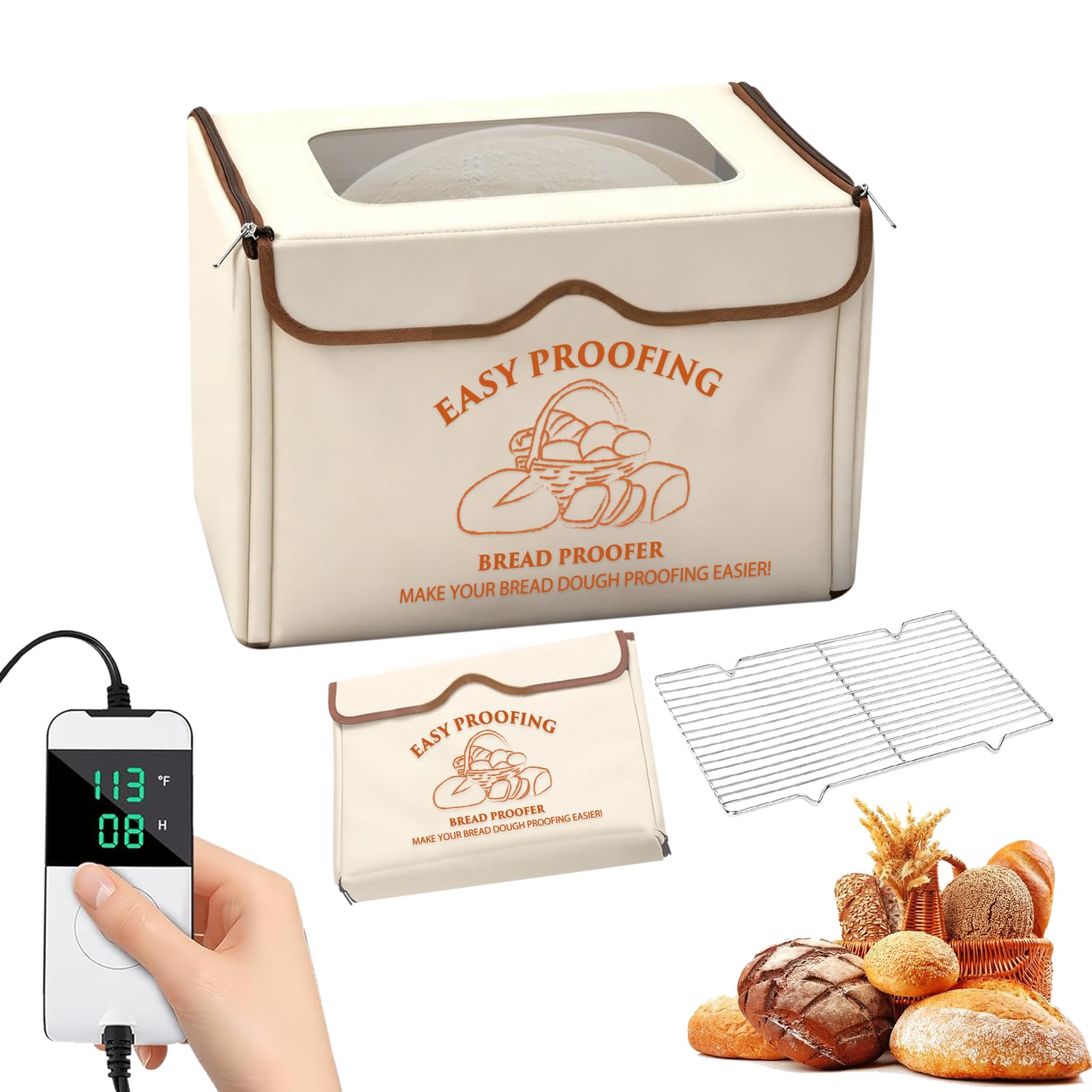
A vinyl box built around one large proofing bowl, with a probe that reads the dough itself.
The NTC probe is what separates this from a plain heated mat. You tape the sensor to the outside of your bowl or pan, and the controller reads the actual temperature of your proofing vessel rather than the air near the heater. In practice that means dough hits 82°F in about 45 minutes and doubles in roughly 90, with the second proof holding that same 82°F. The LED shows the live temperature, so you are watching the dough, not guessing from a dial.
The controller runs a 50–113°F range with a 0–48 hour timer, where 0 hours means always on. It draws 120V at 45W and reaches its set temperature quickly. The enclosure measures 15.75 x 13 x 9.8 inches and is sized to fit one standard proofing bowl comfortably, with a 7-foot cord that gives you room to place it away from the counter edge.
The structural weak point is the zipper on top, which is the part most likely to wear out over years of opening and closing. The bottom also warms through, so setting the box on a cooling rack for air circulation keeps your countertop safe.
timer and thermostat
- Probe reads the temperature at your bowl, not just ambient air
- Dough reaches 82°F in about 45 minutes on the first proof
- Folds flat and fits a standard proofing bowl
- 7-foot cord allows flexible placement
heavier unit
- Zippered top is the first part likely to wear
- Bottom runs warm, so raise it on a rack
- Displayed temperature can sit a few degrees off true air
set and forget: you proof in a big mixing bowl and want the probe reading the bowl, not the box.
travel with it: plan to raise it off the counter and treat the zipper with care.
7. VONATES Folding Bread Proofing Box (M)
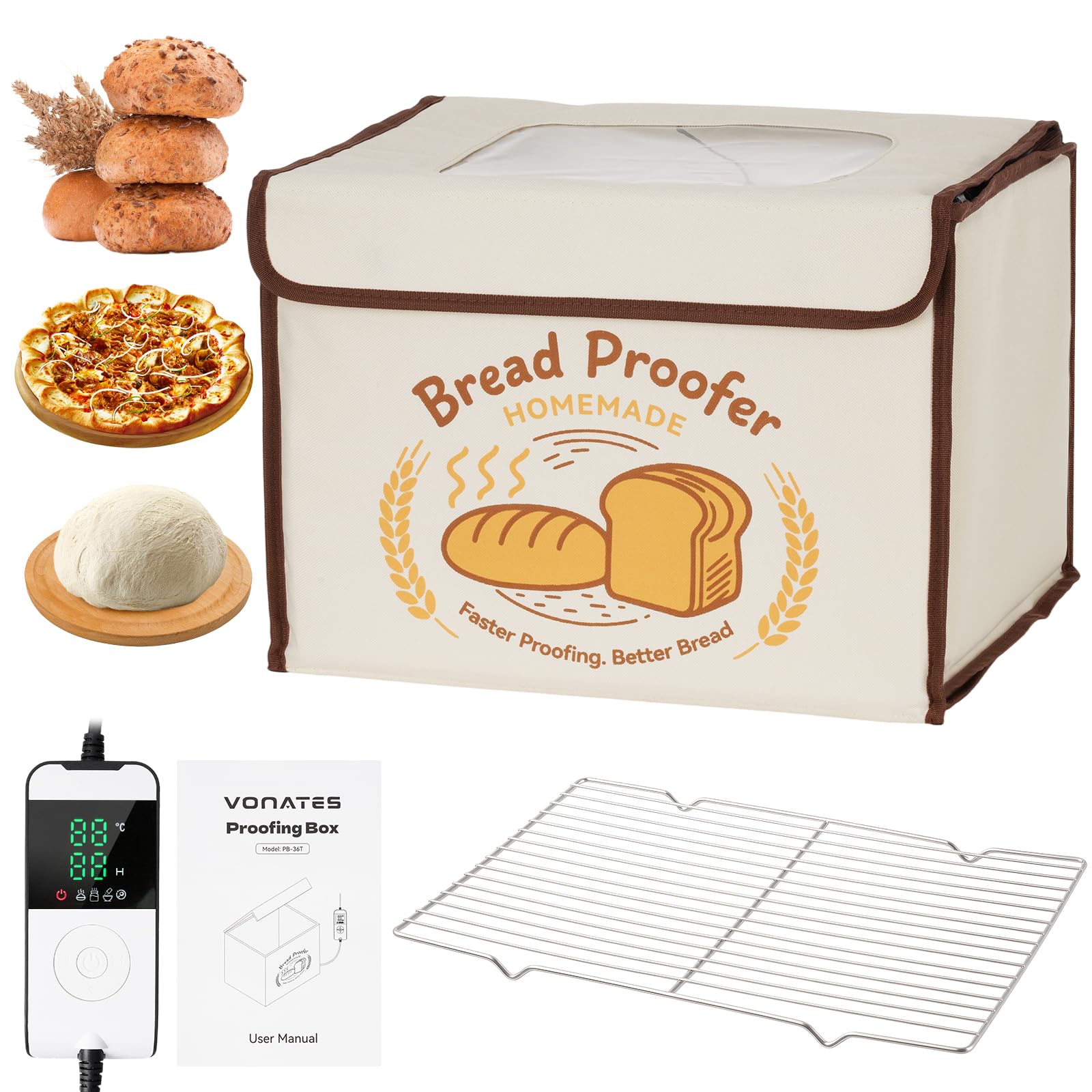
A 36-liter interior that holds multiple bowls, loaves, or a row of yogurt jars.
This box wins on room. At 36 liters across 15.7 x 11.8 x 11.8 inches, it holds multiple dough bowls, several sourdough loaves, or yogurt jars without crowding — enough to batch a whole weekend’s bake in one go. Four preset modes (Bread, Yogurt, Sourdough Feeding, Sourdough Activation) set the temperature for you, so you skip the guesswork. The controller runs 50–113°F (10–45°C) with a timer up to 48 hours, or continuous 24/7 operation.
Three heating zones sit at the front, back, and bottom, wrapping the dough in warmth rather than warming just one surface. Preheating takes about 3–10 minutes, and an NTC sensor keeps the setpoint steady while a stainless steel shelf lifts the dough off the bottom heating layer. Five layers of insulation lock the warmth in. It also has a memory function that saves your last temperature and time, so a repeat weekly bake is one button away.
A few practical quirks are worth knowing. The controller beeps for 10 seconds when preheat and fermentation finish, then repeats every 3 minutes until you press the plus key or switch it off — handy if you wander off, mildly insistent if you are in the room. If an EE code (an error message) shows on the screen at plug-in, check that the power cord and controller are fully tightened; that is the usual cause. Some UK-plug units have shipped without clear warning, so confirm the plug type for your region before ordering.
folds flat fast: a busy baker proofing several loaves or bowls at once, who wants presets and a memory function to cut setup time.
tight kitchens: large batches and anyone who wants the box to remember last week’s settings.
large loaves only: confirm the plug type for your region, since UK-plug units have reached buyers unexpectedly.
8. Uoxfill Folding Bread Proofing Box with Hygrometer

A clear acrylic window and built-in hygrometer let you watch the rise without breaking the seal.
Most boxes make you choose between keeping the warm air in and seeing how the dough is doing. This one gives you both. The transparent acrylic window on top shows the rise, and a hygrometer mounted alongside it reads the humidity inside the chamber. The interior runs 15.7″ x 11.8″ x 11.8″ across 36 liters, so multiple batches or a large quantity fit easily without stacking on each other.
Three heating zones — front, back, and bottom — surround the dough with even warmth across a 50–122°F range, with a timer from 0–48 hours. Five layers of insulation keep the temperature steady, the waterproof interior wipes clean, and the stainless steel shelf keeps dough off the hot base. If no timer is set, the unit shuts off automatically after 4 hours, which is a nice safety floor for anyone nervous about an unattended heater.
One detail to plan around: the power button needs a 3-second press-and-hold to turn the controller on after plugging in, which confuses a few first-time users into thinking the box is dead. Beyond that, setup is straightforward and the folding design stores flat. It is the box to buy if the humidity reading matters to you — a dry chamber toughens the surface of a shaped loaf, and watching that number makes the fix obvious.
track the moisture: a baker who wants to see temperature and humidity at a glance and prefers not to unzip the box.
hate extra gadgets: hold the power button for 3 seconds to switch it on.
9. InnovifyHub Bread Proofing Box with Heater
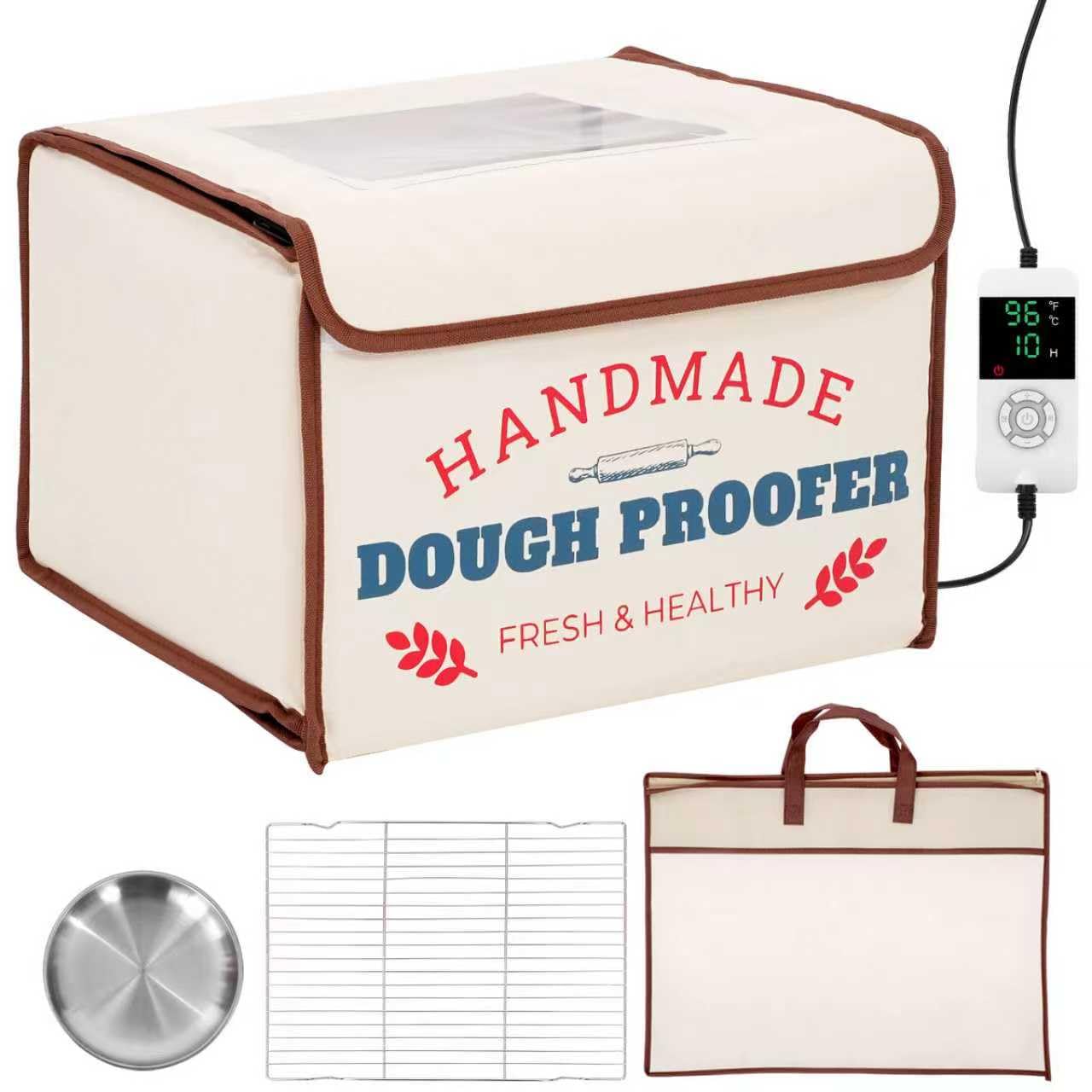
A small-chamber box that heats fast, fits one big bowl, and folds almost flat.
The narrower chamber is the point here. A smaller space heats up faster and holds stability with less energy, and this box leans into that: it fits one large mixing bowl up to 5L, a banneton, or several mason jars for a starter. It runs a full 50–130°F range with three-sided heat, a 24-hour timer, and an audible alarm that beeps when your proof is done rather than leaving you to check a clock.
The controls are the smart part. A one-touch °C/°F toggle switches units instantly, which matters if you follow international recipes calling for 27°C instead of 80°F. An NTC sensor holds the air steady through an overnight ferment, and automatic overheat protection adds a safety backstop. It weighs 2.5 pounds and measures 11.8″D x 21.6″W x 11.8″H, folding ultra-flat for a cabinet or RV shelf.
The trade is capacity. This is built for a single bowl and small-batch work — a 5L bowl or a set of yogurt jars — so if you routinely proof two loaves or a big Dutch oven, this chamber is too tight. It suits apartment bakers who value speed and a small footprint over batch volume. For a starter maintenance routine and a single boule, that is a fair fit.
active heater inside: a fast-heating single-bowl chamber with a °C/°F toggle and a timer alarm that ends the phone-checking.
single loaf rises: apartment and RV kitchens where fast heat and a tiny footprint beat batch capacity.
bake for crowds: two-loaf bakes or large Dutch oven proofing — the chamber is sized for one bowl.
10. GIYUDOT Folding Bread Proofing Box with Humidor
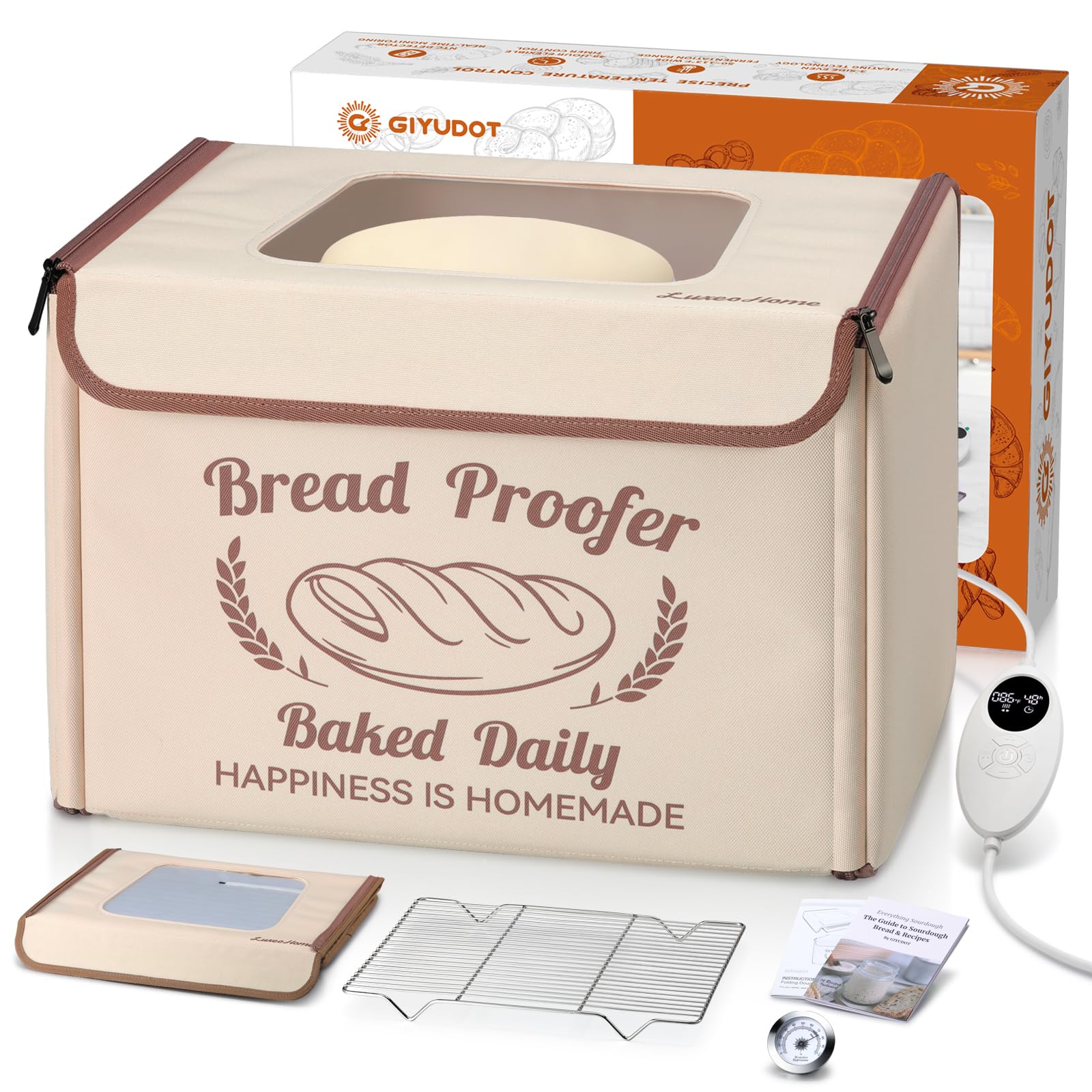
A 36-liter box that swallows two large dough containers and comes with a humidor.
If you proof in Cambro tubs, this is the interior that takes them. The 16 x 12 x 12 inch space handles 6 L and 4 L dough containers together, and the folding design collapses for storage when the bake is done. Three heating zones run 50–113°F with a timer up to 48 hours and automatic shut-off at 131°F, and the waterproof food-grade interior wipes clean while the stainless steel shelf keeps heat off the dough.
What makes this one easy to live with is the detail kit. Alongside the box you get a stainless steel rack, a humidor, a detailed user manual, and a Guide to Sourdough Bread & Recipes, packaged in a gift box. An NTC sensor continuously monitors the air inside and holds it steady, which is what turns a flaky rise into a repeatable one. The transparent acrylic viewing window lets you check progress without opening the lid.
The honest caveat is a small sensor offset. Because the probe reads near the heating element rather than the center of the chamber, the air around your dough can run a few degrees above the setpoint — set 74°F and you may see around 77°F inside. It is a consistent offset, not a swing, so you learn to adjust the dial and move on. A separate thermometer gives you the true number if you want to be exact.
humidor holds damp
- Holds two 4–6 L dough containers with room to spare
- Humidor plus steel rack included for humidity and even heat
- Folds flat and comes with recipes and a user guide
- Timer and auto shut-off take the worry out of overnight ferments
fiddly to seal
- Internal air can read a few degrees above the set number
- Sturdy two-zipper closure needs to be seated fully each time
crisp crust dough: bakers running two dough tubs at once who want a humidor and rack in the box.
dry climate only: dial a few degrees lower than your target to account for the sensor offset.
11. McKesse Folding Dough Proofer with Silicone Basket
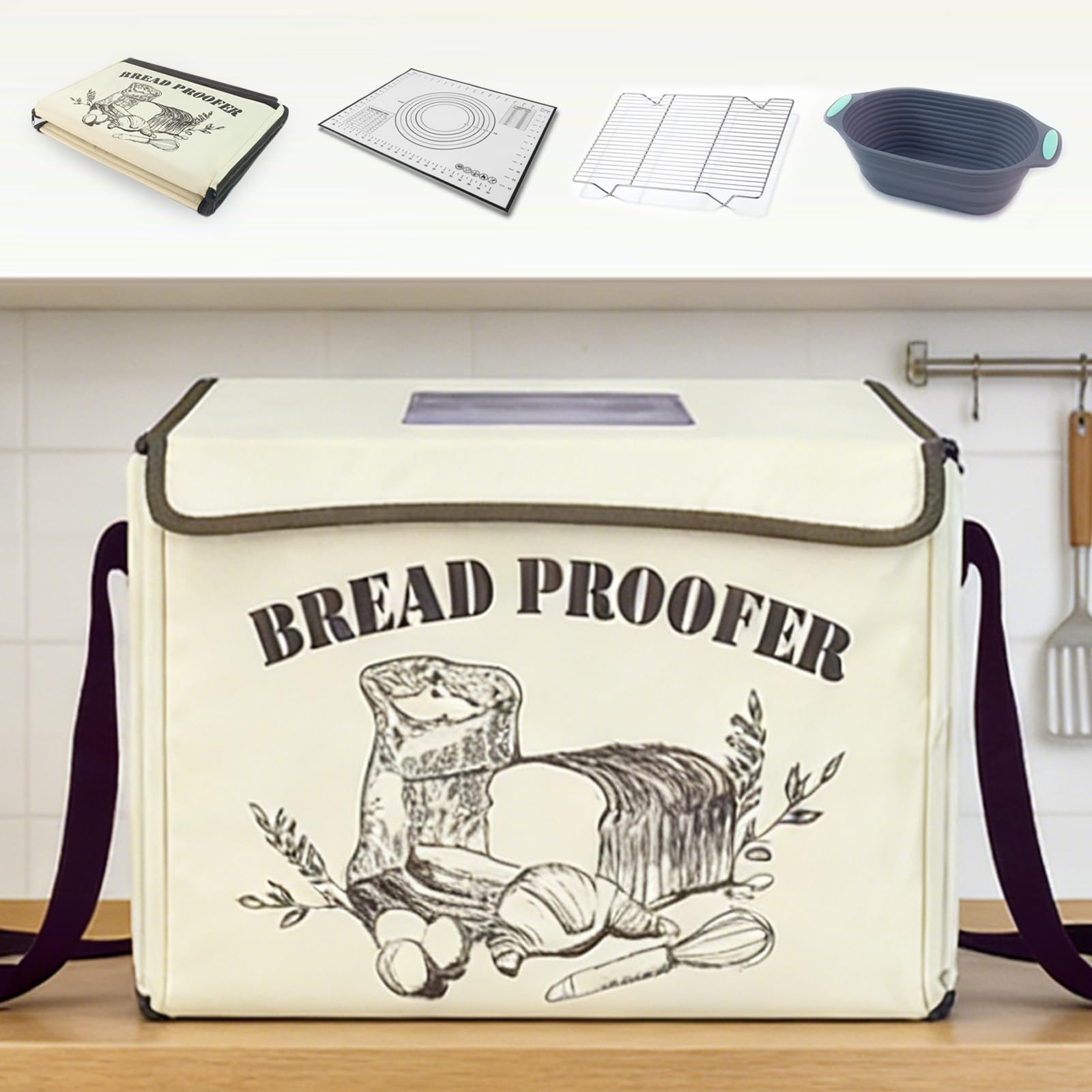
Fifteen fine temperature steps and a silicone proofing basket in one folding kit.
Where most boxes give you a dial and a handful of increments, this one offers 15 temperature steps from 50–113°F. That matters if you like to nudge fermentation up or down by a couple of degrees for a starter versus a bulk dough. The viewing window lets you check progress without repeatedly opening the box, and the flexible 1–48 hour timer runs in one-hour steps up to 12 hours, then jumps to 24, 36, or 48. It draws 40 watts at 110–120V, 60Hz.
The construction is built for warmth and easy cleanup. A 420D Oxford fabric exterior wraps a honeycomb support panel, EPE foam, aluminum foil layer, and a thickened waterproof TPU inner lining that holds heat in and wipes out quickly. The kit includes the folding box, stainless steel rack, humidity tray, silicone proofing basket, and silicone bread sling — enough to start sourdough without buying the tools separately. The 36-liter interior measures 16″L x 12″W x 12″H and weighs 1.2 kg.
What you should know is that this is the newest design here and the thinnest track record of any pick on the list, so the long-term durability of the fabric shell and controller is simply unproven. Fifteen steps also means more dialing than a three-button preset box; if you want one-button simplicity, this is more control than you need. For a baker who likes to fine-tune the exact temperature for different ferments, the granularity is the whole appeal.
gentle dough handling: you want fine temperature steps and a complete kit with a silicone basket and sling included.
want rigid frame: it is the newest design on the list, so there is no long history to judge durability by.
Know the Specs
Temperature range and setpoint control
The range is the spread of temperatures the box can hold, often something like 50–113°F or 70–120°F. Sourdough bulk fermentation usually wants the high 70s to low 80s, so a box topping out at 113°F covers it. A sensor — often an NTC probe — reads the actual temperature and keeps the heater cycling to match your setpoint, which holds steadier than a simple gear dial. A few degrees of offset is common because the probe can sit near the heating element rather than the center of the chamber.
Interior space and folding storage
Interior space is what determines whether a 9-inch banneton, a large mixing bowl, or two loaf pans fit inside. Fabric boxes fold flat and slide into a drawer or hang on a wall loop; hard-sided folding units collapse but usually need a cabinet shelf. A soft shell is easier to stash, while a rigid one holds its shape when you set a full bowl inside. Size the interior to your usual batch and pick a fold that fits where the box is stored.
Common Questions
What temperature should a bread proofing box be set to?
Will a proofing box actually help if my kitchen is cold?
Can I proof two loaves at once in one of these boxes?
Do I need a separate thermometer if the box has a controller?
Is a soft fabric box as good as a hard-sided proofer?
Can I use these boxes for yogurt and kombucha too?
How long does a proofing box take to reach its set temperature?
What does an EE error on the display mean?
Do I still need to cover my dough with plastic wrap inside the box?
How do I store a folding proofing box between bakes?
The Bottom Line
If your kitchen runs cold, the bread proofing box to buy is the Brod & Taylor Folding Proofer & Slow Cooker. It holds a set temperature in a cold room instead of chasing the room’s air, and it folds into a drawer when the bake is done. Want a fabric box that takes a 9-inch basket plus a starter jar? Grab the Suntee Folding Bread Proofing Box. And for a 36-liter interior that swallows two large dough containers, reach for the GIYUDOT Folding Bread Proofing Box.
The crowd favorite earns its spot the hard way — the Brod & Taylor carries a 4.5+ rating across 1,400+ owners, and it earns that score on temperature consistency in real cold-kitchen conditions. If your weekly bake is one loaf and one starter jar, the Suntee or the GIYUDOT will get you there for less and stash away faster. Match the interior to your batch size, confirm the range reaches the high 70s, and pick a fold that fits your kitchen.
How we choose
We do not accept paid placement. Every pick is matched to a real buyer and a real use-case; we do not hands-on test units.
Sources
Specifications: manufacturer listings and product documentation. Review insights: verified customer reviews, as of October 2026. Pricing: not shown on this page (it changes often); check the current price via the retailer link.
As an Amazon Associate, Aappliancez earns from qualifying purchases. This does not affect which products we feature.