Disclosure: Some links in this post are affiliate links. As an Amazon Associate I earn from qualifying purchases, at no extra cost to you. Learn more
Specs are compiled from manufacturer listings and verified buyer reviews and can change over time — please confirm the key details on the product page before buying.
If you are managing stage 3 chronic kidney disease, the bread aisle is the hardest five feet in the grocery store. Almost every loaf, bun, and roll is built on salt, and salt is the one ingredient your care team keeps telling you to watch. A handful of genuinely low-sodium breads exist, and they still chew and fold like real bread. The picks below cover the two things that matter most: sodium you can actually see on the label, and a texture you will want to eat again tomorrow. The top pick is the Quaker Large Rice Cakes, Salt Free — crisp, salt-free, and easy to top with whatever your meal plan allows.
This guide is built by comparing the manufacturers’ published specifications and the patterns across verified customer reviews, so you get each pick’s real strengths and trade-offs instead of marketing spin.
When you have kidney disease, the sodium number on the label matters more than the price. Check that line first, then look at carbs and fiber so the rest of your day still fits. This guide covers the labels, the freezer math, and the trade-offs behind every bread for ckd stage 3 pick here.
Top Picks

How To Choose The Best Bread for CKD Stage 3
The single number that decides whether a bread belongs in your cart is sodium per serving. Most sandwich breads carry a meaningful salt load per slice, and two slices plus a salty filling can eat a large share of a low-sodium day. Before you compare anything else, flip the package over and find the sodium line. If a bread says “no added salt” or “salt free,” that is your starting shortlist.
Next, check what the bread is made of. A short ingredient list of whole grains, water, and yeast tells you more than a front-of-bag claim does. Watch for ingredients you do not recognize. Also note whether the grain is whole kernel rye, whole wheat, or brown rice. Those bases tend to carry more fiber per slice, so a small portion feels like a real meal.
Why the sodium line outranks every other label claim
Sodium is the nutrient most closely tied to the fluid and blood-pressure side of kidney care, so it is the one figure your clinician will ask about first. A bread with a strong whole-grain story but a heavy salt load is still a bread you will need to budget around for the rest of the day. A lower-sodium bread gives you room to add a topping you actually enjoy, like peanut butter or a slice of cheese.
Reading net carbs, fiber, and calories together
Fiber and net carbs describe two different things, and both matter. Fiber is the part of the grain your body does not fully break down, so a higher-fiber slice tends to keep you full longer on fewer slices. Net carbs — total carbs minus fiber — tell you how much of the bread lands as usable carbohydrate. If your meal plan counts carbs, compare that net figure across the packages rather than the total carb line alone.
Shelf life and freezer reality
Fresh-baked flatbreads and pitas usually ship fresh, not frozen, which means the countdown starts the day the box lands. Freezing what you will not eat in the next few days is the single easiest way to avoid waste and to keep a portion-controlled stash on hand. Breads that hold up for months in the freezer let you buy in a larger pack without losing half of it to the bin.
Side-by-Side Comparison
| Model | Best For | Sodium Positioning | Grain Base | Total Units | Amazon |
|---|---|---|---|---|---|
| Quaker Large Rice Cakes, Salt Free★ Best Overall | Topping-friendly snacks | Salt free | Whole grain brown rice | 13.5 Ounce | Amazon |
| Joseph’s Bakery Lavash Bread, Flax Oat Bran & Whole WheatTop Performer | Wraps and thin-crust pizza | Reduced carb | Flax, oat bran, whole wheat | 27 Ounce | Amazon |
| Mestemacher Natural High Fiber Bread 3 Flavor Variety Bundle | Toast and sandwiches | No preservatives | Rye, pumpernickel, three grain | 52.8 Ounce | Amazon |
| Toufayan KETO Pita Bread | Stuffed pockets on a keto plan | 0g sugar | Keto hearth-baked pita | 26.7 Ounce | Amazon |
| Toufayan No Added Salt Whole Wheat Pitettes | Sodium watchers who want real pita | No added salt | Whole wheat | 24 Ounce | Amazon |
Detailed Reviews
1. Quaker Large Rice Cakes, Salt Free, 8.53 Ounce (Pack of 3)
Our pick — over 4.5★ from 550+ verified ratings; the strongest balance of quality and price.
The salt-free crunch that lets you build your own low-sodium plate from scratch.
For anyone counting sodium gram by gram, a rice cake is the rare bread-adjacent food where the salt question is already settled. Each cake is 35 calories per serving, made from whole grain brown rice, and baked rather than fried. That means an empty-handed base you can top with whatever fits your plan — a spoon of peanut butter, a smear of hummus, a slice of low-sodium cheese. Nothing is pre-seasoned, so the sodium decision stays in your hands.
Check the pack size too. Each box holds 13.5 ounces across three packs. That is roughly 3.9 times the volume of the Toufayan KETO Pita Bread’s 26.7-ounce total. Unlike the pita, a rice cake does not go stale the moment you open the bag if you keep it sealed and dry. This is the pick for a household that eats a small portion most days rather than one big sandwich, since a single cake is a controllable unit. Crumbs are minimal too, which matters if you load one up with a wet topping.
What wins people over here is the crunch — a crisp, evenly puffed bite with no salt to mask a stale cake. The trade-off is flavor: plain rice cakes taste like plain rice cakes, and the crunch arrives well before any seasoning does. A little peanut butter or a savory spread fixes that in seconds. It is also a gluten-free product rather than a grain-rich loaf, so if you specifically want a slice of whole-grain bread in your hand, this is a crunchier stand-in rather than a true replacement.
The case for a blank base
- Salt free with 35 calories per serving, so you control every gram of sodium that lands on the plate
- Whole grain brown rice, baked for a crisp puffed texture that holds up under peanut butter or hummus
- Three packs of 8.53 ounces each, so you can keep one open and two sealed and dry
- Gluten free, which keeps it usable if gluten is also off the table
Where it needs help
- On its own it is plain, so plan on a topping you already enjoy
- It is a crisp snack base, not a soft slice — if you want the chew of real bread, this will not satisfy that
- Verified buyers report the grocery store rarely carries the salt-free version, so online ordering is the practical route
Reach for this if: you want a topping platform you can portion one cake at a time and salt to your own plan.
Look elsewhere if: you need something that behaves like a soft sandwich slice.
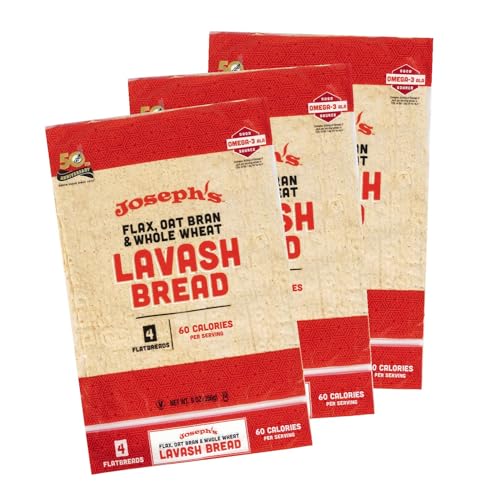
2. Joseph’s Bakery Lavash Bread Flax
A big, thin, flexible sheet that turns a single wrap into a full plate of food.
Take a look at the numbers before anything else: 6g net carbs and 60 calories per serving, with each lavash measuring 11.5″ x 8.25″. That is a large, workable surface, and it is the reason this one gets reached for over smaller flatbreads. Roll a whole chicken breast and a handful of spinach into one sheet and you have lunch with the carbs and sodium both under your control, since the seasoning decision is yours. The math checks out against the pack: three packages of four lavash each, so twelve sheets in total.
Storage is where this bread separates itself. The flatbreads ship FRESH, not frozen, which is convenient but starts a clock — consume within two weeks, or freeze unopened for up to 1 year and then use within 30 days after defrosting. That window is generous for a fresh-baked product, and it means you can buy the twelve-pack without watching half of it spoil. A resealable bag at room temperature keeps a single pack good for about a week.
Owners mention taste more than anything else on this one. It is the dominant theme in the feedback. Customers note a soft sheet that makes a convincing low-carb pizza base and a sturdy wrap for chicken, spinach, and cheese. The recurring gripe is durability: the sheets can tear more easily than a standard tortilla, so treat them gently when you load a wet filling.
What the sheet size buys you: at 11.5″ x 8.25″ it is roughly 1.5 times the footprint of the Mestemacher loaves at 6 x 7 inches. So a single wrap carries far more filling before it starts to feel like a thin snack. It is also vegan and kosher, which keeps it usable across more than one diet in the house.
The flax angle: flax, oat bran, and whole wheat are the grain story here, and the manufacturer lists it as a good source of Omega-3 ALA. That is a nutritional-features claim on the packaging, not a health promise — read it as a label detail note, not a treatment for anything.
Pick this one for: wraps, pinwheels, and air-fryer taco pockets where a big thin sheet is the whole point.
Then weigh the caveat: if you prefer bread that will not tear, the Mestemacher rye loaves below hold together better under a loaded filling.
3. Mestemacher Natural High Fiber Bread 3 Flavor Variety Bundle
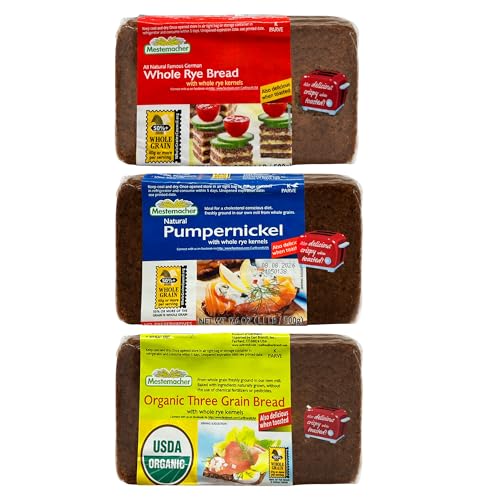
Three dense European rye loaves that sit on a shelf for months without a single preservative.
This bundle puts three different ryes in your pantry at once: Organic Three Grain, Pumpernickel, and Whole Rye, each a 17.6-ounce loaf. The ingredient lists are short and readable across all three — whole kernel rye, water, wholemeal rye flour, salt, oat fiber, and yeast, with malt extract and no preservatives in the pumpernickel version. Every ingredient is one you can pronounce. The Organic Three Grain version adds organic oat flakes, barley flakes, flax seed, sea salt, and sesame.
Where this one beats the lighter flatbreads is in bulk and staying power. At 52.8 ounces across the three loaves, it is by far the largest total here — the Toufayan pitettes come in at 24 ounces, which covers less than half that amount of bread. The loaves are pre-sliced and dense, the kind of bread that lasts for months on a shelf, and the pieces hold together far better than a thin wrap when you load them with a heavy filling.
The recurring gripe is crumbly slices. The bread is dense and dry by design, which is exactly why it keeps so well. But that also means some packages arrive with broken slices, and a few buyers describe the texture as very dry straight from the bag. Toasting it helps a lot — the flavor opens up and the slices firm into a proper piece of toast. This is not a soft sandwich loaf. A wetter topping like cream cheese or a generous spread of hummus goes a long way toward balancing the density.
Flavor range across the three loaves: the pumpernickel is the most intense of the three. The whole rye sits in the middle. The three-grain is the mildest and the easiest one to use with sweet toppings like fruit spread or a little honey.
What to know about the shape: the loaves are tall and oddly proportioned, so they do not fit most standard toasters without some fiddling. A toaster oven or a broiler settles the matter in a couple of minutes.
This suits: a household that wants a real bread slice with a deep grain flavor and only needs to store it in the pantry.
One thing to plan around: buy a toaster oven or expect to eat it as-is — the loaf shape makes standard toasting awkward.
4. Toufayan KETO Pita Bread 3 Pack
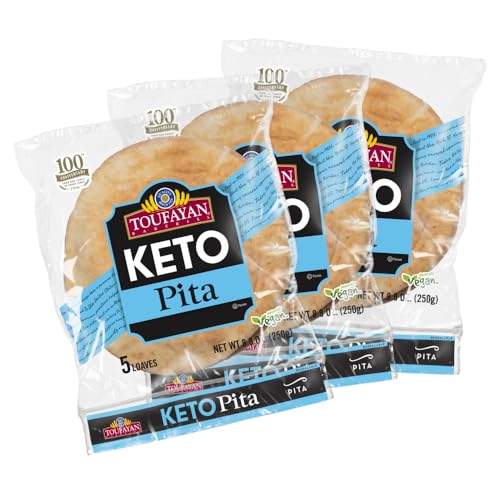
Pita that tastes like the real thing, with a pocket built for stuffing.
The macro line is the headline: 5 net carbs, 14g fiber, 7g protein, and 0g sugar per pita. Those macros come in a pita that chews and folds like the real thing. The rounds are hearth-baked the traditional way so the pocket forms on its own, which means you can open one up and load it without reaching for a knife. Fifteen pitas come in the box, split across three resealable packages, so you can keep one pack out and two sealed.
Freezer handling is the practical skill here. These ship fresh and the maker asks you to freeze them on arrival for up to 8 months, then thaw as needed and eat within 5 days. Read the date stamp carefully — it is a manufacturing date, not an expiration date, so the printed number tells you how old the bake is, not when it goes bad. Reading it correctly keeps you from tossing pitas that are still good.
Taste scores well across the feedback, with owners describing a texture close to regular pita and no aftertaste — a common complaint with low-carb breads. The pocket is the weak spot. It tears more easily than a traditional pita once you load it, so a gentler hand works better with a wet filling, and a thinner pita rewards a lighter stuff.
Why the macros matter
- 5 net carbs, 14g fiber, 7g protein per pita gives you a bread that pulls its weight on a low-carb plan
- Hearth-baked pockets form naturally, so you can stuff without cutting
- Vegan and kosher, baked by a family bakery that has been at it since 1926
- Freezes for up to 8 months, so the 15-count pack does not go to waste
Where it falls short
- The pocket tears if you overstuff it, so build light
- Some buyers find it pricey for the count, so watch the per-pita value
- Not a low-sodium product by design — this is the carb play, not the salt play
Best fit: a keto or low-carb household that misses the chew and fold of a real pita.
Not the right pick: if sodium is your primary driver — the Toufayan No Added Salt Pitettes are the sibling built for that job.
5. Toufayan No Added Salt Whole Wheat Pitettes Pita Bread 3 Pack
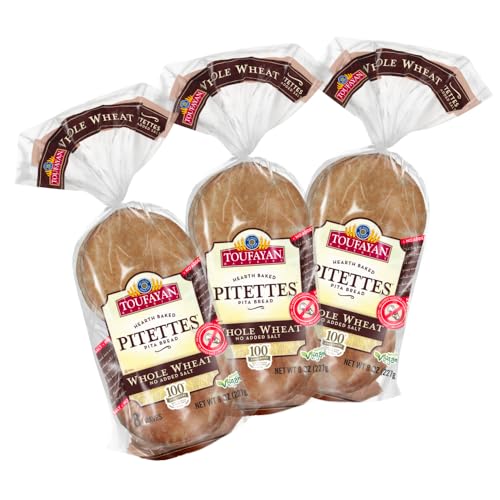
Real whole wheat pita with the salt left out entirely, in a size that fits a portion plan.
Whole wheat bread with no added salt is genuinely hard to find on a shelf, and this one is the most direct answer for a sodium-focused shopper. The key word is “no added salt,” meaning the recipe is built without a salt addition rather than promising a salt-free finished product — read the panel yourself so you know exactly what you are getting. The rounds are hearth-baked so the pocket forms naturally, and the size is smaller than a full pita, which makes a single round an easy portion to count.
Storage follows the same playbook as its keto sibling: freeze on arrival for up to 8 months, thaw only what you need, and eat within 5 days of defrosting. Twenty-four pitas total across three packs means you can keep most of the box frozen and pull out a week’s worth at a time. That keeps a 24-pita box from going stale before you finish it.
What earns this one its place is the flavor. Reviewers point out the pita warms nicely in a convection oven — hot, soft, lightly crispy — and works beautifully with a low-sodium pizza sauce and a low-sodium mozzarella. One caution to note: a few buyers find the texture thin and the edges tear when filled, so a light hand with the stuffing pays off.
How to use it best: warm a round briefly before you fill it — that softens the whole wheat and makes the pocket easier to open without splitting it.
The honest catch: the whole-wheat texture here is drier and thinner than the keto version, so expect a firmer chew rather than the soft, pliable feel of its sibling. If you want a softer pita and you are not watching sodium, the KETO version ahead is the better texture.
This is yours if: sodium is your top line and you want a whole-wheat pita you can trust.
Think twice if: you want a soft, thick pocket for a heavy filling — the thin rounds prefer a lighter load.
Know the Specs
Sodium: Salt Free vs. No Added Salt
These two phrases sound interchangeable but they are not. “Salt free” is a defined claim. It means the food meets a set threshold for how little sodium it can contain per serving. It is the strictest version — that is why the Quaker rice cakes carry it. “No added salt” means no salt was added during baking. But the ingredients themselves may bring some sodium along, so the finished product can still contain some. When you read a package, look past the front of the bag to the sodium line on the panel for the number that actually counts. When the front-of-bag claim and the panel agree, you can trust the number.
Net Carbs, Fiber, and Calories: How They Fit Together
Net carbs are the total carbohydrates per serving minus the fiber, because fiber is the portion your body does not convert into blood sugar the same way. That is why a pita with 5 net carbs and 14g fiber reads very differently from a plain 20g-carb bread, even if the total carb line on the panel is higher. Fiber also earns its keep in another way: it makes a smaller serving feel like more food, which matters when you are trying to spread your daily intake across a few small meals. No single number on the panel lives alone — read carbs, fiber, and calories together, then compare across the packages rather than judging one in isolation.
Common Questions
Is “salt free” the same as “no added salt” on bread labels?
Can I eat rice cakes instead of bread on a low-sodium kidney diet?
How long can I freeze these breads before they go bad?
Do any of these breads actually count as whole grain?
Why does some of this bread arrive packaged as a pita rather than a loaf?
Do I need to worry about preservatives in low-sodium breads?
Is the Toufayan KETO Pita a good choice if I am on a low-sodium plan?
How many slices or pieces do I actually get in each pack?
What is the best way to store bread that ships fresh rather than frozen?
Should I check with a dietitian before choosing a bread for a renal diet?
The Bottom Line
The best bread for CKD Stage 3 depends on if you want a topping base or a slice you can toast. If you want a base you can top yourself and control every gram of seasoning, the Quaker Large Rice Cakes, Salt Free is the most flexible place to start. If you want a real whole-wheat pita with the salt left out of the recipe, grab the Toufayan No Added Salt Pitettes. And for a plain pantry loaf you can toast slice by slice, the Mestemacher Natural High Fiber Bread bundle is the one to reach for. Check the sodium line against your own targets before you buy — your care team’s guidance beats any label.
How we choose
We do not accept paid placement. Every pick is matched to a real buyer and a real use-case; we do not hands-on test units.
Sources
Specifications: manufacturer listings and product documentation. Review insights: verified customer reviews, as of October 2026. Pricing: not shown on this page (it changes often); check the current price via the retailer link.
As an Amazon Associate, Aappliancez earns from qualifying purchases. This does not affect which products we feature.