Disclosure: Some links in this post are affiliate links. As an Amazon Associate I earn from qualifying purchases, at no extra cost to you. Learn more
Specs are compiled from manufacturer listings and verified buyer reviews and can change over time — please confirm the key details on the product page before buying.
If you are nursing a posterior cruciate ligament tear, the right brace does one job above all: it stops your shin from drifting backward and hyperextending while the ligament heals. The wrong one slides down your leg, pinches your calf, or locks at an angle that fights your rehab. This list sorts seven real braces by what actually matters — range-of-motion control, fit, and how they hold on a moving leg.
This guide is built by comparing the manufacturers’ published specifications and the patterns across verified customer reviews, so you get each pick’s real strengths and trade-offs instead of marketing spin.
Below you will find the differences between a post-op hinge brace and a sports sleeve brace, then a breakdown of each model. Every pick below shows exactly how much motion it controls and who it fits, so you can choose the best brace for PCL injury recovery or return to sport with more confidence.
Top Picks

How To Choose The Best Brace for PCL Injury
The posterior cruciate ligament sits behind the knee and keeps your shinbone from sliding backward. That changes what you need from a brace compared to a front-of-knee ACL problem. You want a brace that controls how far your knee can straighten and holds the shin forward, not just something tight.
Range-of-motion control is the headline feature
A range-of-motion (ROM) hinge is a metal joint on each side of the brace with a dial or clip that sets how far the knee can bend and straighten. It is the difference between a brace that protects your healing ligament and one that lets it drift into a dangerous position. Look for an extension stop — a setting that blocks the knee from fully straightening past your prescribed limit.
Fit at the thigh and calf decides whether it stays put
A brace that slides down your leg is not protecting anything. Measure your thigh and calf circumference with a flexible tape, then match it to the brace’s stated range. Telescoping frames extend in length so one brace fits more leg lengths, which matters if you are taller or shorter than average.
Rigid frame or compression sleeve
A rigid post-op brace with a hinge and straps is built for the early weeks after surgery, when you need hard stops. A compression sleeve brace is built for returning to activity, when you want support and knee tracking without a bulky frame. Many people end up owning one of each for different stages of recovery.
Side-by-Side Comparison
| Model | Best For | ROM Range | Fit Detail | Frame / Build | Amazon |
|---|---|---|---|---|---|
| Breg T Scope Premier★ Best Overall | Post-op ligament recovery | Adjustable ROM hinge | 17″–27″ length, thighs to 30.5″ | Lightweight plastic frame | Amazon |
| DonJoy Drytex SportBest Value | Compressive daily support | Hinged support | Measure thigh/calf 6″ above/below kneecap | Hinged knit sleeve | Amazon |
| kefit Hinged ROM | Adjustable rehab on a budget | -10° to 120° flexion, -10° to 30° extension | Open design, either leg | 4-part frame, 2.1 lb | Amazon |
| DOUKOM Hinged ROM | Long-leg post-op support | -10°–110° flexion, -10°–90° extension | 19″–28″ telescoping frame | Aluminum alloy, 3.2 lb | Amazon |
| KD ROM Hinged | Wide-thigh recovery fit | 0°–120° flexion/extension | Thighs up to 35″ | Aluminum hinges | Amazon |
| Shock Doctor Bionic | Return to sport with sleeve | Hinged, natural range | Strap system, men and women | Bi-lateral aluminum hinges | Amazon |
| DonJoy Performance Bionic Fullstop | Hyperextension control in play | FullStop dampening hinge | Four adjustable straps | Neoprene with mesh, 2.5 lb | Amazon |
Detailed Reviews
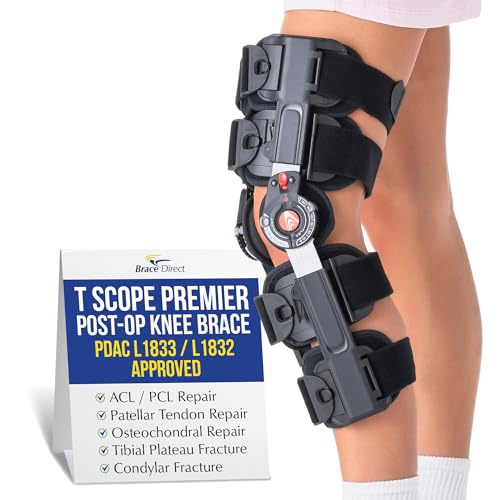
1. Breg T Scope Premier Post Op Knee Brace
Our pick — 4.0+★ from 150+ verified ratings; the strongest balance of quality and price.
The post-op brace that grows with your leg and holds a locked angle without wandering.
The feature that separates the Breg T Scope Premier is its telescoping frame. The adjustable bars extend from 17″ to 27″ in length, so the same brace fits different leg lengths as swelling rises and falls. It also accommodates thigh circumferences up to 30.5″, which covers a wide range of adult legs without a custom order.
What wins people over is the build quality. Surgeons recommend it and families track it down, and the hinge holds its setting — as one owner put it, “Can lock at 90° flexion and 90° extension and stays locked.” The locking mechanism feels tight and secure, and the quick clip buckles mean you can get it on in seconds even during tender early recovery. One parent bought it on an orthopedic suggestion and found the same brace the clinic wanted for far less.
The honest catch is fit on a moving leg. The frame is sturdy and some owners find it bulky, and a few report it sliding down without a sleeve underneath. A thin compression sleeve under the straps solved that for most. This is a rigid post-op frame, not a low-profile athletic sleeve — expect it to feel substantial on the leg, especially in the first weeks.
What earns it the top spot
- Telescoping frame stretches 17″ to 27″ to match leg length and swelling changes.
- Fits thighs up to 30.5″ without a custom build.
- Hinge locks firmly and holds flexion and extension once you set it.
- Quick clip buckles apply fast during painful post-surgery weeks.
Where it asks more of you
- Frame is heavy and bulky compared with a sleeve-style brace.
- Without a sleeve beneath, it can slide down on some legs.
- It is a rigid post-op tool, not a daily athletic brace.
Reach for this if: you are in the structured post-op phase and need a hinge that holds a locked angle while you heal.
Look elsewhere if: you want a low-profile brace to wear under clothes during sport — a sleeve-style pick lower down fits that job.
2. DonJoy Drytex Sport Knee Brace (Large)
The everyday compressive hinge for sprains and the return to normal movement.
This is the brace for the stretch after the rigid frame comes off — knee sprains, meniscus support, and getting back to sports with compression under a hinge. The knit sleeve gives a snug, breathable feel around the joint, and the hinge pair adds side support without the bulk of a telescoping post-op rig. It is also far more compact in the bag than the Breg above, which is the practical reason it ends up in a gym bag instead of staying home.
Support is what owners talk about, and it delivers a firm, reassuring hold through daily activity. Getting the size right is the whole game here, though. Measure your thigh and calf circumference 6″ above and below your kneecap with a flexible tape, and choose by that diameter. The sizing runs generously — a buyer who first ordered an XL found it “really too big, especially after wearing several times” and stepped down to a Large. Order based on the tape, not the guess.
There is one quirk worth knowing before you put it on. The round cutout that usually sits over the kneecap actually belongs behind the knee on this design, so the metal hinge can flex correctly. It is not spelled out on the listing, so read the fit guidance before your first wear or you will spend a few minutes confused. Get past that and it is a dependable, discreet daily brace.
The sizing reality: the tape measure is not optional advice here — order by the thigh and calf diameter and you will avoid the most common return.
Fits best when: you have moved past the rigid frame phase and want compression plus hinge support for daily life.
Think twice if: you cannot easily reach a flexible tape measure — sizing off a guess is where this brace goes wrong.
3. kefit Hinged Knee Brace ROM

A rehab hinge with a wide motion window, priced to replace a clinic brace.
Where the others lock you into one narrow range, the kefit lets you dial the window you need. The bilateral locking dial adjusts from -10° to 120° of flexion and -10° to 30° of extension in 10-degree steps, so you can follow your rehab protocol as it opens up week by week. That -10° extension stop is the specific setting that keeps a healing PCL from hyperextending.
The build is light for its size at 2.1 pounds, and the open design fits either leg while the adjustable struts adapt to individual leg length. The front straps can be adjusted independently, which helps when one side of the knee swells. One owner compared it against a lineup of braces and found it held its own against far pricier options. It is also the more compact frame next to the DOUKOM below — it measures less front-to-back, so it tucks closer to the leg.
The trade-off is a heavier feel on skinny legs. Some owners find it slides down over time and needs a retighten, and the lower strap can run out of Velcro on very slim calves. The padding also has its limits — the side adjustments have to grip correctly or it loses support. Treat it as a solid mid-weight rehab frame and add a compression sleeve under it if your leg runs lean.
Why it holds a mid-list place
- Full -10° to 120° flexion range in 10-degree steps for staged rehab.
- -10° extension stop guards against hyperextension early on.
- Open design fits either leg and adjusts to leg length.
- Light for its class at 2.1 pounds.
The honest limits
- Tends to slide on slim legs and needs periodic retightening.
- Side adjustments must grip well or support fades.
- Padding can be thin against bony areas.
Best for: a recovering knee that needs a wide, changeable motion window at a mid-range cost.
Skip when: your calves are very slim and you know from experience that heavy frames slide on you.
4. DOUKOM Hinged ROM Knee Brace

A tall frame for tall legs, with a shoulder strap that takes weight off the hip.
The DOUKOM is built long. Its telescoping frame runs 19″ to 28″, so it suits a taller or longer leg than the kefit and Breg manage, and the aluminum alloy frame holds a firm line down the leg. The dual-side ROM dials adjust from -10° to 110° of flexion and -10° to 90° of extension, which is a wide window for staged recovery, including posterior cruciate ligament rehab.
What sells it is the removable shoulder strap. It lets the brace take its weight from your shoulder instead of your leg, and that reduces the slipping that plagues heavy frames on a moving thigh. The buckle design also makes it easy to put on and take off once you have the initial setup dialed in. Quality and function are the two things owners bring up most, and the build earns both — it steadies a knee that wants to overextend. At 3.2 pounds it is the heaviest frame here, though, so the strap earns its place.
The catch shows up for shorter buyers. The frame runs long, and a few owners below the advertised height range found it too long and slow to strap on each time. A squeaky hinge can also develop — the maker suggests silicon oil but does not name a brand. If you are tall and heavy, this is a strong match; if you are petite, size down mentally before you commit.
The shoulder-strap advantage: the removable strap is the feature that keeps a 3.2-pound frame from dragging your thigh down while you walk.
Where it can frustrate: the long frame overwhelms shorter legs, and the hinge can start squeaking without regular oiling.
Pick it if: you are on the taller side and want a rigid post-op frame with a shoulder strap to spread the weight.
Leave it if: a compact brace on a shorter leg matters more than a wide telescoping range.
5. KD ROM Hinged Knee Brace

The frame that finally fits a heavy thigh, with a soft lining to match.
Most braces give out at a big thigh. The KD extends to thigh circumferences up to 35″, which opens the door for larger legs that the 30.5″ Breg and slimmer sleeves cannot cover. The aluminum hinges stabilize the knee through daily movement and rehab, and the ROM dials adjust flexion and extension from 0° to 120° with quick-lock settings so you can move through recovery stages.
The soft, breathable lining under the straps is the comfort hook — it cushions pressure and cuts skin irritation over long wear, which matters when you have it on all day. It is universal for left or right, and fast-clip buckles speed up putting it on. Owners across a wide range of body types report a snug fit, and the rigid frame keeps the knee from twisting side to side. One reviewer wore it under jeans and work pants without a bulge.
Two things to plan for. The strap setup takes a first-time session to get right — after that it is a one-minute job, but do not expect out-of-box instant. And when you wear shorts, the shoulder-strap bolts on the upper thigh can rub bare skin even with the plastic tabs removed. Skip the shoulder strap when you can; the frame stays put without it on most legs. For heavy thighs and hot climates, though, it is a strong match.
Where it pulls ahead
- Fits thighs up to 35″ — the widest fit on this list.
- Soft breathable lining reduces pressure on long wear.
- 0°–120° ROM with quick-lock dials for staged recovery.
- Fast-clip buckles and universal left/right fit.
What to plan around
- First strap setup takes a session to dial in.
- Shoulder-strap bolts can rub bare skin in shorts.
- Not the lightest frame to wear all day.
Go with this if: a larger thigh or a hot climate has made other braces slip or chafe.
Look past it if: you live in shorts and cannot tolerate any hardware near the upper thigh.
6. Shock Doctor Bionic Hinged Knee Brace

The athletic brace that pairs metal hinges with a sleeve so you can move again.
This is the pick for the person ready to get back on the ice, court, or trail and wants side support without a telescoping frame. The bi-lateral aluminum hinges give a fluid, natural feel at the joint, and the semi-rigid frame wraps a soft compression sleeve. That sleeve is included and does double duty — support and fit — and you can wear the brace with or without it depending on the day.
The construction is what keeps owners loyal. It is built to hold up through real activity, and the brace steadies the knee without locking it in place. One buyer with a loose ligament from an old reconstruction said it restored stability and ended the chained hip and knee pain. The strap system adjusts across a wide range, and it works for both men and women. The knee-tracking support keeps the joint from twisting during cutting and landing.
The fit is where you have to slow down. Sizing runs inconsistent — a 5’10”, 210-pound buyer with thick legs found the chart’s XL too loose and a Large fit perfectly after adjustments, so measure and expect to exchange if needed. Comfort is mixed; it is supportive but not plush, and it can cause bruising when worn over jeans if the sleeve bunches. It is also the brace to re-measure if a swollen knee adds an inch to your leg. Get the size right and it is a serious athletic pick.
The sleeve pairing: the included compression sleeve means cushioning against chafing and a closer fit, which is why this brace works for both recovery and play.
The sizing caution: do not trust a single guess — measure, and be ready to size up or down after a few wears as swelling changes.
Made for you if: you want to swing back into sport and need side support plus a compression sleeve under a sturdy hinge.
Not for you if: you want a plush, low-pressure fit for lying around all day in recovery.
7. DonJoy Performance Bionic Fullstop Knee Brace

Dampening hinges that catch the knee before it snaps into hyperextension.
The standout feature here is the FullStop hinge. Instead of letting the knee straighten at full speed, the hinge dampens as you near full extension, which is the exact motion that strains a healing posterior cruciate ligament. The Four-Point Leverage System and its four straps support the joint through cutting, landing, and direction changes — the high-risk movements that bring a PCL problem back. An open hex-shaped foam buttress around the kneecap guides tracking through the bend.
Support is the reason owners come back to this brace. It stabilizes a meniscus-repaired knee through activity, and a golfer with an injured left knee wore it for months of play without re-injury. The neoprene gives compression while breathable mesh manages heat, and the four adjustable straps with grip tabs let you fine-tune the hold mid-activity. It runs firmer on the leg than the Shock Doctor sleeve brace, so decide by how much compression you actually want.
Two honest limits. The neoprene and the metal hinge can break down over heavy use, and the lower hinge can dig into a muscular calf while walking. Sizing is unforgiving too — it runs small for some and large for others, so measure carefully and expect a return if you guess. For a player who wants hinge protection against hyperextension and can dial in the fit, it is a focused athletic choice.
Worth it for: athletes who fear hyperextension and want a hinged brace that warns the knee off full straightening.
Consider another pick if: you have thick calves that metal hinges tend to press into, or you want a softer daily sleeve.
Know the Specs
ROM range and the extension stop
A ROM (range-of-motion) setting is the window of movement a hinge allows. Flexion is how far the knee bends; extension is how far it straightens. A -10° extension stop means the brace blocks the last stretch into hyperextension — the motion a PCL is most vulnerable to. Match the stop to your rehab protocol and you protect the ligament while you build strength.
Thigh and calf circumference fit
A circumference number tells you the widest part of leg a brace will wrap. Measure your thigh and calf with a flexible tape at the spot the listing names, then match the number to the brace’s stated range. A brace that fits the range stays put; one that does not will slide or pinch, and no strap can fully fix a wrong size.
Rigid frame versus compression sleeve
A rigid frame with aluminum or plastic hinges delivers hard support and a locked angle for early recovery. A compression sleeve gives support and knee tracking with flexibility for return to sport. Many buyers keep one of each — the rigid frame for post-op weeks, the sleeve for activity later.
Telescoping length and weight
Telescoping frames extend in length to fit different leg lengths, so one brace covers a taller or shorter leg and grows as swelling changes. Weight matters too — a heavier frame supports firmly but can drag the thigh down without a shoulder strap, so weigh the trade-off against how long you wear it each day.
Common Questions
Do I need a hinged brace or a sleeve brace for a PCL injury?
How do I set the ROM dial for my posterior cruciate ligament?
How should I measure for a knee brace so it does not slide?
Can I wear a PCL brace under jeans or work pants?
Why does my brace slide down when I walk?
Is a brace with a shoulder strap better for walking?
How long does a knee brace last before the hinge wears out?
Can the same knee brace be worn on the left or right leg?
Should I wear a sleeve under a rigid knee brace?
What is the difference between a FullStop hinge and a standard hinge?
The Bottom Line
For most people recovering from a posterior cruciate ligament tear, the brace for pcl injury winner is the Breg T Scope Premier because its telescoping 17″–27″ frame, thigh fit to 30.5″, and firm locking hinge cover the whole early recovery without a custom build. If your thigh runs large and you need a wide fit, grab the KD ROM Hinged with its 35″ thigh ceiling. And for returning to sport with hyperextension protection, the DonJoy Performance Bionic Fullstop is the one to reach for. Sizing is the single decision that makes or breaks any of these, so measure once more before you order.
How we choose
We do not accept paid placement. Every pick is matched to a real buyer and a real use-case; we do not hands-on test units.
Sources
Specifications: manufacturer listings and product documentation. Review insights: verified customer reviews, as of October 2026. Pricing: not shown on this page (it changes often); check the current price via the retailer link.
As an Amazon Associate, Aappliancez earns from qualifying purchases. This does not affect which products we feature.