Disclosure: Some links in this post are affiliate links. As an Amazon Associate I earn from qualifying purchases, at no extra cost to you. Learn more
Specs are compiled from manufacturer listings and verified buyer reviews and can change over time — please confirm the key details on the product page before buying.
This guide covers seven lumbar braces built to hold the natural inward curve of your lower spine steady, and it tells you plainly which waist sizes fit which brace, how much support each one gives, and where each one falls short on comfort or bulk.
This guide is built by comparing the manufacturers’ published specifications and the patterns across verified customer reviews, so you get each pick’s real strengths and trade-offs instead of marketing spin.
You will see that support comes from three things: how many stays and plates sit against your spine, how tightly you can dial the compression, and whether the brace stays where you put it. Below, every pick is sorted by what it actually does for a curved lower back, so you can pick the right Brace for Lumbar Lordosis in one pass instead of guessing at a size chart.
Top Picks
How To Choose The Best Brace for Lumbar Lordosis
A brace for an exaggerated inward curve of the lower back does one job: it holds your lumbar spine in a supported position while you move. The catch is that “support” means different things on different belts. Some braces push a firm pad into the curve and rely on stiff stays to stop it rolling. Others wrap you in a wide elastic band and let you dial the squeeze with straps. Knowing which type you need — and which waist range you fall into — is most of the decision.
Count the stays and plates, not the padding
Stays are the stiff vertical bars sewn into the back of a brace. They are what stops the belt from bunching and rolling when you sit or bend. The FEATOL uses 3 memory-aluminum stays plus 2 support plates for 360° stability, while the Rakiie builds its support from 9 components — 4 memory aluminum bars, 2 elastic springs, 2 PP strips, and 1 spine-guiding bar. More and better-placed components usually mean a firmer hold on the curve, but they also mean less give when you twist.
Measure your waist at the navel before you pick a size
Almost every return on a lumbar brace traces back to guessing the size from your pants. Measure bare skin at the level of your belly button and match that number to the maker’s range. The FEATOL covers S at 25.6–27.5 inches all the way up to 5XL at 57.6–65 inches. The NEENCA runs Small at 25.9″–30.7″ through XX-Large at 51.2″–65.0″. If you land between two sizes on a brace that runs small, go up — you can always tighten a belt down, but you cannot stretch one out.
Decide between Velcro straps and a pulley system
Velcro straps are the common design and they are easy to adjust one-handed. A pulley system pulls a cable to multiply your effort, so a light tug gives firm compression. The Aspen uses a 4:1 tightening system and the BaxMAX a 5-to-1 pulley. Both let you tighten the top and bottom separately, which matters when the curve sits high and the belt sits low. The trade-off is that pulley braces have almost no stretch, so they feel rigid when you bend.
Side-by-Side Comparison
| Model | Best For | Support Build | Waist Range | Design Note | Amazon |
|---|---|---|---|---|---|
| FEATOL Back Brace (5-Stays)★ Best Overall | Everyday work and lifting | 3 stays + 2 plates, 360° | 27.5″–34.3″ (M) | Stretch sizing to 5XL | Amazon |
| Sparthos Back BraceMost Versatile | Long shifts and heavy lifting | Vertical stays + lumbar pad | Size S to XXL range | Removable lumbar pad | Amazon |
| Rakiie Lower Back Brace | Women’s body-shaped fit | 9 components, curve-matched | Extension strap included | 3D gel pad, hand wash | Amazon |
| Lightweight Neoprene Brace | Discreet wear under clothes | Dual elastic straps | Adjustable range | 220 g, 4-inch width | Amazon |
| Aspen Lumbar Support | Firm inelastic compression | Patented 4:1 pulley | 36″–42″ (Large) | Sizes run small | Amazon |
| NEENCA Back Brace | Side-by-side adjustment | 2 straps, multi-point support | 37.4″–45.3″ (Large) | Medical-grade mesh | Amazon |
| BaxMAX Pulley Brace | Ultralight pulley support | 5-to-1 pulley, Kevlar cord | Five sizes, S to 2XL | 5 oz nylon/kevlar mesh | Amazon |
Detailed Reviews
1. FEATOL Back Brace 5-Stays
Our pick — 4.5+★ from 1,000+ verified ratings; the strongest balance of quality and price.
Five stiff bars and plates against the curve — the reason this one holds its shape while you work
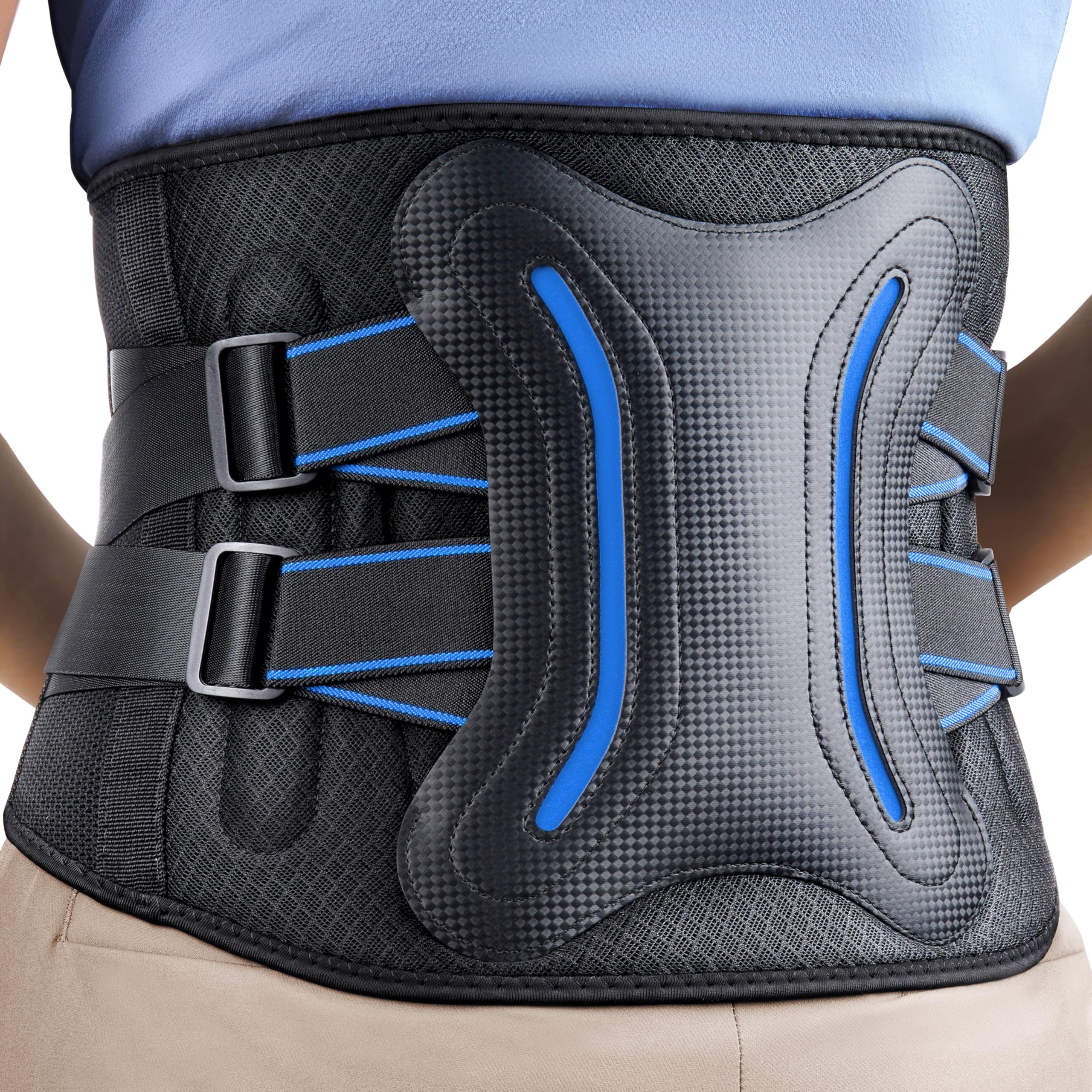
What you get here is real structure: 3 memory-aluminum stays plus 2 support plates working together for 360° stability around the lumbar region. The central stay lines up with your spine, and the side stays are what stop the belt rolling or bunching the moment you sit down. For an inward-curving lower back, that no-roll behavior is the whole point — a brace that folds on itself stops supporting the curve.
The fit is where this brace earns the top slot. Sizing runs from S at 25.6–27.5 inches up to 5XL at 57.6–65 inches, so most bodies land somewhere in the range. The dual-tension strap setup lets you set one level of snugness for walking and a firmer one for heavy lifting, and buyers report that a size L “fits 36″ waist accurately” with both straps tightening independently. The breathable mesh vents heat well — it does not turn swampy after an hour — and the low-profile build slips under loose clothing.
Here is the honest catch: it is bulky under tight clothing, and the material is not machine washable, so you spot-clean it. If you wear slim shirts all day, that bulk will show. If you wear work clothes or looser tops, you will forget it is there.
What holds up under use
- 3 stays plus 2 plates give a 360° hold that will not roll when you sit
- Dual-tension straps let you go snug for lifting, softer for walking
- Stretch sizing covers 25.6 inches to 65 inches at the navel
- Breathable mesh stays dry through an hour of wear
Where it asks for accommodation
- Bulky silhouette under tight clothing
- Not washable — spot clean only
- Runs a little large for some buyers
Daily-wear winner: the right call if your day is bending, lifting and driving and you want one brace that holds the curve without constant re-adjusting.
Worth knowing: the material needs spot cleaning rather than a wash cycle, and the bulk will read through slim-fit shirts.
2. Sparthos Back Brace
A removable lumbar pad you can position exactly where the curve needs pressure
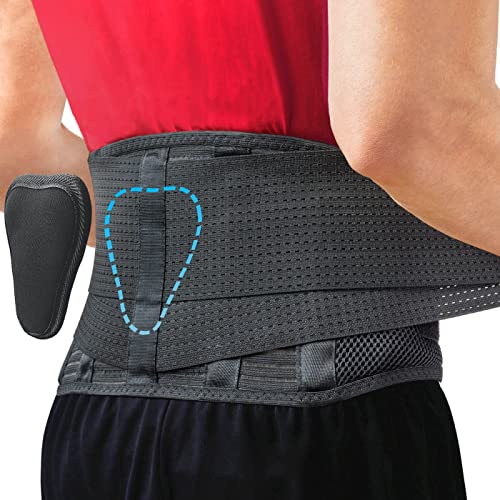
Most braces give you one built-in pad and one place it sits. This one hands you a removable lumbar pad and an adjustable double-strap design, so you can slide the pressure point to wherever your lower back actually aches. Vertical support stays run up the back to keep the belt from rolling, and the 3D mesh is there to stop heat building up over a long shift.
Where it beats the FEATOL above is flexibility in use: the pad comes out when you want a flatter profile and goes back in when you want targeted compression. It is also thin — the belt measures 0.15 inches thick — so it hides under a shirt. Owners mention that a Size S fits a 5’7″, 133 lb frame with a 31-inch waist, and that the firm build is supportive without feeling restrictive.
The recurring note on this brace is sizing: the guidelines can steer you toward a size that feels oversized, so measure your waist at the navel and trust the tape over the chart. Long walks can also get warm under the mesh. Neither is a dealbreaker for a brace this adjustable — it is the one to reach for if you want to tune where the support lands.
Why it flexes well: a removable pad plus double straps means you can shift support from the base of the spine to mid-lumbar without buying a second brace — and the 0.15-inch thickness keeps it flat under clothing.
The one thing to get right: sizing. Follow the tape measure, not the pants size, and consider sizing up if you sit between two.
Pick it when: you want to control exactly where the compression lands and prefer a slim belt under everyday clothes.
Think twice if: you want a single fixed pad you never have to reposition.
3. Rakiie Lower Back Brace for Women, 9X Support System
Nine separate support pieces shaped to follow a woman’s lumbar curve
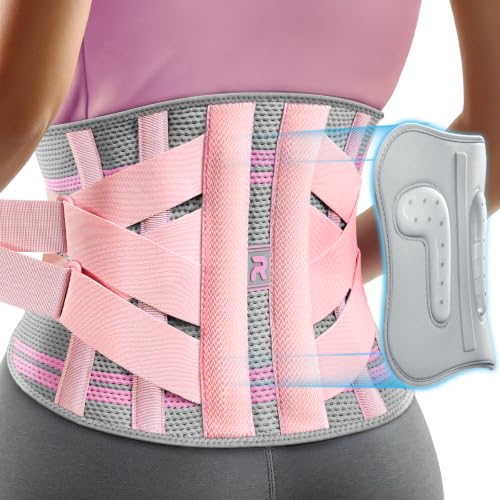
This brace was built from the curve outward. The 9X design packs in 4 memory aluminum bars, 2 elastic springs, 2 PP strips and 1 spine-guiding bar — nine components in total — and shapes them to follow the natural inward line of the lower back rather than fighting it with a flat panel. That is a lot of pieces working together, and it is why the support reads as firm rather than bulky.
The body-matching continues below the spine: a 3D contouring gel pad sits against the muscles, and two adjustable straps plus four compression bands spread the squeeze evenly instead of pinching at one point. The 3D mesh knit keeps it breathable enough for a full day at a desk or behind the wheel, and the reinforced hook-and-loop fasteners are rated for over 3,000 open-and-close cycles. A detachable extension strap is in the box too, so families can share one brace across different body shapes.
Two fit notes come with this design. Heavier-set or taller frames can find the top edge sitting under the ribs, which gets uncomfortable fast; sizing up or using the extension strap eases it. The stiff build also feels rigid when you drive, and the maker says hand wash only. If you want a brace shaped for a woman’s torso instead of a scaled-down unisex belt, this is the pick.
Built for a woman’s frame
- 9 support components match the lumbar curve rather than flattening it
- Four compression bands spread pressure evenly across the back
- Detachable extension strap covers more body types
- 3D gel pad and mesh knit stay breathable through long days
Limits to know before ordering
- Top edge can dig under the ribs on taller or heavier frames
- Rigid enough that driving feels stiff
- Hand wash only
Shape advantage first: the curve-matched build is why women with an inward lumbar curve land here over unisex belts.
Honest limit: if you are short-waisted or broad through the ribs, try the extension strap before you decide the fit is wrong.
4. Lightweight Back Brace for Lower Back Pain Under Clothes

A 220-gram belt that disappears under a T-shirt and still applies real compression
Weight is the headline. This brace comes in at 220 g and measures 4 inches wide, which is a fraction of the bulk you get from a five-stay build like the FEATOL. The bottom strap is perforated neoprene — a rubber-backed fabric that stretches and springs back — so it hugs the hips and pelvis while the dual elastic straps apply pressure across the lumbar band. It moves with you when you bend, twist or sit.
What this brace is not is a rigid holder. There are no aluminum stays and no support plates, so the compression is fabric-driven rather than structural. That makes it the right choice for standing, walking, golfing or gardening, and the wrong one for heavy lifting that needs the spine held still. The perforated neoprene is there for breathability, and the compact design is meant to sit under a shirt for hours.
One honest note from new owners: neoprene can carry a mild manufacturing smell when you first unzip it. Air it near a window for a couple of days and it fades. Expect flexible support rather than a stiff cage — if you need a brace to lock the curve rigidly, this is the wrong tool. If you need a brace that stays hidden under a shirt all day, this is the one.
Best for stealth: 220 g and 4 inches of width sit flat under ordinary clothing, so the brace stays hidden through a whole workday.
Where it gives up grip: no stays means the support is elastic compression, not rigid stabilization — great for walking about, less so for hoisting weight.
Your brace if: the main obstacle to wearing a brace is that you hate the way they look and feel — this one you can forget about.
Look elsewhere if: you need a stiff spine hold under load, where a stayed brace does the job better.
5. ASPEN Lumbar Support Back Brace, Patented Pulley System

A pulley that turns one light pull into a firm, localized squeeze on the lumbar curve
The 4:1 tightening system is what separates this brace from every Velcro belt on the list. A small tug on the cable multiplies into firm compression, and two independent tabs let you tighten the top and bottom of the brace separately — useful when the curve sits higher than the widest part of the belt. The nylon body is inelastic, meaning it does not stretch, so it behaves like an external frame across your lower back.
That non-stretch construction is the point for lordosis support. An elastic belt gives a little under load; this one does not. Customers note it gives leverage and firm support in a thin, breathable package with no neoprene smell, and that the belt hugs the lower back closely enough to walk any distance. It is also low-profile enough to wear for hours under clothes.
Now the fit reality: Aspen builds this brace in six sizes and admits the sizes run small. That is the single most common reason people swap a size up, so order up if your measurement lands between sizes — you can tighten a bigger brace but you cannot stretch a smaller one. Because the material has zero give, this is also not a brace for cardio or athletic movement. Office days, recovery days and long walks, yes.
The pulley advantage
- 4:1 tightening gives firm compression from a light pull
- Independent top and bottom tabs let you localize the squeeze
- Inelastic nylon holds its shape instead of stretching out
- Thin, breathable build wears comfortably under clothes
Trade-offs to plan for
- Sizes run small — plan to size up
- No stretch, so not suited to athletic activity
- Firmer feel than a soft elastic belt
For firm contact: you get the most controllable tension on the list from one cable, which is why it suits people who need targeted pressure on a pronounced curve.
Be ready for: ordering up a size and a rigid feel that resists bending more than a mesh belt.
6. NEENCA Back Brace For Lower Back Pain Relief

Two straps that tighten on their own so each side of the curve gets its own pressure
The feature that sells this brace is side-by-side control. Two elastic Velcro straps each adjust independently, so if one side of your curve feels tighter than the other, you can tune each strap to its own setting without loosening the other. The multi-point support design spreads load across the lumbar band, and the shell is made from medical-grade polyester and spandex for a build that holds up to daily wear.
Sizing is generous on paper: Small covers a 25.9″–30.7″ waist and the range runs up to XX-Large at 51.2″–65.0″. The maker is direct about one thing — measure at the navel, not by pants size. Reviewers point out that even going slightly below their belly measurement still fit comfortably without excess tightness, so the straps have real range. The breathable mesh is designed for long hours at a desk or on your feet, and the slim profile hides under clothes.
Where this one asks for patience is stability. The support panel has a habit of riding up a little during movement, which you fix with a quick re-adjust rather than a full re-hang. Some also find the rigid back supports are not shaped to the body’s contours. Both are minor. If you want to tailor pressure left and right, this brace gives you that control in a way a single-strap belt cannot.
What the two straps buy you: left and right tension are set separately, so an asymmetric curve gets an asymmetric squeeze — and the medical-grade polyester-spandex shell is built for repeated daily use.
The catch: the panel can ride up as you move, and the back supports are flatter than the body’s curve, so plan on a quick re-adjust now and then.
Reach for it if: one side of your back needs more pressure than the other and you want to fix that without trading the brace in.
Not for you if: you want a set-and-walk belt that never needs a mid-day reset.
7. BaxMAX Adjustable Back Brace with 5-to-1 Compression Pulley
Five-to-one pulley leverage in a brace that weighs five ounces
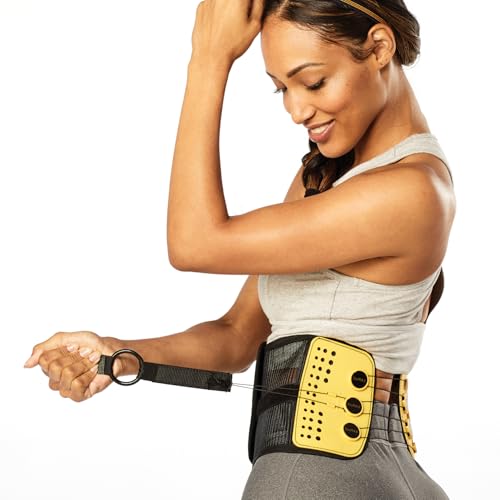
Here is a combination that is hard to find: this brace uses a patented 5-to-1 pulley system, so one easy pull delivers five times the compression, and the whole thing weighs only 5 ounces. It is built from a nylon and Kevlar blend mesh, and the pulley cable itself is Kevlar-reinforced — the same kind of cord used where stretch is unwanted. That means you get pulley-grade tension without a heavy steel-lined frame pressing into your back.
Where this differs from a fixed belt is adjustability through a day. It is engineered for three different wearing positions, so you can dial the compression level up for lifting and back down when you sit, without taking it off. It can be worn over or under clothing, and it runs from Small up to 2X-Large. It also accepts optional hot and cold therapy packs and support cards, sold separately, that change the feel of the front panel.
The trade-off sits in the numbers behind the design: this brace has fewer owners behind it than the Sparthos or the FEATOL, so it is a less-tested choice for most buyers. Overall owner feedback on comfort is the most-praised quality, and the pulley earns good marks for support. If you want the lightest body with the strongest mechanical squeeze, this is worth a look — but check the size chart carefully, since it is a specialty pick.
Strongest squeeze per ounce: the 5-to-1 pulley delivers firm compression from one pull, and the Kevlar cable holds tension without stretching, all in a 5-ounce mesh body.
Know what you are buying: it is the least-reviewed brace here, so it suits buyers who want pulley leverage and a lightweight feel more than a crowd-tested standard.
Best for tinkerers: three wearing positions and accessory compatibility let you change support level through the day without swapping braces.
Decide carefully if: you would rather follow a large body of owner experience than be an early adopter of a lighter design.
Know the Specs
Stays and support plates
Stays are the stiff vertical bars sewn into the back panel of a brace. They are what stop the belt from rolling or folding when you sit, and they are the main source of structural support in a lumbar brace. More stays, or more support plates added alongside them, usually translate to a firmer hold on the curve. The FEATOL uses 3 stays plus 2 plates; the Sparthos uses vertical support stays with an adjustable lumbar pad. Stiff stays hold the curve better but feel rigid when you twist, so match the count to how much movement your day involves.
Waist range and sizing
Every brace here is sized by waist measurement, not pants size, and that is the number that decides whether a brace works for you. Measure bare skin at the level of your navel. The NEENCA runs Small at 25.9″–30.7″ through XX-Large at 51.2″–65.0″; the FEATOL runs S at 25.6–27.5 inches through 5XL at 57.6–65 inches. Pulley braces like the Aspen and the BaxMAX tend to run small, so if you sit between two sizes, size up. You can always tighten a belt down, but you cannot stretch one out.
Common Questions
How do I measure my waist for a lumbar lordosis brace?
Is a pulley brace better than a Velcro strap brace for lumbar lordosis?
How tight should a lumbar support brace be?
Can I wear a lumbar brace under my clothes all day?
Should I wear a back brace all day if I have lordosis?
Will a back brace with stays stay in place when I sit down?
Are these braces washable?
Does a lumbar lordosis brace have to be rigid to work?
What does a lumbar brace with a removable pad do differently?
Which brace is easiest to put on by myself?
The Bottom Line
For most people with a pronounced inward lower-back curve, the brace for lumbar lordosis to start with is the FEATOL Back Brace because its 3 stays plus 2 plates give a 360° hold that will not roll when you sit, and its sizing runs from a 25.6-inch to a 65-inch waist. If you want side-by-side control of each strap, grab the NEENCA Back Brace. And for a brace that hides under a shirt through the whole day, the Lightweight Neoprene Brace is the one to reach for. For a firmer, inelastic squeeze from a light pulley pull, the Aspen Lumbar Support earns the extra size-up step.
How we choose
We do not accept paid placement. Every pick is matched to a real buyer and a real use-case; we do not hands-on test units.
Sources
Specifications: manufacturer listings and product documentation. Review insights: verified customer reviews, as of October 2026. Pricing: not shown on this page (it changes often); check the current price via the retailer link.
As an Amazon Associate, Aappliancez earns from qualifying purchases. This does not affect which products we feature.