Disclosure: Some links in this post are affiliate links. As an Amazon Associate I earn from qualifying purchases, at no extra cost to you. Learn more
Specs are compiled from manufacturer listings and verified buyer reviews and can change over time — please confirm the key details on the product page before buying.
Knee braces fail for one boring reason: they slide. A brace that creeps down your shin halfway through the day gives you compression and nothing else — no ligament stability, no confidence in the hinge. This guide separates the seven braces that hold their position from the ones you’ll spend all afternoon yanking back up. It also matches each design to a knee problem: a soft hinged sleeve guards a sprain, while a post-surgical ROM brace caps how far the joint can bend.
This guide is built by comparing the manufacturers’ published specifications and the patterns across verified customer reviews, so you get each pick’s real strengths and trade-offs instead of marketing spin.
Fit is the whole ballgame here, so you’ll find sizing guidance, hinge details, and adjustability called out for every pick rather than buried in fine print. What follows is a plain-English walk through hinge types, ROM dials, and sizing so you can pick the right brace for your knee.
Top Picks


How To Choose The Best Brace for Knee Stability
Start with the job: sport protection, all-day arthritis support, or post-surgical range-of-motion control. Ligament protection during sport, all-day support for an arthritic joint, and post-surgical range-of-motion control are three different products that happen to share a shelf.
Hinges and side stabilizers
Hinges are the pivoting metal or plastic arms on either side of the brace. They keep your knee tracking forward and back instead of wobbling sideways, which is what protects a strained MCL or LCL. Some braces, like the Ovation unloader, run a single upright on the outside of the knee specifically so nothing presses on the inner side.
Range of motion and locking dials
A range-of-motion (ROM) brace uses a dial to cap how far your knee can bend or straighten. A brace adjustable from 0° to 120° lets a clinician set a limit of 45° so the knee can’t collapse, then widen the range week by week. Pure sports braces usually skip this — they assume you already have a working range and just need guarding.
Fit and measurement
Measure your thigh and calf with a flexible tape, about 6 inches above and below the kneecap, and size from those numbers instead of the chart label. Manufacturers’ charts run small as often as they run large, and a brace sized by guesswork will either cut circulation or slide down all day.
Fabric, heat, and slippage
Breathable mesh and vented panels matter more than they sound, because sweat is what loosens a hook-and-loop strap and turns a snug brace into a sliding one. Neoprene gives firm compression but traps heat; mesh-backed neoprene trades a little of that grip for all-day wearability.
Side-by-Side Comparison
| Model | Best For | Type | Adjustability | Material | Amazon |
|---|---|---|---|---|---|
| ACE Brand Hinged Knee Brace★ Best Overall | Everyday all-day support | Hinged wrap-around, either knee | Adjustable straps, one size fits most | Neoprene | Amazon |
| GHORTHOUD Hinged ROM Knee BracePost-Op Control | Post-op range-of-motion control | ROM with locking dial | 0° to 120° dial, removable stabilizers | Lycra / Spandex | Amazon |
| MUELLER Hg80 Hinged Knee Brace | Everyday arthritis and sprain support | Hinged sleeve, either knee | Sized S to XXL, hook-and-loop | Aluminum hinges | Amazon |
| DonJoy Drytex Sport Knee Brace | Low-profile wear under pants | Hinged sleeve | Sized, measurement-based | Drytex fabric | Amazon |
| Shock Doctor Hinged Knee Brace | Sport and active ligament support | Hinged with bilateral dual hinges | Four-way stretch, sized by measurement | Neoprene / Lycra mesh | Amazon |
| Ovation Medical Game Changer Unloader | Arthritis pain on one side of the joint | Single-upright unloading brace | Push-button buckles, trimmable straps | Neoprene / Plastic | Amazon |
| DonJoy Performance Bionic Fullstop | High-risk cutting and landing sports | FullStop dampening hinges | Four adjustable straps, pull tabs | Neoprene with mesh | Amazon |
Detailed Reviews
1. ACE Brand Hinged Knee Brace
Our pick — 4.0+★ from 800+ verified ratings; the strongest balance of quality and price.
The wrap-around hinge that holds a whole workday without a single readjustment.
What makes the ACE the sensible first pick is that it solves the most common complaint in this category — slipping — by wrapping rather than pulling on. Two dual-pivoting hinges sit at each side of the knee and a kneecap cushion adds extra padding over the patella. You lay the brace on, cinch the adjustable straps, and the whole thing stays where you set it. It holds 4.0+ stars across 800+ ratings because it does the basic job without fuss.
It weighs 10.56 ounces, which is light for a hinged brace. The neoprene shell gives that firm, firming compression around the joint, and the open design means it works over pants or against skin. For a bad knee that aches through a shift of yard work or chasing grandkids, that’s enough. As buyers put it: “It gets me thru an 8 hour day without any comfort issues.”
The honest catch is the one-size design. Wrapping one shell around every leg means it fits some people beautifully and others not at all. For a smaller or larger leg, the straps have to stretch to reach the closure, and a few people found their leg fell outside the intended range. Cut down on the guesswork by checking the strap length before you commit. If you’re between sizes and want an exact fit, a measurement-sized brace like the MUELLER below is the safer bet.
Where it earns its keep
- Wrap-around straps mean no threading your foot through a sleeve, and you can tighten it exactly where you need it.
- Dual-pivoting hinges on both sides plus a kneecap cushion — proper side-to-side guarding, not just compression.
- At 10.56 ounces it’s lighter than the MUELLER Hg80 at 13.76 ounces, so it disappears on the leg.
- Fits left or right knee, so one purchase covers whichever joint acts up.
What to weigh first
- One size fits most means it genuinely won’t suit every leg — check your circumference against the strap length before ordering.
- Neoprene traps heat; it’s a fine winter brace and a sweaty one in July.
- The hook-and-loop closure is the part that wears first over months of daily use.
Go with it if: you want a hinged brace you can put on in seconds for work, errands, or light activity, and your leg sits in the middle of the sizing range.
Try a sized brace instead if: your thigh or calf runs notably small or large — you’ll get a better clamp from a measurement-based fit.
2. GHORTHOUD Hinged ROM Knee Brace
A range-of-motion brace you dial to a hard stop, then turn into a sports brace later.
If your knee has to be held at a limit — say locked so it can’t straighten past a set angle after surgery — this is the tool. The locking dial adjusts from 0° to 120°, giving you a hard cap on how far the joint can move during rehabilitation. Two side hinges keep the knee tracking, and the open patella design takes pressure off the kneecap. It’s built from Lycra with plenty of stretch, so it fits snug around the leg at 360°.
Better still, the hinges and dials come off. Once you’re past the recovery phase it converts into a plain sports knee brace, which is a lot more use than a post-op brace that goes in a drawer. It weighs 0.64 kg and comes as one piece, hand wash only. The XL has fit a 21-inch thigh snugly, according to buyers.
Fit is where you’ll spend your energy. It’s sold by size, and sizing runs snug, so measure your thigh and calf rather than trusting the chart. Some owners found the upper thigh straps too short for a thicker leg and had to work around it. The straps are also the part that loosens over a long day — the support is real, but a brace this committed to holding an angle takes a little more patience than a simple sleeve.
The range-of-motion win: being able to set a limit and then gradually widen it is the whole reason to buy this brace, and it delivers that without a clinic visit each time.
The trade you make: straps that need occasional re-tightening and an upper-band fit that can run short on larger legs — measure first.
Made for: anyone in the weeks after a ligament or meniscus procedure who needs the bend capped while the joint settles.
Not the right shape for: someone who wants a discreet brace under trousers for all-day walking — this is a structured, full-length device.
3. MUELLER Sports Medicine Hg80 Hinged Knee Brace
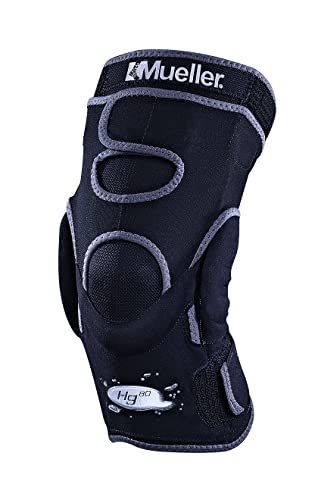
The slim aluminum-hinged sleeve that slides on in two seconds and hides under jeans.
The MUELLER’s pitch is comfort you forget about. Its triaxial hinges are built to follow the knee joint’s near-normal motion instead of fighting it, and the HydraCinn fabric shell keeps the support soft against the leg. It’s specially aimed at sprains, strains, and arthritic knees, and designed to limit the side-to-side drift and hyperextension that make a wobbly joint feel untrustworthy. Sizes run S through XXL on knee circumference, and it fits either leg.
What wins people over is the slimming effect. At 13.76 ounces it’s a touch heavier than the ACE at 10.56 ounces, but it’s a low-profile sleeve, so it tucks under normal trousers without a visible lump. Owners wear it through a full workday and forget it’s there, and the aluminum hinges come out for washing, which keeps the fabric from going stale. It sits between a thin elastic sleeve and the heavier strapped sports braces further down this list.
The recurring gripe is slippage during heavy activity — the lower edge rides down onto the shin after several hours of hard use, and the sizing chart runs small. Measure around the knee and go up a size if you’re on the line. Light activity, standing, and desk work are where it stays put; sprint-and-cut sports want a more aggressive strapped brace.
Why it keeps selling
- Slim enough to wear under jeans without a bulge — rare for a hinged brace.
- Triaxial hinges track the joint’s natural motion rather than restricting it.
- Removable hinges mean the fabric can actually be washed.
- Sizes S through XXL give a real fitted option instead of one-size compromise.
Worth knowing before you buy
- Sizing runs small — measure the knee and consider stepping up.
- Under heavy, sweaty activity it can ride down the shin.
- No hard extension stop like a dedicated ROM brace offers.
Right choice for: the arthritic or sprained knee that needs guarding through a normal workday and looks fine under a trouser leg.
Look elsewhere if: your day involves sprinting and hard cutting — that’s the Shock Doctor’s territory.
4. DonJoy Drytex Sport Knee Brace

A discreet compression brace for the knee that’s healed enough to move but not to trust.
The Drytex Sport is for the in-between stage: past the locked brace, back at work and light sport, still wary of a side-slip. It provides stability after ligament or meniscus injuries and compressive support after sprains, so it’s doing two jobs at once — holding the joint and calming the soft tissue around it. The fit comes from measuring your thigh and calf about 6 inches above and below the kneecap and picking the size from that number.
Support is what this brace is known for, and the fabric choice is why people keep buying replacements of the same model rather than switching. It’s a thin, flexible sleeve rather than a bulky hinged shell, which makes it easy to wear under clothing and easy to keep on for hours. Compared with the structured braces in this list, it’s the one that quietly disappears and just lives on your leg.
Sizing is the sticking point. The chart and the body don’t always agree — people sized up or down and got it wrong in both directions — and one reviewer noted receiving the wrong size in the box. Measure carefully, allow a little room for swelling, and check the size on the label when it lands. The upside is a comfortable, unobtrusive brace that does its stabilization job without announcing itself to anyone.
Pick this if: you want a soft, unobtrusive brace for a healing ligament and a full day of normal movement.
Check the sizing chart twice if: you’ve been burned by a chart before — this one rewards an accurate tape measurement and punishes a guess.
5. Shock Doctor Hinged Knee Brace
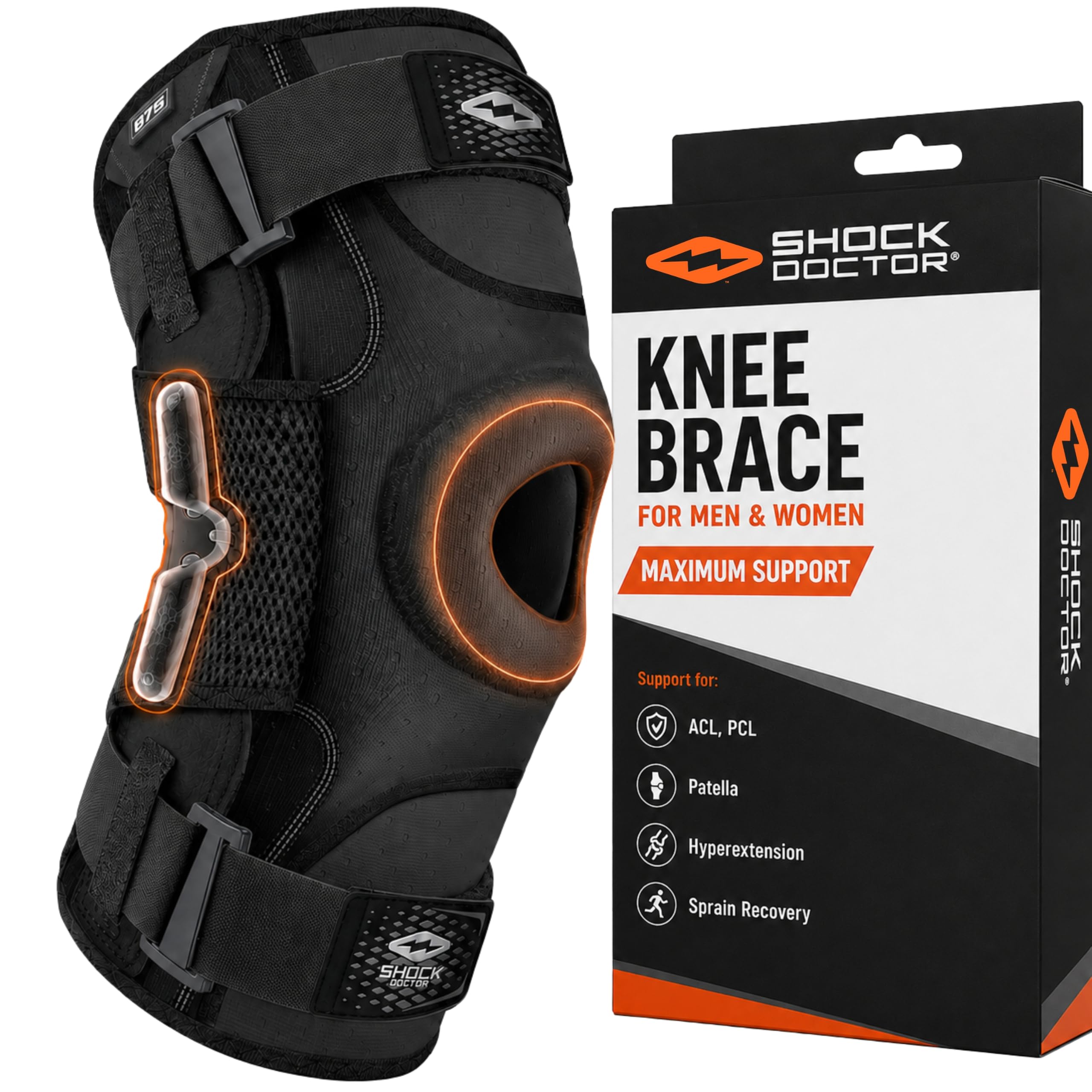
Heavy-duty bilateral hinges and a vented mesh back for knees that still play hard.
The Shock Doctor is the brace you reach for when the knee has to survive a tennis court, a pick-up basketball game, or a hike. Its heavy-duty bilateral dual hinges work both sides of the joint to resist ACL and PCL strain, medial and lateral instability, hyperextension, and patella displacement. The four-way stretch Lycra mesh stretches in every direction, and the pre-curved anatomical shape is cut to the bend of a knee, fitting either leg.
At 16 ounces it’s the heaviest of the mid-range picks here, and that weight is the point — this is structure, not a sleeve. The vented panels are what make it wearable: air moves through the back of the brace, which cuts the sweat that turns a snug fit into a slipping one. Owners routinely fit it under loose jeans and wear it for hours. It’s been the go-to for meniscus tears, ligament sprains, and osteoarthritic joints that want real support rather than a reminder.
Give it a break-in period. The fabric starts tight and softens over the first few days, so a brace that feels uncomfortably snug on day one is usually right by day three. The straps sit close behind the knee and a few people find them diggy on a full bend, and the plastic buckles on the strap ends are the first thing to crack after months of daily use. Measure your calf and size by that number rather than the label — sizing runs small.
The support story: bilateral dual hinges plus thick, soft compression give a genuinely stable knee without the rigid feel of a post-op device.
The honest cost: a break-in period and buckles that don’t last forever — but the support itself holds up for years of regular wear, which is why this brace gets bought again.
Built for: the injured knee that wants to keep playing tennis, hiking, or shooting hoops with real side-to-side protection.
Overkill if: you’re mostly desk-bound — the extra structure doesn’t earn its keep sitting at a keyboard.
6. Ovation Medical Game Changer Unloader Left Knee Brace

One upright on the outside of the knee, so nothing presses on the sore inner side.
If arthritis pain sits on one side of your knee, an unloading brace eases it by pushing the joint back into alignment and taking pressure off that worn side. The Game Changer does this with a single upright (a rigid bar) on the outside of the knee instead of a double-sided frame, so nothing rubs the inner knee. That same design lets someone with both knees affected wear two at once. It’s built for osteoarthritis, degenerative meniscal tears (wear-and-tear cartilage damage), and medial or lateral pain that eases when the joint is offloaded.
The push-button release buckles are a thoughtful touch for anyone with limited hand strength — you clip and unclip instead of wrestling hook-and-loop. The straps are adjustable enough to fit a range of leg sizes, and they’re narrow with rubber ends, so they hold their grip once set. Set-up takes a bit of patience the first time and the offloading key is a separate tool you don’t want to misplace. It fits under loose trousers at its low profile and the padded lining keeps it from feeling like a plastic cage.
Buyers report mixed results, and the complaints center on fit and slippage. On a well-matched leg it stays put and the offload does its work. On a very slim or unusually shaped leg it can need constant readjustment, and some owners end up trimming straps or wearing a thin sleeve underneath. If you’re smaller-framed, plan to spend that first evening dialing in the clips and key properly rather than expecting it to fit right from the start.
The arguments for it
- Single upright leaves the inner knee free — the exact spot many arthritic knees can’t tolerate pressure on.
- Push-button buckles are easier to manage with weak or stiff hands than hook-and-loop straps.
- Strap adjustment spans a wide range, so it accommodates larger thighs.
- Low profile enough to wear under loose jeans and keep on through a workday.
The honest counterpoints
- Slim legs often fight the fit and the brace slides without tweaking.
- Initial set-up and the offload key take practice.
- It targets one side of the joint — general instability is better served by a double-hinge brace.
Worth it if: your pain sits on the medial or lateral side of the joint and a clinician has pointed you toward offloading support.
Skip if: what you need is plain all-day stability — a simpler hinge brace will suit you better and cost less.
7. DonJoy Performance Bionic Fullstop Knee Brace

Hinges that catch the knee just before it snaps straight too far.
This is the brace for the athlete who hyperextends. FullStop dampening hinges engage as the knee nears full extension, so the joint is stopped from reaching the position where it tends to give. The Four-Point Leverage System supports the ligaments during cutting, landing, and fast direction changes. An open hex-shaped foam buttress wraps the kneecap to guide how the patella tracks as the knee bends. Four adjustable straps with easy-grip pull tabs let you fine-tune compression mid-game.
At 2.5 pounds it’s the heaviest brace on this list by a wide margin, and it feels it — a structured shell you notice on the leg. The trade is that you get neoprene compression with breathable mesh panels to keep the heat from building up over a match. For someone with an ACL history who plays a pivoting sport, that structure is the reason to buy it. For a casual walker, 2.5 pounds of FullStop hinge is more brace than the knee needs.
Sizing veers large, so measure and consider stepping down if your numbers land at the top of a range. There’s also a report of the lower hinge digging into a muscly calf on the walk, which is a real fit consideration for heavily built legs. Everything else — the support, the patella buttress, the strap security — holds up well across repeated sessions and high-risk movement, which is exactly what you’re paying premium-tier money for here.
Its defining strength: the FullStop hinge action, which guards against the sudden over-straightening that puts a rebuilt ACL at risk on a hard landing.
What you accept: weight and bulk, plus a fit that rewards careful measuring — this brace is a commitment to serious activity.
Choose it when: you’re returning to cutting sports after a ligament injury and want active protection against hyperextension.
Too much brace if: your knee is stable and you just want everyday compression — the lighter picks above cover that without the weight.
Know the Specs
Hinge type and side stabilizers
A hinge is the pivoting arm on each side of the brace that forces your knee to bend forward and back instead of wobbling sideways. Bilateral hinges give you one on each side, which is what resists medial and lateral drift. A single-upright unloading brace deliberately runs one arm on the outside so the inner knee is left free — useful when the sore spot is medial.
Range of motion and locking dials
A ROM dial caps how far your knee can bend or straighten, adjustable here from 0° to 120°. Set a hard limit while a healing joint is fragile and widen it as it strengthens. Sports braces typically drop this feature because they assume a full working range; post-op recovery braces keep it because the limit is the whole point.
Compression fabric and breathability
Neoprene gives firm, warm compression that feels supportive on a sore joint but traps heat. Mesh-backed and vented versions trade a little of that grip for airflow, which keeps sweat from loosening the closure. If you’ll wear the brace for hours under clothing, breathability matters as much as the hinge.
Measurement versus one-size fit
A measurement-sized brace, chosen from your thigh and calf circumference, clamps more precisely than a one-size wrap-around. The wrap-around is faster to put on and fits most people adequately. For a leg that runs notably small, large, or muscularly uneven, the measured fit is what keeps the brace from sliding.
Common Questions
How do I know which size knee brace to order?
Will a hinged brace stop my knee from hyperextending?
Can I wear a knee brace under my trousers?
What is an unloading brace and who needs one?
Why does my knee brace keep sliding down?
How long does a hinged knee brace last?
Can I wear a knee brace on either leg?
Is a range-of-motion brace only for after surgery?
Can I wear the same brace all day at work?
Should I wear a knee brace for a meniscus tear?
The Bottom Line
For most buyers, the brace for knee stability that makes the most sense is the ACE Brand Hinged Knee Brace. Its wrap-around straps and dual-pivoting hinges (two hinges that bend with your knee) keep the knee guarded without a lifetime of readjustment. If you’re managing the weeks after surgery, the GHORTHOUD Hinged ROM Brace gives you the dial-controlled limit you need, so you can cap how far the knee bends. And if arthritis pain sits on one side of the joint, the Ovation Game Changer is the one to reach for. Match the brace to your knee’s job, measure your thigh and calf honestly, and the right pick follows.
How we choose
We do not accept paid placement. Every pick is matched to a real buyer and a real use-case; we do not hands-on test units.
Sources
Specifications: manufacturer listings and product documentation. Review insights: verified customer reviews, as of October 2026. Pricing: not shown on this page (it changes often); check the current price via the retailer link.
As an Amazon Associate, Aappliancez earns from qualifying purchases. This does not affect which products we feature.