Disclosure: Some links in this post are affiliate links. As an Amazon Associate I earn from qualifying purchases, at no extra cost to you. Learn more
Specs are compiled from manufacturer listings and verified buyer reviews and can change over time — please confirm the key details on the product page before buying.
Forearm pain rarely announces itself politely. You notice it when you twist a jar lid, grip a coffee mug, or wake at 3 a.m. with a dull throb running from your elbow down to your wrist. The right brace stops that cycle by taking load off the overworked tendons and nerves — but only if you pick the shape that matches your problem. Below are five braces that actually do different jobs: a rigid night splint for wrist compression, an elbow splint for nerve pain, and compression sleeves for tendonitis and day wear.
This guide is built by comparing the manufacturers’ published specifications and the patterns across verified customer reviews, so you get each pick’s real strengths and trade-offs instead of marketing spin.
You will see which brace holds your wrist neutral overnight, which one stabilizes the elbow tendon, and which sleeve you can wear through a workday without sweating it off. By the end you should be able to match one specific brace to one specific kind of forearm pain — and skip the trial-and-error purchases that pile up in a drawer. That is the practical promise of this guide to the best brace for forearm pain.
Top Picks


How To Choose The Best Brace for Forearm Pain
Most people buy the wrong brace shape first, not the wrong brand. A rigid splint and a stretchy sleeve both say “forearm pain” on the box, but they work in opposite ways. One freezes a joint so it can rest; the other squeezes the muscle so it fires with support. Getting that shape right is the whole decision.
Find where the pain lives first
Pain that sits on the thumb side of your wrist and worsens at night points toward the wrist — that is where a splint with a metal stay does its work. Pain on the inside of the elbow, with tingling running down into the ring and pinky fingers, points toward the ulnar nerve, where an elbow splint makes more sense. Pain along the outer elbow after a long day of gripping points toward the tendon, and that is sleeve territory.
Match the support type to the job
A removable metal splint (a stiff insert that runs along the wrist) keeps your hand from folding inward while you sleep, which is the whole point of night support. A compression sleeve has no hard parts at all — it relies on snug fabric to stabilize the tendon during activity. Neither is better; they solve different problems. If you need to type through the day and sleep in the same brace, look for adjustable straps and an extended cuff so the brace stays on without pinching.
Measure before you buy, not after
Sizing is where forearm braces fail most often. Wrist braces are sized by wrist circumference, and elbow braces by arm circumference, so a tape measure around the joint beats guessing every time. A brace that is slightly too loose slides out of position overnight. One that is too tight cuts circulation and makes you take it off by hour two. Check the size chart for the exact numbers before you commit.
Side-by-Side Comparison
| Model | Best For | Support Type | Fit Range | Material | Amazon |
|---|---|---|---|---|---|
| FEATOL Wrist Brace★ Best Overall | Night wrist support and carpal tunnel | Removable metal splint plus two fixed plastic splints | Wrist 5.4–10 inches, three sizes | Fabric with hook-and-loop straps | Amazon |
| Oyakin Elbow BraceNerve Pain Pick | Cubital tunnel and ulnar nerve pain | Two removable splints, three straps | Arm 6–11 inches, one size | Nylon and neoprene | Amazon |
| OrthoSleeve ES3 | Wearing under clothing during activity | Pull-on compression sleeve, no hard parts | — | 76% Micro-Nylon, 24% LYCRA Spandex | Amazon |
| NUFABRX Medicated Sleeve | All-day wear with medicated fabric | Pull-on compression, no hard parts | — | Nylon with Capsaicin infusion | Amazon |
| Modvel 2 Pack | Gym, lifting, and everyday support | Slip-on compression sleeve, two per pack | — | 70% nylon, 20% latex, 10% spandex | Amazon |
Detailed Reviews
1. FEATOL Carpal Tunnel Wrist Brace Left Hand
Our pick — 4.5+★ from 11,000+ verified ratings; the strongest balance of quality and price.
The night brace that stops your wrist from curling while you sleep
If your forearm pain shows up as morning stiffness, numbness, or a wrist that wakes you up, this is the shape you want. FEATOL combines one removable metal splint with two fixed plastic splints (stiff inserts that hold the wrist at a neutral angle). Together they stop the unconscious bending and twisting that aggravates inflammation overnight. That neutral position is the entire reason a night brace exists, and this one is built around it.
The adjustable side matters just as much. Three straps with hook-and-loop closures let you dial in compression without cutting off circulation, and the extended cuff design keeps the brace from slipping off while you sleep. Sizing runs in three bands: Small/Medium for a wrist circumference of 5.4–5.9 inches, Medium/Large for 6–8 inches, and Large/X-Large for 8.1–10 inches. Order the wrong hand and you will be sending it back, so double-check left versus right before you check out.
What wins people over here is simple effectiveness — the biggest thing buyers report is that the brace actually does its job, and that this one keeps the hand where it belongs instead of letting it drift. Comfort is the runner-up theme, and there is a very specific scene that keeps coming up: waking up in the morning with no tingling or numbness in the fingers. One buyer describes it plainly — “Brace supports small left wrist fracture, preventing up/down and sideways movement.” It has a 4.5+ star rating across 11,000+ ratings, which is a deep enough pool to trust.
Where the build holds up
- Metal and plastic splints keep the wrist locked in neutral through the night
- Three hook-and-loop straps adjust compression instead of locking you into one tension
- Extended cuff design resists falling off during sleep
- Full finger mobility stays open — the brace stiffens the wrist only
The trade-offs worth knowing
- Some wearers land between sizes and want a half-step the chart does not offer
- Strap ends can feel scratchy against bare skin at the low end of a size range
- Left and right hand versions are separate — wrong hand means a return
Built for: Anyone whose forearm or wrist pain flares at night, especially with tingling or morning stiffness.
Think again if: You mainly need flexible support for gripping during the day — a splint this rigid will feel like overkill, and a sleeve is the better fit.
2. Oyakin Elbow Brace Cubital Tunnel
For the inside-of-the-elbow ache that shoots down your forearm
Cubital tunnel pain and ulnar nerve entrapment are a different animal from wrist pain. The nerve runs along the inside of the elbow, which is why bending the arm tight during sleep makes the tingling worse. Oyakin answers that with two removable splints that hold the arm straighter, plus three hook-and-loop straps to set compression the way you like it. Pull the splints out and the brace turns into a soft compression sleeve for light household tasks.
The build is nylon and neoprene, which is why it stays breathable during long wear. Check your arm circumference before ordering — the fit range is 6–11 inches and it ships as one size. Neoprene can carry a slight odor straight out of the packaging, so give the brace a day of airing in a ventilated spot before you wear it for a full night. It is hand wash only, so plan on a simple rinse rather than a machine cycle.
Pain relief is what buyers talk about most, and the standout report is a real turnaround: one reviewer noted about seventy percent of inner-elbow pain easing after roughly two days of wear, which lines up with the cubital tunnel and ulnar nerve symptoms this brace targets. Quality is the second theme — three strong velcro closures, soft inner and outer fabric, and two removable support braces. The honest catch: comfort and adjustability split opinion. Those with medium or smaller arms sometimes find the straps fussy, and a few say it behaves more like an immobilizer than a soft brace.
Why it earns the slot: The removable splint design is the versatile part — rigid for sleep, soft for daytime errands, all from one brace.
The honest limit: That same rigidity can feel like too much restriction on smaller arms, so treat the strap tension as something to tune down, not crank up.
Go for this when: The pain sits on the inside of the elbow with nerve tingling down the forearm, especially at night.
Pass if: You want a soft sleeve you forget you are wearing — this one is meant to restrict.
3. OrthoSleeve ES3 Elbow Brace

A sleeve thin enough to disappear under a shirt
Tennis elbow and golfer’s elbow live in the tendon, not the joint, so locking the arm in a splint is the wrong tool. OrthoSleeve goes the other direction — a pull-on sleeve that fits snugly and stabilizes the tendon with compression while you keep moving. The fabric is 76% Micro-Nylon and 24% LYCRA Spandex, which gives it stretch and recovery without a hard insert anywhere.
The moisture-wicking construction is what makes it usable for long stretches. Sweat buildup is the reason most sleeves end up in a gym bag after a week, and this one is built to avoid that. It also fits easily under clothing, so you can wear it at a desk or on a course and nobody is the wiser. The lightweight design trades rigid support for a more wearable shape — the trade-off is less bracing than a splint, and that is a deliberate choice, not a flaw.
What the purchasers respond to is build quality first, with compression a close second — the sleeve holds tension without pinching, which is what tendon support needs. It gets used for long daytime stretches and it lets golfers keep swinging, which tells you how unobtrusive it is. Fit is the one area where opinions split: this is a measured pull-on sleeve, so a wrong size is a common first complaint. Get the measurement right and the rest follows.
The case for it: Nothing hard, nothing bulky — this is the brace you can forget you have on.
What to watch: Pull-on sleeves live and die by sizing, so measure your elbow and mid-forearm before ordering.
Reach for this if: You need tendon support that stays hidden under a work shirt or golf polo.
Look elsewhere if: Your arm needs real restriction at night — a soft sleeve will not hold a joint steady.
4. NUFABRX Arm and Elbow Compression Sleeve
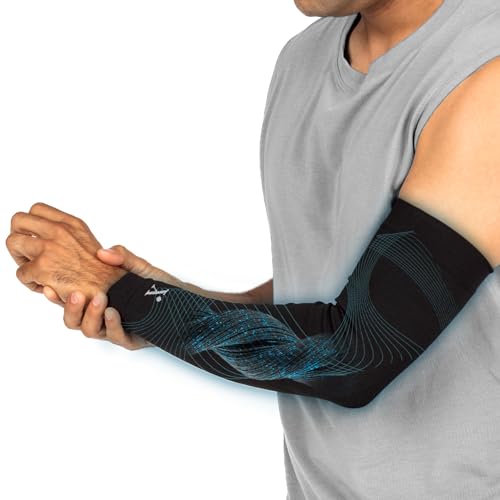
Compression with a warming ingredient woven into the fabric
NUFABRX takes a different angle: the nylon sleeve carries Capsaicin woven into the fabric, which activates when it touches your skin. The maker claims the medicine lasts for 15+ washes, longer than creams or patches you reapply. The appeal is practical — no greasy lotion to reapply, no patch to peel off. You slide the sleeve on and it works through the day.
It is made for daily wear under most outerwear, so it suits a desk job or a commute where a bulky brace would draw stares. The compression sleeve is unisex and works on either arm, and it targets tendonitis, joint pain, and muscle fatigue. It is a pull-on design with no straps, so fit relies on picking the right size the first time — there is no dial to tighten.
The buying pattern is interesting: the strongest signal is repeat buying. One buyer puts it simply — “I’ve bought it before and loved the material and how good it compresses.” That repeat-purchase pattern is the real test for a sleeve you wear every day. But capsaicin is polarizing. Some wearers feel a warming sensation that helps; others report burning or stinging. Compression also gets mixed reviews, with some finding it decent and others wanting more pressure. If you have sensitive skin, this is one to try in short bursts before committing to all-day wear.
Why it stands apart: Medicated fabric means the pain-relief step and the support step happen at the same time, without adding a cream or patch to your routine.
The real catch: If you are sensitive to capsaicin’s warming effect, this sleeve will feel like a distraction rather than a relief.
The right call for: Anyone who wants all-day comfort under clothing and does not mind a warming sensation against the skin.
Skip this one if: You have reactive skin or prefer a sleeve with more aggressive compression.
5. Modvel 2 Pack Elbow Brace for Tendonitis and Tennis Elbow
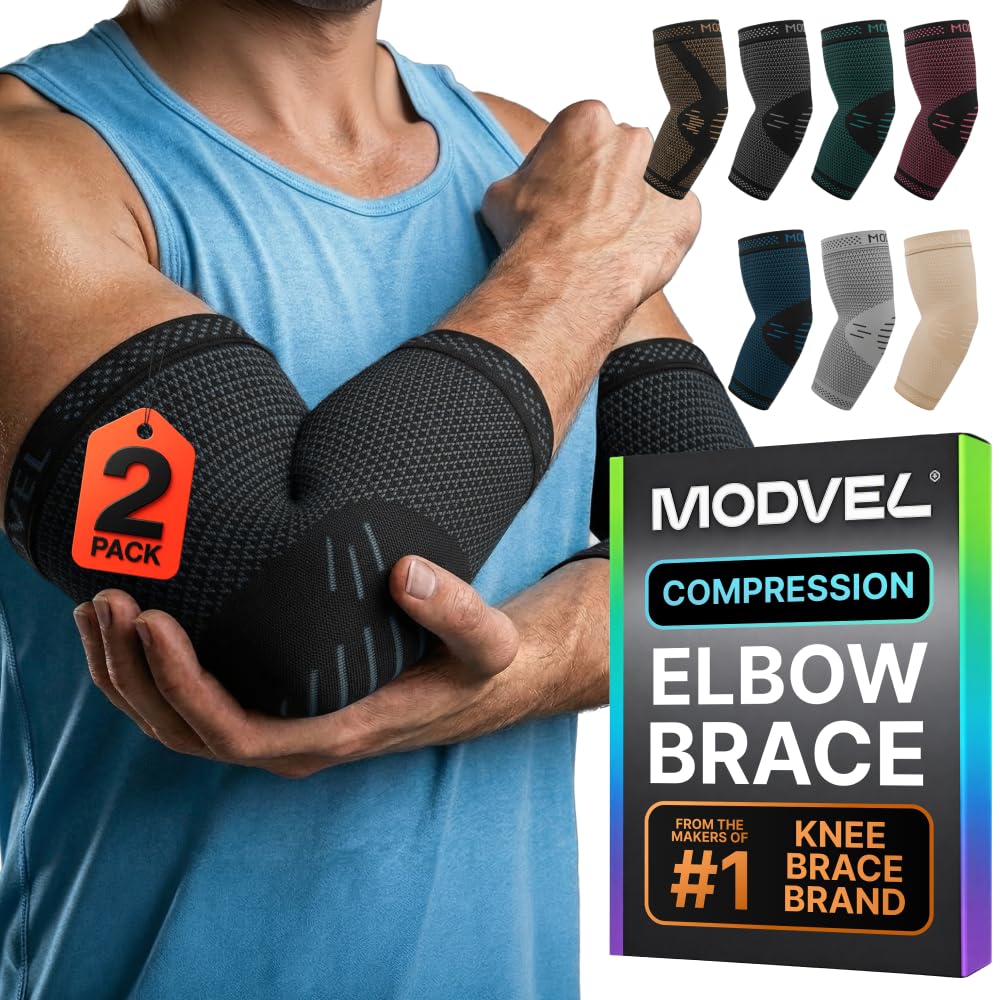
Two sleeves for the gym bag, the yard, and the workday
The math on this one is simple: you get two sleeves, so one can live in the gym bag and one can stay at your desk. Each is a slip-on compression sleeve made from 70% nylon, 20% latex, and 10% spandex — the latex is what gives it that firm, springy tension across the forearm. It targets tennis elbow and tendonitis support during activity rather than rest, which makes it the odd one out among the splints and night braces here.
Where it shines is sustained load. Owners use it through shoveling, outdoor work, gym training, and weightlifting, and the compression holds up through all of it. The breathable fabric keeps it wearable for a full day rather than an hour. It is not built for sleeping, though — this is daytime support for repetitive arm activity, and that is exactly how it should be used.
Build quality is the thing people praise most, with effectiveness right behind it, and that combination is why it holds up as a repeat-use sleeve rather than a throwaway. The recurring issue is sizing — this sleeve runs tight, and some wearers find it tighter than they expect, especially at first. It is a latex blend, too, so anyone with a latex allergy should look at a different sleeve. Get the size right and the compression feels supportive rather than restrictive.
The value read: Two sleeves in one pack means you are not washing the same one every night, and the latex-spandex blend keeps its tension through workouts.
The honest caveat: Tight is the word that keeps surfacing — this sleeve does not ease up, so check the size chart carefully.
Pick it for: An active forearm that needs support through lifting, yard work, or a repetitive job.
Look past it if: You have a latex sensitivity or need a brace that stays on for sleep.
Know the Specs
Splint type: what the stiff insert actually does
A splint is a rigid insert built into a brace that holds a joint at a fixed angle. A removable metal splint can be taken out when you want flexibility, while a fixed plastic splint stays put — that distinction decides how restrictive a brace feels. If a brace lists a removable metal piece, you get both a rigid overnight mode and a softer day mode from the same product. That flexibility is why splint design is the first spec worth checking.
Wrist and arm circumference: the number that decides whether it fits
Forearm braces are sized by circumference, not by small, medium, or large alone. A wrist brace may list 5.4–5.9 inches for Small/Medium and down to 8.1–10 inches for Large/X-Large, while an elbow brace might fit 6–11 inches in one size. Measure around the joint with a tape and match the number to the chart. That single measurement is the difference between a brace that works and one that ends up in a drawer.
Compression fabric: why the material matters
Sleeves rely on fabric stretch to stabilize the tendon, so the blend is the support. A mix like 76% Micro-Nylon and 24% LYCRA Spandex gives stretch and recovery, while a blend of 70% nylon, 20% latex, and 10% spandex delivers firmer tension. Latex makes a sleeve springy and tight; spandex keeps it from sagging through the day. Read the blend and you will know how the sleeve will feel within an hour of wear.
Capsaicin infusion: what it is and who it suits
Capsaicin is the compound that gives chili peppers their heat, and in a medicated sleeve it is woven into the fabric so it activates on skin contact. The idea is to combine compression with a warming sensation in one garment, without a separate cream or patch. Some wearers find the warmth helps; others find it irritating or feel nothing at all. If you have sensitive skin, try a medicated sleeve gradually before relying on it for a full day.
Common Questions
Should I wear a wrist splint or an elbow sleeve for forearm pain?
Can I sleep in a compression sleeve?
How do I measure my wrist for a splint?
Is a latex blend safe for sensitive skin?
Does a medicated sleeve really relieve pain, or is it just marketing?
Can I wear a brace while typing or driving?
How tight should an elbow brace be?
Are removable splints better than fixed ones?
How long will a compression sleeve last before it loses stretch?
The Bottom Line
For most people with nighttime wrist pain or carpal-tunnel symptoms, the best brace for forearm pain pick is the FEATOL Wrist Brace, because the metal-and-plastic splint setup holds the wrist in neutral through the night and the three-strap design keeps it from slipping off. If your pain sits on the inside of the elbow with nerve tingling running down the arm, reach for the Oyakin Elbow Brace and pull the splints out for daytime tasks. For tendon pain during lifting, yard work, or a long workday, the Modvel 2 Pack gives you two sleeves and a firm latex-blend tension. And if you want support that hides under a shirt for a full day at a desk, the OrthoSleeve ES3 slips on and stays out of the way. Each of these solves a different shape of forearm pain, so pick the one that matches where yours actually lives.
How we choose
We do not accept paid placement. Every pick is matched to a real buyer and a real use-case; we do not hands-on test units.
Sources
Specifications: manufacturer listings and product documentation. Review insights: verified customer reviews, as of October 2026. Pricing: not shown on this page (it changes often); check the current price via the retailer link.
As an Amazon Associate, Aappliancez earns from qualifying purchases. This does not affect which products we feature.