Disclosure: Some links in this post are affiliate links. As an Amazon Associate I earn from qualifying purchases, at no extra cost to you. Learn more
Specs are compiled from manufacturer listings and verified buyer reviews and can change over time — please confirm the key details on the product page before buying.
An AC joint separation (a torn ligament where your collarbone meets the shoulder blade) makes the simplest reach feel like a warning shot. The right brace has to steady the joint without locking the whole arm. The short answer: a compression sleeve suits a mild sprain you still use daily, while a sling with a support strap is the pick for a fresh separation that needs real rest. These five options cover both jobs.
This guide is built by comparing the manufacturers’ published specifications and the patterns across verified customer reviews, so you get each pick’s real strengths and trade-offs instead of marketing spin.
Your choice depends on two things: how much arm movement you need back, and how much stillness the joint can tolerate. Here is the honest breakdown of each brace, so you can match one to your grade of injury.
Top Picks

How To Choose The Best Brace for AC Joint Separation
Your AC joint sits right at the top of the shoulder, so a brace that only squeezes the upper arm won’t do much for a separation there. You want to know two things before you buy: how much the brace limits arm motion, and whether it pulls the collarbone back toward the shoulder blade. Below is what separates a brace that supports the joint from one that just squeezes the arm.
Sling or compression sleeve: which job are you doing
A sling hangs the arm and keeps it out of the way, which is what you want in the early days of a separation when movement is the enemy. A compression sleeve wraps the shoulder and upper arm to remind you to hold still while still letting you dress, work, and sleep. If your doctor has told you to rest the arm, pick the sling. If you’re back to light daily activity and just need support and a nudge to stop reaching, the sleeve is the more livable choice.
The closure is what you’ll fight daily
Every brace here uses a hook-and-loop closure (the grab-and-release Velcro style), and that matters because you’ll be strapping it on with one good hand. A closure you can reach and re-tighten with one hand keeps the brace on your shoulder instead of in a drawer. Look for straps you can adjust without help, since a brace that needs a second person gets worn less.
Fit runs small more often than you’d expect
Across these braces the most repeated complaint isn’t the material — it’s sizing. Measure your chest and bicep before ordering and treat the size chart as a starting point, not gospel. A brace that’s slightly too big slides off the shoulder; one that’s slightly small digs into the armpit and chest. And several models here include a gel ice pack, which adds cold therapy on top of support when swelling is part of the picture.
Side-by-Side Comparison
| Model | Best For | Item Weight | Closure Type | Material | Amazon |
|---|---|---|---|---|---|
| KONSEDIK Shoulder Brace Sling Immobilizer★ Best Overall | Mild sprains and daily wear | 0.45 kg | Hook & Loop | Neoprene, Polyester | Amazon |
| VISKONDA Shoulder Brace Sling ImmobilizerBest for Night Support | Night support and tendinitis | 0.45 kg | Hook & Loop | Neoprene, Polyester | Amazon |
| BraceAbility The Shoulder Sling | Post-op and shower-friendly rest | 0.07 kg | Buckle | Polyester Blend | Amazon |
| Copper Compression Shoulder Brace | SLAP tears and active recovery | — | — | 75% Nylon (copper infused) | Amazon |
| ORTONYX Shoulder Stability Brace | Wearing under clothes long-term | — | — | Nylon 85%, Elastane 15% | Amazon |
Detailed Reviews
1. KONSEDIK Shoulder Brace Sling Immobilizer
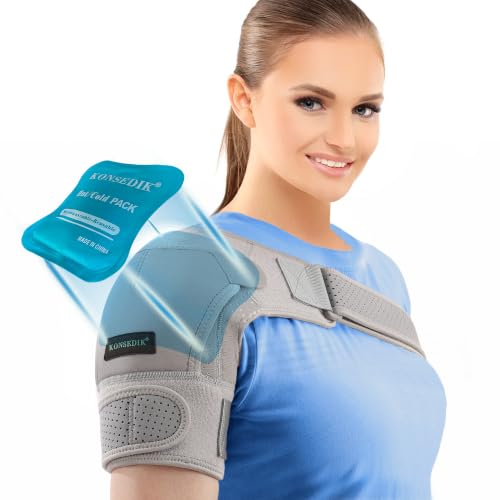
A breathable shoulder cuff that brings its own gel ice pack and adjusts with one hand.
The KONSEDIK earns its spot by doing two jobs at once: a flexible neoprene cuff (a stretchy, breathable fabric) gives gentle compression, and a reusable gel ice pack sits in its own pocket against the shoulder. That combo suits the first week or two of an AC joint sprain, when you want cold on the swelling and light pressure reminding you to keep the arm quiet. The catch: it’s not a full sling, so it won’t hold your arm in place if your doctor wants total rest. Pick it if you’re managing a mild-to-moderate sprain and still need to function day to day; skip it if you need the arm fully immobilized.
Off comes the guesswork on setup. The hook-and-loop straps (grab-and-release Velcro) let you tighten the chest and arm bands without a helper, and the height adjusts for either shoulder. That’s a real asset when one arm is reluctant to move. The materials blend neoprene and polyester, and the whole thing comes in at 0.45 kg — noticeably heavier than a bare sling like the BraceAbility, because it carries that gel pack and more fabric.
Where it earns its keep is fit on slimmer frames. Thin-waisted wearers report it molding comfortably, and it’s sized for adults in gray. Do mind the ice pack, though — it’s cold for a short spell rather than a long session, which is expected for a small gel pouch and not a fault of the material. For mild-to-moderate AC joint discomfort you still want to power through light daily tasks with, it’s the most well-rounded package here.
What earns it the top spot
- Gel ice pack included for cold therapy on swelling
- Breathable neoprene-and-polyester cuff for daily wear
- One-handed hook-and-loop adjustment for either shoulder
- Molds comfortably to slimmer frames
Where it falls short
- Not a full sling, so it limits motion less than a strap-style hanger
- Gel pack holds its cold only a short while per session
- Heavier than a bare fabric sling at 0.45 kg
Reach for this if: you’re managing a mild AC joint sprain or tendinitis and want support plus cold therapy in one wearable.
Skip the sling hunt if: your doctor has told you to rest the arm fully — you’ll want a true sling with a support strap instead.
2. VISKONDA Shoulder Brace Sling Immobilizer
The cuff that quietly keeps your shoulder from rolling awake at 3 a.m.
Compared with the KONSEDIK above, the VISKONDA is built around the same compression-cuff idea but angles harder at overnight and repetitive-use comfort. It pairs a breathable neoprene sleeve with a reusable gel ice pack, and it’s made for both men and women, adjustable for either shoulder. It’s the one to look at if the AC joint ache creeps in when you lie on that side — the gentle pressure keeps the shoulder from collapsing forward through the night.
Its paperwork lists it 0.45 kg with a 0.12-inch thickness, so it stays low and flexible against the body while still giving compression. The three most reassuring things about it: the reusable ice pack for swelling, the one-handed hook-and-loop adjustability, and the fact that it costs a fraction of the pricier branded sleeves. Just know that sizing is the weak link — the chest and arm straps run snug on bigger builds, so measure before you commit.
For repetitive tasks and tendinitis nagging through the day, this cuff is a sensible pick. Buyers report: “Size S fits 5’2″, 123 lb user with room; velcro forearm strap needs tightening; underarm strap too short by ~1 ft.” Take that as a bias toward sizing up and tightening the forearm band as needed.
The real-world strength: gentle, even pressure that many find takes the edge off night-time shoulder tendinitis and helps them sleep, while still letting them dress and work the next day.
The honest catch: the ice pack barely registers through the fabric and can slide out of its pocket, so treat cold therapy as a bonus rather than the reason to buy. Fit also runs snug — order with your chest and bicep measurements in hand.
Your match if: you want a wearable compression cuff for night comfort and daytime support without paying premium prices.
Look elsewhere if: you have a larger chest or arm and need something that won’t need constant re-tightening all evening.
3. BraceAbility The Shoulder Sling — Patented Arm Support Strap

The one thin sling you can keep on in the shower without wrecking recovery.
If your separation needs the arm actually hung out of the way rather than just nudged, the BraceAbility sling does the restraint job — and it does it while staying waterproof enough for a shower. Compare the heft: this sling is 0.07 kg to the KONSEDIK and VISKONDA cuffs at 0.45 kg each, so it’s dramatically lighter and won’t add bulk under a coat. That thin, strap-style build is exactly what makes it unobtrusive during a six-week rest period.
The trade-off is straightforward: with very little material comes gentle support rather than rigid support. Its stretchy fabric reminds you not to lift the arm instead of locking it down. If your clinician wants a firm hold, this isn’t that brace — but the reminder function is apparently enough for many people to get through post-op restrictions. It’s also machine washable, which is a small mercy for something you wear every day.
The universal size is the sticking point. It’s built as one-size, and it fit complaints in the reviews tend to land on it being too big for smaller frames. If you’re slim, expect to fine-tune the buckle and strap length. As owners mention: “after four weeks post op, this is my go to — it reminds you not to use the shoulder or arm, and the stretching material is actually a benefit.”
Why it earns a place
- Waterproof design for showering and daily wear
- Featherweight at 0.07 kg — barely there under clothing
- Buckle closure, machine washable
- Works for left or right arm
What to know first
- Gentle, stretchy support rather than rigid immobilization
- One-size build can run large on smaller frames
- Strap method takes a little figuring out at first
Built for: the post-op or post-injury stretch where you need the arm out of circulation and a sling that survives getting wet.
Not the one for: a rigid hold or a trim custom fit on a small frame.
4. Copper Compression Shoulder Brace with PowerKnit Technology

A two-strap compression brace for people who can’t fully stop moving.
The Copper Compression brace names your exact injury on the label: shoulder separation. It lists AC Joint Separation expressly among the injuries it’s built around, along with SLAP tears and rotator cuff trouble. It goes after them with its PowerKnit fabric — a woven compression material that holds the shoulder without a stiff shell. The standout feature is the two independently adjustable straps, which let you dial in pressure over the joint itself and along the upper arm separately. That makes it a fit for a sprained joint you still need to move; it’s not the pick if you want a rigid shell holding everything still.
That setup suits athletes itching back toward light sport. It’s listed for basketball, soccer, and baseball use, and the woven construction is meant to keep the shoulder from rotating forward while you’re active. The majority of wearers find it stabilizes the joint and eases discomfort, so if you want support that moves with you rather than pins you down, this fits the brief better than a loose sling. It’s sized Large-X Large, and the copper-infused nylon blend makes up the bulk of the fabric.
Its weak point is on-body ease of use. The recurring review theme is fit and donning: some find it slides off the shoulder or sits awkwardly, and getting the two straps set right takes getting used to when one arm is favoring the joint. Many report it’s simply built too large for smaller frames. Even so, for a leaner athlete it may feel just right.
Tailored to the active recovery stage: the two adjustable straps and PowerKnit compression give a stabilizing hold aimed at sports and daily activity, with copper-infused nylon for the fabric.
Set your expectations on the fit: the Large-X Large sizing and the strap adjustments are where buyers diverge — measure carefully and expect a learning curve putting it on one-handed.
Pick this if: you’re past the strict-rest phase, want the brace named for AC joint separation specifically, and need support through light sport.
Pass if: you’re on the smaller side or want a brace that slips on in seconds without strap fuss.
5. ORTONYX Shoulder Stability Brace Compression Sleeve
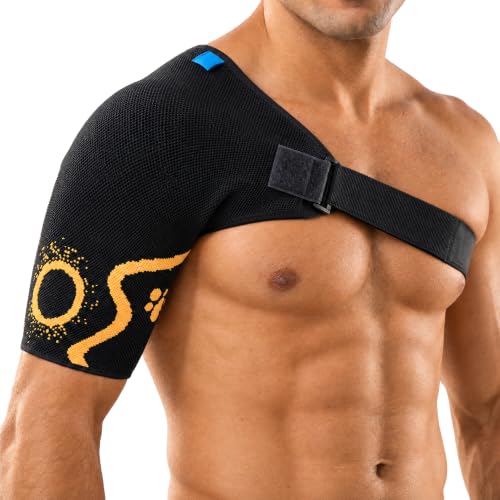
A slim knit sleeve you can keep wearing when the brace has to hide under a shirt.
Made of Nylon 85% and Elastane 15%, this knit sleeve is the most clothing-friendly option in the group — the slim design is built to sit quietly under regular clothes for extended wear. That makes it the answer to a very specific problem: you need support through the workday without a strap-and-buckle rig announcing itself. The moisture-wicking fabric keeps the shoulder cool and dry while you move, and the reversible 3D knit construction is listed as even-distribution compression rather than point pressure.
Its 12-count pain-relief and quality signals point the same direction — owners who use it feel it stabilizes the upper arm and reminds them to ease off the injured shoulder. The two biggest reasons to like it are that it slips under clothing and it can be worn for hours without becoming a hassle. Just plan on hand-washing it in cool water and air-drying away from heat, since the care instructions rule out the dryer and iron.
The size M option is where things get tricky, and that’s the whole honest story here. Fit is the most-discussed factor for this brace, and it swings both ways — some wearers find it perfect, others find it too loose at the shoulder despite the arm feeling right. There’s also a real-life note that a knit sleeve can stretch with heavy use over time. Work from the size chart, and size with care around the shoulder, since two buyers can measure identically and get a different fit.
The draw: a slim, moisture-wicking knit sleeve built to hide under clothes and be worn all day, with an adjustable strap for a customized hold.
The honest catch: fit is the make-or-break factor — go by the chart, watch for shoulder looseness on a size that’s right at the bicep, and hand-wash only.
Made for: the wearer who wants discreet, hours-long compression under clothing and doesn’t need rigid support.
Not your solution if: you need a firm hold on the clavicle or want a size guaranteed to fit without trial.
Know the Specs
Compression sleeve vs. sling
A compression sleeve wraps the shoulder and upper arm to apply even pressure and remind you to limit movement. A sling hangs the arm against the body to take the load off entirely. For an AC joint separation, a sleeve helps when you’re still active and need support, while a sling is for the rest phase when any lifting gets in the way of healing.
Hook-and-loop closure
Hook-and-loop (the Velcro-style grab-and-release strap) is the closure on most braces here. It lets you tighten and re-adjust with one hand, which matters when your injured arm shouldn’t be doing the work. A buckle closure, by contrast, sets the strap and holds it, but is trickier to re-tighten solo.
The gel ice pack
Some shoulder braces include a reusable gel ice pack that slips into a pocket against the shoulder for cold therapy on swelling. It’s a bonus, not the main event — a small gel pouch holds its cold for a short session, so expect to re-freeze it between uses rather than wear it all day.
Why sizing decides everything
Fit decides whether a shoulder brace stays on your shoulder or ends up in a drawer. A brace that’s too big slides off the shoulder, and one that’s too small digs into the armpit and gets left in a drawer. Measure your chest and bicep and treat the size chart as a starting point — several of these braces run small or large, so a measured order beats a guess.
Common Questions
Will a compression sleeve work for an AC joint separation or do I need a sling?
How do I size a shoulder brace so it doesn’t slip off?
Can I wear a shoulder brace to sleep in?
Is the included ice pack worth relying on?
Can I shower in a shoulder sling?
How do I put on a shoulder brace with one good arm?
What’s the difference between an AC joint brace and a rotator cuff brace?
Will a shoulder brace loosen or stretch over time?
How long should I wear a brace for an AC joint separation?
Can I wear a compression shoulder brace under regular clothes?
The Bottom Line
For most people managing a mild-to-moderate AC joint sprain who still need to function day to day, the KONSEDIK Shoulder Brace is the smart all-rounder — breathable compression, a reusable gel ice pack, and one-handed adjustment in a single affordable package. If the ache is worst at night and you want a low-cost cuff for sleeping, the VISKONDA is the more budget-friendly route. And when your recovery calls for the arm genuinely out of the way with a shower-safe, featherweight hanger, the BraceAbility sling is the one to reach for. Whichever you pick, measure your chest and bicep before you order — fit, more than any other spec on this list, is what keeps a brace on your shoulder instead of in a drawer.
How we choose
We do not accept paid placement. Every pick is matched to a real buyer and a real use-case; we do not hands-on test units.
Sources
Specifications: manufacturer listings and product documentation. Review insights: verified customer reviews, as of October 2026. Pricing: not shown on this page (it changes often); check the current price via the retailer link.
As an Amazon Associate, Aappliancez earns from qualifying purchases. This does not affect which products we feature.