Disclosure: Some links in this post are affiliate links. As an Amazon Associate I earn from qualifying purchases, at no extra cost to you. Learn more
Specs are compiled from manufacturer listings and verified buyer reviews and can change over time — please confirm the key details on the product page before buying.
If your wrist breaks back at the top of your swing, no amount of new equipment will fix your release. You know the shot: the ball comes off your hand flat, it slides past the break point, and you leave another 10-pin standing. A wrist brace holds your hand in one repeatable position from the push-away to the follow-through, so your release stops changing shot to shot. The right brace disappears on your hand by the second frame; the wrong one rubs and shifts through all three games. This guide covers braces built for the lanes, including positioners with metal inserts that lock the wrist and soft supports that just remind you to stay firm.
This guide is built by comparing the manufacturers’ published specifications and the patterns across verified customer reviews, so you get each pick’s real strengths and trade-offs instead of marketing spin.
We’ll sort out the key differences: a rigid metal positioner, a soft neoprene support, and the strap arrangement that decides whether it stays put. By the end you’ll know which bowling wrist brace actually fits your hand and your release, not just the photo on the listing.
Top Picks

How To Choose The Best Bowling Wrist Brace
Your wrist brace only earns its place in your bag if it does two jobs: it holds your wrist firmly, and it stays comfortable through a full three-game set. A brace that locks your wrist at a fixed angle can flatten the cup that generates hook. A brace with too little structure lets your wrist collapse again on the downswing. the balance is a brace that holds the wrist angle you already throw with and stays out of your way.
Rigid positioner versus soft support
A positioner with metal inserts on the front and back locks your wrist into one angle, so the ball comes off your hand the same way every throw. That helps if you are trying to straighten a collapsing wrist or repeat a clean release. A soft neoprene cuff wraps the wrist in compression without forcing an angle, which suits bowlers who want a gentle reminder to stay firm rather than a hard stop.
Hand orientation and finger loops
Many braces are built for one hand only, so check whether yours is right-handed or left-handed before you buy. Some models add an extended index finger or a pinkie loop to nudge your hand into a specific position at release. Those features help players chasing more axis rotation. They can feel strange if you just want basic support, so decide which camp you are in first.
Fit, straps, and breathability
Measure around your wrist and match it to the maker’s size chart, since a loose brace slides and a tight one cuts circulation. Adjustable hook-and-loop straps let you dial in snugness per game. Look for breathable fabric and a low profile if you bowl several games in one session, because a sweaty, bulky brace wears on your hand by the third frame.
Side-by-Side Comparison
| Model | Best For | Type | Hand | Weight | Amazon |
|---|---|---|---|---|---|
| McDavid Wrist Brace★ Best Overall | All-round support | Neoprene compression cuff | — | 1.6 ounces | Amazon |
| Brunswick Shot Repeater XWrist Lock | Locking wrist position | Rigid positioner with metal inserts | Right hand | — | Amazon |
| MUELLER Hg80 Premium | All-day comfort | Soft adjustable wrap | Fits either hand | 100 g | Amazon |
| Storm Xtra-Grip Plus | Grip and control | Glove-style support with grip material | Right hand | 3.2 ounces | Amazon |
| Storm Xtra-Hook | Extra hook and axis rotation | Positioner with extended index finger | Right hand | 5.6 ounces | Amazon |
Detailed Reviews
1. McDavid Wrist Brace
Our pick — 4.5+★ from 500+ verified ratings; the strongest balance of quality and price.
A 1.6-ounce neoprene cuff that steadies the wrist without adding swing weight.
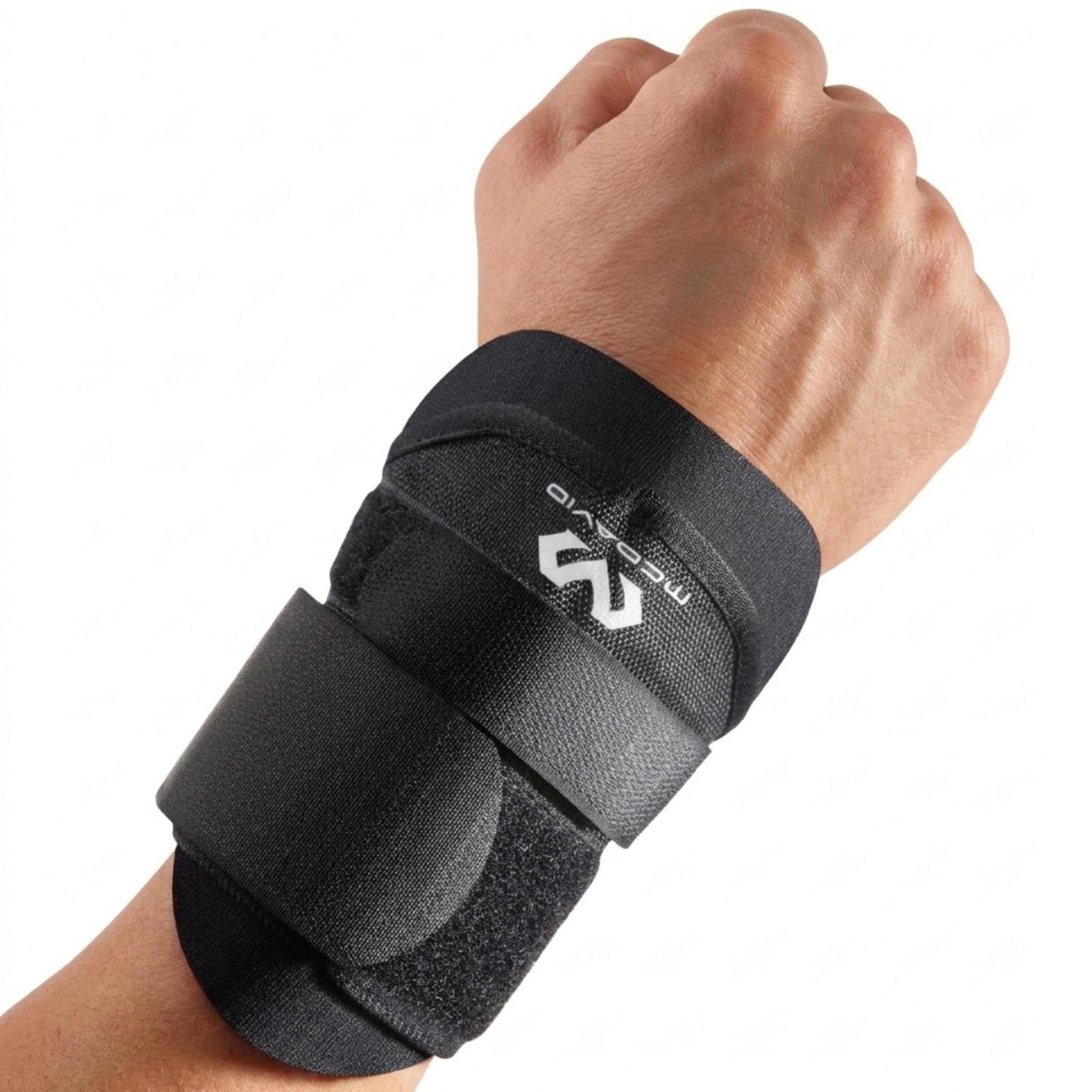
The McDavid earns the top spot by doing the least: it wraps your wrist in a latex-free neoprene cuff and adds two elastic straps for support. At 1.6 ounces it is half the weight of the Storm Xtra-Grip Plus at 3.2 ounces, and that gap shows up the moment you wear it for a full set. Your hand stays light through the swing, so you are not fighting the brace to get a clean release.
Owners praise the build: two elastic straps cinch across the wrist for real support, and the neoprene adds thermal compression without bulk. Pull it on, cinch the straps, and your wrist has a firm, repeatable platform for every shot. It has plenty of fans who wear it for collision sports too, and that everyday toughness carries over to the lanes.
The catch is the closure: it is pull-on with straps, so it goes on slower than a simple wrap. It is also a neoprene cuff rather than a rigid positioner, so it supports your wrist rather than locking it at a set angle. If you need a metal insert forcing a fixed wrist position, the Brunswick Shot Repeater X is the better fit.
What It Does Well
- Featherweight 1.6-ounce neoprene cuff keeps your hand free and unburdened
- Two elastic straps give adjustable compression across the wrist
- Latex-free neoprene stays comfortable over a long session
- Build quality holds up to repeated, rough wear
Worth Knowing
- Pull-on design with straps takes longer to seat than a simple wrap
- Neoprene support is not a rigid, fixed-angle positioner
- A few find it overpriced for what it is
Go for it if: you want a light, dependable cuff that adds steady support without dictating your wrist angle.
Think twice if: you are chasing a locked, metal-backed position for a repeatable release.
2. Brunswick Shot Repeater X Right Hand
The positioner for bowlers whose wrist keeps breaking back on the downswing.
Brunswick’s Shot Repeater X is the one to look at if you want your wrist locked, not just cradled. Metal inserts on the front and back hold your wrist at a set position and keep it there through the swing, so the ball comes off your hand the same way each frame. That repeatability is the whole point of a positioner: it trains a consistent release and takes the variable of a wandering wrist out of play. Unlike the McDavid’s soft neoprene cuff, this one physically resists your wrist breaking during the swing.
You get a snug fit you can set yourself, thanks to three Velcro straps, and the light fabric helps manage moisture so your hand does not turn clammy mid-set. As owners put it: “Three Velcro straps are adjustable to get it as snug as you like.” The metal bar that gives it stability also feels stiff at first, and the general read is that it breaks in and starts to feel natural once you get some games behind it. Functionality leads the feedback — bowlers find it does exactly what a positioner should, holding the wrist in the proper spot.
Comfort is where opinions split. The rigid metal is the source of the stability, and it is also the reason a few bowlers say it initially hurts the wrist until it softens up. Snug it down lightly at first rather than cranking the straps. This is a right-hand model, so lefties need a different brace entirely.
The support story: a firm metal insert front and back holds the wrist steady, which is exactly what a bowler fighting a collapsing wrist needs for a repeatable release.
Where it pushes back: the stiff bar needs a break-in period, so the first couple of sessions may feel tight against a sore wrist.
The right call for: right-handed bowlers chasing a locked, repeatable wrist angle.
Pair it with patience: expect a break-in stretch before the metal bar feels natural.
3. MUELLER Sports Medicine Hg80 Premium Wrist Brace

A breathable HydraCinn wrap built for comfort over a full session, not a locked angle.
If your wrist aches after a long set and you want something you can leave on, the Mueller Hg80 is built for that. It uses HydraCinn fabric, a high-performance material the maker describes as moisture-wicking with heat management, so the brace stays cooler against the skin than a plain neoprene cuff. It weighs 100 g and slides on easily, then tightens with a hook-and-loop closure to your comfort level.
The flexibility is the point. This is not a rigid positioner; it lets your hand move through the swing while a hook-and-loop strap keeps the wrist supported. That is why owners describe it as enough support to protect the wrist and remind you to be careful, without the immovable stiffness of a metal-splint brace. As the review pages sum it up: “I have a lot of different braces and this one fits perfectly.” It also fits either hand, so one brace serves both.
The obvious trade-off is that it will not lock your wrist at a fixed angle the way the Shot Repeater X does. Its thumb hole runs a touch tight on some hands, though owners say it stretches with use. If you want a hard structural lock for your release, this is the wrong tool — it is a comfort-first wrap for a sore or tired wrist.
Comfort first: breathable HydraCinn fabric and a lightweight 100 g build make this the brace you forget you are wearing over a long session.
The honest limit: it supports the wrist without forcing a fixed angle, so it will not straighten a collapsing wrist on its own.
Pick this when: comfort and all-day wear matter more to you than a locked position.
Look elsewhere if: you need a rigid positioner to control your release angle.
4. Storm Xtra-Grip Plus Right Hand Wrist Support, Black, Large

A glove-style support with a tacky gripping panel that adds feel at release.
The Storm Xtra-Grip Plus solves a different problem than a rigid positioner: it adds feel. A reinforced backhand panel supports a consistent wrist position, and a unique gripping material increases your feel for added control. If your hand tends to slip or your release feels vague, this is the brace that puts more of the ball in your hand. It weighs 3.2 ounces, so it is noticeably heftier than the featherweight McDavid at 1.6 ounces, but the added material is part of where the grip and support come from.
What wins people over is the wrist support — the elastic wrist wrap increases tendon support and keeps the hand firm. The tacky feel is a bonus that many bowlers say helps their release and rotation on the ball. Ventilation keeps the hand dry across three games, and the pinkie loop is a small comfort touch. As the review pages sum it up: “This is by far the best.” For a right-hander who wants grip as much as support, it is a strong pick.
The recurring gripe is durability — stitching has been known to come loose in places with heavy use. It is also a right-hand-only model and harder to pull off than a plain cuff when your hand is sweaty. Treat the seams gently and hand-wash it to stretch its life.
Where It Shines
- Tacky gripping material adds feel and control at release
- Reinforced backhand panel holds a consistent wrist position
- Ventilated fabric keeps the hand dry through three games
- Elastic wrist wrap increases tendon support
Trade-Offs To Weigh
- Stitching has been known to come loose with heavy use
- Right hand only, and harder to remove when sweaty
- Heavier than a basic neoprene cuff
Reach for this if: a right-hander who wants grip and feel blended into a supportive wrist wrap.
Keep in mind: the seams want gentle handling and hand-washing to last.
5. Storm Xtra-Hook Wrist Support

A 5.6-ounce positioner with an extended index finger aimed at more axis rotation.
The Xtra-Hook is the most specialized brace here. An extended index finger is designed to increase axis rotation, and the brace ensures proper wrist and hand positioning for added lift. If your goal is more hook and a stronger ball reaction, this is the tool aimed squarely at that. It weighs 5.6 ounces, the heaviest of the group, because of the added structure and the finger guide.
The trade-off for that extra hook help is an adjustment period. The stiffness takes a little getting used to, and the extended pointer-finger guard is the feature that divides bowlers most. Several say it feels odd at first, and some simply stop using the finger guard after a few games. The wrist support itself is what most bowlers praise, and the comfortable fit keeps it wearable once the mechanism feels familiar.
A word on sizing: order up. A medium glove does not equal a medium guard here, and at least a few owners found they should have gone a size larger. The Velcro straps adjust easily to dial in fit. It is a right-hand, medium model, so check the size chart carefully before you commit.
The hook chaser’s pick: an extended index finger and proper wrist positioning are aimed at more axis rotation and lift for a stronger reaction.
The adjustment cost: the stiff finger guard can feel awkward at first, and sizing runs small enough that some wish they’d ordered up.
Made for: right-handers hunting more hook and axis rotation who don’t mind adapting to a finger guide.
Size up first: a medium glove does not mean a medium guard here.
Know the Specs
Rigid Inserts and Wrist Angle
A positioner with metal inserts on the front and back locks your wrist at a set angle so the ball releases the same way every throw. Use one when your wrist collapses on the downswing and you want to force a repeatable position. A soft wrap like the Mueller supports the wrist without forcing an angle, so it suits bowlers who want a gentle reminder to stay firm rather than a hard stop.
Fabric, Weight, and Breathability
Weight and fabric decide whether you can wear a brace for a full set. Lighter cuffs sit near 1.6 ounces and stay out of your way, while a structured positioner with a finger guide runs heavier. Moisture-wicking material helps keep your hand dry across three games, and a low profile keeps the brace from crowding your grip on the ball.
Hand Orientation and Finger Loops
Many braces are built for one hand only, so confirm whether yours is right-handed before buying. An extended index finger or a pinkie loop nudges your hand into a specific position at release, which helps players chasing axis rotation but can feel strange if you just want basic support. A brace that fits either hand, like the Mueller, gives you more flexibility.
Straps and Fit
Adjustable hook-and-loop straps let you set snugness per game, and a good fit is what keeps the brace from sliding during your swing. Measure around your wrist and match the maker’s size chart. Too loose and it shifts mid-approach; too tight and it cuts circulation. When in doubt on a structured guard, size up rather than down.
Common Questions
Will a rigid wrist positioner help or hurt my hook?
How do I know which hand to order?
Should a bowling wrist brace fit tight or loose?
Can I wear a wrist brace for a whole bowling session?
Why does the Storm Xtra-Hook have an extended index finger?
Is a metal insert better than a soft wrap?
How long does a bowling wrist brace last?
Do I need a wrist brace for a weak wrist?
Can I use these braces for other sports?
The Bottom Line
For most bowlers, the bowling wrist brace winner is the McDavid Wrist Brace because it balances light, breathable neoprene support with two adjustable straps and real build quality. If you want your wrist locked at a repeatable angle, the Brunswick Shot Repeater X gives you that with metal inserts you can adjust via three Velcro straps. For a comfort-first wrap you can wear all session, the Mueller Hg80 Premium earned one of the higher scores of the group across a deep pool of owners — a safe, well-loved choice. And if you are chasing more hook, the Storm Xtra-Hook is the one built for axis rotation. Whichever you pick, match the hand orientation and size to your wrist first.
How we choose
We do not accept paid placement. Every pick is matched to a real buyer and a real use-case; we do not hands-on test units.
Sources
Specifications: manufacturer listings and product documentation. Review insights: verified customer reviews, as of October 2026. Pricing: not shown on this page (it changes often); check the current price via the retailer link.
As an Amazon Associate, Aappliancez earns from qualifying purchases. This does not affect which products we feature.