Disclosure: Some links in this post are affiliate links. As an Amazon Associate I earn from qualifying purchases, at no extra cost to you. Learn more
Specs are compiled from manufacturer listings and verified buyer reviews and can change over time — please confirm the key details on the product page before buying.
Water creeping under the garage door is the problem you are here to end. The right bottom seal presses flat against the floor and keeps rain, snowmelt, leaves, and mice outside. The wrong one won’t fit your track, won’t sit flush on your concrete, and fails within a season. This guide narrows it to five proven options, leads with the strongest, and names the exact track and door each one fits.
This guide is built by comparing the manufacturers’ published specifications and the patterns across verified customer reviews, so you get each pick’s real strengths and trade-offs instead of marketing spin.
You will learn which T-end width your track needs, how thick a seal should be, and which material survives cold snaps and summer heat. Here is the honest shortlist of the bottom garage door seal picks that actually hold the weather out.
Top Picks

How To Choose The Best Bottom Garage Door Seal
Two different problems hide behind this one keyword. One is a seal that slides into the track at the bottom of the door itself — that piece travels with the door as it lifts. The other is a threshold strip that glues to the concrete floor and stops water from washing in under the door. Get the wrong type and it will not matter how carefully you install it. Start by looking at your door.
Identify your track before you buy anything
Look at the metal channel running along the bottom edge of your door. You need to measure the width of the T-shaped slot that holds the old seal. The common sizes in this group are 5/16 inch, a 1/4 inch T-end, and a match for Amarr or Clopay doors at roughly 2.75 to 3 inches of flat width. A seal that is a hair too wide will refuse to slide in, and one that is too narrow will twist and pop out.
Thickness is the real trade-off
A thicker strip seals an uneven concrete floor better because it has more material to press into the dips. A thinner strip feeds through the track faster and fits tighter channels. The Universal seal in this group is 0.7 inches thick and glues to the floor, so it fills gaps rather than sliding into a track. The T-style seals sit closer to 0.31 to 0.25 inches of thickness and rely on the track channel for a hold.
Pick a material that survives your winters
Rubber and silicone both flex, but they behave differently. A silicone strip tends to keep its shape across a wide temperature range, and the seals here often list working ranges from -40° Fahrenheit to 140° Fahrenheit or higher. If you live somewhere with ice and snowmelt, remember that a solid threshold seal also traps the drips inside the garage until you sweep them out.
Side-by-Side Comparison
| Model | Best For | Seal Type | Length | Thickness | Amazon |
|---|---|---|---|---|---|
| VUAOHIY Universal Threshold Seal★ Best Overall | Gluing down to the floor to stop water wash-in | Adhesive floor strip | 16 Feet | 0.7 inches | Amazon |
| DGSL 20FT Garage Door Bottom SealBest Value | Long doors and uneven floors on a budget | 5/16″ T-End slide-in | 20 Feet | 0.31 inches | Amazon |
| Jin&Bao Garage Door Bottom Rubber Seal | Heavy daily door traffic and big temperature swings | 5/16″ T-End U+O ring | 16 Feet | 1.5 millimeters | Amazon |
| NATGAI 1/4″ T-End Garage Door Seal | Tracks built for a 1/4 inch T-end | 1/4″ T-End U+O ring | 16 Feet | 0.25 inches | Amazon |
| HOOIMA T-Ends Weather Seal | Amarr and Clopay owners who want an OEM-style match | T-Ends, Amarr/Clopay style | 20 Feet | — | Amazon |
Detailed Reviews
1. VUAOHIY Garage Door Bottom Threshold Seal
Our pick — 4.5+★ from 600+ verified ratings; the strongest balance of quality and price.
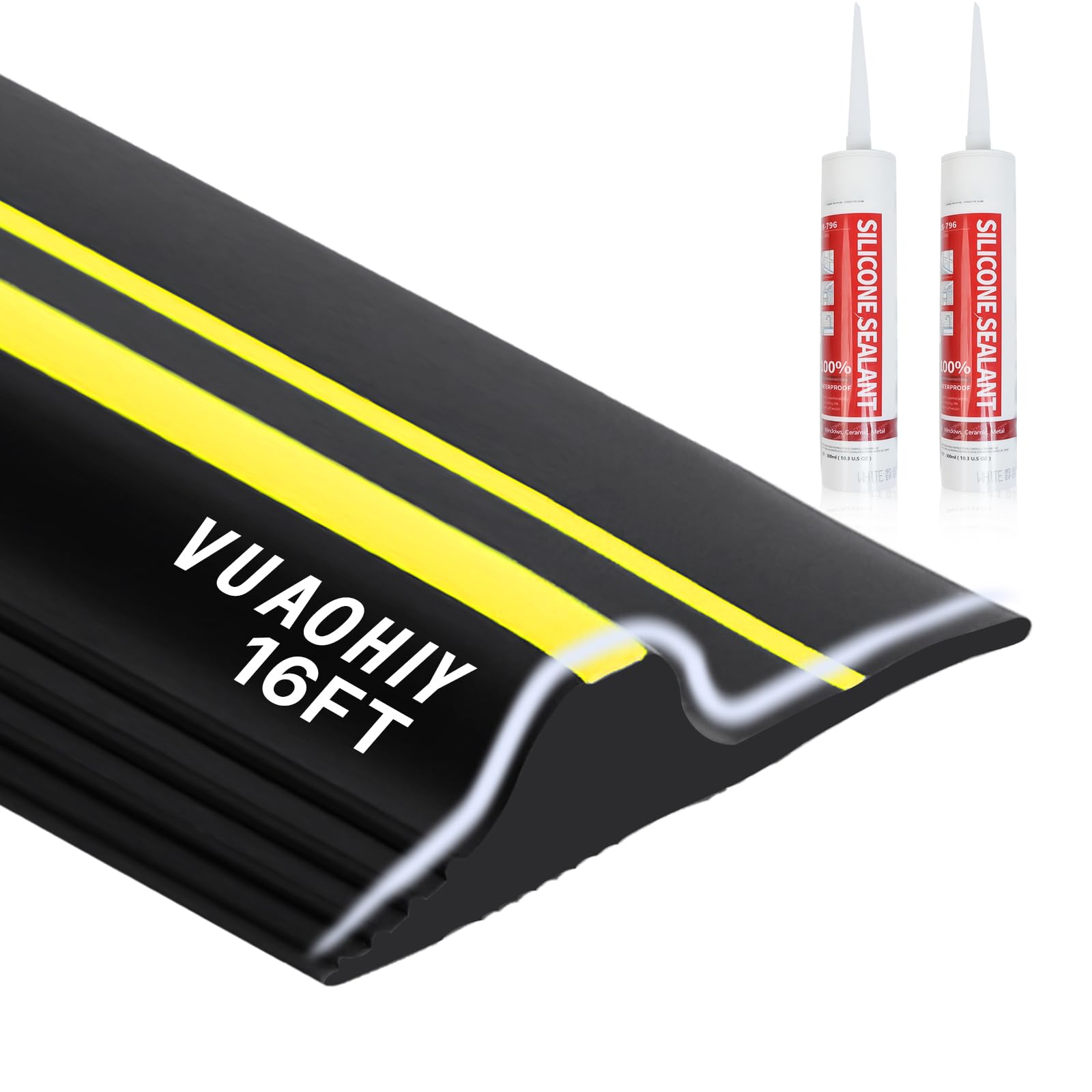
The 0.7-inch-tall floor strip that stops water washing in under the door.
The water you keep mopping off the garage floor usually comes under the door, not through it. This VUAOHIY strip is 0.7 inches thick — more than double the 0.31-inch thickness of the DGSL seal below — so it stands tall enough to take the hit from rain and snowmelt before they reach inside. It is made from non-toxic flexible EPDM rubber (a synthetic rubber built to stay soft in the cold) and is rated to keep its grip from -40°C to 120°C. What wins owners over most is straight quality, and the water-resistance feedback is the next strongest theme in the reviews.
You glue it to the concrete, not into a track, so it fits just about any door that has a gap to close. A full-length yellow safety strip runs the whole length so nobody trips on the edge, and anti-slip ridges give shoes something to grip. The serrated base is cut with grooves to give the glue more surface to bite into, and you get two 300ml tubes of adhesive in the box. It cuts to fit thresholds between 10 and 16 feet, so you can trim it to your opening. Buyers report: “Orders 2 of these, one for each 10’ door. Weird, ai had to cut about 1” off one and the other was about 1” too short.” Measure and dry-fit before the glue goes down.
The honest catch is the adhesive itself. Some garage floors are harder to stick to than others, and the mixed feedback centered on silicone caulk that refuses to bond to rubber. Many owners end up switching to Liquid Nails or a construction adhesive for a hold they can trust. If your floor is smooth, sealed, or painted, clean and prep it first, then weigh the strip flat while it cures. The product also comes with a 180-day warranty and 24/7 support, which takes some of the worry out of a first DIY job.
Where the VUAOHIY Pulls Ahead
- 0.7-inch thickness stands tall against water wash-in — noticeably bulkier than the 0.31-inch DGSL strip.
- EPDM rubber rated for -40°C to 120°C so it stays flexible in a hard freeze.
- Yellow safety strip and anti-slip ridges make the edge visible and walkable.
- Two 300ml adhesive tubes included, so you are not buying glue separately.
- Cut-to-fit for 10 to 16-foot openings.
What You Should Know First
- Adhesion is the recurring weak point — silicone glue does not always bond to the rubber, so plan on a construction adhesive.
- A solid floor strip traps snowmelt and drips inside the garage instead of letting them drain out.
- Roll lengths sometimes arrive an inch long or an inch short, so measure your door first.
Reach for this one if: your problem is water pooling under the door and you have a concrete floor to glue down to.
Look elsewhere if: your door uses a slide-in track seal — this strip sits on the floor, not in the channel.
2. DGSL 20FT Garage Door Bottom Seal
A 20-foot slide-in seal that is the simplest install in this group.
If you want the fastest path from drafty door to sealed door, this is the one. The strip slides into a 5/16-inch T-track — the T-shaped slot at the bottom of the door — with no screws and no nails. It measures 20 feet long by 3 3/4 inches wide, which gives you extra to trim for a shorter door or a two-door garage. Installation is what buyers talk about most, clearing every other theme by a wide margin.
The seven insulation round layers are built into the strip to close the gap between door and floor and hold cold air, water, and leaves out. It is rated for -40° to 140° Fahrenheit, and the maker claims up to 5x sound reduction. It cuts easily with a utility knife, so you can adapt it to any floor threshold under 6 meters. The typical install runs under 10 minutes after you clean the old track. As owners put it, replacing both doors took “less than 40 min to complete both doors.”
Here is the trade-off to plan around. The material is a little thinner than the beefier seals, and durability gets mixed feedback — a few owners found it coming apart at one end or slipping off the track over time. A clean channel and a light coat of white lithium grease before you slide it in make a real difference. If your track has crimps or bends, straighten them first. The 3/5 feedback focused on the thinner feel and the higher price compared to other door styles, so this is a value seal for standard tracks, not a heavy-duty replacement for a badly worn door.
Fit and length in plain terms: the 20-foot roll leaves room to spare on a 16-foot door, and the 5/16-inch T-end matches standard tracks. Measure your channel width before ordering — this will not fit a 1/4-inch track.
The honest limit: thinner rubber does not forgive a rough channel or a badly worn floor, so this rewards a careful install more than the thickest seals do.
Best matched to: standard 5/16-inch tracks and owners who want a fast, low-cost swap.
Think twice if: your track is bent, crimped, or built for a 1/4-inch T-end.
3. Jin&Bao Garage Door Bottom Rubber Seal 16FT
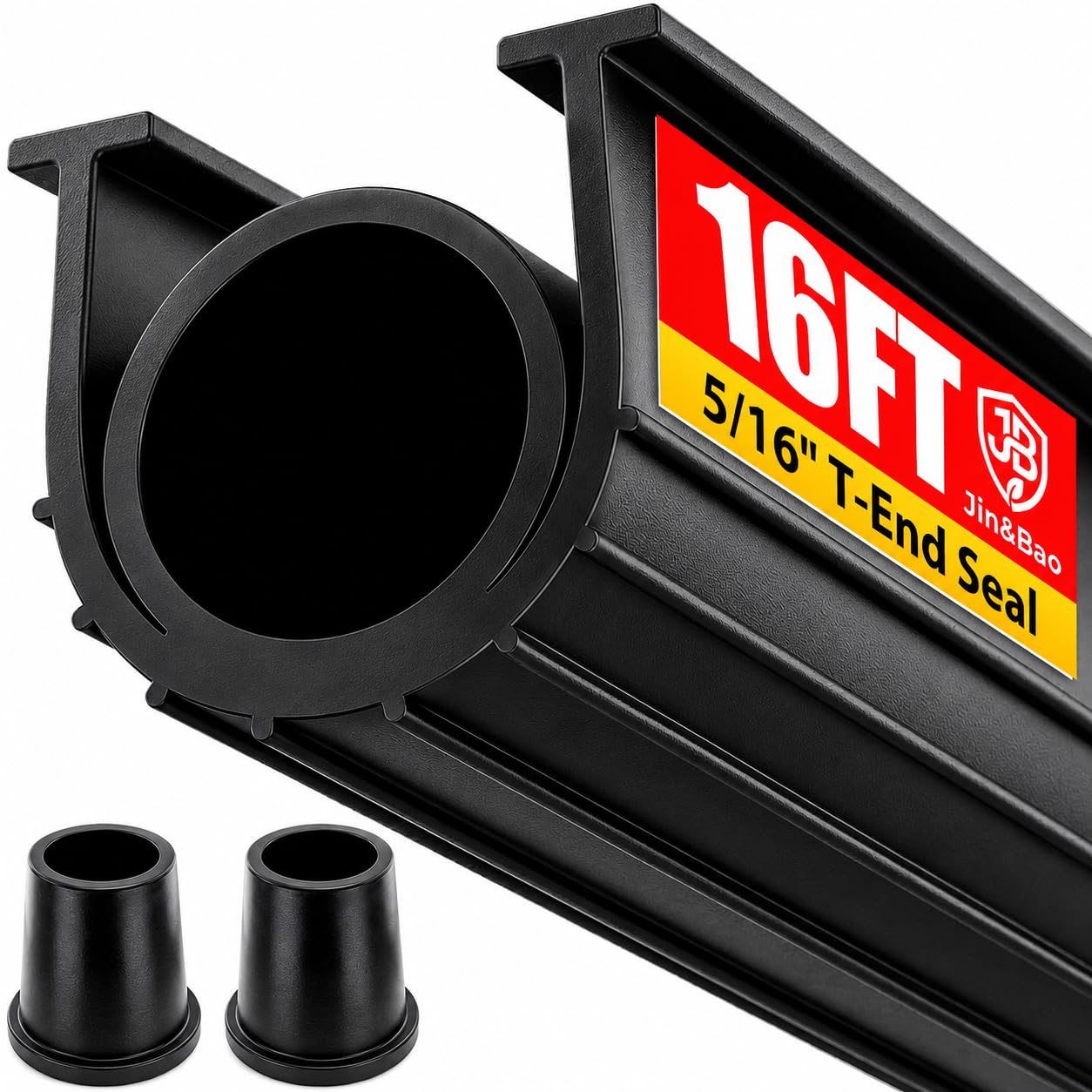
Built for doors that open and close all day without losing their seal.
Daily use is where most bottom seals give up first. This Jin&Bao strip is built around a U+O ring structure — a U-shaped body with a round O-ring core inside — that gives it roughly 2 inches of flex to keep pressure on an uneven floor. That flex is why it seals tight to a concrete slab even where the surface dips and rises. The 5/16-inch T-channel ends slide into standard tracks with no special tools, and it comes with two extra end plugs for closing off the full ends of the strip. It also holds its flexibility across a working range of -40°F to 240°F, one of the widest listed ranges in this group.
The dual-seal design also blocks wind-driven rain, dust, dirt, and leaves, and the maker describes it as a barrier against rodents getting under the door. UV resistance and ozone stabilization are built in to resist yellowing, hardening, and heat cracking, so it should not turn brittle after a hot summer. The rubber is flexible enough to trim freely for a gapless fit. In reviews, it earned credit for sealing uneven gaps in a concrete slab where other products had failed. That is the kind of concrete-floor problem this seal was made for.
The install is the part to budget time for. This strip is meant to be fed through the channel with two people, and doing it solo can stretch to around two hours. Cleaning the channels with a wire brush and greasing them with silicone, dish soap, or lithium grease makes the sliding much smoother. One owner found the included screws were not self-tapping and had to predrill. The 1.5-millimeter thickness can also be too much for a plastic track, so check your track material before you start. Owners who spend the extra time get a tight, quiet seal with very little readjusting.
The winning detail: the internal O-ring gives the strip real pressure against the floor, which is why it closed gaps on uneven concrete that a flatter seal could not reach.
Set aside an afternoon: two people make this quick, and a solo install can take about two hours. The end result is worth the patience.
The one thing to verify: plastic T-tracks may be too tight for the 1.5-millimeter end, so confirm your track is metal before ordering.
Choose this when: your door gets used hard and your floor is not perfectly flat — the flexible core keeps the seal tight through it all.
Skip the solo route: plan on a second set of hands unless you have a free afternoon to feed it slowly.
4. NATGAI 1/4″ T-End x 16FT Garage Door Seal Bottom Rubber
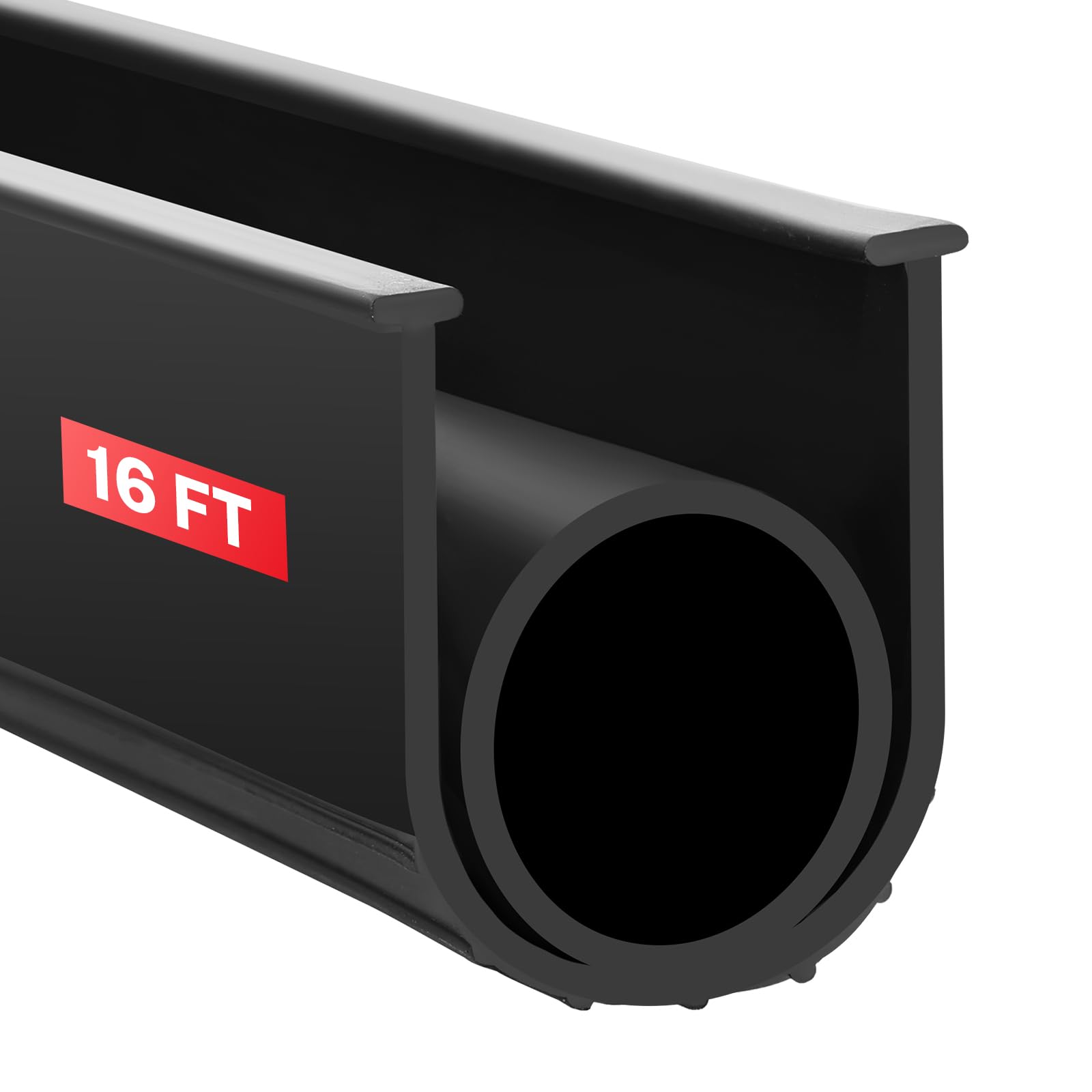
The 1/4-inch T-end answer when a 5/16-inch strip will not go in.
Some tracks simply will not take a 5/16-inch seal, and that is exactly where this NATGAI strip earns a spot. Its T-channel end is 1/4 inch — thinner than the 5/16-inch ends on the DGSL and Jin&Bao strips — so it feeds into narrower channels. It measures 4 inches wide and 16 feet long and uses the same U+O ring shape, a U-shaped body around a round core that flexes against the floor. The EPDM rubber (a flexible synthetic rubber) is rated to work within -40° to 140°, so it holds up without cracking, fading, or aging in the cold and heat. Installation is the theme that carries this pick, and quality sits right behind it.
No screws and no nails are needed. The strip slides into your existing track with a little soapy water or silicone spray as lube, and the flexible body adapts to seams of different shapes so the seal stays tight. The design is intended for both new and existing garage doors, so it is a straightforward replacement job. If your channel is crimped anywhere, widen it slightly before feeding. Owners mention that once they watched a short video on the technique, the seal slid in surprisingly easily and looked great once set.
The catch is length and thickness. You get 16 feet, which reaches one 9-foot door with room to spare but leaves you trimming carefully if you have a two-door garage. Some found the 1/4-inch material thinner than the old seal and worried it might twist out of the track over time. The fit and stability feedback is mixed for that reason. Soapy water alone does not always do it — a dedicated spray lubricant and a couple of spring clamps to hold the U-shape flat make a big difference. Keep the strip level as you feed it, and adjust the opener’s down-travel if the new seal makes the door stop early.
Why the 1/4-Inch Makes a Difference
- Fits narrower channels that a 5/16-inch T-end cannot enter.
- U+O ring body flexes to press against the floor for a tighter seal.
- EPDM rubber rated for -40° to 140° Fahrenheit.
- No screws or nails — slides into the existing track.
- 16 feet trims to a single 9-foot door with extra to spare.
Where It Takes More Care
- The thinner 1/4-inch end can twist or pop out on a loose or worn track.
- One 16-foot roll covers a single door, so a two-door garage needs more than one strip.
- A solo install leans on a proper spray lube and spring clamps to feed evenly.
Built for: doors with a 1/4-inch T-slot and owners who already know a wider seal will not slide in.
Keep in mind: it covers one standard door length, so measure your opening before you commit.
5. HOOIMA Garage Door Bottom Weather Seal 20′

An OEM-style match for Amarr and Clopay owners who want the original look back.
If your door already has a familiar flat-bottom seal and you want to replace it with something close to the factory part, this is the one to look at. It arrives as a 20-foot strip with a 2.88-inch flat width, sized to meet the 2.75 to 3-inch Amarr and Clopay style doors. That OEM-style fit is a big part of why installation and fit are the strongest themes in the reviews. It slides into your existing T-track with no screws or nails and cuts easily to fit an 8 or 16-foot door, so a single roll gives you extra to trim.
The rubber is rated from 40° to 140° Fahrenheit, staying flexible enough to press tight against the floor. It seals the door to keep dust, dirt, debris, and pests from slipping underneath. Owners describe a full install in ten to twenty minutes for one person, and several note the dimensions matched their old seal almost exactly. That easy match matters if you are replacing a factory strip on a newer house and want a clean, uniform edge. It carries a two-year warranty, the longest guarantee in this group.
The trade-off is thickness and long-term wear. This strip is a little less beefy than the thicker seals, which one buyer felt made it more flexible and easier to slide in but less sturdy. Durability and sealing get mixed feedback — a couple of owners wondered whether it would hold up as long as the original. Clean the track and spray silicone on the channel before you install, and it will slide in without fighting you. For a door that is newer and in good shape, this is a smart match. For a badly worn, badly bent door, a thicker flexible seal may suit you better.
The strongest reason to pick it: a 2.88-inch flat width that mirrors Amarr and Clopay originals, plus a two-year warranty — the longest guarantee in this group.
The fair caveat: a slightly lighter build than the heaviest seals here, so it rewards a door that is in good shape rather than one that is falling apart.
Ideal if: you own an Amarr or Clopay door and want a factory-style replacement that slides in fast.
Not the best fit for: a heavily warped door with large floor gaps — a thicker flexible seal handles that better.
Know the Specs
T-End Width
The T-end is the T-shaped part that slides into the metal channel at the bottom of your door. Its width has to match the slot. Common sizes here are 5/16 inch and 1/4 inch. If your track takes a 5/16-inch end, a 1/4-inch one will sit loose in it, and the reverse will not go in at all. Measure the old strip with a ruler before ordering — this one number saves a return.
Seal Thickness
Thickness decides how well the strip fills gaps between door and floor. A thicker strip, like the 0.7-inch Universal floor seal, presses into uneven concrete. The T-track seals run thinner — 0.31 inches on the DGSL and 0.25 inches on the NATGAI. The trade-off is simple: thicker fills better, thinner feeds into the track easier. Pick based on whether your floor is smooth or full of dips.
Length and Trimming
A seal longer than your door gives you room to cut it to a snug fit. The rolls here come in 16 and 20 feet, so a standard single door leaves extra. Leave a little overlap at each end rather than cutting short, and cut with a sharp utility knife on a flat surface. A straight, square cut is what keeps the end from curling away from the track.
Material and Temperature Range
EPDM rubber and silicone both stay flexible, which is what keeps the seal pressing down when the temperature drops. The seals here list working ranges as wide as -40° to 140° Fahrenheit, and one reaches 240° Fahrenheit. That range matters most in climates that swing from deep freeze to hot summer, because a seal that hardens in the cold loses its grip on the floor.
Common Questions
How do I know if my door needs a 5/16-inch or a 1/4-inch T-end seal?
Does a bottom seal stop water coming in during heavy rain?
How long does it take to install a bottom garage door seal?
Can I install a bottom seal without screws or nails?
What is the difference between a U+O ring seal and a plain T-end seal?
Will a new seal make my garage door opener stop halfway?
How do I get a tight seal on an uneven concrete floor?
Why does my bottom seal keep sliding out of the track?
Does a garage door threshold strip trap water inside in winter?
What temperature range should a garage door seal handle?
The Bottom Line
For most garages, the bottom garage door seal winner is the VUAOHIY Universal Threshold Seal because its 0.7-inch height and EPDM rubber stand up to water wash-in with the tallest profile in the group. If you have a standard 5/16-inch track and want the quickest install, the DGSL 20FT gives you a 20-foot roll that slides in fast. And if your door gets heavy daily use on an uneven floor, the flexible U+O ring on the Jin&Bao is the one to reach for. Measure your track first, then match the seal to it — that single step makes the difference between a dry floor and another return trip.
How we choose
We do not accept paid placement. Every pick is matched to a real buyer and a real use-case; we do not hands-on test units.
Sources
Specifications: manufacturer listings and product documentation. Review insights: verified customer reviews, as of October 2026. Pricing: not shown on this page (it changes often); check the current price via the retailer link.
As an Amazon Associate, Aappliancez earns from qualifying purchases. This does not affect which products we feature.