Disclosure: Some links in this post are affiliate links. As an Amazon Associate I earn from qualifying purchases, at no extra cost to you. Learn more
Specs are compiled from manufacturer listings and verified buyer reviews and can change over time — please confirm the key details on the product page before buying.
You have a compression test telling you something is wrong, and a spark plug hole that is the only way in. What you need next is a probe slim enough to slide through that hole and a camera you can steer around the piston crown and up the cylinder wall. Those two things — a slim probe and a steerable tip — are the whole job. Screen size, storage and battery life all rank behind them.
This guide is built by comparing the manufacturers’ published specifications and the patterns across verified customer reviews, so you get each pick’s real strengths and trade-offs instead of marketing spin.
Megapixels are not the deciding factor here. It is whether the probe fits the plug hole and whether the tip steers, which is why the picks below break down by probe diameter, cable length and articulation before anything else, and this ranking covers the best borescope for cylinder inspection for that exact job.
Top Picks

How To Choose The Best Borescope for Cylinder Inspection
A cylinder inspection punishes the wrong tool faster than almost any other borescope job. You are working through a hole roughly the width of a spark plug, in an engine that may be hot, oily and full of reflective metal. Get the probe diameter wrong and the camera never enters the plug hole. Get the articulation wrong and you stare at the piston crown with no way to angle toward the wall.
Start with the probe diameter, not the screen
A spark plug hole is where the shopping decision really begins. A 5.5mm probe slides through most plug holes, and a 6.2mm probe goes through a spark plug hole into a cylinder without removing anything else. Anything described as a standard 8mm scope gives you a better view but a harder entry — and the listings here treat that as the dividing line.
Articulation is what turns a peek into a diagnosis
A fixed camera looking straight ahead shows you the piston top and the far wall at an angle. A two-way articulating tip lets you bend the head around and look back at the cylinder wall, valve seats and the piston edge from the side. That 180° or 220° sweep, depending on the model, is what separates a diagnostic tool from a fixed camera on a stick.
Cable length versus control
Longer cable reaches deeper into an engine bay or a drain line, but a semi-rigid gooseneck that runs too long gets harder to steer precisely. For cylinder work from the top of an engine, a shorter probe holds shape better in the bore. Save the long goosenecks for duct and pipe inspection.
Heat, oil and the honest limits
Carbon deposits and oil are normal inside a cylinder, so the probe needs to be sealed against both. IP67 waterproofing and an overheat cutoff both show up on the better models here. A scope that times out in a hot bore is normal, so plan a cool-down instead of blaming the camera.
Side-by-Side Comparison
| Model | Best For | Probe Diameter | Articulation | Cable Length | Amazon |
|---|---|---|---|---|---|
| Teslong 5mm Dual Lens Borescope★ Best Overall | Tight plug holes on a long job | 5.5mm | Fixed (forward plus 90° side) | 5 ft | Amazon |
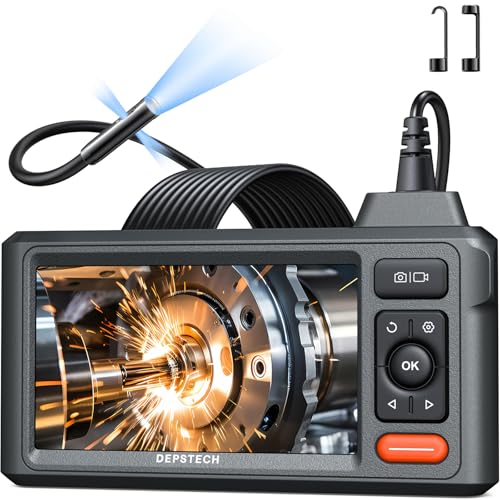
| DEPSTECH DS620 Triple LensThree Lenses, One Probe | Three viewing angles on one probe | Not stated | Fixed (triple lens) | 16.5 ft | Amazon |
| Klein Tools ET17 | Durability in a shop environment | 5.5mm | Fixed (gooseneck) | 9.8 ft | Amazon |
| FOXWELL Y400 | Steering around a small bore | 6.2mm | 220° two-way | Not stated | Amazon |
| Teslong TD300P Articulating | Slim probe plus joystick control | 5.5mm | 180° joystick | 5 ft | Amazon |
| DEPSTECH DS650 Articulating | Reach and steering combined | 0.33 in | 210° two-way | 10 ft | Amazon |
| DXZtoz AGC500L Dual Lens | Dual lens with a big screen | Not stated | Two-way articulating | Not stated | Amazon |
Detailed Reviews
1. Teslong 5mm Dual Lens Borescope Camera
Our pick — 4.5+★ from 700+ verified ratings; the strongest balance of quality and price.
The slim-probe pick that squeezes into a plug hole and looks sideways once it gets there.
For cylinder work, the number that decides everything is 5.5mm — the diameter of the probe that has to enter a spark plug hole. The Teslong gets in, and then a button press switches you from the forward camera to a 90° side-view camera so you can look across at the cylinder wall without dragging the probe back out. That second angle is the difference between seeing a piston top and diagnosing a scored cylinder wall.
The cable runs 5 ft, which is short next to the 16.5 ft on the DEPSTECH DS620 — a deliberate trade for a scope you use from above an engine rather than down a duct. Battery life runs to 6 hours on the 3500mAh cell, and that is three times the 2 hours the DS620 advertises, so a full day of diagnostics does not end at lunch. The kit comes with a 32GB micro SD card, a hook and a magnet for fishing out a dropped nut, and a carrying case.
What wins people over is the picture quality and the fact that it needs no phone and no app — power on and the 5-inch screen shows you the image. There is one small orientation snag: the camera has a known up-direction, and a couple of buyers have suggested a yellow marker on the cable to fix it. The controls split opinion too, with some finding them unintuitive at first. Both are learning-curve notes, not faults.
The cylinder-inspection case
- 5.5mm probe fits spark plug holes that wider scopes cannot enter
- 90° side camera lets you look at the wall from the same entry point
- 6 hours of runtime from a 3500mAh battery
- Standalone 5-inch screen — no phone, no app pairing
Where it asks patience
- The kickstand and controls take a little getting used to
- Camera orientation can confuse you until you learn the up-direction
- Cable exits at the probe base, so deep-bay reach is limited
Reach for this if: your entry point is a spark plug hole and you want to see the cylinder wall from the side.
Think twice if: you need to work deep inside a long duct — the 5 ft cable runs out of road.
2. DEPSTECH Triple Lens Inspection Endoscope Camera
Three lenses on a single fixed tip — press a button rather than bend a cable.
Not everyone wants to learn articulation. The DS620 takes a different approach: three lenses built into the tip, switched with a button. You get the forward view plus two side cameras, each one a 2MP sensor recording 1080P video at a 76° field of view, so you cover the angles an articulating tip would reach without any steering to master. For a first-time cylinder inspection, that is a gentler learning curve than a joystick.
The screen is the other headline. A 5-inch IPS panel gives you real-time viewing with no lag, and against the 4.3-inch LCD on the Klein Tools ET17 that is a meaningfully bigger window on the bore. Built-in storage needs a microSD card, and the listing is blunt that it is not included — factor that in. The IP67 waterproof probe carries 10 adjustable LEDs in an 8+1+1 layout for dark and damp cavities.
Quality is what people praise most here, and it translates directly: the picture is clear enough to spot carbon on a valve or a scratch on a wall. The split point is the cable. At 16.5 ft it reaches nearly anywhere, but it is stiff, and several owners describe it as awkward to maneuver in a tight bore. A few also wish the front camera had a bezel and lens cap to protect it inside an engine.
Straight read: a fixed triple-lens tip removes the steering skill requirement, and the 16.5 ft cable makes this the pick for drums, ducts and long runs as well as a bore.
Suits you if: you want three views without learning to steer, and you also need reach for pipes and HVAC.
Less ideal if: your priority is precise tip control inside a narrow cylinder.
3. Klein Tools ET17 Utility Borescope
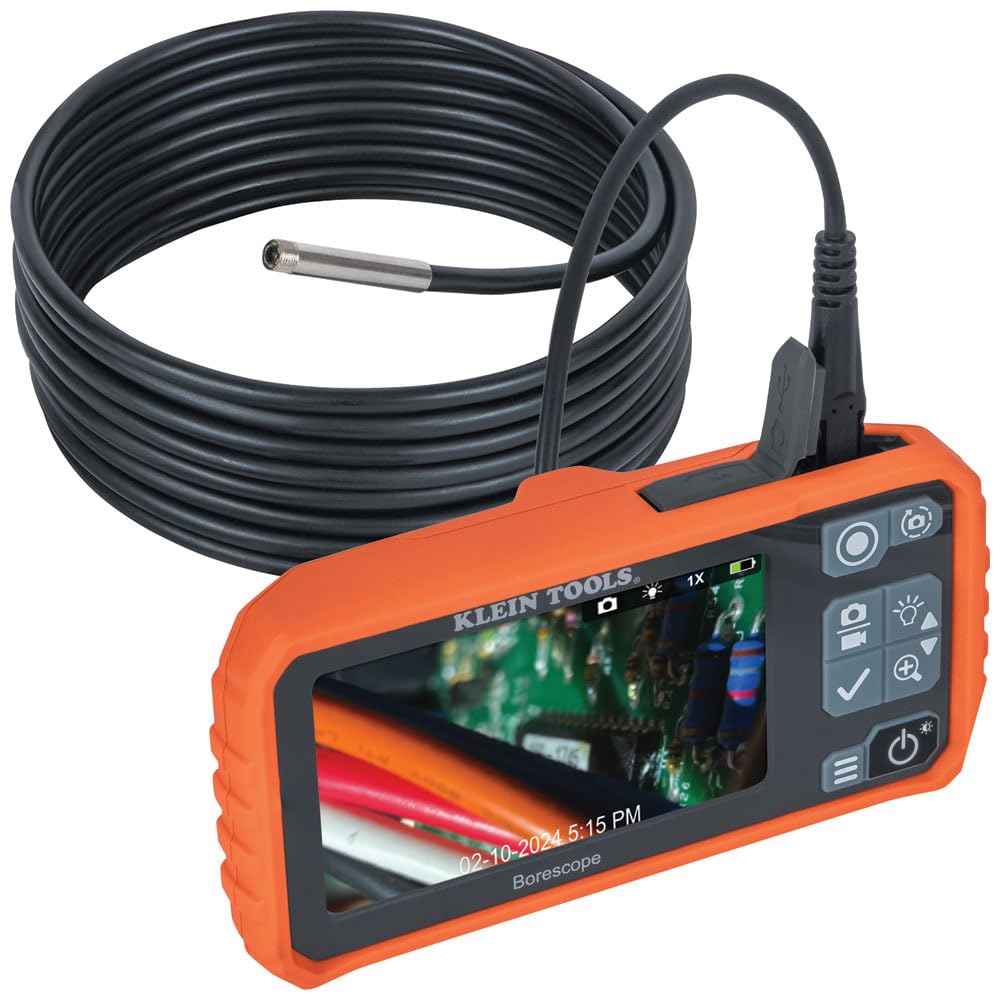
A 5.5mm probe on a 9.8 ft gooseneck, built to survive being thrown in a toolbox.
If the engine is in a van, a tractor or a fleet truck and you are working at it from odd angles, the 9.8 ft snake is the reason to look here. It threads through bends and holds its shape, and the 5.5mm camera head still fits tight openings. A self-storing kickstand behind the 4.3-inch LCD means you can set the monitor down on a fender and keep both hands on the probe.
The build is what people keep coming back to. This is a camera console that reads compact and fairly rugged, and the review pages are full of gearbox inspections and tight-opening work rather than hobby projects. It records JPEG stills and MP4 video, so you can log a bore before you pull the head off and compare against it later. Attachments include a mirror, a hook and a magnet.
Here is the honest part: image quality splits opinion. Most describe it as clear and the color video as strong, but there is a real cohort who feel resolution is no better than cheaper scopes. If you are chasing fine valve-seat detail, this is not the sharpest tool on the page. If you are chasing a tool that survives a shop floor, it earns its place.
What earns its keep: 9.8 ft of shape-holding gooseneck plus a kickstand-mounted monitor is a combination built around real working conditions.
Pick it for: durability and reach on fleet and field work, where the tool gets knocked around.
Pass if: maximum resolution for fine internal detail is your deciding requirement.
4. FOXWELL Y400 220° 2-Way Articulating Borescope
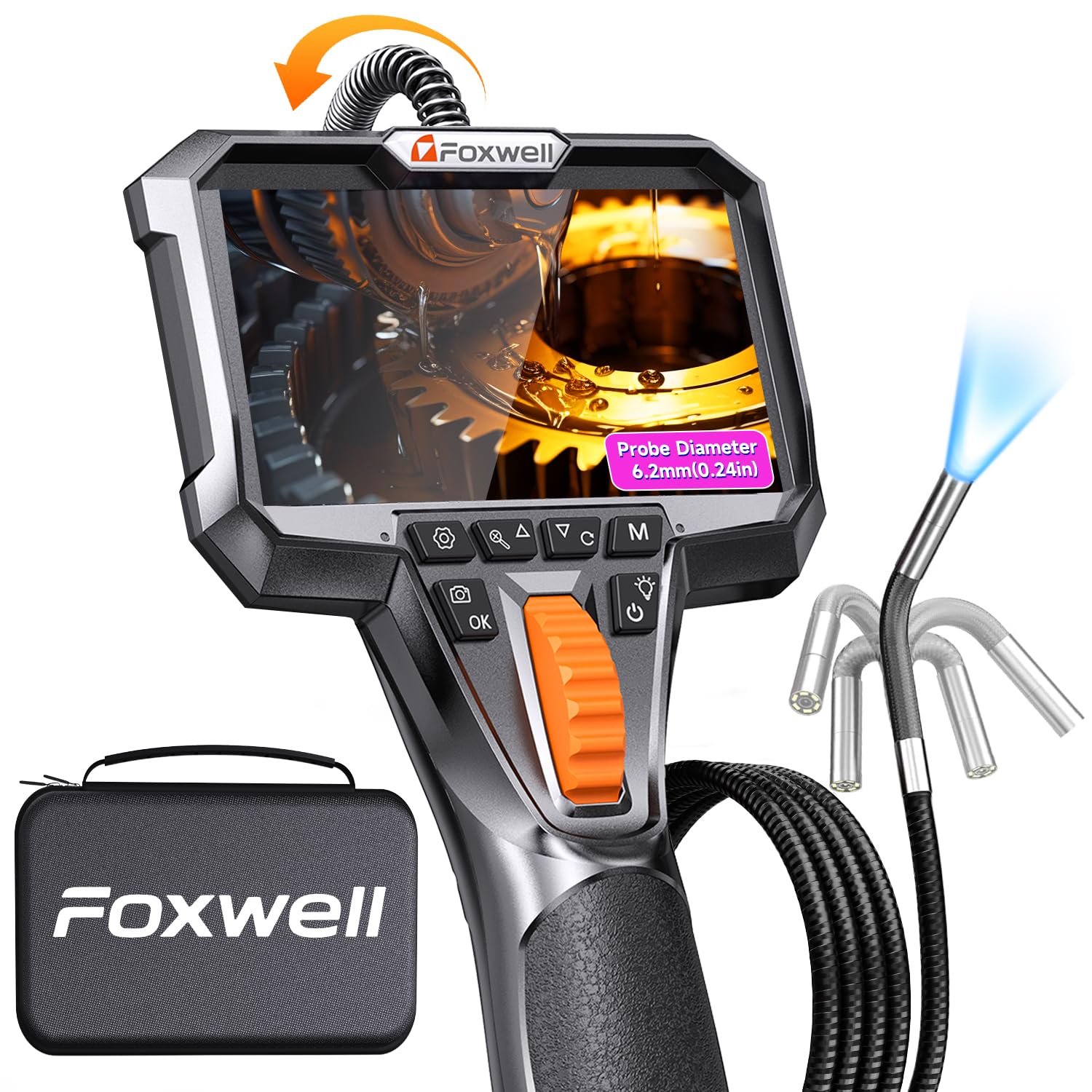
The one that lets you point the camera at the cylinder wall without repositioning the probe.
Steering is the whole story with the Y400. A thumb wheel drives 220° of two-way tip articulation — you sweep around a piston crown and back down the wall, then hold the angle while you read it. That sweep surpasses the 180° of the Teslong TD300P, and for cylinder work the extra travel lets you see behind a valve rather than just past it. The probe itself measures 6.2mm (listed as 0.24 in), slim enough for a spark plug hole but not the slimmest here.
Zoom is what makes the articulation genuinely useful. A 2X/4X digital zoom pulls up micro-cracks and carbon buildup without moving the probe, and six adjustable LEDs with three brightness levels light the cavity through the screen. Runtime is listed as 5-7 hours, and the 32GB of onboard storage holds the images and video with no Wi-Fi or app pairing at any point. Overheat protection shuts the probe down at 158°F (70°C), which is real protection in a hot bore rather than a marketing line.
Image quality is the consensus strength, and the sharpness holds at both close and far range. The controls are the caveat — a mixed bag, with some finding them straightforward and others wrestling the menu. The included hard case and the pre-installed memory card soften that learning curve because you can shoot on day one.
The diagnostic edge
- 220° two-way articulation steers around pistons and valve seats
- 2X and 4X zoom inspects cracks without moving the probe
- 5-7 hour runtime and 32GB onboard storage
- IP67 probe with 158°F overheat shutoff
The honest catch
- Menu navigation splits opinion at first
- The 6.2mm probe is wider than the 5.5mm options here
- Two small plastic attachments are undocumented in the manual
Best matched to: anyone who needs to look back at a cylinder wall from inside the bore and hold that view.
Skip past if: the plug hole is exceptionally tight and a 5.5mm probe is your hard ceiling.
5. Teslong 5.5mm Two-Way Articulating Borescope

5.5mm of probe and 180° of joystick steering — the size-and-control combination for plug holes.
This is the pick that combines the two things cylinder work demands: a 5.5mm probe that fits spark plug holes and injector ports, and a joystick that sweeps the tip 180° left and right so you can look around pistons and behind valves. It is narrower than the FOXWELL Y400’s 6.2mm probe, which matters when the hole is the tightest part of the job. The display is a 5-inch IPS panel at 1280×720, with 1.3x and 1.5x digital magnification for fine cracks.
It runs standalone — no phone, no Wi-Fi, no app. Six adjustable LEDs with brightness control handle dark cylinders, and a 3000mAh battery plus USB-C charging keeps a full shift of diagnostics moving. The kit includes a 32GB micro SD card, a 5 ft probe cable, a USB charging cable, a hard case and a manual. It records video in AVI format, which is a small difference from the JPEG and MP4 kits on this list but worth knowing if your shop laptop is fussy.
Picture quality and value are what carry this model, and the articulation genuinely lets you look around inside a cylinder instead of staring straight ahead. The trade-off is honest: the articulation and flexibility draw mixed reviews, with the flexible cable cited as a drawback when you want a firm hold on a specific angle. Durability is the other question mark. A failed sensor batch and a distorted display show up in the review history, and the responsiveness of support is part of what buyers weigh. Treat it as a tool that holds up if you do not abuse it.
Why it makes the cut: a 5.5mm probe with true joystick control is a rare combination, and 1.5x magnification on a 1280×720 screen backs it up.
Right for you if: you want the slimmest possible probe that still steers.
The risk to weigh: the flexible cable and durability reports mean you want the support channel handy.
6. DEPSTECH DS650 Articulating Borescope
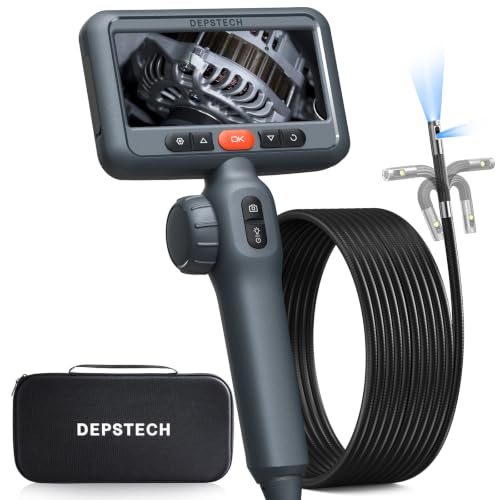
Ten feet of gooseneck with a camera head that steers — reach and control in one tool.
Articulation plus length is the pitch. The DS650 puts 210° of two-way articulation on a 10 ft semi-rigid gooseneck, with dual 78° field-of-view lenses feeding a split screen so you see the forward view and the side view together. A side-mounted control wheel means one-handed steering, and that matters when your other hand is holding a fender out of the way. The 4.5-inch IPS display runs without Wi-Fi or apps.
Manual focus is the feature that separates this from fixed-focus competitors. It focuses between 3cm and 8cm, said to be optimal at 3-5cm, and the 1.5x zoom pulls up close detail of a cylinder wall. The IP67 probe adds a high-temperature warning to protect it in hot cavities. The 2200mAh battery is listed at 4+ hours of continuous operation, and an 8GB TF card is included for storage.
Functionality is the most-discussed quality here, and the split-screen dual view earns the praise. The catch shows up in hot work. When the probe is inside a hot engine cylinder, the camera can auto-shut off as it heats, giving only around 20 seconds of use before a cool-down. That is a real constraint on engine diagnostics — you plan around it, and the high-temp warning is part of the same system. In cooler ducts and plumbing, the 24-count maneuverability thread is mixed but the tool does its job.
The reach-and-steer package
- 210° articulation on a 10 ft gooseneck
- Dual 78° lenses with split-screen viewing
- Manual focus tuned for 3-5cm close work
- 8GB card and EVA carrying case included
What to plan around
- Auto-shutoff in hot cylinders limits engine work to short bursts
- Battery listed at 4+ hours rather than a full shift
- No hook or magnet in the box
Fits the job when: you are chasing a fault down a long duct or pipe and also want steering in the bore.
Look elsewhere if: sustained inspection of a hot cylinder is the main task — the thermal cutoff will interrupt you.
7. DXZtoz AGC500L Dual Lens Articulating Borescope
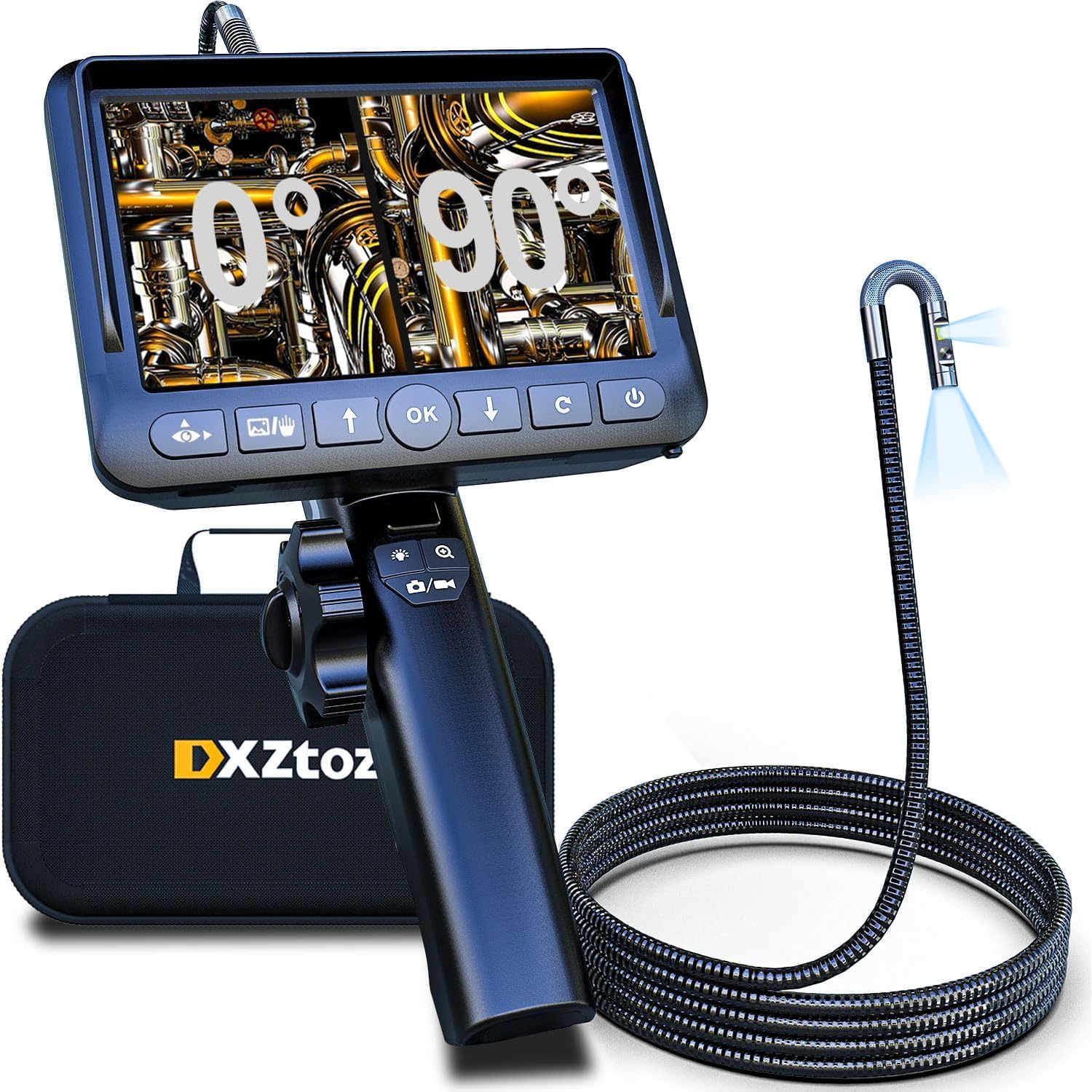
A rotatable tip with a 90° side camera — one button and no dead spots in the bore.
The dead spot problem is real in cylinder work: you can point a camera into a bore, but there is no room to spin it around. The AGC500L solves that with a 90° side camera on a rotatable probe tip. Press a button to switch to the side view and rotate the cable to sweep the full interior without fighting for room. A control knob turns the tip to any angle, and the dual lens arrangement targets cracks, corrosion and HVAC blockages without disassembly.
The screen makes the decision easier. At 5.0 inches it is bigger than a 4.5-inch display, and the 1080P IPS panel adds 10X digital zoom for fine detail. Focus varies between 1cm wide-angle and 100cm telephoto, with best performance between 2cm and 15cm — a useful range for looking at a wall up close or the far end of a combustion chamber. The IP67 waterproof and oil-proof probe carries adjustable LEDs, and a 32GB micro SD card comes in the box with a hook, a magnet and a lens clean set.
Image quality is the strength — clear and sharp, and close and far detail both hold up. The articulated head lets you see into areas a fixed scope never reaches. The caveats are fair. At least one buyer found the probe resolution marginal for fine valve-seat detail, which matches the general reality that many budget scopes claim HD while returning grainy images. Steering has also arrived bound up on occasion. Those are setup and ceiling notes rather than reasons to pass.
Editor’s note: the dual-lens tip plus a 10X zoom is what converts a peek into evidence — 3000mAh of battery supports 4-5 hours of it.
Choose this when: you need a side view with no room to rotate the camera head.
Not your pick if: you are chasing the finest valve-seat detail and need the sharpest possible resolution.
Know the Specs
Probe diameter in millimeters
The width of the camera head is the first gate. A spark plug hole and an injector port set a hard limit, and a 5.5mm probe fits where an 8mm one will not. A 6.2mm probe still enters a plug hole but leaves less margin. Check this against the specific hole on your engine before anything else.
Articulation degrees
Articulation is how far the camera tip bends away from straight. A 180° sweep takes the head around and back, and 210° or 220° adds travel beyond that. More range lets you look behind a valve rather than only past it. A fixed tip saves cost but limits you to the angle the cable happens to hold.
IP67 waterproofing
An IP67 rating means the probe is sealed against dust and against water ingress. In a cylinder that means oil and carbon residue are less of a threat, and in a drain it means the probe survives a dunking. Without that seal, a wet job risks the camera itself.
Overheat protection
Precision optics generate heat, and a hot engine bay adds to it. An automatic cutoff at a set temperature protects the internals, and the better tools warn you before that point. A scope that shuts down mid-inspection is a nuisance on a cold pipe and a real limitation in a hot bore.
Common Questions
Will a 5.5mm borescope fit through a spark plug hole?
Do I need an articulating borescope for cylinder walls?
Is a longer cable better for engine inspection?
Why does my borescope keep shutting off inside the engine?
Do these borescopes need a phone or an app?
What resolution do I actually need for spotting cracks?
Can a borescope retrieve a dropped nut from a cylinder?
Is an articulating scope worth it over a fixed one?
How long does the battery last on a cylinder-inspection borescope?
Do I need a hard case for a borescope?
The Bottom Line
The borescope for cylinder inspection winner is the Teslong 5mm Dual Lens because it nails the two things that matter most — a 5.5mm probe that fits a plug hole and a 90° side camera that lets you look at the wall from the same entry point — and it backs that with a 6-hour battery. If you want true steering to sweep around a piston, the FOXWELL Y400 gives you 220° of two-way articulation and 4X zoom. And for a long gooseneck that reaches down a duct as well as into a bore, the DEPSTECH DS650 is the one to reach for.
How we choose
We do not accept paid placement. Every pick is matched to a real buyer and a real use-case; we do not hands-on test units.
Sources
Specifications: manufacturer listings and product documentation. Review insights: verified customer reviews, as of October 2026. Pricing: not shown on this page (it changes often); check the current price via the retailer link.
As an Amazon Associate, Aappliancez earns from qualifying purchases. This does not affect which products we feature.