Disclosure: Some links in this post are affiliate links. As an Amazon Associate I earn from qualifying purchases, at no extra cost to you. Learn more
Specs are compiled from manufacturer listings and verified buyer reviews and can change over time — please confirm the key details on the product page before buying.
The quick answer: if you want the deepest, most natural CD sound for the money, the Cambridge Audio AXC35 is the one to beat — it is the crowd favorite at 4.5+ stars across 300+ ratings. Everything below is about matching a player to the shelf, speakers, and old discs you actually own. Some of these units are just a disc spinner you pair with your own amplifier. Others are complete little stereos with speakers in the box. Getting that distinction right decides whether the box plays out of the carton or needs an amp.
This guide is built by comparing the manufacturers’ published specifications and the patterns across verified customer reviews, so you get each pick’s real strengths and trade-offs instead of marketing spin.
We start with the boxes that include speakers and work up to component players built for a real hi-fi rack. By the end you will know exactly which shelf system matches your room and your disc collection. These are the picks that make the most sense for a bookshelf cd player.
Top Picks


How To Choose The Best Bookshelf CD Player
Your first decision is if you need speakers included, not brand or wattage. A component player like the Cambridge or Denon has no amplifier and no speakers — it just reads the disc and sends the signal out. A system like the Panasonic or LONPOO arrives with its own speakers and plays on its own. Buy a component player without an amp and you will be shopping for one you did not plan on.
Component Player or Complete System?
Pick a component player if you already own a receiver, amplifier, or powered speakers with a spare input. These units focus their whole budget on the disc mechanism and the DAC, so the sound is the priority. Pick a complete system if the box is going on a kitchen counter or bedroom shelf and you want to press play within minutes. Those units trade some refinement for convenience, Bluetooth, and a remote in the box.
Will It Play Your Burned Discs?
This is the quiet deal-breaker in the category. Commercial CDs play almost anywhere, but burned CD-Rs and CD-RWs are fussier, and some decks are very selective about them. If a big chunk of your collection is home-burned, check the disc compatibility line before you buy. CD-R/RW support listed in a unit’s specs is the detail to look for, not a guess from the brand name.
Matching the Player to Your Room
A 20W stereo (measured as 10W per channel) suits a bedroom or small study. An 80W system (40W per channel) fills a living room with more headroom. Above that, the Philips 100W rig with its 5.25-inch woofers moves into open-plan territory. Bigger wattage numbers are not automatically better, but they predict how loud the unit stays clean before the sound thins out.
Side-by-Side Comparison
| Model | Best For | Type | Output | Connectivity | Amazon |
|---|---|---|---|---|---|
| Cambridge Audio AXC35★ Best Overall | Pure sound from your own amp | Component player | — | Auxiliary, Coaxial Digital | Amazon |
| Panasonic SC-PM700PP-KFull System Pick | Full living-room stereo | Complete system | 80W RMS | Bluetooth, USB | Amazon |
| Emerson EPB-4000Cassette Comeback | Cassettes and radio too | Boombox | — | Auxiliary | Amazon |
| LONPOO LP-816 | Retro wood look | Complete system | 40W rated | Bluetooth, USB, Auxiliary | Amazon |
| Panasonic SC-PM270PP-K | Small rooms, simple use | Complete system | 20W RMS | Bluetooth, USB | Amazon |
| Philips TAM8905/37 | Internet radio plus discs | Complete system | 100W | Bluetooth, USB, Wi-Fi, Auxiliary | Amazon |
| Denon DCD-600NE | Hi-fi rack build quality | Component player | — | Auxiliary, Optical | Amazon |
| Yamaha CD-S303 | USB files and scratched discs | Component player | — | USB | Amazon |
| Bose Wave Music System IV | One-box simplicity | Complete system | — | Bluetooth (adapter), Auxiliary | Amazon |
Detailed Reviews
1. Cambridge Audio AXC35 CD Player (Lunar Grey)
Our pick — 4.5+★ from 350+ verified ratings; the strongest balance of quality and price.
The bare-bones spinner that makes old discs sound newly recorded.
This is a component player, which means it reads the disc and hands the music off to your amplifier and speakers — nothing more. That focus is exactly why it tops this list. The frequency response is quoted at 20Hz – 20kHz with a tolerance of just +/-0.4dB, which in plain terms means the player reproduces the full span of human hearing almost perfectly flat. Nothing gets boosted, nothing gets scooped out.
The thing that wins people over is the built-in DAC (the converter that turns a disc’s digital code into an audio signal). A vinyl devotee compared it to a turntable and could not tell the difference in a blind listen with friends. Disc noise is kept far below the music, thanks to a signal-to-noise rating above 93dB — so quiet passages between tracks stay genuinely quiet instead of hissing.
Set against the Panasonic all-in-ones further down, the trade-off is clear: this unit brings no speakers, no Bluetooth, and no headphone jack. You need an amp or powered speakers already sitting there. The upside is a 3.5mm and coaxial digital output for clean, long cable runs to a receiver. It sits at 16.9 inches wide and 3 inches tall, so it slots into a standard hi-fi shelf with room to spare. It will not tolerate a fussy attitude toward home-burned discs — it plays clean commercial CDs beautifully but runs stubborn on some CD-Rs.
Where the AXC35 earns its keep
- Flat 20Hz – 20kHz response with +/-0.4dB tolerance means faithful, uncolored playback
- Signal-to-noise above 93dB keeps quiet passages free of hiss
- Distortion below 0.01% at 1kHz keeps vocals and strings clean
- Coaxial digital output for a clean hand-off to a receiver
What to know before you commit
- No speakers, no Bluetooth, and no headphone jack — this is a bare component
- Fussy with some CD-Rs, so burned discs may not play
- The remote is plain black plastic that does not match the Lunar Grey finish
The right buyer: someone with a receiver, amp, or powered speakers who wants the cleanest possible CD signal and does not care about streaming.
Think twice if: your collection leans on homemade CD-Rs, or you want an all-in-one box that plays out of the carton.
2. Panasonic Compact Stereo System SC-PM700PP-K
A complete shelf stereo with real muscle for an apartment living room.
Here the standout number is the output: 80W RMS (40W per channel), which is the honest, continuous wattage rather than a peak figure cooked for a spec sheet. The speakers are a 10cm woofer paired with a 6cm tweeter and a bass reflex port, so you get real low-end from a box that measures 10.3 x 8.3 x 4.5 inches. For scale, the Emerson boombox below is 17.7 x 9.92 x 8.7 inches — a substantially wider footprint for its own speakers.
What owners rave about is how good this sounds on a shelf near a couch, at a volume that does not shake the walls. Bluetooth pairing is quick, the FM antenna locks in a stable signal, and the USB port lets you play straight from a flash drive. Bass and treble knobs sit right on the front, alongside “My Sound” presets, so you tune it without diving into a menu. The volume knob has satisfying resistance, and the display is readable across a dim room.
The catch is disc handling, and it is worth knowing before you commit. The CD drive takes one disc at a time and is picky about burned discs — data-format CD-Rs frequently fail, and the unit wants Audio or Music format burns. It also lacks CD autoplay and resume memory, so a power blip means finding your place again. The power cord and speaker cables are on the short side too, which limits where you can place the speakers away from the main unit.
Sound-to-space ratio: you get 80W of RMS power and a proper two-way speaker from a unit that slides onto a bookshelf — the near-field listening experience is where it shines.
Reach for this if: you want an all-in stereo that plays loud enough for a living room and streams from your phone without extra boxes.
Look elsewhere if: you spin a lot of homemade CD-Rs or need your speakers positioned far from the unit.
3. Emerson EPB-4000 Portable CD Cassette Boombox
Turns a shoebox of dusty cassettes back into a Saturday afternoon.
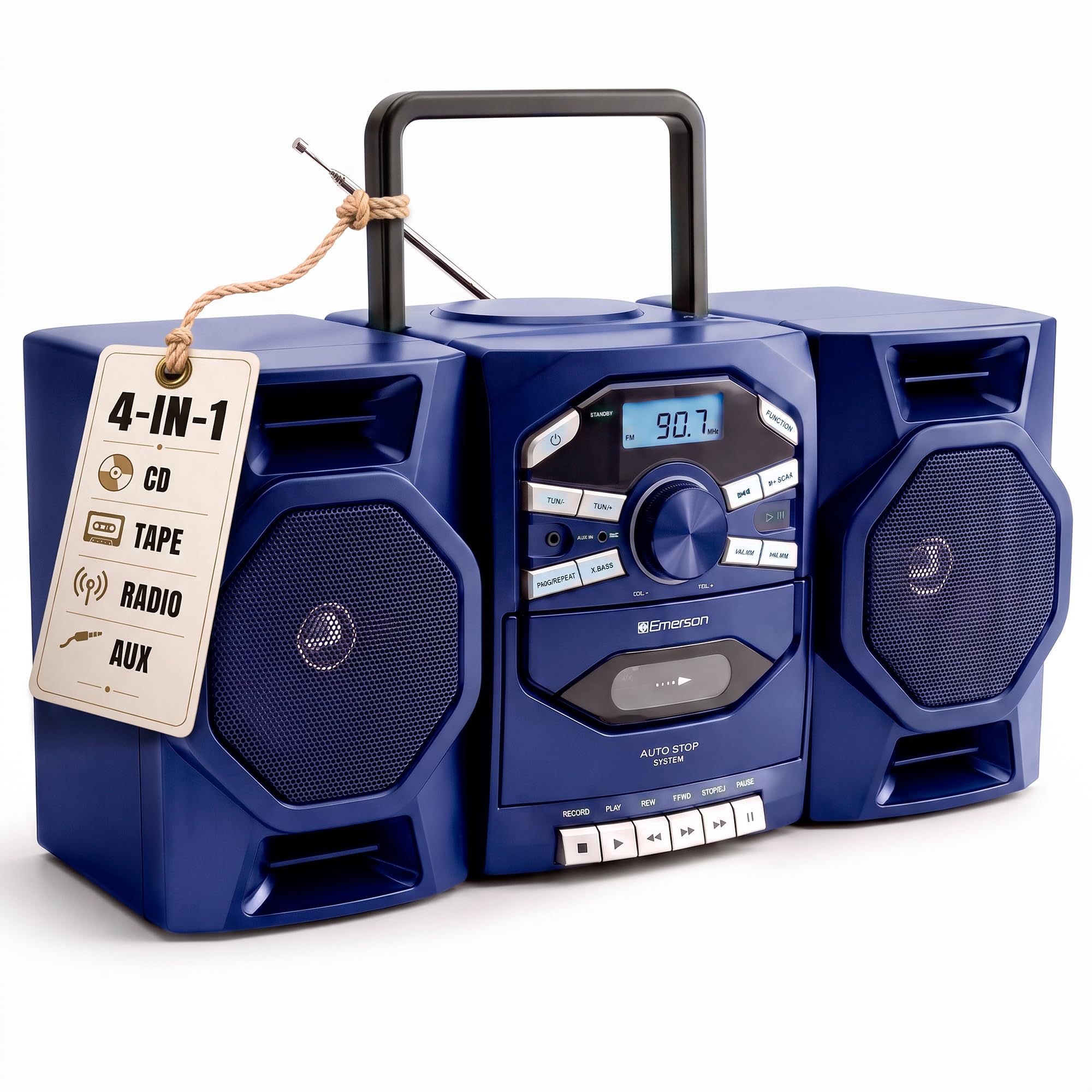
The whole reason to look at this box is the cassette deck. It handles both playback and recording, and it sits alongside a top-loading CD player that takes standard CDs plus CD-Rs and CD-RWs. AM/FM tuning uses PLL circuitry, and there’s a built-in microphone for the odd voice recording. Two 4-inch detachable speakers let you widen the stereo by pulling them off the main body, and X-BASS adds low-end punch when you want it.
Owners love the sound in both CD and tape mode, and it is the compact size that comes up next most often as a plus — this is a boombox you can move around the house. Power from the included AC adapter indoors, or load 8 D batteries (sold separately) and take it to the patio or garage. A carry handle makes the hop easy, and a 3.5mm AUX input lets you plug a phone or MP3 player in when you want digital audio.
Be realistic about the cassette transport (the tape-playing mechanism). It works, but it is not a precision mechanism, and the occasional unit arrives with a misaligned motor that chews a tape on rewind. If tape is your main draw, that is the part to watch. Sound also thins out at high volume — one honest take sums it up, “the sound can start to sound a little tinny if to much volume is attempted.” At 7.9 pounds it is a moveable unit rather than a hifi anchor.
The all-in-one angle: CD, cassette, AM/FM radio, and AUX in one portable box is a combination almost nothing else in this category offers — you get a whole nostalgia station, not just a disc spinner.
Perfect for: anyone with a cassette collection who wants one box that plays every format and moves between rooms.
skip it if: your primary purpose is critical listening at loud volume rather than revisiting tapes and burned CDs.
4. LONPOO Bluetooth Stereo System LP-816

Wood grain, analog knobs, and enough soul to be furniture.
Design first on this one, because that is what the LONPOO sells. It is a real wood enclosure with 12mm thick MDF panels (medium-density fiberboard — a dense engineered wood), an aluminum front panel, and a crisp white display that reads more like a vintage hi-fi than a plastic kitchen radio. Two 3-inch full-range drivers push 40W rated power (60W peak), and a built-in DSP chip (digital signal processing — it shapes the sound before it reaches the speakers) is on hand to smooth and detail every source, even at low night volume.
What owners love most is the sound, and that follows from the cabinet. A heavier wood box absorbs vibration that a plastic one would let rattle through, so mids stay clean and bass stays tight. The unit is 16.2 x 11 x 4.6 inches and weighs 9.6 pounds, so it holds a shelf with authority. Six sources in one box: CD, Bluetooth, FM, AUX, USB, and a 3.5mm headphone jack — a genuinely useful set of options in one retro cabinet.
The honest catch is usability on the disc drive. The CD tray is a little flimsy, so handle it gently rather than yanking it, and a handful of units have arrived dead right out of the carton. LONPOO’s quality team replaced a faulty unit for one owner and the replacement worked flawlessly. Volume control also draws scattered grumbles. This is a sound-and-style buy, not a rugged-use one.
Looks that earn their place: a real wood box at 12mm cabinet thickness with analog knobs — it is the rare CD player you would leave on show rather than hide on a low shelf.
Grab it if: the player is going somewhere visible and the warmth of a wood cabinet matters as much as the disc drive.
Pass if: you need the lid and drawer to feel tank-tough — the disc tray here rewards a light touch.
5. Panasonic Compact Stereo System SC-PM270PP-K

The one that fits a tiny kitchen counter without giving up discs.
Twenty watts RMS (10W per channel) is the modest headroom on this model, and Panasonic puts that in the smaller footprint of the pair — this is the tidy, space-miser version of the PM700 above. The speakers are still a 10cm woofer and 6cm tweeter with a bass reflex port, so the output stays clean rather than hollow. Bluetooth Re-Master is here to compensate for the compression that streaming strips out, so phone audio comes back sounding fuller than raw Bluetooth.
What people talk about most is just how little room this box demands while still filling a small living space. Setup is described as plug-and-play: the front panel carries the full set of controls including a big volume knob, so you do not need the remote for everyday use. The FM tuner is sensitive and uses a standard antenna connector, and it plays CD plus CD-R/RW. In a small home or an apartment living room, it replaces a defunct old wave-style radio without a redesign of the room.
The honest limit: there is no AUX, no phono, no headphone jack, no optical, and no coaxial input — speakers only. If you want to plug in a turntable or an old media player, this unit says no. The remote also needs an AA battery that is not included. Both are small snags on an otherwise well-judged basic stereo.
Why it earns a slot
- Compact footprint that suits a counter or nightstand
- Big front-mounted volume knob works without the remote
- Sensitive FM tuner with standard antenna connector
- Plays CD, CD-R, and CD-RW discs
Where it holds you back
- No AUX, phono, headphone, optical, or coaxial inputs
- Remote needs an AA battery that is not in the box
A fit for: small homes, apartments, and bedrooms where the box goes on a shelf and stays there.
Not for: anyone who wants to plug a turntable or wired headphones into the same stack.
6. Philips Bluetooth & WiFi Stereo System TAM8905/37

A streaming hub that just happens to have a CD drawer.
The headline here is the 100W of output driving 5.25-inch woofers with bass-reflex ports and dome tweeters — the largest speakers and wattage on this list. But the reason people buy it is the connectivity: Wi-Fi with Spotify Connect, Bluetooth with 30 feet of range, USB, AUX, a headphone jack, Internet Radio, and FM. It is a stereo you can feed from a phone, a USB stick, a CD, or a station on the other side of the world without adding another box.
The look is more upscale than the price implies, with a matte aluminum central unit and wooden speaker cabinets. A color display shows the source or station and pulls in album art, artist, and song info when the station provides it. Bass and treble plus preset sound styles mean you can tune for hip-hop or choral without menu-diving. Bluetooth Re-Master style compensation and the wide 50Hz – 20,000Hz response round out the spec sheet. The whole thing is 22.8 x 10.3 x 10.2 inches — a piece the room accommodates rather than ignores.
Setup is where the split opinions live. The streaming side can be fiddly: one owner described the internet radio as hard to configure and quick to stop working, and a couple of units rejected burned CDs. The speakers are the weakest link on a system this powerful, and the bass can overpower the mids in the tight preset settings. It is a system to buy for the streaming and the convenience, not for the most neutral disc sound on the market.
One box, every source: 100W, Wi-Fi, Bluetooth, USB, and Internet Radio together — genuinely more input options than any other pick here, including the ones with speakers attached.
The pick for: a home office or lounge where you stream as much as you spin discs and want a single box to do everything.
Hold off if: you want perfectly neutral disc sound with zero network setup — this one asks you to configure a few things first.
7. Denon DCD-600NE Compact CD Player
A disc spinner with the weight and feel of proper hi-fi kit.
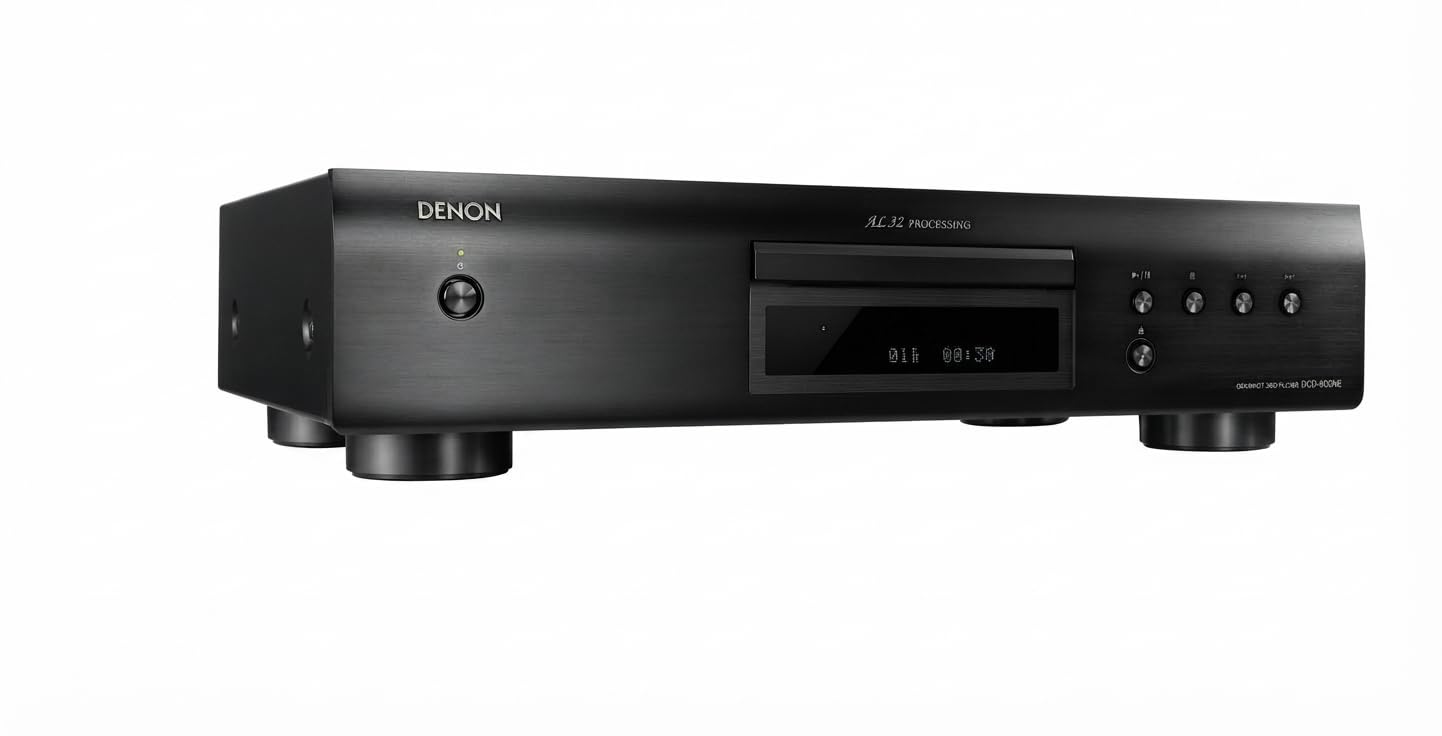
Denon’s angle is engineering: proprietary AL32 Processing, power transformers tucked next to insulators inside a slim 4-inch body to fight vibration, and a Direct Mechanical Ground Construction. In plain English, the player is built so that physical shake does not leak into the music. It plays CDs, CD-R/RW, MP3, and WMA, has an optical output for a clean digital hand-off to a receiver, and measures 17.09 inches wide by 4.21 inches tall — standard rack width.
The thing everyone raves about is the sound signature: warm, with solid build to match. It is described as playing CDs that skipped on old decks without complaint, and showing artist and song names for MP3 discs in the display. A billet aluminum front panel, decent heft, and a sturdy remote give it the feel of a long-term component. If you own the matching Denon amplifier it is designed to pair with, it belongs in that stack.
The drawback worth knowing: the disc mechanism can fail early. There are accounts of units running well for about six and a half months and then refusing every disc with a “Can’t read disc” error, including commercial CDs. That is not the common outcome, but this is the one product here where an extended warranty is genuinely worth considering. The display also loses some appeal if random play matters — it lives on the remote, not the front panel.
Choose it when: sound warmth and solid construction matter more than streaming options, and you already run a Denon or similar receiver.
Hesitate if: you want a low-hassle long-term disc spinner without a warranty safety net.
8. Yamaha CD-S303 Single CD Player

Plays the scratched, burned, and oddball discs others choke on.
Start with the disc resilience, because that is the difference. This deck handles CD-R and CD-RW playback and mounts its laser on a floating pickup mechanism, which helps it read worn and imperfect discs. It also plays MP3, WMA, LPCM, AAC, and FLAC files straight from a USB drive on the front panel — no computer needed. A high-performance DAC keeps conversion quiet and precise, and output runs at 2 +/- 0.3V.
What wins people over is reliability plus sound in equal measure. It picks up gapless playback for live albums, shows track, time, artist, and album on the display, and reports describe it playing heavily scratched CDs without a hitch. Firmware 1.53 fixed burned and previously unplayable discs for one early buyer — a USB update via the Yamaha site is easy if you ever need it. It measures 17.12 inches wide and 3.38 inches tall, standard rack width and rack depth, and there is a remote in the box.
The nudge here is about the DAC inside. It is adequate rather than spectacular, and more than one critical ear reports the sound opening up noticeably when routed through an external DAC via the optical or coaxial output. That is fine if you already own one — less fine if you are buying this to be the last word in sound. It is a versatile, dependable disc reader, not the warmest-sounding unit on this list.
Best for stubborn collections
- Floating laser pickup helps tame scratched and worn CDs
- Front USB plays FLAC, MP3, WMA, LPCM, and AAC files
- Gapless playback makes live recordings flow properly
- Firmware can be updated by USB to fix stubborn discs
Where it comes up short
- Built-in DAC is described as just adequate, not stellar
- Some very old homemade CD-Rs still refuse to play
Buy it for: a rack system and a collection that includes plenty of burned, scratched, and non-standard discs plus a USB library.
Look past it if: you want the warmest possible disc sound without adding an external DAC.
9. Bose Wave Music System IV (Renewed)

The smallest footprint here, with sound that belies its 4.5-inch height.
If space is the constraint, this is the answer. At just 4.5 inches tall, the Bose packs waveguide speaker technology (a folded internal pipe that guides low frequencies out of a tiny box) into a cabinet smaller than any other pick on this list, and the sound it pushes is genuinely room-filling for the size. The disc player handles CDs and MP3 CDs (a CD that holds compressed music files), the tuner shows song text, and there are dual alarms with a touch-top snooze for a nightstand. The slim remote carries 12 presets, and a 2.4m AC power cable gives plenty of reach from an outlet.
This unit comes certified refurbished — tested by the manufacturer or a third-party refurbisher to look and work like new, shipped with all relevant accessories, a minimum 90-day warranty, and possibly a generic box. Owners of the Wave line are devoted for good reason: one describes 20 years with a previous Wave system and calling the sound on this one “out of this world.” The espresso black finish looks the part of a piece of furniture rather than electronics.
Two realities to weigh. First, this is a refurbished unit, so the 90-day warranty is shorter than a new purchase’s, and a small number of units arrive with static. Second, this is a single-disc player — you change the disc to change the album. Bluetooth is not built in; you add an optional adapter to stream from your phone. Neither is a defect, but they shape who this suits.
A footprint like no other: at 4.5 inches tall with waveguide speakers inside, this puts real sound on a nightstand or kitchen counter where nothing larger would fit — and it adds dual alarms to boot.
Made for: a bedroom, kitchen, or bedside spot where a tiny footprint and a quality one-box sound matter more than a big speaker stack.
Not the one if: you need Bluetooth built in or you are not comfortable buying a refurbished unit with a 90-day warranty.
Know the Specs
Component Player vs. Complete System
A component player (like the Cambridge or Denon) reads the disc and sends a digital or analog signal out — you supply the amplifier and speakers. A complete system (like the Panasonic or Philips) includes the speakers, so it plays on its own. Neither is better in the abstract: the complete system saves you setup, and the component player lets you upgrade each piece separately. Getting the type right is what stops you opening a box that has no speakers in it.
Wattage: RMS Versus Peak
Look at the RMS figure (continuous power) rather than the peak. A 20W stereo means 10 watts per channel, which suits a bedroom. An 80W system is 40 per channel and fills a living room. The Philips at 100W with 5.25-inch woofers pushes into open-plan territory. Higher wattage predicts headroom at loud volume, not refinement at low volume — a 20W unit can still sound lovely on a shelf.
The DAC and Disc Reading
The DAC (digital-to-analog converter) is what turns the ones and zeros on a disc into the music that reaches your ears. Some units here build a good one in, like the Cambridge’s flat 20Hz – 20kHz response. Others run fine through a receiver’s DAC instead. What matters equally is disc compatibility: CD-R and CD-RW support, and how fussy the tray is with burned discs, decide whether your mixtape collection even plays.
Disc Trays and Longevity
Most failures in this category come down to disc mechanisms, not electronics. A top-loading tray, a powered drawer, or a single-disc slot all have moving parts that wear. Keep discs clean, avoid forcing a tray by hand, and treat an early “disc error” as a sign to check the laser rather than a permanent failure. A refurbished unit with a short warranty is the one case where a longer-term safety net really matters.
Common Questions
Do I need an amplifier to use a component CD player?
Will a bookshelf CD player play my homemade burned discs?
How loud is a 20W stereo compared to an 80W one?
Can I connect a turntable or phone to a bookshelf CD player?
Is the Bose Wave Music System IV worth buying refurbished?
What is a DAC and does it matter in a CD player?
How long should a bookshelf CD player last?
Should I use Bluetooth or a digital cable for the best sound?
Can a complete system be used without its included speakers?
Do I need an optical cable to connect a CD player to my receiver?
The Bottom Line
For anyone with an amplifier or powered speakers already sitting in the room, the Cambridge Audio AXC35 is the pick that returns the most faithful sound for the space it takes up, with a flat 20Hz – 20kHz response (it reproduces the full range of human hearing evenly) and a converter that makes old discs shine. If you would rather have speakers, a remote, and Bluetooth in the same carton, the Panasonic SC-PM700PP-K delivers 80W and a proper two-way speaker setup you just plug in. And if the box has to be tiny, the Bose Wave Music System IV packs its waveguide speaker into 4.5 inches of cabinet and adds dual alarms. Pick the type that fits your room, then choose the model.
How we choose
We do not accept paid placement. Every pick is matched to a real buyer and a real use-case; we do not hands-on test units.
Sources
Specifications: manufacturer listings and product documentation. Review insights: verified customer reviews, as of October 2026. Pricing: not shown on this page (it changes often); check the current price via the retailer link.
As an Amazon Associate, Aappliancez earns from qualifying purchases. This does not affect which products we feature.