Disclosure: Some links in this post are affiliate links. As an Amazon Associate I earn from qualifying purchases, at no extra cost to you. Learn more
Specs are compiled from manufacturer listings and verified buyer reviews and can change over time — please confirm the key details on the product page before buying.
Paint peeling off a plastic bumper or a galvanized railing is almost never the paint’s fault — it is a bonding problem. A bonding primer (sometimes called an adhesion promoter) is the thin gripping layer that sits between a slick surface and your topcoat, and it is the single step that decides whether your finish lasts or flakes off in sheets. If you want the short answer: the Klean-Strip Bulldog Adhesion Promoter is the one to beat for plastic, and the SEM 39683 Grey Self Etching Primer is the pick for bare metal. Everything below explains why, and which one fits your surface.
This guide is built by comparing the manufacturers’ published specifications and the patterns across verified customer reviews, so you get each pick’s real strengths and trade-offs instead of marketing spin.
This breakdown shows you how to choose the right bonding primer without wasting cans on surfaces it cannot grip.
Top Picks

How To Choose The Best Bonding Primer
A bonding primer has one job: to make the next layer stick. That sounds simple, but the chemistry changes completely depending on what you are coating. A product built to grab bare steel will do very little for a plastic bumper, and a plastic promoter sprayed on a rusty gate wastes a can. Start by naming your surface, then pick the product built for it.
Match the primer to the surface, not the colour
Polyolefin plastics — the waxy, flexible material used on bumpers, trim and fender flares — are the hardest common surface to paint because they actively resist adhesion. A promoter made for polyolefin is the only reliable starting point there. Bare metal needs an etching primer that bites into the surface chemically, while wood, masonry and stained ceilings want a sealing primer that blocks stains from bleeding up. One general-purpose can will not grip all three surfaces.
Understand dry time versus cure time
A can that dries to the touch in half an hour is telling you when you can apply the next coat, not when the job is finished. Full cure can run far longer, and topcoating too early traps solvent under the finish. Check both numbers before you plan a one-day job, because a fast-drying primer with a long full cure will still tie up your project overnight.
Plan coverage before you buy
Coverage is given in square feet per can, usually measured in light coats rather than one heavy pass. Two light coats of a 10-to-12-square-foot can covers a different amount of real panel than one wet layer. Rough out your surface area first, then work backwards to the number of cans — it saves a second trip and avoids a half-primed panel sitting overnight.
Side-by-Side Comparison
| Model | Best For | Volume | Dry Time | Surface | Amazon |
|---|---|---|---|---|---|
| KLEAN-STRIP Bulldog Adhesion Promoter★ Best Overall | Plastic and trim | 15 fluid ounces | 5 minutes flash time | Polyolefin plastic | Amazon |
| SEM 39683 Grey Self Etching PrimerBest for Metal | Bare metal and aluminum | 15.5 ounces | 3 hours | Bare metal, fiberglass | Amazon |
| Rust-Oleum 01008 Primer Spray, White | Stain blocking indoors | 13 ounces | 0.5 hours | Wood, ceilings, drywall | Amazon |
| SEM 39133 Flexible Primer Surfacer | Flexible bumpers and panels | 13 fluid ounces | 1 hour | Plastic bumpers | Amazon |
| Rust-Oleum Stops Rust Universal Bonding Primer | Mixed hard surfaces outdoors | 12 fluid ounces | 0.5 hours | Galvanized steel, PVC, masonry | Amazon |
Detailed Reviews
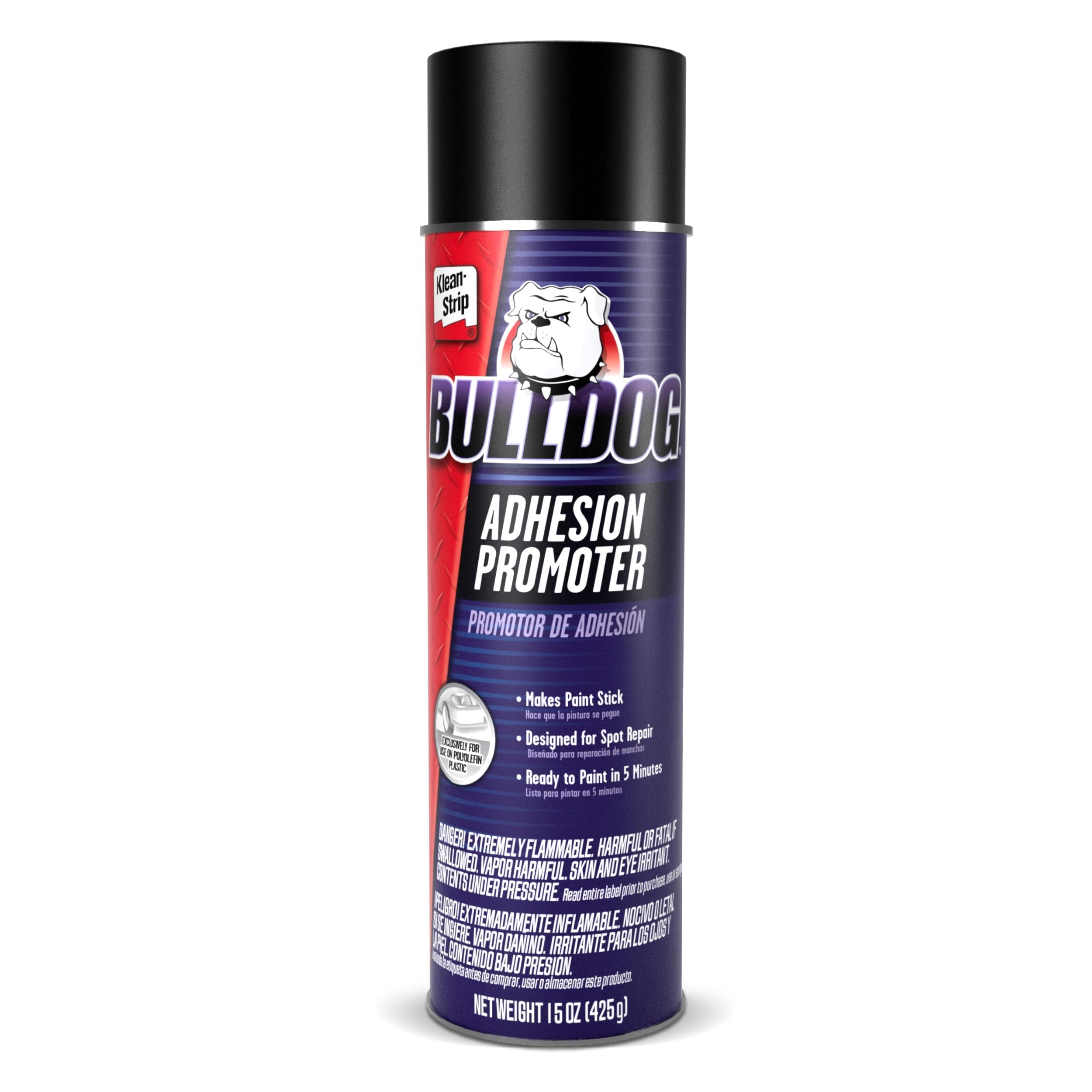
1. KLEAN-STRIP Bulldog Adhesion Promoter for Polyolefin Plastic
Our pick — 4.5+★ from 650+ verified ratings; the strongest balance of quality and price.
The clear spray that finally makes paint grip waxy plastic trim.
If you are painting a bumper, fender flare, plastic trim or a chrome-and-plastic grille, this is the can that does the heavy lifting. It is built specifically for polyolefin plastic — the slick, waxy material that ordinary paint slides right off — and it is the top-rated product in this group at 4.5+ stars across 650+ ratings. Adhesion is the theme running through the reviews, including paint holding on a Ford Expedition’s chrome and plastic without chipping or peeling.
The workflow is what makes it livable. Flash time is 5 minutes, so you are not waiting an afternoon between steps. It also stays active for up to 24 hours after application, which means you can prep the night before and topcoat the next morning. Better still, it fills fine 320 grit sanding scratches as it goes, so a lightly scuffed panel comes out smoother than it went in. One can is 15 fluid ounces and arrives ready to spray with no mixing.
Two things to plan around. First, it sprays very thin, almost like water, so runs happen fast — hold the can roughly a foot above the piece and let it mist down rather than soaking the surface. Second, it is a promoter, not a substitute for prep: it amplifies a clean, properly sanded surface and does nothing for a greasy one. The price sits at the higher end for a single can, which is why some buyers flag the cost per job even while praising the result.
What earns it the top slot
- 5-minute flash time keeps a multi-stage paint job moving
- Stays active up to 24 hours, so you can prep a day ahead
- Fills 320 grit scratches while it preps the surface
- Dries clear, so it works under any topcoat colour
Where it asks for care
- Sprays thin enough to run — mist it from about a foot away
- Costs more per can than basic primers
- Only earns its keep on polyolefin plastic; other surfaces need a different product
Made for: anyone painting bumpers, trim, fender flares or plastic panels who wants the topcoat to stay put.
Look elsewhere if: you are prepping bare steel or a stained ceiling — this can is formulated for plastic and would be wasted there.
2. SEM 39683 Grey Self Etching Primer – 15.5 oz.
Bare aluminium and steel get a chemical bite, not just a coat of paint.
Self-etching means the primer contains a mild acid that microscopically opens up the metal surface as it dries, so the coating locks in rather than sitting on top. On bare aluminium, steel or fibreglass that is the difference between a finish that holds and one that lifts at the edges. It carries the joint highest score in this group at 4.5+ stars, and the word that comes up most in its feedback is quality — the finish it leaves behind is the reason people keep buying it.
Here is a number worth knowing before you plan the day: this one lists a 3-hour dry time, where the Rust-Oleum 01008 white primer lists 0.5 hours. Full cure is stated at 1 hour. A 15.5 oz can covers a good amount of panel, and the grey tone gives you a visible, even base so you can see exactly where you have and have not sprayed — handy on corners and joints where a brush would struggle.
The honest caveat is the nozzle. It can spit and sputter, and some units arrive spraying unevenly, so shake it thoroughly and test on scrap cardboard before you commit to a panel. It also lists a grey colour code, yet some cans have arrived black — fine under a dark topcoat, less so if you wanted grey. Given the surface area a single can covers, most buyers call the result worth it, though a few find the price steep for an aerosol.
Why metal workers reach for it: the mild acid etches bare aluminium and steel so the topcoat locks in, and the grey tone shows exactly where you have sprayed.
The sputter caveat: test the nozzle on cardboard first and shake well — an uneven pattern shows up fast on a flat panel, and it is easier to fix before the first coat than after.
Right call when: your job is bare metal, aluminium or fibreglass and you want a primer that chemically bonds rather than just coats.
Not the one for: you need a fast turnaround on a strict schedule, since the 3-hour dry time is the longest here and rewards planning ahead.
3. SEM 39133 Flexible Primer Surfacer – 13 oz.

A surfacer that moves with a plastic bumper instead of cracking off it.
Bumpers flex. A rigid primer cracks the moment the panel bends, which is why this one is formulated to stay flexible and why it is the pick for car bumpers with minor imperfections to fill. It is ready to spray, dries in 1 hour, sands easily, and takes most refinish topcoats. Coverage is listed at 10 square feet per can, so a single bumper is a realistic job.
Buyers keep repeating that it fills bumper imperfections perfectly, and on many jobs it adheres well to plastic without a separate promoter. That last point is worth a note: on a plastic dashboard job, buyers have layered a promoter, this surfacer, colour and clear coat with 800 grit wet sanding and alcohol cleaning between stages, and reported a hard, chip-free finish.
Then there is the nozzle, and it is the one thing to go in knowing. The review pages are blunt about it: it sputters, fans poorly, and produces globs or “silly string” at the start of a spray. Decent workaround is to spray onto spare cardboard for a few seconds until a proper pattern forms, then move to the panel. Budget for extra coats too, because sputter spots need wet sanding at 800 grit to smooth out.
Why bumper jobs like it
- Flexible film that follows the panel instead of cracking
- Ready to spray straight from the can
- Sands easily at 800 grit for a smooth base
- Takes most refinish topcoats
The friction point
- The nozzle sputters and needs a cardboard pre-spray to clear
- Sputter spots demand extra sanding between coats
- Some find the cost hard to justify for a 13 fluid ounce can
Go here if: you are filling and smoothing a flexible bumper and want the primer to bend with the panel.
Think twice if: you want a fuss-free nozzle — the pre-spray ritual on cardboard is not optional on this can.
4. Rust-Oleum Corporation 01008 Primer Spray, 13-Ounce, White

The ceiling-saver for water rings, knots and smoke stains.
This is a shellac-base primer-sealer, and that chemistry is the whole point: it blocks stains from bleeding back through your finish instead of simply covering them. Water marks from a roof leak, knots and sap streaks in wood, pet and smoke odours — this is the can built for those jobs, and it is rated the best in this group for sheer quality of result. Two light coats over a ceiling water spot and the mark is gone under the ceiling paint; that is the everyday win it delivers.
Dry time is 0.5 hours, so you are recoating the same day rather than waiting. It is rated for both interior and spot exterior use, and it grabs paint well on a lightly sanded surface — a drywall patch comes out sealed and ready for colour. Coverage stretches far enough that a single can has handled multiple cabinet doors in one go.
The catch is the smell and the sprayer. The solvent load is heavy, so this is an open-the-windows, outdoors-or-ventilated job, not a closed-room one. The sprayer also clogs easily, and heavy streams rather than a wide fan are a known frustration — short bursts and a clean nozzle between passes keep it manageable. Larger stains can still show through and need extra coats, so plan for two or three on anything substantial.
The real strength: as a stain sealer it does the one job a normal primer cannot — it locks a water ring or a knot in place so your topcoat stays clean instead of letting the mark ghost back through.
Best suited to: indoor stain-blocking on ceilings, wood and patched drywall, where you need a mark gone for good.
Skip the turbo nozzle version: the standard spray head works, but the turbo variant has been a repeated let-down — stick with the plain can.
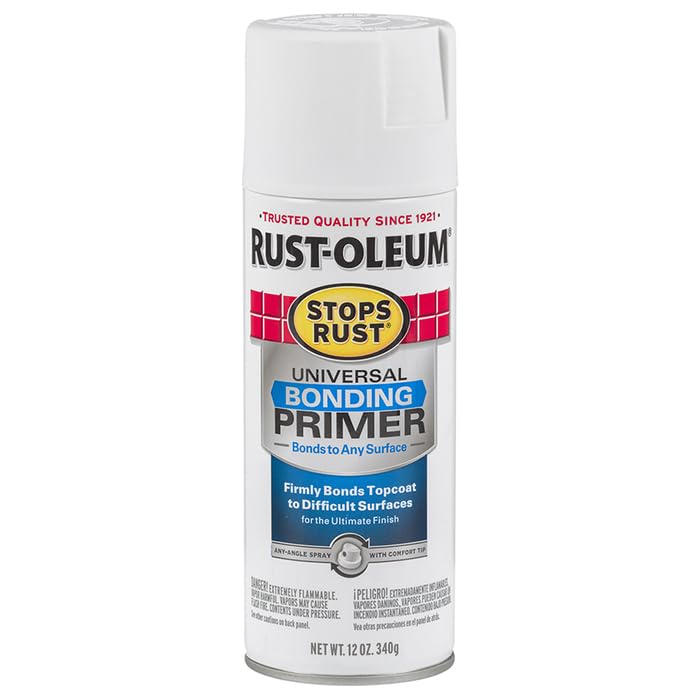
5. Rust-Oleum Stops Rust Universal Bonding Primer Spray
One water-based can that grabs galvanized steel, PVC and masonry.
When your job is a mix of awkward hard surfaces — galvanized steel railings, wrought iron, laminate, PVC, porcelain, glazed brick or masonry — this is the can that covers the widest spread in a single product. It is the highest-rated pick here at 4.5+ stars across 750+ ratings, and buyers keep returning to its performance on heavy gauge stainless steel prepped with two coats before a black topcoat. It also primes fibreglass and aged fibreglass antennas.
The formula is water-based with low odour and low VOC (volatile organic compounds — the solvents that make paint smell strong), and it is built for wet adhesion in moist or humid conditions. Touch-dry comes at 30 minutes, and full cure is listed at 48 hours, so you can topcoat the same day but want to leave the finish alone for a couple of days after. Coverage is listed at 12 square feet, and it also helps prevent rust and corrosion on the surface beneath.
Two honest limits. Coverage per can is modest, so a large railing or tower section eats it quickly and you should buy more than you think you need. The smell is also stronger than the low-odour label suggests on some batches — plan for outdoors and a mask, especially on big pieces. Neither is a reason to pass it up; both are reasons to set up your workspace properly first.
The surface spread
- Works on galvanized steel, wrought iron, PVC, porcelain, masonry and glazed brick
- Water-based with low VOC and built for humid conditions
- Touch-dry in 30 minutes so you can topcoat the same day
- Helps prevent rust and corrosion under the finish
Plan around this
- Coverage is listed at 12 square feet, so large jobs need extra cans
- Odour is stronger than expected on some cans — work outdoors with a mask
- Full cure is 48 hours, so leave the finish alone for two days
Pick it for: mixed hard surfaces where you want one water-based primer to handle steel, PVC, masonry and porcelain in the same session.
Buy an extra can if: you are coating anything large, because 12 square feet per can goes faster on a railing than you would guess.
Know the Specs
Flash Time vs Full Cure
Flash time is how long you wait before the next coat — the Klean-Strip Bulldog lists a 5-minute flash time, which is why it suits multi-stage jobs. Full cure is when the finish is genuinely finished, and it can be far longer: the Rust-Oleum Universal Bonding Primer lists a 48-hour full cure. Plan your project around the cure number, not the touch-dry one, or you risk marking a finish that looks set but is not.
Coverage in Square Feet
Coverage tells you how much panel a can will actually do, usually measured in light coats. The SEM 39133 is listed at 10 square feet per can and the Rust-Oleum Universal Bonding Primer at 12 square feet, which is enough for a bumper or a small railing but not a whole fence. Rough out your surface area before you buy, then add a spare can for the second coat.
The Meaning of Etching
An etching primer carries a mild acid that microscopically roughens bare metal as it dries, giving paint a mechanical and chemical foothold. That is why a self-etching formula like the SEM 39683 is reserved for bare metal and fibreglass rather than plastic. It matters most on smooth aluminium and steel, where a non-etching primer can sit on the surface rather than bite in.
Polyolefin and Why It Resists Paint
Polyolefin plastics — the waxy material on bumpers and trim — have a low surface energy, which means paint simply will not wet out and grip on its own. A dedicated adhesion promoter like the Klean-Strip Bulldog raises that grip so the topcoat holds. This is why a general-purpose primer fails on plastic while a plastic-specific promoter succeeds on the same panel.
Common Questions
Do I need a bonding primer on a plastic car bumper?
Can I use a self-etching primer on plastic instead of metal?
How long should I wait before topcoating a bonding primer?
Will a bonding primer stop water stains from bleeding through ceiling paint?
Does a water-based bonding primer work on galvanized steel?
Why does my primer spray can sputter and leave globs?
How many coats of primer does a bumper need?
Is a primer the same as an adhesion promoter?
Can I use bonding primer indoors, or does it need ventilation?
What does full cure mean and why does it matter before I topcoat?
The Bottom Line
For most jobs, the bonding primer winner is the KLEAN-STRIP Bulldog Adhesion Promoter because it is built specifically for the polyolefin plastic that defeats ordinary paint, it flash-dries in 5 minutes, and it stays active for up to 24 hours so you can prep ahead. If you want a primer that chemically bites into bare metal, grab the SEM 39683 Grey Self Etching Primer. And for a mixed bag of galvanized steel, PVC and masonry, the Rust-Oleum Stops Rust Universal Bonding Primer is the one that covers the widest spread. Whichever surface you are prepping, match the can to the material and check the cure time before you start.
How we choose
We do not accept paid placement. Every pick is matched to a real buyer and a real use-case; we do not hands-on test units.
Sources
Specifications: manufacturer listings and product documentation. Review insights: verified customer reviews, as of October 2026. Pricing: not shown on this page (it changes often); check the current price via the retailer link.
As an Amazon Associate, Aappliancez earns from qualifying purchases. This does not affect which products we feature.