Disclosure: Some links in this post are affiliate links. As an Amazon Associate I earn from qualifying purchases, at no extra cost to you. Learn more
Specs are compiled from manufacturer listings and verified buyer reviews and can change over time — please confirm the key details on the product page before buying.
If you want the short answer: a boat alarm system is only worth buying when it makes noise loud enough for someone else to hear it. That single idea separates the picks below. A 130 dB siren carries across a marina; an 85 dB in-dash buzzer mostly just tells you. And a man-overboard beacon that stays silent unless it hits water is a different job entirely from a bilge alarm that screams the moment water rises. This guide sorts all three jobs apart so you buy the one that actually covers your boat.
This guide is built by comparing the manufacturers’ published specifications and the patterns across verified customer reviews, so you get each pick’s real strengths and trade-offs instead of marketing spin.
Every pick here earns its spot on a real number — decibels, range in feet, battery hours, or ounces on the rail. The one rule that keeps you safe is matching the alarm’s job to your boat’s weak spot, and that is exactly what this guide to the best boat alarm system does for you.
Top Picks


How To Choose The Best Boat Alarm System
Start by naming the emergency you actually fear, because “boat alarm” covers three unrelated devices. One is a high-water alarm that watches your bilge (the lowest inside part of the hull where water collects) and screams when a float switch trips. One is a visual signal kit for daytime distress. One is a wearable beacon that fires when a person hits the water. Buy for the emergency you have, not the word on the box.
Decibels decide whether anyone comes
Loudness is measured in decibels (dB), and it is the spec that determines whether a passerby reacts or walks on. A siren in the 85 dB range is roughly the loudness of heavy road traffic — enough to alert someone standing right at your slip. Push past 100 dB and you are into the range of a chainsaw; at 130 dB you are near the threshold of pain, and that sound carries across open water. If your boat sits empty for weeks, buy for the higher number.
Whether it needs a power supply or batteries
Hardwired alarms run off your boat’s 12-volt system, so they never run flat — but the moment you cut into the loom, wiring quality becomes everything. Battery-powered units skip the wiring job entirely and keep working when shore power dies. Beacon-style devices run on their own sealed battery for years and need no connection at all. Match this to who does the install: if you are not comfortable splicing marine wire, buy the battery option.
Range that survives a real hull and a real marina
Radio range claims are always lofted in perfect conditions. What matters is what happens through fiberglass, around a cabin, and down a dock — and whether the signal repeats when your boat is closed up for the season. A wireless system that keeps working when the marina Wi‑Fi drops and the shore power is pulled is worth more than one that is only clever when everything else is working.
Side-by-Side Comparison
| Model | Best For | Alarm Type | Audible Output | Power Source | Amazon |
|---|---|---|---|---|---|
| Orion Safety 572 Coastal Alerter Kit★ Best Overall | Daytime visual distress signaling | Visual (aerial flares) | 116 dB whistle | None (pyrotechnic) | Amazon |
| Rule Hi-Water Bilge AlarmBest for Trailered Boats | Unattended engine compartments | Visual + audible bilge | 85 dB | 12V hardwired | Amazon |
| Johnson Pumps 72303-001 Bilge Alert | DIY bilge monitoring on 12V | Visual + audible bilge | 100 dB | 12V hardwired | Amazon |
| YoLink Outdoor Alarm Kit | Dock, shed and cabin perimeter | Wireless siren + sensors | 130 dB | 4x C alkaline batteries | Amazon |
| CS 2-Way LCD Alarm/Starter | Towed trailer and stored boat security | Vehicle alarm + remote start | 105 dB+ | Rechargeable (vehicle 12V) | Amazon |
| Mob+ Wireless Man Overboard System | Crew-overboard engine cut-off | Wearable kill-switch alarm | — | 12V DC wired hub | Amazon |
| Ocean Signal rescueME MOB1 | Offshore crew location alerting | AIS + DSC locator beacon | — | Sealed 7-year battery | Amazon |
Detailed Reviews
1. Orion Safety 572 Coastal Alerter Kit
Our pick — 4.5+★ from 850+ verified ratings; the strongest balance of quality and price.
One kit that covers the daytime distress call your flare gun alone cannot make.
The 572 is the crowd favorite, holding a 4.5+ star average across 800+ ratings. Buyers report the kit’s overall quality is what wins them over, and the whole Orion package holds up to a Coast Guard inspection on the water. You get a complete coastal alerting kit, not just a lone launcher: a corrosion-resistant 12-gauge safety launcher (a gun that fires flares) with a hammer safety lock, a bandolier (a shoulder belt) that carries 6 signals, and a lifetime warranty. The six U.S. Coast Guard approved red aerial flares reach altitudes of up to 500 feet with 16,000 candela brightness (a measure of light intensity) and a 7-second burn time. That height and burn time make the flare visible from a rescuer’s deck, not just your own bow.
The rest of the kit covers the situations where a flare is the wrong tool. A pealess safety whistle emits 116 dB and is built to resist freezing, so it keeps working on a cold morning when your hands are too numb to do anything else. The non-corrosive signal mirror includes a viewfinder and a lanyard — a mirror aimed at a distant boat in daylight can be seen when nothing else in the kit can. Everything stows in a floating, high-visibility orange neoprene case, and an Orion Safety Manual is included so you handle and store the flares correctly.
At 14.4 ounces, it is far heavier than the compact Rule bilge alarm down this page — but it is a completely different job, a carry kit rather than a fixed sensor. The recurring note in reviews is that the flares carry an expiration date, and the listing tops out at what is physically in the box. Expect to replace it; a signal kit is not a lifetime purchase.
What owners consistently point to
- Complete kit — launcher, 6 flare shells, whistle, mirror, and a floating orange case all in one
- 500-foot flare altitude with 16,000 candela brightness and a 7-second burn time
- 116 dB whistle is freeze-resistant, so it works when the temperature is not on your side
- Pealess whistle and non-corrosive mirror have no moving parts to seize up in salt air
- Ships with an Orion Safety Manual and covered by a lifetime warranty on the launcher
The catches worth knowing before you buy
- Flares carry an expiration date, so the kit needs periodic replacement — never a one-time buy
- Some owners mention the listing description did not match the box contents, so verify what ships
- Ships via ground only and returns are not accepted — check the listing carefully before ordering
- At 14.4 ounces it is not something you want to strap to your wrist
Best fit: anyone who wants a single box that covers daytime distress signaling on a boat that sees open coastal water.
Look elsewhere if: you need a fixed alarm that monitors your bilge while you are away — this kit only works when a person is there to fire it.
2. Rule Hi-Water Bilge Alarm
The simplest 12V install here — a float switch, a gauge, and no guesswork.
Two parts do the job: a float switch that sits in the bilge and an in-dash gauge that shows both a visual warning and an 85 dB audible alarm. It complies with CFR 182.530, the rule that requires a visual and audible alarm in each unmanned space on commercial vessels at least 26 feet in length. Rated for pumps drawing up to 20 amps at 12 volts, it fits the common bilge pump setups on trailerable and mid-size boats.
At 3.2 ounces, it is the lightest alarm here, and reviewers repeatedly note how quick it installs. One long-term owner said it did exactly what a bilge alarm should: “The 85 dB alarm alerted a passerby to a leaking valve and a cycling bilge pump without disturbing the rest of the marina.” That suits the quiet-alarm user who wants a heads-up without waking the whole marina. The same buyer suggested running it as a secondary upper-level pump alarm for extra coverage.
The obvious constraint is the 85 dB ceiling. That is roughly the loudness of a busy road — fine for alerting someone nearby, but short of what carries across open water, where the YoLink’s 130 dB has a clear edge. A recurring gripe in the review pages is that the wiring harness from the alarm runs short, so plan an extension before you cut the dash. It is also 4″L x 10″W x 6″H on the panel, and it takes a 12V supply, so a dedicated circuit or a fused tap is part of the job.
Where it earns its keep: Simple, reliable monitoring of an unmanned compartment at the lowest fuss of any 12V unit here.
What will trip you up: That same low-decibel alarm means it works best close to someone who will hear it — not on a mooring you visit twice a month.
Reach for this if: you keep your boat on a trailer or a slip you visit regularly and want a dead-simple high-water alert.
Pass it over if: you need an alarm that carries far enough to reach you at home.
3. Johnson Pumps 72303-001 Bilge Alert
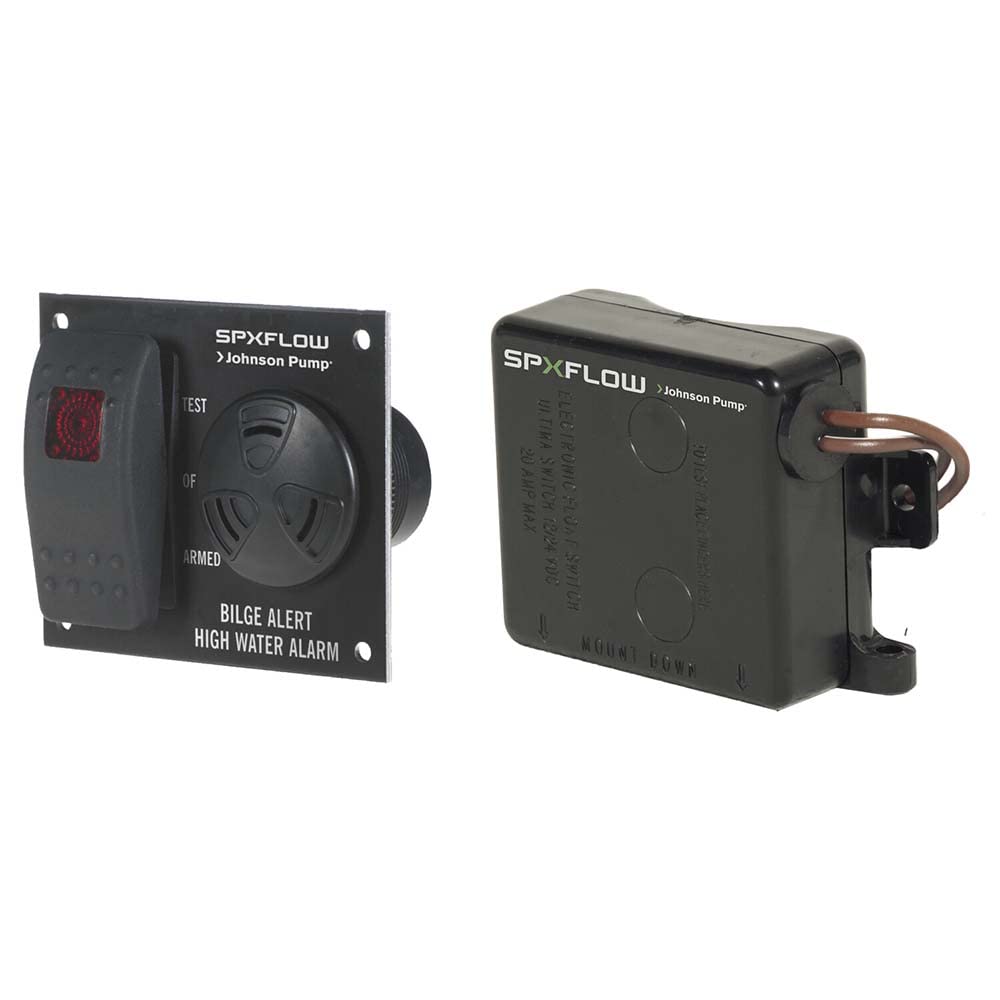
15 dB louder than the Rule — and that margin is the whole reason to pick it.
Where the Rule tops out at 85 dB, this Johnson Pump unit hits 100 dB — a genuinely audible jump if you have ever tried to hear an 85 dB buzzer over engine noise. It also sits on a non-mechanical sensor rather than a float switch, so there is no arm to gum up or stick. It measures 7.7″L x 4″W x 3.9″H, and it is the boxier of the two bilge alarms here, so check your panel space before you commit.
Owners who got it wired up describe it as the alarm they would install again. The core praise is ease of installation — the connection points are logical and the sensor mounts cleanly — and loudness comes right behind it. A two-year owner reports it still triggers at the set height, draws no current when the switch is open, and carries across the marina. A 28-foot sailboat owner wired it to meet a Coast Guard requirement and noted the waterproof connectors included in the box were the right quality for a wet compartment.
Here is the honest part: the wiring diagram is the most-complained-about thing in the whole review page — labeled for a three-wire setup when the switch is two-wire, or vice versa. Multiple buyers wasted time with a multimeter hunting for the diagram. Reliability is the other mixed signal; some units work exactly as expected, others fail. If you are comfortable reading a schematic and testing with a meter, it is a solid choice. If you are not, buy the Rule for the simpler install.
The wiring reality check: It is the loudest fixed bilge alarm on this list, but it also asks the most patience of you at install time.
Who this suits: a DIY owner with basic 12V skills who wants maximum alarm volume and is comfortable sorting out a mislabeled diagram.
Best for: the owner who prioritizes alarm loudness over plug-and-play installation.
Skip if: you have neither the tools nor the patience to troubleshoot a wiring diagram — the extra 15 dB is not worth an afternoon of confusion.
4. YoLink Outdoor Alarm Kit: Controller 2 + 130 dB Siren + Hub
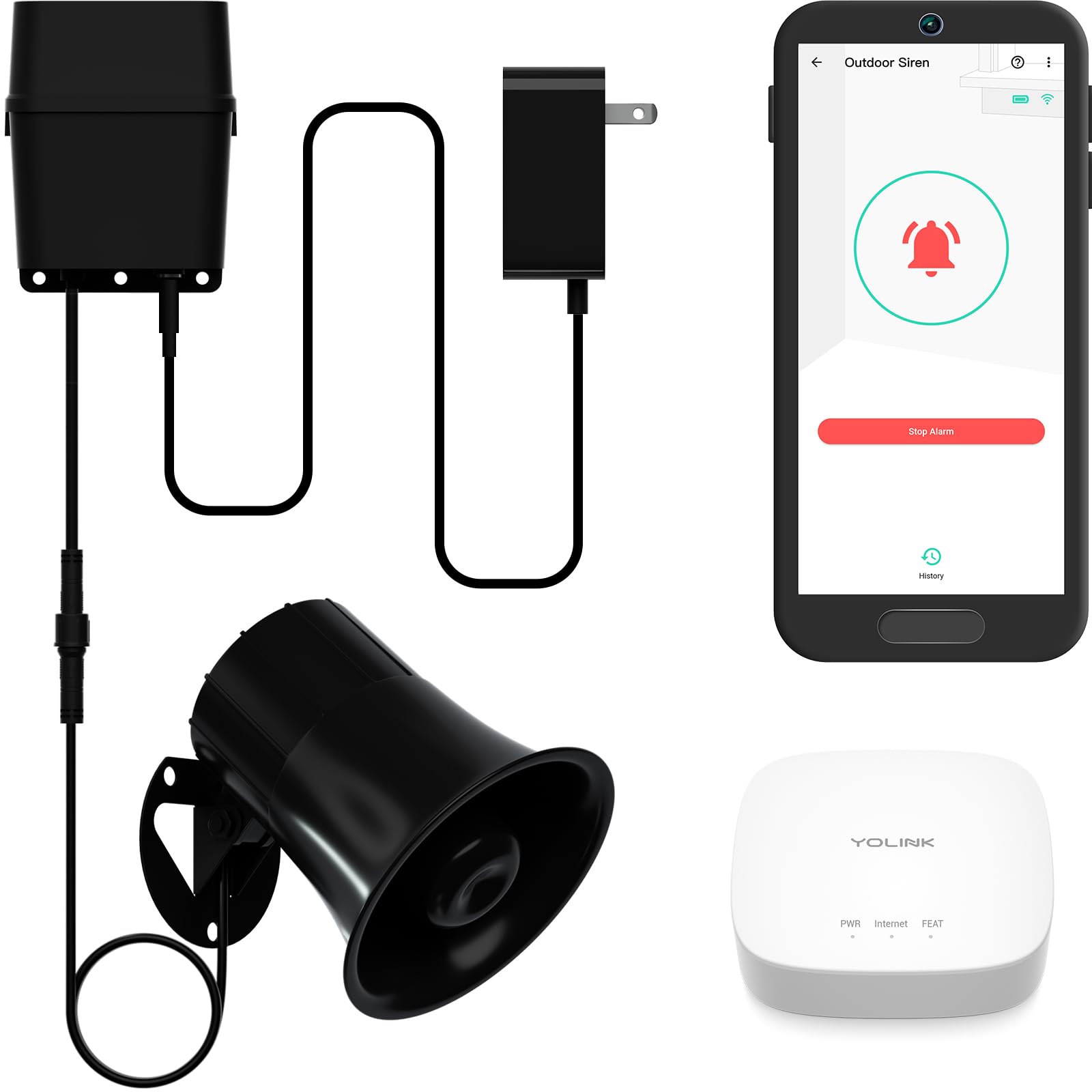
130 dB is the loudest siren on this list, and it does not need a live internet connection to fire.
If you need to get attention across a whole marina, this siren is the loudest here. It outputs 130 dB (decibels, a measure of loudness) with a 12VDC supply (a 12-volt direct-current power source), and 110 dB without one. A reviewer confirms it carries: “The 130 dB siren carries across 5 acres, and the whooping tone repeats every second.” Inside the kit, four C cell alkaline batteries let the siren run with no wiring from your boat at all. A patented Control-D2D pairing lets YoLink devices talk to each other over the LoRa network (a long-range, low-power wireless system).
The range figure backs that up in a way few wireless alarms can: up to 4000 feet of maximum range, with the device highlight listing LoRa YoLink Protocol up to 2034 feet. It also keeps working when the marina is offline — pairing holds through a Wi‑Fi drop, an internet outage, or a shore-power cut, which is exactly the failure mode when a boat is left sit for weeks. Owners here pair it with door and window sensors and water-leak sensors as much as they use it as a straight alarm, though those add-ons are sold separately.
Plan for two things. First, it is made for outdoor use but is not waterproof — the listing says to keep it out of direct rain, standing water, condensation, and too much moisture. A covered spot under a hardtop or a vented enclosure is the right home. Second, the siren is large and sits on a tabletop, not flush on your dash. One fix that helps: mount it on a wood post where you can reach it easily, since owners repeatedly note the mount is dead simple on that surface.
The case for it: Loudest alarm on this list, and the one that keeps running when the marina Wi‑Fi, the internet, and the shore power all drop at once.
Plan for this: It wants a covered, dry location — the “outdoor” label means “outside the cabin,” not “rainproof.”
Go here if: you want the loudest siren with the longest wireless reach, and you are covering a dock, a shed, or an exposed float.
Think twice if: you want a single dash-mounted unit — this one is bulky and wants to sit on a surface in a dry spot.
5. CS 2-Way LCD 3000′ Alarm/Starter, Blade Ready

Engine start and lock at 3,000 feet — the one pick here that saves you a walk to the dock.
Many boats sit for long stretches, and this is the pick that covers that idle time plus your winter starts. The 2-way LCD remote confirms every command back to you on its screen, so you know the engine started before you walk the length of the float. It carries a 3000-foot range — the longest of any remote here — and pairs with a 1-way backup remote for when the LCD fob is left in the cabin.
The security side is layered: a 105 dB+ siren plus a dual-stage shock sensor that reacts to both a light nudge and a hard hit. That means a hull knock in a quiet marina gets a warning, not an instant full siren, which owners describe as exactly the right balance for a stored boat. It works with gas and diesel engines, so it covers most trailerable and mid-size boats. If your hull is a diesel, confirm the wiring before you buy — that is the case this one is built to handle, but the install still needs to match your harness.
The honest catch is the install. It takes more expertise than the bilge alarms here, and the Blade module (a control unit) complicates the wiring unless you have done one before. Owners who went through it call the result solid: the LCD (a small screen) is clear, the remote works from the house or across the parking lot, and you get both alarm and remote start for the price of one device. What you save in walk time, you pay back in install patience.
Why owners keep it: It turns a twice-yearly walk to the dock into a button press, with the added bonus of an alarm that already knows when the hull has been moved.
The trade-off: The Blade module and vehicle wiring make it the most involved install on this page — a job for someone with real wiring confidence.
Made for: owners of a stored or trailered boat who want remote start, confirmed lock, and a shock-triggered alarm in one unit.
Not for you if: you want a single weekend install — set aside a knowledgeable installer or plan the wiring job carefully first.
6. Mob+ Wireless Man Overboard System

Turns the old lanyard kill-switch into four wireless fobs your whole crew can wear.
This is the one that stops the boat when a person goes overboard — a function no siren on this page can perform. It supports up to 4 crew members on wireless fobs, and it cuts the engine automatically when a fob leaves range or hits the water. Where a traditional kill-switch strap tethers the driver to the console, the Mob+ frees them to move around the boat while the sensor still watches. It is also the lightest item here at 9.6 ounces.
Owners who have lived with it are emphatic about the freedom it buys. A center-console owner of five years reports the engine cut reliably whenever the fob left range or got wet, and the finished install looked factory-clean. Another described testing it on purpose — dunking the fob and watching the ignition kill exactly as it should.
Two real-world caveats, both about the hardware rather than the idea. The wristband and fob hold up to daily abuse but the strap has been known to break after a season of use, and the fob’s gasket seal can wear until water gets in. And the fob has to be pressed after ignition, which adds a few seconds of boot-up — a small delay that is worth building a habit around. Neither issue changes the verdict, but they are worth planning replacement parts into your season.
Why it deserves the spot
- Automatic engine stop the moment a fob leaves range or gets wet — the one function here that prevents a runaway boat
- Up to 4 crew members can each wear a fob, so passengers can move freely without a tether
- Panel-mounted hub installs cleanly — owners describe the finished unit as looking factory-fitted
- 9.6 ounces on the rail, the lightest item on this list
- Works whether the boat is at the dock or underway — no wiring complexity beyond the hub
Where owners flag wear
- Wristband strap can break after a season of hard use — plan on replacing it periodically
- Fob gasket can degrade over time, allowing water in — the maker recommends a DIY gasket fix
- Fob requires a press after ignition, adding a few seconds of delay on startup
- Install requires a permanent mounting hole and some rewiring, so removal leaves a mark on the panel
The right match: any boat with a crew on board — especially a small offshore center console where losing the driver over the side is the emergency you fear most.
Look past it if: you want zero permanent changes to your helm — this install leaves a 2-inch mounting hole.
7. Ocean Signal rescueME MOB1

The smallest device here, and the only one that sends your exact position by radio.
For a crew member overboard offshore, shouting does not carry and a siren does not float. The MOB1 transmits an emergency alert to every AIS receiver and chart plotter in the surrounding area, sending its precise location to your vessel and any assisting parties. Its integrated 66 GPS channels share that position quickly and accurately, and the integrated Digital Selective Calling (DSC) transmitter sends automatically formatted distress alerts with your location to your own vessel or any nearby DSC-equipped radio.
It mounts on a lifejacket and activates by immersion in water, so it fires without anyone needing to press anything. Operation runs up to 24 hours at temperatures as low as -20°C, and a high-intensity strobe helps rescuers spot you in the dark. The 7-year battery life means it can sit mounted and ready without a seasonal check-in. What it is not is a two-way radio — it tells nearby vessels where you are, not your voice over the air.
Here is the honest warning that outweighs everything else: the install is the part that owners fight with. The review page reports accidental activation during setup even on a calm anchorage — alarms heard on nearby boats — and the instructions leave the antenna and tether placement unclear. Owners of the MOB1 also say it is not for beginners, and that setup benefits from being done on shore with patience. Budget an unhurried hour and follow the manual slowly, and the MOB1 does what it was built to do.
What you get at the top of the range: AIS and DSC alerts in a package small enough to vanish on a lifejacket, with 24 hours of operating time and a 7-year battery.
The install reality: Setup is the weak point — the instructions are unclear and easy to misread as a step-by-step, which owners say causes accidental activations. Read the manual twice before you touch the hardware.
Reach for this if: you sail or run offshore and want every AIS-equipped vessel in range to see exactly where your crew went in.
Hold off if: you are a first-time beacon buyer with no patience for a fiddly installation — this one needs a careful afternoon on shore before it touches a lifejacket.
Know the Specs
Audible output in decibels (dB)
Decibels measure how loud a siren is, and they are the single number that decides whether anyone comes. Roughly 85 dB sits at the level of heavy road traffic — audible to someone standing nearby but not across a wide mooring field. Around 100 dB is closer to a chainsaw: it will pull attention from a neighboring slip. At 130 dB you are near the edge of physical pain, and that sound carries across open water. If your boat often sits empty and unvisited, buy for the higher number.
Power source and install difficulty
An alarm runs on one of three supplies, and the choice changes how much time you spend with a crimper. A 12V hardwired unit pulls from your boat’s system and never needs a battery change — but wiring quality, fuses, and connector sealing become part of the install. Battery-powered units skip the loom entirely and keep working when shore power dies. A sealed beacon battery can last years and needs no connection at all. If you avoid splicing marine wire, buy battery power.
Common Questions
What is the difference between a bilge alarm and a man overboard system?
How loud does a boat alarm need to be to wake a neighbor?
Do I need a WiFi connection for a boat alarm to work?
Can a boat alarm run on batteries only?
Will one alarm cover a boat with several compartments?
How long do the flares in a coastal alerter kit last?
What is AIS and DSC on a man overboard beacon?
How much wiring work does a 12V boat alarm need?
Where should a wireless outdoor alarm be mounted on a boat?
Can a man overboard system cut the engine automatically?
The Bottom Line
For the single best answer, the boat alarm system winner is the Orion Safety 572 Coastal Alerter Kit — a complete coastal alerting kit that passes Coast Guard inspection with the flares, whistle, and mirror in one floating case. If you want the loudest siren and the longest wireless reach, the YoLink Outdoor Alarm Kit hits 130 dB and keeps running when the marina WiFi drops. And if keeping your crew on board is the emergency you fear most, the Mob+ Wireless Man Overboard System is the one to reach for — it cuts the engine the instant a fob goes over the side.
How we choose
We do not accept paid placement. Every pick is matched to a real buyer and a real use-case; we do not hands-on test units.
Sources
Specifications: manufacturer listings and product documentation. Review insights: verified customer reviews, as of October 2026. Pricing: not shown on this page (it changes often); check the current price via the retailer link.
As an Amazon Associate, Aappliancez earns from qualifying purchases. This does not affect which products we feature.