Disclosure: Some links in this post are affiliate links. As an Amazon Associate I earn from qualifying purchases, at no extra cost to you. Learn more
Specs are compiled from manufacturer listings and verified buyer reviews and can change over time — please confirm the key details on the product page before buying.
Six players is the number that breaks weak game collections. Most boxes say “2 to 4 players” on the lid, and the moment a fifth friend walks in, half your shelf is useless. The games that handle six well share three traits: short turns that keep everyone involved, rules built for the top of the player range, and components that survive six sets of hands. This guide sorts the strongest options by what each one is genuinely best at.
This guide is built by comparing the manufacturers’ published specifications and the patterns across verified customer reviews, so you get each pick’s real strengths and trade-offs instead of marketing spin.
The picks below range from fantasy quests that run for hours to compact tile sets that fit in a suitcase. Each entry explains what makes it work at a full table of six. If you are shopping for a group that regularly fills every seat, this breakdown of the board games for 6 players covers the mechanics and pieces that matter most.
Top Picks


How To Choose The Best Board Games for 6 Players
A six-player game is a different animal from a four-player one. Turn order gets longer, downtime grows, and any game where one person can run away with the lead early leaves five people watching. The games that work at six either keep every turn short, or give the trailing players a real way back in.
Check the player range, not just the maximum
A box that says “2-6 players” is telling you the game scales across that whole range. A box that says “2-4 players” with a note that six can squeeze in is telling you something different. Look for games where the designer built the rules around the upper end, not just tolerated it. Scaling mechanics — where enemy health or resource counts adjust to how many seats are filled — are the clearest sign a game was tested at a full table.
Watch the clock per turn
With six players, a two-minute turn becomes a twelve-minute round. Games with short, simple turns — roll and move, draw and place, pick and pass — keep everyone engaged because nobody waits long. Games with deep planning phases feel slower at six seats unless the design limits how much one person can do per turn.
Match the style to your group
Competitive games reward the player who plans best. Cooperative games let six people work one problem together, which suits mixed-skill groups where one person usually wins everything. Social and conversation games use the sixth seat as a feature rather than a stretch. Match the style to who actually shows up: competitive for planners, co-op for mixed skill levels, social for talkers.
Side-by-Side Comparison
| Model | Best For | Players | Playtime | Style | Amazon |
|---|---|---|---|---|---|
| Avalon Hill Talisman 5th Edition★ Best Overall | Long fantasy sessions | 2 to 6 | 1.5 to 2 hours typical | Competitive quest | Amazon |
| Connect War – 4 in a Row Table Top GameMost Portable | Big gatherings, all ages | 2-6 | — | Handcrafted connect | Amazon |
| Hasbro Games Dungeons & Dragons: Bedlam in NeverwinterBest Co-op | Co-op puzzle nights | 2-6 | 90 minutes | Cooperative mystery | Amazon |
| Connect More – Social Skills Game | Conversation and bonding | 2-6 | — | Conversation connect | Amazon |
| Doreimi Non-Transparent Rummy Cube Travel Game Set | Travel and family nights | 6 | — | Tile strategy | Amazon |
| Capstone Games Wandering Towers | Short tactical rounds | 1-6 | 30 minutes | Fantasy strategy | Amazon |
| Renegade Game Studios Acquire | Teens and adults | 2-6 | 90 minutes | Economic strategy | Amazon |
| VAMSLOVE Large 17″ Chinese Checkers Board Game | Multi-generational play | 2-6 | — | Classic strategy | Amazon |
| 2-6 Players Rummy Game by Soopotay | Holiday gatherings | 2-6 | — | Tile strategy | Amazon |
Detailed Reviews
1. Avalon Hill Talisman 5th Edition
Our pick — 4.5+★ from 550+ verified ratings; the strongest balance of quality and price.
Twelve characters, one dragon, and a race where the sixth seat changes everything.
If your group wants a two-hour fantasy quest that leaves everyone with a story, this is the one. You play as one of 12 detailed character figures — a Prophetess, a Wizard, a Thief and more — each with a matching card that lays out that character’s unique ability. The goal never changes: chase down a Talisman first, reach the Crown of Command, and beat the guardian dragon. At six players that race gets crowded in the best way, because every character actively competes for the same treasures.
The 100 illustrated adventure cards are what keep it from getting stale. They drop enemies, strangers, magical objects and new places onto the board, so the map literally changes as you play. The base board itself splits into 3 regions of enchanted locations, and layering Adventure cards on top pushes you into encounters you did not plan for. Compare that to a fixed-board game and the difference is real — the fifth and sixth players are not just filling seats, they are adding pressure and unpredictability.
The 5th edition also smoothed the rules. Owners consistently describe a game that newcomers and non-gamers can pick up, with most sessions running about two hours. What wins people over most is simply the gameplay loop itself — the roll, move, and follow-your-location turn is easy to teach but still leaves room for real decisions. One thing to know before you buy: the lighter build quality on some components draws mixed feelings, and a few owners find certain characters stronger than others. Those are small notes against a game this well loved, but worth setting expectations.
What players keep coming back for
- 12 character figures with matching ability cards give six players genuinely different roles
- 100 adventure cards plus 3 board regions mean the map is different every session
- Simplified 5th-edition rules suit newcomers and non-gamers alike
- Runs about 2 hours, which fits a real game night without dragging
Worth knowing before you buy
- Build quality draws mixed feedback — some describe parts as flimsy
- Character balance is uneven, and a few players find the older rules quirks still present
- Runs long by some groups’ standards — several owners note games stretching several hours
Built for: groups of four to six who want a sprawling fantasy quest they can replay for months.
Think twice if: your table prefers tight 60-minute games — the long sessions are the trade-off here.
2. Connect War – 4 in a Row Table Top Game for 2-6 Players
The connect game that finally has room for everyone at the table.
Standard four-in-a-row is a two-person duel, which makes it useless the moment a third friend arrives. Connect War solves that by building the same idea around 2-6 players, so a full table can play at once instead of taking turns watching. The set is handcrafted rather than molded plastic, and the grid is compact — 9.25 inches wide by 5.75 inches high — so it sits comfortably even on a crowded coffee table.
You get one die and 126 discs total, six colors of 21 each: green, orange, purple, blue, pink and yellow. The die is what makes the six-player version work, adding a light random element that keeps a large group from turning the game into a pure standoff. It is an indoor game aimed at all ages, which is the real draw — grandparents and kids can share the same board without anyone needing a rulebook refresher.
Almost all the praise centers on how fun and social the gameplay feels, with the six-player capacity right behind it as the second thing people mention. That said, there are two honest notes. Some buyers report pieces arriving stuck together initially, and a few find the board smaller than they pictured. Neither is a dealbreaker — the discs separate and the compact size is part of why it travels well — but if you want a big statement board on the dining table, this is a modest-sized one. A 60-day warranty against manufacturer defects backs it up.
Where it earns its spot: 126 discs across six colors plus a die mean the six-player mode is built into the design, not tacked on as an afterthought.
The small print: rustic wood-stain finish means color variation between units is normal, and the board’s modest footprint suits a small table more than a large one.
Grab this one if: you need a genuinely all-ages game that packs flat and handles a mixed group of six.
Pass it over if: you want a large, showpiece board — this one is compact by design.
3. Hasbro Games Dungeons & Dragons Bedlam in Neverwinter
Escape room meets dungeon crawl, with six players all solving the same mystery together.
This is the pick for a group where not everyone knows how to play D&D and nobody wants to learn a 300-page rulebook first. It runs as a 3-part escape room where players join forces to investigate a string of disappearances, tracking clues and cracking a mystery at the end of each act. Everyone works toward the same goal, so the sixth seat adds solving power rather than competition.
The component list is substantial: 6 plastic figures, 11 gameboards, 298 cards, 43 cardboard tokens, 4 secret envelopes, a d20 and a d6, plus one mysterious object. You choose a Race, Class and Starting Weapon to build a character, then collect loot and fight monsters while hunting an evil mage and his cult. The board is dynamic — it builds and changes as you solve puzzles, open up new locations and clues along the way. Puzzles range from wordplay problems to multi-card visual riddles, which keeps a mixed group of six engaged because different people spot different things.
Expect about 90 minutes on the box, though acts run longer in practice and the three-act structure gives you natural stopping points if six people cannot commit to a full evening. The praise lands on how easy it is to play and how good the components look. The one honest limit is replay value — the puzzles have fixed answers, so once your group solves them, the mystery loses its pull. That makes it a pass-along game rather than a permanent shelf staple, but as a D&D on-ramp it does its job well.
What makes it click at six: cooperative puzzles reward a crowd — more heads means more people spotting the visual and wordplay solutions, and enemy health scales with player count to keep the challenge honest.
Reach for this if: your group wants a story-driven co-op night and at least one person is D&D-curious.
Look elsewhere if: you replay games weekly — the fixed puzzle answers mean it is a one-and-done journey.
4. Connect More – Social Skills Games and Therapy Games

A connect game that quietly turns six players into a real conversation.
Connect More uses the familiar four-in-a-row board as scaffolding for something else entirely. The full set contains 250 reflection cards and over 300 questions spread across them, so every move can trigger a prompt about opinions, feelings, thoughts or goals. It plays 2-6 players and is rated for ages 8 and up, which means it works across a family table or an adult group without needing two different games.
The component list is generous: a wood grid, a die, the 250 cards, a game guide, and a full spread of discs — 7 yellow, 9 pink, 11 blue, 14 purple, 21 green and 21 orange. It was designed for teachers, counselors and therapists, then adopted for general use. At six seats, that design choice is exactly what you want: the larger the group, the more varied the answers get, and the conversation carries itself.
Owners mention the gameplay itself stands out, followed closely by how well it fits a classroom or group setting — a strong signal that this is a game built for many people, not just a pair. The caveat is honest but narrow: quality and value draw mixed feedback, and some find the depth of the questions varies. It is not a heavy strategy game and will not fill a three-hour evening — it works best as the opening round of a gathering or a quieter alternative to a competitive board.
Why six seats suit it
- 250 reflection cards keep prompts fresh across repeated sessions
- Rated 8-65+, so a mixed-age table can genuinely play the same round
- Full disc count across five colors supports all six players without sharing pieces
Where it is not for everyone
- Question depth varies — some prompts land deeper than others
- Not a strategy game: groups wanting competitive depth will want something heavier
- Quality is fine rather than standout, with components earning mixed marks
The right pick when: your group would rather talk than compete, or you are hosting a mixed table of kids and adults.
skip it if: you want a win-and-lose challenge — this one is built around the conversation, not the scoreboard.
5. Doreimi Non-Transparent Rummy Cube Travel Game Set 6 Players
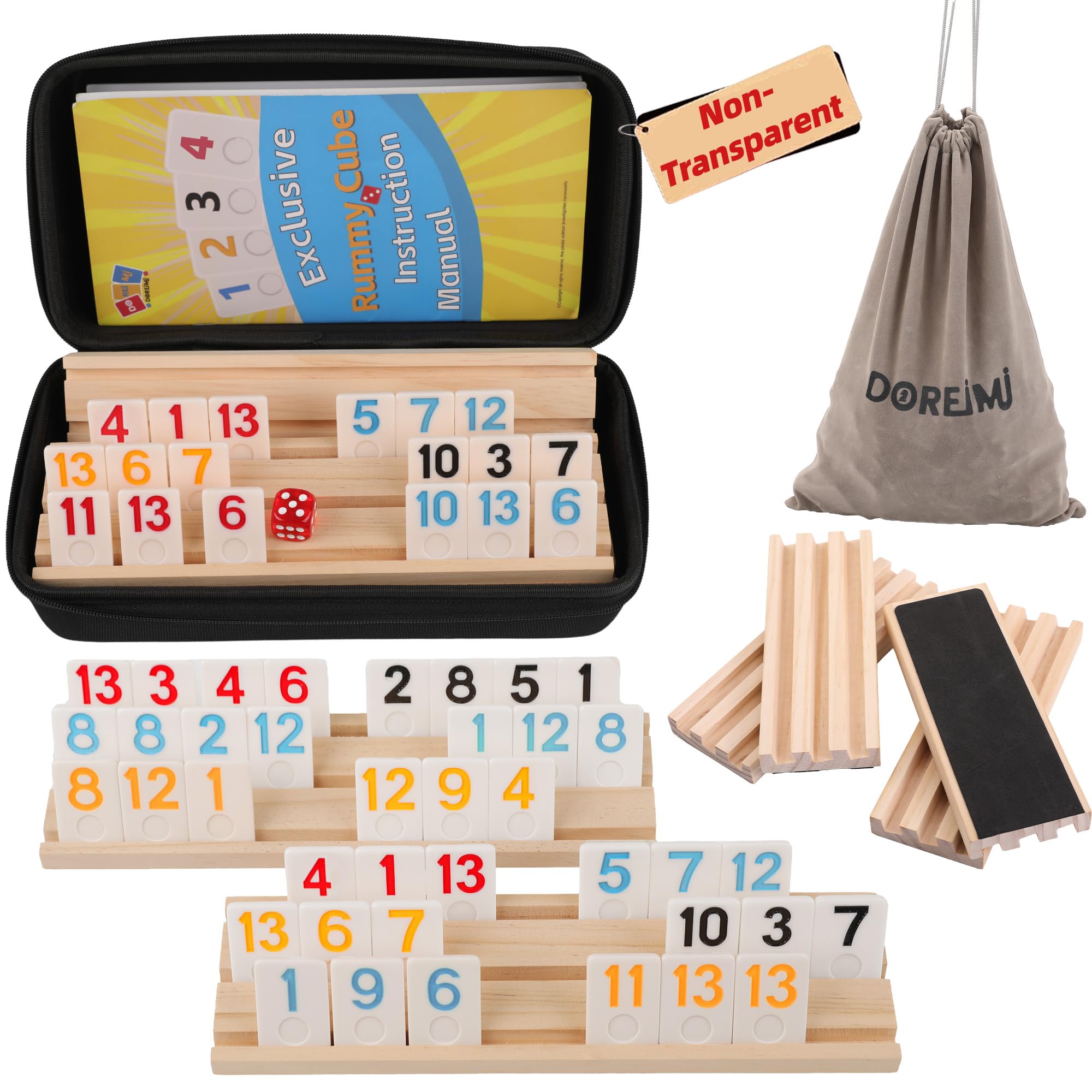
Opaque tiles, six wooden racks, and a case that closes the whole game up tight.
If your group plays rummy and your old set only has four racks, this is the upgrade that ends the argument about who sits out. The set carries 162 tiles in total — 156 rummy tiles, four jokers and two spare jokers — plus 6 wooden holders, a die, instructions, a carrying case and a drawstring bag. The tiles are non-transparent BPA-free melamine, which sounds like a small detail and is not: opaque tiles keep your hand private, so nobody can read your strategy through the back of a piece.
The racks are the part owners single out most, and for good reason. Each of the six wooden trays uses a 3-slot design with felt bottoms that cut sliding, table scratches and the clatter of tiles shifting mid-turn. That matters more at six players than four, because longer rounds mean more chances for a rack to spill. Everything stores in the carrying case or the drawstring bag, which makes this a genuine travel set rather than a stay-at-home one.
Quality is the runaway winner here — owners describe heavy, premium tiles with clear numbering and sturdy, non-sliding racks, and portability sits right behind it. One honest note: the yellow and orange tile tones read too similar for some players, so if anyone in your group has trouble distinguishing close shades, plan for it. A couple of buyers also mention a production odor that fades after airing out. Neither flaw affects how the set plays, but both are worth knowing before game night.
What the table notices first: heavy, clearly numbered tiles and six felt-bottomed wooden racks that hold a full hand without tipping.
Suits: families and travel groups who want a six-player rummy set that packs into a case and survives the back seat.
Consider carefully if: anyone at your table struggles with similar yellows and oranges — the tile tones are close.
6. Capstone Games Wandering Towers Strategy Board Game

Thirty minutes, six wizards, and towers that will not stay where you left them.
Most six-player games ask you to commit a whole evening. Wandering Towers asks for 30 minutes, which changes the math entirely for a group that wants strategy without the marathon. You move wizards across the board while towers shift around them, so positioning matters and a plan you made two turns ago can be undone by the time your turn comes back. At six seats that tension is constant, because more players means more moves that rearrange the board before you act again.
The box holds a full set of components: 10 towers split into 1 Ravenskeep, 5 Raven Towers and 4 Normal Towers, 4 landscape tiles, 8 magic spells, 90 movement cards, 30 wizard meeples, 36 potion bottles, a die and a starting player token. The magical theme is lighthearted rather than heavy, so the game reads as imaginative family fun while still rewarding the player who thinks a turn ahead. Repeated sessions stay fresh because shifting board conditions mean no two games play the same.
Owners describe a game that lands well with both kids and adults, with solid pieces and good artwork supporting the experience. What gets praise first is simply the gameplay, followed by how quickly people pick up the rules — a rare combination for a strategy title, since accessible rules usually mean shallow decisions and this one manages both. The honest limit: this is tactics and timing, not a sprawling campaign. Groups that want deep, multi-hour strategy will find it light, while groups that want to keep everyone moving will find it exactly right.
Why it fits a full table: 30-minute rounds mean the sixth player never checks out, and 90 movement cards keep each turn’s options genuinely open.
Where it stops short: depth is moderate by design — this is a sharp tactical filler, not a campaign game.
Your pick if: you want strategy that fits between dinner and dessert, with room for six at the table.
Not your pick if: you measure a game by how many hours it fills.
7. Renegade Game Studios Acquire

The thinking person’s property game, rebuilt with a 9×12 grid and six seats.
Acquire has been around for decades, and Renegade’s version sharpens the tools rather than the premise. You play a real estate tycoon, building hotel chains, negotiating mergers and trading stock to outgrow everyone else. The board is an upgraded 9×12 grid with printed designations and legible building tiles, which fixes one of the oldest complaints about the original: unclear board spaces during a busy six-player round.
The component count is real: 108 building tiles, 175 stock cards, 155 paper money bills, 7 headquarters buildings, 11 headquarters banners, 6 stockholder info cards, a merger player aid, a stock market tray and a rulebook. That is a lot of moving parts, and at six players each turn involves a decision about where to place a tile and whether it triggers a merge. Two modes let you dial it in — Classic Mode for the traditional rules, Tycoon Mode for a different challenge.
Strategy is the point here, and owners say so: this is not a casual family game night pick, it is the version of Monopoly where the planning actually decides who wins. Directions are described as easy to follow, and playtime runs roughly 90 minutes on the box. Two honest notes: value draws mixed opinions, and the paper money is thin enough that it may wear over many games. Multiple owners also flag that the two-player rules inject heavy randomness — but at six players, that is not your problem, since the full table plays as a low-luck test of skill.
Where the depth pays off
- Upgraded 9×12 grid with printed designations keeps the board readable at six players
- Two modes — Classic and Tycoon — extend how long the game stays interesting
- 175 stock cards and 108 building tiles support the merger and trade mechanics fully
- At three or more players, luck mostly depends on tile draws
Small things to expect
- Paper money is thin and may show wear after repeated plays
- Value for money draws mixed opinions among buyers
- Two-player rules add heavy randomness — best played with a bigger group
It fits: teens and adults who enjoy negotiation, economics and planning several turns ahead.
Move along if: your group wants light, fast fun — this one asks you to think before every placement.
8. VAMSLOVE 17″ Chinese Checkers

A 17-inch wooden board with a marble drawer built into both sides.
Chinese checkers is one of the few classics that genuinely works with six people, and this version leans into the reason why. The board measures 17 inches, so there is real space to maneuver your fingers between marbles without knocking a neighbor’s piece out of position — a problem on smaller boards the moment six people crowd around one. The holes are sized to hold marbles securely, so the board stays stable through a full session.
You get 72 glass marbles total: 10 each in six colors (black, white, blue, green, red and yellow) plus two spares of each color. The storage drawer opens on both sides of the board, which is a genuinely useful design at a six-player table — marbles go in and out from wherever you happen to be sitting. The hexagonal shape doubles as a display piece on a table when the game is not in play, and it plays 2-6 players either individually or in groups.
Quality and build are what owners praise most, with the solid real-wood feel and larger size close behind. It is the kind of board that works across generations — one owner gifted it to an 84-year-old mother who called it far nicer than the cardboard version from her childhood. The honest caveat: a handful of customers note that some marble colors look very similar and are hard to track, and that the marble packaging can arrive opened in shipping. Buying from a reliable seller and checking the box on arrival is a small smart move on this one.
The detail that matters: a 17-inch board with a drawer that opens on both sides solves the two biggest six-player annoyances — cramped fingers and loose marbles.
Best for: multi-generational tables where kids, parents and grandparents all share one round.
Know before ordering: the similar-color marbles make this harder to track if anyone in your group has trouble with close shades.
9. 2-6 Players Rummy Game by Soopotay

Six wooden racks, opaque tiles, and a zippered case built for holiday-table chaos.
This set is aimed squarely at the family gathering — the kind where six people crowd a table after dinner and someone always ends up without a rack. It ships with 160 durable melamine tiles and 6 premium wooden trays at 9.85 x 2.76 inches each, so everyone at a full table gets their own. The tiles are opaque rather than see-through, which keeps hands private, and a scoresheet is included to simplify tallying between rounds.
The racks are where this beats most rummy sets on the shelf. Where the typical box ships plastic trays, this one uses wooden holders with 3 specially designed slots and felt at the bottom to protect the table and stop slipping. That combination matters most in a long six-player round, because a rack that slides or tips costs you the layout you spent three turns building. Everything fits into the zippered case for storage and travel, which makes it a decent vacation or camping companion as well as a holiday gift.
Quality is the thing owners talk about above all else, with gameplay close behind, and the sturdy wooden tile holders are routinely called out for keeping tiles from tipping over. The carrying case, player capacity and portability all earn consistent praise too — this is a set designed around the full table, not retrofitted to it. One honest note: some buyers mention tile visibility as a sticking point, and prices for this kind of set draw a range of opinions. Neither flaw stops six people from sitting down and playing the moment it arrives.
what separates it: 6 wooden racks with 3-slot felt-bottomed design, versus the plastic trays most rummy sets ship with.
Worth it for: gift-givers and host families who want one box that seats six without anyone sharing a rack.
Worth a second look if: tile readability is a priority for your group — some players find the surface harder to read.
Know the Specs
Player count and scaling rules
The “2-6 players” figure on the box tells you the range the designer tested. What matters more is how the rules adjust when all six seats fill — enemy health that scales up, resources that grow with group size, or turn structures that keep everyone moving. Games like Bedlam in Neverwinter scale difficulty to the table; games like Connect War build a die into the loop so six-player rounds stay unpredictable. When a box qualifies its maximum instead of designing for it, expect longer downtime and looser balance at the top end.
Component quality and table logistics
At six players, components take far more handling than at two. Look at three things: whether tiles or pieces are opaque so hands stay private, whether racks and trays have felt or other anti-slip treatment so layouts survive a long round, and whether the whole set stores back into one case or bag between sessions. Wooden racks, weighted tiles and integrated storage drawers are the details that separate a set built for six from one that merely allows six.
Common Questions
Which of these games actually plays well with exactly six people?
How long does a six-player game night usually run?
Can a game rated 2-6 players really handle six without the rules breaking?
What should I check first on a rummy set for six players?
Is a cooperative game better than a competitive one for a mixed group?
Do any of these games lose value after the first playthrough?
How many pieces do I need to seat six at one table?
What makes a large board easier to play with six people?
Are any of these suitable for younger players joining a group of six?
Which pick works best if we travel or play away from home?
The Bottom Line
For the majority of shoppers, the board games for 6 players winner is the Avalon Hill Talisman: The Magical Quest Board Game, 5th Edition because it combines 12 unique characters, 100 adventure cards and a board that changes every session into a genuine six-player quest. If you want a strategic economy game that teens and adults both enjoy, grab the Renegade Game Studios Acquire. And for keeping six people talking instead of competing, the Connect More Social Skills Game is the one to reach for. If short rounds matter more than long campaigns, the 30-minute Wandering Towers gets everyone back to the table faster than anything else here.
How we choose
We do not accept paid placement. Every pick is matched to a real buyer and a real use-case; we do not hands-on test units.
Sources
Specifications: manufacturer listings and product documentation. Review insights: verified customer reviews, as of October 2026. Pricing: not shown on this page (it changes often); check the current price via the retailer link.
As an Amazon Associate, Aappliancez earns from qualifying purchases. This does not affect which products we feature.