Disclosure: Some links in this post are affiliate links. As an Amazon Associate I earn from qualifying purchases, at no extra cost to you. Learn more
Specs are compiled from manufacturer listings and verified buyer reviews and can change over time — please confirm the key details on the product page before buying.
You want to play music from your phone through the good speakers you already own, without a cable stretched across the room. That is the whole job of a Bluetooth receiver for speakers, and the models below do it well for different setups. The quick answer: if you have passive speakers with no amplifier of their own, you need an amp-receiver like the Fosi Audio BT20A. If your stereo already has power and just needs a wireless input, a receiver such as the 1Mii DS220 or the Xvive P3 drops straight in.
This guide is built by comparing the manufacturers’ published specifications and the patterns across verified customer reviews, so you get each pick’s real strengths and trade-offs instead of marketing spin.
The wrong assumption most buyers carry is that Bluetooth audio is inherently muddy; modern codecs and a proper DAC fix that. My picks below separate the ones that genuinely do from the ones that only claim to, in this bluetooth receiver for speakers roundup.
Top Picks


How To Choose The Best Bluetooth Receiver for Speakers
Before you buy anything, work out what your speakers already have. Passive speakers with bare wire terminals need an amplifier built into the box. Active or powered speakers, a home theater receiver, or a mixer only need a wireless input added. Buy an amp-receiver for bare-wire passive speakers and a plain receiver for powered speakers or a stereo with its own amp, and you avoid the most common return.
Receiver, transmitter, or amplifier — pick the right job
A receiver takes Bluetooth in from your phone and sends audio out to a system that already makes sound. A transmitter does the reverse: it takes audio from a TV or plane seat and beams it to your headphones. The Twelve South AirFly Pro is that second kind, so read the label carefully. An integrated amplifier like the Fosi Audio BT20A does both jobs — it receives Bluetooth and powers passive speakers directly.
The codecs and DAC that decide how good it sounds
Codecs are the compression rules your phone uses to squeeze music over the air. The basic SBC codec sounds fine, but LDAC and aptX HD carry more musical detail. A DAC (a chip that converts digital audio into the analog signal your speakers understand) built into the receiver also matters. The 1Mii DS220 names both LDAC and aptX HD alongside an audiophile DAC, which is why it earns its higher spot.
Range, power, and where it actually sits
Bluetooth range tells you how far you can walk before the music stutters. Published figures here run from 33 feet on the AirFly Pro up to 100 feet on the Xvive P3 and 1Mii DS220. Power wiring matters just as much on a wall-mounted unit — the Pyle PWPBT67 can be powered over CAT6 cable, which lets you tuck the supply away at the head end.
Side-by-Side Comparison
| Model | Best For | Type | Output / Connector | Wireless Range | Amazon |
|---|---|---|---|---|---|
| Fosi Audio BT20A★ Best Overall | Passive speakers in a garage or patio | Bluetooth amplifier | Speaker terminals, RCA | — | Amazon |
| Xvive P3Top Performer | PA systems and DJ gear | XLR receiver | XLR | 100 feet | Amazon |
| Twelve South AirFly Pro | In-flight and 3.5mm jacks | Transmitter & receiver | 3.5mm AUX | 10m/33ft | Amazon |
| 1Mii DS220 | Hi-res home stereo | HiFi Bluetooth receiver | Optical, RCA | 100 feet | Amazon |
| WiiM Pro | Whole-home network streaming | Network streamer | Optical, Coax, RCA | — | Amazon |
| Pyle PWPBT67 | In-wall installations | Wall-mount receiver | RCA, 3.5mm AUX | 50 feet | Amazon |
| Pyle PDA99BU | Multi-source home theater | Streaming amplifier | Optical, Coaxial, RCA | — | Amazon |
Detailed Reviews
1. Fosi Audio BT20A Bluetooth Stereo Amplifier
Our pick — 4.5+★ from 8,500+ verified ratings; the strongest balance of quality and price.
The one that actually powers your speakers, not just talks to them.
This is the pick for anyone with a pair of passive bookshelf or outdoor speakers and no amplifier in the chain. The Fosi Audio BT20A delivers 100Wx2 maximum output power, which is enough to drive multiple speaker cabinets in a bedroom, garage, or patio. It is a Class D amplifier (a compact, efficient amp design that runs cooler than old-style amps) built into a single black housing that sits neatly on a shelf.
Sound is the reason it lands at number one. Fosi owners consistently describe clean audio with no distortion and plenty of headroom for 100-watt speakers, and the Bluetooth link holds steady rather than stuttering. As buyers report about one long wall-crossing setup, they got a “Clean uninterrupted connection through wall at 12-14ft.” Setup is quick too — most people wire speakers and pair in well under 10 minutes, helped by a one-touch power switch and smooth bass and treble knobs for tuning to taste.
Where it needs a fair caveat: durability is the one mixed note in the feedback, and a few owners have needed a replacement unit. Fosi’s support handles those promptly, which softens it. Also worth knowing — if you bridge it between an old amp and vintage speakers, you may need to pull the bass and treble near minimum to keep the midrange clean.
What wins people over
- 100Wx2 output powers real passive speakers in a garage, patio, or small room
- Bluetooth pairing is fast and holds steady at distance through walls
- Bass and treble knobs let you shape the tone without extra gear
- Compact single-piece build tucks onto any shelf
Where it asks a little patience
- Durability is the mixed note in owner feedback; support does replace faulty units
- Feeding vintage gear may need bass and treble dialed near minimum to avoid midrange grit
- No built-in tone bypass, so tuning is manual
Reach for this if: your speakers have bare wire terminals and you need the amp built in.
Look elsewhere if: your stereo already powers itself — a plain receiver like the 1Mii DS220 is the cheaper fit.
2. Xvive P3 XLR Bluetooth Receiver
A pro-audio plug that turns any powered PA speaker wireless in seconds.
If your gear takes an XLR cable — a powered PA cabinet, a mixer, DJ equipment — the Xvive P3 slots in where the cable would go. It streams Bluetooth audio from an iPhone, iPad, or laptop straight into the XLR input, so you skip the cable run entirely. The 16-bit/48kHz DAC resolution is the detail that keeps the sound close to a wired connection rather than compressed and dull.
Functionality is what this unit does best, and the versatility of the formula shows. It handles mono from the start; the P3D twin version lets you link two receivers for dual mono or true stereo. Bluetooth 5.1 with A2DP and AVRCP keeps the link stable across a 100-foot range, which covers a wedding hall, church, or party floor without dropouts. One buyer made a whole cafeteria wireless — “Made our cafeteria speakers bluetooth” — and another ran it for a three-day camp, charging as it played. Battery is rated to 8 hours and refills over USB-C in 2 hours.
The honest trade-off is battery life, which is the one shaded point in owner feedback. Several run it fine, but if you need all-day coverage for a long gig, plan a charge break or keep a USB source nearby. An 8-hour rating covers a typical evening gig, but a full wedding day needs a USB-C top-up between sets.
Why sound pros like it: an XLR plug and a real DAC mean a pro PA sounds like it is still cabled — no fizz, no latency tricks.
The gap to mind: the P3 outputs mono on its own, so true stereo requires the P3D twin-receiver version.
Your move: grab it if you own powered PA or DJ gear with an XLR input and want a cable-free feed for events.
Not the fit if: you need a receiver for a home stereo with RCA or optical inputs — that is the 1Mii DS220’s job.
3. Twelve South AirFly Pro
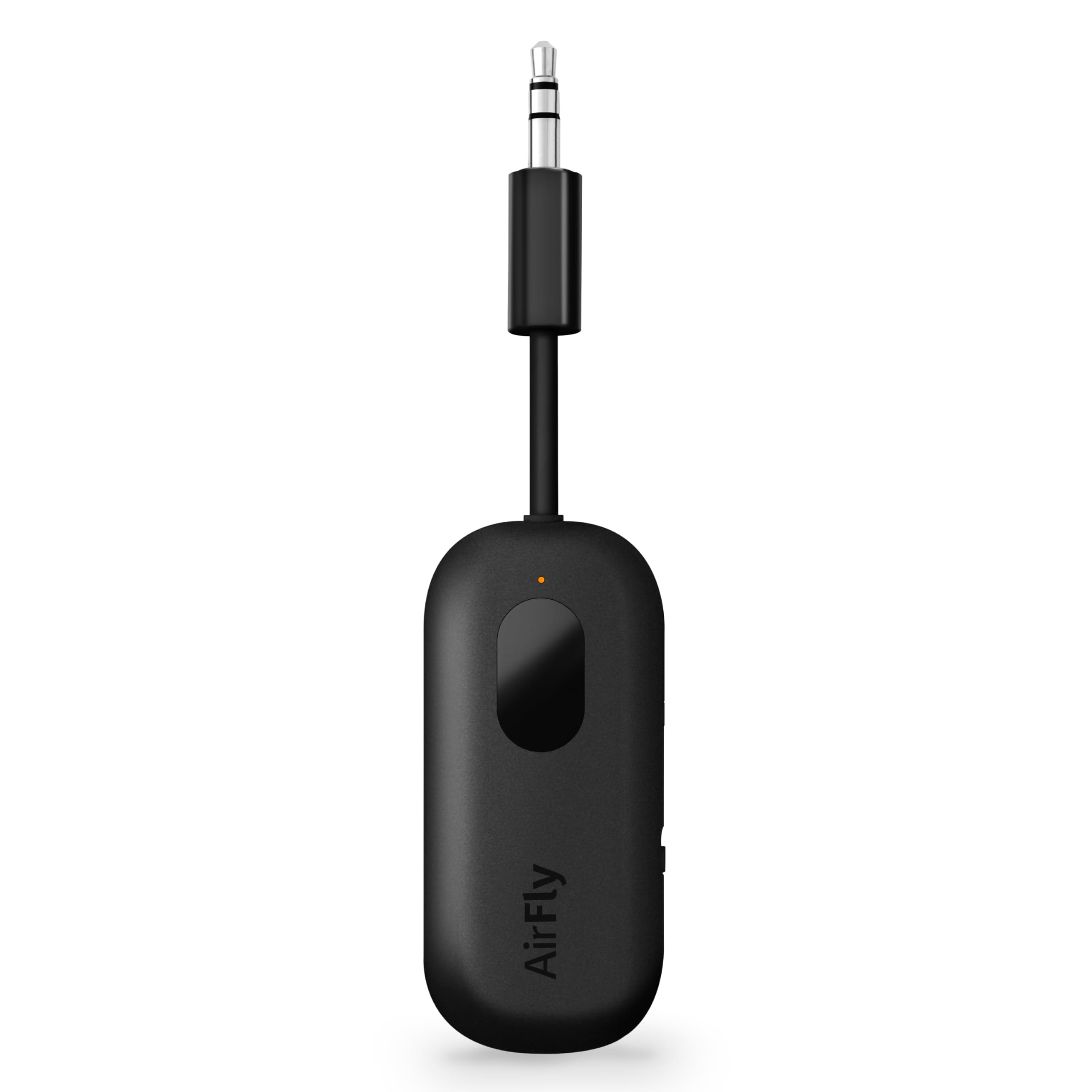
The two-way adapter that makes an old stereo or a plane seat wireless to your headphones.
Read the spec carefully: the AirFly Pro works in both directions. As a transmitter it takes audio from a 3.5mm jack — a seat-back screen, gym equipment, or a TV — and beams it to your wireless earbuds. As a receiver it does the reverse, sending your phone’s audio into a wired speaker or car input. That 3.5mm AUX plug is the whole interface, and it works on any device with that jack.
Battery is the standout: over 25 hours, and it can be used while charging over USB-C, so a long-haul flight barely dents it. Bluetooth 5.0 with aptX Low Latency, aptX, and SBC codecs keeps the audio close to what the source sends, and the 10m/33ft range lets you move around. The dual-link feature wires up two sets of headphones at once, which is the difference between sharing a movie and fighting over it. Even a vintage Pioneer stereo gets in on it — “Sound quality is very good too.”
Pairing is the fair warning. Getting it connected the first time takes a couple of tries for some people, and the trick is turning off nearby Bluetooth on your phone so the AirFly can grab the headphones cleanly. Lip-sync lag can show up on older in-flight systems, so match it to a source that supports Bluetooth 5.2 for the smoothest video.
The a neat extra that earns its keep
- Works as both transmitter and receiver on any 3.5mm jack
- 25+ hour battery that can charge while it plays over USB-C
- Pairs two headphone sets at once for shared listening
- aptX Low Latency keeps audio synced with video on supported gear
Things to plan for
- Initial pairing can take several attempts; switch off nearby phone Bluetooth first
- Some older seat-back systems show slight lag on video
- It needs an existing audio source — it adds wireless, it does not amplify
Worth it for: frequent flyers and anyone with a wired-only TV, gym machine, or stereo who wants their own earbuds in play.
Skip past if: you mainly need to power passive speakers — this adds wireless, it does not drive them.
4. 1Mii DS220 Bluetooth Receiver for Home Stereo

Hi-res wireless that plugs into a stereo you already love and stay out of its way.
This is the receiver for the person with a good amplifier already sitting in a rack. The 1Mii DS220 takes Bluetooth in and sends it out over optical or RCA, so it feeds your existing stereo’s own DAC or head unit. LDAC and aptX HD decoding capture more of the file than the basic codec, and a built-in audiophile DAC handles the analog path. Bluetooth 5.3 with dual antennas is rated to hold up to 100 feet.
The OLED display is the small thing that makes it easy to live with. It shows the codec, volume, and connection status at a glance, so you always know what format is actually streaming instead of guessing. Seven EQ modes cover Bass, Jazz, Classical, Rock, Pop and more, letting you nudge the sound for the track without touching the amplifier. Owners describe clean, reliable connections with no dropouts and use it as far as a large ballroom; a tablet in the living room becomes a streaming source across the house.
Two honest notes. There are no rubber feet in the box, so it can slide or scratch on a hard shelf — easy to fix with a couple of adhesive pads. And one owner lost a star because the USB input would not connect to an iPhone, though every other function was fine. Set it up with a wired source for that port rather than a phone.
One spec to lock in: LDAC and aptX HD over Bluetooth 5.3 with a 100-foot range — the sort of wireless quality that used to demand a cable run.
The trade-off: it treats your amplifier as the power source, so pair it with a receiver or powered speakers, not bare passive cabinets.
Fits your rack if: you want wireless into a hi-fi system and care about codec quality and seeing what is playing.
Cross this off if: you still need to supply amplification to passive speakers — the Fosi BT20A covers that job.
5. WiiM Pro Music Streamer

Steps past Bluetooth entirely and streams over your home network instead.
If you have Wi-Fi in the room, the WiiM Pro is a different class of upgrade. Where a Bluetooth receiver compresses the audio to make it fit through the air, the WiiM Pro streams over the network and handles up to 24-bit/192 kHz music on its digital and analog outputs. It also makes your old stereo an AirPlay 2 endpoint, so Apple devices around the house can target it directly.
What owners gravitate to is the control. Spotify Connect, TIDAL Connect, and casting from Amazon Music all pull the stream directly to the device, freeing your phone for other tasks — and giving more range and quality than a Bluetooth hop. Voice control covers Alexa, Google, and Siri, and multiroom groups let several WiiM units or smart speakers stay in lockstep. The system is Roon Ready, and Wi-Fi setup is often done in a few minutes.
Two real caveats separate it from a plug-and-play box. It runs on your home network, so a weak Wi-Fi signal means dropouts — several owners fixed it by wiring the unit to Ethernet or using a network extender. And the software is still maturing; input auto-switching and latency settings have glitched for some, though firmware updates keep arriving. If you want plug-and-play without app setup, a plain Bluetooth receiver here is the easier fit.
Where the upgrade shows up
- True 24-bit/192 kHz streaming instead of compressed Bluetooth
- AirPlay 2, Spotify Connect, TIDAL Connect, and Amazon Music casting on one box
- Multiroom grouping with other WiiM units and smart speakers
- Room correction and Roon readiness built into the app
The cost of the extra power
- Needs a stable home network; weak Wi-Fi causes dropouts, fixed with Ethernet
- Firmware is still evolving, so auto-switching can misbehave occasionally
- More setup and more knobs than a simple Bluetooth receiver
The clear win for: homes that already stream music through their phones and want higher quality plus multiroom control.
The obvious pass for: a single wireless input into a garage amp with no reliable Wi-Fi nearby.
6. Pyle PWPBT67 In-Wall Bluetooth Receiver

A receiver that lives in your wall and gives any hidden sound system a wireless front door.
The Pyle PWPBT67 is built for a different job than a shelf receiver. It mounts in the wall as two plates — one holding the AUX, USB ports, and rotary volume knob, the other holding the RCA connectors and an optional DC input. Bluetooth carries the audio up to 50 feet to the connected system, and it is powered over CAT6 cable so the supply can live at the head end. In a clubhouse paging system it streamed music and announcements cleanly from Android and iOS phones.
The dual USB ports are a genuine convenience for anyone streaming from a phone that needs keeping alive; they charge devices as the music plays. Touch buttons handle pairing, play/pause, and track skipping, and the rotary knob sets the level at the wall. Installation is quick, and the receiver automatically shuts off when no source is connected — a small thing that matters in a commercial room where you want the system to power down on its own.
Two things to know going in, both fixable. Grounding is the weak point: a buzzing or hum can appear when other amplifiers in the chain switch on, and the fix is a ground wire soldered to the RCA signal ground. A few heavy-duty years in, a rare unit has failed with a capacitor fault, so treat it as a normal-electronic lifespan risk rather than a forever part. Plan to use a deeper plastic outlet box — a large circuit board and thick metal mounting plate make a snug fit harder.
The install-ready angle: two wall plates and CAT6 power routing let you finish a room without a visible cable run, powered from a single hidden point.
The honest limit: this is an installer’s device — expect to troubleshoot ground hum and box depth rather than just plug it in.
Made for: a wall tucked beside a hidden amplifier in a clubhouse, kitchen island, or entertainment room you want cable-free.
Wrong tool for: a renter or someone who wants a desk-plug solution — that is the 1Mii DS220’s easier fit.
7. Pyle PDA99BU Streaming Amplifier
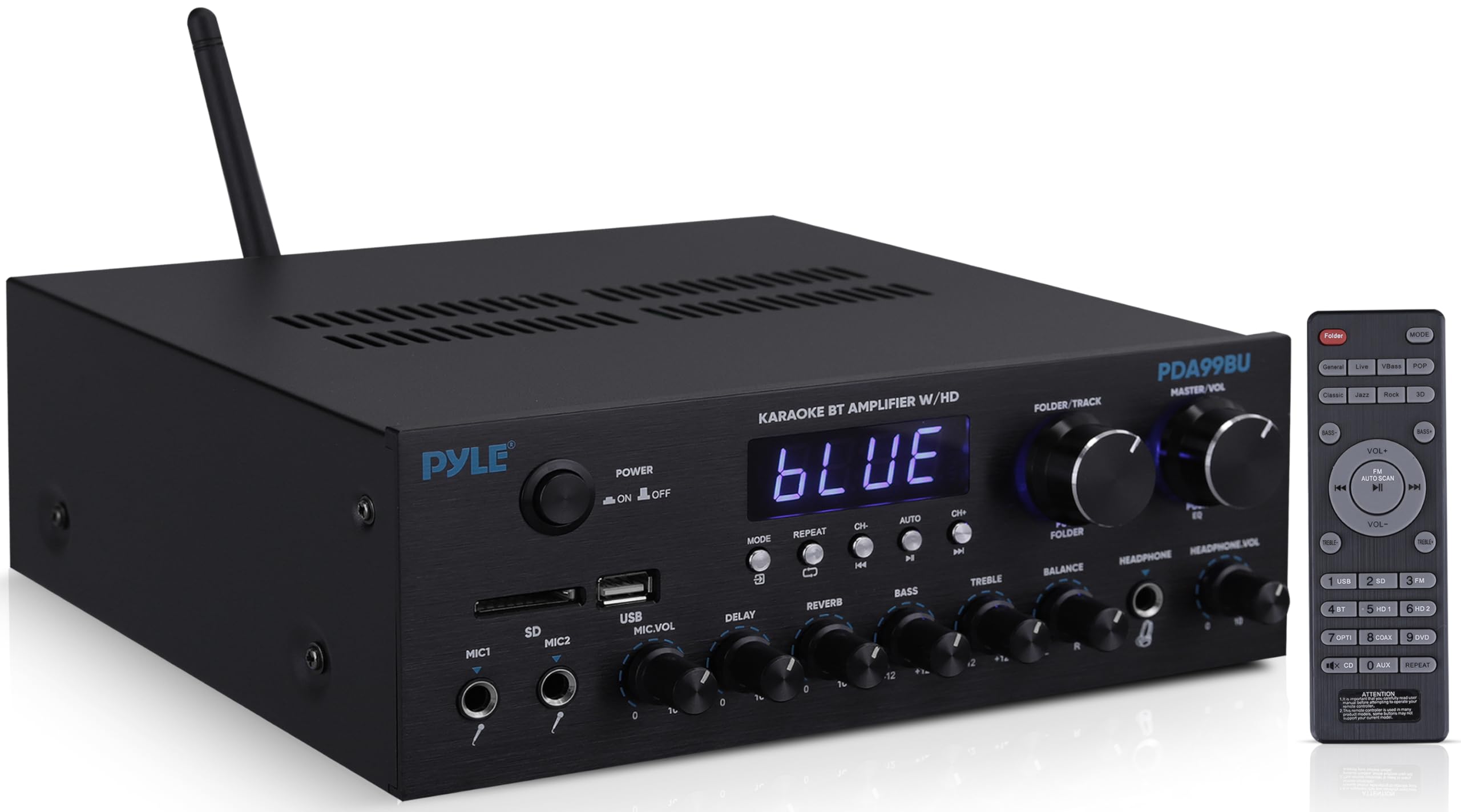
The one-box hub when you want Bluetooth, HDMI, USB, SD, and FM all in one panel.
The PDA99BU swings wide rather than deep. It puts 300W peak power and Class A/B amplification into a compact metal chassis measuring 10.2″ x 9.8″ x 2.8″, so it fits a shelf or an entertainment unit. Around that core it scatters every input a home theater could ask: two HDMI inputs and one HDMI output with 4K/3D support, 24-bit optical and coaxial digital decoding, Bluetooth, USB, SD card, FM radio, and dual 1/4″ mic inputs with echo for karaoke nights.
It runs on the cool side; owners note no fan noise after hours of use, and a 115/230V switch lets it travel. The front-panel headphone jack has its own volume control, so you can listen privately without disturbing the speakers and switch back without touching the main output. One feed reads: “For the cost it’s surprising the clear sound” — and it replaced an aging Sansui in a barn shop with no complaints.
Sound quality is the point of caution here, because it is the mixed note in the owner feedback. Some units deliver clean audio, while others report hiss or harsh bass and a loud Bluetooth connect signal. If clean two-channel audio matters more than input count, the 1Mii DS220 into your own amp is the safer pick. If you want HDMI, optical, USB, SD, and Bluetooth on one chassis, the PDA99BU covers all of them.
A jack-of-most-trades read: two HDMI inputs, 24-bit optical and coaxial decoding, Bluetooth, USB, and SD in one compact box is a lot of connectivity under one roof.
The sound you gamble on: clean performance shows up in the feedback, but so does hiss and a loud connect ping — check it early if pure audio is your main use.
Buy this for: a garage or second system where one box cables up a TV, a phone, and a mic and convenience beats audiophile purity.
Wait and see if: your ears demand the cleanest signal — a receiver into your own amp usually beats one do-it-all unit.
Know the Specs
Bluetooth codecs and what they carry
A codec is the compression rule your phone uses to squeeze music over Bluetooth. SBC is the universal baseline that every device supports. aptX and aptX HD carry more detail, and LDAC carries the most of the group. If a receiver lists LDAC or aptX HD, it can mean richer sound — but only when your phone sends that codec too. If it does not, the receiver falls back to a lower standard.
DAC resolution and why it matters
The DAC (digital-to-analog converter) is the chip that turns the digital stream into the analog signal your speakers play. Resolution is written as bit-depth over sample rate — the Xvive P3 lists 16-bit/48kHz, and the WiiM Pro runs up to 24-bit/192 kHz. Higher numbers generally mean more detail is preserved, especially with lossless sources. On a basic Bluetooth receiver, 16-bit is the norm and sounds fine for casual listening.
Amplifier power and speaker matching
A Bluetooth receiver only sends signal; an amplifier does the work of driving the speaker. The Fosi Audio BT20A lists 100Wx2 maximum output power, and the Pyle PDA99BU lists 300W peak. The practical rule: match the amp’s stated output to your speaker’s comfort range. Small bookshelf speakers do not need huge numbers, while larger cabinets want more headroom. An underpowered amp clips when pushed and can damage a tweeter faster than a slightly oversized one.
Range, connectors, and where the box lives
Range tells you how far you can move from the receiver before the sound stutters. Listed ranges here run from 33 feet to 100 feet, and line-of-sight beats walls and metal in every case. Connectors decide fit: XLR for PA and mixers, RCA or optical for home stereo, 3.5mm AUX for headphones and jacks, and speaker terminals for passive speakers. Pick XLR for a PA or mixer, RCA or optical for a home stereo, 3.5mm AUX for a headphone jack, and speaker terminals for passive cabinets.
Common Questions
Will a Bluetooth receiver work with my old passive speakers?
What is the difference between a Bluetooth receiver and a Bluetooth transmitter?
Does LDAC or aptX HD really sound better than standard Bluetooth?
Why does my Bluetooth receiver hum or buzz?
Can one Bluetooth receiver feed several speakers at once?
How long does the battery last on a portable unit?
Is a Wi-Fi streamer better than a Bluetooth receiver for home audio?
Can I use a Bluetooth receiver on a plane or in a car?
What connector do I need for a mixer or PA system?
The Bottom Line
For most people with a pair of passive speakers and no amplifier, the Fosi Audio BT20A is the one to buy — 100Wx2 of clean power, fast Bluetooth, and simple tone knobs in a box that fits on a shelf. If your amplifier already exists and you just want a wireless input, reach for the 1Mii DS220 and its LDAC plus OLED readout. And if you own Wi-Fi everywhere and want whole-home streaming, the WiiM Pro steps above Bluetooth entirely. Whichever you pick, decide first whether your speakers need amplification or just a wireless input — that choice, not the model, decides whether it works.
How we choose
We do not accept paid placement. Every pick is matched to a real buyer and a real use-case; we do not hands-on test units.
Sources
Specifications: manufacturer listings and product documentation. Review insights: verified customer reviews, as of October 2026. Pricing: not shown on this page (it changes often); check the current price via the retailer link.
As an Amazon Associate, Aappliancez earns from qualifying purchases. This does not affect which products we feature.