Disclosure: Some links in this post are affiliate links. As an Amazon Associate I earn from qualifying purchases, at no extra cost to you. Learn more
Specs are compiled from manufacturer listings and verified buyer reviews and can change over time — please confirm the key details on the product page before buying.
If you want one answer fast: the Cardo Packtalk Helmet Kit is the safest bet for most riders, and the Cardo Spirit is the best fit if you only ever ride with one other person. Everything below sorts out who should buy which headset, without the spec-sheet fog.
This guide is built by comparing the manufacturers’ published specifications and the patterns across verified customer reviews, so you get each pick’s real strengths and trade-offs instead of marketing spin.
The quick comparison table, plain-English spec breakdowns, and real owner patterns will help you land a bluetooth intercom for helmet without guesswork.
Top Picks

How To Choose The Best Bluetooth Intercom for Helmet
The headset you regret buying pairs fine in the garage, then dissolves into wind noise at 70 mph. Four things decide whether you keep it — how it connects, how many people it connects, how it mounts, and how it survives weather.
Mesh versus Bluetooth pairing
Bluetooth intercom pairs one headset directly to another, which is ideal for a two-up ride or a single riding partner. Mesh networking (a system where each headset acts as a relay for the others) is built for groups, because riders can drop out of range and rejoin without anyone stopping to re-pair. If your Sunday ride is you and one friend, Bluetooth is simpler and cheaper. If it is five bikes and a sweep rider, you want mesh.
Speaker size and thickness
The driver (the round speaker element that produces the sound) is usually 32mm to 40mm. Bigger drivers generally move more air in the low end, while thinner housings matter just as much — a slimmer speaker sits flatter in your helmet, so your ears are not pressed all day on a long tour.
Water and dust resistance
An IP rating is two digits: the first covers dust, the second covers water. IP67 means full dust protection and surviving a rain soak. IP65 means protected from dust and from water spray. Both are fine for a commuter; IP67 is the one you want if you ride through anything.
Helmet type and microphone choice
Full-face helmets pair best with a button mic (a microphone that sticks inside the chin bar), while open-face and modular helmets need a boom mic (a microphone on a flexible stalk that reaches your mouth). Several units in this list ship with both, so check before you decide your helmet is the problem.
Side-by-Side Comparison
| Model | Best For | Bluetooth Version | Intercom Reach | Riders Per Group | Amazon |
|---|---|---|---|---|---|
| Cardo Unisex Adult Packtalk Helmet KIT★ Best Overall | Multi-helmet owners who want mesh range | 5.2 | — | Mesh & Bluetooth | Amazon |
| JESIMAIK Motorcycle Bluetooth Headset 2-WayBest Value | Budget two-up riders who want music sharing | 5.1 | 1500m | 2 | Amazon |
| Fodsports FX-S Motorcycle Bluetooth Headset V5.4 | Front-of-pack clarity for a two-person pair | 5.4 | 1000m | 2 | Amazon |
| JESIMAIK 10-Rider Mesh Anti-Theft Magnet Mount | Group tours where you park in public | 5.2 | — | 10 | Amazon |
| Cardo Systems Spirit | One-partner rides with universal brand pairing | 5 | — | 2 | Amazon |
| Fodsports FX4 Pro | Small groups plus FM radio on long days | 5 | 1000m | 4 | Amazon |
| Sena 5S | Dial-control simplicity with a status screen | 5 | — | 2 | Amazon |
Detailed Reviews
1. Cardo Unisex Adult Packtalk Helmet KIT
Our pick — 4.5+★ from 950+ verified ratings; the strongest balance of quality and price.
The second-helmet kit that finally makes your spare lid worth owning.
If you own more than one helmet, this is the pick that ends the swap-everything-over routine. It runs dual core technologies — DMC mesh plus Bluetooth — so you are covered whether you are riding solo, talking to one partner, or holding a group together. The 40mm JBL interchangeable speakers carry the audio, and the whole unit is rated IP67, which means rain, dust, and mud are simply not a problem.
Talk time is the number that matters: 13 hours of operation with one week of standby from the 850mAh battery. Pair two phones at once, stream parallel audio, trigger the natural voice operation without taking a hand off the bar, and swap between the hybrid corded boom and wired microphones depending on your helmet. Buyers report an intercom range beyond a mile in real riding.
The catch is fit, not performance. The high-density helmet rim on some lids is too thick for the clip, so a stick-on mount is the answer; sound also rewards patience, because the speakers need to sit directly over your ears or you lose the bottom end. An LS2 Advant X Forged Carbon goes on cleanly with the adhesive route.
Where it earns its keep
- Mesh plus Bluetooth in one unit means small groups and one-to-one calls both work.
- IP67 sealing stands up to rain, dust, and mud without a cover.
- 13 hours of talk time and a week of standby cover a full touring day.
- Interchangeable boom and wired mics suit several helmet styles.
Worth knowing before you buy
- Thick helmet rims may need the stick-on mount instead of the clip.
- Speaker placement is fussy — sound drops sharply if they drift off your ears.
- The 40mm drivers are the base setup; riders chasing deeper bass look at larger speakers separately.
Settle on this if: you keep two or more helmets in rotation and want one system that moves between them.
Think twice if: you ride solo with a phone and rarely talk to anyone — the dual-core cleverness is wasted on you.
2. JESIMAIK Motorcycle Bluetooth Headset
Big claimed range, slim speakers, and two riders sharing one song.
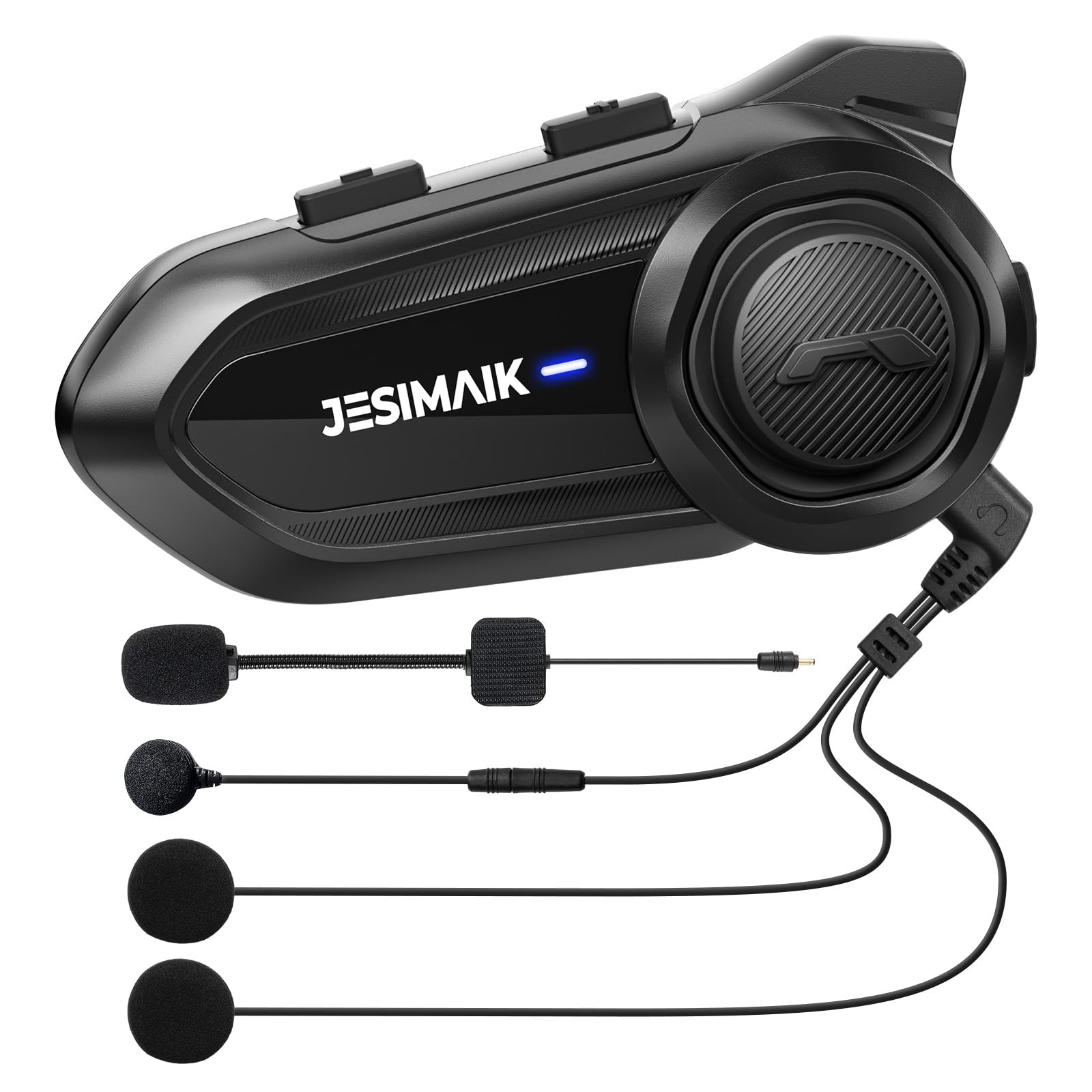
Here is the headline a touring pair notices first: a maximum 1500m communication range in open areas, paired with the Qualcomm Bluetooth 5.1 chip for a steadier signal and lower latency. For context, this is a step behind the Fodsports FX-S on the wireless standard itself — 5.1 versus 5.4 — but it reaches further on paper. The speakers are 7mm ultra-thin with a 40mm dynamic driver, which is the slimmer construction that spares your ears inside a snug shell.
Noise handling is the other draw. Five layers of reduction — ENC2.0, DSP and CVC8.0 among them — claim to cut up to 90% of wind and engine roar. Four EQ modes (Standard, Bass, Rock, Pop) let you color the sound your way. Two riders can share the same track, and there is FM radio for the solo stretches. Big anti-slip buttons mean gloved hands can find them without looking down.
Be realistic about the sound at the top end: the feedback on clarity is genuinely split, and riders who push volume to the ceiling report distortion. It also does not run intercom and music at the same time, so you switch between them rather than blending. The battery stands up well under load — as owners mention, “Battery good (3hr full blast still 100%).”
Big draws
- 1500m maximum open-area range reaches further than most in this list.
- 7mm ultra-thin speakers cut ear pressure under a tight helmet.
- Music sharing lets two riders hear the same track.
- Four sound modes plus FM radio cover solo and paired rides.
Honest trade-offs
- Sound quality divides opinion — clear for some, distorting at high volume for others.
- Intercom and music cannot run together.
- Bluetooth 5.1 is a generation behind the newest chips here.
Made for: two-up riders and couples who want range and music sharing without paying premium-tier money.
Pass on it if: you expect reference-grade audio or need a group of four to stay together.
3. Fodsports FX-S Motorcycle Bluetooth Headset V5.4
The newest wireless standard here, and a two-rider pair built for clear calls.
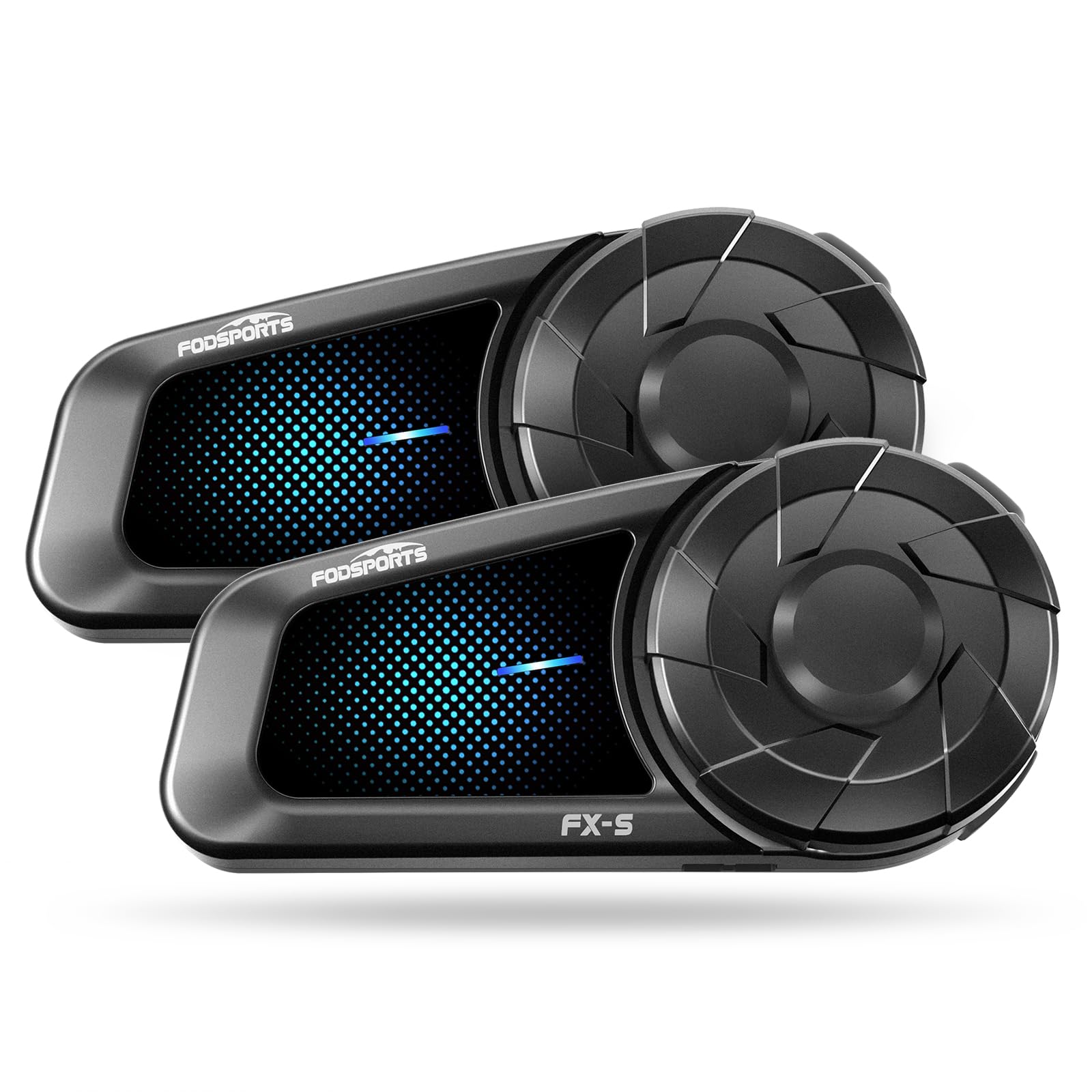
On the wireless standard, the FX-S sits ahead of the field: Bluetooth 5.4 against the JESIMAIK 2-way unit’s 5.1. That is the chip inside that decides how quickly and how stably your headset locks onto a partner or your phone. Two riders get clear calls and music out to a claimed 1000m, and the 40mm by 9mm Hi-Fi speakers are shaped to drop into a helmet without pressing on your ears.
Calls are where this one earns its reputation. The CVC and DSP noise cancellation strips out engine and wind clutter, and customers note call clarity is excellent at cutting engine noise and wind, with the intercom holding to roughly 200+ yards in real conditions. Two phones can be connected at once, there is one-touch voice assistant access, and USB-C fast charging lets you power it as you ride.
It is also the lightest in this comparison at 0.08 pounds, which sounds small until you have felt a heavier unit swinging off your helmet all afternoon. Two mic types come in the box, one for full-face and one for open-face lids. The trade-off: intercom caps at two riders, and the speakers lean toward the high frequencies, so some riders tame the top end with earplugs.
Reasons it climbs the list
- Bluetooth 5.4 leads the units here on the wireless standard.
- Call clarity is the standout — engine and wind noise handled well.
- USB-C fast charging supports use while charging.
- 0.08 pounds keeps it barely noticeable on the helmet.
What to weigh first
- Two riders only — there is no group mesh here.
- High-frequency focus can sound thin with some helmets.
- You cannot run music and intercom together on every mode.
Go here if: clear phone calls and a modern chip matter more to you than group mesh.
Keep looking if: four bikes or more need to stay in one conversation.
4. JESIMAIK Motorcycle Helmet Bluetooth Intercom, 10-Rider Mesh
A one-second magnetic release built for riders who park in public.
A ten-rider group is the number that sets this apart — one click connects up to 10 riders through the QIK-MESH 2.0 network, and it reconnects steadily when someone drifts out of range. That mesh approach is the reason a group ride stops turning into a parking-lot pairing session. It runs Qualcomm Bluetooth 5.2 and pairs with most mainstream third-party helmet intercoms, so your riding partners do not all need the same brand.
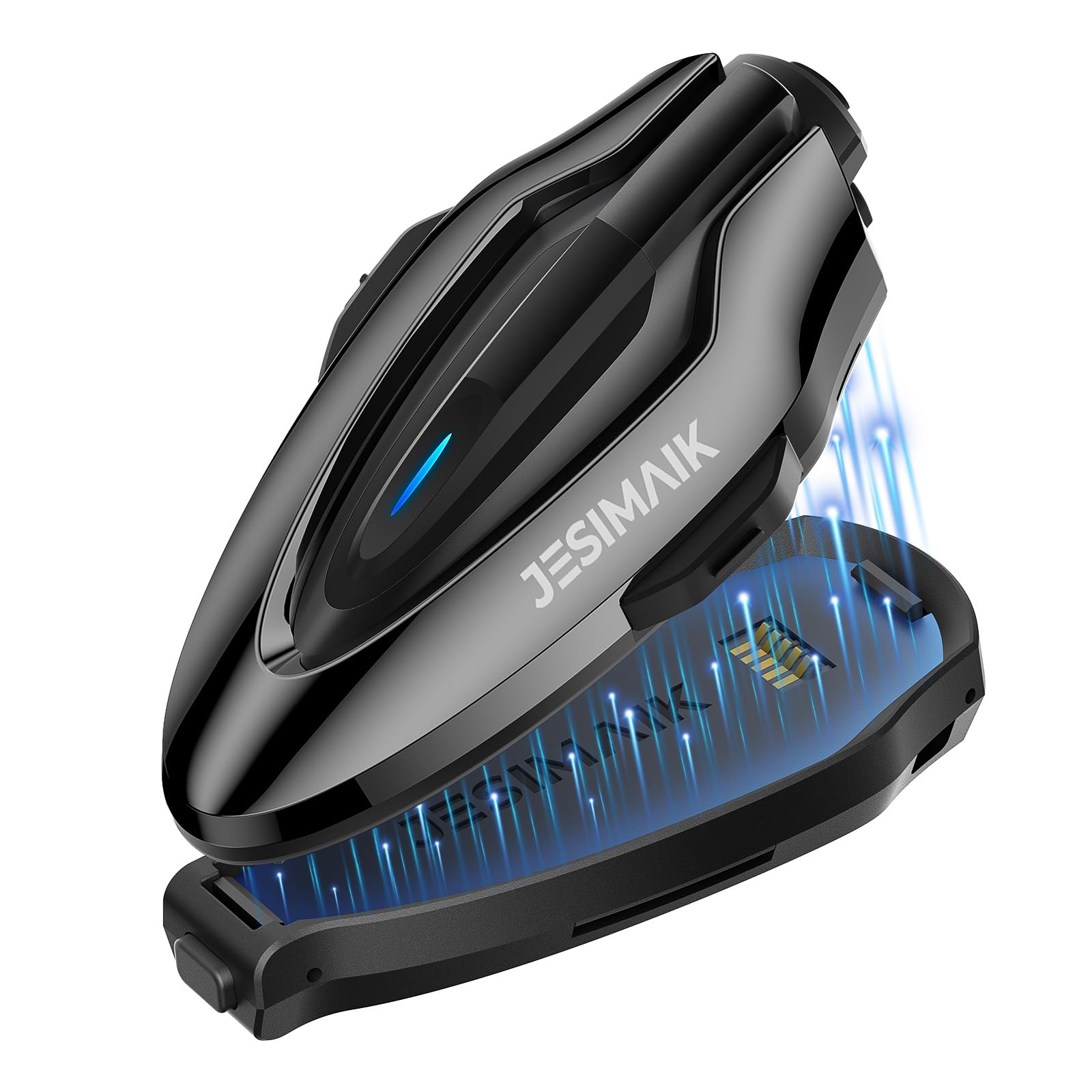
The magnetic mount is the feature you will actually use. The heavy-duty magnetic mount releases the main unit in about a second, so you can carry it with you instead of leaving it clipped to a helmet in a public lot. It clamps onto full-face, modular, half-face and open-face shells. The audio side runs 8mm ultra-thin speakers with a 40mm neodymium driver and PET diaphragm, four EQ modes, and a seven-layer stack claiming to block 95% of wind and engine noise.
Power is generous for the money: the 900mAh battery covers 23 hours of intercom time, 25 hours of music, and 450 hours of standby, with a full Type-C charge in an hour. IP67 keeps it working through rain and road spray. Dual Qualcomm chips handle GPS or FM radio without cutting into a group call.
The standout: 8mm speakers are built to be slimmer than ordinary designs, which is a real comfort gain across a full day in the saddle.
Fit note: the magnetic mount is the whole point here — if you rarely leave your helmet unattended, you are paying for a feature you will not use.
Reach for this if: you ride in large groups, park in busy lots, and switch helmets between bikes.
Look elsewhere if: it is just you and one buddy on quiet back roads.
5. Cardo Systems Spirit Motorcycle Bluetooth Headset
The easiest way into the Cardo family, and it talks to almost anything.
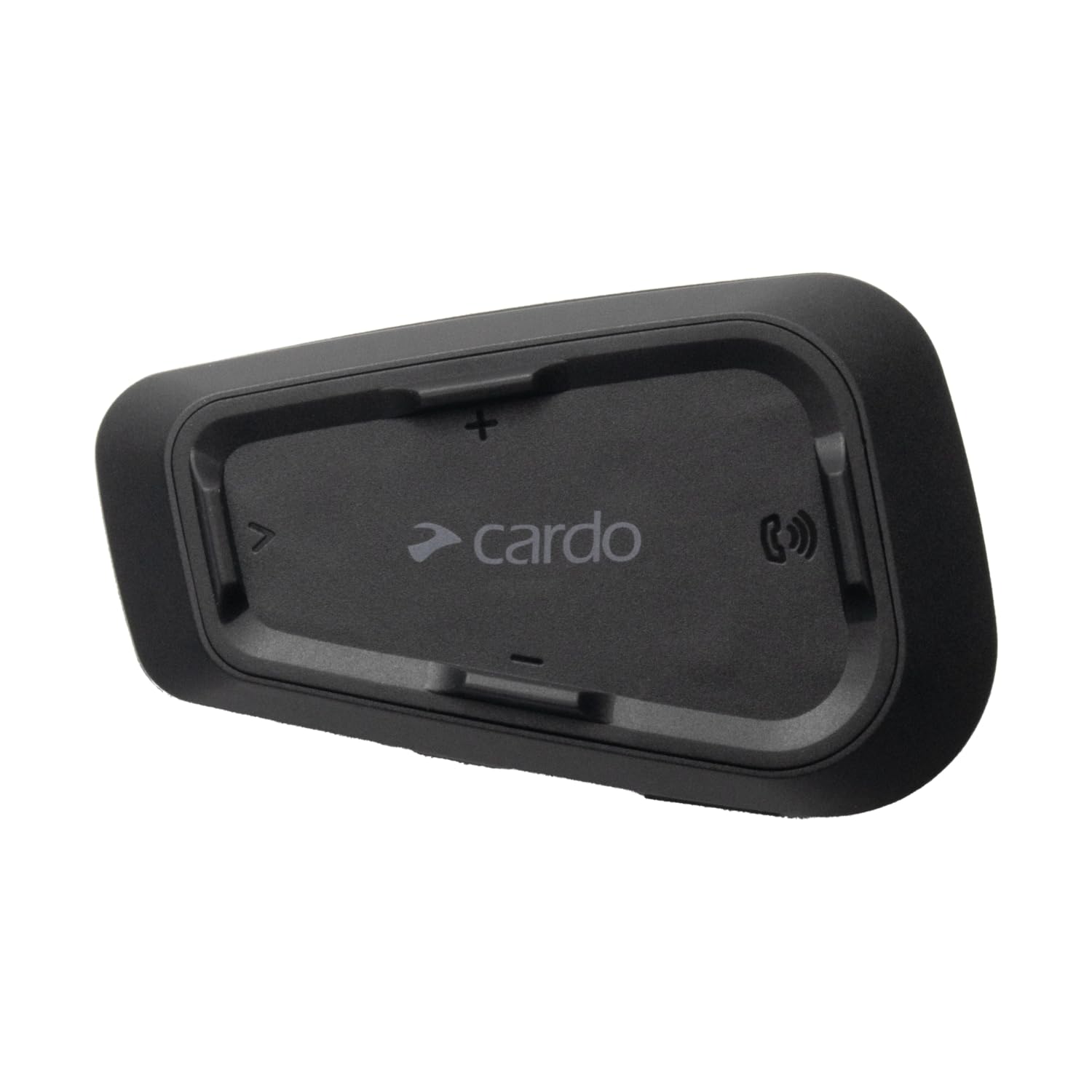
If your riding partner owns a completely different brand of headset, this is the one that does not care. The Spirit connects with any other Bluetooth headset of any brand, which removes the single most annoying problem in this category before it starts. Updating is handled over the air through the Cardo Connect app, so you get new firmware without hunting for a cable.
Audio comes through 32mm speakers with a dynamic driver. Battery life runs 10 hours with a 2-hour charge time, and the feedback holds up: riders report more than 50% left after a 5-hour ride. The speaker size is where it deliberately sits below this list’s front runners — 32mm against the 40mm drivers on the Packtalk and several Fodsports units.
Controls suit gloved hands, and it is loud enough to be heard clearly well up into the speed range; some riders notice distortion pushing past 85 mph. The honest limit is grouping: natively it intercoms with one other Cardo, and you need an upgrade for more. Music drains the battery faster than talk, and communication or directions run for hours.
Why riders keep this one: the universal pairing and over-the-air updates make it forgiving, and the waterproof build takes rain, mud, and dust without a fuss.
Where it stops: two riders, one partner, no mesh — this is a personal-communication unit, not a group system.
Pick this one if: you want to talk to one partner and pair with whatever brand they happen to be running.
skip it if: you already know your crew rides four or more strong and expects to stay linked.
6. Fodsports FX4 Pro Motorcycle Bluetooth Headset
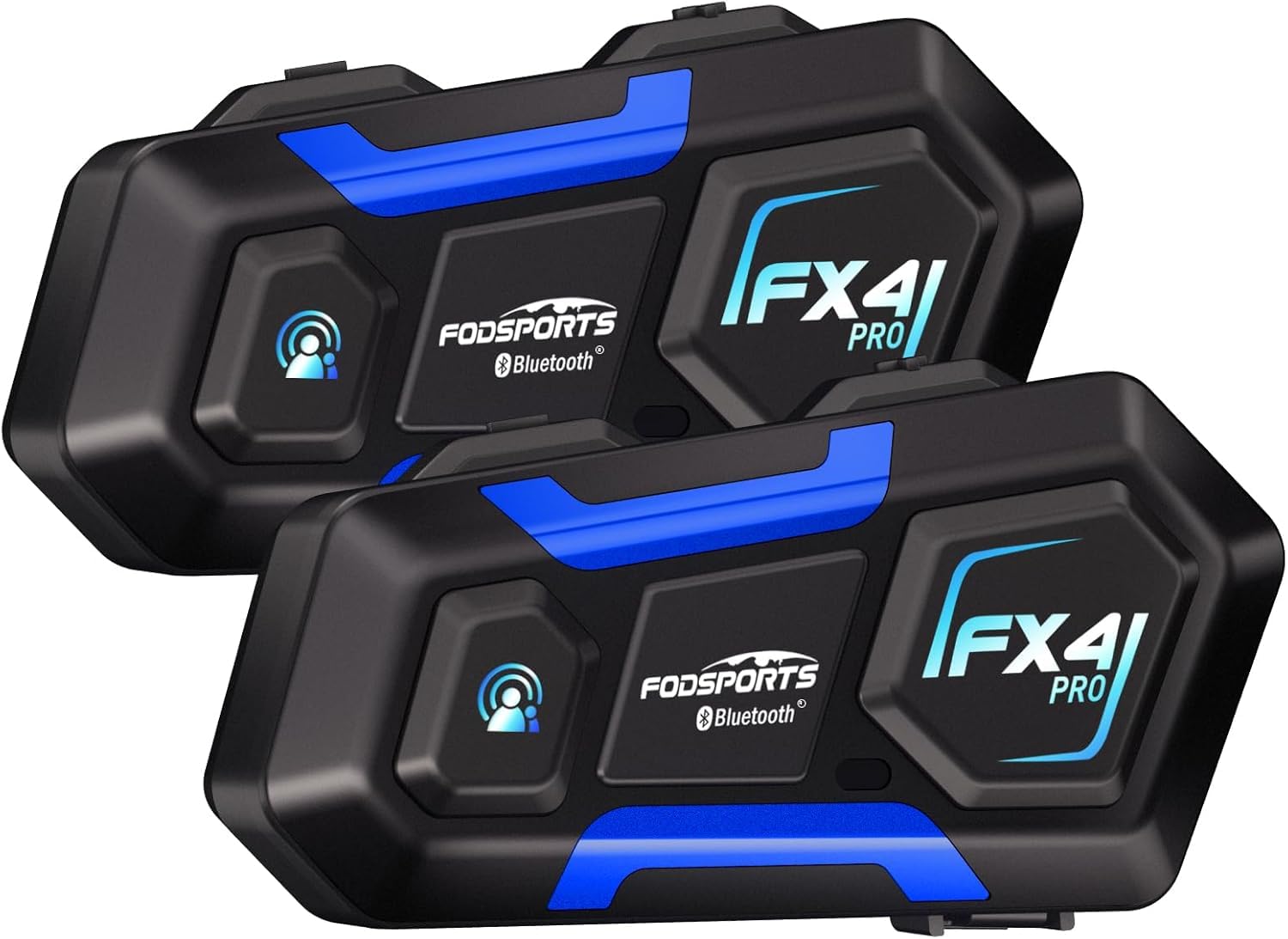
Four riders, a full FM dial, and speakers that punch above the price.
Four riders in one conversation over a claimed 1000m is the core offer, and the 40mm by 9mm Hi-Fi speakers backed by CVC noise reduction are what make that conversation worth having. The microphone actively suppresses wind and road noise, so a group rolling at highway speed can still hear each other clearly. For the two-pack buyer, that is the practical difference between chatter and yelling.
The FM chip is the sleeper feature: it covers the full 76–108 MHz band with European and Japanese frequency options, plus voice assistant access for hands-free calls, music, and GPS. Automatic call answering kicks in within 12 seconds, and the button layout is labeled clearly enough to work with gloves on.
Battery is the touring answer: up to 15 hours of music, 12 hours of talk time, and over a week on standby from a dual battery, charged in 3 hours. IP65 covers dust and water spray, and it runs Bluetooth 5. The clear caveat is the charging port — it still uses Micro-USB rather than USB-C, and riders describe the connector as fragile. Pairing four units also tests patience compared with two or three.
Why it stands out
- 4-way intercom out to a claimed 1000m handles small groups.
- 40mm speakers with CVC noise reduction deliver rich stereo audio.
- Full 76–108 MHz FM band with European and Japanese tuning options.
- Dual battery covers 15 hours of music and 12 hours of talk time.
Honest limits
- Still Micro-USB, not USB-C — the connector feels delicate.
- Pairing four units is harder than pairing two or three.
- IP65 spray resistance, not a full IP67 soak rating.
Best for: four-rider crews who want music, radio, and voice control across long touring days.
Not for you if: you insist on USB-C or you ride alone with one Bluetooth connection.
7. Sena 5S Motorcycle Bluetooth Communication System, Dual Pack
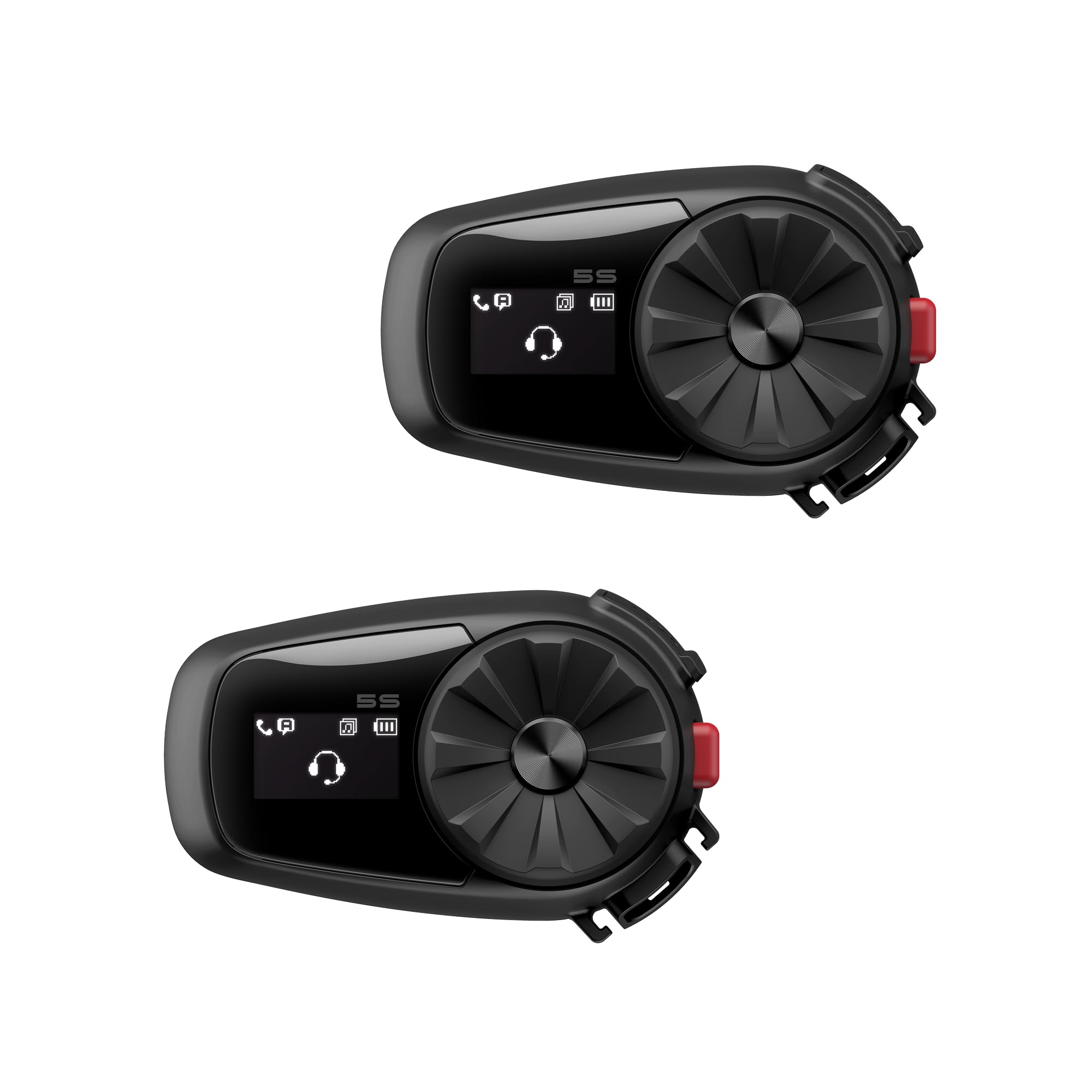
A small screen and a jog dial make this the simple one to live with.
Most helmet headsets ask you to memorize button patterns. This one shows you. The built-in LCD screen displays battery life, radio frequency, and volume level, so you are never guessing at your charge or your station mid-ride. Volume is handled by a jog dial rather than a button combination, and that is the detail riders keep returning to.
Pair it to your phone for music, GPS navigation, and calls, and pair with another nearby 5S user for intercom. The HD speakers are tuned for a bump in volume, bass, and clarity, and the whole kit arrives complete — main unit, clamp, glued mounting plate, speakers, boom and wired microphones, USB-C power and data cable, and speaker pads. Clamp kit plus boom microphone keeps setup straightforward.
Reality check on the battery: plenty of riders get a full day, while others find it dying after several hours. Two-up use also carries a switching delay when you jump into intercom, which is worth knowing if you ride tight. The dial is the reason it stays in the conversation despite the price tag.
What earns it a spot: the LCD screen and jog dial remove the guesswork that trips up gloved riders on other systems.
The caveat: USB-C charging requires you to pull the auxiliary cable first, which adds a step to every charge cycle.
Choose this for: a clean, screen-guided experience where you would rather see your status than memorize button combos.
Weigh it against: budget pairs that cover two riders for far less, or a unit rated IP67 if you ride through weather often.
Know the Specs
Bluetooth Version
The version number tells you which generation of the wireless standard the headset runs, and it matters because newer chips generally hold a signal more steadily and pair faster. In this list, versions run from 5 up to 5.4. Higher is not the whole story — antenna design and chip quality decide real-world range just as much — but Bluetooth 5.4 sets the modern baseline.
Intercom Reach
This is the maximum distance two headsets can talk over open ground, and the honest caveat is that open ground is rare. Trees, hills, and traffic all cut the number down, which is why riders frequently report usable range below the claimed figure. Treat the rating as a ceiling, not a promise.
Battery Hours
Talk time is the number most riders underestimate. Music playback drains far faster than intercom, and a claimed 10 hours of talk time can mean only a few hours if you are streaming the whole ride. Look at talk time, music time, and standby separately before you judge a unit’s endurance.
Speaker Drivers
Driver size runs these units between 32mm and 40mm. Larger drivers tend to deliver more low end, and thinner housings press less on your ears inside a tight helmet. If long rides leave your ears sore, the 7mm and 8mm designs on this list are the ones worth prioritizing.
Common Questions
Can a Bluetooth intercom work with a helmet it was not designed for?
How many riders can one helmet intercom talk to at once?
Does the intercom drain the battery faster than music?
Is an IP67 intercom better than an IP65 one?
Will a Bluetooth headset reduce wind noise on a call?
Can I install one without modifying my helmet?
Do I need USB-C charging or is the older port fine?
Can two riders listen to the same song through the intercom?
What is the difference between mesh and plain Bluetooth intercom?
Can I charge the headset while riding to extend a long trip?
The Bottom Line
For most riders, the bluetooth intercom for helmet winner is the Cardo Packtalk Helmet Kit because it handles mesh and Bluetooth in one unit, runs on IP67 sealing, and moves between helmets without swapping hardware. If you only ever ride with one partner and value universal pairing, grab the Cardo Systems Spirit. And for large group tours where you park in public lots, the JESIMAIK Mesh unit is the one to reach for. Whichever you choose, match the intercom to how many people you ride with.
How we choose
We do not accept paid placement. Every pick is matched to a real buyer and a real use-case; we do not hands-on test units.
Sources
Specifications: manufacturer listings and product documentation. Review insights: verified customer reviews, as of October 2026. Pricing: not shown on this page (it changes often); check the current price via the retailer link.
As an Amazon Associate, Aappliancez earns from qualifying purchases. This does not affect which products we feature.