Disclosure: Some links in this post are affiliate links. As an Amazon Associate I earn from qualifying purchases, at no extra cost to you. Learn more
Specs are compiled from manufacturer listings and verified buyer reviews and can change over time — please confirm the key details on the product page before buying.
You want a blood pressure cuff that takes the reading once and files it away on your phone without you writing anything down. The picks below all do it, but they split into two camps: monitors that live on their own screen with an app as a backup, and monitors that lean on an app to make sense of your numbers. Which camp suits you depends on whether you track for yourself or hand reports to a doctor.
This guide is built by comparing the manufacturers’ published specifications and the patterns across verified customer reviews, so you get each pick’s real strengths and trade-offs instead of marketing spin.
Cuff fit, phone sync, and who reads the numbers decide whether a monitor stays in your routine. This guide sorts the bluetooth blood pressure monitor field by exactly those three, so you buy once.
Top Picks
How To Choose The Best Bluetooth Blood Pressure Monitor
Measure your arm before you compare apps. A cuff that is too small or too loose gives you a number you cannot trust, and no amount of phone sync fixes that. Measure your upper arm circumference once with a soft tape before you shop.
Cuff fit sets the ceiling on accuracy
Most upper-arm cuffs here cover a wide band. The iHealth cuff spans 8.7″–16.5″, the A&D cuff spans 8.6″–16.5″, the Omron cuff fits arms 9″–17″, and the Garmin cuff fits 9″–17″. The AQESO kit goes wider by shipping three cuffs covering 7″ to 21″. If your arm sits near the top or bottom edge of a single-cuff range, a multi-cuff or modular-cuff option is the safer buy.
What Bluetooth actually buys you
Bluetooth lets the monitor push each reading into a phone app with a timestamp, so your history builds itself. That matters when a doctor asks what your numbers looked like over the last month, not just this morning. Apps here track trends over windows like 3, 7, and 30 days, or build 7-day, 4-week and 1-year reports.
Battery or plug-in power
AA and AAA batteries make a monitor portable. Rechargeable lithium-ion means no battery drawer to raid. The Greater Goods unit runs on a rechargeable battery, the Withings charges and, per its maker, holds charge up to 6 months, and the Garmin runs on 4 AAA batteries with up to 9 months stated life. The AQESO accepts AAA batteries or a USB Type-C cable, but it is not rechargeable — on USB it needs a continuous connection.
Shared households and memory
If more than one person uses the cuff, check user profiles and stored readings. The AQESO supports up to 3 users with 500 readings each. The Garmin lets up to 16 users sync their own Garmin Connect accounts. The Greater Goods unit is built for two users.
Side-by-Side Comparison
| Model | Best For | Cuff Range | Power | Users / Memory | Amazon |
|---|---|---|---|---|---|
| iHealth Track★ Best Overall | Everyday home tracking | 8.7″–16.5″ | 4 AAA batteries | 99 readings on device | Amazon |
| A&D Medical UA-1040TBLEBest for Low Vision | Voice-guided and low-vision use | 8.6″–16.5″ | 4 AA batteries, AC adapter optional | Unlimited in Heart Track app | Amazon |
| Greater Goods Bluetooth | Travel and on-the-go checks | Not stated | Rechargeable lithium-ion | 2 users | Amazon |
| AQESO 3-Cuff | Families and hard-to-fit arms | 7″–21″ | 4 AAA or USB Type-C | 3 users × 500 readings | Amazon |
| Omron Gold | Irregular-rhythm screening | 9″–17″ | 4 AA batteries | 2 users | Amazon |
| Withings BPM Connect | Wi-Fi auto-sync | 22–42 cm | Rechargeable battery | Unlimited in Health Mate app | Amazon |
| Garmin Index BPM | Garmin Connect users | 9″–17″ | 4 AAA batteries | Up to 16 users | Amazon |
Detailed Reviews
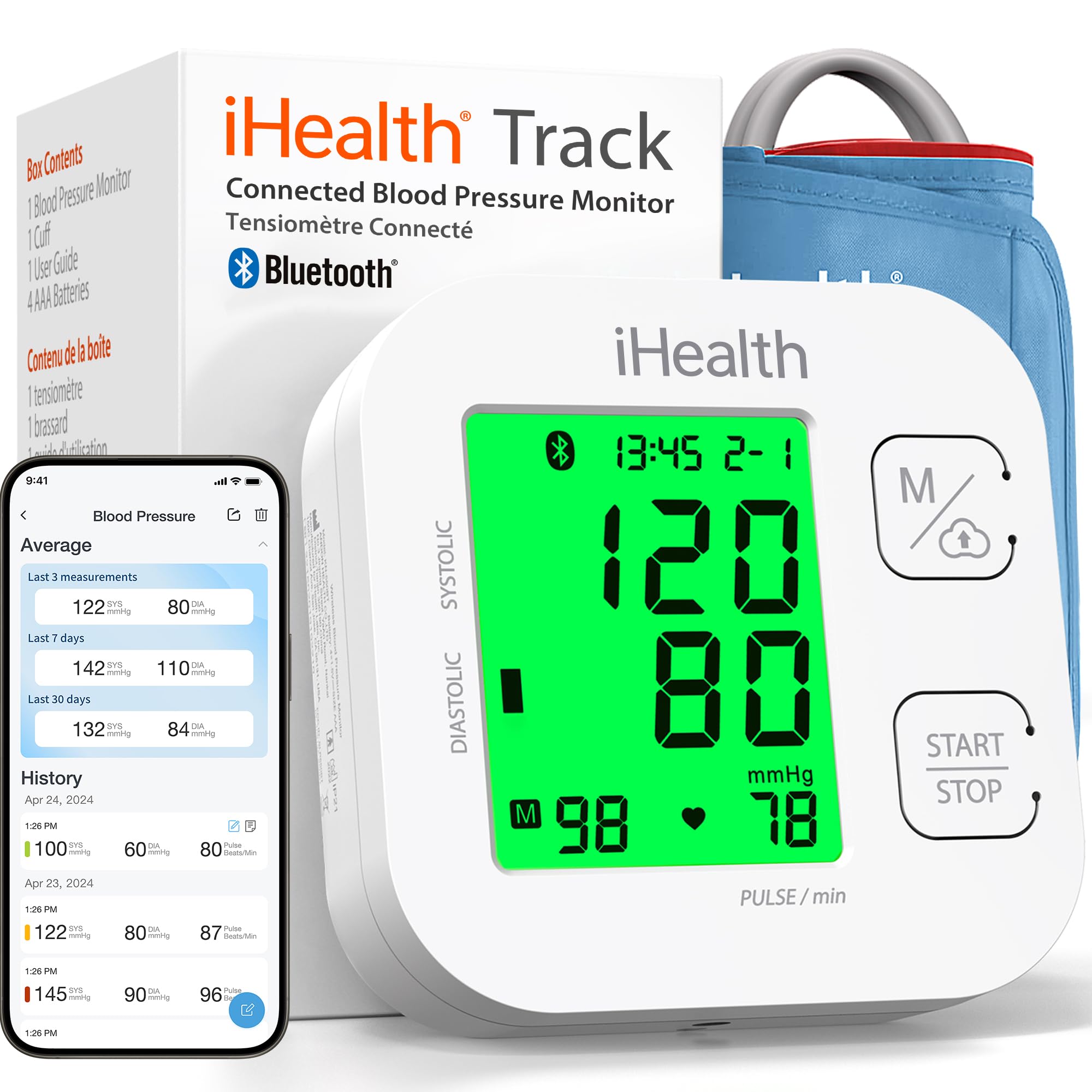
1. iHealth Track Blood Pressure Monitor
Our pick — 4.0+★ from 68,500+ verified ratings; the strongest balance of quality and price.
Two buttons, a colour-coded screen, and a cuff that covers most adult arms without a special order.
The iHealth Track earns the top spot for one plain reason: it works as a standalone monitor and as a Bluetooth gadget. You get a cuff that fits upper arms from 8.7″ to 16.5″ (22–42 cm), so most people never need to buy a second band. Press two buttons and the oversized backlit numbers appear, colour-coded green, yellow or red so you can read the result at a glance instead of squinting at a manual chart.
Where it pulls ahead of the Omron Gold is size and weight: the iHealth Track sits at 15.45 oz and 3.9 x 3.9 x 1.6 inches, against the Omron’s 1.37 lb and 7.5 x 4.6 x 3.3 inches. It is the smaller unit to stash in a drawer. The device holds 99 readings on board, and the free iHealth app keeps unlimited readings on your phone with trend views over 3, 7 and 30 days. It also flags heart rhythm disturbances with a warning symbol after a reading, and it meets ESH 2010 performance standards.
The honest caveat is speed and the odd flier. A full measurement can run around 60 seconds, which feels long when you are holding still. Now and then a reading looks off — the kind of number you retake and get a normal result from. Set your cuff and arm position properly and that mostly disappears. The other thing to know: the app needs Bluetooth 4.0 and up, plus iOS 12.0 or Android 9.0 or later, so check your phone before you count on syncing.
What earns it first place
- Cuff covers 8.7″–16.5″, so you likely skip a separate band purchase
- Colour-coded green/yellow/red display cuts out the chart-checking step
- 99 readings on device plus unlimited app storage with 3/7/30-day trends
- Light and compact next to the Omron Gold, and it runs on included 4 AAA batteries
Where it asks patience
- Measurements can take about 60 seconds — you must hold still that long
- Needs Bluetooth 4.0 and a recent iOS or Android build to sync
- An occasional odd reading means retaking for a clean number
Go for it if: you want one cuff that fits the household and a screen you can read without your glasses, with app history as a bonus.
Think twice if: your phone is older than iOS 12.0 or Android 9.0, since the app sync is the part you would be paying attention for.
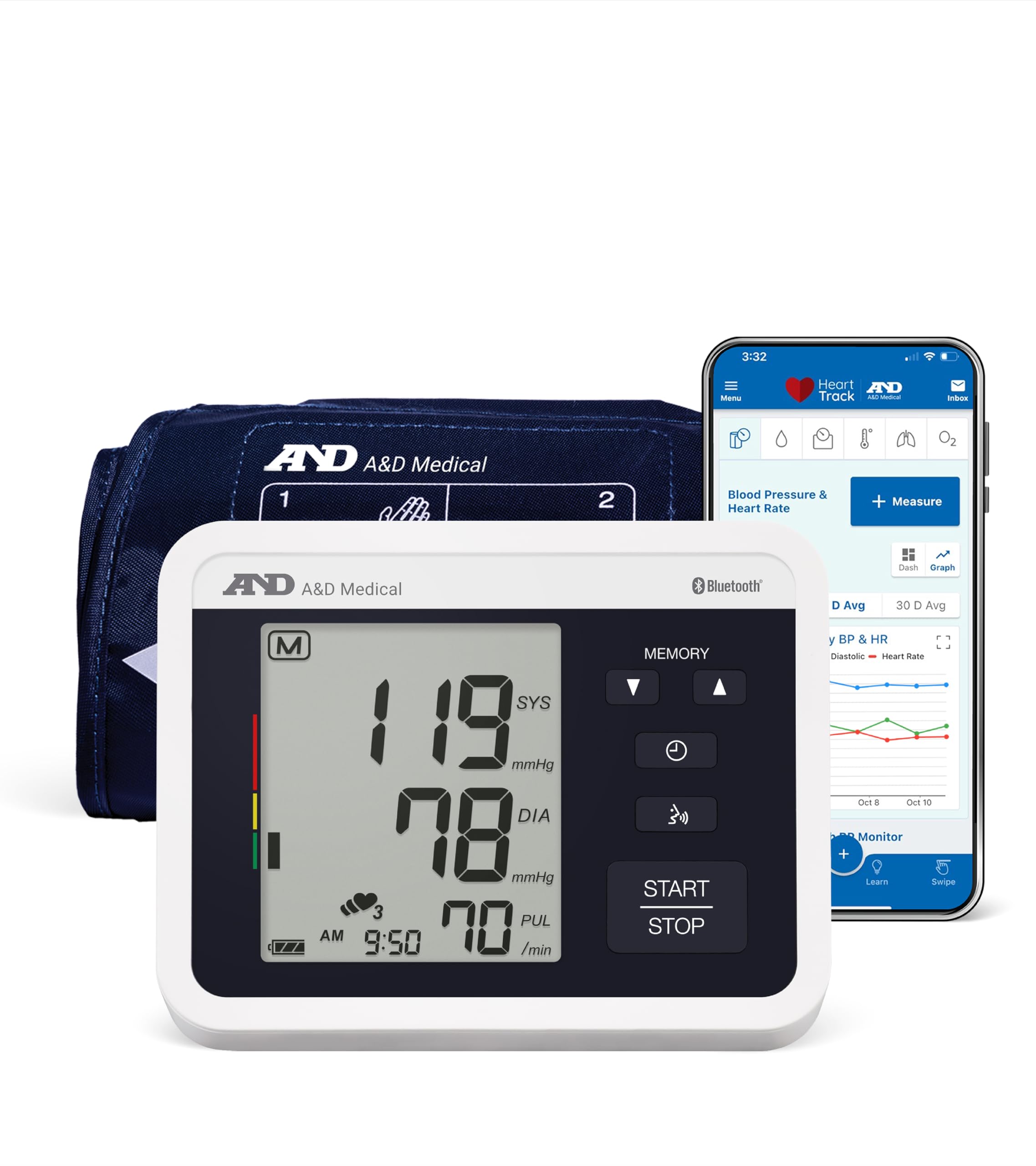
2. A&D Medical UA1040TBLE Blood Pressure Monitor
It talks you through the measurement out loud, which turns a solo check into something you can do without seeing the screen.
A&D built this one for people who cannot easily read a small display. Spoken instructions and spoken results come in English, Spanish and French, so the whole routine is audible. That is why the blind and low-vision crowd gravitates to it — the review pages read simply “Very accessible.” The large LCD with oversized numbers backs that up for anyone with partial sight.
The accuracy story is where this monitor earns trust. It adds an optional TriCheck function that takes three consecutive readings automatically and gives you the average, which smooths out the wobble of a single measurement. A cuff-fit detector and a movement detector flag the two most common ways a home reading goes wrong. The included wide-range cuff fits 8.6″–16.5″ (22–42 cm), and A&D sells small, medium and large cuffs separately if your arm falls outside that band.
One owner ran it side by side with another monitor and landed within +/-2 mmHg — the kind of agreement that tells you the hardware is sound. The catch is the app, not the cuff. Measurements do not flow into the A&D Heart Track app on their own; you have to start the reading from inside the app for it to transfer. The app also skips hypertensive-range alerts and prompts two measurements where three are often recommended. Use the device’s own TriCheck and treat the app as a logbook and you sidestep most of that. Four AA batteries come included, and it can run off an optional AC adapter.
Who it is built for: anyone who wants the reading spoken aloud, or who shares a home with someone whose eyesight makes a screen unreliable. The physical switch-free design and loud, clear voice make a solo morning check genuinely independent.
The trade-off to plan around: sync discipline. If you want every reading in the app automatically, this is not the unit that does it — you press start inside the app each time, or you log the device’s own numbers yourself.
Pick this one when: spoken results and TriCheck averaging matter more to you than hands-off app sync.
Look elsewhere if: you refuse to open an app before each measurement, because the readings will not jump across on their own.
3. Greater Goods Blood Pressure Monitor

A cordless all-in-one you can drop in a bag, with a battery that sits idle for months without complaint.
The Greater Goods unit is the lightest full monitor here at 10.4 oz, and it is built as a single piece — cuff and readout together, no rubber hose to tangle. That all-in-one shape is the whole pitch for travel. It runs on a rechargeable lithium-ion battery, so there is no AAA drawer to raid before a trip. At 4.72 x 8.15 x 2.72 inches it is the larger footprint of the two compact picks, but it folds into a bag without a separate box.
The Balance app does the tracking, storing unlimited entries for two users and logging automatically or by hand. The cuff has clear visual alignment guides and a one-hand adjustable Velcro band, which helps when you are measuring alone. On-device history means you are not stranded if the phone is elsewhere. Here is the honest number: the manufacturer says readings start at the beginning of the cuff’s expansion for faster results, and one buyer tested it against a physician’s office and found it ran about 10 high on both the top and bottom numbers. Others call it close enough to know whether you are high or low.
The recurring gripes are the power plug and the occasional restart. The charger is a proprietary AC adapter, not USB-C, so lose it and you are hunting a replacement. A few readings error out and need two or three restarts before they take. The cuff is also not swappable, so if the band does not fit your arm you need a different machine, not a bigger cuff — measure before you buy. The display is a simple black-and-white screen with large numbers, easy to read in dim light.
The value read: you are buying portability and a rechargeable battery in a compact body, and the app plus PDF export covers the doctor-report side nicely.
Ask before you commit: does the fixed band fit your arm? That single question decides whether this is the right monitor or the wrong one, because you cannot swap the cuff.
Best fit for: travelers and two-person homes that want a cordless, rechargeable cuff with a decent app.
Skip the idea of: swapping in a different cuff size — the band is fixed, so fit it to your arm first.
4. AQESO Blood Pressure Machine

Three cuffs in the box mean nobody in the house has to make their arm fit the band.
This is the kit you buy when one monitor has to serve a whole family. It ships with a small cuff (7″–9″), a medium/large cuff (9″–17″) and an extra-large cuff (13″–21″), so arms from 7 to 21 inches are covered from the start. That is the widest range here by a clear margin — the single-cuff picks top out at 16.5″ or 17″. No separate cuff order, no guessing.
The rest of the package is built for a shared bathroom shelf. Up to 3 users each store 500 readings — 1500 total — and a button press recalls them, which suits a household tracking several people. The backlit LCD uses oversized numbers for low-light reading, and one-touch operation measures systolic and diastolic automatically. A WHO classification bar sits beside the reading so you can see the band it falls into. Power comes two ways: 4 AAA batteries, or a USB Type-C cable for continuous use. It is not rechargeable on USB, so plan on the cable staying plugged in if you go that route.
Accuracy reports are strong. In one household the readings came out nearly identical to the doctor’s, and the same buyer found it accurate on toddlers, on themselves and on a husband — after earlier cuffs gave false readings. The catch is cuff longevity: a medium cuff in one case started leaking air after about 5 months of daily use and would not inflate. The company sent a replacement and doubled the stated warranty, so the support side showed up. Treat the cuffs as the wearable part and you are forewarned.
Why a family picks it
- Three cuffs cover 7″ to 21″, the widest span in this lineup
- 3 users with 500 readings each keeps everyone’s history separate
- Backlit display with oversized numbers and a WHO classification bar
- Battery or USB Type-C power gives you a backup option
Keep an eye on
- Cuffs are the wear item — one medium band gave out after months of daily use
- USB power needs a continuous connection; the unit is not rechargeable
- The carry bag is large once all three cuffs are packed
Reach for this: when multiple people of different builds share one monitor and you want the cuffs sorted on day one.
Not the pick for: solo users who want the smallest possible footprint — three cuffs take up room.
5. OMRON Gold Blood Pressure Monitor & Upper Arm Cuff
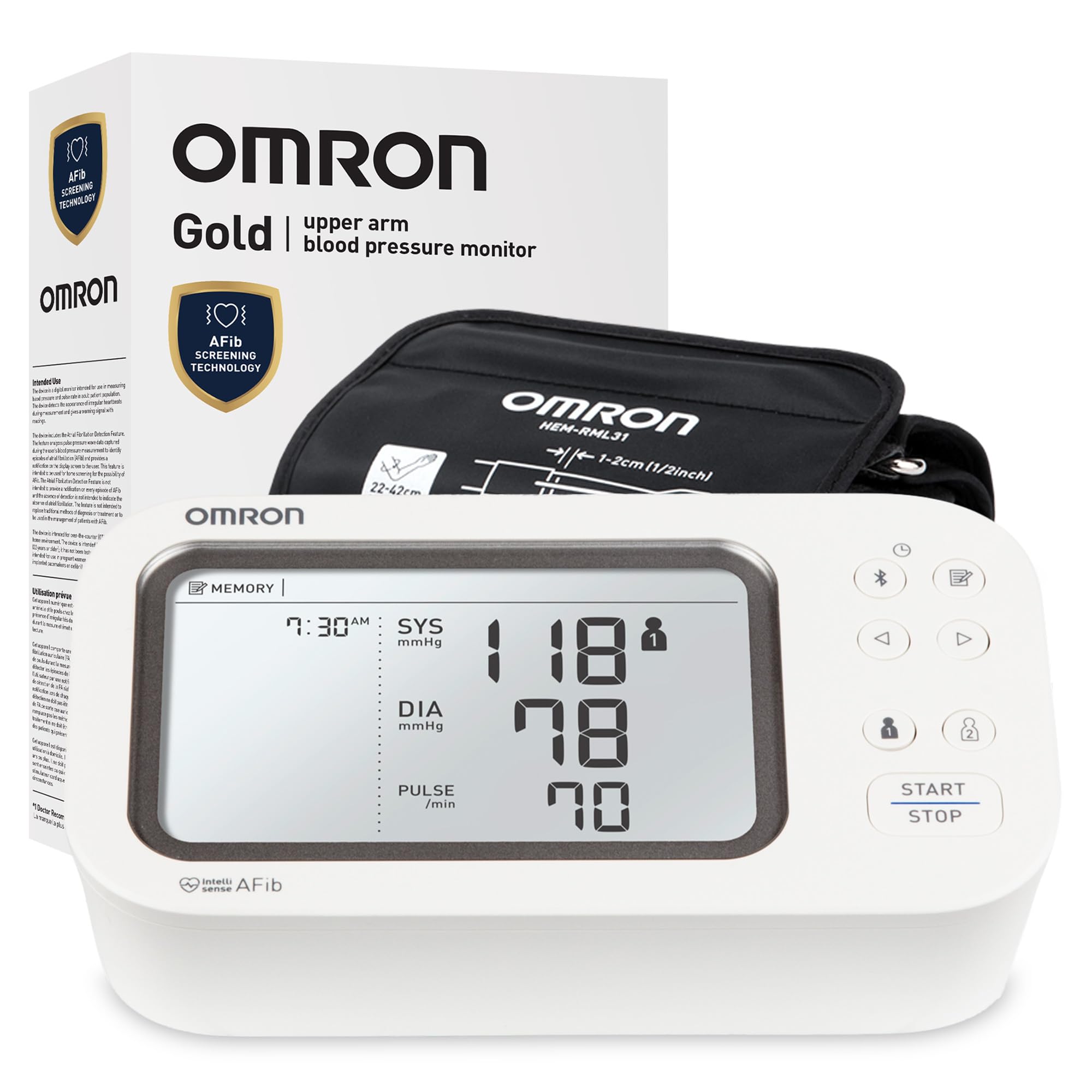
It screens for irregular heart rhythms on every check and shows your current reading next to the last one.
The Omron Gold is the pick for anyone whose doctor has mentioned rhythm or morning spikes. Its exclusive Atrial Fibrillation (AFib) Detection screens for unusual heart rhythms each time you take a reading. A High Morning Average Indicator checks for morning spikes. Those two features are the reason to pay premium-tier money here, and they are not on the iHealth or the A&D. Note the limit though: AFib detection runs on a 30-second reading, so it may miss intermittent episodes.
The dual-display design is genuinely useful. Current reading sits beside the previous one, so you see change at a glance. TruRead averages 3 consecutive readings, a cuff-wrap guide light confirms the band is tight enough, and a physical switch toggles between User 1 and User 2. On-device history is large, and the free Omron connect app stores unlimited readings via Bluetooth, compatible with Apple Health and Google Fit. The wide-range D-ring cuff fits arms 9″–17″, and a storage case plus four AA batteries come included.
The catch is one that rarely gets said out loud: if AFib is detected, the unit will not display a blood pressure reading, because readings taken during an irregular rhythm are likely inaccurate. That limitation is not in the listing headline — it sits in the manual. There is also a known app quirk where a buggy sync can wipe unbacked-up data, so export or back up your log. As for raw size, this is the heaviest of the two flagship-ish picks at 1.37 lb and 7.5 x 4.6 x 3.3 inches, and the D-ring cuff is bulky to travel with.
If AFib screening and the morning-average check matter to you or your doctor, the extra setup is worth learning.
Know the manual before you trust it: no BP number displays during a detected irregular rhythm, and the app should be backed up — both are quirks, not defects.
Suits you if: you want rhythm screening and a morning-spike check built into a two-user home monitor.
Look past it if: you need a reading displayed even during an irregular rhythm, since this one withholds the number by design.
6. WITHINGS BPM Connect – Blood Pressure Cuff, WiFi & Bluetooth

It pushes each reading straight to Wi-Fi and the Health Mate app, no phone in the room required.
The Withings BPM Connect is the easiest monitor here to just leave on the shelf and forget about. It syncs readings wirelessly over Wi-Fi and Bluetooth to the Health Mate app, so your history keeps building even when your phone is in another room. The battery is rechargeable and, per the maker, holds charge up to 6 months, with an in-app battery monitor so you are not caught flat. It is FDA cleared, and its one-size cuff covers 22–42 cm (8.7″–16.5″).
When it matches, that is the whole appeal. One owner compared it to a calibrated WelchAllyn ProBP 3400 and found systolic within 2 points, diastolic within 4–5 points and pulse within 1–3 beats. Another who had it for a long stretch told how easy it is — the app setup takes minutes and readings flow to Apple Health automatically.
Here is where the honest part gets uncomfortable, because accuracy is the most-discussed topic in this monitor’s review history and it is not all praise. A number of buyers report it reading 20 points or more high, and one traced it to cuff placement: the white shell must sit on the inside of your arm, palm up, which the instructions do not explain well. Fix the position and the readings settle. Others found the one-size cuff less accurate than a sized cuff, and it can over-constrict, making the measurement slower and less comfortable. This is the middle of the road, not the top — the A&D ran within +/-2 mmHg while some Withings units run 20 high. So while it is wonderfully convenient, it rewards careful cuff placement more than any other pick here.
The sync advantage: Wi-Fi means the reading is logged whether or not your phone is nearby, and the rechargeable battery removes the AAA chore entirely.
The trade-off package: accuracy depends heavily on getting the cuff exactly right, and the one-size band is not as precise as a sized cuff. Treat it as a convenience device you calibrate carefully, not a set-and-forget.
Choose it for: Wi-Fi syncing, a rechargeable battery and a clean app that pushes readings into Apple Health.
Look past it if: you want the tightest accuracy straight from the start — careful cuff placement is non-negotiable here.
7. Garmin Index BPM

A compact cuff that files your readings into Garmin Connect and turns them into a report you can email your doctor.
If you already live in Garmin Connect, this is the monitor that fits your existing routine. Readings sync over Wi-Fi to your Garmin Connect account, where you build 7-day, 4-week and 1-year reports and export them to PDF. It is FDA cleared and clinically validated, and up to 16 users can sync their own Garmin Connect accounts. The adjustable cuff fits arms 9″–17″ (22–42 cm), and the all-in-one design with an integrated display has a retractable cord so it folds up compact. Battery life is up to 9 months on 4 AAA batteries.
For existing Garmin users, setup is quick and one-touch reads make a morning ritual easy. The one-touch 3X mode takes three readings, and the data flows to the cloud automatically, which is what most people want. It weighs 11.3 ounces and measures 2.3 x 5.7 x 1.6 inches — a small unit to leave on a shelf. One buyer summed it up: “Easy to use and fits nicely into the Garmin ecosystem.”
Two things to weigh. First, it averages the three readings rather than saving each individually, which frustrates anyone who wants the separate systolic and diastolic pairs. Second, the Wi-Fi setup is unintuitive at first and slow before it smooths out. It is a premium-tier price for a monitor whose real value is the ecosystem, not the hardware alone. The cuff is also long and heavy to handle one-handed, which is awkward on very small arms. Accuracy leans on getting the position right, the same as any upper-arm cuff — but if you are not already a Garmin user, a simpler pick will serve you for less.
Second-guess it if: you need each reading recorded separately, since this monitor groups the three into one average.
Know the Specs
Cuff range and arm fit
The cuff range is the spread of upper-arm circumferences a band will measure accurately, usually written in inches and centimetres. A monitor with a wide range like 9″–17″ handles most adults; a fixed one-size band may be less precise than a sized cuff. If your arm sits near either edge, a kit with multiple cuffs, or a brand that sells small, medium and large bands separately, is the safer buy.
Device memory and app storage
On-device memory is the number of readings kept inside the monitor itself — 99 on the iHealth Track, up to 1500 across 3 users on the AQESO. App storage sits on your phone and is often unlimited. Both matter: on-device history keeps working when the phone is away, and the app gives you the trend views and reports a doctor wants.
Power options
Battery type decides where the monitor can go. AA or AAA batteries keep it portable; rechargeable lithium-ion removes the battery drawer; hybrid units run on batteries or USB but may not recharge over that cable. Check whether an AC adapter is included or sold separately before you plan around it.
Extra indicators
Beyond the numbers, some monitors add a classification bar, AFib (irregular rhythm) detection, or a morning-average check. These screen for patterns; they do not replace a doctor’s reading. A monitor that withholds the BP number when it detects an irregular rhythm is behaving intentionally, not breaking.
Common Questions
Will a Bluetooth blood pressure monitor work without the app?
How do I know which cuff size I need?
Can two people share one Bluetooth blood pressure monitor?
Why does my reading change between two back-to-back checks?
Does my phone need a certain software version to sync?
Is an upper-arm monitor better than a wrist monitor?
How long do the batteries last on these monitors?
What happens if the monitor detects an irregular rhythm?
Can I export my readings to send to my doctor?
Will the readings match the ones at my doctor’s office?
The Bottom Line
For most households, the bluetooth blood pressure monitor to start with is the iHealth Track, because its 8.7″–16.5″ cuff fits most arms and its colour-coded screen and 99-reading memory work with or without the phone. If someone in the house needs the reading spoken aloud, the A&D UA-1040TBLE with voice guidance and TriCheck averaging is the better fit. For a family sharing one cuff across very different arm sizes, the AQESO 3-cuff kit covers 7″ to 21″ without extra orders.
If you already run your health data through Garmin, the Garmin Index BPM earns its premium-tier place by feeding readings straight into Garmin Connect with PDF reports. And if the draw for you is Wi-Fi syncing and a rechargeable battery you rarely touch, the Withings BPM Connect is the convenience pick — just set the cuff carefully. Match the cuff to your arm and the app to your phone first; the extras are polish.
How we choose
We do not accept paid placement. Every pick is matched to a real buyer and a real use-case; we do not hands-on test units.
Sources
Specifications: manufacturer listings and product documentation. Review insights: verified customer reviews. Pricing: not shown on this page (it changes often); check the current price via the retailer link.
As an Amazon Associate, Aappliancez earns from qualifying purchases. This does not affect which products we feature.