Disclosure: Some links in this post are affiliate links. As an Amazon Associate I earn from qualifying purchases, at no extra cost to you. Learn more
Specs are compiled from manufacturer listings and verified buyer reviews and can change over time — please confirm the key details on the product page before buying.
You already own a stereo you love, and the only thing missing is a way to play music from your phone through it. A Bluetooth audio receiver module is the small box that fixes that: it takes the wireless signal from your phone or laptop and feeds it into your receiver, amplifier, or powered speakers through a cable. The trick is picking one whose outputs match your gear and whose sound chip does not flatten your music. Start with the Audioengine B1 below if you want the safest all-round choice — it is the crowd favorite at 4.5+ stars across 2,300+ owners — then work down the list for XLR stage gear, budget-friendly first steps, and everything between.
This guide is built by comparing the manufacturers’ published specifications and the patterns across verified customer reviews, so you get each pick’s real strengths and trade-offs instead of marketing spin.
Most buyers get burned by the same two things: a receiver with the wrong connector type, or a codec that never actually activates. Below you get the real output list, the real codec support, and the honest quirks for every pick. This is the practical shortlist of the bluetooth audio receiver module options worth wiring into your system.
Top Picks


How To Choose The Best Bluetooth Audio Receiver Module
The mistake almost every first-time buyer makes is shopping on the Bluetooth version number alone. A module can say Bluetooth 5.3 and still leave you with no way to plug it into the receiver you own. Pick by connector first, then by codec, then by everything else.
Match the output to your stereo’s inputs
Your receiver needs a cable that physically fits. RCA gives you the familiar red-and-white analog connection. Optical (Toslink) and coaxial are digital outputs that hand the signal to your own DAC. XLR is the balanced three-pin connector used on PA mixers and pro speakers. Check the back of your amp before anything else — an optical-only module cannot talk to an RCA-only input.
Codes are the ceiling on sound quality
Both your phone and the receiver must support the same codec (the compression scheme used to send audio) or you drop to a lower rung. LDAC and aptX HD are the high-bitrate options; AAC is what iPhones typically use; SBC is the fallback everyone gets. If your phone is an iPhone, LDAC support on the module will not help you. If you stream from Android, it is worth having.
Decide if you need battery power
Some modules run from a USB power adapter at a fixed spot near your amp. Others carry a built-in rechargeable battery, which is what you want for a portable DJ rig or a church soundboard that moves. Battery modules also tend to auto-sleep when nothing is playing, which protects the cell but sometimes needs a wake-up.
Side-by-Side Comparison
| Model | Best For | Outputs | Codecs | Range (claimed) | Amazon |
|---|---|---|---|---|---|
| Audioengine B1★ Best Overall | Best Overall for home stereo | RCA & Optical | Bluetooth 5.3 | Up to 100 ft | Amazon |
| blafili B3Stage Ready | Pro XLR and install use | XLR, RCA, Optical, Coaxial | LDAC, aptX HD, aptX LL, aptX, SBC, AAC | Up to 100 ft (33m) | Amazon |
| B2 LDAC aptX HD | Audiophile sound on a budget | RCA, 3.5mm AUX, Optical, Coaxial | LDAC, aptX HD, aptX LL, aptX, AAC, SBC | Class 1 with external antenna | Amazon |
| 1Mii B06HD+ | Display lovers and LDAC fans | Optical, Coaxial, RCA, AUX | LDAC, aptX HD, aptX LL | 197 ft outdoor / 50–80 ft indoor | Amazon |
| YMOO DS200Plus | Compact aluminum builds | RCA, Optical, Coaxial | LDAC, aptX HD, AAC | Up to 100 ft open space | Amazon |
| Pro-Ject BT Box S2 HD | Turntables and hi-fi racks | RCA & Toslink optical | aptX, aptX-HD, SBC | ~33 ft (10m) | Amazon |
| Xvive P3 | DJ rigs, mixers, PA | XLR | Bluetooth 5.1, A2DP, AVRCP | Up to 100 ft | Amazon |
Detailed Reviews
1. Audioengine B1 Bluetooth Receiver for Home Stereo System
Our pick — 4.5+★ from 2,000+ verified ratings; the strongest balance of quality and price.
A grown-up aluminum box that makes a room-filling stereo feel like it was always wireless.
The B1 is here because it gets the basics right without making you learn anything. It has an RCA output for the red-and-white analog jacks on your receiver, plus an optical output for a digital handoff. A 32-bit DAC (the chip that converts the stream into analog sound) sits inside, so the signal leaving the box is already cleaned up. Pairing is a button press, and once a phone is stored it reconnects on its own. The list says up to 100 feet of range in most environments, and owners regularly report holding a solid signal from a room away.
On sound, this is not a device you will notice in the chain. Voices stay forward, the low end comes through with weight, and the background is quiet. Set it against the cheap stock approach on a set of powered bookshelf speakers and the difference is not subtle — the B1 keeps its imaging where the bargain units start to smear. It also plays nicely with newer sources; an Echo Dot, a laptop, a tablet, all pair without fuss. The connected-source reliability is what wins people over most, closely followed by how quickly the whole thing is up and running.
Two honest heads-ups. The power light is bright enough to matter in a dark listening room, and the analog output occasionally needs a reboot after the power cuts out. Neither is a reason to pass on it for home use. Owners consistently report zero connection drops and stable sound after weeks of daily use.
What works
- RCA and optical outputs cover both analog and digital inputs on your amp
- 32-bit DAC keeps the sound clean before it ever reaches your receiver
- Up to 100 ft range, with owners reporting solid signals a room away
- Simple button pairing with fast automatic reconnection
- Compact 3.5 x 4 x 1in metal body sits behind a rack without crowding it
What to know
- Bright power light can be a nuisance in a dark room
- Occasional reboot needed after a power interruption
- Only one device streams at a time, though several can be stored
Most buyers should start here: if your receiver has an RCA or optical input and you want a set-and-forget box, this is the safest choice in the list.
The one thing to check: if you plan to move it around on battery power, the B1 is not that kind of module — it lives on a shelf.
2. blafili B3 Professional XLR Bluetooth 5.1 Audio Receiver
Four outputs at once, a silent handshake, and a name you can rename — built for shared rooms.
If your rig ends in a balanced XLR cable into a mixer, start here. The B3 has the widest connector set on this list: dual balanced XLR, RCA, optical, and coaxial, and all four can feed different devices at the same time. A Qualcomm QCC5125 Bluetooth chipset and ESS ES9018K2M DAC handle the wireless side and the analog conversion respectively. It receives LDAC, aptX HD, aptX Low Latency, aptX, SBC, and AAC. Claimed range is up to 33m (100 ft) with the removable RP-SMA antenna attached.
The feature that quietly separates it from the Audioengine above is the install kit. You can rename its broadcast name up to 12 letters or numbers, which stops a gym or church from seeing six identical boxes on a phone. You can also add a 4-digit passcode to keep stray phones out. It makes no beeps or voice prompts when it pairs — a real comfort for classroom and venue work. Buyers report a solid signal through a concrete wall at roughly 100 feet from inside a metal AV rack, and one gym swapped out a Denon DN-300Z for the longer range and automatic pairing.
Two caveats worth knowing before you buy. It is a receiver only: it cannot take sound from a TV or amp and send it to Bluetooth headphones, and it cannot drive passive speakers. And the optical and coaxial ports are outputs, not inputs, so a CD player cannot feed into it that way. The 1.3-inch display is small but readable in a rack. As owners put it about the build, it is genuine ESS and Qualcomm hardware with gold-plated connectors — you are paying for the chipset, not the badge.
Where it shines: installations where several rooms share one box, or where a phone must not hijack the sound by accident. The custom name and optional passcode solve problems the home-stereo models never think about.
What it will not do: turn a passive speaker into a wireless speaker, or accept a digital source as input. It sends audio out; that is the whole job.
Reach for this if: your setup lives on a stage, in a church, or in a gym, and you need XLR plus the option to lock out random phones.
Look elsewhere if: your stereo only has red-and-white jacks and you want the simplest possible box — the Audioengine costs less effort.
3. B2 LDAC aptX HD Bluetooth Audio Receiver
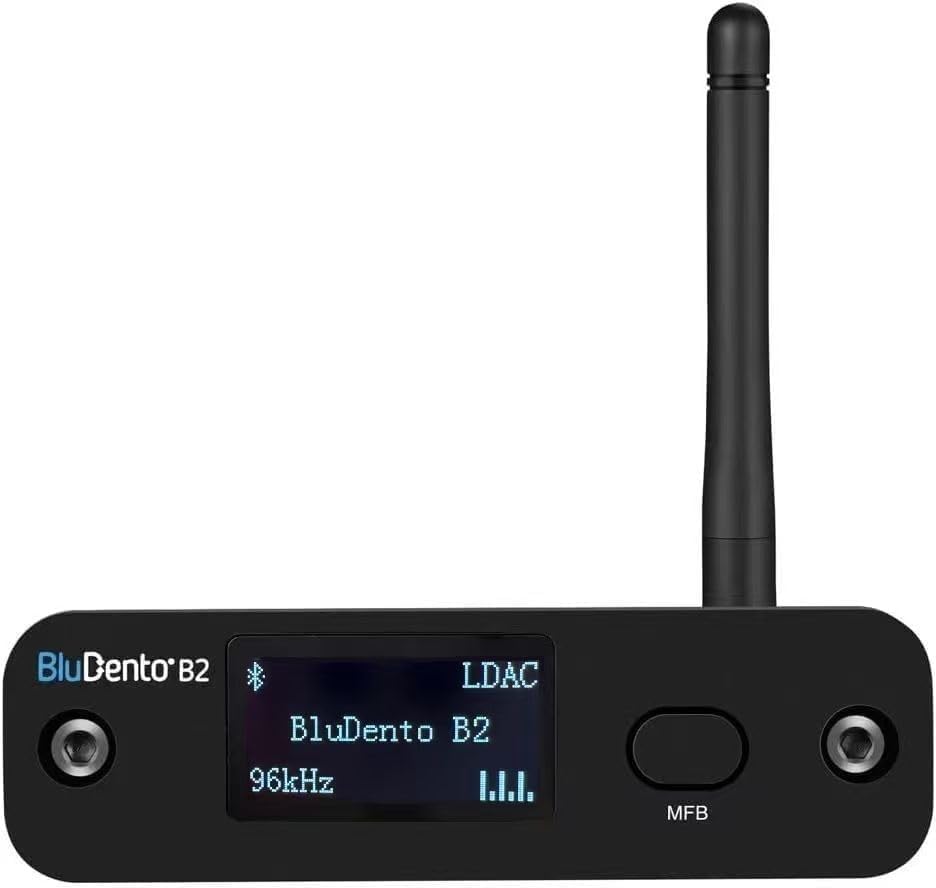
An audiophile-grade DAC in a compact grey box that wakes your old speakers with no app at all.
No app, no driver, no pairing menu to fight. Power the BluDento B2 on and it drops straight into pairing mode; connect your phone once and it auto-reconnects from then on. Inside is an ESS ES9018K2M DAC handling 32-bit / 384kHz PCM data in two channels, with a 2.1VRMS max RCA output. It receives Bluetooth 5.1 and decodes LDAC, aptX HD, aptX Low Latency, aptX, AAC, and SBC. Outputs cover both analog (L/R RCA plus 3.5mm AUX) and digital (Optical TOSLINK and SPDIF Coaxial), so it slots into almost any stereo stack.
Sound quality is the thing owners praise most, and the reason is the chip, not the marketing. Set against cheaper DAC adapters, the B2 brings forward clarity and a quieter floor, so vocals sit exactly where the engineer put them. It is a genuine step above a straight analog cable into the same amp on many systems. Physical range comes from Class 1 Bluetooth with an external gain antenna, though walls and metal obstructions will cut it down.
The catch is value, and it is a real one for some buyers. The DAC here is older generation than some dual-chip rivals that sell for similar money, and that gap shows up in the spec sheet. If you are chasing the highest possible conversion quality at this tier, compare carefully. If you want plug-and-play LDAC with no fuss and clean analog output, this is a good place to land. Owners say the B2 revived dormant bookshelf speakers, and several bought a second unit for another room.
The honest read: buy it for convenience and clean analog sound, not for the newest DAC silicon. The auto-pairing alone is worth a look if you hate pressing buttons.
Fits best with: a fussy listener who wants LDAC streaming into a decent amp and refuses to install an app.
Worth a second look if: you are comparing DAC chips line by line — the B2 is honest but not the newest design at its tier.
4. 1Mii B06HD+ Hi-Res LDAC Bluetooth 5.3 Receiver
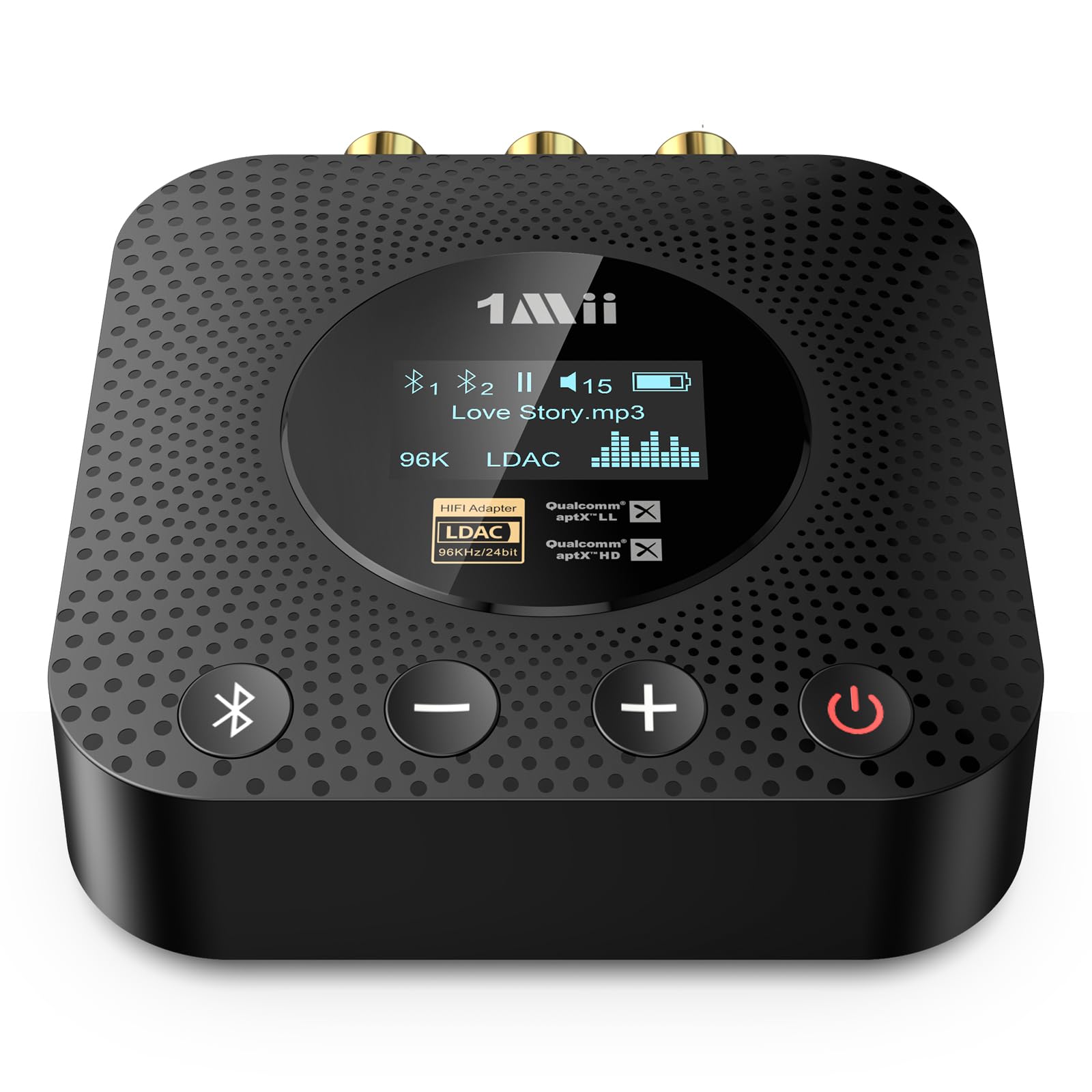
A tiny OLED panel that tells you exactly what codec you are streaming and at what resolution.
Plenty of receivers hide how they are working. The B06HD+ puts it on a screen: song name, codec in use, sampling rate, volume, and connection status, all scrolling at a glance. It decodes LDAC, aptX HD, and aptX Low Latency through Bluetooth 5.3, powered by an ES9018K2M DAC. Output options include Optical, Coaxial, AUX, and RCA, so it can feed a stereo receiver, an AV receiver, powered speakers, or a stand-alone DAC. Cable bundle covers the needs — an AUX-to-RCA, an RCA-to-RCA, a power lead, and an optical cable.
The range claim is the standout on paper: up to 197 feet outdoors without obstacles and 50 to 80 feet indoors. A built-in battery is good for up to 13 hours of use and sleeps once nothing is playing for about ten minutes. On sound, the louder it plays the more it impresses; owners drive JBL 305 monitors with it and get more clean volume than a laptop’s 3.5mm output manages. A 3D mode adds a wide surround effect, though reactions vary — some love it, others leave it off.
Where it gets finicky is in the details. Some older receivers will not accept LDAC from the start, so you have to switch to aptX HD from the phone’s hidden developer menu to get optical working cleanly. A few owners have to power-cycle it before connecting, or notice it waking up on its own after interference. That rechargeable battery is what lets you carry a house-filling stream out to the patio without hunting for an outlet.
Why it earns a spot
- Onboard OLED shows codec, sample rate, volume, and connection at a glance
- Up to 197 ft outdoors and 50–80 ft indoors
- Built-in battery rated to 13 hours so it can travel to the patio
- LDAC and aptX HD across optical, coaxial, AUX, and RCA outputs
Where the fuss lives
- LDAC can misbehave with older receivers until you drop to aptX HD
- Occasional power-cycle needed before it reconnects
- 3D mode is a love-it-or-leave-it feature
Made for: the buyer who wants to see the codec working and move between patio and living room without a wall socket.
Not the pick if: you want a set-and-forget box you never touch a menu on — the B06HD+ rewards a little curiosity.
5. YMOO DS200Plus Bluetooth Receiver with LDAC
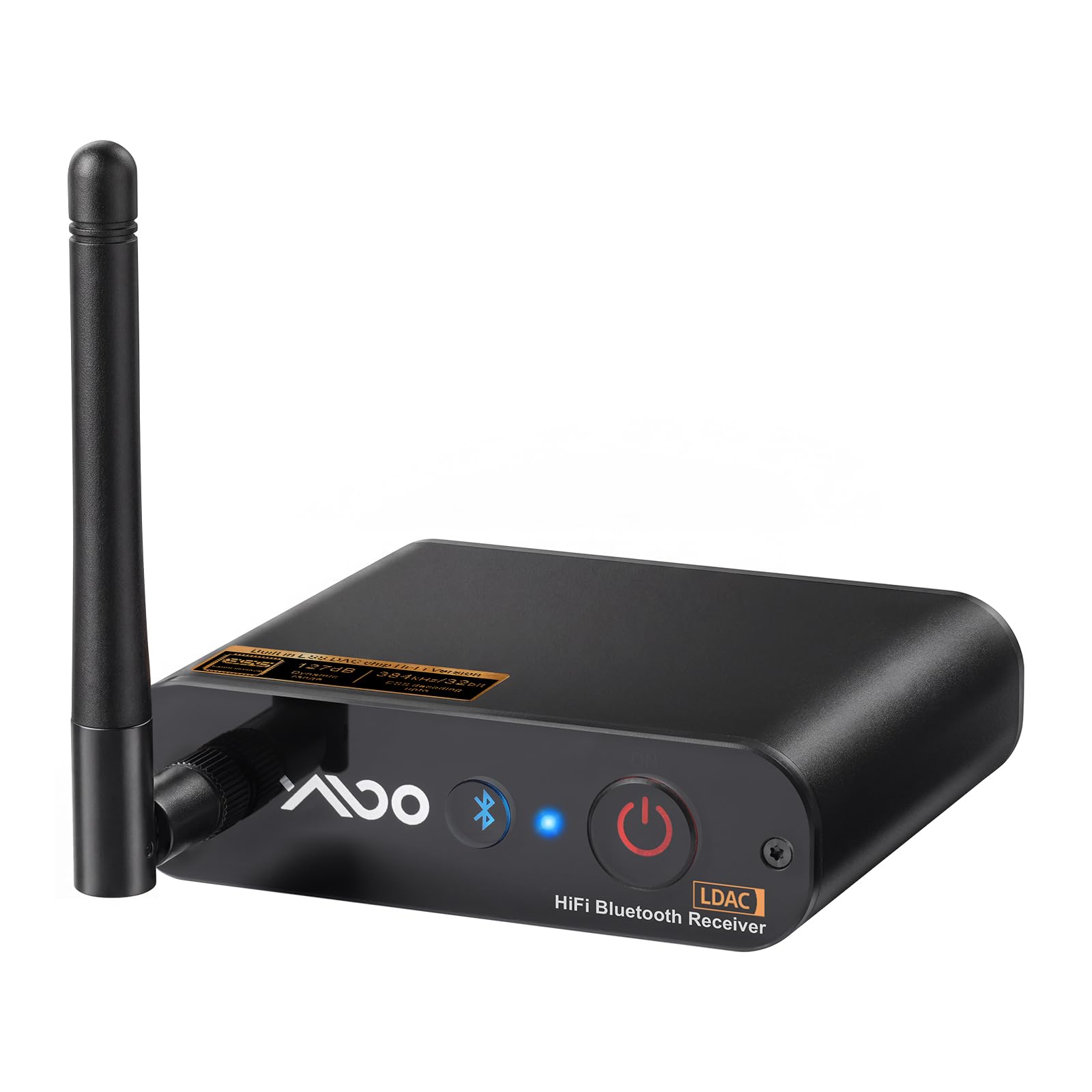
A brushed aluminum slab with an external antenna that quietly modernizes a classic stereo.
The DS200Plus is a two-channel receiver with RCA, optical, and coaxial outputs, so it can reach a stereo amp, a soundbar, powered speakers, or a digital audio system. It decodes LDAC, aptX HD, and AAC over Bluetooth 5.3 with an external antenna, and it claims up to 100 feet in open space. Setup is plug-and-play, and the aluminum alloy housing is small enough to slip behind a rack without feeling cheap. The box comes with an optical cable, a 3.5mm-to-RCA, an RCA-to-RCA, a USB power cable, and a power adapter, plus four self-adhesive feet.
Owners mention two honest camps on this one. The happy camp had it cabled and paired in about 13 minutes — ten on the RCA side, three on the source side. The less impressed camp had a lower-end speaker system to begin with, and found the sound improvement less dramatic than hoped. That is a fair read of the device: it feeds a good system faithfully and it makes a poor system sound only a little better. The build, the compact shape, and the digital outputs are the parts that stand out.
Value is the recurring question. At its tier, there are cheaper options that get close on features, and one thing to check before you buy is that it is a receiver only — it will not push sound out to Bluetooth headphones. For a decent stereo that needs a clean wireless input, it fits. For a budget setup, temper the expectation.
Pick it when: your receiver has the inputs, your speakers sound good already, and you want a small aluminum box that disappears behind your rack.
Pass it when: your sound system is the weak link — this module is honest enough to show you that.
Right choice for: the buyer who cares about a tidy metal build and a compact footprint over extras like a screen or battery.
The trade-off: a receiver-only design and value-conscientious pricing mean your money goes into the chassis and outputs, not the feature list.
6. Pro-Ject BT Box S2 HD Bluetooth 5.0 Audio Receiver

A proper hi-fi component for turntable owners who want their rack to look intentional.
Pro-Ject built its name in turntables, and the BT Box S2 HD reads like a rack component, not a dongle. It carries Bluetooth 5.0 with aptX, aptX-HD, and SBC codecs, switchable RCA analog and Toslink digital outputs, an included antenna, and auto pairing in 3 to 5 seconds. Claimed range is about 33 feet (10 meters). The point for many owners is pairing it with a turntable that has a Bluetooth output, or upgrading the built-in Bluetooth in a powered speaker system that streams poorly on its own.
The optical output is the part that matters if you own an external DAC. Owners feed its Toslink output straight into their own DAC for a clear step up in sound, and the case looks like it belongs on a shelf rather than behind one. Against the Audioengine above, the Pro-Ject trades wireless range and codec breadth for finish and simplicity: no LDAC here, just aptX-HD, but the look and the auto-pair really land for a traditional hi-fi buyer. The catch to note is the short power lead on the external supply.
Two honest limits. The 33-foot range is the shortest on this list, and bluetooth reliability has been described as iffy in a couple of settings. The other is delay — if you try to use it to stream TV audio, the lag is enough to throw off lip-sync. This is not a TV adapter; it is music only.
The case for it: a turntable with Bluetooth out, or a powered speaker system that needs a better signal. The Toslink out gives you a clean path to your own DAC.
The case against: very short range and clear lip-sync delay make it wrong for TV and wrong for a big house.
Fits if: you own a turntable or a compact hi-fi rack and want a component that looks the part with a clean digital out.
Skip it for: TV sound or whole-house coverage — the Pro-Ject is designed for a single close listening room.
7. Xvive P3 XLR Bluetooth Receiver for PA Systems and Mixers

A slim XLR stick with a rechargeable battery that cuts the cable between your phone and the mixer.
For a mobile DJ or a church soundboard, the P3 makes the most sense because it plugs straight into an XLR input. It receives Bluetooth 5.1 with A2DP and AVRCP, decodes to a 16-bit / 48kHz DAC, and claims up to 100 feet of range. An internal rechargeable battery runs up to 8 hours, recharges over USB-C in about 2 hours from any 5V source, and the slim metal-and-plastic body sits neatly on a mixer edge. The P3 is the mono version; the dual P3D pairs for true stereo if you want to feed two channels at once.
This is the most useful receiver in this list for live work, and the reason is the connection type, not the codec list. It still sounds clean against a direct cable, and the automatic re-pair after the first setup means you can walk up with a phone and play. Customers note running a full three-day camp on one charge, and many buy a second P3 for a home or second venue.
Be realistic about the edges. It is XLR only, so it is pointless on a home receiver that has only RCA. The 16-bit / 48kHz ceiling is below the LDAC crowd, which you will not notice on a PA but will notice on a critical listening setup. And the dual-unit pairing workflow has a learning curve — you have to turn off Bluetooth on the source, link the two receivers, then turn Bluetooth back on and pair. Once you know the order, it stops being a problem.
What earns it a place
- XLR output plugs into mixers, PA speakers, and DJ gear directly
- Up to 8 hours of battery on a built-in cell, about 2 hours to recharge
- Auto re-pairs after the first setup, so it is ready when you are
- Up to 100 ft range with Bluetooth 5.1 and 16-bit / 48kHz DAC
Be honest with yourself
- XLR only — no RCA or optical for a home stereo
- The dual-unit P3D pairing order takes getting used to
- 16-bit / 48kHz does not match LDAC for critical listening
Buy it if: your rig has an XLR input free and you want music between sets without running a cable across the stage.
Not for you if: you need RCA, optical, or LDAC — this is a specialist connector for live sound.
Know the Specs
Bluetooth codecs: LDAC, aptX HD, AAC, SBC
A codec is the compression method your phone and the receiver use to talk. LDAC and aptX HD send more data so the sound retains detail before it hits your speakers; AAC is what iPhones typically negotiate; SBC is the lowest common denominator. Both ends must support the same codec or you fall back to the lower one. That is why a receiver with LDAC can still stream in AAC from an iPhone, and why your phone’s Bluetooth menu is the deciding factor.
DAC: the chip that turns bits into sound
A DAC (digital-to-analog converter) is what converts the incoming stream into the analog signal your amplifier can actually play. The ESS ES9018K2M appears in several of the modules here, and a 32-bit / 384kHz spec means the chip processes high-resolution streams without downsampling. On a good stereo, a better DAC means a quieter floor and more precise imaging. On a speaker that was never good, it means much less.
RCA, optical, coaxial, and XLR outputs
These are the physical connectors on the back of your receiver. RCA carries analog on two channels using the familiar red-and-white plugs. Optical (Toslink) and coaxial carry digital, which means your own DAC in the amp handles the conversion. XLR is a three-pin balanced connection used on PA mixers and pro speakers. All four types need to match what the receiving device expects — an XLR-only module cannot feed an RCA-only input.
Wireless range: open air versus inside the house
The range figures on the box are measured in open space without obstacles. Walls, metal racks, and concrete cut that figure substantially. A receiver that claims up to 197 feet outdoors behaves like a 50 to 80 foot distance indoors. Bluetooth 5.3 and a removable external antenna improve stability, but not the fundamental physics. If the module lives in a metal AV rack, budget for a shorter working range than the box suggests.
Common Questions
Will a Bluetooth audio receiver work with my old stereo that only has RCA inputs?
What is the difference between LDAC and aptX HD?
Can I use a Bluetooth receiver to listen to my TV through the stereo?
Does a Bluetooth audio receiver need a separate DAC?
Can I connect two pairs of Bluetooth headphones to the same receiver?
How long does the battery last on a portable Bluetooth receiver module?
Why does my receiver not find LDAC on my phone?
Will a Bluetooth receiver work with powered speakers?
Can the blafili B3 power a mixer with its XLR outputs?
Is a Bluetooth audio receiver module as good as a wired connection?
The Bottom Line
For most people who just want their stereo to sound better wirelessly without a complicated setup, the Audioengine B1 remains the safest pick — RCA and optical outputs cover both home amp types, and the 32-bit onboard DAC (a chip that converts the digital signal to analog sound) means it is unlikely to be the weak link in your chain. If your rig ends in XLR (a three-pin pro audio connector) and lives on a stage or in a church, the blafili B3 repays the extra outlay with four usable outputs and a custom broadcast name. For turntables and tight racks, the Pro-Ject BT Box S2 HD looks and behaves like a real component. And if a battery and a codec display (a screen showing which Bluetooth audio format is playing) mean something to you, the 1Mii B06HD+ is the pick that makes that want answering.
How we choose
We do not accept paid placement. Every pick is matched to a real buyer and a real use-case; we do not hands-on test units.
Sources
Specifications: manufacturer listings and product documentation. Review insights: verified customer reviews, as of October 2026. Pricing: not shown on this page (it changes often); check the current price via the retailer link.
As an Amazon Associate, Aappliancez earns from qualifying purchases. This does not affect which products we feature.