Disclosure: Some links in this post are affiliate links. As an Amazon Associate I earn from qualifying purchases, at no extra cost to you. Learn more
Specs are compiled from manufacturer listings and verified buyer reviews and can change over time — please confirm the key details on the product page before buying.
Zone 8 is the awkward middle ground of blueberry growing. Your winters are too mild for the northern highbush types that need a long deep chill, so you have to shop the rabbiteye and southern highbush side of the family instead. Rabbiteye and southern highbush blueberries thrive in that heat and humidity, so a well-chosen pair can fruit heavily for years.
This guide is built by comparing the manufacturers’ published specifications and the patterns across verified customer reviews, so you get each pick’s real strengths and trade-offs instead of marketing spin.
The biggest mistake new growers make is buying one lonely bush. Most blueberry varieties need a second, different variety blooming at the same time to set fruit at all, which is why every pick below lists its pollination partner and its mature footprint. If you want berries rather than a pretty shrub, this guide to blueberry bushes for zone 8 that tells you which ones actually cross-pollinate.
Top Picks


How To Choose The Best Blueberry Bushes for Zone 8
Buying a blueberry bush is not like buying a shrub for looks. You are buying a fruit factory, and a lone bush with no partner variety sets little to no fruit. So the first question is not which bush is prettiest, it is which two varieties you are planting.
Match the variety to your zone, not the label on the pot
The USDA hardiness zone number tells you the coldest winter a plant is expected to survive. Zone 8 winters are mild, so southern-adapted rabbiteye and southern highbush types handle them happily. Northern highbush types rated to zone 3 or 4 will often survive a zone 8 winter, but they may not get enough cold hours to bloom well. Read the plant’s own zone range before you buy, and if it starts at zone 8 or higher, treat that as a warning rather than a bonus.
Buy two varieties, and check the bloom window
Blueberries set more and larger fruit when pollen comes from a different variety. The catch is that both bushes have to be flowering at the same time. Rabbiteye types generally pollinate other rabbiteye types, and southern highbush types pollinate other southern highbush types, so pair within the same family. A variety that ripens in June and one that ripens in July may still overlap enough to work, but a spring bloomer and a winter bloomer will never meet.
Check the mature size before you dig the hole
A bush sold in a 1 gallon pot looks tiny, and that is normal. The number that matters is the mature height and width, because a rabbiteye can spread 6 to 10 feet wide. Rabbiteye types can reach 6 to 15 feet tall with a 6 to 10 foot spread, while compact varieties stay around 3 to 4 feet. In a small yard, a compact bush with a 4 to 5 foot recommended spread saves you years of constant pruning. Blueberries do respond well to pruning, so a large type can be held smaller, but you will be cutting every year.
Plan for acidic soil and full sun
Blueberries are fussy about soil in one specific way: they want it acidic. Most of the picks here list full sun as their light preference, and the ones that tolerate partial shade still fruit best with a long sunny day. If your soil is heavy clay, plan to plant in a raised mound or a large container rather than fighting the ground.
Side-by-Side Comparison
| Model | Best For | Mature Height | Mature Width | Sunlight | Amazon |
|---|---|---|---|---|---|
| Perfect Plants Rabbiteye Blueberry Bush (Tifblue)★ Best Overall | First-time zone 8 planters | 3–15 ft | 3–10 ft | Full sun | Amazon |
| Blueberry Plant — BluerayBest Berry Size | Big berries for freezing | — | — | Full sun | Amazon |
| Perfect Plants Powder Blue Rabbiteye Blueberry | Pie and muffin bakers | 6–15 ft | 6–10 ft | Full sun | Amazon |
| Bushel and Berry Pink Icing Blueberry | Patio pots and small yards | 3–4 ft | 4–5 ft spread | Partial shade to full sun | Amazon |
| Blueberry 2.5 Qt. Duke Shrub | Cooler pockets of zone 8 | 48–72 in | 48–72 in | Full sun to partial shade | Amazon |
Detailed Reviews
1. Perfect Plants Rabbiteye Blueberry Bush 1 Gallon
Our pick — 4.0+★ from 500+ verified ratings; the strongest balance of quality and price.
The Tifblue that shows up already carrying fruit, food included.
If you are planting your first blueberry in zone 8, this is the one to start with. It is a Tifblue rabbiteye, which is the workhorse variety of the warm-climate blueberry world, and it arrives as a live 1 gallon bush with a packet of blueberry food so you are not hunting down the right fertilizer on day one. Tifblue is also a heavy producer compared to other varieties, and the berries hold a tart edge until they are fully ripe, when they turn juicy-sweet. Pick too early and you get pucker; wait for full color and you get dessert.
In zone 8 the mature size is the thing to plan around. Perfect Plants lists this bush at a mature height of 3 to 15 feet and a mature width of 3 to 10 feet, which is a wide range because pruning controls the top end. The branches spread outward rather than shooting straight up, and they carry light-green foliage with pink to white blossoms before the fruit sets. It wants full sun all day. The variety has one hard rule: it needs a different rabbiteye variety nearby to pollinate it, so this bush is only half of a purchase.
Owners consistently describe these plants as better than advertised — healthy, well packed, and often showing up with berries already developing. The quality of the plant is the aspect buyers praise most, and fruit development runs a close second. There is real spread on size and on first-year growth: some buyers see vigorous growth and fruit in the same season, while a few end up with a smaller or struggling plant. The company’s replacement policy is the safety net owners keep mentioning, covering a plant that arrives in poor condition after photos are sent in.
What Earns Its Keep
- Arrives as a live 1 gallon bush with blueberry food included, so it is plantable on day one
- Tifblue is a heavy producer, with berries ripening June through July and sweetening fully at maturity
- Flowers pink to white on outward-spreading branches — you get an ornamental spring show before the crop
- Pruning is effective on this variety, so you can hold a 15-foot ceiling down to a workable height
Before You Buy
- It cannot fruit alone — you need a second rabbiteye variety blooming on the same schedule
- Mature width of 3 to 10 feet means it will crowd a narrow border
- Arrival size varies, so a small box does not mean a dead plant — but patience is required
- Not shippable to California, Arizona, or Washington because of state restrictions
Plant this if: you have full sun, room for two bushes, and you want fruit this season from a variety that ripens into real sweetness.
Think twice if: you only have space for a single shrub — a lone Tifblue will flower and give you almost nothing to pick.
2. Blueberry Plant BLUERAY
The one you plant for a chest freezer, not a garnish bowl.
Blueray exists for one reason: the berry. This is a firmer, extra-large fruited variety, and the listing is explicit about where that pays off — canning, dehydrating, freezing, fresh eating, and pies or cobblers. A firm berry holds its shape through a freezer bag and does not collapse into mush in a cobbler the way soft berries do. If your goal is a stocked freezer shelf rather than a handful of snacks off the bush, this is the pick built for that job.
Where it differs sharply from the Tifblue above is in the foundation. The Tifblue lists a zone 3 rating, which makes it comfortable through a zone 8 winter with cold to spare. This Blueray is rated to zone 4, and it names winter as its expected blooming and planting period, so it is a cold-leaning plant being asked to perform in a mild-winter garden. That contrast is the whole story on this bush: outstanding fruit quality, and a plant that may want a colder winter than a warm zone 8 pocket delivers.
Owners are clear that the quality is there when the plant takes hold. The trouble is establishment — growth is the most-discussed subject in the reviews, and it splits hard. Some buyers report the plant budding nicely and pushing new leaves after a rough shipping transition, with one eventually reaching about 4 feet tall and covered in foliage. Others, in the bluntest words on the page, report: “They never grew. Just sticks…” That is a real risk with a dormant bare plant, not a defect in the berry itself.
The honest trade: Extra-large fruit that freezes, cans, and bakes beautifully is the entire reason to buy this bush — but it is the least forgiving of the group on rooting in, so give it loam soil, steady moisture, and a shaded first week rather than full sun on arrival.
Choose it or not: Buy it if berries for the freezer matter more to you than fast establishment. If you want the surest first-year start in a warm zone 8 yard, this is the riskier of the two nursery picks.
Worth it when: you garden in a cooler pocket of zone 8 with loam ground and you are stocking up for canning and pies.
Look elsewhere when: your zone 8 spot bakes in summer and you want a plant that shrugs off the heat — a rabbiteye handles that better.
3. Blueberry 2.5 Qt. Duke Shrub
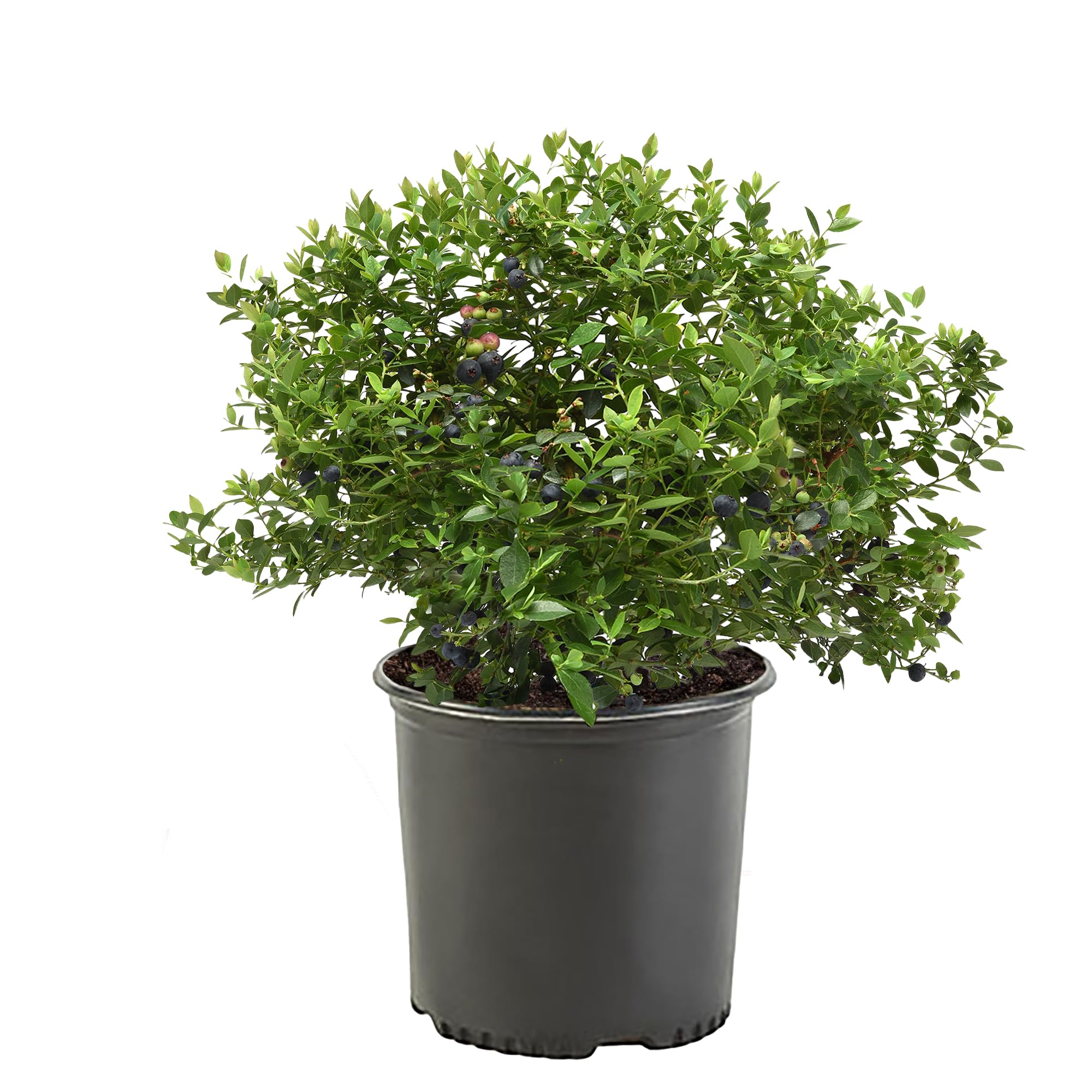
A patio-sized bush with a tidy 48-inch footprint and no pruning ladder.
The Duke shrub is the sensible choice for a small yard, a balcony, or a decorative pot by the door. It matures at 48 to 72 inches wide by 48 to 72 inches tall, and the recommended spacing is 48 inches — so this is a bush you can place without measuring your whole property line first. It works in containers and in landscape beds, which is unusual flexibility for a fruiting shrub. Full sun to partial shade is listed as acceptable, giving you some slack on placement.
There is a caveat worth stating plainly before you buy, because it is unusual: this shrub thrives in USDA Zones 4 through 7. The keyword here is zone 8, and this plant’s published range stops at 7. In the cooler pockets of zone 8 — higher elevation, a north-facing slope, a spot that catches more winter chill — a Duke can perform. In a hot, humid, sea-level zone 8 garden it is the wrong bush, and no amount of care will change that. Decide where you sit before you order.
It ships dormant from winter through early spring, so a leafless bundle of stems arriving in February is completely normal. The plant is deciduous, meaning it drops foliage in winter and pushes new growth in spring, and it blooms white flowers in spring before the berries come on. Plants are trimmed at shipping to promote health, so do not read a shorter-than-expected plant as a problem. Owners describe healthy plants that grow steadily, with quality the standout, and at least one grower picking berries in the same season they planted.
Size is the selling point: 48-inch recommended spacing and a 48 to 72 inch mature spread make this the easiest of the group to fit into a real yard without constant cutting.
Read your zone twice: the published range of zones 4 to 7 is the constraint — this is the pick for a cool-leaning zone 8 site only.
Reach for this if: your zone 8 property runs cool and you want a compact, container-friendly bush for a patio or small border.
Pass if: your garden sits in the hot, humid heart of zone 8 — a rabbiteye is the better match for that climate.
4. Perfect Plants Powder Blue Rabbiteye Blueberry 1 Gallon

Big sweet berries for pies — and the widest bush on this list by far.
Powder Blue is the baker’s rabbiteye. It produces large, sweet berries in June and July that the grower specifically points at blueberry pie and muffins, and the green foliage turns yellow and copper in autumn, so this bush earns its space in the landscape even after the crop is done. It ships as a live 1 gallon plant with easy-to-use blueberry food, same as the Tifblue, and it wants full sun across the day.
The size is where this one separates itself from its cousin. This bush matures at 6 to 15 feet tall with a mature width of 6 to 10 feet, compared against the 3 to 10 foot spread listed for the Tifblue 1 gallon plant — roughly double the footprint at the top end. In a zone 8 yard with a fence line or a back corner to fill, that is a bonus. In a tight patio garden, it is the wrong purchase. Match the plant to the space before you fall for the pie photos.
There is a second purchase hiding inside this one. Powder Blue requires two types of pollinators to produce fruit, and the grower recommends pairing it with Premier or Climax. Buy a single bush on its own and you have bought a handsome autumn shrub with almost no berries. Reviewers who ordered several describe plants arriving heavy with fruit, and the company’s habit of replacing a failing plant after photos are sent gets mentioned favorably more than once.
Why Bakers Choose It
- Large, sweet berries that ripen June to July and are aimed squarely at pies, muffins, and baking
- Green foliage shifts to yellow and copper in autumn for season-long landscape interest
- Arrives as a live 1 gallon plant with blueberry food included
- 6 to 10 foot mature width and 6 to 15 foot height suit a hedge or back-border position
Know Before Ordering
- It will not fruit alone — the grower recommends Premier or Climax as its pollinator partner
- At roughly double the Tifblue’s top-end spread, it overpowers a small garden bed
- A few plants arrive with spotting or broken branches, though the company replaces failing ones
Buy it for: a full-sun back border where you want big baking berries, a pair of pollinator bushes, and copper autumn color.
Skip it for: a patio container or a narrow bed — 6 to 10 feet of mature width needs real room.
5. Bushel and Berry Vaccinium Pink Icing Blueberry #2

Pink in spring, blue-green in winter, berries in between — and already potted.
Most blueberry bushes look like a green hedge that happens to make fruit. Pink Icing is the exception — pink spring foliage shifts to deeper blue-green in winter, so it holds color through the season when a deciduous blueberry is just bare stems. It arrives in a #2 size, 2-gallon container, fully rooted in soil and ready to plant on arrival, weather permitting, with planting and care instructions in the box. That rooted head start matters: no bare-root dormancy gamble, which is exactly what tripped up the Blueray above.
The size is the other reason to choose it. Mature height is listed at 3 to 4 feet, and the grower recommends spreading plants 4 to 5 feet apart — compact enough for a decorative patio pot or a small garden bed. It handles partial shade and full sun both, which is more placement flexibility than the full-sun-only rabbiteyes. Pair it with a front-planted companion for a two-level foliage display if you want the look the grower describes.
Growth is the quality owners rave about most, with the plant’s appearance close behind. The deep purple and pink foliage with variegated leaves is what people keep coming back to, and berry production follows — growers report berries the same season and blooms just after arrival. The one mixed note is leaf condition, with occasional browning on arrival that clears once the shrub settles in. Shipping is the other variable: a wrong plant showed up at least once, and the seller made it right with a larger, healthy replacement.
The compact powerhouse: A 2-gallon rooted container, a 3 to 4 foot mature height, and 4 to 5 foot recommended spacing make this the easiest of the five to plant the day it lands.
The one honest catch: leaf browning on arrival is the recurring gripe — usually cosmetic on a plant that has just spent days in a box, and it clears as new growth pushes.
Plant this if: you want a good-looking container shrub for a deck or patio that also feeds you, and you would rather skip the bare-root gamble.
Choose differently if: you need a hedge to fill a long fence line — a compact 3 to 4 foot shrub will not cover that ground.
Know the Specs
Container Size: 1 Gallon vs #2 Size
The container size tells you how established the root system already is when the box lands. A 1 gallon live plant is a smaller, younger start, which is why it costs less and why it may take a season or two to size up — the Tifblue and Powder Blue picks here both ship as 1 gallon live plants with blueberry food. A #2 size, 2-gallon container like the Pink Icing is a bigger, fully rooted plant that can go straight into the ground on arrival, weather permitting. A #2 container fruits sooner; a 1 gallon plant costs less and catches up in a season or two.
Mature Height and Width, and Why the Ranges Are Wide
A published mature size like 3 to 15 feet tall sounds uselessly broad, but the range reflects pruning, not uncertainty. Left alone in good ground, a rabbiteye will push toward the tall end; cut back each winter, it holds at the low end, and blueberries respond well to pruning for exactly this reason. Width is the number people forget, and it is the one that crowds a border. Check the width figure against your bed first, because a bush listed at 6 to 10 feet wide will overhang whatever is planted alongside it.
Common Questions
Do I really need two blueberry bushes to get fruit?
Will a northern highbush blueberry survive a zone 8 winter?
How long does a blueberry bush take to produce berries after planting?
Is it normal for a blueberry bush to arrive with no leaves?
What kind of soil do blueberry bushes need in zone 8?
How far apart should I space blueberry bushes?
Can I grow a blueberry bush in a pot in zone 8?
Why do blueberry bushes need full sun in zone 8?
What is the difference between a rabbiteye and a southern highbush blueberry?
Can I order these blueberry bushes if I live in California or Arizona?
The Bottom Line
For zone 8 growers, the strongest first buy on this list is the Perfect Plants Rabbiteye Blueberry Bush, because Tifblue is a heavy-producing rabbiteye that arrives with blueberry food and often with fruit already set. If your goal is berries for pies and the freezer, the Powder Blue Rabbiteye gives you large sweet berries and copper autumn color, as long as you have a partner bush and room for its wide spread. For a patio pot or a small bed, the Pink Icing Blueberry arrives rooted in a #2 container and stays compact enough for a deck. Whichever pair you choose, plant two varieties that bloom together — that single decision is what turns a leafy shrub into a bush you actually pick from.
How we choose
We do not accept paid placement. Every pick is matched to a real buyer and a real use-case; we do not hands-on test units.
Sources
Specifications: manufacturer listings and product documentation. Review insights: verified customer reviews, as of October 2026. Pricing: not shown on this page (it changes often); check the current price via the retailer link.
As an Amazon Associate, Aappliancez earns from qualifying purchases. This does not affect which products we feature.